Application of Cloud
Computing for Agriculture
presented by:
Swathi.R
Manasa.V
CIT,Gubbi
Introduction
 Though the farmers have grown the same crop for centuries, the
ever changing weather conditions, soil fertility, pests and diseases
etc. Affects the final outcome.
 Information Technologies and tools.
 Information Communication Technology(ICT)
 That latest and most promising area of ICT is Cloud Computing.
Cloud Computing
 The term “cloud computing” refers to the fact that users do not
really need to know who is providing those services and the cloud
hid all the technicalities from them.
 less manpower and zero maintenance.
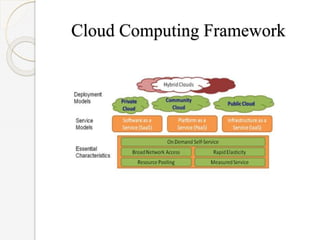
 Cloud computing, it has three different deployment models namely
private, public and hybrid.
 Cloud computing offers the following basic models to deliver the
services.
◦ Software as a Service (SaaS)
◦ Platform as a Service (PaaS)
◦ Infrastructure as a Service(IaaS)
Cloud Computing Framework
Current Challenges in Indian
Agriculture :
 Poor knowledge about the weather forecast, pests and diseases.
 Deficient production information.
 Not enough sales and distribution information.
 Poor ICT infrastructure and ICT illiteracy.
 Lack of awareness among farmers about the benefits of ICT in
agriculture.
 Insufficient power availability in rural areas.
Role of Cloud Computing in Solving
these Challenges
 Using the applications of cloud the farmers have nothing to worry
about hardware and software investment and also the technical
knowledge required to learn them.
 They can get most up-to-date farming and propagation techniques.
 They can also leverage the systematic methods in information
collection, supply chain logistics, market forecasting and business
decision-making.
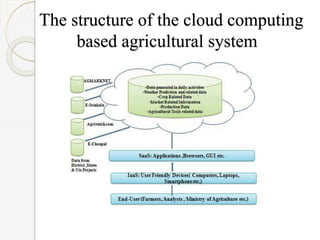
The structure of the cloud computing
based agricultural system
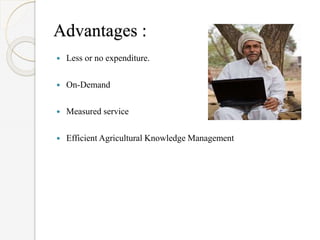
Advantages :
 Less or no expenditure.
 On-Demand
 Measured service
 Efficient Agricultural Knowledge Management
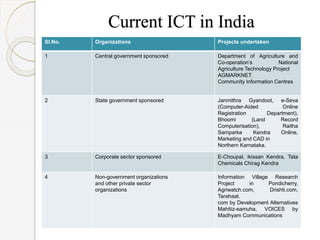
Current ICT in India
Sl.No. Organizations Projects undertaken
1 Central government sponsored Department of Agriculture and
Co-operation’s National
Agriculture Technology Project
AGMARKNET.
Community Information Centres
2 State government sponsored Janmithra Gyandoot, e-Seva
(Computer-Aided Online
Registration Department),
Bhoomi (Land Record
Computerisation), Raitha
Samparka Kendra Online,
Marketing and CAD in
Northern Karnataka.
3 Corporate sector sponsored E-Choupal, ikissan Kendra, Tata
Chemicals Chirag Kendra
4 Non-government organizations
and other private sector
organizations
Information Village Research
Project in Pondicherry,
Agriwatch.com, Drishti.com,
Tarahaat.
com by Development Alternatives
Mahitiz-samuha, VOICES by
Madhyam Communications
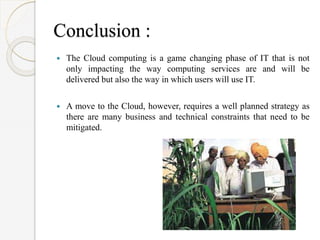
Conclusion :
 The Cloud computing is a game changing phase of IT that is not
only impacting the way computing services are and will be
delivered but also the way in which users will use IT.
 A move to the Cloud, however, requires a well planned strategy as
there are many business and technical constraints that need to be
mitigated.
References
[1] Cloud computing and emerging IT platforms: Vision, hype, and
reality for delivering computing as the 5th utility R Buyya et al. /
Future Generation Computer Systems 25 (2009) 599_616.
[2] Cloud Security Alliance. Security best practices for cloud
computing, 2010b http://www.cloudsecurityalliance.org
[Accessed: July 2013].
Application of cloud computing to agriculture

Application of cloud computing to agriculture

  • 1.
    Application of Cloud Computingfor Agriculture presented by: Swathi.R Manasa.V CIT,Gubbi
  • 2.
    Introduction  Though thefarmers have grown the same crop for centuries, the ever changing weather conditions, soil fertility, pests and diseases etc. Affects the final outcome.  Information Technologies and tools.  Information Communication Technology(ICT)  That latest and most promising area of ICT is Cloud Computing.
  • 3.
    Cloud Computing  Theterm “cloud computing” refers to the fact that users do not really need to know who is providing those services and the cloud hid all the technicalities from them.  less manpower and zero maintenance.  Cloud computing, it has three different deployment models namely private, public and hybrid.  Cloud computing offers the following basic models to deliver the services. ◦ Software as a Service (SaaS) ◦ Platform as a Service (PaaS) ◦ Infrastructure as a Service(IaaS)
  • 4.
  • 5.
    Current Challenges inIndian Agriculture :  Poor knowledge about the weather forecast, pests and diseases.  Deficient production information.  Not enough sales and distribution information.  Poor ICT infrastructure and ICT illiteracy.  Lack of awareness among farmers about the benefits of ICT in agriculture.  Insufficient power availability in rural areas.
  • 6.
    Role of CloudComputing in Solving these Challenges  Using the applications of cloud the farmers have nothing to worry about hardware and software investment and also the technical knowledge required to learn them.  They can get most up-to-date farming and propagation techniques.  They can also leverage the systematic methods in information collection, supply chain logistics, market forecasting and business decision-making.
  • 7.
    The structure ofthe cloud computing based agricultural system
  • 8.
    Advantages :  Lessor no expenditure.  On-Demand  Measured service  Efficient Agricultural Knowledge Management
  • 9.
    Current ICT inIndia Sl.No. Organizations Projects undertaken 1 Central government sponsored Department of Agriculture and Co-operation’s National Agriculture Technology Project AGMARKNET. Community Information Centres 2 State government sponsored Janmithra Gyandoot, e-Seva (Computer-Aided Online Registration Department), Bhoomi (Land Record Computerisation), Raitha Samparka Kendra Online, Marketing and CAD in Northern Karnataka. 3 Corporate sector sponsored E-Choupal, ikissan Kendra, Tata Chemicals Chirag Kendra 4 Non-government organizations and other private sector organizations Information Village Research Project in Pondicherry, Agriwatch.com, Drishti.com, Tarahaat. com by Development Alternatives Mahitiz-samuha, VOICES by Madhyam Communications
  • 10.
    Conclusion :  TheCloud computing is a game changing phase of IT that is not only impacting the way computing services are and will be delivered but also the way in which users will use IT.  A move to the Cloud, however, requires a well planned strategy as there are many business and technical constraints that need to be mitigated.
  • 11.
    References [1] Cloud computingand emerging IT platforms: Vision, hype, and reality for delivering computing as the 5th utility R Buyya et al. / Future Generation Computer Systems 25 (2009) 599_616. [2] Cloud Security Alliance. Security best practices for cloud computing, 2010b http://www.cloudsecurityalliance.org [Accessed: July 2013].