Polymer and Environment
KEJ4604
Semester II 2015/2016
GROUP 3
Nur Izzati Ishak (UK29492)
Siti Khadijah Ariffin (UK29511)
18 April 2016
Overview
1. Recap
2. What is Stabilizer?
3. Importance of Stabilizer
4. Heat Stabilizer
5. Light Stabilizer
6. Conclusion
7. References
Recap
Environmental Stability
- The ability of a polymer to remain unchanged over
time in the influence of environmental agents.
Environmental Agents:
1. Heat
2. Light
3. Moisture, oxygen and other aggressive gases
4. Bio-active organism
•Polymer may decomposed when heated.Heat
•The energy of the UV component of natural light is
sufficient to break chemical bonds in polymer.Light
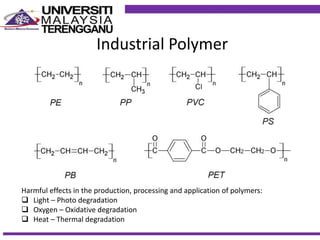
Industrial Polymer
Harmful effects in the production, processing and application of polymers:
 Light – Photo degradation
 Oxygen – Oxidative degradation
 Heat – Thermal degradation
What is Stabilizer?
The term stabilizer is the comprehensive
technological term used to describe the
inhibition (prevention) of polymer degradation.
 Stabilizer is the key component of an additive
system.
Why to use stabilizer in polymer?
• Improve processing conditions
• Obtain better impact resistance
• Increase or decrease hardness
• Control surface tension
• Control blocking
• Increase flame resistance
HEAT STABILIZER
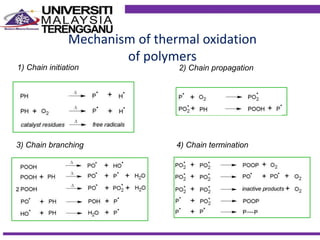
Mechanism of thermal oxidation
of polymers
1) Chain initiation 2) Chain propagation
3) Chain branching 4) Chain termination
Methods to Prevent Thermal
Degradation
Method #1
Primary (chain breaking)
 Interfere with the chain propagation step
Method #2
Secondary (preventive)
 Destroy hydroperoxide groups
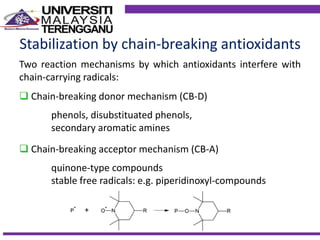
Stabilization by chain-breaking antioxidants
Two reaction mechanisms by which antioxidants interfere with
chain-carrying radicals:
 Chain-breaking donor mechanism (CB-D)
phenols, disubstituated phenols,
secondary aromatic amines
 Chain-breaking acceptor mechanism (CB-A)
quinone-type compounds
stable free radicals: e.g. piperidinoxyl-compounds
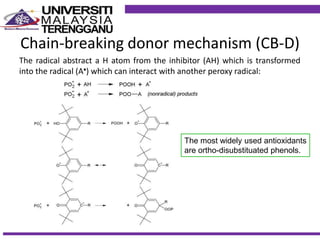
Chain-breaking donor mechanism (CB-D)
The radical abstract a H atom from the inhibitor (AH) which is transformed
into the radical (A) which can interact with another peroxy radical:
The most widely used antioxidants
are ortho-disubstituated phenols.
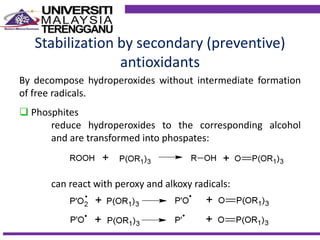
Stabilization by secondary (preventive)
antioxidants
By decompose hydroperoxides without intermediate formation
of free radicals.
 Phosphites
reduce hydroperoxides to the corresponding alcohol
and are transformed into phospates:
can react with peroxy and alkoxy radicals:
Stabilization by secondary (preventive)
antioxidants
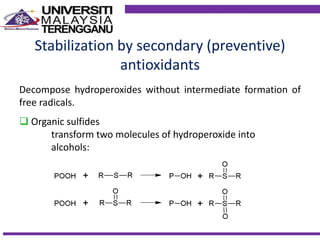
Decompose hydroperoxides without intermediate formation of
free radicals.
 Organic sulfides
transform two molecules of hydroperoxide into
alcohols:
Commercially used antioxidant
• Depending upon the type of oxidation , various heat stabilizers :
I. Metallic salts (stabilize PVC) – barium cadmium, barium zinc
II. Organometallic compounds – based on tin
III. Non metallic organic stabilizer -phosphites
IV. Epoxies – derivatives of soya bean oil
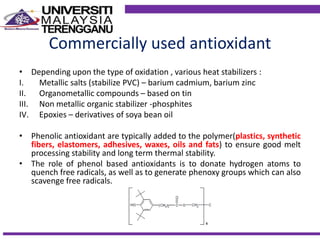
• Phenolic antioxidant are typically added to the polymer(plastics, synthetic
fibers, elastomers, adhesives, waxes, oils and fats) to ensure good melt
processing stability and long term thermal stability.
• The role of phenol based antioxidants is to donate hydrogen atoms to
quench free radicals, as well as to generate phenoxy groups which can also
scavenge free radicals.
• Mostly stabilizer used contained heavy metals
(e.g. lead carbonate, cadmium and barium
carboxylates)
• Due to their potential toxicological effects in the
human environment it has been replaced by Zn
and Ca which is less toxic and give very
transparent PVC for bottles.
• Heat stabilizers as additives for polymers increase
the overall ability of the plastic to withstand the
negative effects of exposure to heat/high
temperatures.
LIGHT STABILIZER
What is Light Stabilizers?
• Light stabilizer are chemical compounds capable of interfering with the
physical and chemical processes of light-induced degradation.
Types of Light Stabilizers
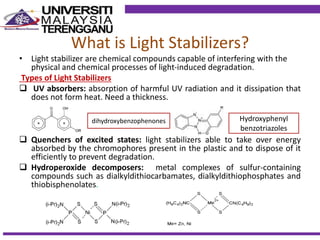
 UV absorbers: absorption of harmful UV radiation and it dissipation that
does not form heat. Need a thickness.
 Quenchers of excited states: light stabilizers able to take over energy
absorbed by the chromophores present in the plastic and to dispose of it
efficiently to prevent degradation.
 Hydroperoxide decomposers: metal complexes of sulfur-containing
compounds such as dialkyldithiocarbamates, dialkyldithiophosphates and
thiobisphenolates.
dihydroxybenzophenones Hydroxyphenyl
benzotriazoles
 Free radical scavengers:
 analogous to that used in prevention of thermal degradation
 some phenolic antioxidant can improve the light stability
• Polymer will be unstable when exposed to UV light with wavelength 280-400nm.
Carbon Black
• Carbon black is the most effective light absorber, it also contain antioxidant groups
(phenolic and quinonoid) as part of the polycyclic ring system.
• Carbon black normally unacceptable for aesthetic reasons except for specialized
applications such as piping.
• Although not as effective as carbon black, titanium dioxide (a white pigment) is
widely used to ‘screen’ plastics from the effects of UV light for example PVC
window profiles.
*Hindered Amine
Light Stabilizers (HALS)
 Free radical scavenger
 Does not absorb any light above 250 nm
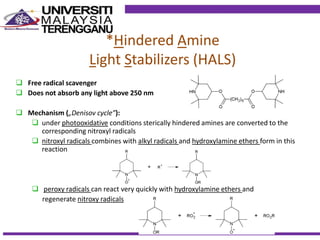
 Mechanism („Denisov cycle”):
 under photooxidative conditions sterically hindered amines are converted to the
corresponding nitroxyl radicals
 nitroxyl radicals combines with alkyl radicals and hydroxylamine ethers form in this
reaction
 peroxy radicals can react very quickly with hydroxylamine ethers and
regenerate nitroxy radicals
Conclusion
Advantages
To increase polymer’s
appearance
 strength,
elasticity,
durability
performance characteristics
Disadvantages
 Further functionalization reactions, which are
often expensive and time consuming.
References
1. Kasza, G. 2013. Thermal, antioxidative and photochemical
stabilization of polymers: low molecular weight versus
macromolecular stabilizers. Advanced bio-friendly polymers.
2. Yousif, E., El- Hiti, G. A., Haddad, R. and Balakit, A.A. 2015.
Photochemical Stability and Photostabilizing Efficiency of
Poly(methyl methacrylate) Based on 2-(6-Methoxynaphthalen-2-
yl)propanoate Metal Ion Complexes). Polymers. 7, 1005-1019.
3. Scott. G. 1999. Polymer and The Environment.
4. Lambert. S. 2013. Environmental Risk of Polymers and Their
Degradation Products. Environment Department.
5. Markarian J. 2005. Advances in PVC Heat and Light Stabilization.
Plastics Additives and Compounding.
6. Platzer, N.A.J. 1968. Stabilization of Polymers and Stabilizer
Processes. American Chemical Society, 85.

Heat and light stabilizer

  • 1.
    Polymer and Environment KEJ4604 SemesterII 2015/2016 GROUP 3 Nur Izzati Ishak (UK29492) Siti Khadijah Ariffin (UK29511) 18 April 2016
  • 2.
    Overview 1. Recap 2. Whatis Stabilizer? 3. Importance of Stabilizer 4. Heat Stabilizer 5. Light Stabilizer 6. Conclusion 7. References
  • 3.
    Recap Environmental Stability - Theability of a polymer to remain unchanged over time in the influence of environmental agents. Environmental Agents: 1. Heat 2. Light 3. Moisture, oxygen and other aggressive gases 4. Bio-active organism •Polymer may decomposed when heated.Heat •The energy of the UV component of natural light is sufficient to break chemical bonds in polymer.Light
  • 4.
    Industrial Polymer Harmful effectsin the production, processing and application of polymers:  Light – Photo degradation  Oxygen – Oxidative degradation  Heat – Thermal degradation
  • 5.
    What is Stabilizer? Theterm stabilizer is the comprehensive technological term used to describe the inhibition (prevention) of polymer degradation.  Stabilizer is the key component of an additive system.
  • 6.
    Why to usestabilizer in polymer? • Improve processing conditions • Obtain better impact resistance • Increase or decrease hardness • Control surface tension • Control blocking • Increase flame resistance
  • 7.
  • 8.
    Mechanism of thermaloxidation of polymers 1) Chain initiation 2) Chain propagation 3) Chain branching 4) Chain termination
  • 9.
    Methods to PreventThermal Degradation Method #1 Primary (chain breaking)  Interfere with the chain propagation step Method #2 Secondary (preventive)  Destroy hydroperoxide groups
  • 10.
    Stabilization by chain-breakingantioxidants Two reaction mechanisms by which antioxidants interfere with chain-carrying radicals:  Chain-breaking donor mechanism (CB-D) phenols, disubstituated phenols, secondary aromatic amines  Chain-breaking acceptor mechanism (CB-A) quinone-type compounds stable free radicals: e.g. piperidinoxyl-compounds
  • 11.
    Chain-breaking donor mechanism(CB-D) The radical abstract a H atom from the inhibitor (AH) which is transformed into the radical (A) which can interact with another peroxy radical: The most widely used antioxidants are ortho-disubstituated phenols.
  • 12.
    Stabilization by secondary(preventive) antioxidants By decompose hydroperoxides without intermediate formation of free radicals.  Phosphites reduce hydroperoxides to the corresponding alcohol and are transformed into phospates: can react with peroxy and alkoxy radicals:
  • 13.
    Stabilization by secondary(preventive) antioxidants Decompose hydroperoxides without intermediate formation of free radicals.  Organic sulfides transform two molecules of hydroperoxide into alcohols:
  • 14.
    Commercially used antioxidant •Depending upon the type of oxidation , various heat stabilizers : I. Metallic salts (stabilize PVC) – barium cadmium, barium zinc II. Organometallic compounds – based on tin III. Non metallic organic stabilizer -phosphites IV. Epoxies – derivatives of soya bean oil • Phenolic antioxidant are typically added to the polymer(plastics, synthetic fibers, elastomers, adhesives, waxes, oils and fats) to ensure good melt processing stability and long term thermal stability. • The role of phenol based antioxidants is to donate hydrogen atoms to quench free radicals, as well as to generate phenoxy groups which can also scavenge free radicals.
  • 15.
    • Mostly stabilizerused contained heavy metals (e.g. lead carbonate, cadmium and barium carboxylates) • Due to their potential toxicological effects in the human environment it has been replaced by Zn and Ca which is less toxic and give very transparent PVC for bottles. • Heat stabilizers as additives for polymers increase the overall ability of the plastic to withstand the negative effects of exposure to heat/high temperatures.
  • 16.
  • 17.
    What is LightStabilizers? • Light stabilizer are chemical compounds capable of interfering with the physical and chemical processes of light-induced degradation. Types of Light Stabilizers  UV absorbers: absorption of harmful UV radiation and it dissipation that does not form heat. Need a thickness.  Quenchers of excited states: light stabilizers able to take over energy absorbed by the chromophores present in the plastic and to dispose of it efficiently to prevent degradation.  Hydroperoxide decomposers: metal complexes of sulfur-containing compounds such as dialkyldithiocarbamates, dialkyldithiophosphates and thiobisphenolates. dihydroxybenzophenones Hydroxyphenyl benzotriazoles
  • 18.
     Free radicalscavengers:  analogous to that used in prevention of thermal degradation  some phenolic antioxidant can improve the light stability • Polymer will be unstable when exposed to UV light with wavelength 280-400nm. Carbon Black • Carbon black is the most effective light absorber, it also contain antioxidant groups (phenolic and quinonoid) as part of the polycyclic ring system. • Carbon black normally unacceptable for aesthetic reasons except for specialized applications such as piping. • Although not as effective as carbon black, titanium dioxide (a white pigment) is widely used to ‘screen’ plastics from the effects of UV light for example PVC window profiles.
  • 19.
    *Hindered Amine Light Stabilizers(HALS)  Free radical scavenger  Does not absorb any light above 250 nm  Mechanism („Denisov cycle”):  under photooxidative conditions sterically hindered amines are converted to the corresponding nitroxyl radicals  nitroxyl radicals combines with alkyl radicals and hydroxylamine ethers form in this reaction  peroxy radicals can react very quickly with hydroxylamine ethers and regenerate nitroxy radicals
  • 20.
    Conclusion Advantages To increase polymer’s appearance strength, elasticity, durability performance characteristics Disadvantages  Further functionalization reactions, which are often expensive and time consuming.
  • 21.
    References 1. Kasza, G.2013. Thermal, antioxidative and photochemical stabilization of polymers: low molecular weight versus macromolecular stabilizers. Advanced bio-friendly polymers. 2. Yousif, E., El- Hiti, G. A., Haddad, R. and Balakit, A.A. 2015. Photochemical Stability and Photostabilizing Efficiency of Poly(methyl methacrylate) Based on 2-(6-Methoxynaphthalen-2- yl)propanoate Metal Ion Complexes). Polymers. 7, 1005-1019. 3. Scott. G. 1999. Polymer and The Environment. 4. Lambert. S. 2013. Environmental Risk of Polymers and Their Degradation Products. Environment Department. 5. Markarian J. 2005. Advances in PVC Heat and Light Stabilization. Plastics Additives and Compounding. 6. Platzer, N.A.J. 1968. Stabilization of Polymers and Stabilizer Processes. American Chemical Society, 85.