 JAVAID IQBAL MOHSIN
 E12-343
 5 SEMESTER
 DEPARTMENT OF METALLURGY AND
MATERIALS ENGINEERING
UNIVERSITY OF THE PUNJAB,LAHORE.
 Polyacrylonitrile(PAN) is the synethic
semicrystalline resin.
 Thermoplastic in nature.And donot melt
under the normal conditions.
 Its resins flammable.
 Used for making textile fibers,military
aircraft,tennis racket,tents,high tech
bicycle,pressure vessels and fishing
rods,carpets etc.
INTRODUCTION OF
POLYACRYLONITRILE
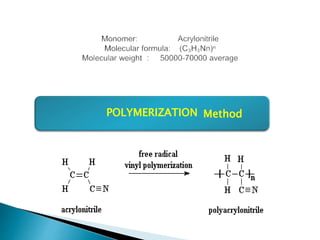
POLYMERIZATION Method
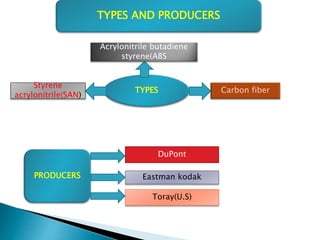
TYPES Carbon fiber
Styrene
acrylonitrile(SAN)
Acrylonitrile butadiene
styrene(ABS
PRODUCERS
DuPont
Eastman kodak
Toray(U.S)
TYPES AND PRODUCERS
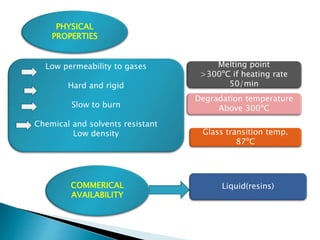
PHYSICAL
PROPERTIES
Low permeability to gases
Hard and rigid
Slow to burn
Chemical and solvents resistant
Low density
Melting point
>300ºC if heating rate
50/min
Degradation temperature
Above 300ºC
Glass transition temp.
87ºC
COMMERICAL
AVAILABILITY
Liquid(resins)
Radiation oxidation
and subsequent
thermal curing of
polyacrylonitrile fiber
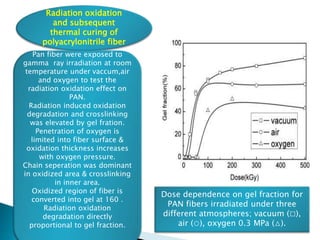
Pan fiber were exposed to
gamma ray irradiation at room
temperature under vaccum,air
and oxygen to test the
radiation oxidation effect on
PAN.
Radiation induced oxidation
degradation and crosslinking
was elevated by gel fration.
Penetration of oxygen is
limited into fiber surface &
oxidation thickness increases
with oxygen pressure.
Chain seperation was dominant
in oxidized area & crosslinking
in inner area.
Oxidized region of fiber is
converted into gel at 160 .
Radiation oxidation
degradation directly
proportional to gel fraction.
Dose dependence on gel fraction for
PAN fibers irradiated under three
different atmospheres; vacuum (□),
air (○), oxygen 0.3 MPa (△).
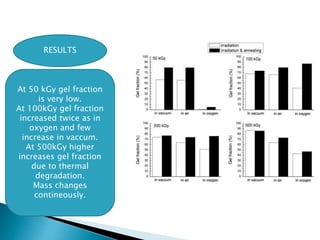
RESULTS
At 50 kGy gel fraction
is very low.
At 100kGy gel fraction
increased twice as in
oxygen and few
increase in vaccum.
At 500kGy higher
increases gel fraction
due to thermal
degradation.
Mass changes
contineously.
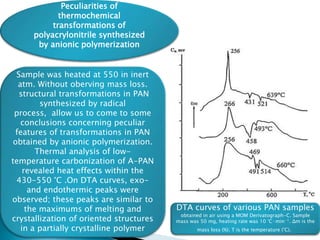
Peculiarities of
thermochemical
transformations of
polyacrylonitrile synthesized
by anionic polymerization
Sample was heated at 550 in inert
atm. Without oberving mass loss.
structural transformations in PAN
synthesized by radical
process, allow us to come to some
conclusions concerning peculiar
features of transformations in PAN
obtained by anionic polymerization.
Thermal analysis of low-
temperature carbonization of A-PAN
revealed heat effects within the
430-550 °C .On DTA curves, exo-
and endothermic peaks were
observed; these peaks are similar to
the maximums of melting and
crystallization of oriented structures
in a partially crystalline polymer
DTA curves of various PAN samples
obtained in air using a MOM Derivatograph-C. Sample
mass was 50 mg, heating rate was 10 °C·min−1. Δm is the
mass loss (%); T is the temperature (°C).
 Used for military purposes.
 Used in aircraft body
 Used in hitech bicycle.
 Used in rocket motors and components to
provide insulation case. .
 Used in tents.
 Used as electrolyte seperators in batteries.
 Acrylic fibers are used as filters in industries.
 Used in fireproof clothes.
 Polyacrylonitrile is supplement as for wool in
textile.
 PAN is also being focus of researcher to used
suitable for drug delivery.
Question and Answers

Presentation of POLYACRYLONITRILE(PAN)

  • 1.
     JAVAID IQBALMOHSIN  E12-343  5 SEMESTER  DEPARTMENT OF METALLURGY AND MATERIALS ENGINEERING UNIVERSITY OF THE PUNJAB,LAHORE.
  • 2.
     Polyacrylonitrile(PAN) isthe synethic semicrystalline resin.  Thermoplastic in nature.And donot melt under the normal conditions.  Its resins flammable.  Used for making textile fibers,military aircraft,tennis racket,tents,high tech bicycle,pressure vessels and fishing rods,carpets etc. INTRODUCTION OF POLYACRYLONITRILE
  • 3.
  • 4.
    TYPES Carbon fiber Styrene acrylonitrile(SAN) Acrylonitrilebutadiene styrene(ABS PRODUCERS DuPont Eastman kodak Toray(U.S) TYPES AND PRODUCERS
  • 5.
    PHYSICAL PROPERTIES Low permeability togases Hard and rigid Slow to burn Chemical and solvents resistant Low density Melting point >300ºC if heating rate 50/min Degradation temperature Above 300ºC Glass transition temp. 87ºC COMMERICAL AVAILABILITY Liquid(resins)
  • 6.
    Radiation oxidation and subsequent thermalcuring of polyacrylonitrile fiber Pan fiber were exposed to gamma ray irradiation at room temperature under vaccum,air and oxygen to test the radiation oxidation effect on PAN. Radiation induced oxidation degradation and crosslinking was elevated by gel fration. Penetration of oxygen is limited into fiber surface & oxidation thickness increases with oxygen pressure. Chain seperation was dominant in oxidized area & crosslinking in inner area. Oxidized region of fiber is converted into gel at 160 . Radiation oxidation degradation directly proportional to gel fraction. Dose dependence on gel fraction for PAN fibers irradiated under three different atmospheres; vacuum (□), air (○), oxygen 0.3 MPa (△).
  • 7.
    RESULTS At 50 kGygel fraction is very low. At 100kGy gel fraction increased twice as in oxygen and few increase in vaccum. At 500kGy higher increases gel fraction due to thermal degradation. Mass changes contineously.
  • 8.
    Peculiarities of thermochemical transformations of polyacrylonitrilesynthesized by anionic polymerization Sample was heated at 550 in inert atm. Without oberving mass loss. structural transformations in PAN synthesized by radical process, allow us to come to some conclusions concerning peculiar features of transformations in PAN obtained by anionic polymerization. Thermal analysis of low- temperature carbonization of A-PAN revealed heat effects within the 430-550 °C .On DTA curves, exo- and endothermic peaks were observed; these peaks are similar to the maximums of melting and crystallization of oriented structures in a partially crystalline polymer DTA curves of various PAN samples obtained in air using a MOM Derivatograph-C. Sample mass was 50 mg, heating rate was 10 °C·min−1. Δm is the mass loss (%); T is the temperature (°C).
  • 9.
     Used formilitary purposes.  Used in aircraft body  Used in hitech bicycle.  Used in rocket motors and components to provide insulation case. .  Used in tents.  Used as electrolyte seperators in batteries.  Acrylic fibers are used as filters in industries.  Used in fireproof clothes.
  • 10.
     Polyacrylonitrile issupplement as for wool in textile.  PAN is also being focus of researcher to used suitable for drug delivery.
  • 11.