POLYMER BLENDS AND ALLOYS
• A polymer blend is a mixture of two or more
polymers that have been blended together to create a
new material with different physical properties.
• Generally, there are five main types of polymer
blend: thermoplastic–thermoplastic blends;
thermoplastic–rubber blends; thermoplastic–
thermosetting blends; rubber– thermosetting
blends; and polymer–filler blends
IMPORTANCE OF POLYMER BLENDS
• The capability to reduce material cost with or without
little sacrifice in properties
• Permit the much more rapid development of modified
polymeric materials to meet emerging needs by by-
passing the polymerization step
• Extended service temperature range
• Light weight
• Increased toughening
• Enhanced ozone resistance
• The ability to improve the processability of materials
which are otherwise limited in their ability to be
transformed into finished products
• Improved modulus and hardness
• Improved barrier property and flame retardant
property
• Improved impact and environmental stress cracking
resistance, etc.
Polymer blends can be broadly divided mainly into
two categories based on their miscibility.
1. Immiscible or heterogeneous polymer blends:
2. Miscible or homogeneous polymer blends:
1. Immiscible or heterogeneous polymer
blends:
The constituent polymers exist in separate
phases and the respective glass transition
temperatures are observed.
2. Miscible or Homogeneous polymer blends:
These mixtures are often made from polymers
with similar chemical structures, resulting in a
polymer blend with a single-phase structure.
One glass transition temperature is observed.
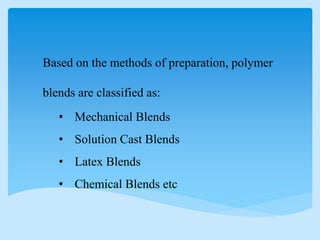
Based on the methods of preparation, polymer
blends are classified as:
• Mechanical Blends
• Solution Cast Blends
• Latex Blends
• Chemical Blends etc
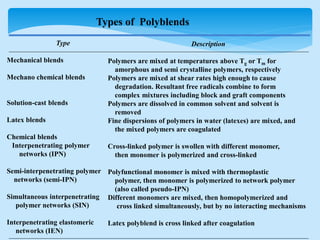
Types of Polyblends
Type
Mechanical blends
Mechano chemical blends
Solution-cast blends
Latex blends
Chemical blends
Interpenetrating polymer
networks (IPN)
Semi-interpenetrating polymer
networks (semi-IPN)
Simultaneous interpenetrating
polymer networks (SIN)
Interpenetrating elastomeric
networks (IEN)
Description
Polymers are mixed at temperatures above Tg or Tm for
amorphous and semi crystalline polymers, respectively
Polymers are mixed at shear rates high enough to cause
degradation. Resultant free radicals combine to form
complex mixtures including block and graft components
Polymers are dissolved in common solvent and solvent is
removed
Fine dispersions of polymers in water (latexes) are mixed, and
the mixed polymers are coagulated
Cross-linked polymer is swollen with different monomer,
then monomer is polymerized and cross-linked
Polyfunctional monomer is mixed with thermoplastic
polymer, then monomer is polymerized to network polymer
(also called pseudo-IPN)
Different monomers are mixed, then homopolymerized and
cross linked simultaneously, but by no interacting mechanisms
Latex polyblend is cross linked after coagulation
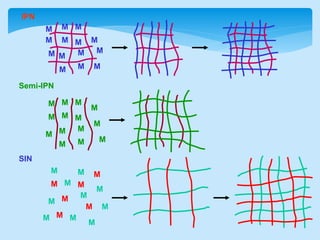
IPN
M M M
M M M M
M M
M M
M M
M
Semi-IPN
M M
M M
M M
M M
M
M
M
M
M
M
SIN
M
M
M
M
M
M
M M
M
M
M
M M
M
M
M
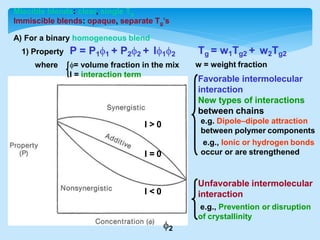
Miscible blends: clear, single Tg
Immiscible blends: opaque, separate Tg’s
A) For a binary homogeneous blend
1) Property P = P11 + P22 + I12
where = volume fraction in the mix
I = interaction term
2
I > 0
I = 0
I < 0
Favorable intermolecular
interaction
New types of interactions
between chains
e.g. Dipole–dipole attraction
between polymer components
e.g., Ionic or hydrogen bonds
occur or are strengthened
Unfavorable intermolecular
interaction
e.g., Prevention or disruption
of crystallinity
Tg = w1Tg2 + w2Tg2
w = weight fraction
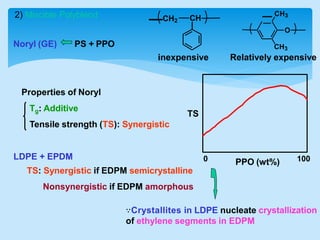
2) Miscible Polyblend CH
CH2
inexpensive
CH3
O
CH3
Relatively expensive
Noryl (GE) PS + PPO
Properties of Noryl
Tg: Additive
Tensile strength (TS): Synergistic
TS
PPO (wt%)
0 100
LDPE + EPDM
TS: Synergistic if EDPM semicrystalline
Nonsynergistic if EDPM amorphous
∵Crystallites in LDPE nucleate crystallization
of ethylene segments in EDPM
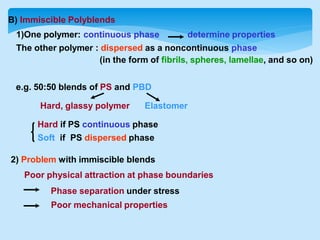
B) Immiscible Polyblends
1)One polymer: continuous phase determine properties
The other polymer : dispersed as a noncontinuous phase
(in the form of fibrils, spheres, lamellae, and so on)
e.g. 50:50 blends of PS and PBD
Hard, glassy polymer Elastomer
Hard if PS continuous phase
Soft if PS dispersed phase
2) Problem with immiscible blends
Poor physical attraction at phase boundaries
Phase separation under stress
Poor mechanical properties
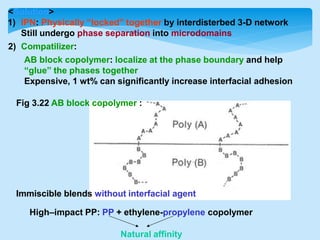
<Solution>
1) IPN: Physically “locked” together by interdisterbed 3-D network
Still undergo phase separation into microdomains
2) Compatilizer:
AB block copolymer: localize at the phase boundary and help
“glue” the phases together
Expensive, 1 wt% can significantly increase interfacial adhesion
Fig 3.22 AB block copolymer :
Immiscible blends without interfacial agent
High–impact PP: PP + ethylene-propylene copolymer
Natural affinity
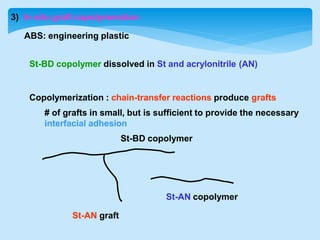
3) In situ graft copolymeration
ABS: engineering plastic
St-BD copolymer dissolved in St and acrylonitrile (AN)
Copolymerization : chain-transfer reactions produce grafts
# of grafts in small, but is sufficient to provide the necessary
interfacial adhesion
St-BD copolymer
St-AN copolymer
St-AN graft

UNIT 2 Polymer Blends and Alloys.pptx

  • 1.
  • 2.
    • A polymerblend is a mixture of two or more polymers that have been blended together to create a new material with different physical properties. • Generally, there are five main types of polymer blend: thermoplastic–thermoplastic blends; thermoplastic–rubber blends; thermoplastic– thermosetting blends; rubber– thermosetting blends; and polymer–filler blends
  • 3.
    IMPORTANCE OF POLYMERBLENDS • The capability to reduce material cost with or without little sacrifice in properties • Permit the much more rapid development of modified polymeric materials to meet emerging needs by by- passing the polymerization step • Extended service temperature range • Light weight • Increased toughening
  • 4.
    • Enhanced ozoneresistance • The ability to improve the processability of materials which are otherwise limited in their ability to be transformed into finished products • Improved modulus and hardness • Improved barrier property and flame retardant property • Improved impact and environmental stress cracking resistance, etc.
  • 5.
    Polymer blends canbe broadly divided mainly into two categories based on their miscibility. 1. Immiscible or heterogeneous polymer blends: 2. Miscible or homogeneous polymer blends:
  • 6.
    1. Immiscible orheterogeneous polymer blends: The constituent polymers exist in separate phases and the respective glass transition temperatures are observed.
  • 7.
    2. Miscible orHomogeneous polymer blends: These mixtures are often made from polymers with similar chemical structures, resulting in a polymer blend with a single-phase structure. One glass transition temperature is observed.
  • 8.
    Based on themethods of preparation, polymer blends are classified as: • Mechanical Blends • Solution Cast Blends • Latex Blends • Chemical Blends etc
  • 9.
    Types of Polyblends Type Mechanicalblends Mechano chemical blends Solution-cast blends Latex blends Chemical blends Interpenetrating polymer networks (IPN) Semi-interpenetrating polymer networks (semi-IPN) Simultaneous interpenetrating polymer networks (SIN) Interpenetrating elastomeric networks (IEN) Description Polymers are mixed at temperatures above Tg or Tm for amorphous and semi crystalline polymers, respectively Polymers are mixed at shear rates high enough to cause degradation. Resultant free radicals combine to form complex mixtures including block and graft components Polymers are dissolved in common solvent and solvent is removed Fine dispersions of polymers in water (latexes) are mixed, and the mixed polymers are coagulated Cross-linked polymer is swollen with different monomer, then monomer is polymerized and cross-linked Polyfunctional monomer is mixed with thermoplastic polymer, then monomer is polymerized to network polymer (also called pseudo-IPN) Different monomers are mixed, then homopolymerized and cross linked simultaneously, but by no interacting mechanisms Latex polyblend is cross linked after coagulation
  • 10.
    IPN M M M MM M M M M M M M M M Semi-IPN M M M M M M M M M M M M M M SIN M M M M M M M M M M M M M M M M
  • 11.
    Miscible blends: clear,single Tg Immiscible blends: opaque, separate Tg’s A) For a binary homogeneous blend 1) Property P = P11 + P22 + I12 where = volume fraction in the mix I = interaction term 2 I > 0 I = 0 I < 0 Favorable intermolecular interaction New types of interactions between chains e.g. Dipole–dipole attraction between polymer components e.g., Ionic or hydrogen bonds occur or are strengthened Unfavorable intermolecular interaction e.g., Prevention or disruption of crystallinity Tg = w1Tg2 + w2Tg2 w = weight fraction
  • 12.
    2) Miscible PolyblendCH CH2 inexpensive CH3 O CH3 Relatively expensive Noryl (GE) PS + PPO Properties of Noryl Tg: Additive Tensile strength (TS): Synergistic TS PPO (wt%) 0 100 LDPE + EPDM TS: Synergistic if EDPM semicrystalline Nonsynergistic if EDPM amorphous ∵Crystallites in LDPE nucleate crystallization of ethylene segments in EDPM
  • 13.
    B) Immiscible Polyblends 1)Onepolymer: continuous phase determine properties The other polymer : dispersed as a noncontinuous phase (in the form of fibrils, spheres, lamellae, and so on) e.g. 50:50 blends of PS and PBD Hard, glassy polymer Elastomer Hard if PS continuous phase Soft if PS dispersed phase 2) Problem with immiscible blends Poor physical attraction at phase boundaries Phase separation under stress Poor mechanical properties
  • 14.
    <Solution> 1) IPN: Physically“locked” together by interdisterbed 3-D network Still undergo phase separation into microdomains 2) Compatilizer: AB block copolymer: localize at the phase boundary and help “glue” the phases together Expensive, 1 wt% can significantly increase interfacial adhesion Fig 3.22 AB block copolymer : Immiscible blends without interfacial agent High–impact PP: PP + ethylene-propylene copolymer Natural affinity
  • 15.
    3) In situgraft copolymeration ABS: engineering plastic St-BD copolymer dissolved in St and acrylonitrile (AN) Copolymerization : chain-transfer reactions produce grafts # of grafts in small, but is sufficient to provide the necessary interfacial adhesion St-BD copolymer St-AN copolymer St-AN graft