ADDITIVES IN PLASTICS
By - Kirtan .V
Roll – MO7049
What are
What are
additives ?
additives ?
Materials
Materials 
 dispersed
dispersed 
 polymer
polymer
matrix without affecting
significantly the molecular structure
of the polymer to attend certain
desirable properties
Why to use additives in
plastics ?
• Improve processing conditions
• Increase resin’s stability to oxidation
• Obtain better impact resistance
• Increase or decrease hardness
• Control surface tension
• Facilitate extrusion moulding
• Control blocking
• Reduce cost
• Increase flame resistance.
Types of additives
• Fillers
• Antioxidants
• Heat stabilizers
• UV stabilizers
• Colorants
• Antistatics
• Flame/fire retardants
• Cross-linking agents
• Blowing agents
• Lubricants
• Impact modifiers
• Processing aids
What are fillers?
• Mostly needed by thermosets,
sometimes also needed by
thermoplastics.
• Added to reduce cost.
Classification of fillers
• Mineral fillers : e.g.
Mineral fillers : e.g. CaCO3
CaCO3 , kaolin, feldspar, talc etc.
, kaolin, feldspar, talc etc.
• Metallic, conductive & magnetic fillers : iron, copper,
Metallic, conductive & magnetic fillers : iron, copper,
zinc & lead
zinc & lead
• Fire retarding fillers :
Fire retarding fillers : Sb2O3
Sb2O3
• Organic and special purpose fillers : carbon black, wood
Organic and special purpose fillers : carbon black, wood
flour, walnut flour
flour, walnut flour
• Flake reinforcement : mica
Flake reinforcement : mica
• Continuous filament reinforcement : fibre glass,
Continuous filament reinforcement : fibre glass,
carbon graphite filaments etc.
• Short fibre reinforcement : asbestos
Short fibre reinforcement : asbestos
Heat stabilizers
• To prevent degradation that occur during high
temp processing/fabrication.
• PVC largest consumer.
• e.g.- family of lead salts, complex barium cadmium
solids, non toxic Ca & Zn salts
• Type: Ba / Cd - Clear calendered products, Injection
moulded flexible products, blown film
• Type: Ba / Cd / Zn – Clear calendered products, blown film,
flexible products, plastisol processing
• Type: Ba / Zn – Flexible calendered products, unsupported
films for garments, artificial leather for automotive
• Type: Ca / Zn (Non-Toxic) – Children’s toys, packaging films,
base coat for artificial leather, top coat for floor
coverings, conveyor belts, sealing compounds
• Type: Ba / Cd / Pb – Calendered, injection moulded
products, extreme high temp, and application.
• Type: Lead Complex – Rigid PVC pipes, casing capping,
electric wires.
UV STABILIZERS
• UV light  280-400nm  polymers unstable
• To overcome this UV stabilizers are used.
Classification-:
1)UV absorbers: Hydroxy benzophenones
2)UV quenchers: Piperidines
3)Pigment: carbon black
Applications -:
1) carpenting outdoor/seatings
2) Acrylic coating used on outdoor sign boards
3) Light diffusers
4) Used in outer liners of HMHDPE
Antioxidants-:
• Polymers when subjected to oxygen attack & if
1)there exists high concentration of unsaturated c-c bonds
2)residual polymerisation catalyst
3)it is subjected to highly oxidising conditions,then it undergo
oxidation.
-to overcome this problems  long service life, antioxidants
are used.
Classification -:
1)primary: hindered phenolics acryl amines
2)secondary: phosphurous &
sulphur containing compounds
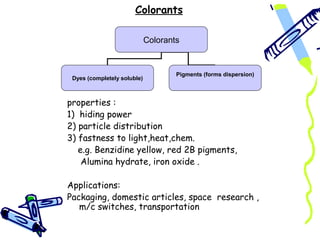
Colorants
properties :
1) hiding power
2) particle distribution
3) fastness to light,heat,chem.
e.g. Benzidine yellow, red 2B pigments,
Alumina hydrate, iron oxide .
Applications:
Packaging, domestic articles, space research ,
m/c switches, transportation
Colorants
Dyes (completely soluble)
Pigments (forms dispersion)
Antistatic agent
• Due to low surface conductivity  have poor
conductivity  accumulation of static charge.
Which is undesirable because
1) attracts dust particles wear & abrasion &
unsightly look.
2) charged metals results into powdering.
3) it can generate spark, which can become
hazardous.
e.g. butyl stearate, tri -ethanol-amine
Fire retardants
• Polymers being organic compounds burn or
decompose on exposure to fire, generates toxic
fumes, smoke.
• Two techniques: 1)use fire retardant raw material.
2)use fire retardant additives.
e.g. inorganic :zinc borate
halogenated :chlorinate paraffins
applicable to polymers to be used in mines,
automobiles, air vehicles, railways, etc.
consumed by - polyesters, polycarbon
polyurethanes.
Cross-linking agents
• Thermosets cure either on application of heat or cross
linking/curing/ hardening agents.
• In some cases agent triggers off the reaction & therefore
linking the resin molecules or
• It enters into the parts between molecules and completes
the chain.
Classification :
1)free radical intiator : Isobutyl nitrile, Alkyl peroxide .
2)non free radical agents : Isocynate with polyol
Used : Manufacture of Thermosets like polyurethane,
Urea Formaldehyde, etc
Blowing agent
• Polymeric foams preparation(2 ways)
1) mechanical
2) chemically
• substances called blowing agents, which on heating
decompose giving N & CO2
• Rigid PVC,ABS,Polystyrene, polyolefins being chief
consumers.
Applications:
mattresses, pillows, insulation, foam pipes
for non-p conditions.
e.g.para toluene sulphonyl hydrazide.
Lubricants
• Hot processing of polymers need lubricants either internally
or externally.
• Internal lubricants decreasing normal cohesive forces
between polymer moleculesgood flow conditions by
lowering viscosity.
• External lubricant don’t let melt to stick to hot surface of
processing. By forming a thin layer at melt-solid interface.
e.g. butyl stearate, octyl stearate, stearic acid
Impact modifiers
• To upgrade physical properties of polymer to the extent
prescribed by consumer, the additives added to polymers
are called as strength (impact) modifiers.
• They impart breakage resistance, rigidity, ease of post
fabrication, strength to sheets
• The strength imparted depends on time & temp conditions
of processing .
• Rigid PVC for prolonged outdoor exposure needs I.m.,
similarly epoxy & polyester thermosets require impact
modifiers.
Additives : Packaging
appications
• Enhances barrier properties
• Better transparency/Gloss
• Better printing/sealing properties
• Anti microbials
Thank you ;)

additivesinplastics2-120924042516-phpapp02 (1).pdf

  • 1.
    ADDITIVES IN PLASTICS By- Kirtan .V Roll – MO7049
  • 2.
    What are What are additives? additives ? Materials Materials   dispersed dispersed   polymer polymer matrix without affecting matrix without affecting significantly the molecular structure significantly the molecular structure of the polymer to attend certain of the polymer to attend certain desirable properties desirable properties
  • 3.
    Why to useadditives in plastics ? • Improve processing conditions • Increase resin’s stability to oxidation • Obtain better impact resistance • Increase or decrease hardness • Control surface tension • Facilitate extrusion moulding • Control blocking • Reduce cost • Increase flame resistance.
  • 4.
    Types of additives •Fillers • Antioxidants • Heat stabilizers • UV stabilizers • Colorants • Antistatics • Flame/fire retardants • Cross-linking agents • Blowing agents • Lubricants • Impact modifiers • Processing aids
  • 5.
    What are fillers? •Mostly needed by thermosets, sometimes also needed by thermoplastics. • Added to reduce cost.
  • 6.
    Classification of fillers •Mineral fillers : e.g. Mineral fillers : e.g. CaCO3 CaCO3 , kaolin, feldspar, talc etc. , kaolin, feldspar, talc etc. • Metallic, conductive & magnetic fillers : iron, copper, Metallic, conductive & magnetic fillers : iron, copper, zinc & lead zinc & lead • Fire retarding fillers : Fire retarding fillers : Sb2O3 Sb2O3 • Organic and special purpose fillers : carbon black, wood Organic and special purpose fillers : carbon black, wood flour, walnut flour flour, walnut flour • Flake reinforcement : mica Flake reinforcement : mica • Continuous filament reinforcement : fibre glass, Continuous filament reinforcement : fibre glass, carbon graphite filaments etc. carbon graphite filaments etc. • Short fibre reinforcement : asbestos Short fibre reinforcement : asbestos
  • 7.
    Heat stabilizers • Toprevent degradation that occur during high temp processing/fabrication. • PVC largest consumer. • e.g.- family of lead salts, complex barium cadmium solids, non toxic Ca & Zn salts
  • 8.
    • Type: Ba/ Cd - Clear calendered products, Injection moulded flexible products, blown film • Type: Ba / Cd / Zn – Clear calendered products, blown film, flexible products, plastisol processing • Type: Ba / Zn – Flexible calendered products, unsupported films for garments, artificial leather for automotive • Type: Ca / Zn (Non-Toxic) – Children’s toys, packaging films, base coat for artificial leather, top coat for floor coverings, conveyor belts, sealing compounds • Type: Ba / Cd / Pb – Calendered, injection moulded products, extreme high temp, and application. • Type: Lead Complex – Rigid PVC pipes, casing capping, electric wires.
  • 9.
    UV STABILIZERS • UVlight  280-400nm  polymers unstable • To overcome this UV stabilizers are used. Classification-: 1)UV absorbers: Hydroxy benzophenones 2)UV quenchers: Piperidines 3)Pigment: carbon black Applications -: 1) carpenting outdoor/seatings 2) Acrylic coating used on outdoor sign boards 3) Light diffusers 4) Used in outer liners of HMHDPE
  • 10.
    Antioxidants-: • Polymers whensubjected to oxygen attack & if 1)there exists high concentration of unsaturated c-c bonds 2)residual polymerisation catalyst 3)it is subjected to highly oxidising conditions,then it undergo oxidation. -to overcome this problems  long service life, antioxidants are used. Classification -: 1)primary: hindered phenolics acryl amines 2)secondary: phosphurous & sulphur containing compounds
  • 11.
    Colorants properties : 1) hidingpower 2) particle distribution 3) fastness to light,heat,chem. e.g. Benzidine yellow, red 2B pigments, Alumina hydrate, iron oxide . Applications: Packaging, domestic articles, space research , m/c switches, transportation Colorants Dyes (completely soluble) Pigments (forms dispersion)
  • 12.
    Antistatic agent • Dueto low surface conductivity  have poor conductivity  accumulation of static charge. Which is undesirable because 1) attracts dust particles wear & abrasion & unsightly look. 2) charged metals results into powdering. 3) it can generate spark, which can become hazardous. e.g. butyl stearate, tri -ethanol-amine
  • 13.
    Fire retardants • Polymersbeing organic compounds burn or decompose on exposure to fire, generates toxic fumes, smoke. • Two techniques: 1)use fire retardant raw material. 2)use fire retardant additives. e.g. inorganic :zinc borate halogenated :chlorinate paraffins applicable to polymers to be used in mines, automobiles, air vehicles, railways, etc. consumed by - polyesters, polycarbon polyurethanes.
  • 14.
    Cross-linking agents • Thermosetscure either on application of heat or cross linking/curing/ hardening agents. • In some cases agent triggers off the reaction & therefore linking the resin molecules or • It enters into the parts between molecules and completes the chain. Classification : 1)free radical intiator : Isobutyl nitrile, Alkyl peroxide . 2)non free radical agents : Isocynate with polyol Used : Manufacture of Thermosets like polyurethane, Urea Formaldehyde, etc
  • 15.
    Blowing agent • Polymericfoams preparation(2 ways) 1) mechanical 2) chemically • substances called blowing agents, which on heating decompose giving N & CO2 • Rigid PVC,ABS,Polystyrene, polyolefins being chief consumers. Applications: mattresses, pillows, insulation, foam pipes for non-p conditions. e.g.para toluene sulphonyl hydrazide.
  • 16.
    Lubricants • Hot processingof polymers need lubricants either internally or externally. • Internal lubricants decreasing normal cohesive forces between polymer moleculesgood flow conditions by lowering viscosity. • External lubricant don’t let melt to stick to hot surface of processing. By forming a thin layer at melt-solid interface. e.g. butyl stearate, octyl stearate, stearic acid
  • 18.
    Impact modifiers • Toupgrade physical properties of polymer to the extent prescribed by consumer, the additives added to polymers are called as strength (impact) modifiers. • They impart breakage resistance, rigidity, ease of post fabrication, strength to sheets • The strength imparted depends on time & temp conditions of processing . • Rigid PVC for prolonged outdoor exposure needs I.m., similarly epoxy & polyester thermosets require impact modifiers.
  • 20.
    Additives : Packaging appications •Enhances barrier properties • Better transparency/Gloss • Better printing/sealing properties • Anti microbials
  • 21.