Additives, Compounds & Color Masterbatches for the plastics industry
Dr. Evgeni Zelikman / Irina Shtein Rozenman
R&D Division, Tosaf
Israel
Migrating Additives vs. Non
Migrating Additives
in Polymer Films
5th Specialty Films & Flexible Packaging Global Summit 2016, 21st - 22nd September 2016 at Grand Hyatt, Mumbai, India
Outline
Additives, Compounds & Color Masterbatches for the plastics industry
Outline
• Tosaf at a Glance
• Introduction
• Slip
• Antifog
• Summary
Additives, Compounds & Color Masterbatches for the plastics industry
Tosaf at a glance
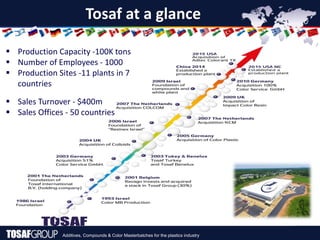
 Sales Turnover - $400m
 Sales Offices - 50 countries
 Production Capacity -100K tons
 Number of Employees - 1000
 Production Sites -11 plants in 7
countries
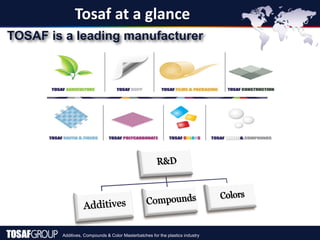
TOSAF is a leading manufacturer
Additives, Compounds & Color Masterbatches for the plastics industry
Tosaf at a glance
Additives, Compounds & Color Masterbatches for the plastics industry
Introduction
Migration mechanism of migrating additives
Film
Time
Additives, Compounds & Color Masterbatches for the plastics industry
Introduction
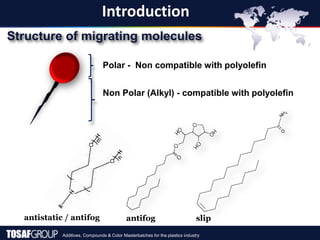
Structure of migrating molecules
Polar - Non compatible with polyolefin
Non Polar (Alkyl) - compatible with polyolefin
antifog
antistatic / antifog slip
Additives, Compounds & Color Masterbatches for the plastics industry
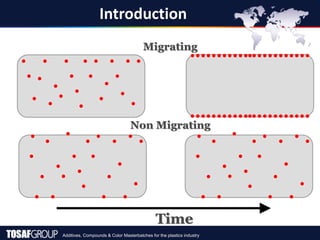
Introduction
Migrating
Non Migrating
Time
Additives, Compounds & Color Masterbatches for the plastics industry
Introduction
• Factors which control migration of additives:
• Polymer/Additive compatibility (Solubility Parameter,
Polarity), Polymer crystallinity
• Temperature
• Concentration of additive in the bulk
• Concentration of additive on the surface
• Other migrating additives
• External conditions
Additives, Compounds & Color Masterbatches for the plastics industry
Introduction
Requirements from migrating additives:
 Create optimal surface coverage for additive activity
 Avoid excessive surface concentration (blooming)
 Minimal effect on optical properties
 Minimal effect on printing
 Minimal effect on lamination
 Minimal effect on sealing
Additives, Compounds & Color Masterbatches for the plastics industry
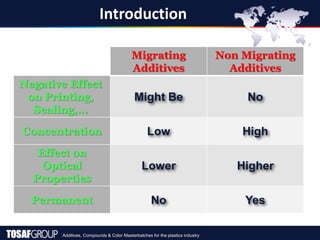
Introduction
Migrating
Additives
Non Migrating
Additives
Negative Effect
on Printing,
Sealing,...
Might Be No
Concentration Low High
Effect on
Optical
Properties
Lower Higher
Permanent No Yes
Additives, Compounds & Color Masterbatches for the plastics industry
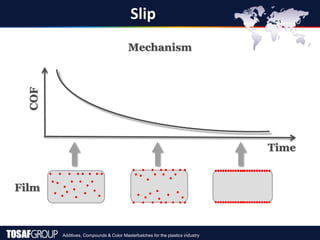
Slip
COF
Time
Film
Mechanism
Additives, Compounds & Color Masterbatches for the plastics industry
Slip
0
0.5
1
1.5
2
20 30 40 50 60
COF
Temperature [oC]
Erucamide
Temperature Dependence
Additives, Compounds & Color Masterbatches for the plastics industry
Slip
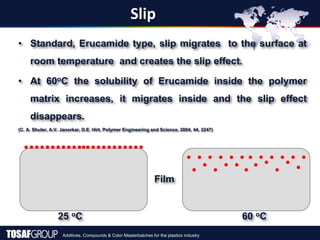
• Standard, Erucamide type, slip migrates to the surface at
room temperature and creates the slip effect.
• At 60oC the solubility of Erucamide inside the polymer
matrix increases, it migrates inside and the slip effect
disappears.
(C. A. Shuler, A.V. Janorkar, D.E. Hirt, Polymer Engineering and Science, 2004, 44, 2247)
25 oC 60 oC
Film
Additives, Compounds & Color Masterbatches for the plastics industry
Slip
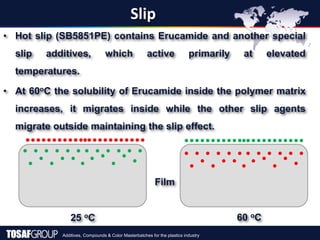
• Hot slip (SB5851PE) contains Erucamide and another special
slip additives, which active primarily at elevated
temperatures.
• At 60oC the solubility of Erucamide inside the polymer matrix
increases, it migrates inside while the other slip agents
migrate outside maintaining the slip effect.
25 oC 60 oC
Film
Additives, Compounds & Color Masterbatches for the plastics industry
Slip
0
0.5
1
1.5
2
20 30 40 50 60
COF
Temperature [oC]
Hot Slip
Erucamide
(SB5851PE)
Migrating Hot Slip Temperature Dependence
Additives, Compounds & Color Masterbatches for the plastics industry
Slip
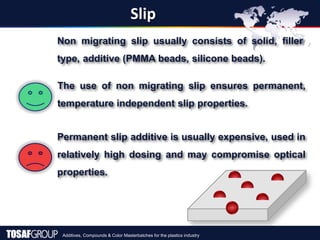
Non migrating slip usually consists of solid, filler
type, additive (PMMA beads, silicone beads).
The use of non migrating slip ensures permanent,
temperature independent slip properties.
Permanent slip additive is usually expensive, used in
relatively high dosing and may compromise optical
properties.
Additives, Compounds & Color Masterbatches for the plastics industry
Slip
Permanent Slip
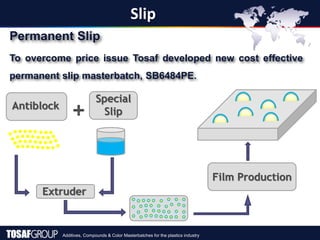
To overcome price issue Tosaf developed new cost effective
permanent slip masterbatch, SB6484PE.
Antiblock
Special
Slip
Extruder
Film Production
Additives, Compounds & Color Masterbatches for the plastics industry
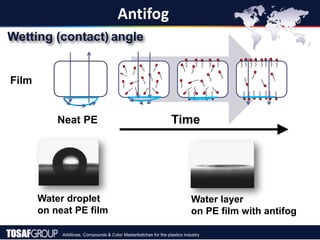
Antifog
Film
Time
Water droplet
on neat PE film
Water layer
on PE film with antifog
Wetting (contact) angle
Neat PE
Additives, Compounds & Color Masterbatches for the plastics industry
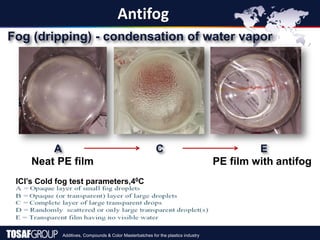
Antifog
ICI’s Cold fog test parameters,40C
A C E
Neat PE film PE film with antifog
Fog (dripping) - condensation of water vapor
Additives, Compounds & Color Masterbatches for the plastics industry
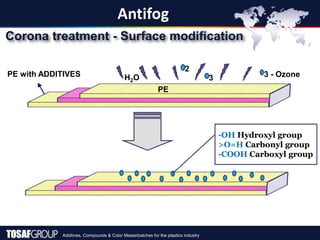
Antifog
Corona treatment - Surface modification
-OH Hydroxyl group
>O=H Carbonyl group
-COOH Carboxyl group
PE with ADDITIVES
PE
3 - Ozone
3
2
H2O
Additives, Compounds & Color Masterbatches for the plastics industry
Corona treatment for printing /coating /lamination
PE with ADDITIVES
PE
PA
PA Tie
PE
PE Tie
EVOH
9 layer barrier film
 Corona treatment
 Polar polymers – EVOH, PA
 Tie layers
 Lamination glue
Antifog
Factors which influence direction of migration
Additives, Compounds & Color Masterbatches for the plastics industry
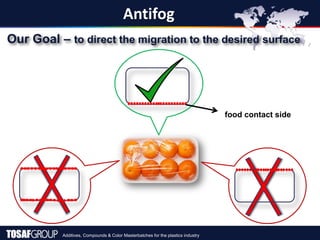
food contact side
Antifog
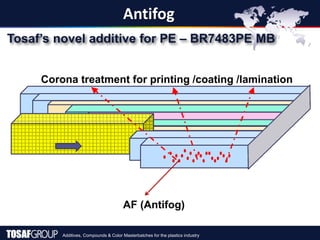
Our Goal – to direct the migration to the desired surface
Additives, Compounds & Color Masterbatches for the plastics industry
Antifog
Corona treatment for printing /coating /lamination
AF (Antifog)
Tosaf’s novel additive for PE – BR7483PE MB
Additives, Compounds & Color Masterbatches for the plastics industry
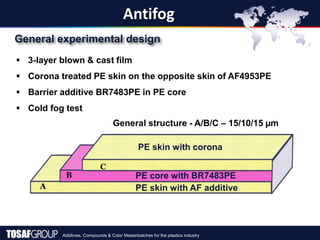
General experimental design
Antifog
 3-layer blown & cast film
 Corona treated PE skin on the opposite skin of AF4953PE
 Barrier additive BR7483PE in PE core
 Cold fog test
PE skin with corona
PE core with BR7483PE
PE skin with AF additive
General structure - A/B/C – 15/10/15 µm
B
A
C
Additives, Compounds & Color Masterbatches for the plastics industry
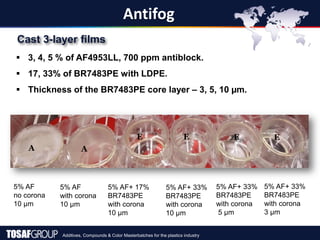
Antifog
Cast 3-layer films
 3, 4, 5 % of AF4953LL, 700 ppm antiblock.
 17, 33% of BR7483PE with LDPE.
 Thickness of the BR7483PE core layer – 3, 5, 10 µm.
5% AF
with corona
10 µm
5% AF+ 33%
BR7483PE
with corona
10 µm
5% AF+ 17%
BR7483PE
with corona
10 µm
5% AF
no corona
10 µm
5% AF+ 33%
BR7483PE
with corona
5 µm
5% AF+ 33%
BR7483PE
with corona
3 µm
A A
E
E
E E
Additives, Compounds & Color Masterbatches for the plastics industry
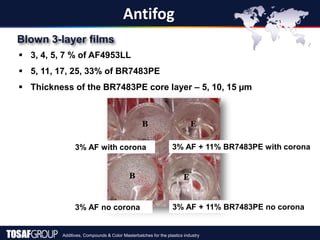
Blown 3-layer films
Antifog
 3, 4, 5, 7 % of AF4953LL
 5, 11, 17, 25, 33% of BR7483PE
 Thickness of the BR7483PE core layer – 5, 10, 15 µm
3% AF + 11% BR7483PE with corona
3% AF + 11% BR7483PE no corona
3% AF no corona
3% AF with corona
E
E
B
B
Additives, Compounds & Color Masterbatches for the plastics industry
Antifog
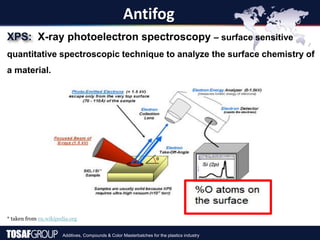
* taken from en.wikipedia.org
XPS: X-ray photoelectron spectroscopy – surface sensitive
quantitative spectroscopic technique to analyze the surface chemistry of
a material.
Additives, Compounds & Color Masterbatches for the plastics industry
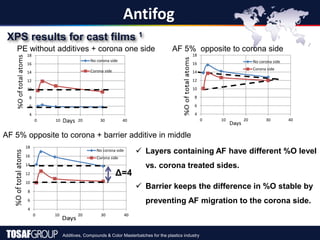
XPS results for cast films 1
Antifog
4
6
8
10
12
14
16
18
0 10 20 30 40
No corona side
Corona side
AF 5% opposite to corona + barrier additive in middle
4
6
8
10
12
14
16
18
0 10 20 30 40
No corona side
Corona side
PE without additives + corona one side
 Layers containing AF have different %O level
vs. corona treated sides.
 Barrier keeps the difference in %O stable by
preventing AF migration to the corona side.
Δ=4
4
6
8
10
12
14
16
18
0 10 20 30 40
No corona side
Corona side
AF 5% opposite to corona side
Additives, Compounds & Color Masterbatches for the plastics industry
Summary
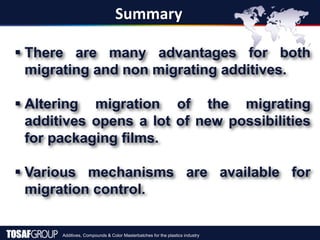
 There are many advantages for both
migrating and non migrating additives.
 Altering migration of the migrating
additives opens a lot of new possibilities
for packaging films.
 Various mechanisms are available for
migration control.
Additives, Compounds & Color Masterbatches for the plastics industry
Studies presented were partially supported supported by the Magnet Program of
the Israeli Ministry of Economy and the Israeli P^3 Consortium with Technion
Research group: Y. Cohen, L. Vaikhanski, R. Khalfin
Acknowledgment

Migrating vs non migrating in polymer

  • 1.
    Additives, Compounds &Color Masterbatches for the plastics industry Dr. Evgeni Zelikman / Irina Shtein Rozenman R&D Division, Tosaf Israel Migrating Additives vs. Non Migrating Additives in Polymer Films 5th Specialty Films & Flexible Packaging Global Summit 2016, 21st - 22nd September 2016 at Grand Hyatt, Mumbai, India
  • 2.
    Outline Additives, Compounds &Color Masterbatches for the plastics industry Outline • Tosaf at a Glance • Introduction • Slip • Antifog • Summary
  • 3.
    Additives, Compounds &Color Masterbatches for the plastics industry Tosaf at a glance  Sales Turnover - $400m  Sales Offices - 50 countries  Production Capacity -100K tons  Number of Employees - 1000  Production Sites -11 plants in 7 countries
  • 4.
    TOSAF is aleading manufacturer Additives, Compounds & Color Masterbatches for the plastics industry Tosaf at a glance
  • 5.
    Additives, Compounds &Color Masterbatches for the plastics industry Introduction Migration mechanism of migrating additives Film Time
  • 6.
    Additives, Compounds &Color Masterbatches for the plastics industry Introduction Structure of migrating molecules Polar - Non compatible with polyolefin Non Polar (Alkyl) - compatible with polyolefin antifog antistatic / antifog slip
  • 7.
    Additives, Compounds &Color Masterbatches for the plastics industry Introduction Migrating Non Migrating Time
  • 8.
    Additives, Compounds &Color Masterbatches for the plastics industry Introduction • Factors which control migration of additives: • Polymer/Additive compatibility (Solubility Parameter, Polarity), Polymer crystallinity • Temperature • Concentration of additive in the bulk • Concentration of additive on the surface • Other migrating additives • External conditions
  • 9.
    Additives, Compounds &Color Masterbatches for the plastics industry Introduction Requirements from migrating additives:  Create optimal surface coverage for additive activity  Avoid excessive surface concentration (blooming)  Minimal effect on optical properties  Minimal effect on printing  Minimal effect on lamination  Minimal effect on sealing
  • 10.
    Additives, Compounds &Color Masterbatches for the plastics industry Introduction Migrating Additives Non Migrating Additives Negative Effect on Printing, Sealing,... Might Be No Concentration Low High Effect on Optical Properties Lower Higher Permanent No Yes
  • 11.
    Additives, Compounds &Color Masterbatches for the plastics industry Slip COF Time Film Mechanism
  • 12.
    Additives, Compounds &Color Masterbatches for the plastics industry Slip 0 0.5 1 1.5 2 20 30 40 50 60 COF Temperature [oC] Erucamide Temperature Dependence
  • 13.
    Additives, Compounds &Color Masterbatches for the plastics industry Slip • Standard, Erucamide type, slip migrates to the surface at room temperature and creates the slip effect. • At 60oC the solubility of Erucamide inside the polymer matrix increases, it migrates inside and the slip effect disappears. (C. A. Shuler, A.V. Janorkar, D.E. Hirt, Polymer Engineering and Science, 2004, 44, 2247) 25 oC 60 oC Film
  • 14.
    Additives, Compounds &Color Masterbatches for the plastics industry Slip • Hot slip (SB5851PE) contains Erucamide and another special slip additives, which active primarily at elevated temperatures. • At 60oC the solubility of Erucamide inside the polymer matrix increases, it migrates inside while the other slip agents migrate outside maintaining the slip effect. 25 oC 60 oC Film
  • 15.
    Additives, Compounds &Color Masterbatches for the plastics industry Slip 0 0.5 1 1.5 2 20 30 40 50 60 COF Temperature [oC] Hot Slip Erucamide (SB5851PE) Migrating Hot Slip Temperature Dependence
  • 16.
    Additives, Compounds &Color Masterbatches for the plastics industry Slip Non migrating slip usually consists of solid, filler type, additive (PMMA beads, silicone beads). The use of non migrating slip ensures permanent, temperature independent slip properties. Permanent slip additive is usually expensive, used in relatively high dosing and may compromise optical properties.
  • 17.
    Additives, Compounds &Color Masterbatches for the plastics industry Slip Permanent Slip To overcome price issue Tosaf developed new cost effective permanent slip masterbatch, SB6484PE. Antiblock Special Slip Extruder Film Production
  • 18.
    Additives, Compounds &Color Masterbatches for the plastics industry Antifog Film Time Water droplet on neat PE film Water layer on PE film with antifog Wetting (contact) angle Neat PE
  • 19.
    Additives, Compounds &Color Masterbatches for the plastics industry Antifog ICI’s Cold fog test parameters,40C A C E Neat PE film PE film with antifog Fog (dripping) - condensation of water vapor
  • 20.
    Additives, Compounds &Color Masterbatches for the plastics industry Antifog Corona treatment - Surface modification -OH Hydroxyl group >O=H Carbonyl group -COOH Carboxyl group PE with ADDITIVES PE 3 - Ozone 3 2 H2O
  • 21.
    Additives, Compounds &Color Masterbatches for the plastics industry Corona treatment for printing /coating /lamination PE with ADDITIVES PE PA PA Tie PE PE Tie EVOH 9 layer barrier film  Corona treatment  Polar polymers – EVOH, PA  Tie layers  Lamination glue Antifog Factors which influence direction of migration
  • 22.
    Additives, Compounds &Color Masterbatches for the plastics industry food contact side Antifog Our Goal – to direct the migration to the desired surface
  • 23.
    Additives, Compounds &Color Masterbatches for the plastics industry Antifog Corona treatment for printing /coating /lamination AF (Antifog) Tosaf’s novel additive for PE – BR7483PE MB
  • 24.
    Additives, Compounds &Color Masterbatches for the plastics industry General experimental design Antifog  3-layer blown & cast film  Corona treated PE skin on the opposite skin of AF4953PE  Barrier additive BR7483PE in PE core  Cold fog test PE skin with corona PE core with BR7483PE PE skin with AF additive General structure - A/B/C – 15/10/15 µm B A C
  • 25.
    Additives, Compounds &Color Masterbatches for the plastics industry Antifog Cast 3-layer films  3, 4, 5 % of AF4953LL, 700 ppm antiblock.  17, 33% of BR7483PE with LDPE.  Thickness of the BR7483PE core layer – 3, 5, 10 µm. 5% AF with corona 10 µm 5% AF+ 33% BR7483PE with corona 10 µm 5% AF+ 17% BR7483PE with corona 10 µm 5% AF no corona 10 µm 5% AF+ 33% BR7483PE with corona 5 µm 5% AF+ 33% BR7483PE with corona 3 µm A A E E E E
  • 26.
    Additives, Compounds &Color Masterbatches for the plastics industry Blown 3-layer films Antifog  3, 4, 5, 7 % of AF4953LL  5, 11, 17, 25, 33% of BR7483PE  Thickness of the BR7483PE core layer – 5, 10, 15 µm 3% AF + 11% BR7483PE with corona 3% AF + 11% BR7483PE no corona 3% AF no corona 3% AF with corona E E B B
  • 27.
    Additives, Compounds &Color Masterbatches for the plastics industry Antifog * taken from en.wikipedia.org XPS: X-ray photoelectron spectroscopy – surface sensitive quantitative spectroscopic technique to analyze the surface chemistry of a material.
  • 28.
    Additives, Compounds &Color Masterbatches for the plastics industry XPS results for cast films 1 Antifog 4 6 8 10 12 14 16 18 0 10 20 30 40 No corona side Corona side AF 5% opposite to corona + barrier additive in middle 4 6 8 10 12 14 16 18 0 10 20 30 40 No corona side Corona side PE without additives + corona one side  Layers containing AF have different %O level vs. corona treated sides.  Barrier keeps the difference in %O stable by preventing AF migration to the corona side. Δ=4 4 6 8 10 12 14 16 18 0 10 20 30 40 No corona side Corona side AF 5% opposite to corona side
  • 29.
    Additives, Compounds &Color Masterbatches for the plastics industry Summary  There are many advantages for both migrating and non migrating additives.  Altering migration of the migrating additives opens a lot of new possibilities for packaging films.  Various mechanisms are available for migration control.
  • 30.
    Additives, Compounds &Color Masterbatches for the plastics industry Studies presented were partially supported supported by the Magnet Program of the Israeli Ministry of Economy and the Israeli P^3 Consortium with Technion Research group: Y. Cohen, L. Vaikhanski, R. Khalfin Acknowledgment