ADDITIVES
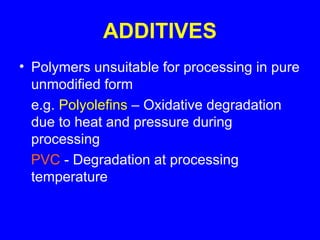
• Polymers unsuitablefor processing in pure
unmodified form
e.g. Polyolefins – Oxidative degradation
due to heat and pressure during
processing
PVC - Degradation at processing
temperature
3.
ADDITIVES
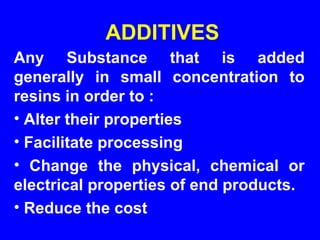
Any Substance thatis added
generally in small concentration to
resins in order to :
• Alter their properties
• Facilitate processing
• Change the physical, chemical or
electrical properties of end products.
• Reduce the cost
4.
Requirements of Additives
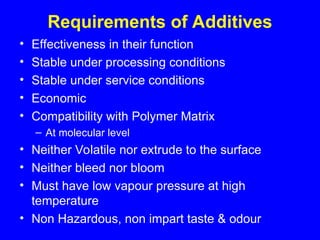
•Effectiveness in their function
• Stable under processing conditions
• Stable under service conditions
• Economic
• Compatibility with Polymer Matrix
– At molecular level
• Neither Volatile nor extrude to the surface
• Neither bleed nor bloom
• Must have low vapour pressure at high
temperature
• Non Hazardous, non impart taste & odour
Processing Stabilizers
• Preventdegradation which is caused by
– Heat
– Oxygen
• What Happens ?
– Oxygen combines with Polymer under high
temp to form carbonyl compounds which
leads to yellow & brown discolouration.
8.
Processing Stabilizers
• PrimaryStabilizers – Antioxidants
• Secondary Stabilizers – Peroxide
decomposes
• Chelating Agents – Metal deactivators
• Special Stabilizers (Heat Stabilizers) – for
halogenated polymers
9.
Antioxidants
( Primary Stabilizer)
• They inhibit or retard the oxidative degradation
of materials at normal or elevated temperature
during processing, storage or service due to
– Heat
– Light
– Chemical Induction
• How it works?
– It interrupt the chain reaction by combining with
the free radicals forming a non reactive products
(Amount : 0.1 – 0.5%)
10.
Effect of Oxidation
–Loss in Tensile Properties
– Discolouration i.e. yellowing,
– Increase in Brittleness
– Melt Flow Instability
– Change in appearance.
– Hardness increases.
– Loss of Gloss.
– loss of transparency.
– Cracking.
• Hindered Phenols or Aromatic Amines
11.
Secondary Stabilizer –Peroxide
decomposes
• How it works?
– Peroxides are reduced to alcohols & are
deactivated.
• EX:
– Sulphur & Phosphorus Compounds such as
Sulphides, thioethers, tertiary phosphites &
phosphorates.
Heat Stabilizers
• PreventDegradation
• Absorb & Neutralize HCl gas evolved
• Prevent Oxidation reactions
• Prevent Discolouration
• Displace active substituents with stable
substituents
14.
Heat Stabilizers
• Lead
–Tri Basic Lead Sulphate (TBLS)
– Dibasic Lead Sulphate (DBLS)
– Basic Lead Carbonate
– Dibasic Lead Phosphite
• Organo-tin
– Dibutyltin meleates
– Dibutyltin bis mercaptides
• Cadmium / Barium /Zinc
– Cadmium/Barium laurates
– Cadmium/Barium/Zinc Complexes
15.
Synergistic Stabilizer Systems
•The term Synergism is used to describe
the combined effect of two or more
stabilizers, which is greater than the sum
of the effects of the individual stabilizers
used in isolation.
Effect (A+B) > Effect A + Effect B
16.
Lubricants or FlowPromoters
Functions :-
• To reduce friction between the material and the
processing equipment. ( Adhesive forces)
• To reduce heat & wear between two surfaces either
between the polymer molecules
( Cohesive forces) or between the polymeric material
and the equipment.
• Reduces thermal degradation of the polymer.
• Modifies flow characteristics.
• Homogenous the polymer melt with other polymer
additives.
• To prevent the plastic from sticking to the mould
surface during processing
External Lubricants
• Preventfriction between polymer melt & metal
surface
• Prevent sticking to the metal parts
• They are usually high molecular compounds and
have non-polar groups.
• They have low compatibility with the polymer but
have high affinity for the metal surface.
• During processing they form a thin film between
polymer melt & metal surface.
• They improve surface finish & gloss.
• They help to reduce melt viscosity and give a high
output rate.
Internal Lubricants
• PromotesFlow by reducing cohesive forces
between molecular interfaces within the resin
• They are usually low molecular weight
compounds, having polar groups.
• They function by reducing intra-molecular friction
before and during the melt formation of the
polymer by promoting flow and reducing melt
viscosity of the polymeric mass.
• They also enhance polymer properties like heat
stability, impact strength, colour & clarity.
Selection of Lubricants
•Metal Soaps – Low Compatibility with
polymer, so used as external lubricants
• Long Chain Fatty Acids – Used as Internal
Lubricants for polar polymers.
• Long Chain di-alkyl esters – Medium
compatibility, so act as external & internal
lubricants.
• High Molecular weight paraffin wax – low
compatibility with polar polymer, so used
as external lubricants.
23.
Plasticizers or softeners
•Improve process ability by reducing Tg
• These are high boiling non-volatile
solvents
• Polar with a high Mol. Wt. ester type
organic compounds.
• Reduce internal friction between
polymer chain.
24.
Effect of Plasticizers
•Easy melt
• Improve flexibility
• Increase Softness and Flexibility.
• Improve Process ability.
• Alters Softening point, Tensile Strength,
Elongation at break & Impact.
25.
Types of Plasticizers
•Primary – These are highly compatible
with PVC and can be used alone.
• e.g.
– Phthalates – Di-Octyl Phthalate (DOP), Di Iso
Octyl Phthalate (DIOP)
– Phosphates – Tricresyl Phosphate (TCP),
– Sebacates,
– Adipates.
26.
Types of Plasticizers
•Secondary – These are less compatible
with resin & and are usually employed
together with primary plasticizers.
• e.g.
– Di Octyl Sebacate (DOS)
– Adipic Acid Polyesters
– Epoxidised oil.
27.
Extenders
• These arenot used alone as plasticizers.
• They are limited compatibility with polymer.
• In conjunction with true plasticizers it enhance
the efficiency of plasticizers.
• Low Cost.
• It replaces the plasticizers without any adverse
effect on polymer.
e.g.
– Chlorinated paraffin wax,
– oil extracts.
28.
Selection of Plasticizers
Solvating power
Efficiency
Compatibility
Flame retardant
Toxicity
Low Temp. Performance
Cost
Effect of Fillers
•The use of inert fillers can influence the
polymer properties in the following ways :-
– Increase in density.
– Increase in modulus of elasticity.
– Lower shrinkage.
– Increase in hardness.
– Increase in HDT.
– Reduction of raw material cost.
– For e.g. Calcium Carbonate,Red mud
Fibrous Fillers &Reinforcement
Reinforcing fillers are those which enhance
the mechanical properties like :
• Tensile Strength
• Modulus
• Hardness of a polymer compound.
The product become stiffer and stronger
than the base polymer.
37.
Fibrous Fillers &Reinforcement
Glass Fibres –
Increase (Tensile, Compressive,Flexural )
Strength ,Increase rigidity, creep resistance
hardness and decrease thermal expansion
co-efficient, elongation at break.
Minerals such as talc, calcuim carbonate,
mica – increases the compound rigidity,
improve the temperature resistance and
reduces shrinkage & warpage.
38.
Coupling Agents
These areused to increase the adhesion
between polymer & filler, fiber by covalent
bonds.
Ex: Methacrylato-chromo chloride used for
glass fibres & Polyester resin
Organosilanes are used for PVC , ABS and
PA
39.
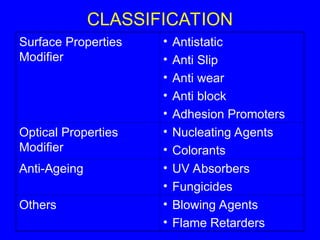
Antistatic Agents
• Staticcharge may built up simply by friction
with the ambient air
• Most plastics have low surface conductivity
• Static charge is not discharged fast enough
Troublesome effects like:
• Heavy contamination of plastics parts
• Shock as charge flows ( floor covering ,
door handles)
40.
Antistatic Agents
• Chemicalsadded to plastics to reduce built
up of electrostatic charges on the surface of
materials
Accumulations can occur during processing
and at various handling points
• Static charges are dissipated by increasing
the surface conductivity
41.
Antistatic Agents
• Preventelectrostatic charges – mostly seen in
PE, PP, PS, Nylons, Polyesters, Urathenes,
Cellulosics, Acrylics & Acrylonitriles
• Because of insulation properties electrical
charge may get deposited on the surface of
the plastics produced during processing.
• This may cause severe damage to the
products & equipments.
• It may cause accumulation of dust.
• The accumulation of static charge can be
minimized by the use of antistatic agents.
Slip & Antiblock Agents
• Slip : Reduces coefficient of friction- They
are high molecular weight fatty alcohols
• Amount (0.05 – 0.2% )
e.g. For film of 25 micron 0.01% of
Oleamide
44.
Slip & Antiblock Agents
• Anti block Agents : Prevent adhesion
between the film surface
Amount (0.05 – 0.2%)
e.g.
– Calcium Carbonate in PVC film
– Metal Salts
– Fatty Acids
– Natural & Synthetic Waxy Materials
45.
Selection of Slip& Anti block Agents
• Must not spoil optical properties.
• Must not interface with the adhesion ink to
film.
• Must not prevent the sealing of film.
• Must be colour less
• Must be odour less
• Must be non toxic
46.
Nucleating Agents
• Aidingtransmission of white light in Plastics
• Forms large nos. of nuclei & reduces the
size of spherulites.
e.g.
– Sodium, Potassium, Lithium benzoates.
– Inorganic Powders – Clays, Silica Flour
47.
Optical Brighteners
• Itmakes a mask over the yellowness formed
during processing.
• Optical Brighteners are organic substance
which absorb UV radation
e.g.
– Benzosulphonic & Sulphonamides
derivatives.
– Vinylene bisbenzoxazoles.
– 4-alkyl-7-dialkyl amino coumarins.
Ultraviolet Light Absorbers
•Detected by
– Loss in Tensile Properties
– Discolouration
– Brittleness
• EX:
– Black in any form : Carbon Black, Black dye, Black paints
– Benzophenones – for PE, Polyesters
– Benzotriazoles – for PS, Polyesters
55.
Impact Modifier
• Toenhance the impact properties of
certain brittle polymers so as to use in the
field.
e.g.
– Chlorinated polyethylene ,EVA are used for
PVC.
– SBR is used for polystyrene material.
– EPDM is used for PP ( Bumpers)
– Acrylic rubbers for Poyamides
56.
Flame Retardants
• Plastics+ Fire –free radical formation
combines with Oxygen – CO – CO2
• Application : Automobile, Aerospace,
Electrical,Transportation,Building,Furnit
ure, TV cabinet
Blowing Agents
• Blowingagents are also known as
foaming agents. Upon heating liberate
Gas
• Are used to produce porous polymers
i.e. cellular/foam plastics.
59.
Blowing Agents
Physical Blowingagents: Nitrogen & CO2
inert gas- Low cost, No solid residue
Trichlorofluromethane – PU foam
Pentane and Heptane - PS foam
Chemical Blowing agents: High temp, Azo
Dicarbonamide decompose on heating to
produe free radicals and N2 gas
60.
Blowing Agents
• Blowingagents are also known as foaming
agents. Upon heating liberate Gas
• Are used to produce porous polymers i.e.
cellular/foam plastics.
• EX:
– Ammonium bi carbonates
– Sodium bi carbonates
– Azo Di carbonamide
– Azo bis formamide
– N-nitrogen Compound
– Sulfonyl Hydrazides
61.
Master Batches,Additives &Reinforced Compounds
Material Supplier
Master Batches S.C.J. plastics Ltd. New
Delhi
www.scjindia.com
Master Batches &
Reinforced
Compounds
Aalekh Polymers (P)
Ltd.
8/30, Kirti Nagar New
Delhi =15
Ph. No. 25195193
Polymer additives Fine organics Bombay
022-25116900-02