ADDITIVES IN PLASTICS


  By - Kirtan .V
       Roll – MO7049
What are
                   additives ?
 Materials  dispersed  polymer
       matrix without affecting
significantly the molecular structure
  of the polymer to attend certain
      desirable properties
Why to use additives in
      plastics ?
 •   Improve processing conditions
 •   Increase resin’s stability to oxidation
 •   Obtain better impact resistance
 •   Increase or decrease hardness
 •   Control surface tension
 •   Facilitate extrusion moulding
 •   Control blocking
 •   Reduce cost
 •   Increase flame resistance.
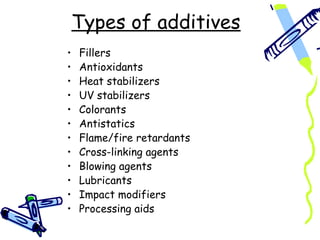
Types of additives
•   Fillers
•   Antioxidants
•   Heat stabilizers
•   UV stabilizers
•   Colorants
•   Antistatics
•   Flame/fire retardants
•   Cross-linking agents
•   Blowing agents
•   Lubricants
•   Impact modifiers
•   Processing aids
What are fillers?
• Mostly needed by thermosets,
  sometimes also needed by
  thermoplastics.


• Added to reduce cost.
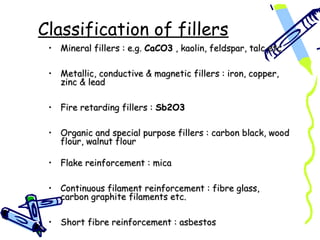
Classification of fillers
 • Mineral fillers : e.g. CaCO3 , kaolin, feldspar, talc etc.

 • Metallic, conductive & magnetic fillers : iron, copper,
   zinc & lead

 • Fire retarding fillers : Sb2O3

 • Organic and special purpose fillers : carbon black, wood
   flour, walnut flour

 • Flake reinforcement : mica

 • Continuous filament reinforcement : fibre glass,
   carbon graphite filaments etc.

 • Short fibre reinforcement : asbestos
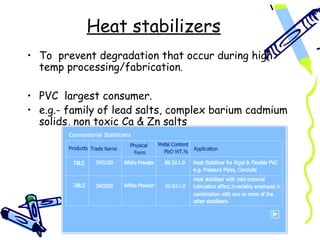
Heat stabilizers
• To prevent degradation that occur during high
  temp processing/fabrication.

• PVC largest consumer.
• e.g.- family of lead salts, complex barium cadmium
  solids, non toxic Ca & Zn salts
• Type: Ba / Cd - Clear calendered products, Injection
  moulded flexible products, blown film

• Type: Ba / Cd / Zn – Clear calendered products, blown film,
  flexible products, plastisol processing

• Type: Ba / Zn – Flexible calendered products, unsupported
  films for garments, artificial leather for automotive

• Type: Ca / Zn (Non-Toxic) – Children’s toys, packaging films,
  base coat for artificial leather, top coat for floor
  coverings, conveyor belts, sealing compounds

• Type: Ba / Cd / Pb – Calendered, injection moulded
  products, extreme high temp, and application.

• Type: Lead Complex – Rigid PVC pipes, casing capping,
  electric wires.
UV STABILIZERS
•   UV light  280-400nm  polymers unstable

•   To overcome this UV stabilizers are used.

Classification-:
1)UV absorbers: Hydroxy benzophenones
2)UV quenchers: Piperidines
3)Pigment: carbon black

Applications -:
1) carpenting outdoor/seatings
2) Acrylic coating used on outdoor sign boards
3) Light diffusers
4) Used in outer liners of HMHDPE
Antioxidants-:
• Polymers when subjected to oxygen attack & if
 1)there exists high concentration of unsaturated c-c bonds
 2)residual polymerisation catalyst
 3)it is subjected to highly oxidising conditions,then it undergo
   oxidation.

-to overcome this problems  long service life, antioxidants
   are used.

Classification -:
1)primary: hindered phenolics acryl amines
2)secondary: phosphurous &
sulphur containing compounds
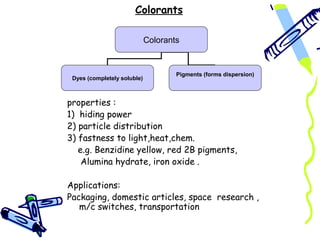
Colorants

                             Colorants


                                     Pigments (forms dispersion)
 Dyes (completely soluble)


properties :
1) hiding power
2) particle distribution
3) fastness to light,heat,chem.
   e.g. Benzidine yellow, red 2B pigments,
    Alumina hydrate, iron oxide .

Applications:
Packaging, domestic articles, space research ,
   m/c switches, transportation
Antistatic agent
• Due to low surface conductivity  have poor
  conductivity  accumulation of static charge.
  Which is undesirable because

  1) attracts dust particles wear & abrasion &
  unsightly look.

 2) charged metals results into powdering.

  3) it can generate spark, which can become
   hazardous.
e.g. butyl stearate, tri -ethanol-amine
Fire retardants
• Polymers being organic compounds burn or
  decompose on exposure to fire, generates toxic
  fumes, smoke.

• Two techniques: 1)use fire retardant raw material.
                      2)use fire retardant additives.
e.g. inorganic :zinc borate
     halogenated :chlorinate paraffins

applicable to polymers to be used in mines,
 automobiles, air vehicles, railways, etc.

   consumed by - polyesters, polycarbon
  polyurethanes.
Cross-linking agents
• Thermosets cure either on application of heat or cross
  linking/curing/ hardening agents.

• In some cases agent triggers off the reaction & therefore
  linking the resin molecules or

• It enters into the parts between molecules and completes
  the chain.

Classification :

1)free radical intiator : Isobutyl nitrile, Alkyl peroxide .
2)non free radical agents : Isocynate with polyol

       Used : Manufacture of Thermosets like polyurethane,
   Urea Formaldehyde, etc
Blowing agent
•  Polymeric foams preparation(2 ways)
      1) mechanical
      2) chemically
• substances called blowing agents, which on heating
  decompose giving N & CO2
• Rigid PVC,ABS,Polystyrene, polyolefins being chief
  consumers.


Applications:
 mattresses, pillows, insulation, foam pipes
  for non-p conditions.
e.g.para toluene sulphonyl hydrazide.
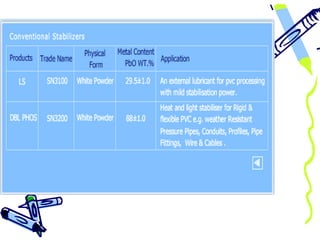
Lubricants
• Hot processing of polymers need lubricants either internally
  or externally.


• Internal lubricants decreasing normal cohesive forces
  between polymer moleculesgood flow conditions by
  lowering viscosity.

• External lubricant don’t let melt to stick to hot surface of
  processing. By forming a thin layer at melt-solid interface.


   e.g. butyl stearate, octyl stearate, stearic acid
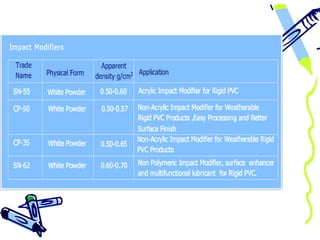
Impact modifiers
• To upgrade physical properties of polymer to the extent
  prescribed by consumer, the additives added to polymers
  are called as strength (impact) modifiers.


• They impart breakage resistance, rigidity, ease of post
  fabrication, strength to sheets


• The strength imparted depends on time & temp conditions
  of processing .


• Rigid PVC for prolonged outdoor exposure needs I.m.,
  similarly epoxy & polyester thermosets require impact
  modifiers.
Additives : Packaging
            appications
•   Enhances barrier properties
•   Better transparency/Gloss
•   Better printing/sealing properties
•   Anti microbials
Thank you ;)

Additives in plastics

  • 1.
    ADDITIVES IN PLASTICS By - Kirtan .V Roll – MO7049
  • 2.
    What are additives ? Materials  dispersed  polymer matrix without affecting significantly the molecular structure of the polymer to attend certain desirable properties
  • 3.
    Why to useadditives in plastics ? • Improve processing conditions • Increase resin’s stability to oxidation • Obtain better impact resistance • Increase or decrease hardness • Control surface tension • Facilitate extrusion moulding • Control blocking • Reduce cost • Increase flame resistance.
  • 4.
    Types of additives • Fillers • Antioxidants • Heat stabilizers • UV stabilizers • Colorants • Antistatics • Flame/fire retardants • Cross-linking agents • Blowing agents • Lubricants • Impact modifiers • Processing aids
  • 5.
    What are fillers? •Mostly needed by thermosets, sometimes also needed by thermoplastics. • Added to reduce cost.
  • 6.
    Classification of fillers • Mineral fillers : e.g. CaCO3 , kaolin, feldspar, talc etc. • Metallic, conductive & magnetic fillers : iron, copper, zinc & lead • Fire retarding fillers : Sb2O3 • Organic and special purpose fillers : carbon black, wood flour, walnut flour • Flake reinforcement : mica • Continuous filament reinforcement : fibre glass, carbon graphite filaments etc. • Short fibre reinforcement : asbestos
  • 7.
    Heat stabilizers • Toprevent degradation that occur during high temp processing/fabrication. • PVC largest consumer. • e.g.- family of lead salts, complex barium cadmium solids, non toxic Ca & Zn salts
  • 8.
    • Type: Ba/ Cd - Clear calendered products, Injection moulded flexible products, blown film • Type: Ba / Cd / Zn – Clear calendered products, blown film, flexible products, plastisol processing • Type: Ba / Zn – Flexible calendered products, unsupported films for garments, artificial leather for automotive • Type: Ca / Zn (Non-Toxic) – Children’s toys, packaging films, base coat for artificial leather, top coat for floor coverings, conveyor belts, sealing compounds • Type: Ba / Cd / Pb – Calendered, injection moulded products, extreme high temp, and application. • Type: Lead Complex – Rigid PVC pipes, casing capping, electric wires.
  • 9.
    UV STABILIZERS • UV light  280-400nm  polymers unstable • To overcome this UV stabilizers are used. Classification-: 1)UV absorbers: Hydroxy benzophenones 2)UV quenchers: Piperidines 3)Pigment: carbon black Applications -: 1) carpenting outdoor/seatings 2) Acrylic coating used on outdoor sign boards 3) Light diffusers 4) Used in outer liners of HMHDPE
  • 10.
    Antioxidants-: • Polymers whensubjected to oxygen attack & if 1)there exists high concentration of unsaturated c-c bonds 2)residual polymerisation catalyst 3)it is subjected to highly oxidising conditions,then it undergo oxidation. -to overcome this problems  long service life, antioxidants are used. Classification -: 1)primary: hindered phenolics acryl amines 2)secondary: phosphurous & sulphur containing compounds
  • 11.
    Colorants Colorants Pigments (forms dispersion) Dyes (completely soluble) properties : 1) hiding power 2) particle distribution 3) fastness to light,heat,chem. e.g. Benzidine yellow, red 2B pigments, Alumina hydrate, iron oxide . Applications: Packaging, domestic articles, space research , m/c switches, transportation
  • 12.
    Antistatic agent • Dueto low surface conductivity  have poor conductivity  accumulation of static charge. Which is undesirable because 1) attracts dust particles wear & abrasion & unsightly look. 2) charged metals results into powdering. 3) it can generate spark, which can become hazardous. e.g. butyl stearate, tri -ethanol-amine
  • 13.
    Fire retardants • Polymersbeing organic compounds burn or decompose on exposure to fire, generates toxic fumes, smoke. • Two techniques: 1)use fire retardant raw material. 2)use fire retardant additives. e.g. inorganic :zinc borate halogenated :chlorinate paraffins applicable to polymers to be used in mines, automobiles, air vehicles, railways, etc. consumed by - polyesters, polycarbon polyurethanes.
  • 14.
    Cross-linking agents • Thermosetscure either on application of heat or cross linking/curing/ hardening agents. • In some cases agent triggers off the reaction & therefore linking the resin molecules or • It enters into the parts between molecules and completes the chain. Classification : 1)free radical intiator : Isobutyl nitrile, Alkyl peroxide . 2)non free radical agents : Isocynate with polyol Used : Manufacture of Thermosets like polyurethane, Urea Formaldehyde, etc
  • 15.
    Blowing agent • Polymeric foams preparation(2 ways) 1) mechanical 2) chemically • substances called blowing agents, which on heating decompose giving N & CO2 • Rigid PVC,ABS,Polystyrene, polyolefins being chief consumers. Applications: mattresses, pillows, insulation, foam pipes for non-p conditions. e.g.para toluene sulphonyl hydrazide.
  • 16.
    Lubricants • Hot processingof polymers need lubricants either internally or externally. • Internal lubricants decreasing normal cohesive forces between polymer moleculesgood flow conditions by lowering viscosity. • External lubricant don’t let melt to stick to hot surface of processing. By forming a thin layer at melt-solid interface. e.g. butyl stearate, octyl stearate, stearic acid
  • 18.
    Impact modifiers • Toupgrade physical properties of polymer to the extent prescribed by consumer, the additives added to polymers are called as strength (impact) modifiers. • They impart breakage resistance, rigidity, ease of post fabrication, strength to sheets • The strength imparted depends on time & temp conditions of processing . • Rigid PVC for prolonged outdoor exposure needs I.m., similarly epoxy & polyester thermosets require impact modifiers.
  • 20.
    Additives : Packaging appications • Enhances barrier properties • Better transparency/Gloss • Better printing/sealing properties • Anti microbials
  • 21.