Unit-4
Polymer Additives
Presentation by
Dr. Nandan C. Pomal
Assistant Professor
Faculty of Science,
Sigma University, Vadodara, Gujarat, India
B.Sc. Sem-3
Polymer Additives
• Plastic manufacturing has evolved significantly over time. Plastics were originally
produced using a few natural materials but now there are thousands of plastics
formulated from a wide range of natural and synthetic materials. One of the big
changes over time in plastic formulations is the use of polymer additives.
• Additives are chemicals added to the base polymer to improve
processability, prolong the life span, and/or achieve the desired physical
or chemical properties in the final product.
• While the content of additives is typically only a few percent, their impact on
polymer performance and stability is significant. Once the additives are
added, the polymer blend is referred to as a masterbatch and is processed
accordingly.
Different types of
Polymer Additives
Polymer
Additives
Plasticizers
Anti-aging
stabilizers
Blowing
agents
Flame
retardants
Nucleating
agents
Processing
Anti-static
Colorants
Odor
Anti-
microbial
Plasticizers
• Definition:
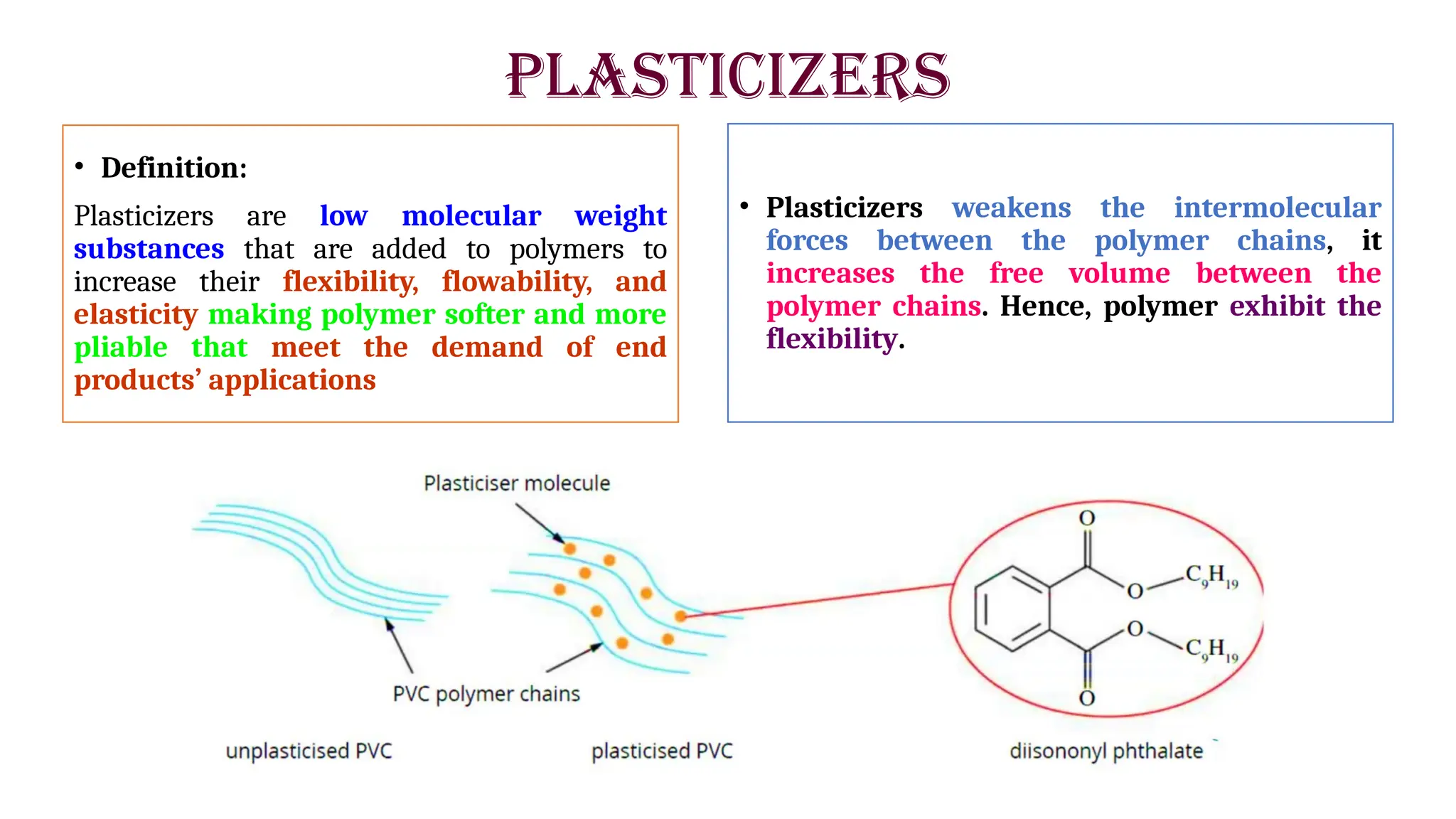
Plasticizers are low molecular weight
substances that are added to polymers to
increase their flexibility, flowability, and
elasticity making polymer softer and more
pliable that meet the demand of end
products’ applications
• Plasticizers weakens the intermolecular
forces between the polymer chains, it
increases the free volume between the
polymer chains. Hence, polymer exhibit the
flexibility.
Properties of Plasticizers
Low Volatility: Effective plasticizers have low volatility to ensure that
they remain within the polymer matrix over time without
evaporating.
Compatibility: They should be compatible with the polymer they are
mixed with, ensuring a homogeneous mixture without phase separation.
Thermal Stability: Good plasticizers should withstand high
temperatures without decomposing, thus maintaining the integrity of
the polymer during processing and in use.
Non-Toxicity: Particularly for applications in food packaging, medical
devices, and children's toys, non-toxic plasticizers are essential.
Flexibility and Durability: Plasticizers impart flexibility, which
enhances the durability of the polymer by making it less brittle.
Migration Resistance: Plasticizers should have low migration rates to prevent
them from leaching out of the polymer, which could lead to changes in properties
over time and potential environmental or health issues.
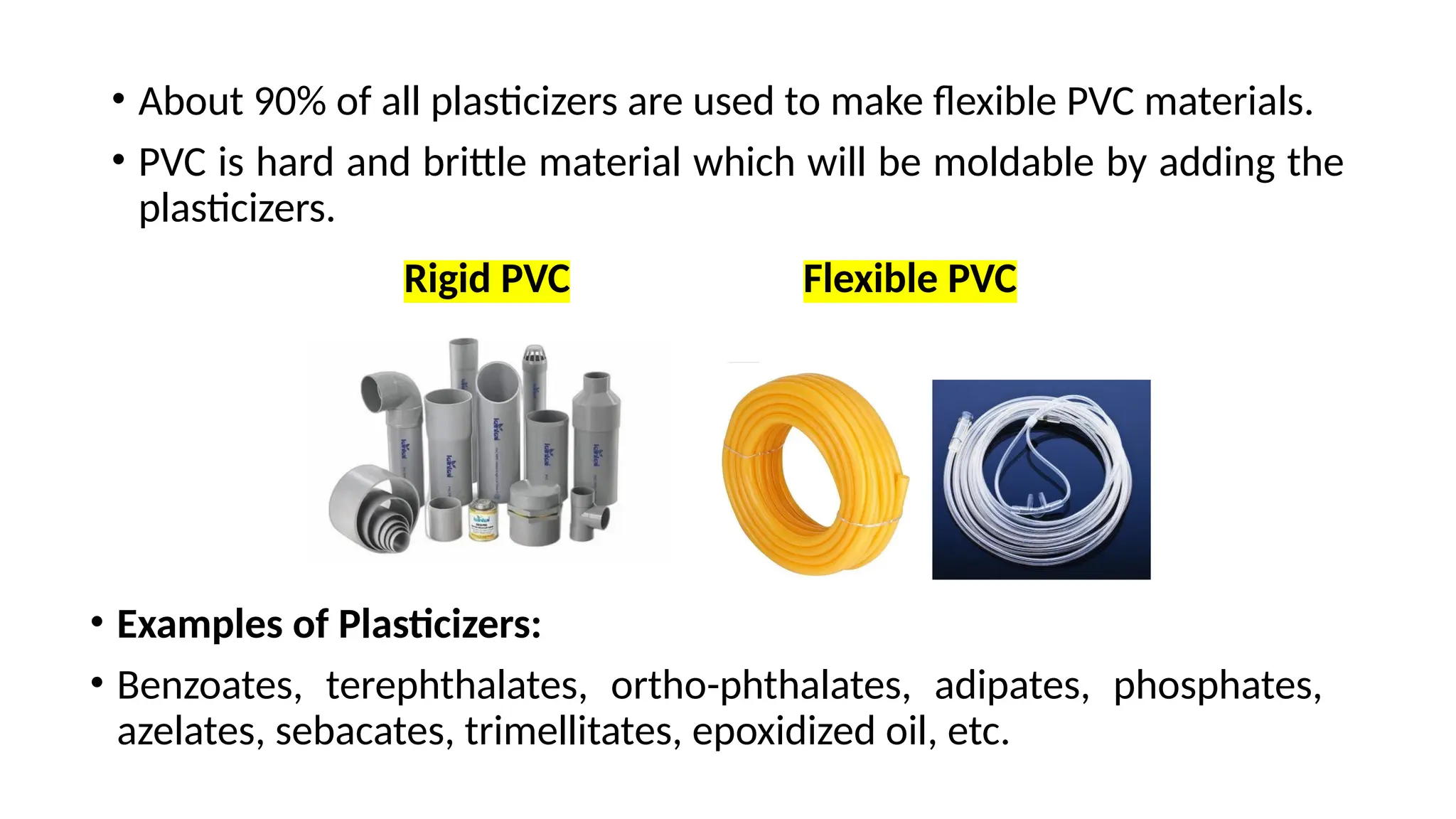
• About 90% of all plasticizers are used to make flexible PVC materials.
• PVC is hard and brittle material which will be moldable by adding the
plasticizers.
Rigid PVC Flexible PVC
• Examples of Plasticizers:
• Benzoates, terephthalates, ortho-phthalates, adipates, phosphates,
azelates, sebacates, trimellitates, epoxidized oil, etc.
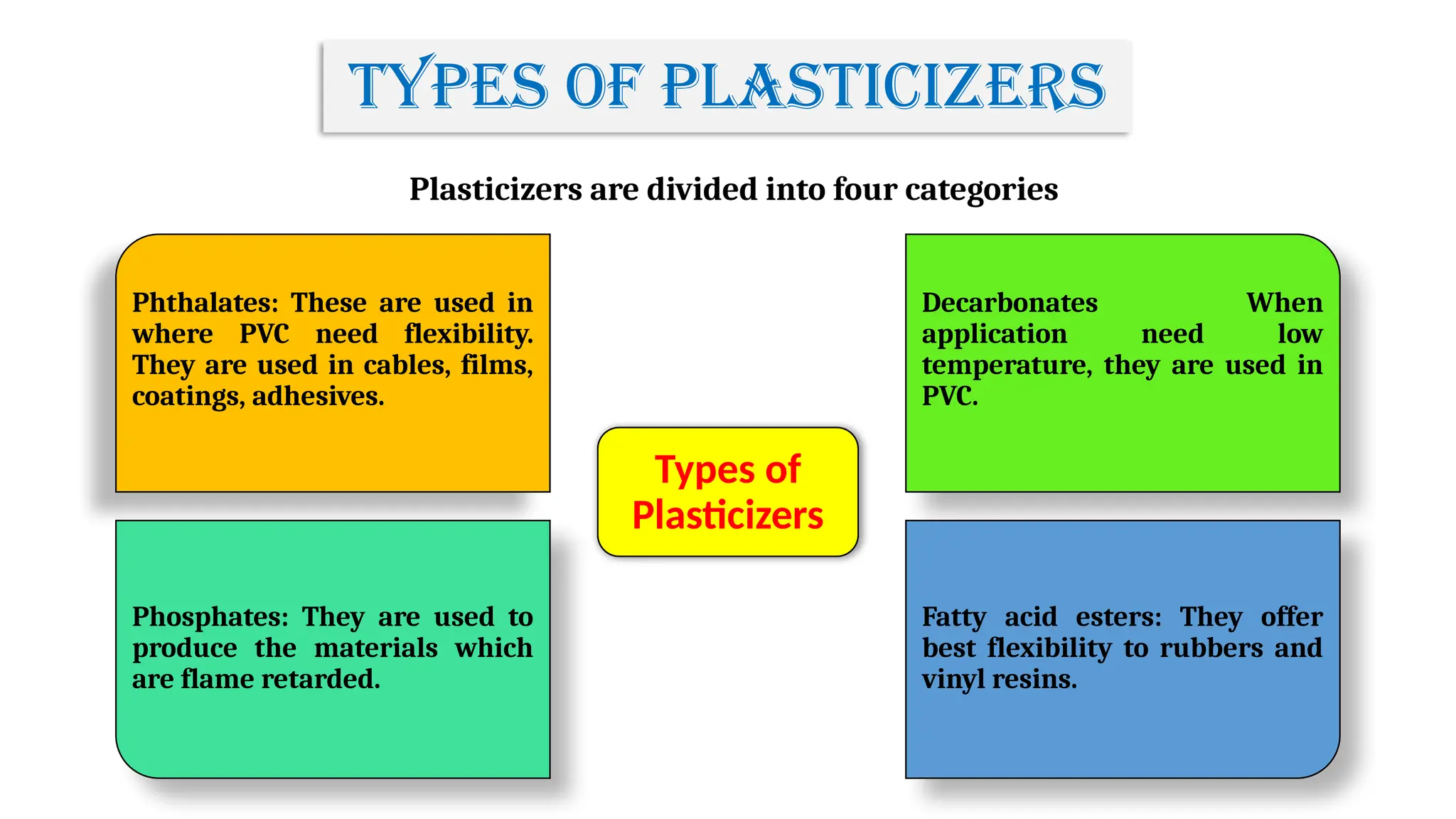
Types of Plasticizers
Plasticizers are divided into four categories
Phthalates: These are used in
where PVC need flexibility.
They are used in cables, films,
coatings, adhesives.
Decarbonates When
application need low
temperature, they are used in
PVC.
Phosphates: They are used to
produce the materials which
are flame retarded.
Fatty acid esters: They offer
best flexibility to rubbers and
vinyl resins.
Types of
Plasticizers
Fillers
• Fillers are the materials that are added to a polymer
formulation to lower the compound cost or to improve
properties.
Classification of Fillers
Based on Performance Based on Type
Extenders Functional
Fillers
Particulate
Fillers
Fibrous
fillers
Rubbery
Fillers
Extender fillers
• Primarily occupy space and are mainly used to lower the formulation
cost.
• Examples : Tyre dust, Saw dust.
• Have a specific and required function in the formulation apart from
lowering the formulation cost.
• Examples : Carbon black and Precipitated Silica provide
reinforcement in tyres. Aluminium and Magnesium hydroxide flame
retardant for many polymers.
Functional Fillers
Particulate fillers
It can be classified into two groups;
A. Inert fillers – Ebonite dust, graphite powder,
lithopone, talc, barium sulphate.
B. Reinforcing fillers – Carbon black, Zinc oxide,
Magnesium carbonate, China clay, calcium
carbonate.
Rubbery fillers
• Rubbery fillers are incorporated into rigid thermoplastics to improve their
toughness. It leads to significant increase in the fracture resistance.
• Used in plastic materials.
• Examples : paper, glass fibres, asbestos fibres, cotton fibres, nonwovens
Fibrous fillers
Functions of fillers
• Cost reduction.
• Improved processing.
• Density control.
• Increase dimension stability of products.
• Give optical effects like transparency.
• Thermal conductivity.
• Control of thermal expansion.
• Magnetic properties.
• Flame retardancy (ex : Magnesium Hydroxide).
• Improved mechanical properties (hardness, abrasion & tear resistance).
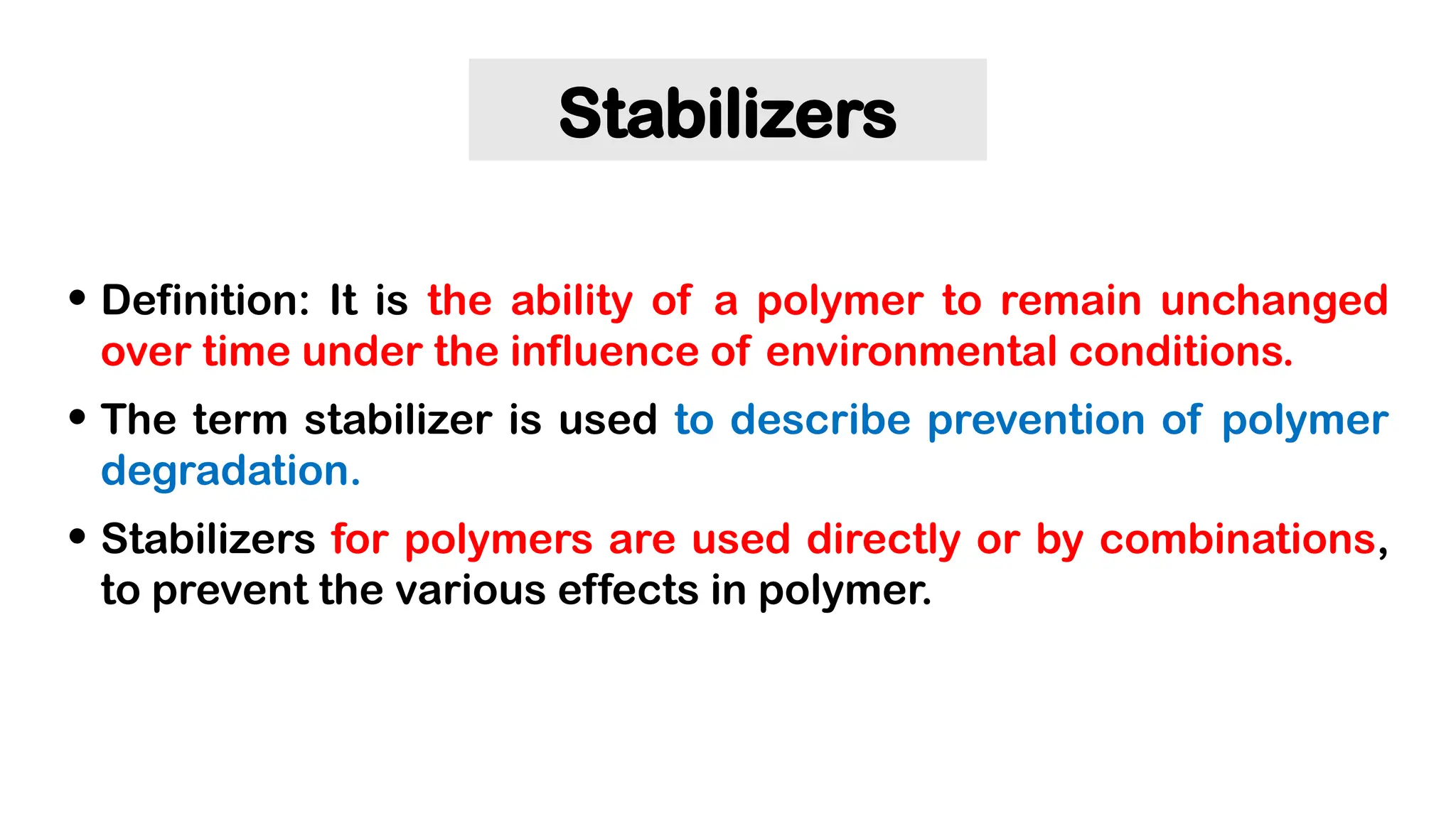
Stabilizers
• Definition: It is the ability of a polymer to remain unchanged
over time under the influence of environmental conditions.
• The term stabilizer is used to describe prevention of polymer
degradation.
• Stabilizers for polymers are used directly or by combinations,
to prevent the various effects in polymer.
COMMON HARMFUL SITUATIONS
IN POLYMER PROCESSING
Heat : Polymer can be decomposed when heat rise up. Its also
known as thermal degradation.
Light : Natural light containing uv rays also. This uv rays having
sufficient energy to break the bonds in polymer. It’s also known
as photo degradation.
Moisture : Moisture influencing in the microbial activities on
the polymer.
Atmosphere gases (oxygen and other aggressive gases) :
Oxidation can be happen in the polymer due to the
atmosphere oxygen. Its also known as oxidative degradation.
Types of Stabilizers used
to Terminate Polymer Degradations
Antioxidants
Antiozonant
Heat stabilizers
Flame retardants
Microbial Stabilizer (Biocides)
Light stabilizers (UV absorbers)
Heat (or thermal) stabilizers are mostly used for Thermoplastics (PVC).
Unstabilized material is having more chance to thermal degradation.
These heat stabilizing agents minimize the degradation process which starts above 70 °C.
Many various Heat stabilizing agents have been used including…
Derivatives of heavy metals (lead, cadmium),Metallic soaps (metal "salts" of fatty acids),
species such as calcium stearate.
Addition levels of these Heat stabilizers vary typically from 2% to 4%.
Heat Stabilizers
Antioxidants
• Almost all commercial polymers can be attacked by oxygen or traces of
ozone in the atmosphere.
• Oxidation is the major cause of their discoloration, impairment of
mechanical properties, and subsequent failure. It is accelerated by heat
or sunlight.
• Antioxidants are added to the polymers to extend their useful
temperature ranges and service lives and to allow outdoor application.
• Oxidation occurs most quicker at polymers with structural double bonds,
such as polybutadiene, polyisoprene.
• TMQ (2,2,4-Trimethyl-1,2-dihydroquinoline), 2,6-didodecyl-pcresol and
2,6-dioctadecyl-p-cresol have been found as highly effective, no
discoloring, and non-volatile antioxidants.
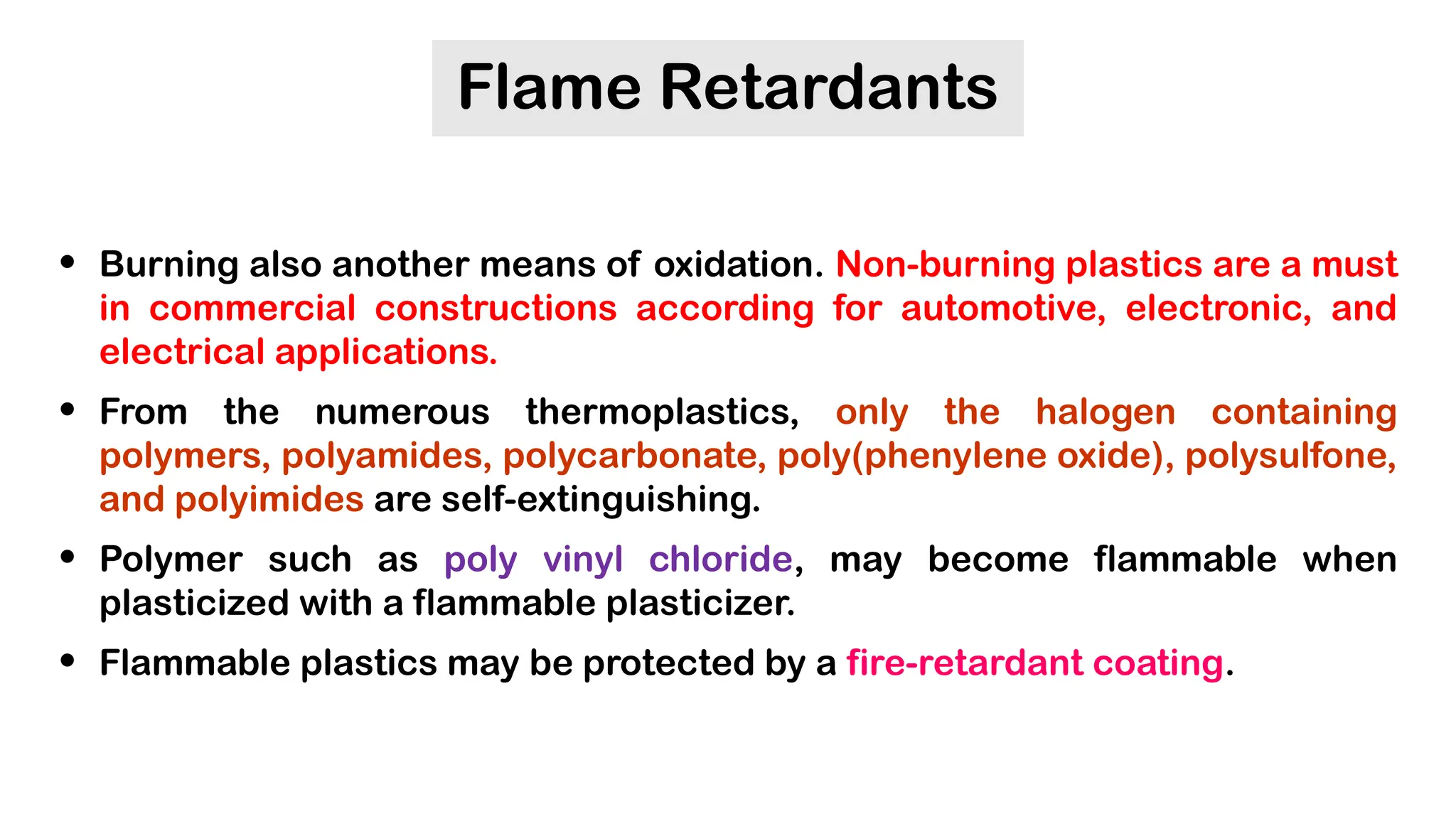
Flame Retardants
• Burning also another means of oxidation. Non-burning plastics are a must
in commercial constructions according for automotive, electronic, and
electrical applications.
• From the numerous thermoplastics, only the halogen containing
polymers, polyamides, polycarbonate, poly(phenylene oxide), polysulfone,
and polyimides are self-extinguishing.
• Polymer such as poly vinyl chloride, may become flammable when
plasticized with a flammable plasticizer.
• Flammable plastics may be protected by a fire-retardant coating.
Microbial Stabilizer (Biocides)
• Fungi and bacteria do not attack synthetic polymers themselves
but their formulated compounds does.
• Their attack on plasticized polymer depends on the type of
plasticizer, and other ingredients used.
• Microbial attack can be occur discolored spots and reduction in
physical properties, such as flexibility, elongation, and strength.
• The purpose of adding biocides is to control the bacteria and fungi
growth on the surface for health reasons.
• Arsine-epoxy adduct as the most universal micro biocide.
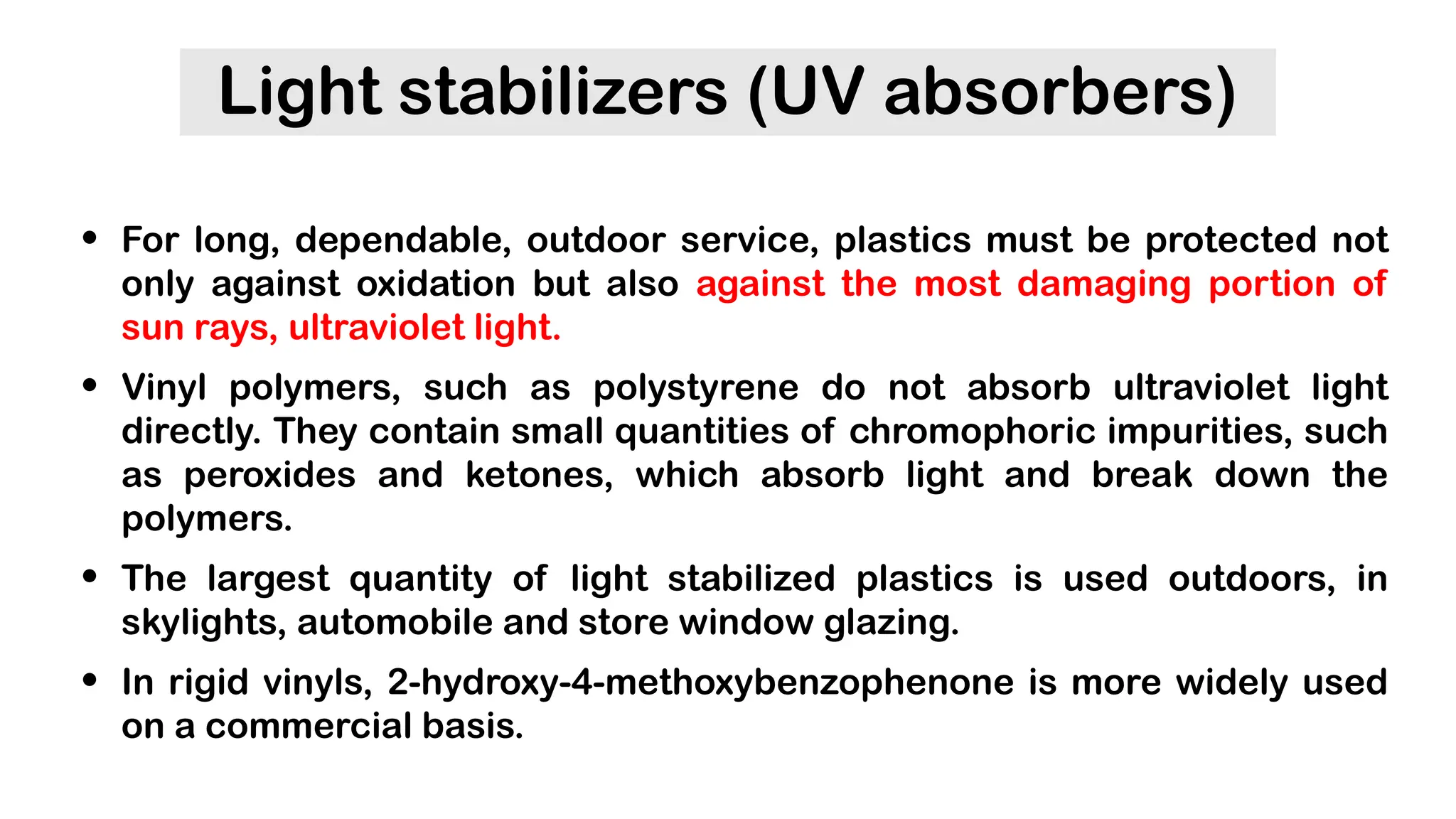
Light stabilizers (UV absorbers)
• For long, dependable, outdoor service, plastics must be protected not
only against oxidation but also against the most damaging portion of
sun rays, ultraviolet light.
• Vinyl polymers, such as polystyrene do not absorb ultraviolet light
directly. They contain small quantities of chromophoric impurities, such
as peroxides and ketones, which absorb light and break down the
polymers.
• The largest quantity of light stabilized plastics is used outdoors, in
skylights, automobile and store window glazing.
• In rigid vinyls, 2-hydroxy-4-methoxybenzophenone is more widely used
on a commercial basis.
THANK YOU

Polymer Additives for BSc Polymer Chemistry

  • 1.
    Unit-4 Polymer Additives Presentation by Dr.Nandan C. Pomal Assistant Professor Faculty of Science, Sigma University, Vadodara, Gujarat, India B.Sc. Sem-3
  • 2.
    Polymer Additives • Plasticmanufacturing has evolved significantly over time. Plastics were originally produced using a few natural materials but now there are thousands of plastics formulated from a wide range of natural and synthetic materials. One of the big changes over time in plastic formulations is the use of polymer additives. • Additives are chemicals added to the base polymer to improve processability, prolong the life span, and/or achieve the desired physical or chemical properties in the final product. • While the content of additives is typically only a few percent, their impact on polymer performance and stability is significant. Once the additives are added, the polymer blend is referred to as a masterbatch and is processed accordingly.
  • 3.
    Different types of PolymerAdditives Polymer Additives Plasticizers Anti-aging stabilizers Blowing agents Flame retardants Nucleating agents Processing Anti-static Colorants Odor Anti- microbial
  • 4.
    Plasticizers • Definition: Plasticizers arelow molecular weight substances that are added to polymers to increase their flexibility, flowability, and elasticity making polymer softer and more pliable that meet the demand of end products’ applications • Plasticizers weakens the intermolecular forces between the polymer chains, it increases the free volume between the polymer chains. Hence, polymer exhibit the flexibility.
  • 5.
    Properties of Plasticizers LowVolatility: Effective plasticizers have low volatility to ensure that they remain within the polymer matrix over time without evaporating. Compatibility: They should be compatible with the polymer they are mixed with, ensuring a homogeneous mixture without phase separation. Thermal Stability: Good plasticizers should withstand high temperatures without decomposing, thus maintaining the integrity of the polymer during processing and in use. Non-Toxicity: Particularly for applications in food packaging, medical devices, and children's toys, non-toxic plasticizers are essential. Flexibility and Durability: Plasticizers impart flexibility, which enhances the durability of the polymer by making it less brittle. Migration Resistance: Plasticizers should have low migration rates to prevent them from leaching out of the polymer, which could lead to changes in properties over time and potential environmental or health issues.
  • 6.
    • About 90%of all plasticizers are used to make flexible PVC materials. • PVC is hard and brittle material which will be moldable by adding the plasticizers. Rigid PVC Flexible PVC • Examples of Plasticizers: • Benzoates, terephthalates, ortho-phthalates, adipates, phosphates, azelates, sebacates, trimellitates, epoxidized oil, etc.
  • 7.
    Types of Plasticizers Plasticizersare divided into four categories Phthalates: These are used in where PVC need flexibility. They are used in cables, films, coatings, adhesives. Decarbonates When application need low temperature, they are used in PVC. Phosphates: They are used to produce the materials which are flame retarded. Fatty acid esters: They offer best flexibility to rubbers and vinyl resins. Types of Plasticizers
  • 8.
    Fillers • Fillers arethe materials that are added to a polymer formulation to lower the compound cost or to improve properties.
  • 9.
    Classification of Fillers Basedon Performance Based on Type Extenders Functional Fillers Particulate Fillers Fibrous fillers Rubbery Fillers
  • 10.
    Extender fillers • Primarilyoccupy space and are mainly used to lower the formulation cost. • Examples : Tyre dust, Saw dust. • Have a specific and required function in the formulation apart from lowering the formulation cost. • Examples : Carbon black and Precipitated Silica provide reinforcement in tyres. Aluminium and Magnesium hydroxide flame retardant for many polymers. Functional Fillers
  • 11.
    Particulate fillers It canbe classified into two groups; A. Inert fillers – Ebonite dust, graphite powder, lithopone, talc, barium sulphate. B. Reinforcing fillers – Carbon black, Zinc oxide, Magnesium carbonate, China clay, calcium carbonate.
  • 12.
    Rubbery fillers • Rubberyfillers are incorporated into rigid thermoplastics to improve their toughness. It leads to significant increase in the fracture resistance. • Used in plastic materials. • Examples : paper, glass fibres, asbestos fibres, cotton fibres, nonwovens Fibrous fillers
  • 13.
    Functions of fillers •Cost reduction. • Improved processing. • Density control. • Increase dimension stability of products. • Give optical effects like transparency. • Thermal conductivity. • Control of thermal expansion. • Magnetic properties. • Flame retardancy (ex : Magnesium Hydroxide). • Improved mechanical properties (hardness, abrasion & tear resistance).
  • 14.
    Stabilizers • Definition: Itis the ability of a polymer to remain unchanged over time under the influence of environmental conditions. • The term stabilizer is used to describe prevention of polymer degradation. • Stabilizers for polymers are used directly or by combinations, to prevent the various effects in polymer.
  • 15.
    COMMON HARMFUL SITUATIONS INPOLYMER PROCESSING Heat : Polymer can be decomposed when heat rise up. Its also known as thermal degradation. Light : Natural light containing uv rays also. This uv rays having sufficient energy to break the bonds in polymer. It’s also known as photo degradation. Moisture : Moisture influencing in the microbial activities on the polymer. Atmosphere gases (oxygen and other aggressive gases) : Oxidation can be happen in the polymer due to the atmosphere oxygen. Its also known as oxidative degradation.
  • 16.
    Types of Stabilizersused to Terminate Polymer Degradations Antioxidants Antiozonant Heat stabilizers Flame retardants Microbial Stabilizer (Biocides) Light stabilizers (UV absorbers)
  • 17.
    Heat (or thermal)stabilizers are mostly used for Thermoplastics (PVC). Unstabilized material is having more chance to thermal degradation. These heat stabilizing agents minimize the degradation process which starts above 70 °C. Many various Heat stabilizing agents have been used including… Derivatives of heavy metals (lead, cadmium),Metallic soaps (metal "salts" of fatty acids), species such as calcium stearate. Addition levels of these Heat stabilizers vary typically from 2% to 4%. Heat Stabilizers
  • 18.
    Antioxidants • Almost allcommercial polymers can be attacked by oxygen or traces of ozone in the atmosphere. • Oxidation is the major cause of their discoloration, impairment of mechanical properties, and subsequent failure. It is accelerated by heat or sunlight. • Antioxidants are added to the polymers to extend their useful temperature ranges and service lives and to allow outdoor application. • Oxidation occurs most quicker at polymers with structural double bonds, such as polybutadiene, polyisoprene. • TMQ (2,2,4-Trimethyl-1,2-dihydroquinoline), 2,6-didodecyl-pcresol and 2,6-dioctadecyl-p-cresol have been found as highly effective, no discoloring, and non-volatile antioxidants.
  • 19.
    Flame Retardants • Burningalso another means of oxidation. Non-burning plastics are a must in commercial constructions according for automotive, electronic, and electrical applications. • From the numerous thermoplastics, only the halogen containing polymers, polyamides, polycarbonate, poly(phenylene oxide), polysulfone, and polyimides are self-extinguishing. • Polymer such as poly vinyl chloride, may become flammable when plasticized with a flammable plasticizer. • Flammable plastics may be protected by a fire-retardant coating.
  • 20.
    Microbial Stabilizer (Biocides) •Fungi and bacteria do not attack synthetic polymers themselves but their formulated compounds does. • Their attack on plasticized polymer depends on the type of plasticizer, and other ingredients used. • Microbial attack can be occur discolored spots and reduction in physical properties, such as flexibility, elongation, and strength. • The purpose of adding biocides is to control the bacteria and fungi growth on the surface for health reasons. • Arsine-epoxy adduct as the most universal micro biocide.
  • 21.
    Light stabilizers (UVabsorbers) • For long, dependable, outdoor service, plastics must be protected not only against oxidation but also against the most damaging portion of sun rays, ultraviolet light. • Vinyl polymers, such as polystyrene do not absorb ultraviolet light directly. They contain small quantities of chromophoric impurities, such as peroxides and ketones, which absorb light and break down the polymers. • The largest quantity of light stabilized plastics is used outdoors, in skylights, automobile and store window glazing. • In rigid vinyls, 2-hydroxy-4-methoxybenzophenone is more widely used on a commercial basis.
  • 22.