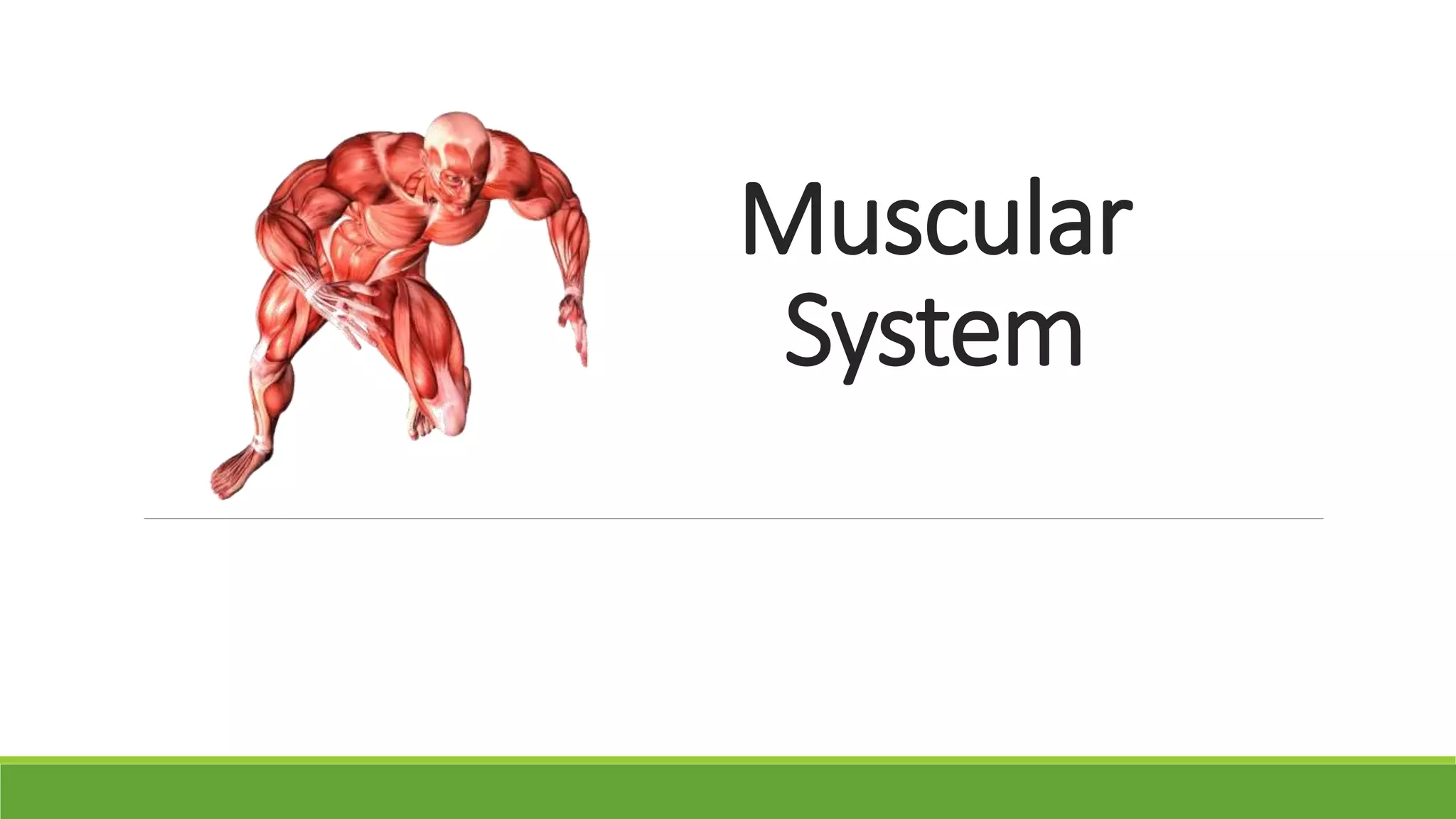
Muscular
System
There are four characteristics associated with
muscle tissue:
 Excitability - Tissue can receive & respond to
stimulation
 Contractility - Tissue can shorten & thicken
 Extensibility - Tissue can lengthen
 Elasticity - After contracting or lengthening,
tissue always wants to return to its resting
state
Functions
The characteristics of muscle tissue enable it to
perform some important functions, including:
 Movement – both voluntary & involuntary
 Maintaining posture
 Supporting soft tissues within body cavities
 Maintaining body temperature
Functions
The Muscular System
 Muscles are responsible for all types of
body movement – they contract or
shorten and are the machine of the
body
 Three basic muscle types are found in
the body, what are they?
3 Types of Muscle
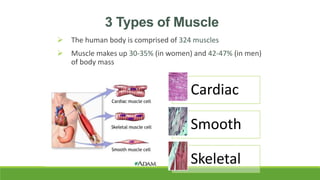
 The human body is comprised of 324 muscles
 Muscle makes up 30-35% (in women) and 42-47% (in men)
of body mass
Cardiac
Smooth
Skeletal
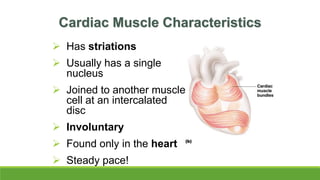
Cardiac Muscle Characteristics
 Has striations
 Usually has a single
nucleus
 Joined to another muscle
cell at an intercalated
disc
 Involuntary
 Found only in the heart
 Steady pace!
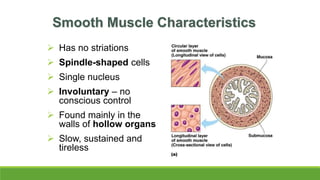
Smooth Muscle Characteristics
 Has no striations
 Spindle-shaped cells
 Single nucleus
 Involuntary – no
conscious control
 Found mainly in the
walls of hollow organs
 Slow, sustained and
tireless
Skeletal Muscle Characteristics
 Most are attached by tendons to bones
 Cells are multinucleate
 Striated – have visible banding
 Voluntary – subject to conscious control
 Cells are surrounded and bundled by
connective tissue = great force, but tires
easily
Characteristics of Muscles
 Muscle cells are elongated
(muscle cell = muscle fiber)
 Contraction of muscles is due to the
movement of microfilaments
 All muscles share some terminology
Prefix myo refers to muscle
Prefix mys refers to muscle
Prefix sarco refers to flesh

Heart and voluntary

  • 1.
  • 2.
    There are fourcharacteristics associated with muscle tissue:  Excitability - Tissue can receive & respond to stimulation  Contractility - Tissue can shorten & thicken  Extensibility - Tissue can lengthen  Elasticity - After contracting or lengthening, tissue always wants to return to its resting state Functions
  • 3.
    The characteristics ofmuscle tissue enable it to perform some important functions, including:  Movement – both voluntary & involuntary  Maintaining posture  Supporting soft tissues within body cavities  Maintaining body temperature Functions
  • 4.
    The Muscular System Muscles are responsible for all types of body movement – they contract or shorten and are the machine of the body  Three basic muscle types are found in the body, what are they?
  • 5.
    3 Types ofMuscle  The human body is comprised of 324 muscles  Muscle makes up 30-35% (in women) and 42-47% (in men) of body mass Cardiac Smooth Skeletal
  • 6.
    Cardiac Muscle Characteristics Has striations  Usually has a single nucleus  Joined to another muscle cell at an intercalated disc  Involuntary  Found only in the heart  Steady pace!
  • 7.
    Smooth Muscle Characteristics Has no striations  Spindle-shaped cells  Single nucleus  Involuntary – no conscious control  Found mainly in the walls of hollow organs  Slow, sustained and tireless
  • 8.
    Skeletal Muscle Characteristics Most are attached by tendons to bones  Cells are multinucleate  Striated – have visible banding  Voluntary – subject to conscious control  Cells are surrounded and bundled by connective tissue = great force, but tires easily
  • 9.
    Characteristics of Muscles Muscle cells are elongated (muscle cell = muscle fiber)  Contraction of muscles is due to the movement of microfilaments  All muscles share some terminology Prefix myo refers to muscle Prefix mys refers to muscle Prefix sarco refers to flesh