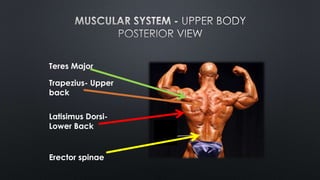
Teres Major
Trapezius- Upper
back
Latisimus Dorsi-
Lower Back
Erector spinae
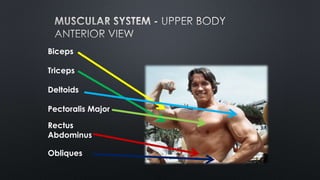
Biceps
Triceps
Deltoids
Pectoralis Major
Rectus
Abdominus
Obliques
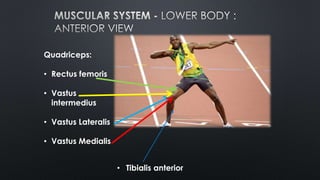
Quadriceps:
• Rectus femoris
• Vastus
intermedius
• Vastus Lateralis
• Vastus Medialis
• Tibialis anterior
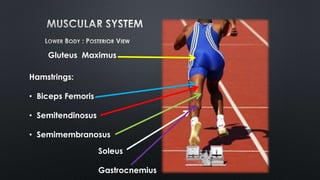
Gluteus Maximus
Hamstrings:
• Biceps Femoris
• Semitendinosus
• Semimembranosus
Soleus
Gastrocnemius
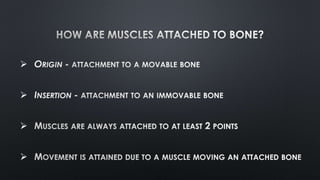
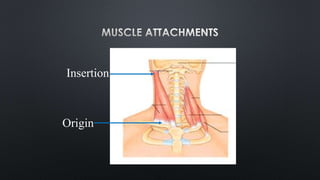
 ORIGIN -
 INSERTION -


Origin
Insertion


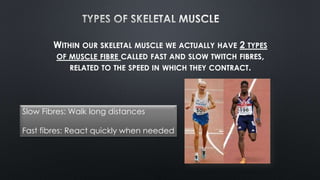
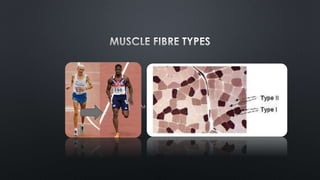
WITHIN OUR SKELETAL MUSCLE WE ACTUALLY HAVE 2 TYPES
OF MUSCLE FIBRE CALLED FAST AND SLOW TWITCH FIBRES,
RELATED TO THE SPEED IN WHICH THEY CONTRACT.
Slow Fibres: Walk long distances
Fast fibres: React quickly when needed
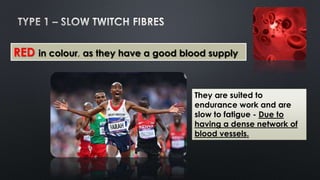
RED in colour, as they have a good blood supply
They are suited to
endurance work and are
slow to fatigue - Due to
having a dense network of
blood vessels.
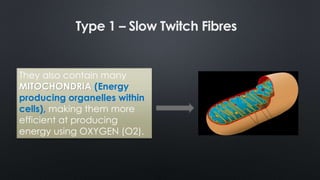
They also contain many
MITOCHONDRIA (Energy
producing organelles within
cells), making them more
efficient at producing
energy using OXYGEN (O2).
Type 1 – Slow Twitch Fibres
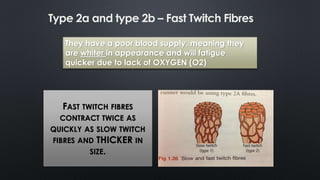
FAST TWITCH FIBRES
CONTRACT TWICE AS
QUICKLY AS SLOW TWITCH
FIBRES AND THICKER IN
SIZE.
They have a poor blood supply, meaning they
are whiter in appearance and will fatigue
quicker due to lack of OXYGEN (O2)
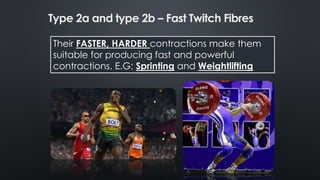
Type 2a and type 2b – Fast Twitch Fibres
Their FASTER, HARDER contractions make them
suitable for producing fast and powerful
contractions. E.G: Sprinting and Weightlifting
Type 2a and type 2b – Fast Twitch Fibres
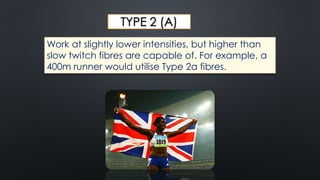
TYPE 2 (A)
Work at slightly lower intensities, but higher than
slow twitch fibres are capable of. For example, a
400m runner would utilise Type 2a fibres.
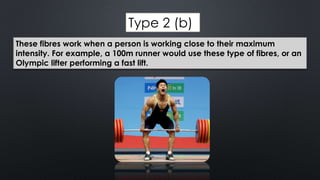
Type 2 (b)
These fibres work when a person is working close to their maximum
intensity. For example, a 100m runner would use these type of fibres, or an
Olympic lifter performing a fast lift.
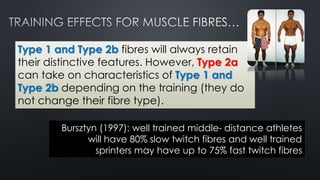
Type 1 and Type 2b fibres will always retain
their distinctive features. However, Type 2a
can take on characteristics of Type 1 and
Type 2b depending on the training (they do
not change their fibre type).
Bursztyn (1997): well trained middle- distance athletes
will have 80% slow twitch fibres and well trained
sprinters may have up to 75% fast twitch fibres
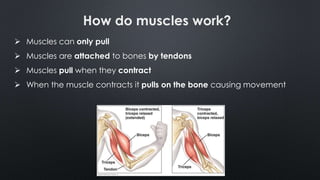
How do muscles work?
 Muscles can only pull
 Muscles are attached to bones by tendons
 Muscles pull when they contract
 When the muscle contracts it pulls on the bone causing movement
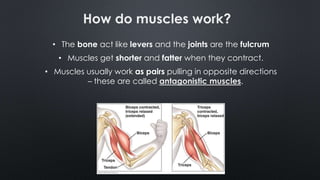
How do muscles work?
• The bone act like levers and the joints are the fulcrum
• Muscles get shorter and fatter when they contract.
• Muscles usually work as pairs pulling in opposite directions
– these are called antagonistic muscles.
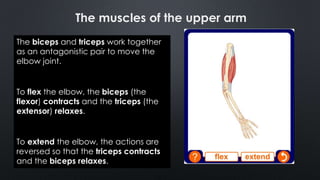
The biceps and triceps work together
as an antagonistic pair to move the
elbow joint.
To flex the elbow, the biceps (the
flexor) contracts and the triceps (the
extensor) relaxes.
To extend the elbow, the actions are
reversed so that the triceps contracts
and the biceps relaxes.
The muscles of the upper arm
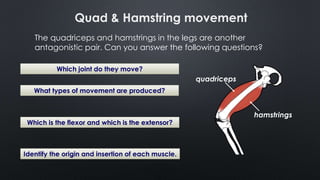
The quadriceps and hamstrings in the legs are another
antagonistic pair. Can you answer the following questions?
Which joint do they move?
What types of movement are produced?
Which is the flexor and which is the extensor?
Identify the origin and insertion of each muscle.
quadriceps
hamstrings
Quad & Hamstring movement
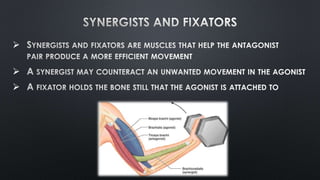



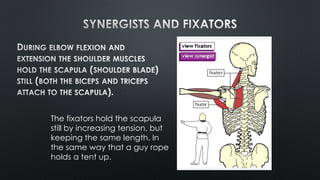
The fixators hold the scapula
still by increasing tension, but
keeping the same length. In
the same way that a guy rope
holds a tent up.
E.g. Walking is automatic takes no real cognitive effort
learned & needs concentration for toddlers.
With constant practice:
1. Neural networks & motor neuron/muscle pathways
become fast and effortless,
2. No conscious thought to achieve the fluid sequence
of motor activity that produces optimal walking
behaviour.
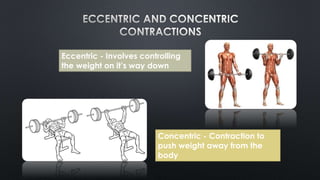
Eccentric - Involves controlling
the weight on it’s way down
Concentric - Contraction to
push weight away from the
body
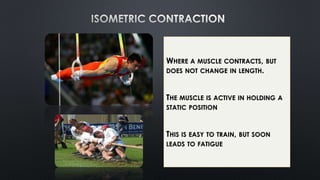
WHERE A MUSCLE CONTRACTS, BUT
DOES NOT CHANGE IN LENGTH.
THE MUSCLE IS ACTIVE IN HOLDING A
STATIC POSITION
THIS IS EASY TO TRAIN, BUT SOON
LEADS TO FATIGUE
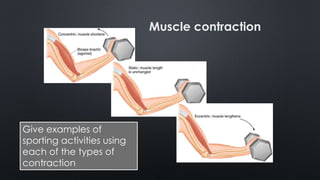
Give examples of
sporting activities using
each of the types of
contraction
Muscle contraction

Concentric and isometric

  • 2.
    Teres Major Trapezius- Upper back LatisimusDorsi- Lower Back Erector spinae
  • 3.
  • 4.
    Quadriceps: • Rectus femoris •Vastus intermedius • Vastus Lateralis • Vastus Medialis • Tibialis anterior
  • 5.
    Gluteus Maximus Hamstrings: • BicepsFemoris • Semitendinosus • Semimembranosus Soleus Gastrocnemius
  • 6.
     ORIGIN - INSERTION -  
  • 7.
  • 8.
  • 9.
    WITHIN OUR SKELETALMUSCLE WE ACTUALLY HAVE 2 TYPES OF MUSCLE FIBRE CALLED FAST AND SLOW TWITCH FIBRES, RELATED TO THE SPEED IN WHICH THEY CONTRACT. Slow Fibres: Walk long distances Fast fibres: React quickly when needed
  • 10.
    RED in colour,as they have a good blood supply They are suited to endurance work and are slow to fatigue - Due to having a dense network of blood vessels.
  • 11.
    They also containmany MITOCHONDRIA (Energy producing organelles within cells), making them more efficient at producing energy using OXYGEN (O2). Type 1 – Slow Twitch Fibres
  • 12.
    FAST TWITCH FIBRES CONTRACTTWICE AS QUICKLY AS SLOW TWITCH FIBRES AND THICKER IN SIZE. They have a poor blood supply, meaning they are whiter in appearance and will fatigue quicker due to lack of OXYGEN (O2) Type 2a and type 2b – Fast Twitch Fibres
  • 13.
    Their FASTER, HARDERcontractions make them suitable for producing fast and powerful contractions. E.G: Sprinting and Weightlifting Type 2a and type 2b – Fast Twitch Fibres
  • 14.
    TYPE 2 (A) Workat slightly lower intensities, but higher than slow twitch fibres are capable of. For example, a 400m runner would utilise Type 2a fibres.
  • 15.
    Type 2 (b) Thesefibres work when a person is working close to their maximum intensity. For example, a 100m runner would use these type of fibres, or an Olympic lifter performing a fast lift.
  • 17.
    Type 1 andType 2b fibres will always retain their distinctive features. However, Type 2a can take on characteristics of Type 1 and Type 2b depending on the training (they do not change their fibre type). Bursztyn (1997): well trained middle- distance athletes will have 80% slow twitch fibres and well trained sprinters may have up to 75% fast twitch fibres
  • 18.
    How do muscleswork?  Muscles can only pull  Muscles are attached to bones by tendons  Muscles pull when they contract  When the muscle contracts it pulls on the bone causing movement
  • 19.
    How do muscleswork? • The bone act like levers and the joints are the fulcrum • Muscles get shorter and fatter when they contract. • Muscles usually work as pairs pulling in opposite directions – these are called antagonistic muscles.
  • 20.
    The biceps andtriceps work together as an antagonistic pair to move the elbow joint. To flex the elbow, the biceps (the flexor) contracts and the triceps (the extensor) relaxes. To extend the elbow, the actions are reversed so that the triceps contracts and the biceps relaxes. The muscles of the upper arm
  • 21.
    The quadriceps andhamstrings in the legs are another antagonistic pair. Can you answer the following questions? Which joint do they move? What types of movement are produced? Which is the flexor and which is the extensor? Identify the origin and insertion of each muscle. quadriceps hamstrings Quad & Hamstring movement
  • 22.
  • 23.
    The fixators holdthe scapula still by increasing tension, but keeping the same length. In the same way that a guy rope holds a tent up.
  • 24.
    E.g. Walking isautomatic takes no real cognitive effort learned & needs concentration for toddlers. With constant practice: 1. Neural networks & motor neuron/muscle pathways become fast and effortless, 2. No conscious thought to achieve the fluid sequence of motor activity that produces optimal walking behaviour.
  • 25.
    Eccentric - Involvescontrolling the weight on it’s way down Concentric - Contraction to push weight away from the body
  • 26.
    WHERE A MUSCLECONTRACTS, BUT DOES NOT CHANGE IN LENGTH. THE MUSCLE IS ACTIVE IN HOLDING A STATIC POSITION THIS IS EASY TO TRAIN, BUT SOON LEADS TO FATIGUE
  • 27.
    Give examples of sportingactivities using each of the types of contraction Muscle contraction