Faradic Body Treatment 
NVQ Level 3 Beauty 
Therapy 
Clare Hargreaves-Norris 
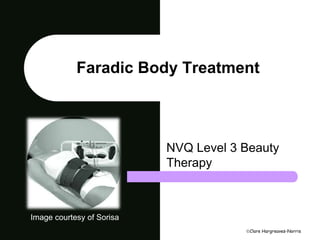
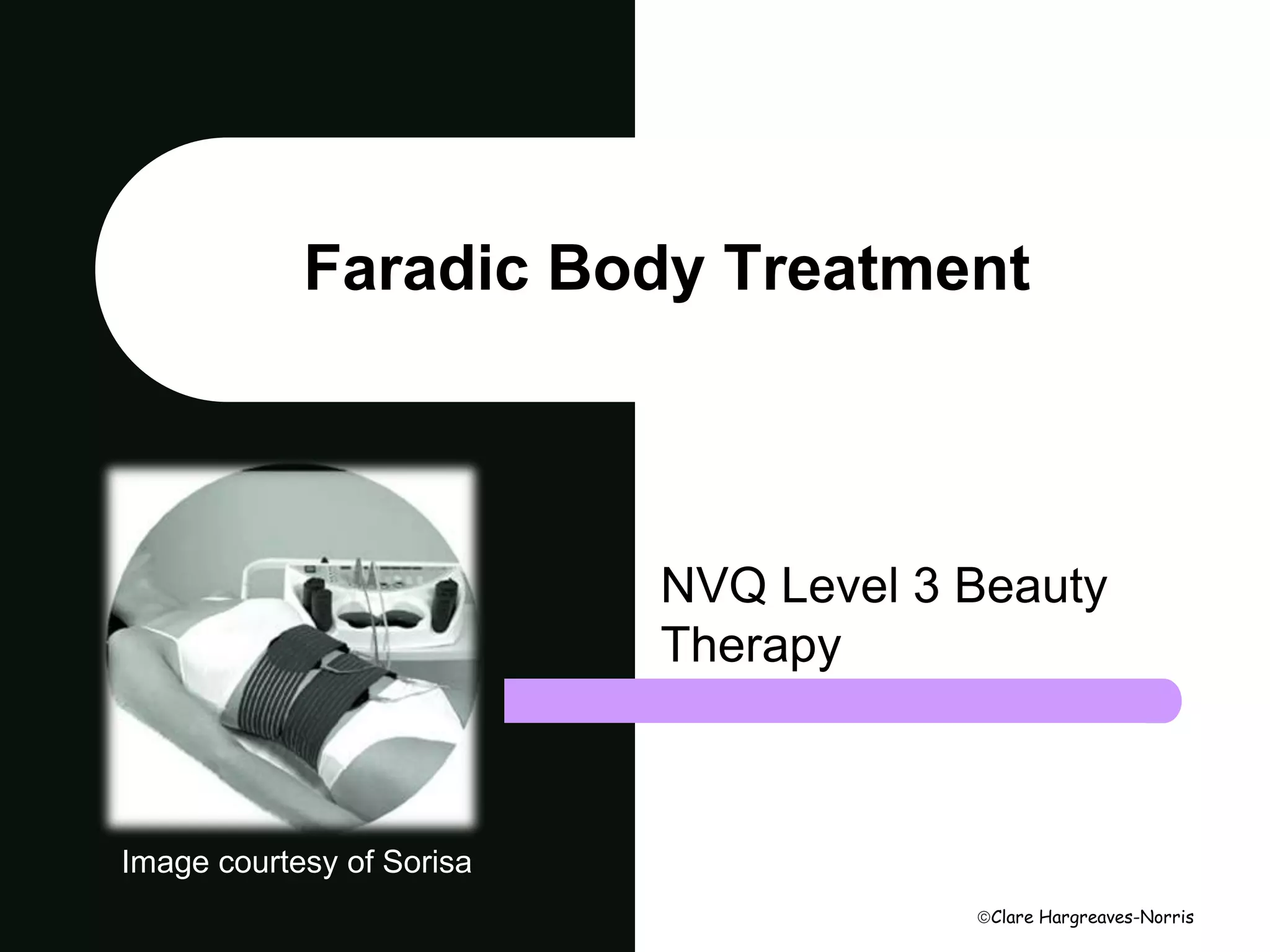
Image courtesy of Sorisa
Clare Hargreaves-Norris 
Introduction 
 The faradic treatment or electrical muscle stimulation (EMS) 
uses the application of electrical pulses, which are applied to 
stimulate the muscles to contract. 
 This results in a tightening and toning effect. 
 The result of the treatment will be that the client will lose inches 
rather than weight. 
 The treatment is usually applied for 30-40 minutes, however 
always refer to specific manufacturer’s instructions. 
 The client will usually attend 2-3 times per week for 4-6 weeks. 
Suggest that a maintenance treatment will then be required 
once every 2 weeks.
Firmer muscles without exercise? 
During the treatment the client does not have to 
participate, they simply relax; therefore, the treatment is 
classified as passive exercise. This treatment is a form of 
isometric exercise as there is no movement produced at 
the joints. 
For most people this is a dream come true, however you 
must reinforce to the client that they will need to attend 
the salon for treatments on a regular basis. In addition, 
the client should be advised to follow an appropriate body 
care routine, healthy eating plan and exercise programme 
Clare Hargreaves-Norris
How does the treatment work? 
 Muscles comprise of bundles of muscle fibres and there are 
many nerves that supply each muscle fibre. 
 These nerves create the movement in the muscle. 
 When the nerves are stimulated they cause the muscle fibres to 
shorten, therefore the muscle contracts and causes movement to 
occur. The nerves that create this movement are called motor 
nerves. 
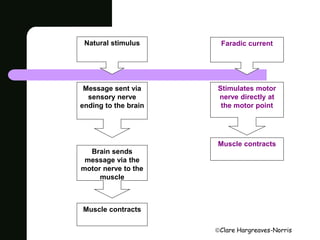
 Normally a muscle would contract in response to an impulse from 
the brain received via a sensory nerve, a message would then be 
sent to the motor nerve, which would cause the muscle to 
contract. 
 Stimulation by a faradic current activates the motor nerve directly 
to produce a contraction; basically it takes a short cut. 
Clare Hargreaves-Norris
Clare Hargreaves-Norris 
Natural stimulus 
Message sent via 
sensory nerve 
ending to the brain 
Brain sends 
message via the 
motor nerve to the 
muscle 
Muscle contracts 
Faradic current 
Stimulates motor 
nerve directly at 
the motor point 
Muscle contracts
Clare Hargreaves-Norris 
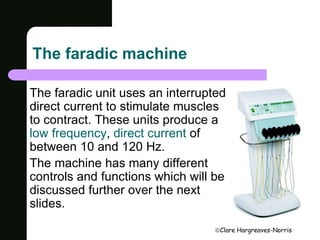
The faradic machine 
The faradic unit uses an interrupted 
direct current to stimulate muscles 
to contract. These units produce a 
low frequency, direct current of 
between 10 and 120 Hz. 
The machine has many different 
controls and functions which will be 
discussed further over the next 
slides.
Clare Hargreaves-Norris 
On/off switch 
Controls the current flow, usually a light will 
indicate if the current is flowing.
Clare Hargreaves-Norris 
Frequency control 
This controls the number of pulses per second. 
Frequency determines the strength of contraction at 
the motor point, and to produce a smooth 
contraction it should be set between 40-60 Hz. 
If the muscle is showing a tremor then you should 
increase the frequency, although there is nothing to 
be gained by working with a frequency over 80 Hz 
as the muscle would already be working at 
maximum force.
Clare Hargreaves-Norris 
Surge control 
Controls the length of time that the current is flowing 
i.e. the length of time the muscle contracts. 
When the current flows the muscle contracts, once 
the current stops flowing the muscle relaxes. 
The length of the current surge should be long 
enough to produce a good muscle contraction. 
This is normally set between ½ to 2 ½ seconds.
Clare Hargreaves-Norris 
Relaxation control 
Controls the rest time in-between the 
contractions. The rest period should be equal 
to, or longer than the stimulation period. 
This allows the muscles to relax fully and 
prevents muscle fatigue from occurring. 
However the rest period should not be too long 
as this would waste time.
Clare Hargreaves-Norris 
Phase control 
Offers the choice of a biphasic or monophasic 
pulse. The difference being that: 
 Monophasic - the current flows in one direction 
therefore the polarity of the pads remains the 
same. One pad will be -ve and one pad will be 
+ve, the cathode (negative) always produces the 
best response and so it is most beneficial to 
place this on the weaker muscle. This is most 
useful when using the split or duplicate padding 
techniques.
Clare Hargreaves-Norris 
Phase control 
 Biphasic - the current flows in both directions, 
therefore eliminating polarity and producing 
an even current under both pads. This is the 
most useful in the longitudinal padding 
technique.
Clare Hargreaves-Norris 
Mode control 
This controls the rhythms of the contractions: 
 Constant - the rhythm remains even, with the surge 
and interval remaining the same throughout the 
treatment. 
 Variable - the rhythm of the surge and interval is 
varied throughout the treatment. This is 
advantageous as it prevents the client anticipating 
the contraction and resisting it.
Clare Hargreaves-Norris 
Pulse width 
This alters the width of each pulse, by increasing 
the pulse width a similar effect is produced as if 
you were to increase the intensity control. 
Select 150-200 at the start of the treatment, and 
if the client cannot tolerate an increase in 
intensity, increase the pulse width to between 
200-300 to produce a better contraction.
Clare Hargreaves-Norris 
Intensity controls 
Adjust the amount of current flowing through 
each pair of electrodes. As the intensity control 
is turned up the amount of current flowing to 
each pad will be increased. 
The aim is to achieve a visibly smooth 
contraction that the client is comfortable with. 
Each set of pads has an intensity control dial.
Clare Hargreaves-Norris 
Master output 
This control increases the amount of current to 
all the outlets being used, it is an easier way to 
increase the intensity once the client has 
become used to the treatment.
Clare Hargreaves-Norris 
Electrodes 
The current is conducted from the machine to the 
muscle via the leads and electrodes. The electrodes 
used on the body are made of rubber impregnated 
with graphite or carbon, which are good conductors. 
The rubber is on the upper side and the conducting 
metal on the lower side, which comes into contact 
with the body. The electrodes are manufactured in 
pairs of various sizes and are usually round or square.
The uses of a faradic treatment 
 To re-educate muscles with poor tone due to 
disuse over a long period of time. 
 To firm body contours and maintain an attractive 
Clare Hargreaves-Norris 
figure. 
 To restore abdominal muscle tone after 
pregnancy. 
 To firm the pectoral muscles, assisting with the 
correction of sagging breasts. 
 To assist with inch loss in a specific area. 
 For figure reshaping, in-conjunction with 
exercise.
Restrictions to a faradic treatment 
In addition to the general contra-indications, the following 
will restrict: 
Clare Hargreaves-Norris 
 Pregnancy – do not treat 
 Immediately post pregnancy - doctors note 
 Muscular injury or spasm 
 Migraine 
 IUD in the uterus – avoid the abdomen 
 Over bony areas 
 Heart area 
 Phlebitis 
 Obese client - too much adipose tissue acts as an insulator 
and makes the treatment ineffective
Clare Hargreaves-Norris 
Padding techniques 
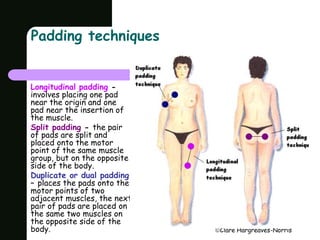
Longitudinal padding - 
involves placing one pad 
near the origin and one 
pad near the insertion of 
the muscle. 
Split padding - the pair 
of pads are split and 
placed onto the motor 
point of the same muscle 
group, but on the opposite 
side of the body. 
Duplicate or dual padding 
– places the pads onto the 
motor points of two 
adjacent muscles, the next 
pair of pads are placed on 
the same two muscles on 
the opposite side of the 
body.
Clare Hargreaves-Norris 
Longitudinal padding 
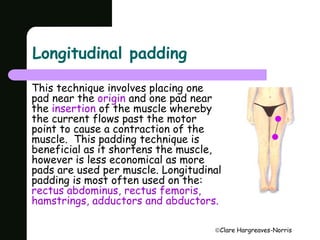
This technique involves placing one 
pad near the origin and one pad near 
the insertion of the muscle whereby 
the current flows past the motor 
point to cause a contraction of the 
muscle. This padding technique is 
beneficial as it shortens the muscle, 
however is less economical as more 
pads are used per muscle. Longitudinal 
padding is most often used on the: 
rectus abdominus, rectus femoris, 
hamstrings, adductors and abductors.
Clare Hargreaves-Norris 
Split padding 
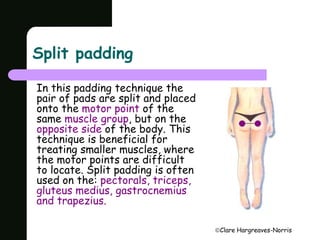
In this padding technique the 
pair of pads are split and placed 
onto the motor point of the 
same muscle group, but on the 
opposite side of the body. This 
technique is beneficial for 
treating smaller muscles, where 
the motor points are difficult 
to locate. Split padding is often 
used on the: pectorals, triceps, 
gluteus medius, gastrocnemius 
and trapezius.
Duplicate or dual padding 
Clare Hargreaves-Norris 
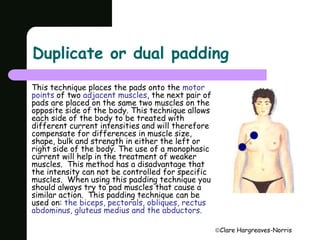
This technique places the pads onto the motor 
points of two adjacent muscles, the next pair of 
pads are placed on the same two muscles on the 
opposite side of the body. This technique allows 
each side of the body to be treated with 
different current intensities and will therefore 
compensate for differences in muscle size, 
shape, bulk and strength in either the left or 
right side of the body. The use of a monophasic 
current will help in the treatment of weaker 
muscles. This method has a disadvantage that 
the intensity can not be controlled for specific 
muscles. When using this padding technique you 
should always try to pad muscles that cause a 
similar action. This padding technique can be 
used on: the biceps, pectorals, obliques, rectus 
abdominus, gluteus medius and the abductors.
Considerations for padding techniques 
The main considerations you need to take into 
account when deciding on the padding technique 
are: 
 The areas of the body being treated and the 
Clare Hargreaves-Norris 
number of pads available 
 The shape or size of the muscle 
 Size of the body 
 Manufacturers instructions 
 Weaker muscles 
 The phase control being used
What are the reasons for poor 
muscle contraction? 
 If there is a grease on the client’s skin 
 The selected intensity is too low 
 Insufficient saline solution on the electrodes 
 Electrode pads are dirty 
 Incorrect positioning of the electrodes i.e. not 
Clare Hargreaves-Norris 
over the motor points 
 Loose leads in the terminals 
 Poor contact between the electrode pads and the 
skin 
 Too much adipose tissue in the area
Effects of a faradic treatment 
 Muscular contraction improves the tone of the muscle. 
 Blood supply to the muscles increases therefore improving the 
Clare Hargreaves-Norris 
functioning of the muscle fibres. 
 Speeds up the body’s metabolism, improving the muscle condition. 
 Sensory nerve endings are initially stimulated producing a tingling 
sensation at the beginning of the treatment. 
 Motor nerves are stimulated resulting in a muscular contraction. 
 Increased circulation brings fresh oxygen and nutrients to the 
muscles and removes waste products. 
 Waste products are more efficiently removed from the area. 
 Vasodilation of the blood vessels improves the colour of the skin 
under the pads. 
 Muscle contractions improve the lymphatic circulation in the area, 
which assists with the removal of waste products.
Clare Hargreaves-Norris 
Precautions 
In order to perform a safe and effective 
treatment the therapist must check that 
the client has normal skin sensation. This is 
ascertained by performing a sensitivity test 
on the client’s skin in the area being treated. 
Examples of sensitivity tests are: 
 Hot and cold - test tubes filled with hot and 
cold water 
 Hard and soft - orange stick and cotton wool
Can you think of other precautions 
that you would need to take? 
 Remember that not all muscles are of equal strength, you can not 
expect a smaller muscle group to be able to take the same intensity 
as a larger group of muscles. 
 Always check that all dials are at zero before applying the current. 
 Test the machine on yourself prior to application. 
 Turn the intensity up during the surge period only. 
 Avoid stimulating opposite muscle groups at the same time i.e. biceps 
Clare Hargreaves-Norris 
and triceps. 
 When the intensity is on do not try to move the pads. 
 Always check all controls before commencing treatment. 
 Avoid padding near to the heart. 
 Always strap the pads securely. 
 Always check the condition of the wires and pads before 
commencing. 
 Ensure the pads are moistened with saline solution or water.
Clare Hargreaves-Norris 
Muscle fatigue 
 Recognised as a muscle that fails to relax completely, causing 
the muscle to go into spasm, which generally results in some 
discomfort in the area. 
 This is due to over exercising of the muscles using a faradic 
type unit. 
 The blood flow is restricted to the muscle fibres as the blood 
can only flow through the capillaries when the muscle is relaxing. 
 The causes of muscle fatigue are lack of oxygen and nutrients 
to the muscle and the accumulation of waste products, mainly 
lactic acid. 
 If you continued to treat the client with a faradic unit it would 
cause severe muscle fatigue and the muscle may fail to work as 
it would become exhausted. It would also be very uncomfortable 
for the client. 
 Stop treatment immediately and massage the muscle to remove 
the waste products and lactic acid.
Clare Hargreaves-Norris 
Aftercare advice 
 The client should avoid exercise for the rest of 
the day. 
 Advise the client when to return for their next 
treatment – usually 2-3 times per week for 6 
weeks. 
 Discuss dietary advice. 
 Reinforce the importance of regular exercise. 
 Contra-action advice.

Faradic body treatment

  • 1.
    Faradic Body Treatment NVQ Level 3 Beauty Therapy Clare Hargreaves-Norris Image courtesy of Sorisa
  • 2.
    Clare Hargreaves-Norris Introduction  The faradic treatment or electrical muscle stimulation (EMS) uses the application of electrical pulses, which are applied to stimulate the muscles to contract.  This results in a tightening and toning effect.  The result of the treatment will be that the client will lose inches rather than weight.  The treatment is usually applied for 30-40 minutes, however always refer to specific manufacturer’s instructions.  The client will usually attend 2-3 times per week for 4-6 weeks. Suggest that a maintenance treatment will then be required once every 2 weeks.
  • 3.
    Firmer muscles withoutexercise? During the treatment the client does not have to participate, they simply relax; therefore, the treatment is classified as passive exercise. This treatment is a form of isometric exercise as there is no movement produced at the joints. For most people this is a dream come true, however you must reinforce to the client that they will need to attend the salon for treatments on a regular basis. In addition, the client should be advised to follow an appropriate body care routine, healthy eating plan and exercise programme Clare Hargreaves-Norris
  • 4.
    How does thetreatment work?  Muscles comprise of bundles of muscle fibres and there are many nerves that supply each muscle fibre.  These nerves create the movement in the muscle.  When the nerves are stimulated they cause the muscle fibres to shorten, therefore the muscle contracts and causes movement to occur. The nerves that create this movement are called motor nerves.  Normally a muscle would contract in response to an impulse from the brain received via a sensory nerve, a message would then be sent to the motor nerve, which would cause the muscle to contract.  Stimulation by a faradic current activates the motor nerve directly to produce a contraction; basically it takes a short cut. Clare Hargreaves-Norris
  • 5.
    Clare Hargreaves-Norris Naturalstimulus Message sent via sensory nerve ending to the brain Brain sends message via the motor nerve to the muscle Muscle contracts Faradic current Stimulates motor nerve directly at the motor point Muscle contracts
  • 6.
    Clare Hargreaves-Norris Thefaradic machine The faradic unit uses an interrupted direct current to stimulate muscles to contract. These units produce a low frequency, direct current of between 10 and 120 Hz. The machine has many different controls and functions which will be discussed further over the next slides.
  • 7.
    Clare Hargreaves-Norris On/offswitch Controls the current flow, usually a light will indicate if the current is flowing.
  • 8.
    Clare Hargreaves-Norris Frequencycontrol This controls the number of pulses per second. Frequency determines the strength of contraction at the motor point, and to produce a smooth contraction it should be set between 40-60 Hz. If the muscle is showing a tremor then you should increase the frequency, although there is nothing to be gained by working with a frequency over 80 Hz as the muscle would already be working at maximum force.
  • 9.
    Clare Hargreaves-Norris Surgecontrol Controls the length of time that the current is flowing i.e. the length of time the muscle contracts. When the current flows the muscle contracts, once the current stops flowing the muscle relaxes. The length of the current surge should be long enough to produce a good muscle contraction. This is normally set between ½ to 2 ½ seconds.
  • 10.
    Clare Hargreaves-Norris Relaxationcontrol Controls the rest time in-between the contractions. The rest period should be equal to, or longer than the stimulation period. This allows the muscles to relax fully and prevents muscle fatigue from occurring. However the rest period should not be too long as this would waste time.
  • 11.
    Clare Hargreaves-Norris Phasecontrol Offers the choice of a biphasic or monophasic pulse. The difference being that:  Monophasic - the current flows in one direction therefore the polarity of the pads remains the same. One pad will be -ve and one pad will be +ve, the cathode (negative) always produces the best response and so it is most beneficial to place this on the weaker muscle. This is most useful when using the split or duplicate padding techniques.
  • 12.
    Clare Hargreaves-Norris Phasecontrol  Biphasic - the current flows in both directions, therefore eliminating polarity and producing an even current under both pads. This is the most useful in the longitudinal padding technique.
  • 13.
    Clare Hargreaves-Norris Modecontrol This controls the rhythms of the contractions:  Constant - the rhythm remains even, with the surge and interval remaining the same throughout the treatment.  Variable - the rhythm of the surge and interval is varied throughout the treatment. This is advantageous as it prevents the client anticipating the contraction and resisting it.
  • 14.
    Clare Hargreaves-Norris Pulsewidth This alters the width of each pulse, by increasing the pulse width a similar effect is produced as if you were to increase the intensity control. Select 150-200 at the start of the treatment, and if the client cannot tolerate an increase in intensity, increase the pulse width to between 200-300 to produce a better contraction.
  • 15.
    Clare Hargreaves-Norris Intensitycontrols Adjust the amount of current flowing through each pair of electrodes. As the intensity control is turned up the amount of current flowing to each pad will be increased. The aim is to achieve a visibly smooth contraction that the client is comfortable with. Each set of pads has an intensity control dial.
  • 16.
    Clare Hargreaves-Norris Masteroutput This control increases the amount of current to all the outlets being used, it is an easier way to increase the intensity once the client has become used to the treatment.
  • 17.
    Clare Hargreaves-Norris Electrodes The current is conducted from the machine to the muscle via the leads and electrodes. The electrodes used on the body are made of rubber impregnated with graphite or carbon, which are good conductors. The rubber is on the upper side and the conducting metal on the lower side, which comes into contact with the body. The electrodes are manufactured in pairs of various sizes and are usually round or square.
  • 18.
    The uses ofa faradic treatment  To re-educate muscles with poor tone due to disuse over a long period of time.  To firm body contours and maintain an attractive Clare Hargreaves-Norris figure.  To restore abdominal muscle tone after pregnancy.  To firm the pectoral muscles, assisting with the correction of sagging breasts.  To assist with inch loss in a specific area.  For figure reshaping, in-conjunction with exercise.
  • 19.
    Restrictions to afaradic treatment In addition to the general contra-indications, the following will restrict: Clare Hargreaves-Norris  Pregnancy – do not treat  Immediately post pregnancy - doctors note  Muscular injury or spasm  Migraine  IUD in the uterus – avoid the abdomen  Over bony areas  Heart area  Phlebitis  Obese client - too much adipose tissue acts as an insulator and makes the treatment ineffective
  • 20.
    Clare Hargreaves-Norris Paddingtechniques Longitudinal padding - involves placing one pad near the origin and one pad near the insertion of the muscle. Split padding - the pair of pads are split and placed onto the motor point of the same muscle group, but on the opposite side of the body. Duplicate or dual padding – places the pads onto the motor points of two adjacent muscles, the next pair of pads are placed on the same two muscles on the opposite side of the body.
  • 21.
    Clare Hargreaves-Norris Longitudinalpadding This technique involves placing one pad near the origin and one pad near the insertion of the muscle whereby the current flows past the motor point to cause a contraction of the muscle. This padding technique is beneficial as it shortens the muscle, however is less economical as more pads are used per muscle. Longitudinal padding is most often used on the: rectus abdominus, rectus femoris, hamstrings, adductors and abductors.
  • 22.
    Clare Hargreaves-Norris Splitpadding In this padding technique the pair of pads are split and placed onto the motor point of the same muscle group, but on the opposite side of the body. This technique is beneficial for treating smaller muscles, where the motor points are difficult to locate. Split padding is often used on the: pectorals, triceps, gluteus medius, gastrocnemius and trapezius.
  • 23.
    Duplicate or dualpadding Clare Hargreaves-Norris This technique places the pads onto the motor points of two adjacent muscles, the next pair of pads are placed on the same two muscles on the opposite side of the body. This technique allows each side of the body to be treated with different current intensities and will therefore compensate for differences in muscle size, shape, bulk and strength in either the left or right side of the body. The use of a monophasic current will help in the treatment of weaker muscles. This method has a disadvantage that the intensity can not be controlled for specific muscles. When using this padding technique you should always try to pad muscles that cause a similar action. This padding technique can be used on: the biceps, pectorals, obliques, rectus abdominus, gluteus medius and the abductors.
  • 24.
    Considerations for paddingtechniques The main considerations you need to take into account when deciding on the padding technique are:  The areas of the body being treated and the Clare Hargreaves-Norris number of pads available  The shape or size of the muscle  Size of the body  Manufacturers instructions  Weaker muscles  The phase control being used
  • 25.
    What are thereasons for poor muscle contraction?  If there is a grease on the client’s skin  The selected intensity is too low  Insufficient saline solution on the electrodes  Electrode pads are dirty  Incorrect positioning of the electrodes i.e. not Clare Hargreaves-Norris over the motor points  Loose leads in the terminals  Poor contact between the electrode pads and the skin  Too much adipose tissue in the area
  • 26.
    Effects of afaradic treatment  Muscular contraction improves the tone of the muscle.  Blood supply to the muscles increases therefore improving the Clare Hargreaves-Norris functioning of the muscle fibres.  Speeds up the body’s metabolism, improving the muscle condition.  Sensory nerve endings are initially stimulated producing a tingling sensation at the beginning of the treatment.  Motor nerves are stimulated resulting in a muscular contraction.  Increased circulation brings fresh oxygen and nutrients to the muscles and removes waste products.  Waste products are more efficiently removed from the area.  Vasodilation of the blood vessels improves the colour of the skin under the pads.  Muscle contractions improve the lymphatic circulation in the area, which assists with the removal of waste products.
  • 27.
    Clare Hargreaves-Norris Precautions In order to perform a safe and effective treatment the therapist must check that the client has normal skin sensation. This is ascertained by performing a sensitivity test on the client’s skin in the area being treated. Examples of sensitivity tests are:  Hot and cold - test tubes filled with hot and cold water  Hard and soft - orange stick and cotton wool
  • 28.
    Can you thinkof other precautions that you would need to take?  Remember that not all muscles are of equal strength, you can not expect a smaller muscle group to be able to take the same intensity as a larger group of muscles.  Always check that all dials are at zero before applying the current.  Test the machine on yourself prior to application.  Turn the intensity up during the surge period only.  Avoid stimulating opposite muscle groups at the same time i.e. biceps Clare Hargreaves-Norris and triceps.  When the intensity is on do not try to move the pads.  Always check all controls before commencing treatment.  Avoid padding near to the heart.  Always strap the pads securely.  Always check the condition of the wires and pads before commencing.  Ensure the pads are moistened with saline solution or water.
  • 29.
    Clare Hargreaves-Norris Musclefatigue  Recognised as a muscle that fails to relax completely, causing the muscle to go into spasm, which generally results in some discomfort in the area.  This is due to over exercising of the muscles using a faradic type unit.  The blood flow is restricted to the muscle fibres as the blood can only flow through the capillaries when the muscle is relaxing.  The causes of muscle fatigue are lack of oxygen and nutrients to the muscle and the accumulation of waste products, mainly lactic acid.  If you continued to treat the client with a faradic unit it would cause severe muscle fatigue and the muscle may fail to work as it would become exhausted. It would also be very uncomfortable for the client.  Stop treatment immediately and massage the muscle to remove the waste products and lactic acid.
  • 30.
    Clare Hargreaves-Norris Aftercareadvice  The client should avoid exercise for the rest of the day.  Advise the client when to return for their next treatment – usually 2-3 times per week for 6 weeks.  Discuss dietary advice.  Reinforce the importance of regular exercise.  Contra-action advice.