HEAD INJURY - DEFINITION
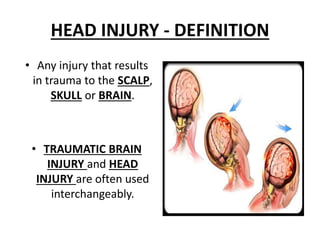
• Any injury that results
in trauma to the SCALP,
SKULL or BRAIN.
• TRAUMATIC BRAIN
INJURY and HEAD
INJURY are often used
interchangeably.
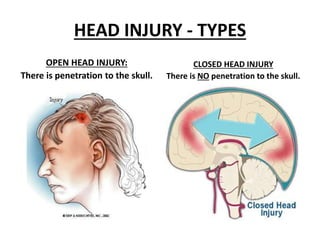
HEAD INJURY - TYPES
OPEN HEAD INJURY:
There is penetration to the skull.
CLOSED HEAD INJURY
There is NO penetration to the skull.
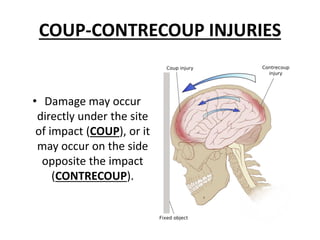
COUP-CONTRECOUP INJURIES
• Damage may occur
directly under the site
of impact (COUP), or it
may occur on the side
opposite the impact
(CONTRECOUP).
HEAD INJURY - MECHANISMS
PRIMARY INTRACRANIAL INJURY
• It is the initial neuronal
damage that occurs
IMMEDIATELY as result of
trauma.
SECONDARY INTRACRANIAL
INJURY
• Secondary injuries are the
result of the
neurophysiological and
anatomic changes, which
occur from MINUTES to
DAYS after the original
trauma.
HEAD INJURY - MECHANISMS
PRIMARY INTRACRANIAL INJURY
• Cerebral Laceration
• Cerebral Contusion
• Epidural Hematoma
• Subdural Hematoma
• Subarachnoid Hematoma
• Intracerebral Hematoma
• Diffuse Axonal Injury
SECONDARY INTRACRANIAL
INJURY
• Edema
• Impaired Metabolism
• Altered Cerebral Blood Flow
• Free Radical Formation
• Excitotoxicity
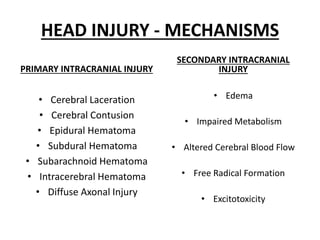
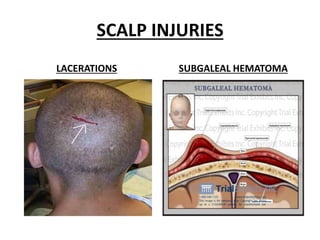
SCALP INJURIES
LACERATIONS SUBGALEAL HEMATOMA
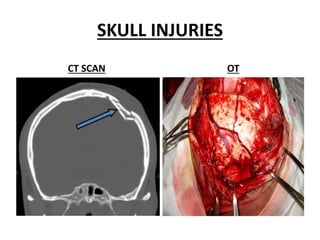
SKULL INJURIES
CT SCAN OT
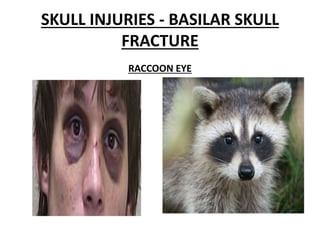
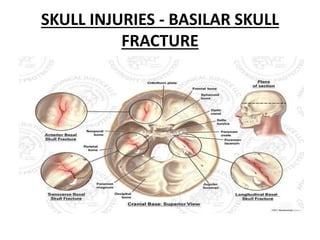
SKULL INJURIES - BASILAR SKULL
FRACTURE
RACCOON EYE
SKULL INJURIES - BASILAR SKULL
FRACTURE
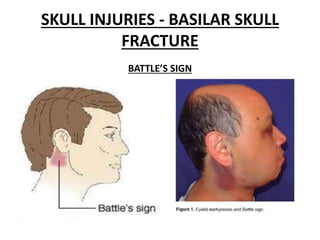
SKULL INJURIES - BASILAR SKULL
FRACTURE
BATTLE’S SIGN
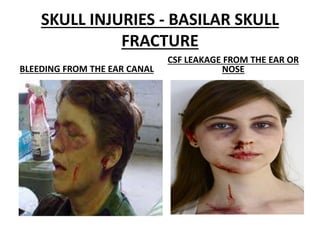
SKULL INJURIES - BASILAR SKULL
FRACTURE
BLEEDING FROM THE EAR CANAL
CSF LEAKAGE FROM THE EAR OR
NOSE
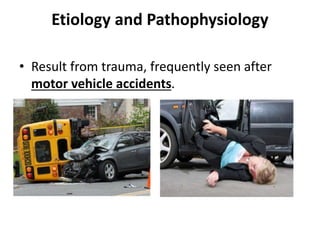
Etiology and Pathophysiology
• Result from trauma, frequently seen after
motor vehicle accidents.
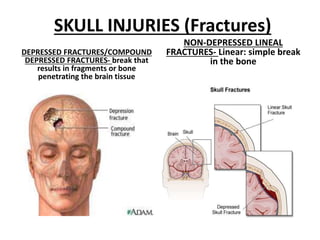
SKULL INJURIES (Fractures)
DEPRESSED FRACTURES/COMPOUND
DEPRESSED FRACTURES- break that
results in fragments or bone
penetrating the brain tissue
NON-DEPRESSED LINEAL
FRACTURES- Linear: simple break
in the bone
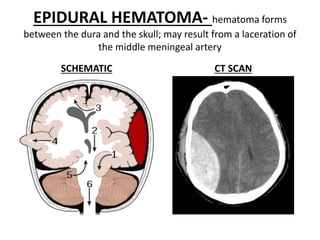
EPIDURAL HEMATOMA- hematoma forms
between the dura and the skull; may result from a laceration of
the middle meningeal artery
SCHEMATIC CT SCAN
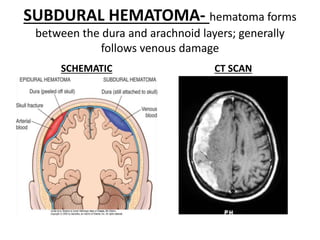
SUBDURAL HEMATOMA- hematoma forms
between the dura and arachnoid layers; generally
follows venous damage
SCHEMATIC CT SCAN
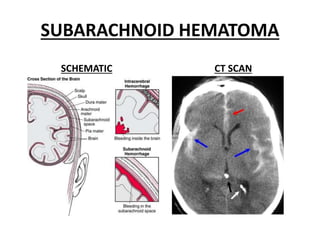
SUBARACHNOID HEMATOMA
SCHEMATIC CT SCAN
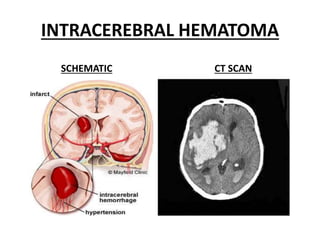
INTRACEREBRAL HEMATOMA
SCHEMATIC CT SCAN
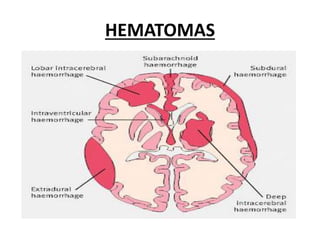
HEMATOMAS
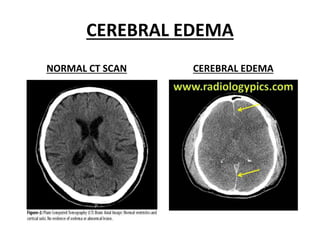
CEREBRAL EDEMA
NORMAL CT SCAN CEREBRAL EDEMA
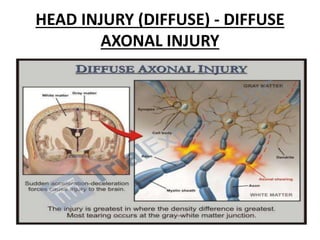
HEAD INJURY (DIFFUSE) - DIFFUSE
AXONAL INJURY
HEAD INJURY (DIFFUSE) -
CONCUSSION
• Temporary disruption of
synaptic activity
• Brain injury that does not
result in any evidence of
structural alteration.
• Return of consciousness
moments or minutes
after impact.
• There may be brief
confusion, disorientation,
headache, dizziness,
amnesia.
• CT scan is normal.
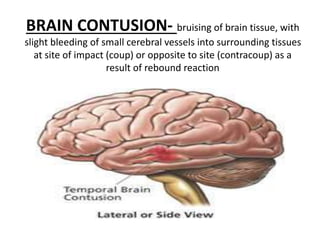
BRAIN CONTUSION- bruising of brain tissue, with
slight bleeding of small cerebral vessels into surrounding tissues
at site of impact (coup) or opposite to site (contracoup) as a
result of rebound reaction
SIGNS
Subjective
• Lethargy
• Indifference to surroundings
• Altered sensory function (e.g. visual or
auditory)
SIGNS
Objective:
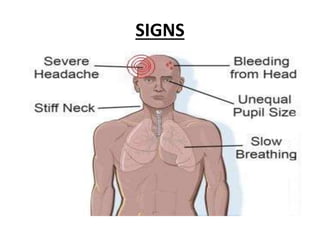
A sign of ↑ICP
(INTRACRANIAL PRESSURE)
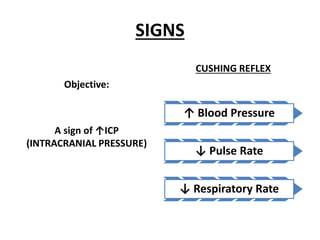
CUSHING REFLEX
↑ Blood Pressure
↓ Pulse Rate
↓ Respiratory Rate
SIGNS
• Lack of orientation to time and place
• Restlessness
• Labored respirations
• Positive Babinski sign (stroking bottom of the
foot causes dorsiflexion of the toes)
• Decreased level of consciousness
SIGNS
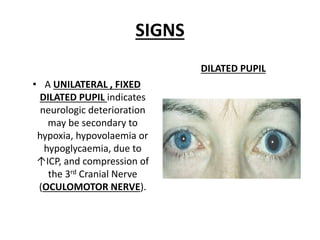
• A UNILATERAL , FIXED
DILATED PUPIL indicates
neurologic deterioration
may be secondary to
hypoxia, hypovolaemia or
hypoglycaemia, due to
↑ICP, and compression of
the 3rd Cranial Nerve
(OCULOMOTOR NERVE).
DILATED PUPIL
SIGNS
SIGNS
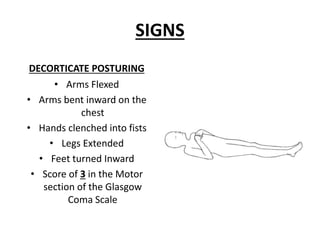
DECORTICATE POSTURING
• Arms Flexed
• Arms bent inward on the
chest
• Hands clenched into fists
• Legs Extended
• Feet turned Inward
• Score of 3 in the Motor
section of the Glasgow
Coma Scale
SIGNS
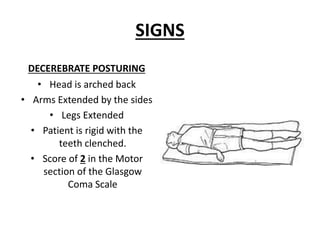
DECEREBRATE POSTURING
• Head is arched back
• Arms Extended by the sides
• Legs Extended
• Patient is rigid with the
teeth clenched.
• Score of 2 in the Motor
section of the Glasgow
Coma Scale
SYMPTOMS
• Confusion/Irritibility
• Drowsiness
• Dizziness
• Nausea & Vomiting
• Amnesia
• Speech/Swallowing
Difficulty
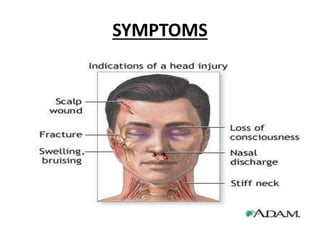
• CSF Leakage
• Ear Bleeding
• Numbness/Paralysis
• Coma
SYMPTOMS
Therapeutic Interventions
• Control seizures with anticonvulsants
• Mechanical ventilation; hyperventilation will
constrict cerebral vessels lowering ICP
• Reduce cerebral edema with glucocorticoids and
loop diuretics; there is disagreement regarding
their efficacy
• Maintain adequate fluid and electrolyte balance
• Surgical intervention in cases of depressed skull
fractures or hematomas
NURSING CARE
Assessment
1. Airway and breathing pattern
• Neurologic status
• Cranial Nerves
• Muscle Tone
• Muscle Power
• Sensations
• Walking Gait
3. Signs of increased intracranial pressure
4. Circumstances of injury
5. Presence of glucose in clear drainage from
nose or ear, which indicates cerebrospinal fluid
DIAGNOSIS - PHYSICAL EXAMINATION
ABCDE
• A = AIRWAY
• B = BREATHING
• C = CIRCULATION
• D = DISABILITY
• E = EXPOSURE
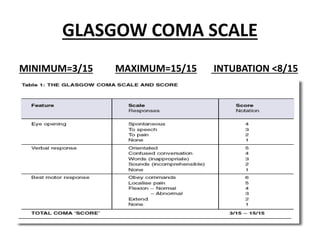
• GLASGOW COMA SCALE
(GCS)
GLASGOW COMA SCALE
MINIMUM=3/15 MAXIMUM=15/15 INTUBATION <8/15
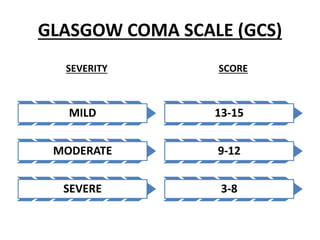
GLASGOW COMA SCALE (GCS)
SEVERITY SCORE
13-15
9-12
3-8
MILD
MODERATE
SEVERE
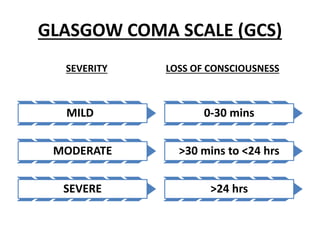
GLASGOW COMA SCALE (GCS)
SEVERITY LOSS OF CONSCIOUSNESS
0-30 mins
>30 mins to <24 hrs
>24 hrs
MILD
MODERATE
SEVERE
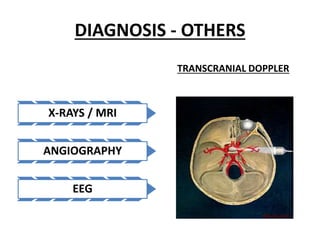
DIAGNOSIS - OTHERS
X-RAYS / MRI
ANGIOGRAPHY
EEG
TRANSCRANIAL DOPPLER
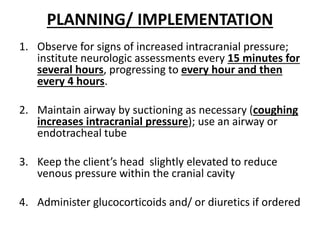
PLANNING/ IMPLEMENTATION
1. Observe for signs of increased intracranial pressure;
institute neurologic assessments every 15 minutes for
several hours, progressing to every hour and then
every 4 hours.
2. Maintain airway by suctioning as necessary (coughing
increases intracranial pressure); use an airway or
endotracheal tube
3. Keep the client’s head slightly elevated to reduce
venous pressure within the cranial cavity
4. Administer glucocorticoids and/ or diuretics if ordered
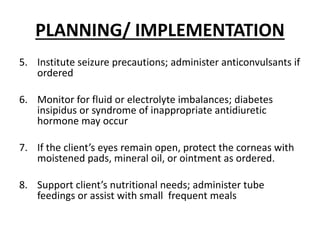
PLANNING/ IMPLEMENTATION
5. Institute seizure precautions; administer anticonvulsants if
ordered
6. Monitor for fluid or electrolyte imbalances; diabetes
insipidus or syndrome of inappropriate antidiuretic
hormone may occur
7. If the client’s eyes remain open, protect the corneas with
moistened pads, mineral oil, or ointment as ordered.
8. Support client’s nutritional needs; administer tube
feedings or assist with small frequent meals
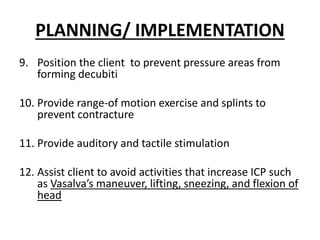
PLANNING/ IMPLEMENTATION
9. Position the client to prevent pressure areas from
forming decubiti
10. Provide range-of motion exercise and splints to
prevent contracture
11. Provide auditory and tactile stimulation
12. Assist client to avoid activities that increase ICP such
as Vasalva’s maneuver, lifting, sneezing, and flexion of
head
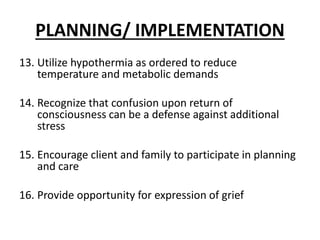
PLANNING/ IMPLEMENTATION
13. Utilize hypothermia as ordered to reduce
temperature and metabolic demands
14. Recognize that confusion upon return of
consciousness can be a defense against additional
stress
15. Encourage client and family to participate in planning
and care
16. Provide opportunity for expression of grief
TREATMENT - ACUTE STAGE
(DISABILITY)
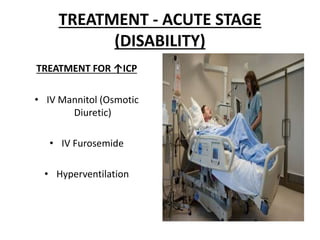
TREATMENT FOR ↑ICP
• IV Mannitol (Osmotic
Diuretic)
• IV Furosemide
• Hyperventilation
TREATMENT - ACUTE STAGE
(DISABILITY)
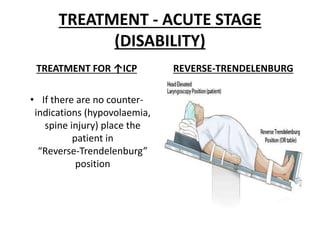
TREATMENT FOR ↑ICP
• If there are no counter-
indications (hypovolaemia,
spine injury) place the
patient in
“Reverse-Trendelenburg”
position
REVERSE-TRENDELENBURG
TREATMENT - ACUTE STAGE
(PARAMETERS)
MONITOR
• Blood Pressure
• Heart Rate
• Respiratory Rate
• S02, Etc02
• ECG
BLOOD SAMPLES
• Serum Electrolytes
• Arterial Blood Gas
• Hyper/Hypoglycaemia
TREATMENT - ACUTE STAGE
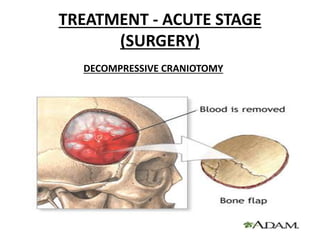
(SURGERY)
DECOMPRESSIVE CRANIOTOMY
Evaluation/ Outcomes
1. Maintains a patent airway
2. Improves level of consciousness
3. Remains free from injury
4. Participate in decisions about administration of
care
5. Maintains ideal body weight for age and frame
6. Identifies new coping skills to deal with changes
in life-style

Head injuries

  • 2.
    HEAD INJURY -DEFINITION • Any injury that results in trauma to the SCALP, SKULL or BRAIN. • TRAUMATIC BRAIN INJURY and HEAD INJURY are often used interchangeably.
  • 3.
    HEAD INJURY -TYPES OPEN HEAD INJURY: There is penetration to the skull. CLOSED HEAD INJURY There is NO penetration to the skull.
  • 4.
    COUP-CONTRECOUP INJURIES • Damagemay occur directly under the site of impact (COUP), or it may occur on the side opposite the impact (CONTRECOUP).
  • 5.
    HEAD INJURY -MECHANISMS PRIMARY INTRACRANIAL INJURY • It is the initial neuronal damage that occurs IMMEDIATELY as result of trauma. SECONDARY INTRACRANIAL INJURY • Secondary injuries are the result of the neurophysiological and anatomic changes, which occur from MINUTES to DAYS after the original trauma.
  • 6.
    HEAD INJURY -MECHANISMS PRIMARY INTRACRANIAL INJURY • Cerebral Laceration • Cerebral Contusion • Epidural Hematoma • Subdural Hematoma • Subarachnoid Hematoma • Intracerebral Hematoma • Diffuse Axonal Injury SECONDARY INTRACRANIAL INJURY • Edema • Impaired Metabolism • Altered Cerebral Blood Flow • Free Radical Formation • Excitotoxicity
  • 7.
  • 8.
  • 9.
    SKULL INJURIES -BASILAR SKULL FRACTURE RACCOON EYE
  • 10.
    SKULL INJURIES -BASILAR SKULL FRACTURE
  • 11.
    SKULL INJURIES -BASILAR SKULL FRACTURE BATTLE’S SIGN
  • 12.
    SKULL INJURIES -BASILAR SKULL FRACTURE BLEEDING FROM THE EAR CANAL CSF LEAKAGE FROM THE EAR OR NOSE
  • 13.
    Etiology and Pathophysiology •Result from trauma, frequently seen after motor vehicle accidents.
  • 14.
    SKULL INJURIES (Fractures) DEPRESSEDFRACTURES/COMPOUND DEPRESSED FRACTURES- break that results in fragments or bone penetrating the brain tissue NON-DEPRESSED LINEAL FRACTURES- Linear: simple break in the bone
  • 15.
    EPIDURAL HEMATOMA- hematomaforms between the dura and the skull; may result from a laceration of the middle meningeal artery SCHEMATIC CT SCAN
  • 16.
    SUBDURAL HEMATOMA- hematomaforms between the dura and arachnoid layers; generally follows venous damage SCHEMATIC CT SCAN
  • 17.
  • 18.
  • 19.
  • 20.
    CEREBRAL EDEMA NORMAL CTSCAN CEREBRAL EDEMA
  • 21.
    HEAD INJURY (DIFFUSE)- DIFFUSE AXONAL INJURY
  • 22.
    HEAD INJURY (DIFFUSE)- CONCUSSION • Temporary disruption of synaptic activity • Brain injury that does not result in any evidence of structural alteration. • Return of consciousness moments or minutes after impact. • There may be brief confusion, disorientation, headache, dizziness, amnesia. • CT scan is normal.
  • 23.
    BRAIN CONTUSION- bruisingof brain tissue, with slight bleeding of small cerebral vessels into surrounding tissues at site of impact (coup) or opposite to site (contracoup) as a result of rebound reaction
  • 24.
    SIGNS Subjective • Lethargy • Indifferenceto surroundings • Altered sensory function (e.g. visual or auditory)
  • 25.
    SIGNS Objective: A sign of↑ICP (INTRACRANIAL PRESSURE) CUSHING REFLEX ↑ Blood Pressure ↓ Pulse Rate ↓ Respiratory Rate
  • 26.
    SIGNS • Lack oforientation to time and place • Restlessness • Labored respirations • Positive Babinski sign (stroking bottom of the foot causes dorsiflexion of the toes) • Decreased level of consciousness
  • 27.
    SIGNS • A UNILATERAL, FIXED DILATED PUPIL indicates neurologic deterioration may be secondary to hypoxia, hypovolaemia or hypoglycaemia, due to ↑ICP, and compression of the 3rd Cranial Nerve (OCULOMOTOR NERVE). DILATED PUPIL
  • 28.
  • 29.
    SIGNS DECORTICATE POSTURING • ArmsFlexed • Arms bent inward on the chest • Hands clenched into fists • Legs Extended • Feet turned Inward • Score of 3 in the Motor section of the Glasgow Coma Scale
  • 30.
    SIGNS DECEREBRATE POSTURING • Headis arched back • Arms Extended by the sides • Legs Extended • Patient is rigid with the teeth clenched. • Score of 2 in the Motor section of the Glasgow Coma Scale
  • 31.
    SYMPTOMS • Confusion/Irritibility • Drowsiness •Dizziness • Nausea & Vomiting • Amnesia • Speech/Swallowing Difficulty • CSF Leakage • Ear Bleeding • Numbness/Paralysis • Coma
  • 32.
  • 33.
    Therapeutic Interventions • Controlseizures with anticonvulsants • Mechanical ventilation; hyperventilation will constrict cerebral vessels lowering ICP • Reduce cerebral edema with glucocorticoids and loop diuretics; there is disagreement regarding their efficacy • Maintain adequate fluid and electrolyte balance • Surgical intervention in cases of depressed skull fractures or hematomas
  • 34.
    NURSING CARE Assessment 1. Airwayand breathing pattern • Neurologic status • Cranial Nerves • Muscle Tone • Muscle Power • Sensations • Walking Gait
  • 35.
    3. Signs ofincreased intracranial pressure 4. Circumstances of injury 5. Presence of glucose in clear drainage from nose or ear, which indicates cerebrospinal fluid
  • 36.
    DIAGNOSIS - PHYSICALEXAMINATION ABCDE • A = AIRWAY • B = BREATHING • C = CIRCULATION • D = DISABILITY • E = EXPOSURE • GLASGOW COMA SCALE (GCS)
  • 37.
    GLASGOW COMA SCALE MINIMUM=3/15MAXIMUM=15/15 INTUBATION <8/15
  • 38.
    GLASGOW COMA SCALE(GCS) SEVERITY SCORE 13-15 9-12 3-8 MILD MODERATE SEVERE
  • 39.
    GLASGOW COMA SCALE(GCS) SEVERITY LOSS OF CONSCIOUSNESS 0-30 mins >30 mins to <24 hrs >24 hrs MILD MODERATE SEVERE
  • 40.
    DIAGNOSIS - OTHERS X-RAYS/ MRI ANGIOGRAPHY EEG TRANSCRANIAL DOPPLER
  • 41.
    PLANNING/ IMPLEMENTATION 1. Observefor signs of increased intracranial pressure; institute neurologic assessments every 15 minutes for several hours, progressing to every hour and then every 4 hours. 2. Maintain airway by suctioning as necessary (coughing increases intracranial pressure); use an airway or endotracheal tube 3. Keep the client’s head slightly elevated to reduce venous pressure within the cranial cavity 4. Administer glucocorticoids and/ or diuretics if ordered
  • 42.
    PLANNING/ IMPLEMENTATION 5. Instituteseizure precautions; administer anticonvulsants if ordered 6. Monitor for fluid or electrolyte imbalances; diabetes insipidus or syndrome of inappropriate antidiuretic hormone may occur 7. If the client’s eyes remain open, protect the corneas with moistened pads, mineral oil, or ointment as ordered. 8. Support client’s nutritional needs; administer tube feedings or assist with small frequent meals
  • 43.
    PLANNING/ IMPLEMENTATION 9. Positionthe client to prevent pressure areas from forming decubiti 10. Provide range-of motion exercise and splints to prevent contracture 11. Provide auditory and tactile stimulation 12. Assist client to avoid activities that increase ICP such as Vasalva’s maneuver, lifting, sneezing, and flexion of head
  • 44.
    PLANNING/ IMPLEMENTATION 13. Utilizehypothermia as ordered to reduce temperature and metabolic demands 14. Recognize that confusion upon return of consciousness can be a defense against additional stress 15. Encourage client and family to participate in planning and care 16. Provide opportunity for expression of grief
  • 45.
    TREATMENT - ACUTESTAGE (DISABILITY) TREATMENT FOR ↑ICP • IV Mannitol (Osmotic Diuretic) • IV Furosemide • Hyperventilation
  • 46.
    TREATMENT - ACUTESTAGE (DISABILITY) TREATMENT FOR ↑ICP • If there are no counter- indications (hypovolaemia, spine injury) place the patient in “Reverse-Trendelenburg” position REVERSE-TRENDELENBURG
  • 47.
    TREATMENT - ACUTESTAGE (PARAMETERS) MONITOR • Blood Pressure • Heart Rate • Respiratory Rate • S02, Etc02 • ECG BLOOD SAMPLES • Serum Electrolytes • Arterial Blood Gas • Hyper/Hypoglycaemia
  • 48.
    TREATMENT - ACUTESTAGE (SURGERY) DECOMPRESSIVE CRANIOTOMY
  • 49.
    Evaluation/ Outcomes 1. Maintainsa patent airway 2. Improves level of consciousness 3. Remains free from injury 4. Participate in decisions about administration of care 5. Maintains ideal body weight for age and frame 6. Identifies new coping skills to deal with changes in life-style