Quality Management
System
Topic : McKinsey 7s Model
Presented By: Mohini Tawade
Under The guidance Of : Dr. Sudhir Pandya
Department: Quality Assurance
Dr. D.Y. Patil College of
Pharmacy , Akurdi
Introduction
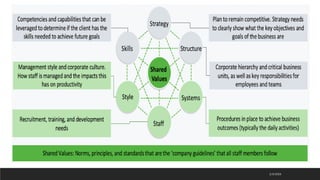
The McKinsey 7-S model is a useful tool that can be used to diagnose
and solve organisational problems. It depicts an organisation as a
collection of seven interconnected elements: structure, strategy,
systems, staff, skills, style and shared values. By considering how
each of these elements impacts on the others, it is possible to take a
holistic approach to organisational change.
2/3/2023
Background
McKinsey 7s model was developed in 1980s by McKinsey
consultants Tom Peters, Robert Waterman and Julien Philips
with a help from Richard Pascale and Anthony G. Athos. Since
the introduction, the model has been widely used by academics and
practitioners and remains one of the most popular strategic planning
tools. It sought to present an emphasis on human resources rather
than the traditional mass production tangibles of capital,
infrastructure and equipment, as a key to higher organizational
performance.
2/3/2023
The 7S model is a strategic model that can be used for any of the
following purposes
A. Organizational alignment or performance improvement
B. Understanding the core and most influential factors in an organization’s strategy
C. Determining how best to realign an organization to a new strategy or other
organization design
D. Examining the current workings and relations an organization exhibits
2/3/2023
2/3/2023
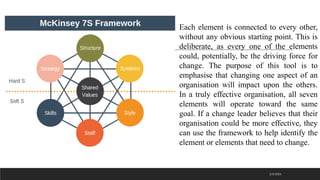
Each element is connected to every other,
without any obvious starting point. This is
deliberate, as every one of the elements
could, potentially, be the driving force for
change. The purpose of this tool is to
emphasise that changing one aspect of an
organisation will impact upon the others.
In a truly effective organisation, all seven
elements will operate toward the same
goal. If a change leader believes that their
organisation could be more effective, they
can use the framework to help identify the
element or elements that need to change.
2/3/2023
2/3/2023
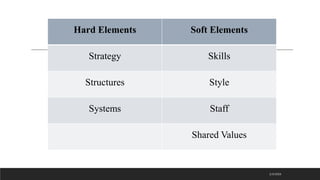
Hard Elements Soft Elements
Strategy Skills
Structures Style
Systems Staff
Shared Values
Hard elements
Hard elements are easy to identify and describe. They are the foundation of any
organisation and can be used to describe its management structure, processes and
objectives. They tend to be recorded and referenced in corporate documents like
statements, strategy reports and organisational charts.
➢Structure: The way in which an organisation's activities are managed. In small
businesses, this might be a traditional hierarchy. In larger organisations, this is more
likely to be a divisional or matrix structure, where different managers have varying
areas of responsibility.
2/3/2023
➢Strategy: The plan an organisation has to achieve its objectives. This is a dynamic
element, in that it changes all the time in response to outside factors like
competition, demand and technological innovations.
➢Systems: The processes an organisation has in place. This includes information
systems, as well as financial procedures, legal policy, risk assessment, health and
safety, pay and benefits. In short, all the systems that direct organisational activity.
2/3/2023
Soft Elements
The four soft Ss are often difficult to identify, and constantly evolve. It can be hard to put them
into words and they sometimes overlap with one another. However, they are no less important to
an organisation undergoing a period of change. They are:
➢Style: the organisational culture, usually described as 'the way things are done around here'. This
also includes individual management and leadership styles.
➢Staff: the people in the organisation, their talents and the way they are developed.
➢Skills: the competencies and capabilities of the organisation and its people.
➢Shared Values: the guiding principles that direct the organisation's behaviour. These were
originally referred to as 'superordinate goals' and are often unwritten. Examples of shared values
might include great customer service, constant innovation or honesty.
2/3/2023
Questions to assess each elements?
Strategy
What is the organization’s strategy seeking to accomplish?
How does the organization plan to use its resources and capabilities to deliver that?
What is distinct about this organization?
How does the organization compete?
How does the organization adapt to changing market conditions?
2/3/2023
Structure
How is the organization organized?
What are the reporting and working relationships (hierarchical, flat, silos, etc.)?
How do the employees align themselves to the strategy?
How are decisions made?
Is it based off of centralization, empowerment, decentralization or other
approaches?
How is information shared (formal and informal channels) across the organization?
2/3/2023
Systems
What are the primary business and technical systems that drive the organization?
What and where are the system controls?
How is progress and evolution tracked?
What internal rules and processes does the team utilize to maintain course?
2/3/2023
Shared Values
What is the mission of the organization?
What is the vision to get there?
What are the ideal versus real values?
How do the values play out in daily life?
What are the founding values that the organization was built upon?
2/3/2023
Style
What is the management/leadership style like? How do they behave?
How do employees respond to management/leadership?
Do employees function competitively, collaboratively, or cooperatively?
Are there real teams functioning within the organization or are they just nominal
groups?
What behaviors, tasks and deliverables does management/leadership reward?
2/3/2023
Staff
What is the size of the organization?
What are the staffing needs?
Are there gaps in required capabilities or resources?
What is the plan to address those needs?
2/3/2023
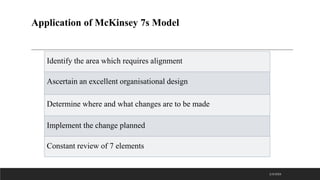
Application of McKinsey 7s Model
2/3/2023
Identify the area which requires alignment
Ascertain an excellent organisational design
Determine where and what changes are to be made
Implement the change planned
Constant review of 7 elements
2/3/2023
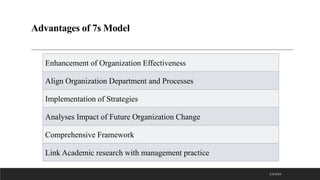
Advantages of 7s Model
Enhancement of Organization Effectiveness
Align Organization Department and Processes
Implementation of Strategies
Analyses Impact of Future Organization Change
Comprehensive Framework
Link Academic research with management practice
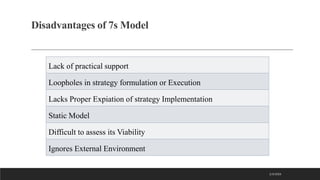
Disadvantages of 7s Model
Lack of practical support
Loopholes in strategy formulation or Execution
Lacks Proper Expiation of strategy Implementation
Static Model
Difficult to assess its Viability
Ignores External Environment
2/3/2023
Examples of the McKinsey 7s Model in Action
The practical applications of this model including both the failure &
success of organisational change projects can be seen by studying the
following corporate examples:
2/3/2023
2/3/2023
Nokia
2/3/2023
From initially being a mobile phone industry pioneer, to drastically losing market
share, and finally getting acquired by Microsoft, Nokia’s journey of change failure
can be explained using the 7-S framework.
Strategy: Nokia faced a dilemma and had to optimise costs and volume, enhance
performance, and maximise security. Nokia opted for a cost-leadership approach
and failed miserably on its innovation and performance fronts.
Structure: Nokia had a top-down line of hierarchy where employees were working
in silos with limited communication. To compete with the likes of Apple, Nokia
should have opted for an agile and decentralised structure, along with a
collaborative approach.
Systems: Nokia considered agility and being nimble as its key competitive advantages. With a
skilled workforce, Nokia was in a position to innovate its products and increase operational
efficiency.
Skills: Nokia had a pool of highly-skilled engineers and initially designed highly efficient mobile
phones. There wasn’t any skill gap weighing them down.
Staff: During 2007-2010, Nokia surprisingly removed the CTO position from top management,
leading to extremely high attrition rates. New hires weren’t properly skilled, to begin with, causing
the downfall of Nokia as a cutting-edge brand.
Style: Due to the low technical competence of leaders, employee morale was low. Instead of
bringing in people with the right backgrounds to further company innovation and growth., Nokia
needed transformational change leadership to help with technological advancement and cutting-
edge designs.
Shared Values: The core values of the company enabling business performance were Respect,
Achievement, Renewal, Challenge.
2/3/2023
2/3/2023
McDonald’s
Here’s how the fast-food giant leverages McKinsey’s 7-S model for driving organisational
change:
Strategy: McDonald’s gained a significant market share through its cost-leadership approach.
Additionally, it sets clear SMART goals to achieve the long-term and short-term vision.
Structure: Unlike other multinational corporations (MNCs) with complex hierarchical
structures, McDonald’s has a flat structure where a store manager manages its employees.
Employees work as a close-knit team and have easy access to the senior management if
required.
Systems: McDonald’s is known for constantly innovating to reduce the wait time and make
its entire production and supply chain more efficient – such as its new McDonalds app and
self-ordering kiosks.
2/3/2023
Shared Values: McDonald’s aims to have a high level of integrity, serve a wide range of
customers, hire employees from different backgrounds, encourage teamwork, and finally,
give some profits back to the community with its core values: Serve, Inclusion, Integrity,
Community, and Family.
Style: McDonald’s leverages a participative leadership style where seniors engage with
employees at different levels to seek their feedback to improve operations and resolve
conflicts.
Staff: With over 210,000 employees, McDonald’s is one of the largest employers in the
world. It believes in the concept of diversity and works towards employee satisfaction.
Skills: McDonald’s regularly trains its employees to provide an unparalleled customer
experience and handle objections.
2/3/2023
2/3/2023
Coca-Cola
Strategy
1 Portfolio building – acquisitions of the Chinese Fruit / Veg and Asian Speciality brand to create a foothold in the Asia
Pacific.
2 Riding on HW-Switch safety switches to FVJ.
3 Packaging amended to raise volume per customer.
4 Resource expansion with a concentrated approach "China-India".
5 Taking advantage of cost synergies through its manufacturing and bottling facilities to ensure quality.
Marketing strategy – well backed by the overall power of the Coca-Cola brand, each product range spanning 7 Coca-Cola
categories. Talent management strategy – Coca-Cola may not have adequately engaged its workers to reduce the rate of
workforce turnover. It will need to tighten up its policies on retention and growth. Development strategy-capitalizing on cost
synergies by combining bottling facilities vertically. Supply chain operations are supported on a global scale with the new
tools. Market strategy – close partnerships with retailers, proximity strategy for bringing a Coke brand within reach through
the use of vending machines, and maintaining sufficient distribution coverage by different means.
2/3/2023
2/3/2023
Structure Coca-Cola – has the Head Office division responsible for providing overall guidance
to Coca-Cola and maintaining the regional structure. ExCo's President of Coca-Cola, sometimes
the CEO. Other managers are either responsible for the big regions or have significant specialized
companies, e.g. the CFO. Coca-Cola combines centralized and decentralized elements. Divisions
and regions act as product line teams and report to the Chairman of the Division with each
Country Manager. The various departments are responsible for national (local) decision-taking,
national market analysis, and local advertising production, for example, using languages from the
countries where Coca-Cola works. Regional decision-making is a matter of fact. A big region such
as the Asia Pacific is grouped according to a map with its own marketing structure.
System Process Systems: each unit is responsible for splitting these into manageable activities
and providing benchmarks for 6P initiatives. (Profit, People, Portfolio, Partners, Planet,
Productivity). Management day to day systems: administrative steps to be placed at a managerial
level along with daily reviews and reports to provide information about the outcomes. Day to day
management systems, In addition to the advantages and opportunities for meeting targets
alignment.
Style Coke Society – look forward and inspired, reflecting solidarity. “One business- One team.
One team. One love. One love. As one business”, employees are provided with relevant and
expedited learning opportunities for the greater good of Coca-Cola. One team links to job
development partnerships. One Love goes beyond the brand's portfolio to sustainability,
community support, and earth preservation and security.
Staff Benchmarked business strategy of recruitment and retention. Facilitating work pathways.
Systems for performance improvement are best controlled. Given the silo existence of some
employees' roles, activities should be implemented in order to promote creativity and to include
employees. Coca-Cola stock ownership financial incentives encourage workers to support the
company.
Skill Vision 2021 calls for creative approaches to achieve its objective, particularly with regard
to product content (new preferences, healthcare trends), volume and efficiency innovation.
Objectives explain the main activities to be performed by Coca-Cola and what should be done at
each stage. Strategically, investment dedication in product quality innovation, volume (new
packaging with a minimum of 10% increase in volume) and effectiveness.
2/3/2023
Shared visions
Coca-Cola systems revenues for 2010 by 2020 through the production of new
beverages, meeting changing consumer tastes by taking the plan into line with
their 6P dream; Profit, People, Portfolio, Partners, Planet, Productivity.
2/3/2023
2/3/2023

McKinsey 7s model.pdf

  • 1.
    Quality Management System Topic :McKinsey 7s Model Presented By: Mohini Tawade Under The guidance Of : Dr. Sudhir Pandya Department: Quality Assurance Dr. D.Y. Patil College of Pharmacy , Akurdi
  • 2.
    Introduction The McKinsey 7-Smodel is a useful tool that can be used to diagnose and solve organisational problems. It depicts an organisation as a collection of seven interconnected elements: structure, strategy, systems, staff, skills, style and shared values. By considering how each of these elements impacts on the others, it is possible to take a holistic approach to organisational change. 2/3/2023
  • 3.
    Background McKinsey 7s modelwas developed in 1980s by McKinsey consultants Tom Peters, Robert Waterman and Julien Philips with a help from Richard Pascale and Anthony G. Athos. Since the introduction, the model has been widely used by academics and practitioners and remains one of the most popular strategic planning tools. It sought to present an emphasis on human resources rather than the traditional mass production tangibles of capital, infrastructure and equipment, as a key to higher organizational performance. 2/3/2023
  • 4.
    The 7S modelis a strategic model that can be used for any of the following purposes A. Organizational alignment or performance improvement B. Understanding the core and most influential factors in an organization’s strategy C. Determining how best to realign an organization to a new strategy or other organization design D. Examining the current workings and relations an organization exhibits 2/3/2023
  • 5.
    2/3/2023 Each element isconnected to every other, without any obvious starting point. This is deliberate, as every one of the elements could, potentially, be the driving force for change. The purpose of this tool is to emphasise that changing one aspect of an organisation will impact upon the others. In a truly effective organisation, all seven elements will operate toward the same goal. If a change leader believes that their organisation could be more effective, they can use the framework to help identify the element or elements that need to change.
  • 6.
  • 7.
    2/3/2023 Hard Elements SoftElements Strategy Skills Structures Style Systems Staff Shared Values
  • 8.
    Hard elements Hard elementsare easy to identify and describe. They are the foundation of any organisation and can be used to describe its management structure, processes and objectives. They tend to be recorded and referenced in corporate documents like statements, strategy reports and organisational charts. ➢Structure: The way in which an organisation's activities are managed. In small businesses, this might be a traditional hierarchy. In larger organisations, this is more likely to be a divisional or matrix structure, where different managers have varying areas of responsibility. 2/3/2023
  • 9.
    ➢Strategy: The planan organisation has to achieve its objectives. This is a dynamic element, in that it changes all the time in response to outside factors like competition, demand and technological innovations. ➢Systems: The processes an organisation has in place. This includes information systems, as well as financial procedures, legal policy, risk assessment, health and safety, pay and benefits. In short, all the systems that direct organisational activity. 2/3/2023
  • 10.
    Soft Elements The foursoft Ss are often difficult to identify, and constantly evolve. It can be hard to put them into words and they sometimes overlap with one another. However, they are no less important to an organisation undergoing a period of change. They are: ➢Style: the organisational culture, usually described as 'the way things are done around here'. This also includes individual management and leadership styles. ➢Staff: the people in the organisation, their talents and the way they are developed. ➢Skills: the competencies and capabilities of the organisation and its people. ➢Shared Values: the guiding principles that direct the organisation's behaviour. These were originally referred to as 'superordinate goals' and are often unwritten. Examples of shared values might include great customer service, constant innovation or honesty. 2/3/2023
  • 11.
    Questions to assesseach elements? Strategy What is the organization’s strategy seeking to accomplish? How does the organization plan to use its resources and capabilities to deliver that? What is distinct about this organization? How does the organization compete? How does the organization adapt to changing market conditions? 2/3/2023
  • 12.
    Structure How is theorganization organized? What are the reporting and working relationships (hierarchical, flat, silos, etc.)? How do the employees align themselves to the strategy? How are decisions made? Is it based off of centralization, empowerment, decentralization or other approaches? How is information shared (formal and informal channels) across the organization? 2/3/2023
  • 13.
    Systems What are theprimary business and technical systems that drive the organization? What and where are the system controls? How is progress and evolution tracked? What internal rules and processes does the team utilize to maintain course? 2/3/2023
  • 14.
    Shared Values What isthe mission of the organization? What is the vision to get there? What are the ideal versus real values? How do the values play out in daily life? What are the founding values that the organization was built upon? 2/3/2023
  • 15.
    Style What is themanagement/leadership style like? How do they behave? How do employees respond to management/leadership? Do employees function competitively, collaboratively, or cooperatively? Are there real teams functioning within the organization or are they just nominal groups? What behaviors, tasks and deliverables does management/leadership reward? 2/3/2023
  • 16.
    Staff What is thesize of the organization? What are the staffing needs? Are there gaps in required capabilities or resources? What is the plan to address those needs? 2/3/2023
  • 17.
    Application of McKinsey7s Model 2/3/2023 Identify the area which requires alignment Ascertain an excellent organisational design Determine where and what changes are to be made Implement the change planned Constant review of 7 elements
  • 18.
    2/3/2023 Advantages of 7sModel Enhancement of Organization Effectiveness Align Organization Department and Processes Implementation of Strategies Analyses Impact of Future Organization Change Comprehensive Framework Link Academic research with management practice
  • 19.
    Disadvantages of 7sModel Lack of practical support Loopholes in strategy formulation or Execution Lacks Proper Expiation of strategy Implementation Static Model Difficult to assess its Viability Ignores External Environment 2/3/2023
  • 20.
    Examples of theMcKinsey 7s Model in Action The practical applications of this model including both the failure & success of organisational change projects can be seen by studying the following corporate examples: 2/3/2023
  • 21.
  • 22.
    Nokia 2/3/2023 From initially beinga mobile phone industry pioneer, to drastically losing market share, and finally getting acquired by Microsoft, Nokia’s journey of change failure can be explained using the 7-S framework. Strategy: Nokia faced a dilemma and had to optimise costs and volume, enhance performance, and maximise security. Nokia opted for a cost-leadership approach and failed miserably on its innovation and performance fronts. Structure: Nokia had a top-down line of hierarchy where employees were working in silos with limited communication. To compete with the likes of Apple, Nokia should have opted for an agile and decentralised structure, along with a collaborative approach.
  • 23.
    Systems: Nokia consideredagility and being nimble as its key competitive advantages. With a skilled workforce, Nokia was in a position to innovate its products and increase operational efficiency. Skills: Nokia had a pool of highly-skilled engineers and initially designed highly efficient mobile phones. There wasn’t any skill gap weighing them down. Staff: During 2007-2010, Nokia surprisingly removed the CTO position from top management, leading to extremely high attrition rates. New hires weren’t properly skilled, to begin with, causing the downfall of Nokia as a cutting-edge brand. Style: Due to the low technical competence of leaders, employee morale was low. Instead of bringing in people with the right backgrounds to further company innovation and growth., Nokia needed transformational change leadership to help with technological advancement and cutting- edge designs. Shared Values: The core values of the company enabling business performance were Respect, Achievement, Renewal, Challenge. 2/3/2023
  • 24.
  • 25.
    McDonald’s Here’s how thefast-food giant leverages McKinsey’s 7-S model for driving organisational change: Strategy: McDonald’s gained a significant market share through its cost-leadership approach. Additionally, it sets clear SMART goals to achieve the long-term and short-term vision. Structure: Unlike other multinational corporations (MNCs) with complex hierarchical structures, McDonald’s has a flat structure where a store manager manages its employees. Employees work as a close-knit team and have easy access to the senior management if required. Systems: McDonald’s is known for constantly innovating to reduce the wait time and make its entire production and supply chain more efficient – such as its new McDonalds app and self-ordering kiosks. 2/3/2023
  • 26.
    Shared Values: McDonald’saims to have a high level of integrity, serve a wide range of customers, hire employees from different backgrounds, encourage teamwork, and finally, give some profits back to the community with its core values: Serve, Inclusion, Integrity, Community, and Family. Style: McDonald’s leverages a participative leadership style where seniors engage with employees at different levels to seek their feedback to improve operations and resolve conflicts. Staff: With over 210,000 employees, McDonald’s is one of the largest employers in the world. It believes in the concept of diversity and works towards employee satisfaction. Skills: McDonald’s regularly trains its employees to provide an unparalleled customer experience and handle objections. 2/3/2023
  • 27.
  • 28.
    Coca-Cola Strategy 1 Portfolio building– acquisitions of the Chinese Fruit / Veg and Asian Speciality brand to create a foothold in the Asia Pacific. 2 Riding on HW-Switch safety switches to FVJ. 3 Packaging amended to raise volume per customer. 4 Resource expansion with a concentrated approach "China-India". 5 Taking advantage of cost synergies through its manufacturing and bottling facilities to ensure quality. Marketing strategy – well backed by the overall power of the Coca-Cola brand, each product range spanning 7 Coca-Cola categories. Talent management strategy – Coca-Cola may not have adequately engaged its workers to reduce the rate of workforce turnover. It will need to tighten up its policies on retention and growth. Development strategy-capitalizing on cost synergies by combining bottling facilities vertically. Supply chain operations are supported on a global scale with the new tools. Market strategy – close partnerships with retailers, proximity strategy for bringing a Coke brand within reach through the use of vending machines, and maintaining sufficient distribution coverage by different means. 2/3/2023
  • 29.
    2/3/2023 Structure Coca-Cola –has the Head Office division responsible for providing overall guidance to Coca-Cola and maintaining the regional structure. ExCo's President of Coca-Cola, sometimes the CEO. Other managers are either responsible for the big regions or have significant specialized companies, e.g. the CFO. Coca-Cola combines centralized and decentralized elements. Divisions and regions act as product line teams and report to the Chairman of the Division with each Country Manager. The various departments are responsible for national (local) decision-taking, national market analysis, and local advertising production, for example, using languages from the countries where Coca-Cola works. Regional decision-making is a matter of fact. A big region such as the Asia Pacific is grouped according to a map with its own marketing structure. System Process Systems: each unit is responsible for splitting these into manageable activities and providing benchmarks for 6P initiatives. (Profit, People, Portfolio, Partners, Planet, Productivity). Management day to day systems: administrative steps to be placed at a managerial level along with daily reviews and reports to provide information about the outcomes. Day to day management systems, In addition to the advantages and opportunities for meeting targets alignment.
  • 30.
    Style Coke Society– look forward and inspired, reflecting solidarity. “One business- One team. One team. One love. One love. As one business”, employees are provided with relevant and expedited learning opportunities for the greater good of Coca-Cola. One team links to job development partnerships. One Love goes beyond the brand's portfolio to sustainability, community support, and earth preservation and security. Staff Benchmarked business strategy of recruitment and retention. Facilitating work pathways. Systems for performance improvement are best controlled. Given the silo existence of some employees' roles, activities should be implemented in order to promote creativity and to include employees. Coca-Cola stock ownership financial incentives encourage workers to support the company. Skill Vision 2021 calls for creative approaches to achieve its objective, particularly with regard to product content (new preferences, healthcare trends), volume and efficiency innovation. Objectives explain the main activities to be performed by Coca-Cola and what should be done at each stage. Strategically, investment dedication in product quality innovation, volume (new packaging with a minimum of 10% increase in volume) and effectiveness. 2/3/2023
  • 31.
    Shared visions Coca-Cola systemsrevenues for 2010 by 2020 through the production of new beverages, meeting changing consumer tastes by taking the plan into line with their 6P dream; Profit, People, Portfolio, Partners, Planet, Productivity. 2/3/2023
  • 32.