CLEANING VALIDATION
PRESENTED BY:PRESENTED BY:
AKASH B.SADAWARTEAKASH B.SADAWARTE
M.PHARM 2-SEM.M.PHARM 2-SEM.
. QAT DEPARTMENT. QAT DEPARTMENT
ROLL. NO. 38.ROLL. NO. 38.
MGV’S PHARMACY COLLEGE, PANCHAVATI NASHIK-3MGV’S PHARMACY COLLEGE, PANCHAVATI NASHIK-3
1
INTRODUCTION
• Pharmaceutical products could be contaminated due to several factors
such as cleaning agents, microorganisms, dust and particulates,
product residue, etc.
• The objective of cleaning validation is to provide documented
evidence that a specific cleaning process will consistently clean to
predetermined limits to prevent contamination that could adversely
affect the safety, efficacy, purity and quality of the products.
• Therefore, implementation and validation of cleaning procedures are
essential.
2
PURPOSE OF CLEANING VALIDATION
• Avoid contamination of the current product in the subsequently
manufacturing product.
• To design and carry cleaning in a way that it continuously reduce
contamination to an acceptable level.
• To have an documented evidence that an approved cleaning procedure will
provide clean equipment .
3
IMPORTANCE OF CLEANING VALIDATION
• It is a customer requirement - it ensures the safety and purity of the
product.
• It is a regulatory requirement in pharmaceutical industries.
• “Particular attention should be accorded to the validation of …
cleaning procedures” (WHO).
• “The data should support a conclusion that residues have been
reduced to an ‘acceptable’ level” (FDA).
4
POSSIBLE CONTAMINANTS
• Product residues.
• Cleaning agent residues and breakdown.
• Airborne matter.
• Lubricants, ancillary material.
• Bacteria, mould and pyrogens.
5
LEVELS OF CLEANING
• The equipment usage. (i.e. Dedicated equipment or not)
• The stage of manufacture. (early, intermediate or final step)
• The nature of the potential contaminants. (toxicity, solubility etc.)
6
MASTER VALIDATION PLAN
• Appropriate cleaning procedure.
• Identification of cleaning agent.
• Description of sampling procedure.
• Acceptance criteria.
• Analytical method.
• A copy of protocol and,
• Final report.
7
CONTINUE..
• CIP or COP.
• Equipment matrix for CV.
• Description of equipment and its location.
• Surface area of equipment.
• Average batch size of each equipment.
• Training program for production and analytical personnel.
• Reference to the company’s change control program.
8
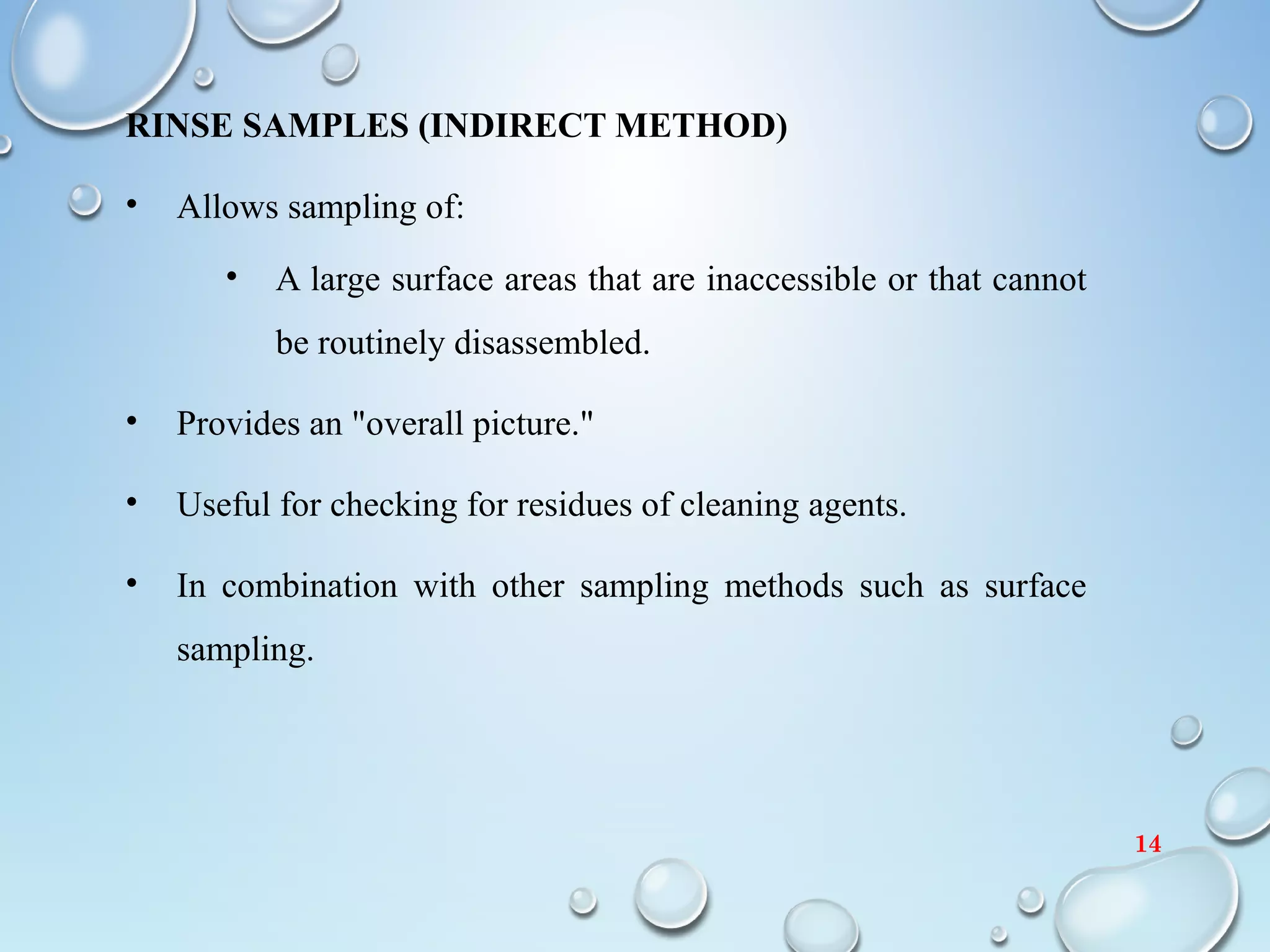
CLEANING PROCEDURE
It is a regulatory requirement and includes,
• Responsibilities for cleaning.
• Equipment parameters to be evaluated.
• Residues to be cleaned.
• Cleaning agent parameters to be evaluated.
• Cleaning techniques to be evaluated.
9
SAMPLING PROCEDURE
• Methods of sampling:
• Direct surface sampling.
• Rinse samples and
• Placebo method.
10
DIRECT SURFACE SAMPLING (DIRECT METHOD)
• A most commonly used method.
• Use “swabs” (inert material) - type of sampling material
should not interfere with the test.
• Factors to be considered include:
• Supplier of the swab,
• Area swabbed, number of swabs used,
• Swab handling and swabbing technique.
11
SWAB
12Direction for swab sampling.
DIRECT SURFACE SAMPLING (DIRECT METHOD)
• Critical areas (hardest to clean)
• e.g. In semi-automatic/fully automatic clean-in-place
systems.
• Use appropriate sampling medium and solvent.
13A UV-active placebo highlights residues before cleaning and after cleaning.
RINSE SAMPLES (INDIRECT METHOD)
• Allows sampling of:
• A large surface areas that are inaccessible or that cannot
be routinely disassembled.
• Provides an "overall picture."
• Useful for checking for residues of cleaning agents.
• In combination with other sampling methods such as surface
sampling.
14
RINSE SAMPLES
The manufacturer has to provide evidence that samples are
accurately recovered.
What is considered acceptable in terms of recovery?
15
VALIDATION
16
Recovery
> 80% is considered
good
VALIDATION
17
Recovery
> 80% is considered
good
> 50% is considered
reasonable
VALIDATION
18
Recovery
< 50% is considered
questionable
> 80% is considered
good
> 50% is considered
reasonable
ESTABLISHMENT OF ACCEPTANCE
CRITERIA
 Limits: practical, achievable and verifiable.
 Each situation assessed individually.
 Principal reactant and other chemical variations.
19
CONTINUE
There should be no residue from:
 Previous product.
 Reaction by-products and degradants.
 Cleaning process itself (e.g. Detergents or solvents)
Remember: uniform distribution of contaminants is not
guaranteed.
20
The limit-setting approach can:
 Be product-specific.
 Group products into families and choose a
worst case product.
 Group products into groups according to risk,
e.g. Very soluble products, products with
similar potency, highly toxic, or difficult to
detect products.
 Use different safety factors for different dosage
forms based on physiological response. (this
method is essential for potent materials)
21
 Limits may be expressed as:
 A concentration in a subsequent product (ppm),
 Limit per surface area (µg/cm2
), or
 In rinse water as ppm.
 Limits for carry-over of product residues should meet defined
criteria.
 What are the three most commonly used criteria?
22
The three most commonly used criteria are:
 Visually clean no residue visible on equipment after
cleaning.
 Not more than 10 ppm of one product will appear in
another product .
 Not more than 0.1% of the normal therapeutic dose of
one product will appear in the maximum daily dose of a
subsequent product.
23
 The most stringent of three options should be used.
 Certain allergenic ingredients and highly potent material should be
undetectable by the best available analytical methods.
 e.g. Penicillins and cephalosporins
 e.g. Potent steroids and cytotoxics
 Dedicated manufacturing facilities needed.
24
METHODS OF CALCULATING ACCEPTANCE CRITERIA
• Based on therapeutic daily dose.
• Used for final product changeover API process. A to API process .B. .
TDD previous x MBS
MACO = ------------------------------
sf x TDD next
• MACO maximum allowable carryover: acceptable transferred amount from the
investigated product. ("previous")
25
• TDD previous standard therapeutic dose of the investigated product.
(in the same dosage form as TDD next)
• TDD next standard therapeutic dose of the daily dose for the next
product.
• MBS minimum batch size for the next product(s). (where MACO
can end up)
• Sf safety factor. (normally 1000 is used in calculations based on
TDD).
26
Batch placebo method
• A placebo batch is manufactured and checks are done for carry-
over of the previous product.
• Expensive and laborious process.
• Little assurance that the contaminants are dislodged.
• Particles not necessarily uniformly dispersed.
• Method used in conjunction with rinse and/or surface
sampling method(s).
• Samples taken throughout the process of manufacture.
• Sensitivity of the assay may be greatly reduced by dilution
of the contaminant.
27
ANALYTICAL METHODS
• Validated analytical methods – able to detect residuals or
contaminants:
• Specific for the substance(s) being assayed
• At an appropriate level of cleanliness (sensitivity)
• Sensitive and specific - may include:
• Chromatographic methods (HPLC),(GC), (HPTLC)). Others
include (alone or in combination), e.g. Total organic carbon
(TOC), PH, conductivity, ultraviolet (UV) spectroscopy.
28
ANALYTICAL METHODS
• Validation of the analytical method should include, e.g.
• Precision, linearity and selectivity (the latter if specific
analytes are targeted);
• Limit of detection (LOD);
• Limit of quantitation (LOQ);
• Recovery, by spiking with the analyte and
• Reproducibility.
• Detection limit (sufficiently sensitive) to detect the established
acceptable level of residue / contaminants.
29
CONTENTS OF CLEANING VALIDATION PROTOCOL
• Objective
• Scope
• Reference inclusive SOP
• Responsibility
• Material and method
• Procedure
• Acceptance criteria: training, deviation, batch, …..
• Work sheet/equipment: cleaning procedure, raw data record, sampling,
analytical procedure, etc.
30
 Introduction
 Summary: method
 Results: table
 Conclusion
 Recommendation
 Appendices: analytical raw data, chromatogram, etc.
31
CONTENTS OF CLEANING VALIDATION REPORT
PRODUCT DETAIL
EQUIPMENT
DETAIL
METHOD
VALIDATION
PROTOCOL DESIGN
EXECUTION OF CV
•GROUPING
•MATRIX
•ACCEPTANCE
CRITERIA
CV REPORT
RE-VALIDATION
Overall review of cleaning validation 333334
44532
CONCLUSION
• Cleaning is an important part of pharmaceutical development of medicines.
• Cleaning and cleaning validation is a major concern and source of
inspectional observations.
• "Clean" is a subjective measure – definition is needed.
33
CONCLUSION
IT IS THE
CLEANING PROCEDURES
THAT MUST BE VALIDATED –
THESE NEED TO BE
RELIABLE AND REPRODUCIBLE
34
CONCLUSION CONT…
• Qualified operators
• Cleaning validation is an expensive, time-consuming and
sometimes unpredictable business ….
BUT ….
35
…ONCE THE FIRST TIME
WELL PLANNEDANDACCOMPLISHED
CLEANING VALIDATION
MAKES EVERYDAY LIFE EASIERAND
SOMETIMES EVEN
CHEAPER
THAN BEFORE VALIDATION
36
REFERENCES
• “Cleaning validation in active pharmaceutical ingredient
manufacturing plants”sep1999
• Www. Cleaningvalidation.Com
• Www.Bioqc.Org/workshopdata/cleaningvalidation
• Apps.Who.Int/prequal/trainingresource
• Http://www.Askaboutvalidation.Com
37
38
39

cleaning validation..

  • 1.
    CLEANING VALIDATION PRESENTED BY:PRESENTEDBY: AKASH B.SADAWARTEAKASH B.SADAWARTE M.PHARM 2-SEM.M.PHARM 2-SEM. . QAT DEPARTMENT. QAT DEPARTMENT ROLL. NO. 38.ROLL. NO. 38. MGV’S PHARMACY COLLEGE, PANCHAVATI NASHIK-3MGV’S PHARMACY COLLEGE, PANCHAVATI NASHIK-3 1
  • 2.
    INTRODUCTION • Pharmaceutical productscould be contaminated due to several factors such as cleaning agents, microorganisms, dust and particulates, product residue, etc. • The objective of cleaning validation is to provide documented evidence that a specific cleaning process will consistently clean to predetermined limits to prevent contamination that could adversely affect the safety, efficacy, purity and quality of the products. • Therefore, implementation and validation of cleaning procedures are essential. 2
  • 3.
    PURPOSE OF CLEANINGVALIDATION • Avoid contamination of the current product in the subsequently manufacturing product. • To design and carry cleaning in a way that it continuously reduce contamination to an acceptable level. • To have an documented evidence that an approved cleaning procedure will provide clean equipment . 3
  • 4.
    IMPORTANCE OF CLEANINGVALIDATION • It is a customer requirement - it ensures the safety and purity of the product. • It is a regulatory requirement in pharmaceutical industries. • “Particular attention should be accorded to the validation of … cleaning procedures” (WHO). • “The data should support a conclusion that residues have been reduced to an ‘acceptable’ level” (FDA). 4
  • 5.
    POSSIBLE CONTAMINANTS • Productresidues. • Cleaning agent residues and breakdown. • Airborne matter. • Lubricants, ancillary material. • Bacteria, mould and pyrogens. 5
  • 6.
    LEVELS OF CLEANING •The equipment usage. (i.e. Dedicated equipment or not) • The stage of manufacture. (early, intermediate or final step) • The nature of the potential contaminants. (toxicity, solubility etc.) 6
  • 7.
    MASTER VALIDATION PLAN •Appropriate cleaning procedure. • Identification of cleaning agent. • Description of sampling procedure. • Acceptance criteria. • Analytical method. • A copy of protocol and, • Final report. 7
  • 8.
    CONTINUE.. • CIP orCOP. • Equipment matrix for CV. • Description of equipment and its location. • Surface area of equipment. • Average batch size of each equipment. • Training program for production and analytical personnel. • Reference to the company’s change control program. 8
  • 9.
    CLEANING PROCEDURE It isa regulatory requirement and includes, • Responsibilities for cleaning. • Equipment parameters to be evaluated. • Residues to be cleaned. • Cleaning agent parameters to be evaluated. • Cleaning techniques to be evaluated. 9
  • 10.
    SAMPLING PROCEDURE • Methodsof sampling: • Direct surface sampling. • Rinse samples and • Placebo method. 10
  • 11.
    DIRECT SURFACE SAMPLING(DIRECT METHOD) • A most commonly used method. • Use “swabs” (inert material) - type of sampling material should not interfere with the test. • Factors to be considered include: • Supplier of the swab, • Area swabbed, number of swabs used, • Swab handling and swabbing technique. 11
  • 12.
  • 13.
    DIRECT SURFACE SAMPLING(DIRECT METHOD) • Critical areas (hardest to clean) • e.g. In semi-automatic/fully automatic clean-in-place systems. • Use appropriate sampling medium and solvent. 13A UV-active placebo highlights residues before cleaning and after cleaning.
  • 14.
    RINSE SAMPLES (INDIRECTMETHOD) • Allows sampling of: • A large surface areas that are inaccessible or that cannot be routinely disassembled. • Provides an "overall picture." • Useful for checking for residues of cleaning agents. • In combination with other sampling methods such as surface sampling. 14
  • 15.
    RINSE SAMPLES The manufacturerhas to provide evidence that samples are accurately recovered. What is considered acceptable in terms of recovery? 15
  • 16.
  • 17.
    VALIDATION 17 Recovery > 80% isconsidered good > 50% is considered reasonable
  • 18.
    VALIDATION 18 Recovery < 50% isconsidered questionable > 80% is considered good > 50% is considered reasonable
  • 19.
    ESTABLISHMENT OF ACCEPTANCE CRITERIA Limits: practical, achievable and verifiable.  Each situation assessed individually.  Principal reactant and other chemical variations. 19
  • 20.
    CONTINUE There should beno residue from:  Previous product.  Reaction by-products and degradants.  Cleaning process itself (e.g. Detergents or solvents) Remember: uniform distribution of contaminants is not guaranteed. 20
  • 21.
    The limit-setting approachcan:  Be product-specific.  Group products into families and choose a worst case product.  Group products into groups according to risk, e.g. Very soluble products, products with similar potency, highly toxic, or difficult to detect products.  Use different safety factors for different dosage forms based on physiological response. (this method is essential for potent materials) 21
  • 22.
     Limits maybe expressed as:  A concentration in a subsequent product (ppm),  Limit per surface area (µg/cm2 ), or  In rinse water as ppm.  Limits for carry-over of product residues should meet defined criteria.  What are the three most commonly used criteria? 22
  • 23.
    The three mostcommonly used criteria are:  Visually clean no residue visible on equipment after cleaning.  Not more than 10 ppm of one product will appear in another product .  Not more than 0.1% of the normal therapeutic dose of one product will appear in the maximum daily dose of a subsequent product. 23
  • 24.
     The moststringent of three options should be used.  Certain allergenic ingredients and highly potent material should be undetectable by the best available analytical methods.  e.g. Penicillins and cephalosporins  e.g. Potent steroids and cytotoxics  Dedicated manufacturing facilities needed. 24
  • 25.
    METHODS OF CALCULATINGACCEPTANCE CRITERIA • Based on therapeutic daily dose. • Used for final product changeover API process. A to API process .B. . TDD previous x MBS MACO = ------------------------------ sf x TDD next • MACO maximum allowable carryover: acceptable transferred amount from the investigated product. ("previous") 25
  • 26.
    • TDD previousstandard therapeutic dose of the investigated product. (in the same dosage form as TDD next) • TDD next standard therapeutic dose of the daily dose for the next product. • MBS minimum batch size for the next product(s). (where MACO can end up) • Sf safety factor. (normally 1000 is used in calculations based on TDD). 26
  • 27.
    Batch placebo method •A placebo batch is manufactured and checks are done for carry- over of the previous product. • Expensive and laborious process. • Little assurance that the contaminants are dislodged. • Particles not necessarily uniformly dispersed. • Method used in conjunction with rinse and/or surface sampling method(s). • Samples taken throughout the process of manufacture. • Sensitivity of the assay may be greatly reduced by dilution of the contaminant. 27
  • 28.
    ANALYTICAL METHODS • Validatedanalytical methods – able to detect residuals or contaminants: • Specific for the substance(s) being assayed • At an appropriate level of cleanliness (sensitivity) • Sensitive and specific - may include: • Chromatographic methods (HPLC),(GC), (HPTLC)). Others include (alone or in combination), e.g. Total organic carbon (TOC), PH, conductivity, ultraviolet (UV) spectroscopy. 28
  • 29.
    ANALYTICAL METHODS • Validationof the analytical method should include, e.g. • Precision, linearity and selectivity (the latter if specific analytes are targeted); • Limit of detection (LOD); • Limit of quantitation (LOQ); • Recovery, by spiking with the analyte and • Reproducibility. • Detection limit (sufficiently sensitive) to detect the established acceptable level of residue / contaminants. 29
  • 30.
    CONTENTS OF CLEANINGVALIDATION PROTOCOL • Objective • Scope • Reference inclusive SOP • Responsibility • Material and method • Procedure • Acceptance criteria: training, deviation, batch, ….. • Work sheet/equipment: cleaning procedure, raw data record, sampling, analytical procedure, etc. 30
  • 31.
     Introduction  Summary:method  Results: table  Conclusion  Recommendation  Appendices: analytical raw data, chromatogram, etc. 31 CONTENTS OF CLEANING VALIDATION REPORT
  • 32.
    PRODUCT DETAIL EQUIPMENT DETAIL METHOD VALIDATION PROTOCOL DESIGN EXECUTIONOF CV •GROUPING •MATRIX •ACCEPTANCE CRITERIA CV REPORT RE-VALIDATION Overall review of cleaning validation 333334 44532
  • 33.
    CONCLUSION • Cleaning isan important part of pharmaceutical development of medicines. • Cleaning and cleaning validation is a major concern and source of inspectional observations. • "Clean" is a subjective measure – definition is needed. 33
  • 34.
    CONCLUSION IT IS THE CLEANINGPROCEDURES THAT MUST BE VALIDATED – THESE NEED TO BE RELIABLE AND REPRODUCIBLE 34
  • 35.
    CONCLUSION CONT… • Qualifiedoperators • Cleaning validation is an expensive, time-consuming and sometimes unpredictable business …. BUT …. 35
  • 36.
    …ONCE THE FIRSTTIME WELL PLANNEDANDACCOMPLISHED CLEANING VALIDATION MAKES EVERYDAY LIFE EASIERAND SOMETIMES EVEN CHEAPER THAN BEFORE VALIDATION 36
  • 37.
    REFERENCES • “Cleaning validationin active pharmaceutical ingredient manufacturing plants”sep1999 • Www. Cleaningvalidation.Com • Www.Bioqc.Org/workshopdata/cleaningvalidation • Apps.Who.Int/prequal/trainingresource • Http://www.Askaboutvalidation.Com 37
  • 38.
  • 39.

Editor's Notes

  • #17 9.3.2. There should be evidence that samples are accurately recovered. For example, a recovery of &amp;gt; 80% is considered good, &amp;gt; 50% reasonable and &amp;lt; 50% questionable.