Presented By:
Miss. Mohini Tawade,
First Year M. Pharmacy,
Department of Quality Assurance,
Dr. D.Y. Patil College of Pharmacy, Akurdi,
Pune.
Hazard Analysis and
Critical Control
Point
INTRODUCTION
 Hazard Analysis And Critical Control Point (HAPPC)
 HAPPC is systemic approach for identification, evaluation and control of
food safety hazards.
 Preventing the problems from occurring is the primary goal of HACCP
system.
 It is logical, scientific approach which controls safety problems in food
products.
 Safety control needs to be monitored in production system related to
biological, chemical and physical hazard.
Hazard Analysis
It is processes of collecting and evaluating information on hazards and addressing them in
safety assurance program.
Critical Control Point :
It is point, step or processes to which control is applied and which results into prevention,
elimination or reduction in hazard up to acceptable limit.
Critical limit:
Maximum or minimum value up to which physical, biological or chemical hazard can be
controlled prevented, eliminated or reduced to acceptable limit.
Hazard:
Biological, chemical or physical property that may cause food to be unsafe for human
consumption.
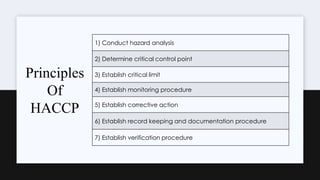
1) Conduct hazard analysis
2) Determine critical control point
3) Establish critical limit
4) Establish monitoring procedure
5) Establish corrective action
6) Establish record keeping and documentation procedure
7) Establish verification procedure
Principles
Of
HACCP
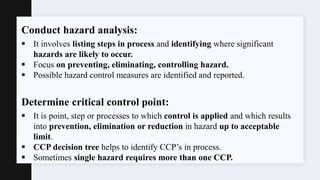
Conduct hazard analysis:
 It involves listing steps in process and identifying where significant
hazards are likely to occur.
 Focus on preventing, eliminating, controlling hazard.
 Possible hazard control measures are identified and reported.
Determine critical control point:
 It is point, step or processes to which control is applied and which results
into prevention, elimination or reduction in hazard up to acceptable
limit.
 CCP decision tree helps to identify CCP’s in process.
 Sometimes single hazard requires more than one CCP.
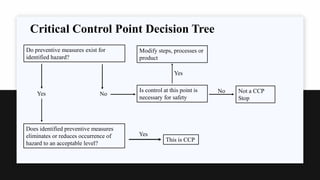
Critical Control Point Decision Tree
Do preventive measures exist for
identified hazard?
Yes No
Is control at this point is
necessary for safety
Yes
Modify steps, processes or
product
No Not a CCP
Stop
Does identified preventive measures
eliminates or reduces occurrence of
hazard to an acceptable level?
Yes
This is CCP
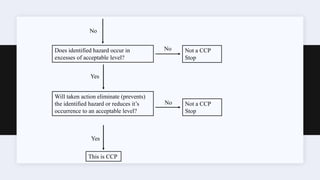
No
Does identified hazard occur in
excesses of acceptable level?
No Not a CCP
Stop
Will taken action eliminate (prevents)
the identified hazard or reduces it’s
occurrence to an acceptable level?
Yes
No Not a CCP
Stop
Yes
This is CCP
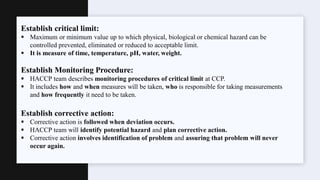
Establish critical limit:
 Maximum or minimum value up to which physical, biological or chemical hazard can be
controlled prevented, eliminated or reduced to acceptable limit.
 It is measure of time, temperature, pH, water, weight.
Establish Monitoring Procedure:
 HACCP team describes monitoring procedures of critical limit at CCP.
 It includes how and when measures will be taken, who is responsible for taking measurements
and how frequently it need to be taken.
Establish corrective action:
 Corrective action is followed when deviation occurs.
 HACCP team will identify potential hazard and plan corrective action.
 Corrective action involves identification of problem and assuring that problem will never
occur again.
Establish record keeping and documentation procedure:
 HACCP plan recording information that can be used to prove that the food was produced
safely.
 It also needs to include information about the HAPPC plan.
 It should include information on:
The HACCP team
Product description
The hazard analysis
The CCP’s identified
Monitoring system
Critical limit
Corrective action
Record keeping procedure
Verification procedure
Establish verification procedure:
 Includes activates other than, monitoring, determining validity of the HACCP
plan.
 The HACCP identifies activities such as:
Auditing of CCP’S
Recording review
Prior shipment review
Instruments calibration
Products testing as a part of the verification activates
THANK YOU!

HACCP.pdf

  • 1.
    Presented By: Miss. MohiniTawade, First Year M. Pharmacy, Department of Quality Assurance, Dr. D.Y. Patil College of Pharmacy, Akurdi, Pune. Hazard Analysis and Critical Control Point
  • 2.
    INTRODUCTION  Hazard AnalysisAnd Critical Control Point (HAPPC)  HAPPC is systemic approach for identification, evaluation and control of food safety hazards.  Preventing the problems from occurring is the primary goal of HACCP system.  It is logical, scientific approach which controls safety problems in food products.  Safety control needs to be monitored in production system related to biological, chemical and physical hazard.
  • 3.
    Hazard Analysis It isprocesses of collecting and evaluating information on hazards and addressing them in safety assurance program. Critical Control Point : It is point, step or processes to which control is applied and which results into prevention, elimination or reduction in hazard up to acceptable limit. Critical limit: Maximum or minimum value up to which physical, biological or chemical hazard can be controlled prevented, eliminated or reduced to acceptable limit. Hazard: Biological, chemical or physical property that may cause food to be unsafe for human consumption.
  • 4.
    1) Conduct hazardanalysis 2) Determine critical control point 3) Establish critical limit 4) Establish monitoring procedure 5) Establish corrective action 6) Establish record keeping and documentation procedure 7) Establish verification procedure Principles Of HACCP
  • 5.
    Conduct hazard analysis: It involves listing steps in process and identifying where significant hazards are likely to occur.  Focus on preventing, eliminating, controlling hazard.  Possible hazard control measures are identified and reported. Determine critical control point:  It is point, step or processes to which control is applied and which results into prevention, elimination or reduction in hazard up to acceptable limit.  CCP decision tree helps to identify CCP’s in process.  Sometimes single hazard requires more than one CCP.
  • 6.
    Critical Control PointDecision Tree Do preventive measures exist for identified hazard? Yes No Is control at this point is necessary for safety Yes Modify steps, processes or product No Not a CCP Stop Does identified preventive measures eliminates or reduces occurrence of hazard to an acceptable level? Yes This is CCP
  • 7.
    No Does identified hazardoccur in excesses of acceptable level? No Not a CCP Stop Will taken action eliminate (prevents) the identified hazard or reduces it’s occurrence to an acceptable level? Yes No Not a CCP Stop Yes This is CCP
  • 8.
    Establish critical limit: Maximum or minimum value up to which physical, biological or chemical hazard can be controlled prevented, eliminated or reduced to acceptable limit.  It is measure of time, temperature, pH, water, weight. Establish Monitoring Procedure:  HACCP team describes monitoring procedures of critical limit at CCP.  It includes how and when measures will be taken, who is responsible for taking measurements and how frequently it need to be taken. Establish corrective action:  Corrective action is followed when deviation occurs.  HACCP team will identify potential hazard and plan corrective action.  Corrective action involves identification of problem and assuring that problem will never occur again.
  • 9.
    Establish record keepingand documentation procedure:  HACCP plan recording information that can be used to prove that the food was produced safely.  It also needs to include information about the HAPPC plan.  It should include information on: The HACCP team Product description The hazard analysis The CCP’s identified Monitoring system Critical limit Corrective action Record keeping procedure Verification procedure
  • 10.
    Establish verification procedure: Includes activates other than, monitoring, determining validity of the HACCP plan.  The HACCP identifies activities such as: Auditing of CCP’S Recording review Prior shipment review Instruments calibration Products testing as a part of the verification activates
  • 11.