Hashimoto Thyroiditis
March 2023
Introduction
Hashimoto's thyroiditis is a prevalent reason for hypothyroidism and is
characterized as an autoimmune ailment. This condition involves the
body's immune system attacking the thyroid gland tissue, leading to
inflammation of the gland (thyroiditis). The thyroid gland is an endocrine
gland that secretes thyroxine (T4) and triiodothyronine (T3), which play
vital roles in regulating basic metabolic rate, protein synthesis, and other
bodily functions. This condition was named after Dr. Hakaru Hashimoto,
who first described it in 1912.
Presentation title 2
Epidemiolog
y
In the United States, Hashimoto's
thyroiditis is the leading cause of
hypothyroidism. It is an autoimmune
disease with an estimated
prevalence in pediatrics of 1–2%. It
occurs more often in women than in
men, which may be related to
hormonal factors. The risk for
women is about 10 times higher
than for men.
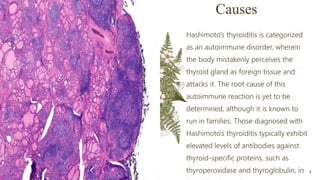
Causes
Hashimoto's thyroiditis is categorized
as an autoimmune disorder, wherein
the body mistakenly perceives the
thyroid gland as foreign tissue and
attacks it. The root cause of this
autoimmune reaction is yet to be
determined, although it is known to
run in families. Those diagnosed with
Hashimoto's thyroiditis typically exhibit
elevated levels of antibodies against
thyroid-specific proteins, such as
thyroperoxidase and thyroglobulin, in
Presentation title 4
5
Signs & Symptoms
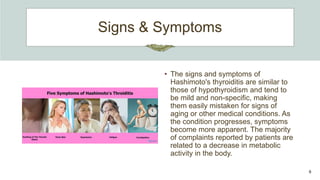
• The signs and symptoms of
Hashimoto's thyroiditis are similar to
those of hypothyroidism and tend to
be mild and non-specific, making
them easily mistaken for signs of
aging or other medical conditions. As
the condition progresses, symptoms
become more apparent. The majority
of complaints reported by patients are
related to a decrease in metabolic
activity in the body.
6
• Common symptoms and signs
of Hashimoto's thyroiditis
include: – Fatigue –
Depression – Modest weight
gain – Cold intolerance –
Excessive sleepiness – Dry,
coarse hair – Constipation –
Dry skin – Muscle cramps
• – Increased cholesterol levels
– Decreased concentration –
Vague aches and pain –
Swelling of legs • As
hypothyroidism becomes more
severe, there may be: –
puffiness around the eyes, – a
slowing of the heart rate, – a
drop in body temperature, –
and heart failure.
• Severe hypothyroidism can
potentially result in myxedema
coma, a life-threatening
condition that requires
immediate hospitalization and
treatment with thyroid
hormone. If left untreated,
hypothyroidism can lead to
several complications,
including cardiomyopathy
(enlarged heart), worsening
heart failure, as well as pleural
or pericardial effusions (fluid
buildup around the lungs or
heart, respectively).
Presentation title 7
Individuals diagnosed with Hashimoto's thyroiditis may initially
undergo a hyperthyroid phase, known as hashitoxicosis, in
which an excessive amount of thyroid hormone is released due
to the destruction of the gland. Other symptoms may include
swelling of the thyroid gland and difficulty in swallowing solids
or liquids.
Diagnosis
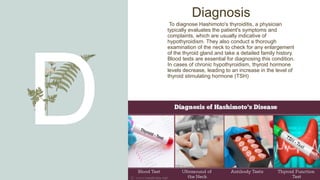
To diagnose Hashimoto's thyroiditis, a physician
typically evaluates the patient's symptoms and
complaints, which are usually indicative of
hypothyroidism. They also conduct a thorough
examination of the neck to check for any enlargement
of the thyroid gland and take a detailed family history.
Blood tests are essential for diagnosing this condition.
In cases of chronic hypothyroidism, thyroid hormone
levels decrease, leading to an increase in the level of
thyroid stimulating hormone (TSH)
9
Treatment
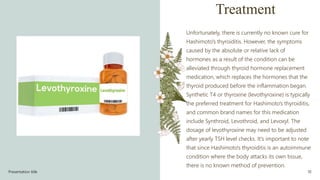
Unfortunately, there is currently no known cure for
Hashimoto's thyroiditis. However, the symptoms
caused by the absolute or relative lack of
hormones as a result of the condition can be
alleviated through thyroid hormone replacement
medication, which replaces the hormones that the
thyroid produced before the inflammation began.
Synthetic T4 or thyroxine (levothyroxine) is typically
the preferred treatment for Hashimoto's thyroiditis,
and common brand names for this medication
include Synthroid, Levothroid, and Levoxyl. The
dosage of levothyroxine may need to be adjusted
after yearly TSH level checks. It's important to note
that since Hashimoto's thyroiditis is an autoimmune
condition where the body attacks its own tissue,
there is no known method of prevention.
Presentation title 10
Presentation title 11
Severe gingivitis
Periodontitis
Oral Lichen Planus
Xerostomia
Delayed Wound Healing
Oral
Manifestation
Presentation title 12
• Establish a dental home
• Toothpaste / Mouth rinse
formulated for Dry mouth
• Xylitol
• Consult the PCP/Endocrinology
Dental Team
Reference
• James Hennessey, Leonard Wartofsky, Hashimoto’s Disease, The Journal of Clinical Endocrinology & Metabolism, Volume 92,
Issue 7, 1 July 2007, Page E1, https://doi.org/10.1210/jcem.92.7.9995
• Li D, Li J, Li C, Chen Q, Hua H. The Association of Thyroid Disease and Oral Lichen Planus: A Literature Review and Meta-
analysis. Front Endocrinol (Lausanne). 2017 Nov 9;8:310. doi: 10.3389/fendo.2017.00310. PMID: 29170653; PMCID:
PMC5684121.
• Aldulaijan HA, Cohen RE, Stellrecht EM, Levine MJ, Yerke LM. Relationship between hypothyroidism and periodontitis: A
scoping review. Clin Exp Dent Res. 2020 Feb;6(1):147-157. doi: 10.1002/cre2.247. Epub 2019 Sep 26. PMID: 32067402;
PMCID: PMC7025985.
• Chandna S, Bathla M. Oral manifestations of thyroid disorders and its management. Indian J Endocrinol Metab. 2011
Jul;15(Suppl 2):S113-6. doi: 10.4103/2230-8210.83343. PMID: 21966646; PMCID: PMC3169868.
• Natori J, Shimizu K, Nagahama M, Tanaka S. The influence of hypothyroidism on wound healing. An experimental study.
Nihon Ika Daigaku Zasshi. 1999 Jun;66(3):176-80. doi: 10.1272/jnms.66.176. PMID: 10401234.
13
Thank you !

hashimoto.pptx

  • 1.
  • 2.
    Introduction Hashimoto's thyroiditis isa prevalent reason for hypothyroidism and is characterized as an autoimmune ailment. This condition involves the body's immune system attacking the thyroid gland tissue, leading to inflammation of the gland (thyroiditis). The thyroid gland is an endocrine gland that secretes thyroxine (T4) and triiodothyronine (T3), which play vital roles in regulating basic metabolic rate, protein synthesis, and other bodily functions. This condition was named after Dr. Hakaru Hashimoto, who first described it in 1912. Presentation title 2
  • 3.
    Epidemiolog y In the UnitedStates, Hashimoto's thyroiditis is the leading cause of hypothyroidism. It is an autoimmune disease with an estimated prevalence in pediatrics of 1–2%. It occurs more often in women than in men, which may be related to hormonal factors. The risk for women is about 10 times higher than for men.
  • 4.
    Causes Hashimoto's thyroiditis iscategorized as an autoimmune disorder, wherein the body mistakenly perceives the thyroid gland as foreign tissue and attacks it. The root cause of this autoimmune reaction is yet to be determined, although it is known to run in families. Those diagnosed with Hashimoto's thyroiditis typically exhibit elevated levels of antibodies against thyroid-specific proteins, such as thyroperoxidase and thyroglobulin, in Presentation title 4
  • 5.
  • 6.
    Signs & Symptoms •The signs and symptoms of Hashimoto's thyroiditis are similar to those of hypothyroidism and tend to be mild and non-specific, making them easily mistaken for signs of aging or other medical conditions. As the condition progresses, symptoms become more apparent. The majority of complaints reported by patients are related to a decrease in metabolic activity in the body. 6
  • 7.
    • Common symptomsand signs of Hashimoto's thyroiditis include: – Fatigue – Depression – Modest weight gain – Cold intolerance – Excessive sleepiness – Dry, coarse hair – Constipation – Dry skin – Muscle cramps • – Increased cholesterol levels – Decreased concentration – Vague aches and pain – Swelling of legs • As hypothyroidism becomes more severe, there may be: – puffiness around the eyes, – a slowing of the heart rate, – a drop in body temperature, – and heart failure. • Severe hypothyroidism can potentially result in myxedema coma, a life-threatening condition that requires immediate hospitalization and treatment with thyroid hormone. If left untreated, hypothyroidism can lead to several complications, including cardiomyopathy (enlarged heart), worsening heart failure, as well as pleural or pericardial effusions (fluid buildup around the lungs or heart, respectively). Presentation title 7
  • 8.
    Individuals diagnosed withHashimoto's thyroiditis may initially undergo a hyperthyroid phase, known as hashitoxicosis, in which an excessive amount of thyroid hormone is released due to the destruction of the gland. Other symptoms may include swelling of the thyroid gland and difficulty in swallowing solids or liquids.
  • 9.
    Diagnosis To diagnose Hashimoto'sthyroiditis, a physician typically evaluates the patient's symptoms and complaints, which are usually indicative of hypothyroidism. They also conduct a thorough examination of the neck to check for any enlargement of the thyroid gland and take a detailed family history. Blood tests are essential for diagnosing this condition. In cases of chronic hypothyroidism, thyroid hormone levels decrease, leading to an increase in the level of thyroid stimulating hormone (TSH) 9
  • 10.
    Treatment Unfortunately, there iscurrently no known cure for Hashimoto's thyroiditis. However, the symptoms caused by the absolute or relative lack of hormones as a result of the condition can be alleviated through thyroid hormone replacement medication, which replaces the hormones that the thyroid produced before the inflammation began. Synthetic T4 or thyroxine (levothyroxine) is typically the preferred treatment for Hashimoto's thyroiditis, and common brand names for this medication include Synthroid, Levothroid, and Levoxyl. The dosage of levothyroxine may need to be adjusted after yearly TSH level checks. It's important to note that since Hashimoto's thyroiditis is an autoimmune condition where the body attacks its own tissue, there is no known method of prevention. Presentation title 10
  • 11.
    Presentation title 11 Severegingivitis Periodontitis Oral Lichen Planus Xerostomia Delayed Wound Healing Oral Manifestation
  • 12.
    Presentation title 12 •Establish a dental home • Toothpaste / Mouth rinse formulated for Dry mouth • Xylitol • Consult the PCP/Endocrinology Dental Team
  • 13.
    Reference • James Hennessey,Leonard Wartofsky, Hashimoto’s Disease, The Journal of Clinical Endocrinology & Metabolism, Volume 92, Issue 7, 1 July 2007, Page E1, https://doi.org/10.1210/jcem.92.7.9995 • Li D, Li J, Li C, Chen Q, Hua H. The Association of Thyroid Disease and Oral Lichen Planus: A Literature Review and Meta- analysis. Front Endocrinol (Lausanne). 2017 Nov 9;8:310. doi: 10.3389/fendo.2017.00310. PMID: 29170653; PMCID: PMC5684121. • Aldulaijan HA, Cohen RE, Stellrecht EM, Levine MJ, Yerke LM. Relationship between hypothyroidism and periodontitis: A scoping review. Clin Exp Dent Res. 2020 Feb;6(1):147-157. doi: 10.1002/cre2.247. Epub 2019 Sep 26. PMID: 32067402; PMCID: PMC7025985. • Chandna S, Bathla M. Oral manifestations of thyroid disorders and its management. Indian J Endocrinol Metab. 2011 Jul;15(Suppl 2):S113-6. doi: 10.4103/2230-8210.83343. PMID: 21966646; PMCID: PMC3169868. • Natori J, Shimizu K, Nagahama M, Tanaka S. The influence of hypothyroidism on wound healing. An experimental study. Nihon Ika Daigaku Zasshi. 1999 Jun;66(3):176-80. doi: 10.1272/jnms.66.176. PMID: 10401234. 13
  • 14.

Editor's Notes

  • #5 It is an autoimmune disease, which means that the body inappropriately attacks the thyroid gland - as if it was foreign tissue. • The underlying cause of the autoimmune process remains unknown. • Tends to occur in families. • Hashimoto's often starts in adulthood. • Blood drawn from people with Hashimoto's thyroiditis typically reveals an increased number of antibodies against thyroid-specific proteins, including Thyro-peroxidase and thyroglobulin.
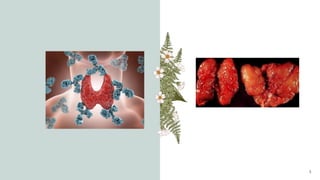
  • #6 It is an autoimmune disease, which means that the body inappropriately attacks the thyroid gland - as if it was Normal thyroid ---- diseased thyroid
  • #7 SIGNS AND SYMPTOMS • Symptoms and signs of Hashimoto's thyroiditis resemble those of hypothyroidism generally and are often subtle. • They are not specific (which means they can mimic the symptoms of many other conditions) and are often attributed to aging. • Symptoms generally become more obvious as the condition worsens. • The majority of these complaints are related to a metabolic slowing of the body Signs of Hypothyroidism M-Memory loss O-Obesity M-Malar flush/Menorrhagia S-Slowness (mentally and physically) S-Skin and hair dryness O-Onset gradual T-Tiredness I-Intolerance to cold R-Really low BP E-Energy levels fall D-Depression/Delayed relaxation of reflexes
  • #10 To diagnose Hashimoto's thyroiditis, a physician should assess: – symptoms and complaints commonly seen in hypothyroidism, – carefully examine the neck to look for enlargement of the thyroid gland, – and take a detailed history of family members. • Blood tests are essential to diagnose Hashimoto's thyroiditis. • With chronic hypothyroidism, the thyroid hormone levels fall, and the level of thyroid stimulating hormone (TSH) becomes high. The most useful assay for determining thyroid status is measurement of TSH in the blood. • The increase in TSH can actually precede the fall of thyroid hormone to low levels by months or years. • So the first sign of hypothyroidism may be an elevated TSH level even when levels of thyroid hormones are normal. • The blood work mentioned above confirms the diagnosis of hypothyroidism, but does not point to an underlying cause. The combination of the patient's clinical history, antibody screening, and a thyroid scan can help diagnose the precise underlying thyroid problem. • The blood tests also usually include an analysis of antibodies (anti-thyroperoxidase antibodies) to aid diagnosis. • If the anti-TPO antibodies are elevated at all, the diagnosis is made.
  • #11 There is no known cure for Hashimoto's thyroiditis. • Thyroid hormone medication can replace the hormones the thyroid made before the inflammation started. • Replacing one or both of these hormones can alleviate the symptoms caused by the absolute or relative lack of hormones as a consequence of Hashimoto's thyroiditis. • The treatment of choice for Hashimoto's thyroiditis is typically synthetic T4 or thyroxine (levothyroxine). • Brand names for this medication include Synthroid, Levothroid and Levoxyl. • The dosage of levothyroxine may need to be modified after checking TSH levels once yearly.
  • #12 Most people with Hashimoto’s have some degree of intestinal permeability, ( leaky gut ) and because the mouth is part of the GI tract, they are more prone to oral health issues, including gum disease, dry mouth, cavities, inflammation, and infection. Our teeth, gums, tongue, and throat are so important to our overall health, and this is especially true for people with Hashimoto’s, who are particularly vulnerable to infections. For us, dental procedures, infections, and fillings (just to name a few), could ignite an autoimmune disease! The prevalence of HT in patients with OLP is considerably higher than that in the common population, suggesting a correlation between OLP and HT Thyroid disease can lead to homeostatic imbalance in the body, which affects the healing abilities of tissue. Thyroid disease has not been linked to periodontal disease officially yet, but there are numerous case studies that have shown a strong correlation between the two Colgate’s new Hydris mouth rinse and toothpaste have helped many dry mouth sufferers. Xylitol products are also great for patients who have oral manifestations of thyroid disease, such as caries and xerostomia.
  • #13 Colgate’s new Hydris mouth rinse and toothpaste have helped many dry mouth sufferers. Xylitol products are also great for patients who have oral manifestations of thyroid disease, such as caries and xerostomia. uncontrolled and/or undiagnosed thyroid disease with gingival inflammation and fast progression of caries