Tips on using my ppt.
1. You can freely download, edit, modify and put your
name etc.
2. Don’t be concerned about number of slides. Half the
slides are blanks except for the title.
3. First show the blank slides (eg. Aetiology ) > Ask
students what they already know about ethology of
today's topic. > Then show next slide which enumerates
aetiologies.
4. At the end rerun the show – show blank> ask questions >
show next slide.
5. This will be an ACTIVE LEARNING SESSION x
three revisions.
6. Good for self study also.
7. See notes for bibliography.
Introduction & History.
• Hypothyroidism is a common endocrine
disorder resulting from deficiency of
thyroid hormone.
•
Etiology
Etiology
• Primary
• Secondary
Etiology
• Congenital
• Iodine Deficiency
• Autoimmune
• Drug induced
• Post operative
• Post irradiation
Etiology
• Iodine deficiency as a cause of
hypothyroidism is more common in less-
developed countries. inadequate iodine
nutrition in 30.6% of the population.
• Routine supplementation of salt, flour, and
other food staples with iodine has decreased
the rates of iodine deficiency.
Etiology:Drug induced
• Amiodarone
• Interferon alfa
• Thalidomide
• Lithium
• Stavudine
• Oral tyrosine kinase inhibitors – Sunitinib,
imatinib [8]
• Bexarotene [9]
• Perchlorate
• Interleukin (IL)-2
Etiology:Drug induced
• Ethionamide
• Rifampin
• Phenytoin
• Carbamazepine
• Phenobarbital
• Aminoglutethimide
• Sulfisoxazole
• p -Aminosalicylic acid
• Ipilimumab
Etiology:Drug induced
Wolff-Chiakoff effect -Excess iodine
• Radiocontrast dyes
• Amiodarone
• Health tonics (herbal and dietary
supplements)
• Seaweed
can transiently inhibit iodide organification
and thyroid hormone synthesis
Etiology:Central Hypothyroidism
when the hypothalamic-pituitary axis is
damaged-
• Pituitary adenoma
• Tumors impinging on the hypothalamus
• Lymphocytic hypophysitis
• Sheehan syndrome
• History of brain or pituitary irradiation
• Drugs (eg, dopamine, prednisone, or
opioids)
Etiology:Central Hypothyroidism
• Congenital nongoiterous hypothyroidism
type 4
• TRH resistance
• TRH deficiency
Pathophysiology
Pathophysiology
Pathophysiology
Wide range of effects due to-
• Slowing of metabolic processes
• Myxedematous infiltration
Pathophysiology:CVS
Pathophysiology:CVS
• Decreased contractility
• Cardiac enlargement
• Pericardial effusion
• Decreased pulse
• Decreased cardiac output
Pathophysiology:GI
Pathophysiology:GI
Pathophysiology:GI
• Achlorhydria
• Prolonged intestinal transit time with gastric
emptying
Pathophysiology:Gynec
• Delayed puberty
• Anovulation
• Menstrual irregularities
• Infertility
TSH screening should be a routine part of any
investigation into menstrual irregularities or
infertility.
Pathophysiology:Metabolism
Increased levels of –
• Total cholesterol
• Low-density lipoprotein (LDL) cholesterol
• High-density lipoprotein (HDL) cholesterol
• May result in an increase in insulin
resistance.
Epidemiology
Epidemiology
• 3.7% of the population
• most prevalent in elderly populations, with
2-20% of older age groups
• 2 to 8 times higher in females.
• higher in whites
Clinical Features
Clinical Features
• Hypothyroidism commonly manifests as a
slowing in physical and mental activity but
may be asymptomatic. Symptoms and signs
are often subtle and neither sensitive nor
specific.
• The patient’s presentation may vary from
asymptomatic to myxedema coma with
multisystem organ failure.
• Cretinism refers to severe hypothyroidism
in an infant or child.
Clinical Features:Symptoms
• Fatigue, loss of energy, lethargy
• Weight gain
• Decreased appetite
• Cold intolerance
• Dry skin
• Hair loss
• Sleepiness
• Muscle pain, joint pain,
• weakness in the extremities
• Depression
Clinical Features:Symptoms
• Emotional lability, mental impairment
• Forgetfulness, impaired memory,
• inability to concentrate
• Constipation
• Menstrual disturbances, impaired fertility
• Decreased perspiration
• Paresthesia and nerve entrapment syndromes
• Blurred vision
• Decreased hearing
• Fullness in the throat, hoarsenes
Symptoms more specific to
Hashimoto thyroiditis:
Symptoms more specific to
Hashimoto thyroiditis:
• Feeling of fullness in the throat
• Painless thyroid enlargement
• Exhaustion
• Transient neck pain, sore throat, or both
Clinical Features:Signs
• Weight gain
• Slowed speech and movements
• Dry skin
• Jaundice
• Pallor
• Coarse, brittle, straw-like hair
• Loss of scalp hair, axillary hair, pubic hair,
or a combination
• Dull facial expression
• Coarse facial features
Clinical Features:Signs
• Periorbital puffiness
• Macroglossia
• Goiter (simple or nodular)
• Hoarseness
• Decreased systolic blood pressure and
increased diastolic blood pressure
• Bradycardia
• Pericardial effusion
• Abdominal distention, ascites (uncommon)
•
Clinical Features:Signs
• Hypothermia (only in severe hypothyroid
states)
• Nonpitting edema (myxedema)
• Pitting edema of lower extremities
• Hyporeflexia with delayed relaxation,
ataxia, or both
Myxedema coma
Myxedema coma
Severe form of hypothyroidism
• Altered mental status
• Hypothermia
• Bradycardia
• Hypercarbia
• Hyponatremia
• Cardiomegaly, pericardial effusion,
cardiogenic shock, and ascites may be
present
Diagnostic Studies
Diagnostic Studies
• Third-generation thyroid-stimulating
hormone (TSH)
• Free T4
• Free T4 Index
• T3 assays are not recommended.
• Elevated TSH with decreased T4 or FTI
• Elevated TSH (usually 4.5-10.0 mIU/L)
with normal free T4 or FTI is considered
mild or subclinical hypothyroidism
Screening
Screening
• At birth
• Age 35 years and every 5 years thereafter,
with closer attention to patients who are at
high risk, such as the following :
– Pregnant women
– Women older than 60 years
– Patients with type 1 diabetes or other
autoimmune disease
– Patients with a history of neck irradiation
Management
Management
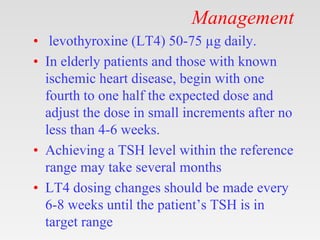
• levothyroxine (LT4) 50-75 µg daily.
• In elderly patients and those with known
ischemic heart disease, begin with one
fourth to one half the expected dose and
adjust the dose in small increments after no
less than 4-6 weeks.
• Achieving a TSH level within the reference
range may take several months
• LT4 dosing changes should be made every
6-8 weeks until the patient’s TSH is in
target range
Overdose
Overdose
• Tachycardia
• Palpitations
• Atrial fibrillation
• Nervousness
• Tiredness
• Headache
• Increased excitability
• Sleeplessness
• Tremors
• Possible angina
Treatment of myxedema coma
• Intravenous (IV) LT4 at a dose of 4 µg/kg
of lean body weight, or approximately 200-
250 µg, as a bolus in a single or divided
dose, depending on the patient’s risk of
cardiac disease
• After 24 hours, 100 µg LT4 IV, then 50
µg/day IV
• Stress doses of IV glucocorticoids
• Subsequent adjustment of the LT4 dose can
be based on clinical and laboratory findings
Get this ppt in mobile
1. Download Microsoft
PowerPoint from play
store.
2. Open Google assistant
3. Open Google lens.
4. Scan qr code from
next slide.
Get this ppt in mobile
Get my ppt collection
• https://www.slideshare.net/drpradeeppande/
edit_my_uploads
• https://www.dropbox.com/sh/x600md3cvj8
5woy/AACVMHuQtvHvl_K8ehc3ltkEa?dl
=0
• https://www.facebook.com/doctorpradeeppa
nde/?ref=pages_you_manage

Hypothyroidism.pptx

  • 1.
    Tips on usingmy ppt. 1. You can freely download, edit, modify and put your name etc. 2. Don’t be concerned about number of slides. Half the slides are blanks except for the title. 3. First show the blank slides (eg. Aetiology ) > Ask students what they already know about ethology of today's topic. > Then show next slide which enumerates aetiologies. 4. At the end rerun the show – show blank> ask questions > show next slide. 5. This will be an ACTIVE LEARNING SESSION x three revisions. 6. Good for self study also. 7. See notes for bibliography.
  • 2.
  • 3.
    Introduction & History. •Hypothyroidism is a common endocrine disorder resulting from deficiency of thyroid hormone. •
  • 4.
  • 5.
  • 6.
    Etiology • Congenital • IodineDeficiency • Autoimmune • Drug induced • Post operative • Post irradiation
  • 7.
    Etiology • Iodine deficiencyas a cause of hypothyroidism is more common in less- developed countries. inadequate iodine nutrition in 30.6% of the population. • Routine supplementation of salt, flour, and other food staples with iodine has decreased the rates of iodine deficiency.
  • 8.
  • 9.
    Etiology:Drug induced • Amiodarone •Interferon alfa • Thalidomide • Lithium • Stavudine • Oral tyrosine kinase inhibitors – Sunitinib, imatinib [8] • Bexarotene [9] • Perchlorate • Interleukin (IL)-2
  • 10.
    Etiology:Drug induced • Ethionamide •Rifampin • Phenytoin • Carbamazepine • Phenobarbital • Aminoglutethimide • Sulfisoxazole • p -Aminosalicylic acid • Ipilimumab
  • 11.
    Etiology:Drug induced Wolff-Chiakoff effect-Excess iodine • Radiocontrast dyes • Amiodarone • Health tonics (herbal and dietary supplements) • Seaweed can transiently inhibit iodide organification and thyroid hormone synthesis
  • 12.
  • 13.
    Etiology:Central Hypothyroidism when thehypothalamic-pituitary axis is damaged- • Pituitary adenoma • Tumors impinging on the hypothalamus • Lymphocytic hypophysitis • Sheehan syndrome • History of brain or pituitary irradiation • Drugs (eg, dopamine, prednisone, or opioids)
  • 14.
    Etiology:Central Hypothyroidism • Congenitalnongoiterous hypothyroidism type 4 • TRH resistance • TRH deficiency
  • 15.
  • 16.
  • 17.
    Pathophysiology Wide range ofeffects due to- • Slowing of metabolic processes • Myxedematous infiltration
  • 18.
  • 19.
    Pathophysiology:CVS • Decreased contractility •Cardiac enlargement • Pericardial effusion • Decreased pulse • Decreased cardiac output
  • 20.
  • 21.
  • 22.
    Pathophysiology:GI • Achlorhydria • Prolongedintestinal transit time with gastric emptying
  • 23.
  • 24.
    Pathophysiology:Gynec • Delayed puberty •Anovulation • Menstrual irregularities • Infertility TSH screening should be a routine part of any investigation into menstrual irregularities or infertility.
  • 25.
  • 26.
    Pathophysiology:Metabolism Increased levels of– • Total cholesterol • Low-density lipoprotein (LDL) cholesterol • High-density lipoprotein (HDL) cholesterol • May result in an increase in insulin resistance.
  • 27.
  • 28.
    Epidemiology • 3.7% ofthe population • most prevalent in elderly populations, with 2-20% of older age groups • 2 to 8 times higher in females. • higher in whites
  • 29.
  • 30.
    Clinical Features • Hypothyroidismcommonly manifests as a slowing in physical and mental activity but may be asymptomatic. Symptoms and signs are often subtle and neither sensitive nor specific. • The patient’s presentation may vary from asymptomatic to myxedema coma with multisystem organ failure. • Cretinism refers to severe hypothyroidism in an infant or child.
  • 31.
  • 32.
    Clinical Features:Symptoms • Fatigue,loss of energy, lethargy • Weight gain • Decreased appetite • Cold intolerance • Dry skin • Hair loss • Sleepiness • Muscle pain, joint pain, • weakness in the extremities • Depression
  • 33.
    Clinical Features:Symptoms • Emotionallability, mental impairment • Forgetfulness, impaired memory, • inability to concentrate • Constipation • Menstrual disturbances, impaired fertility • Decreased perspiration • Paresthesia and nerve entrapment syndromes • Blurred vision • Decreased hearing • Fullness in the throat, hoarsenes
  • 34.
    Symptoms more specificto Hashimoto thyroiditis:
  • 35.
    Symptoms more specificto Hashimoto thyroiditis: • Feeling of fullness in the throat • Painless thyroid enlargement • Exhaustion • Transient neck pain, sore throat, or both
  • 36.
  • 37.
    Clinical Features:Signs • Weightgain • Slowed speech and movements • Dry skin • Jaundice • Pallor • Coarse, brittle, straw-like hair • Loss of scalp hair, axillary hair, pubic hair, or a combination • Dull facial expression • Coarse facial features
  • 38.
    Clinical Features:Signs • Periorbitalpuffiness • Macroglossia • Goiter (simple or nodular) • Hoarseness • Decreased systolic blood pressure and increased diastolic blood pressure • Bradycardia • Pericardial effusion • Abdominal distention, ascites (uncommon) •
  • 39.
    Clinical Features:Signs • Hypothermia(only in severe hypothyroid states) • Nonpitting edema (myxedema) • Pitting edema of lower extremities • Hyporeflexia with delayed relaxation, ataxia, or both
  • 40.
  • 41.
    Myxedema coma Severe formof hypothyroidism • Altered mental status • Hypothermia • Bradycardia • Hypercarbia • Hyponatremia • Cardiomegaly, pericardial effusion, cardiogenic shock, and ascites may be present
  • 42.
  • 43.
    Diagnostic Studies • Third-generationthyroid-stimulating hormone (TSH) • Free T4 • Free T4 Index • T3 assays are not recommended. • Elevated TSH with decreased T4 or FTI • Elevated TSH (usually 4.5-10.0 mIU/L) with normal free T4 or FTI is considered mild or subclinical hypothyroidism
  • 44.
  • 45.
    Screening • At birth •Age 35 years and every 5 years thereafter, with closer attention to patients who are at high risk, such as the following : – Pregnant women – Women older than 60 years – Patients with type 1 diabetes or other autoimmune disease – Patients with a history of neck irradiation
  • 46.
  • 47.
    Management • levothyroxine (LT4)50-75 µg daily. • In elderly patients and those with known ischemic heart disease, begin with one fourth to one half the expected dose and adjust the dose in small increments after no less than 4-6 weeks. • Achieving a TSH level within the reference range may take several months • LT4 dosing changes should be made every 6-8 weeks until the patient’s TSH is in target range
  • 48.
  • 49.
    Overdose • Tachycardia • Palpitations •Atrial fibrillation • Nervousness • Tiredness • Headache • Increased excitability • Sleeplessness • Tremors • Possible angina
  • 50.
  • 51.
    Treatment of myxedemacoma • Intravenous (IV) LT4 at a dose of 4 µg/kg of lean body weight, or approximately 200- 250 µg, as a bolus in a single or divided dose, depending on the patient’s risk of cardiac disease • After 24 hours, 100 µg LT4 IV, then 50 µg/day IV • Stress doses of IV glucocorticoids • Subsequent adjustment of the LT4 dose can be based on clinical and laboratory findings
  • 52.
    Get this pptin mobile 1. Download Microsoft PowerPoint from play store. 2. Open Google assistant 3. Open Google lens. 4. Scan qr code from next slide.
  • 53.
    Get this pptin mobile
  • 54.
    Get my pptcollection • https://www.slideshare.net/drpradeeppande/ edit_my_uploads • https://www.dropbox.com/sh/x600md3cvj8 5woy/AACVMHuQtvHvl_K8ehc3ltkEa?dl =0 • https://www.facebook.com/doctorpradeeppa nde/?ref=pages_you_manage

Editor's Notes

  • #2 drpradeeppande@gmail.com 7697305442
  • #18 Deficiency of thyroid hormone has a wide range of effects. Systemic effects are the result of either derangements in metabolic processes or direct effects by myxedematous infiltration (ie, accumulation of glucosaminoglycans in the tissues).
  • #19 Deficiency of thyroid hormone has a wide range of effects. Systemic effects are the result of either derangements in metabolic processes or direct effects by myxedematous infiltration (ie, accumulation of glucosaminoglycans in the tissues).
  • #20 Deficiency of thyroid hormone has a wide range of effects. Systemic effects are the result of either derangements in metabolic processes or direct effects by myxedematous infiltration (ie, accumulation of glucosaminoglycans in the tissues).
  • #21 Deficiency of thyroid hormone has a wide range of effects. Systemic effects are the result of either derangements in metabolic processes or direct effects by myxedematous infiltration (ie, accumulation of glucosaminoglycans in the tissues).
  • #22 Deficiency of thyroid hormone has a wide range of effects. Systemic effects are the result of either derangements in metabolic processes or direct effects by myxedematous infiltration (ie, accumulation of glucosaminoglycans in the tissues).
  • #23 Deficiency of thyroid hormone has a wide range of effects. Systemic effects are the result of either derangements in metabolic processes or direct effects by myxedematous infiltration (ie, accumulation of glucosaminoglycans in the tissues).
  • #24 Deficiency of thyroid hormone has a wide range of effects. Systemic effects are the result of either derangements in metabolic processes or direct effects by myxedematous infiltration (ie, accumulation of glucosaminoglycans in the tissues).
  • #25 Deficiency of thyroid hormone has a wide range of effects. Systemic effects are the result of either derangements in metabolic processes or direct effects by myxedematous infiltration (ie, accumulation of glucosaminoglycans in the tissues).
  • #26 Deficiency of thyroid hormone has a wide range of effects. Systemic effects are the result of either derangements in metabolic processes or direct effects by myxedematous infiltration (ie, accumulation of glucosaminoglycans in the tissues).
  • #27 Deficiency of thyroid hormone has a wide range of effects. Systemic effects are the result of either derangements in metabolic processes or direct effects by myxedematous infiltration (ie, accumulation of glucosaminoglycans in the tissues).