Thyroidism & Thyroiditis
Dr. Tushar
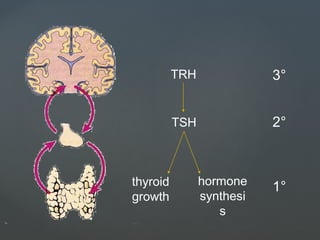
TRH
TSH
thyroid
growth
hormone
synthesi
s
3°
2°
1°
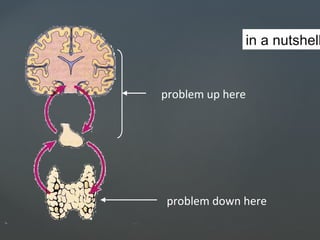
problem up here
problem down here
in a nutshell
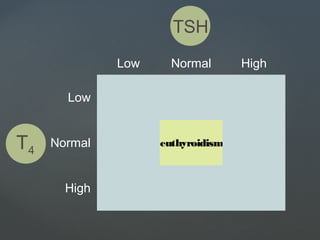
Low Normal High
Low
Normal euthyroidism
High
TSH
T4
Low Normal High
Low
Normal
High
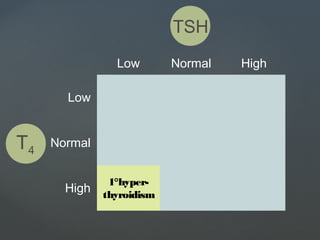
1°hyper-
thyroidism
T4
TSH
Low Normal High
Low
Normal
High
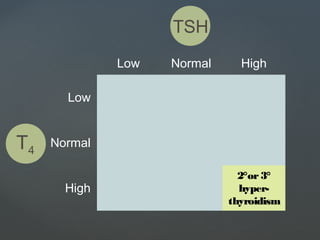
2°or3°
hyper-
thyroidism
T4
TSH
Low Normal High
Low
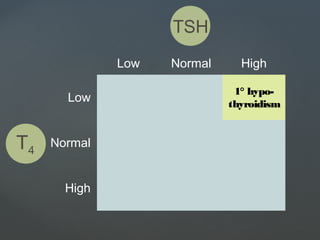
1° hypo-
thyroidism
Normal
High
T4
TSH
Low Normal High
Low
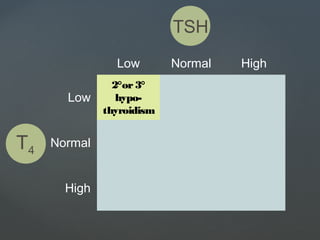
2°or3°
hypo-
thyroidism
Normal
High
T4
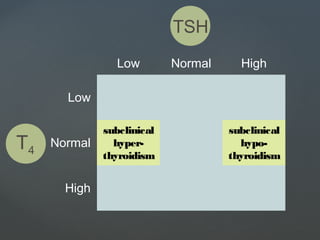
TSH
Low Normal High
Low
Normal
subclinical
hyper-
thyroidism
subclinical
hypo-
thyroidism
High
T4
TSH
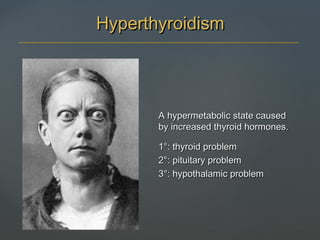
A hypermetabolic state causedA hypermetabolic state caused
by increased thyroid hormones.by increased thyroid hormones.
1°: thyroid problem1°: thyroid problem
2°: pituitary problem2°: pituitary problem
3°: hypothalamic problem3°: hypothalamic problem
HyperthyroidismHyperthyroidism
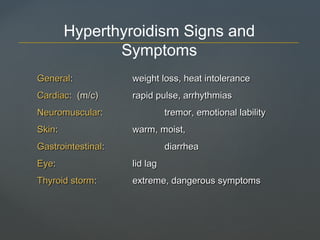
GeneralGeneral:: weight loss, heat intoleranceweight loss, heat intolerance
CardiacCardiac: (m/c): (m/c) rapid pulse, arrhythmiasrapid pulse, arrhythmias
NeuromuscularNeuromuscular:: tremor, emotional labilitytremor, emotional lability
SkinSkin:: warm, moist,warm, moist,
GastrointestinalGastrointestinal:: diarrheadiarrhea
EyeEye:: lid laglid lag
Thyroid stormThyroid storm:: extreme, dangerous symptomsextreme, dangerous symptoms
Hyperthyroidism Signs and
Symptoms
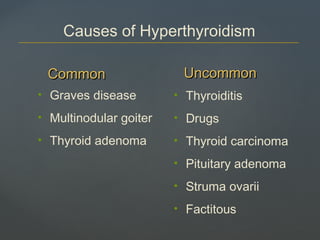
CommonCommon UncommonUncommon
• Thyroiditis
• Drugs
• Thyroid carcinoma
• Pituitary adenoma
• Struma ovarii
• Factitous
• Graves disease
• Multinodular goiter
• Thyroid adenoma
Causes of Hyperthyroidism
Diagnosis
Lab Diagnosis :Lab Diagnosis : Low or suppressed TSH,
elevated free thyroxin
level (FT4)
[Normal value TSH – 0.46 – 5.68
mcIU/ml
FT4 – 10.0 – 28.2 pmol/L]
• 10% of patients have an increased total or free T3 level and
normal T4 level with suppressed TSH level, a condition
called "T3 toxicosis“ [Normal FT3 – 4.26 – 8.10 pmol/L]
• In Graves disease, elevated levels of antitopoisomerase
antibodies and antithyroglobulin antibodies are found in 80%
and 50% of cases, respectively.
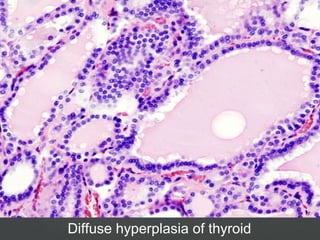
Diffuse hyperplasia of thyroid
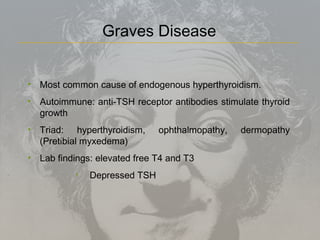
• Most common cause of endogenous hyperthyroidism.
• Autoimmune: anti-TSH receptor antibodies stimulate thyroid
growth
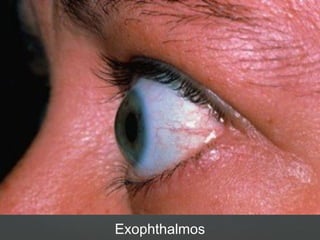
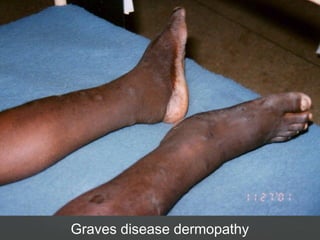
• Triad: hyperthyroidism, ophthalmopathy, dermopathy
(Pretibial myxedema)
• Lab findings: elevated free T4 and T3
• Depressed TSH
Graves Disease
Exophthalmos
Graves disease dermopathy
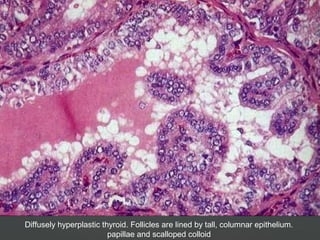
Diffusely hyperplastic thyroid. Follicles are lined by tall, columnar epithelium.
papillae and scalloped colloid
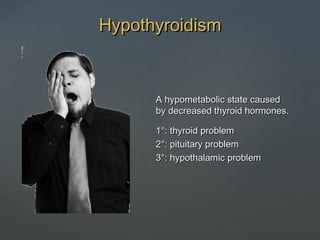
A hypometabolic state causedA hypometabolic state caused
by decreased thyroid hormones.by decreased thyroid hormones.
1°: thyroid problem1°: thyroid problem
2°: pituitary problem2°: pituitary problem
3°: hypothalamic problem3°: hypothalamic problem
HypothyroidismHypothyroidism
GeneralGeneral:: fatigue, weight gain, cold intolerancefatigue, weight gain, cold intolerance
CardiacCardiac:: slow pulse, impaired contractionslow pulse, impaired contraction
NervousNervous:: delayed reflexes, lethargydelayed reflexes, lethargy
SkinSkin:: rough, dry; hair loss (eyebrows)rough, dry; hair loss (eyebrows)
GastrointestinalGastrointestinal:: reduced appetite, constipationreduced appetite, constipation
MyxedemaMyxedema:: deepened voice,deepened voice, “edema”“edema”
Myxedema comaMyxedema coma:: deteriorating mental statusdeteriorating mental status
Hypothyroidism Signs and
Symptoms
• Causes:
• endemic iodine deficiency,
• genetic problems (inborn error of thyroid metabolism
[dyshormonogenetic goiter])
• Thyroid agenesis [PAX8, FOXE1, TSH receptor mutations]
• Thyroid hypoplasia
• Symptoms are mild to severe
• Treatment: thyroid hormone replacement
• Prevention better
Congenital Hypothyroidism
CommonCommon UncommonUncommon
• Goiter
• Infiltrative stuff
• Too much iodine
• 2° hypothyroidism
• 3° hypothyroidism
• Other thyroiditis
• Hashimoto
• Iatrogenic
Causes of Acquired Hypothyroidism
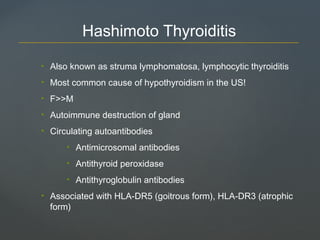
• Also known as struma lymphomatosa, lymphocytic thyroiditis
• Most common cause of hypothyroidism in the US!
• F>>M
• Autoimmune destruction of gland
• Circulating autoantibodies
• Antimicrosomal antibodies
• Antithyroid peroxidase
• Antithyroglobulin antibodies
• Associated with HLA-DR5 (goitrous form), HLA-DR3 (atrophic
form)
Hashimoto Thyroiditis
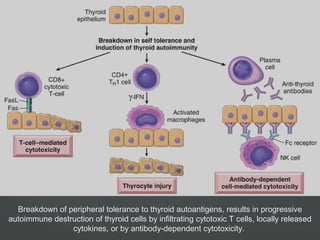
Breakdown of peripheral tolerance to thyroid autoantigens, results in progressive
autoimmune destruction of thyroid cells by infiltrating cytotoxic T cells, locally released
cytokines, or by antibody-dependent cytotoxicity.
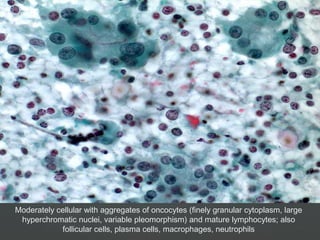
Moderately cellular with aggregates of oncocytes (finely granular cytoplasm, large
hyperchromatic nuclei, variable pleomorphism) and mature lymphocytes; also
follicular cells, plasma cells, macrophages, neutrophils
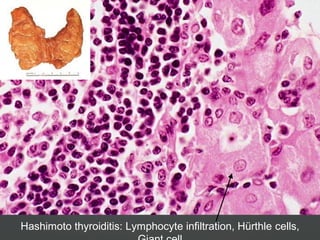
Hashimoto thyroiditis: Lymphocyte infiltration, Hürthle cells,
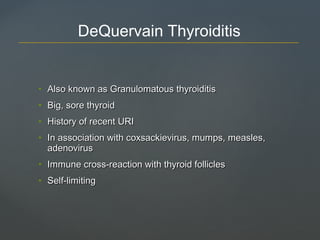
• Also known as Granulomatous thyroiditisAlso known as Granulomatous thyroiditis
• Big, sore thyroidBig, sore thyroid
• History of recent URIHistory of recent URI
• In association with coxsackievirus, mumps, measles,In association with coxsackievirus, mumps, measles,
adenovirusadenovirus
• Immune cross-reaction with thyroid folliclesImmune cross-reaction with thyroid follicles
• Self-limitingSelf-limiting
DeQuervain Thyroiditis
Looks scary
Really harmless
Goes away by itself
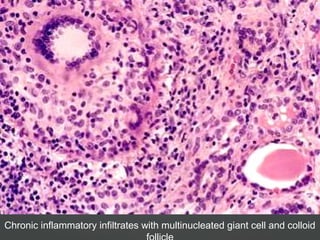
Chronic inflammatory infiltrates with multinucleated giant cell and colloid
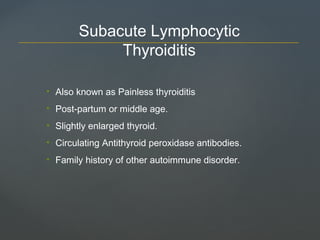
• Also known as Painless thyroiditis
• Post-partum or middle age.
• Slightly enlarged thyroid.
• Circulating Antithyroid peroxidase antibodies.
• Family history of other autoimmune disorder.
Subacute Lymphocytic
Thyroiditis
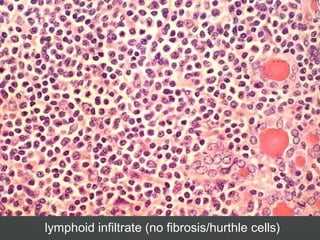
lymphoid infiltrate (no fibrosis/hurthle cells)
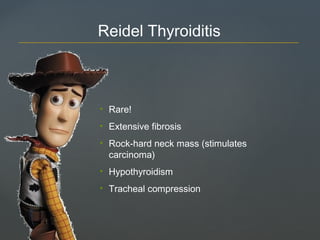
• Rare!
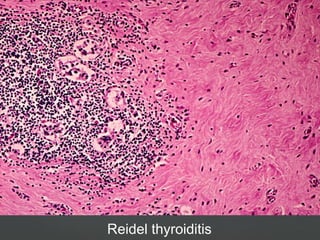
• Extensive fibrosis
• Rock-hard neck mass (stimulates
carcinoma)
• Hypothyroidism
• Tracheal compression
Reidel Thyroiditis
Reidel thyroiditis
Thank you.Thank you.

Hypo and Hyper Thyroidism

  • 1.
  • 2.
  • 3.
    problem up here problemdown here in a nutshell
  • 4.
    Low Normal High Low Normaleuthyroidism High TSH T4
  • 5.
  • 6.
  • 7.
    Low Normal High Low 1°hypo- thyroidism Normal High T4 TSH
  • 8.
  • 9.
  • 10.
    A hypermetabolic statecausedA hypermetabolic state caused by increased thyroid hormones.by increased thyroid hormones. 1°: thyroid problem1°: thyroid problem 2°: pituitary problem2°: pituitary problem 3°: hypothalamic problem3°: hypothalamic problem HyperthyroidismHyperthyroidism
  • 11.
    GeneralGeneral:: weight loss,heat intoleranceweight loss, heat intolerance CardiacCardiac: (m/c): (m/c) rapid pulse, arrhythmiasrapid pulse, arrhythmias NeuromuscularNeuromuscular:: tremor, emotional labilitytremor, emotional lability SkinSkin:: warm, moist,warm, moist, GastrointestinalGastrointestinal:: diarrheadiarrhea EyeEye:: lid laglid lag Thyroid stormThyroid storm:: extreme, dangerous symptomsextreme, dangerous symptoms Hyperthyroidism Signs and Symptoms
  • 12.
    CommonCommon UncommonUncommon • Thyroiditis •Drugs • Thyroid carcinoma • Pituitary adenoma • Struma ovarii • Factitous • Graves disease • Multinodular goiter • Thyroid adenoma Causes of Hyperthyroidism
  • 13.
    Diagnosis Lab Diagnosis :LabDiagnosis : Low or suppressed TSH, elevated free thyroxin level (FT4) [Normal value TSH – 0.46 – 5.68 mcIU/ml FT4 – 10.0 – 28.2 pmol/L] • 10% of patients have an increased total or free T3 level and normal T4 level with suppressed TSH level, a condition called "T3 toxicosis“ [Normal FT3 – 4.26 – 8.10 pmol/L] • In Graves disease, elevated levels of antitopoisomerase antibodies and antithyroglobulin antibodies are found in 80% and 50% of cases, respectively.
  • 14.
  • 15.
    • Most commoncause of endogenous hyperthyroidism. • Autoimmune: anti-TSH receptor antibodies stimulate thyroid growth • Triad: hyperthyroidism, ophthalmopathy, dermopathy (Pretibial myxedema) • Lab findings: elevated free T4 and T3 • Depressed TSH Graves Disease
  • 16.
  • 17.
  • 18.
    Diffusely hyperplastic thyroid.Follicles are lined by tall, columnar epithelium. papillae and scalloped colloid
  • 19.
    A hypometabolic statecausedA hypometabolic state caused by decreased thyroid hormones.by decreased thyroid hormones. 1°: thyroid problem1°: thyroid problem 2°: pituitary problem2°: pituitary problem 3°: hypothalamic problem3°: hypothalamic problem HypothyroidismHypothyroidism
  • 20.
    GeneralGeneral:: fatigue, weightgain, cold intolerancefatigue, weight gain, cold intolerance CardiacCardiac:: slow pulse, impaired contractionslow pulse, impaired contraction NervousNervous:: delayed reflexes, lethargydelayed reflexes, lethargy SkinSkin:: rough, dry; hair loss (eyebrows)rough, dry; hair loss (eyebrows) GastrointestinalGastrointestinal:: reduced appetite, constipationreduced appetite, constipation MyxedemaMyxedema:: deepened voice,deepened voice, “edema”“edema” Myxedema comaMyxedema coma:: deteriorating mental statusdeteriorating mental status Hypothyroidism Signs and Symptoms
  • 21.
    • Causes: • endemiciodine deficiency, • genetic problems (inborn error of thyroid metabolism [dyshormonogenetic goiter]) • Thyroid agenesis [PAX8, FOXE1, TSH receptor mutations] • Thyroid hypoplasia • Symptoms are mild to severe • Treatment: thyroid hormone replacement • Prevention better Congenital Hypothyroidism
  • 22.
    CommonCommon UncommonUncommon • Goiter •Infiltrative stuff • Too much iodine • 2° hypothyroidism • 3° hypothyroidism • Other thyroiditis • Hashimoto • Iatrogenic Causes of Acquired Hypothyroidism
  • 23.
    • Also knownas struma lymphomatosa, lymphocytic thyroiditis • Most common cause of hypothyroidism in the US! • F>>M • Autoimmune destruction of gland • Circulating autoantibodies • Antimicrosomal antibodies • Antithyroid peroxidase • Antithyroglobulin antibodies • Associated with HLA-DR5 (goitrous form), HLA-DR3 (atrophic form) Hashimoto Thyroiditis
  • 24.
    Breakdown of peripheraltolerance to thyroid autoantigens, results in progressive autoimmune destruction of thyroid cells by infiltrating cytotoxic T cells, locally released cytokines, or by antibody-dependent cytotoxicity.
  • 25.
    Moderately cellular withaggregates of oncocytes (finely granular cytoplasm, large hyperchromatic nuclei, variable pleomorphism) and mature lymphocytes; also follicular cells, plasma cells, macrophages, neutrophils
  • 26.
    Hashimoto thyroiditis: Lymphocyteinfiltration, Hürthle cells,
  • 27.
    • Also knownas Granulomatous thyroiditisAlso known as Granulomatous thyroiditis • Big, sore thyroidBig, sore thyroid • History of recent URIHistory of recent URI • In association with coxsackievirus, mumps, measles,In association with coxsackievirus, mumps, measles, adenovirusadenovirus • Immune cross-reaction with thyroid folliclesImmune cross-reaction with thyroid follicles • Self-limitingSelf-limiting DeQuervain Thyroiditis
  • 28.
  • 29.
    Chronic inflammatory infiltrateswith multinucleated giant cell and colloid
  • 30.
    • Also knownas Painless thyroiditis • Post-partum or middle age. • Slightly enlarged thyroid. • Circulating Antithyroid peroxidase antibodies. • Family history of other autoimmune disorder. Subacute Lymphocytic Thyroiditis
  • 31.
    lymphoid infiltrate (nofibrosis/hurthle cells)
  • 32.
    • Rare! • Extensivefibrosis • Rock-hard neck mass (stimulates carcinoma) • Hypothyroidism • Tracheal compression Reidel Thyroiditis
  • 33.
  • 34.