Presented by-
KANISHKA UPADHYAY
Bsc(H).Biochemistry II Year
CONTENTS
1.DISORDERS
• GOITER
• CRETINISM
• MYXEDEMA
• HASHIMATO’S DISEASE
• GRAVES’S DISEASE
• THYROID NODULES
2. SYMPTOMS
3.TREATMENT
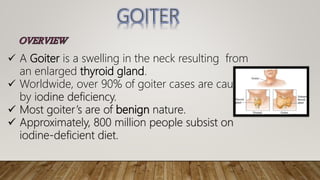
 A Goiter is a swelling in the neck resulting from
an enlarged thyroid gland.
 Worldwide, over 90% of goiter cases are caused
by iodine deficiency.
 Most goiter’s are of benign nature.
 Approximately, 800 million people subsist on
iodine-deficient diet.
CAUSES
 Lack of iodine
 Thyroid Cancer
 Pregnancy
 Inflammation
 Grave’s disease (overactive goiter)
 Hashimoto’s disease (underactive goiter)
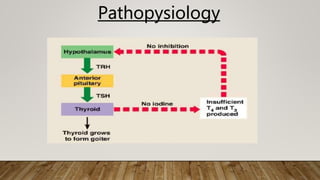
Pathopysiology
Classification
(based on growth pattern)
 Uninodular : One thyroid nodule; can be either an inactive or a
toxic nodule.
 Multinodular : Multiple nodules; can be inactive or toxic, the
latter is called toxic multinodular goiter and associated
with hyperthyroidism.
 Diffuse: The whole thyroid appearing to be enlarged due to
hyperplasia(increase in number of cells in an organ or tissue).
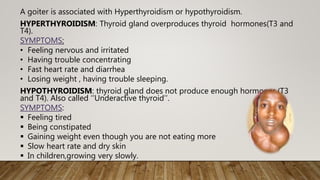
A goiter is associated with Hyperthyroidism or hypothyroidism.
HYPERTHYROIDISM: Thyroid gland overproduces thyroid hormones(T3 and
T4).
SYMPTOMS:
• Feeling nervous and irritated
• Having trouble concentrating
• Fast heart rate and diarrhea
• Losing weight , having trouble sleeping.
HYPOTHYROIDISM: thyroid gland does not produce enough hormones.(T3
and T4). Also called ‘’Underactive thyroid’’.
SYMPTOMS:
 Feeling tired
 Being constipated
 Gaining weight even though you are not eating more
 Slow heart rate and dry skin
 In children,growing very slowly.
TREATMENT
 Goitre is treated according to the cause. If the thyroid gland
is producing too much T3 and T4 , radioactive iodine is
given to the patient to shrink the gland.
 If goiter is caused by iodine deficiency, small doses of
iodide in the form of Lugol’s Iodine or KI solution are
given.
 If goiter is associated with underactive thyroid, thyroid
supplements are used as treatment.
 In extreme cases, a partial or complete thyroidectomy is
required.
A usually congenital abnormal condition
marked by physical stunting and mental
retardation and caused by severe
hypothyroidism.
CAUSE
S
A diet deficient in iodine (endemic cretinism).
Genetic defect of the gland.
Congenital lack of thyroid gland(congenital
cretinism).
Pathophysiology
 Congenital hypothyroidism can be endemic, genetic, or
sporadic. If untreated, it results in mild to severe impairment of
both physical and mental growth and development.
 In adults, Cretinism results in mental deterioration, swelling of
the skin, loss of water and hair. Bone maturation and puberty
are severely delayed. Ovulation is impeded, and infertility is
common.
Symptoms
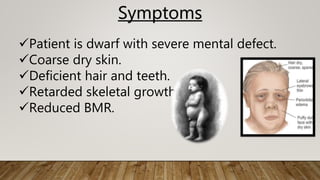
Patient is dwarf with severe mental defect.
Coarse dry skin.
Deficient hair and teeth.
Retarded skeletal growth.
Reduced BMR.
 Thyroxine must be dosed as tablets only, even to newborns, as
the liquid oral suspensions and compounded forms cannot be
depended on for reliable dosing.
 In the case of dosing infants, the T4 tablets are generally
crushed and mixed with breast milk, formula milk or water.
 If the medication is mixed with formulas containing iron or
products, larger doses may be required, as these substances
may alter the absorption of thyroid hormone from the gut.
 Frequent monitoring (every 2–3 weeks during the first months
of life) is recommended to ensure that infants with congenital
hypothyroidism remain within the high end of normal range.
TREATMENT
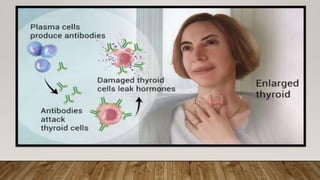
Hashimoto's thyroiditis, also known as chronic
lymphocytic thyroiditis and Hashimoto's disease, is an
autoimmune disease in which the thyroid gland is
gradually destroyed.
What is Hashimato’s Thyroiditis?
 Hashimoto’s thyroiditis (also called autoimmune or chronic
lymphocytic thyroiditis) is the most common thyroid disease in
the United States.
 It is an inherited condition that affects approximately 14 million
Americans and is about 7 times more common in women than in
men.
 It is characterized by the production of immune cells and
autoantibodies by the body’s immune system, which can
damage thyroid cells and compromise their ability to make
thyroid hormone.
What is the cause?
Hashimoto’s thyroiditis results from a malfunction in the
immune system. When working properly, the immune system
is designed to protect the body against invaders, such as
bacteria, viruses, and other foreign substances. The immune
system of someone with Hashimoto’s thyroiditis mistakenly
recognizes normal thyroid cells as foreign tissue, and it
produces antibodies that may destroy these cells. Although
various environmental factors have been studied, none have
been positively proven to be the cause of Hashimoto’s
thyroiditis.
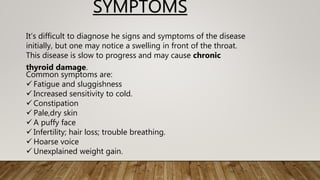
It’s difficult to diagnose he signs and symptoms of the disease
initially, but one may notice a swelling in front of the throat.
This disease is slow to progress and may cause chronic
thyroid damage.
Common symptoms are:
 Fatigue and sluggishness
 Increased sensitivity to cold.
 Constipation
 Pale,dry skin
 A puffy face
 Infertility; hair loss; trouble breathing.
 Hoarse voice
 Unexplained weight gain.
SYMPTOMS
How is it Diagnosed?
A physician experienced in the diagnosis and treatment
of thyroid disease can detect a goiter due to
Hashimoto’s thyroiditis by performing a physical
examination and can recognize hypothyroidism by
identifying characteristic symptoms, finding typical
physical signs, and doing appropriate laboratory tests.
LABORATORY DIAGNOSIS
 T3 and T4 decrese and TSH (increase) serum levels.
 Antithyroid Antibodies: Increased antithyroid
antibodies provide the most specific laboratory
evidence of Hashimoto’s thyroiditis, but they are not
present in all cases.
TREATMENT
Treatment may include continuous supervision
and medication use.
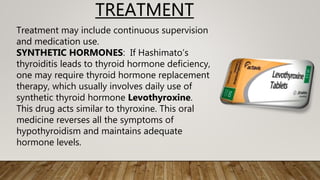
SYNTHETIC HORMONES: If Hashimato’s
thyroiditis leads to thyroid hormone deficiency,
one may require thyroid hormone replacement
therapy, which usually involves daily use of
synthetic thyroid hormone Levothyroxine.
This drug acts similar to thyroxine. This oral
medicine reverses all the symptoms of
hypothyroidism and maintains adequate
hormone levels.
Myxedema or myxoedema is a term used
synonymously with severe hypothyroidism.
 Caused by diminished production of
Thyroxin.
 Condition is also called Myxedema as
a gelatinous mixture of mucoprotein
and extracellular fluid is deposited in
the intracellular spce, specifically in
dermal connective tissue.
 Rate of metabolism in all tissues is
decreased to half.
CAUSES
 Myxedema causes specific forms of dermal
edema.
 The connective fibres is separated by an
increased amount of mucosaccharides. This
protein-mucosaccharide complex binds water.
 In particular,around eyes,hads and feet.
 Myxedema is also responisible for tickening of
tongue and laryngeal and pharyngeal mucous
membranes.
Pathophysiology
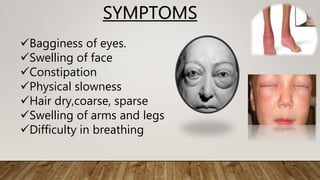
Bagginess of eyes.
Swelling of face
Constipation
Physical slowness
Hair dry,coarse, sparse
Swelling of arms and legs
Difficulty in breathing
SYMPTOMS
TREATMENT
Passive warming
Thyroxin: 0.1mg,5tab,2 tab/day
Antibiotics,ventilation, hydrocortisone IV ,
passive warming, careful volume
management.
Medication to replace the reduced thyroid
hormones, such as levothyroixine are
prescribed at low dosage.
Grave’s disease is an autoimmune disorder that
leads to over-activity of the thyroid gland
(hyperthyroidism).
 The patient’s own immune system attacks the Thyroid
gland.
 It is most common in women over age 20 but can
affect either gender at any age.
 Abnormal immune response that
causes thyroid gland to produce too
much thyroid
hormone(hyperthyroidism).
 Normally, thyroid gets production
orders through TSH (thyroid stimulating
hormone) released by the pituitary
gland, but in Grave’s disease a
malfunction in the body’s immune
system release abnormal antibodies
that mimic TSH.
CAUSE
SYMPTOMS
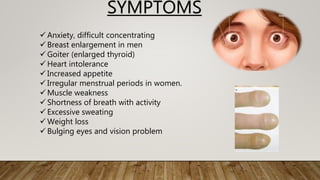
 Anxiety, difficult concentrating
 Breast enlargement in men
 Goiter (enlarged thyroid)
 Heart intolerance
 Increased appetite
 Irregular menstrual periods in women.
 Muscle weakness
 Shortness of breath with activity
 Excessive sweating
 Weight loss
 Bulging eyes and vision problem
DIAGNOSIS
A simple physical exam can reveal an enlarged
thyroid,enlarged bulging eyes and signs of
increased metabolism.
Blood tests to check for high levels of
Thyroxine(T4) and low levels of TSH, both of which
are signs of Grave’s disease.
A radioactive Iodine uptake might also be
administered to measure how quickly the thyroid
takes up iodine,which it needs to function properly.
A high intake of Iodine is consistent with Grave’s
Disease.
TREATMENT
 Beta blockers such as, propranolol (treat rapid
heart rate, anxiety and sweating)
 To treat hyperthyroidism:
• Antithyroid medications
• Radioactive iodine
• Surgery
**Using radiation or surgery will require one to
take replacement thyroid hormones for the rest of
your life because these treatments destroy the
gland.
 Thyroid nodules are growths that form on or in the
thyroid gland.
 The nodules can be solid or fluid-filled.
 Most of the nodules are benign in nature.
 Most thyroid nodules don’t cause any symptoms.
However, if they grow large enough , they can cause
swelling in the neck and lead to breathing difficulties.
 Some nodules produce thyroid hormone,causing
abnormally high levels in the bloodstream.
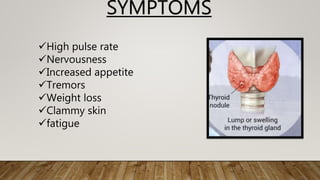
High pulse rate
Nervousness
Increased appetite
Tremors
Weight loss
Clammy skin
fatigue
SYMPTOMS
THYROID NODULES DIAGNOSIS AND TREATMENT
 Thyroid nodules can be detected during an
ultrasound,CT scan,or an MRI. Once, a nodule is
detected,other procedures- TSH test and a Thyroid
scan- can check for hyper or hypothyroidism.
 A Fine-needleAspiration(FNA) is used to take a
sample of cells from the nodule and determine
whether the nodule is cancerous.
 Chemotheraphy is often required iuf cancerous
nodules spread to other parts of the body.
 Radiation therapy is sometimes used with or
without surgery.
Thyroid gland disorders

Thyroid gland disorders

  • 1.
  • 2.
    CONTENTS 1.DISORDERS • GOITER • CRETINISM •MYXEDEMA • HASHIMATO’S DISEASE • GRAVES’S DISEASE • THYROID NODULES 2. SYMPTOMS 3.TREATMENT
  • 3.
     A Goiteris a swelling in the neck resulting from an enlarged thyroid gland.  Worldwide, over 90% of goiter cases are caused by iodine deficiency.  Most goiter’s are of benign nature.  Approximately, 800 million people subsist on iodine-deficient diet.
  • 4.
    CAUSES  Lack ofiodine  Thyroid Cancer  Pregnancy  Inflammation  Grave’s disease (overactive goiter)  Hashimoto’s disease (underactive goiter)
  • 5.
  • 6.
    Classification (based on growthpattern)  Uninodular : One thyroid nodule; can be either an inactive or a toxic nodule.  Multinodular : Multiple nodules; can be inactive or toxic, the latter is called toxic multinodular goiter and associated with hyperthyroidism.  Diffuse: The whole thyroid appearing to be enlarged due to hyperplasia(increase in number of cells in an organ or tissue).
  • 7.
    A goiter isassociated with Hyperthyroidism or hypothyroidism. HYPERTHYROIDISM: Thyroid gland overproduces thyroid hormones(T3 and T4). SYMPTOMS: • Feeling nervous and irritated • Having trouble concentrating • Fast heart rate and diarrhea • Losing weight , having trouble sleeping. HYPOTHYROIDISM: thyroid gland does not produce enough hormones.(T3 and T4). Also called ‘’Underactive thyroid’’. SYMPTOMS:  Feeling tired  Being constipated  Gaining weight even though you are not eating more  Slow heart rate and dry skin  In children,growing very slowly.
  • 8.
    TREATMENT  Goitre istreated according to the cause. If the thyroid gland is producing too much T3 and T4 , radioactive iodine is given to the patient to shrink the gland.  If goiter is caused by iodine deficiency, small doses of iodide in the form of Lugol’s Iodine or KI solution are given.  If goiter is associated with underactive thyroid, thyroid supplements are used as treatment.  In extreme cases, a partial or complete thyroidectomy is required.
  • 9.
    A usually congenitalabnormal condition marked by physical stunting and mental retardation and caused by severe hypothyroidism.
  • 10.
    CAUSE S A diet deficientin iodine (endemic cretinism). Genetic defect of the gland. Congenital lack of thyroid gland(congenital cretinism).
  • 11.
    Pathophysiology  Congenital hypothyroidismcan be endemic, genetic, or sporadic. If untreated, it results in mild to severe impairment of both physical and mental growth and development.  In adults, Cretinism results in mental deterioration, swelling of the skin, loss of water and hair. Bone maturation and puberty are severely delayed. Ovulation is impeded, and infertility is common.
  • 12.
    Symptoms Patient is dwarfwith severe mental defect. Coarse dry skin. Deficient hair and teeth. Retarded skeletal growth. Reduced BMR.
  • 13.
     Thyroxine mustbe dosed as tablets only, even to newborns, as the liquid oral suspensions and compounded forms cannot be depended on for reliable dosing.  In the case of dosing infants, the T4 tablets are generally crushed and mixed with breast milk, formula milk or water.  If the medication is mixed with formulas containing iron or products, larger doses may be required, as these substances may alter the absorption of thyroid hormone from the gut.  Frequent monitoring (every 2–3 weeks during the first months of life) is recommended to ensure that infants with congenital hypothyroidism remain within the high end of normal range. TREATMENT
  • 14.
    Hashimoto's thyroiditis, alsoknown as chronic lymphocytic thyroiditis and Hashimoto's disease, is an autoimmune disease in which the thyroid gland is gradually destroyed.
  • 15.
    What is Hashimato’sThyroiditis?  Hashimoto’s thyroiditis (also called autoimmune or chronic lymphocytic thyroiditis) is the most common thyroid disease in the United States.  It is an inherited condition that affects approximately 14 million Americans and is about 7 times more common in women than in men.  It is characterized by the production of immune cells and autoantibodies by the body’s immune system, which can damage thyroid cells and compromise their ability to make thyroid hormone.
  • 16.
    What is thecause? Hashimoto’s thyroiditis results from a malfunction in the immune system. When working properly, the immune system is designed to protect the body against invaders, such as bacteria, viruses, and other foreign substances. The immune system of someone with Hashimoto’s thyroiditis mistakenly recognizes normal thyroid cells as foreign tissue, and it produces antibodies that may destroy these cells. Although various environmental factors have been studied, none have been positively proven to be the cause of Hashimoto’s thyroiditis.
  • 18.
    It’s difficult todiagnose he signs and symptoms of the disease initially, but one may notice a swelling in front of the throat. This disease is slow to progress and may cause chronic thyroid damage. Common symptoms are:  Fatigue and sluggishness  Increased sensitivity to cold.  Constipation  Pale,dry skin  A puffy face  Infertility; hair loss; trouble breathing.  Hoarse voice  Unexplained weight gain. SYMPTOMS
  • 19.
    How is itDiagnosed? A physician experienced in the diagnosis and treatment of thyroid disease can detect a goiter due to Hashimoto’s thyroiditis by performing a physical examination and can recognize hypothyroidism by identifying characteristic symptoms, finding typical physical signs, and doing appropriate laboratory tests. LABORATORY DIAGNOSIS  T3 and T4 decrese and TSH (increase) serum levels.  Antithyroid Antibodies: Increased antithyroid antibodies provide the most specific laboratory evidence of Hashimoto’s thyroiditis, but they are not present in all cases.
  • 20.
    TREATMENT Treatment may includecontinuous supervision and medication use. SYNTHETIC HORMONES: If Hashimato’s thyroiditis leads to thyroid hormone deficiency, one may require thyroid hormone replacement therapy, which usually involves daily use of synthetic thyroid hormone Levothyroxine. This drug acts similar to thyroxine. This oral medicine reverses all the symptoms of hypothyroidism and maintains adequate hormone levels.
  • 21.
    Myxedema or myxoedemais a term used synonymously with severe hypothyroidism.
  • 22.
     Caused bydiminished production of Thyroxin.  Condition is also called Myxedema as a gelatinous mixture of mucoprotein and extracellular fluid is deposited in the intracellular spce, specifically in dermal connective tissue.  Rate of metabolism in all tissues is decreased to half. CAUSES
  • 23.
     Myxedema causesspecific forms of dermal edema.  The connective fibres is separated by an increased amount of mucosaccharides. This protein-mucosaccharide complex binds water.  In particular,around eyes,hads and feet.  Myxedema is also responisible for tickening of tongue and laryngeal and pharyngeal mucous membranes. Pathophysiology
  • 24.
    Bagginess of eyes. Swellingof face Constipation Physical slowness Hair dry,coarse, sparse Swelling of arms and legs Difficulty in breathing SYMPTOMS
  • 25.
    TREATMENT Passive warming Thyroxin: 0.1mg,5tab,2tab/day Antibiotics,ventilation, hydrocortisone IV , passive warming, careful volume management. Medication to replace the reduced thyroid hormones, such as levothyroixine are prescribed at low dosage.
  • 26.
    Grave’s disease isan autoimmune disorder that leads to over-activity of the thyroid gland (hyperthyroidism).  The patient’s own immune system attacks the Thyroid gland.  It is most common in women over age 20 but can affect either gender at any age.
  • 27.
     Abnormal immuneresponse that causes thyroid gland to produce too much thyroid hormone(hyperthyroidism).  Normally, thyroid gets production orders through TSH (thyroid stimulating hormone) released by the pituitary gland, but in Grave’s disease a malfunction in the body’s immune system release abnormal antibodies that mimic TSH. CAUSE
  • 28.
    SYMPTOMS  Anxiety, difficultconcentrating  Breast enlargement in men  Goiter (enlarged thyroid)  Heart intolerance  Increased appetite  Irregular menstrual periods in women.  Muscle weakness  Shortness of breath with activity  Excessive sweating  Weight loss  Bulging eyes and vision problem
  • 29.
    DIAGNOSIS A simple physicalexam can reveal an enlarged thyroid,enlarged bulging eyes and signs of increased metabolism. Blood tests to check for high levels of Thyroxine(T4) and low levels of TSH, both of which are signs of Grave’s disease. A radioactive Iodine uptake might also be administered to measure how quickly the thyroid takes up iodine,which it needs to function properly. A high intake of Iodine is consistent with Grave’s Disease.
  • 30.
    TREATMENT  Beta blockerssuch as, propranolol (treat rapid heart rate, anxiety and sweating)  To treat hyperthyroidism: • Antithyroid medications • Radioactive iodine • Surgery **Using radiation or surgery will require one to take replacement thyroid hormones for the rest of your life because these treatments destroy the gland.
  • 31.
     Thyroid nodulesare growths that form on or in the thyroid gland.  The nodules can be solid or fluid-filled.  Most of the nodules are benign in nature.  Most thyroid nodules don’t cause any symptoms. However, if they grow large enough , they can cause swelling in the neck and lead to breathing difficulties.  Some nodules produce thyroid hormone,causing abnormally high levels in the bloodstream.
  • 32.
    High pulse rate Nervousness Increasedappetite Tremors Weight loss Clammy skin fatigue SYMPTOMS
  • 33.
    THYROID NODULES DIAGNOSISAND TREATMENT  Thyroid nodules can be detected during an ultrasound,CT scan,or an MRI. Once, a nodule is detected,other procedures- TSH test and a Thyroid scan- can check for hyper or hypothyroidism.  A Fine-needleAspiration(FNA) is used to take a sample of cells from the nodule and determine whether the nodule is cancerous.  Chemotheraphy is often required iuf cancerous nodules spread to other parts of the body.  Radiation therapy is sometimes used with or without surgery.