NON-
COMMUNICABLE
DISEASE
EPIDEMIOLOGY
PROGRAM: BSC
PUBLIC HEALTH
[YEAR: TWO (2)]
DEPARTMENT OF
EPIDEMIOLOGY&
BIO-STATISTIC NJALA
UNIVERSITY (Bo
Campus)
HASHIMOTO’S
THYROIDITIS
Introduction
The burden of hashimoto's thyroiditis (globally
and in sierra leone)
Risk factors
Sings and symptoms
Diagnosis
Treatment
Prevention and control
OUTLINE
 The name Hashimotos thyroiditis is derived from the 1912
report by Hashimoto describing patients with Goiterand
intense lymphocytic infiltration of the thyroid
(strumalymphomatosa).
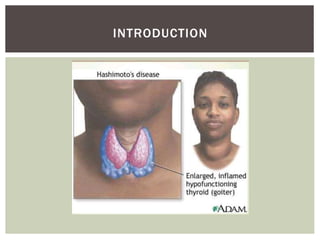
 Hashimoto's thyroiditis is an autoimmune disease in which
the thyroid gland is attacked by a variety of cell- and
antibody-mediated immune processes causing primary
hypothyroidism In this case the immune system mistakenly
attacks the thyroid gland, leading to inflammation and
damage over time this form of thyroid disease may also be
referred to as chronic lymphocytic thyroiditis.
INRODUCTION
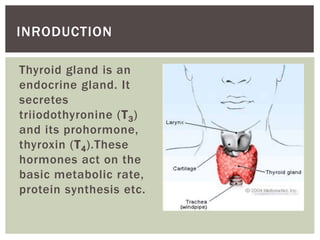
Thyroid gland is an
endocrine gland. It
secretes
triiodothyronine (T3)
and its prohormone,
thyroxin (T4).These
hormones act on the
basic metabolic rate,
protein synthesis etc.
INRODUCTION
INTRODUCTION
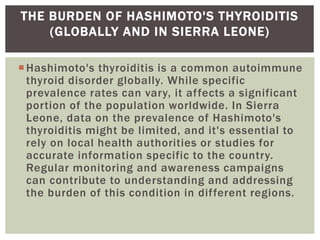
Hashimoto's thyroiditis is a common autoimmune
thyroid disorder globally. While specific
prevalence rates can vary, it affects a significant
portion of the population worldwide. In Sierra
Leone, data on the prevalence of Hashimoto's
thyroiditis might be limited, and it's essential to
rely on local health authorities or studies for
accurate information specific to the country.
Regular monitoring and awareness campaigns
can contribute to understanding and addressing
the burden of this condition in different regions.
THE BURDEN OF HASHIMOTO'S THYROIDITIS
(GLOBALLY AND IN SIERRA LEONE)
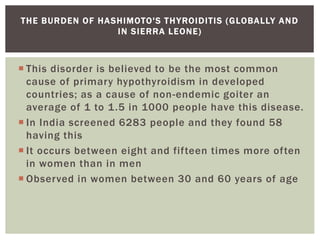
 This disorder is believed to be the most common
cause of primary hypothyroidism in developed
countries; as a cause of non-endemic goiter an
average of 1 to 1.5 in 1000 people have this disease.
 In India screened 6283 people and they found 58
having this
 It occurs between eight and fifteen times more often
in women than in men
 Observed in women between 30 and 60 years of age
THE BURDEN OF HASHIMOTO'S THYROIDITIS (GLOBALLY AND
IN SIERRA LEONE)
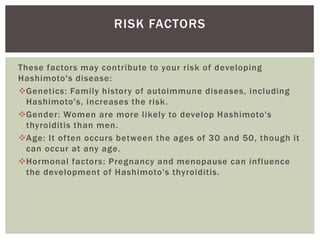
These factors may contribute to your risk of developing
Hashimoto's disease:
Genetics: Family history of autoimmune diseases, including
Hashimoto's, increases the risk.
Gender: Women are more likely to develop Hashimoto's
thyroiditis than men.
Age: It often occurs between the ages of 30 and 50, though it
can occur at any age.
Hormonal factors: Pregnancy and menopause can influence
the development of Hashimoto's thyroiditis.
RISK FACTORS
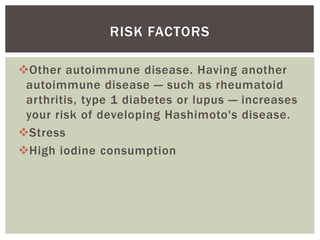
Other autoimmune disease. Having another
autoimmune disease — such as rheumatoid
arthritis, type 1 diabetes or lupus — increases
your risk of developing Hashimoto's disease.
Stress
High iodine consumption
RISK FACTORS
Symptoms and signs of Hashimoto's thyroiditis
resemble those of hypothyroidism generally and
are often subtle. They are not specific (which
means they can mimic the symptoms of many
other conditions) and are often attributed to
aging. Symptoms generally become more
obvious as the condition worsens. The majority
of these complaints are related to a metabolic
slowing of the body
SINGS AND SYMPTOMS
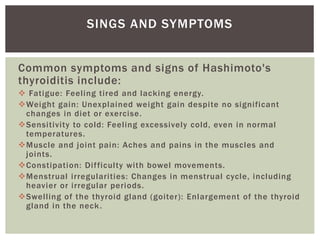
Common symptoms and signs of Hashimoto's
thyroiditis include:
 Fatigue: Feeling tired and lacking energy.
Weight gain: Unexplained weight gain despite no significant
changes in diet or exercise.
Sensitivity to cold: Feeling excessively cold, even in normal
temperatures.
Muscle and joint pain: Aches and pains in the muscles and
joints.
Constipation: Difficulty with bowel movements.
Menstrual irregularities: Changes in menstrual cycle, including
heavier or irregular periods.
Swelling of the thyroid gland (goiter): Enlargement of the thyroid
gland in the neck.
SINGS AND SYMPTOMS
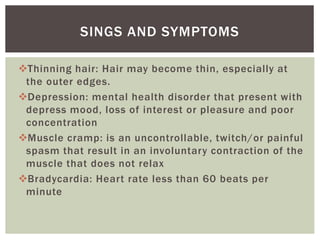
Thinning hair: Hair may become thin, especially at
the outer edges.
Depression: mental health disorder that present with
depress mood, loss of interest or pleasure and poor
concentration
Muscle cramp: is an uncontrollable, twitch/or painful
spasm that result in an involuntary contraction of the
muscle that does not relax
Bradycardia: Heart rate less than 60 beats per
minute
SINGS AND SYMPTOMS
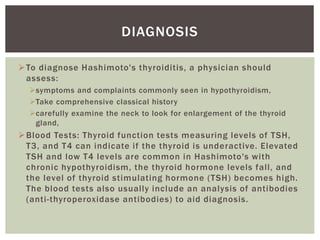
To diagnose Hashimoto's thyroiditis, a physician should
assess:
symptoms and complaints commonly seen in hypothyroidism,
Take comprehensive classical history
carefully examine the neck to look for enlargement of the thyroid
gland,
Blood Tests: Thyroid function tests measuring levels of TSH,
T3, and T4 can indicate if the thyroid is underactive. Elevated
TSH and low T4 levels are common in Hashimoto's with
chronic hypothyroidism, the thyroid hormone levels fall, and
the level of thyroid stimulating hormone (TSH) becomes high.
The blood tests also usually include an analysis of antibodies
(anti-thyroperoxidase antibodies) to aid diagnosis.
DIAGNOSIS
Ultrasound: Imaging studies, such as
ultrasound, may be used to visualize the
thyroid gland and assess its structure
The combination of the patient's clinical
history, antibody screening, and a thyroid scan
can help diagnose the precise underlying
thyroid problem.
If the anti-TPO antibodies are elevated at all,
the diagnosis is made.
DIAGNOSIS
There is no known cure for Hashimoto's thyroiditis.
Thyroid Hormone Replacement: Levothyroxine is a
common medication used to replace the deficient
thyroid hormones and normalize hormone levels.
Monitoring: Regular thyroid function tests are
essential to adjust medication dosage and ensure
optimal hormone levels.
Lifestyle Management: A healthy lifestyle, including
a balanced diet, regular exercise, and stress
management, can support overall well-being.
TREATMENT
Iodine Management: Depending on iodine
levels, healthcare providers may recommend
iodine supplements or advise against
excessive intake.
Addressing Symptoms: Symptomatic relief for
specific symptoms, such as fatigue or joint
pain, may be part of the treatment plan.
TREATMENT
Hashimoto's thyroiditis is an autoimmune condition in which the
body perceives its own tissue as foreign.
i. There is no clear way to prevent this condition but a few
precautions can be recommended, such as:
ii. Maintain a Healthy Lifestyle: Eat a balanced diet rich in
nutrients, engage in regular physical activity, and manage
stress levels. These habits can support overall immune system
function.
iii. Regular Health Check-ups: Periodic check-ups with healthcare
professionals can help monitor your health, including thyroid
function. Early detection of thyroid abnormalities can lead to
prompt management.
iv. Avoid Excessive Iodine: While iodine is essential for thyroid
function, excessive intake can potentially trigger or exacerbate
thyroid conditions. Maintain a balanced iodine intake through
dietary sources.
PEEVENTION AND CONTROL
QUESTIONS??
THE END!!!!THANKS!

HASHIMOTO’S THYROIDITIS presentation.pptx

  • 1.
    NON- COMMUNICABLE DISEASE EPIDEMIOLOGY PROGRAM: BSC PUBLIC HEALTH [YEAR:TWO (2)] DEPARTMENT OF EPIDEMIOLOGY& BIO-STATISTIC NJALA UNIVERSITY (Bo Campus) HASHIMOTO’S THYROIDITIS
  • 2.
    Introduction The burden ofhashimoto's thyroiditis (globally and in sierra leone) Risk factors Sings and symptoms Diagnosis Treatment Prevention and control OUTLINE
  • 3.
     The nameHashimotos thyroiditis is derived from the 1912 report by Hashimoto describing patients with Goiterand intense lymphocytic infiltration of the thyroid (strumalymphomatosa).  Hashimoto's thyroiditis is an autoimmune disease in which the thyroid gland is attacked by a variety of cell- and antibody-mediated immune processes causing primary hypothyroidism In this case the immune system mistakenly attacks the thyroid gland, leading to inflammation and damage over time this form of thyroid disease may also be referred to as chronic lymphocytic thyroiditis. INRODUCTION
  • 4.
    Thyroid gland isan endocrine gland. It secretes triiodothyronine (T3) and its prohormone, thyroxin (T4).These hormones act on the basic metabolic rate, protein synthesis etc. INRODUCTION
  • 5.
  • 6.
    Hashimoto's thyroiditis isa common autoimmune thyroid disorder globally. While specific prevalence rates can vary, it affects a significant portion of the population worldwide. In Sierra Leone, data on the prevalence of Hashimoto's thyroiditis might be limited, and it's essential to rely on local health authorities or studies for accurate information specific to the country. Regular monitoring and awareness campaigns can contribute to understanding and addressing the burden of this condition in different regions. THE BURDEN OF HASHIMOTO'S THYROIDITIS (GLOBALLY AND IN SIERRA LEONE)
  • 7.
     This disorderis believed to be the most common cause of primary hypothyroidism in developed countries; as a cause of non-endemic goiter an average of 1 to 1.5 in 1000 people have this disease.  In India screened 6283 people and they found 58 having this  It occurs between eight and fifteen times more often in women than in men  Observed in women between 30 and 60 years of age THE BURDEN OF HASHIMOTO'S THYROIDITIS (GLOBALLY AND IN SIERRA LEONE)
  • 8.
    These factors maycontribute to your risk of developing Hashimoto's disease: Genetics: Family history of autoimmune diseases, including Hashimoto's, increases the risk. Gender: Women are more likely to develop Hashimoto's thyroiditis than men. Age: It often occurs between the ages of 30 and 50, though it can occur at any age. Hormonal factors: Pregnancy and menopause can influence the development of Hashimoto's thyroiditis. RISK FACTORS
  • 9.
    Other autoimmune disease.Having another autoimmune disease — such as rheumatoid arthritis, type 1 diabetes or lupus — increases your risk of developing Hashimoto's disease. Stress High iodine consumption RISK FACTORS
  • 10.
    Symptoms and signsof Hashimoto's thyroiditis resemble those of hypothyroidism generally and are often subtle. They are not specific (which means they can mimic the symptoms of many other conditions) and are often attributed to aging. Symptoms generally become more obvious as the condition worsens. The majority of these complaints are related to a metabolic slowing of the body SINGS AND SYMPTOMS
  • 11.
    Common symptoms andsigns of Hashimoto's thyroiditis include:  Fatigue: Feeling tired and lacking energy. Weight gain: Unexplained weight gain despite no significant changes in diet or exercise. Sensitivity to cold: Feeling excessively cold, even in normal temperatures. Muscle and joint pain: Aches and pains in the muscles and joints. Constipation: Difficulty with bowel movements. Menstrual irregularities: Changes in menstrual cycle, including heavier or irregular periods. Swelling of the thyroid gland (goiter): Enlargement of the thyroid gland in the neck. SINGS AND SYMPTOMS
  • 12.
    Thinning hair: Hairmay become thin, especially at the outer edges. Depression: mental health disorder that present with depress mood, loss of interest or pleasure and poor concentration Muscle cramp: is an uncontrollable, twitch/or painful spasm that result in an involuntary contraction of the muscle that does not relax Bradycardia: Heart rate less than 60 beats per minute SINGS AND SYMPTOMS
  • 13.
    To diagnose Hashimoto'sthyroiditis, a physician should assess: symptoms and complaints commonly seen in hypothyroidism, Take comprehensive classical history carefully examine the neck to look for enlargement of the thyroid gland, Blood Tests: Thyroid function tests measuring levels of TSH, T3, and T4 can indicate if the thyroid is underactive. Elevated TSH and low T4 levels are common in Hashimoto's with chronic hypothyroidism, the thyroid hormone levels fall, and the level of thyroid stimulating hormone (TSH) becomes high. The blood tests also usually include an analysis of antibodies (anti-thyroperoxidase antibodies) to aid diagnosis. DIAGNOSIS
  • 14.
    Ultrasound: Imaging studies,such as ultrasound, may be used to visualize the thyroid gland and assess its structure The combination of the patient's clinical history, antibody screening, and a thyroid scan can help diagnose the precise underlying thyroid problem. If the anti-TPO antibodies are elevated at all, the diagnosis is made. DIAGNOSIS
  • 15.
    There is noknown cure for Hashimoto's thyroiditis. Thyroid Hormone Replacement: Levothyroxine is a common medication used to replace the deficient thyroid hormones and normalize hormone levels. Monitoring: Regular thyroid function tests are essential to adjust medication dosage and ensure optimal hormone levels. Lifestyle Management: A healthy lifestyle, including a balanced diet, regular exercise, and stress management, can support overall well-being. TREATMENT
  • 16.
    Iodine Management: Dependingon iodine levels, healthcare providers may recommend iodine supplements or advise against excessive intake. Addressing Symptoms: Symptomatic relief for specific symptoms, such as fatigue or joint pain, may be part of the treatment plan. TREATMENT
  • 17.
    Hashimoto's thyroiditis isan autoimmune condition in which the body perceives its own tissue as foreign. i. There is no clear way to prevent this condition but a few precautions can be recommended, such as: ii. Maintain a Healthy Lifestyle: Eat a balanced diet rich in nutrients, engage in regular physical activity, and manage stress levels. These habits can support overall immune system function. iii. Regular Health Check-ups: Periodic check-ups with healthcare professionals can help monitor your health, including thyroid function. Early detection of thyroid abnormalities can lead to prompt management. iv. Avoid Excessive Iodine: While iodine is essential for thyroid function, excessive intake can potentially trigger or exacerbate thyroid conditions. Maintain a balanced iodine intake through dietary sources. PEEVENTION AND CONTROL
  • 19.