Tips on using my ppt.
1. You can freely download, edit, modify and put your
name etc.
2. Don’t be concerned about number of slides. Half the
slides are blanks except for the title.
3. First show the blank slides (eg. Aetiology ) > Ask
students what they already know about ethology of
today's topic. > Then show next slide which enumerates
aetiologies.
4. At the end rerun the show – show blank> ask questions >
show next slide.
5. This will be an ACTIVE LEARNING SESSION x
three revisions.
6. Good for self study also.
7. See notes for bibliography.
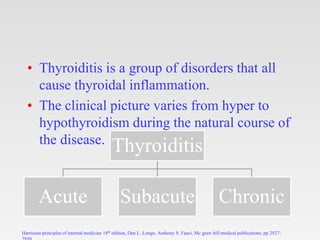
• Thyroiditis is a group of disorders that all
cause thyroidal inflammation.
• The clinical picture varies from hyper to
hypothyroidism during the natural course of
the disease.
Thyroiditis
Acute Subacute Chronic
Harrisons principles of internal medicine 18th edition, Dan L. Longo, Anthony S. Fauci, Mc graw hill medical publications, pp 2927-
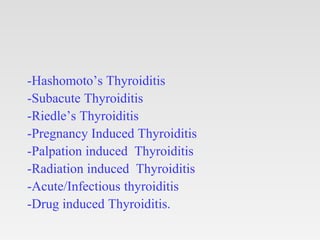
-Hashomoto’s Thyroiditis
-Subacute Thyroiditis
-Riedle’s Thyroiditis
-Pregnancy Induced Thyroiditis
-Palpation induced Thyroiditis
-Radiation induced Thyroiditis
-Acute/Infectious thyroiditis
-Drug induced Thyroiditis.
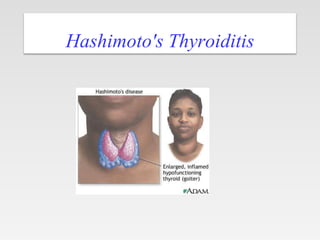
Hashimoto's Thyroiditis
• It is characterized by:
Gradual thyroid failure because of
autoimmune destruction of the thyroid
gland.
• The name Hashimoto thyroiditis is
derived from the 1912 report by
Hashimoto describing patients with goiter
and intense lymphocytic infiltration of the
thyroid (struma lymphomatosa)
• The most common cause of thyroiditis.
• This condition is the most common cause of
hypothyroidism in the United States in
individuals older than 6 years.
• This form of thyroid disease may also be
referred to as chronic lymphocytic
thyroiditis.
Incidence:
Incidence:
• it is primarily a disease of older women.
• can occur in children “ nonendemic goiter”
• The concordance rate in monozygotic twins
is 30% to 60%.
• Several chromosomal abnormalities have
been associated with thyroid autoimmunity.
• There are reports that polymorphisms in the
HLA locus, specifically the HLA-DR3 and
HLA-DR5 alleles, are linked to Hashimoto
thyroiditis, but the association is weak.
• genome wide linkage analyses in families
with Hashimoto thyroiditis have provided
evidence for several susceptibility loci, such
as on chromosomes 6p and 12q, that may
harbor genes predisposing to this disorder.
Pathogenesis
Pathogenesis
• Hashimoto thyroiditis is an autoimmune
disease in which the immune system reacts
against a variety of thyroid antigens.
• There is progressive depletion of thyroid
epithelial cells (thyrocytes), which are
gradually replaced by mononuclear cell
infiltration and fibrosis.
Morphology
Morphology
• The thyroid is often diffusely enlarged.
• The capsule is intact.
• the gland is well demarcated from adjacent
structures.
• The cut surface is pale, yellow-tan, firm,
Clinical Features
Clinical Features
• many of the symptoms associated with thyroid
hormone deficiency.
• Fatigue
• Drowsiness
• Difficulty with learning
• Dry, brittle hair and nails
• Dry, itchy skin
• Puffy face
• Constipation.
• Weight gain
• Heavy menstrual flow
• Increased frequency of miscarriages
• Increased sensitivity to many medications.
DD
DD
• Euthyroid Sick Syndrome
• Goiter
• Goiter, Diffuse Toxic
• Goiter, Lithium-Induced
• Goiter, Nontoxic
• Goiter, Toxic Nodular
• Hypopituitarism (Panhypopituitarism)
• Polyglandular Autoimmune Syndrome, Type I
• Polyglandular Autoimmune Syndrome, Type II
• Thyroid Lymphoma
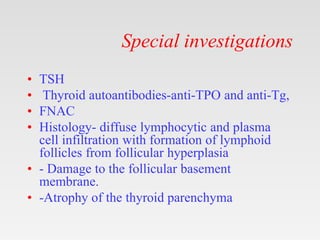
Special investigations
• TSH
• Thyroid autoantibodies-anti-TPO and anti-Tg,
• FNAC
• Histology- diffuse lymphocytic and plasma
cell infiltration with formation of lymphoid
follicles from follicular hyperplasia
• - Damage to the follicular basement
membrane.
• -Atrophy of the thyroid parenchyma
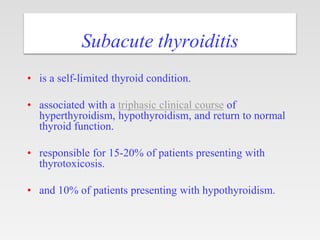
Subacute thyroiditis
• is a self-limited thyroid condition.
• associated with a triphasic clinical course of
hyperthyroidism, hypothyroidism, and return to normal
thyroid function.
• responsible for 15-20% of patients presenting with
thyrotoxicosis.
• and 10% of patients presenting with hypothyroidism.
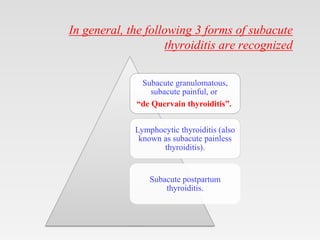
In general, the following 3 forms of subacute
thyroiditis are recognized
Subacute granulomatous,
subacute painful, or
“de Quervain thyroiditis”.
Lymphocytic thyroiditis (also
known as subacute painless
thyroiditis).
Subacute postpartum
thyroiditis.
“de Quervain thyroiditis”.
• Self limited disease
• CAUSE:
Possible viral cause.
• CLINICAL FEATURES:
Enlarged Gland, Tender
thyrotoxicosis followed by hypothyroidism.
Over Active Phase:
Over Active Phase:
• Within the first one to four months
• This phase can be characterized by :
1. slight enlargement of the thyroid .
2. Anxiety.
3. Restlessness.
4. Insomnia.
5. weight loss.
6. difficulty concentrating.
D/Ds
D/Ds
• Acute hemorrhage into a thyroid cyst,
nodule, or neoplasm
• Infectious thyroiditis
• Radiation-induced thyroiditis
• Trauma- or palpation-induced thyroiditis
• Riedel or fibroid thyroiditis
• Graves thyrotoxicosis
• Toxic thyroid adenoma
• Toxic multinodular goiter
Diagnosis:
Diagnosis:
• blood tests to measure :
• increased levels of thyroid hormone in the
bloodstream .
• the abnormal antibodies, anti-microsomal
and antithyroglobulin antibodies.
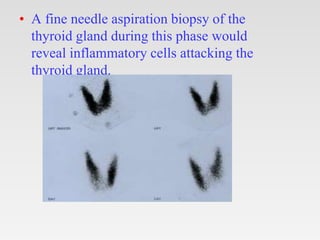
• A fine needle aspiration biopsy of the
thyroid gland during this phase would
reveal inflammatory cells attacking the
thyroid gland.
Treatment:
Treatment:
• During this hyperthyroid phase, treatment is
usually not recommended because this
phase usually lasts for a short period of
time, about 2 to 4 months.
• However, if the symptoms are extreme, beta
blockers may be used to slow the heart rate
and decrease nervousness.
Treatment
• thyroid hormone medication for about six
months.
• After this time, the medication is stopped to
determine whether or not the thyroid has
recovered its normal function.
• If so, the medication may be stopped
permanently, otherwise the medication must
be resumed because of permanent injury to
the thyroid gland.
Riedel’s Thyroiditis
Harrisons principles of internal medicine 18th edition, Dan L. Longo, Anthony S. Fauci, Mc graw hill medical publications, pp 2927-
Riedel’s Thyroiditis
• Rare disease
• Replacement of the normal
thyroid parenchyma by a dense
fibrosis.
• Painless goiter “woody”
• Open biopsy often needed to
diagnose
• Associated with focal sclerosis
syndromes.
Harrisons principles of internal medicine 18th edition, Dan L. Longo, Anthony S. Fauci, Mc graw hill medical publications, pp 2927-
Clinical features
Clinical features
• nonpainful, rapidly growing thyroid mass
Differential Diagnoses
•
Differential Diagnoses
• De Quervain Thyroiditis
• Goiter
• Hashimoto Thyroiditis
• Thyroid Lymphoma
• Anaplastic Carcinoma
• Thyroiditis, Subacute
complications
complications
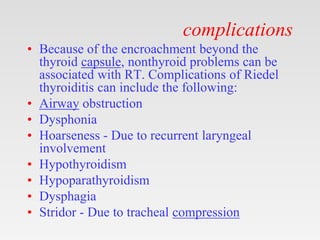
• Because of the encroachment beyond the
thyroid capsule, nonthyroid problems can be
associated with RT. Complications of Riedel
thyroiditis can include the following:
• Airway obstruction
• Dysphonia
• Hoarseness - Due to recurrent laryngeal
involvement
• Hypothyroidism
• Hypoparathyroidism
• Dysphagia
• Stridor - Due to tracheal compression
Treatment
Treatment
• Pharmacologic therapy includes the use of
corticosteroids, tamoxifen, and
levothyroxine.
Surgerry
Surgerry
• . A wedge resection of the thyroid isthmus
• Surgery is indicated when tissue is needed
for diagnosis, medical treatment shows no
benefit, or compressive symptoms are very
severe
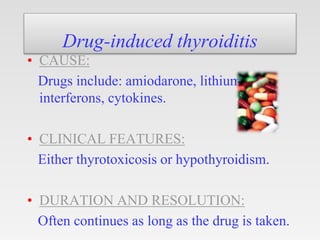
Drug-induced thyroiditis
• CAUSE:
Drugs include: amiodarone, lithium,
interferons, cytokines.
• CLINICAL FEATURES:
Either thyrotoxicosis or hypothyroidism.
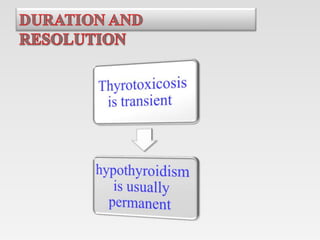
• DURATION AND RESOLUTION:
Often continues as long as the drug is taken.
Radiation induced Thyroiditis
• CAUSE:
1. Follows treatment with radioactive iodine for
hyperthyroidism
2. external beam radiation therapy for certain cancers.
CLINICAL FEATURES:
1. Occasionally thyrotoxicosis
2. more frequently hypothyroidism.
Acute/Infectious thyroiditis
• Acute suppurative thyroiditis is quite rare
in modern times.
• Cause:
It is caused by a bacterial infection in the
thyroid which causes pus to collect and
form an abscess within the thyroid gland.
The bacterial infection may be carried in the
bloodstream from anywhere in the body or
it may come from the throat itself.
Treatment of thyroiditis
• Treatment depends on the type of thyroiditis
and the clinical presentation.
Thyrotoxicosis Hypothyroidism Thyroidal pain
Thyrotoxicosis
Thyrotoxicosis
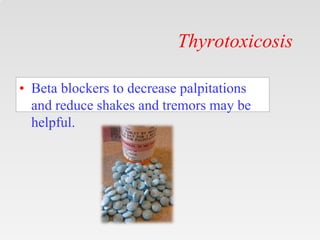
• Beta blockers to decrease palpitations
and reduce shakes and tremors may be
helpful.
Hypothyroidism
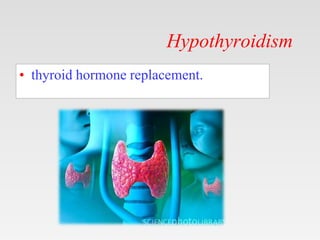
Hypothyroidism
• thyroid hormone replacement.
Thyroidal pain
Thyroidal pain
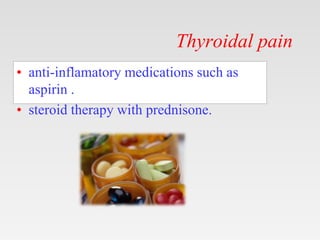
• anti-inflamatory medications such as
aspirin .
• steroid therapy with prednisone.
MCQ
MCQ
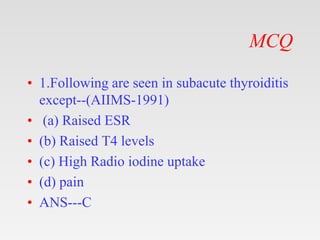
• 1.Following are seen in subacute thyroiditis
except--(AIIMS-1991)
• (a) Raised ESR
• (b) Raised T4 levels
• (c) High Radio iodine uptake
• (d) pain
• ANS---C
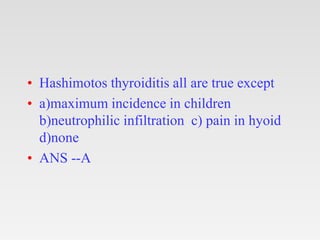
• Hashimotos thyroiditis all are true except
• a)maximum incidence in children
b)neutrophilic infiltration c) pain in hyoid
d)none
• ANS --A
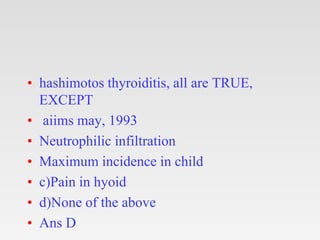
• hashimotos thyroiditis, all are TRUE,
EXCEPT
• aiims may, 1993
• Neutrophilic infiltration
• Maximum incidence in child
• c)Pain in hyoid
• d)None of the above
• Ans D
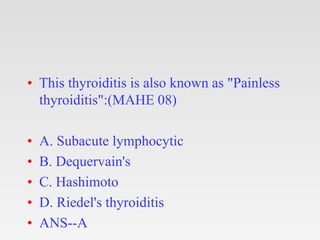
• This thyroiditis is also known as "Painless
thyroiditis":(MAHE 08)
• A. Subacute lymphocytic
• B. Dequervain's
• C. Hashimoto
• D. Riedel's thyroiditis
• ANS--A
• The feature of subacute thyroiditis include
a) Elevated T3 & T4 levels
b) Depressed TSH levels
c) Depressed RAIU
d) All of the above
• In chronic lymphocytic thyroiditis—
KARNATAKA 2007
• A)Surgery is indicated in a majority of
cases
A. B)Thyroid antibody estimation is useful in
a few cases
• C)FNAC is the most appropriate
investigation
• D)there is no role for steroid therapy in the
management
• The only reason for operating in case thyroiditisis -
• To prevent cancerous degeneration AIIMS
• 86)(JIPMER79)
• A)For relief of pain in neck and ear
•
• B)To overcome pressure on trachea or oesophagus
C)To cure the toxic reaction
• D)If there is auto immune reaction
• . Most common cause of Thyroiditis is -
• A)Reidl's Thyroiditis
• Subacute Thyroiditis
• Hashimoto's Thyroiditis
• Viral thyroiditis
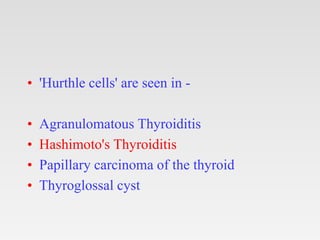
• 'Hurthle cells' are seen in -
• Agranulomatous Thyroiditis
• Hashimoto's Thyroiditis
• Papillary carcinoma of the thyroid
• Thyroglossal cyst
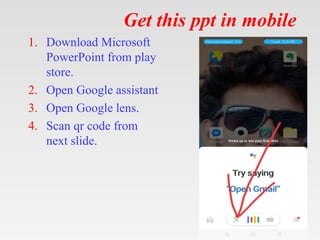
Get this ppt in mobile
1. Download Microsoft
PowerPoint from play
store.
2. Open Google assistant
3. Open Google lens.
4. Scan qr code from
next slide.
Get this ppt in mobile
Get my ppt collection
• https://www.slideshare.net/drpradeeppande/
edit_my_uploads
• https://www.dropbox.com/sh/x600md3cvj8
5woy/AACVMHuQtvHvl_K8ehc3ltkEa?dl
=0
• https://www.facebook.com/doctorpradeeppa
nde/?ref=pages_you_manage

Thyroiditist.pptx

  • 1.
    Tips on usingmy ppt. 1. You can freely download, edit, modify and put your name etc. 2. Don’t be concerned about number of slides. Half the slides are blanks except for the title. 3. First show the blank slides (eg. Aetiology ) > Ask students what they already know about ethology of today's topic. > Then show next slide which enumerates aetiologies. 4. At the end rerun the show – show blank> ask questions > show next slide. 5. This will be an ACTIVE LEARNING SESSION x three revisions. 6. Good for self study also. 7. See notes for bibliography.
  • 3.
    • Thyroiditis isa group of disorders that all cause thyroidal inflammation. • The clinical picture varies from hyper to hypothyroidism during the natural course of the disease. Thyroiditis Acute Subacute Chronic Harrisons principles of internal medicine 18th edition, Dan L. Longo, Anthony S. Fauci, Mc graw hill medical publications, pp 2927-
  • 4.
    -Hashomoto’s Thyroiditis -Subacute Thyroiditis -Riedle’sThyroiditis -Pregnancy Induced Thyroiditis -Palpation induced Thyroiditis -Radiation induced Thyroiditis -Acute/Infectious thyroiditis -Drug induced Thyroiditis.
  • 5.
  • 6.
    • It ischaracterized by: Gradual thyroid failure because of autoimmune destruction of the thyroid gland. • The name Hashimoto thyroiditis is derived from the 1912 report by Hashimoto describing patients with goiter and intense lymphocytic infiltration of the thyroid (struma lymphomatosa)
  • 7.
    • The mostcommon cause of thyroiditis. • This condition is the most common cause of hypothyroidism in the United States in individuals older than 6 years. • This form of thyroid disease may also be referred to as chronic lymphocytic thyroiditis.
  • 8.
  • 9.
    Incidence: • it isprimarily a disease of older women. • can occur in children “ nonendemic goiter” • The concordance rate in monozygotic twins is 30% to 60%. • Several chromosomal abnormalities have been associated with thyroid autoimmunity.
  • 10.
    • There arereports that polymorphisms in the HLA locus, specifically the HLA-DR3 and HLA-DR5 alleles, are linked to Hashimoto thyroiditis, but the association is weak. • genome wide linkage analyses in families with Hashimoto thyroiditis have provided evidence for several susceptibility loci, such as on chromosomes 6p and 12q, that may harbor genes predisposing to this disorder.
  • 11.
  • 12.
    Pathogenesis • Hashimoto thyroiditisis an autoimmune disease in which the immune system reacts against a variety of thyroid antigens. • There is progressive depletion of thyroid epithelial cells (thyrocytes), which are gradually replaced by mononuclear cell infiltration and fibrosis.
  • 13.
  • 14.
    Morphology • The thyroidis often diffusely enlarged. • The capsule is intact. • the gland is well demarcated from adjacent structures. • The cut surface is pale, yellow-tan, firm,
  • 15.
  • 16.
    Clinical Features • manyof the symptoms associated with thyroid hormone deficiency. • Fatigue • Drowsiness • Difficulty with learning • Dry, brittle hair and nails • Dry, itchy skin • Puffy face • Constipation. • Weight gain • Heavy menstrual flow • Increased frequency of miscarriages • Increased sensitivity to many medications.
  • 17.
  • 18.
    DD • Euthyroid SickSyndrome • Goiter • Goiter, Diffuse Toxic • Goiter, Lithium-Induced • Goiter, Nontoxic • Goiter, Toxic Nodular • Hypopituitarism (Panhypopituitarism) • Polyglandular Autoimmune Syndrome, Type I • Polyglandular Autoimmune Syndrome, Type II • Thyroid Lymphoma
  • 19.
  • 20.
    Special investigations • TSH •Thyroid autoantibodies-anti-TPO and anti-Tg, • FNAC • Histology- diffuse lymphocytic and plasma cell infiltration with formation of lymphoid follicles from follicular hyperplasia • - Damage to the follicular basement membrane. • -Atrophy of the thyroid parenchyma
  • 21.
    Subacute thyroiditis • isa self-limited thyroid condition. • associated with a triphasic clinical course of hyperthyroidism, hypothyroidism, and return to normal thyroid function. • responsible for 15-20% of patients presenting with thyrotoxicosis. • and 10% of patients presenting with hypothyroidism.
  • 22.
    In general, thefollowing 3 forms of subacute thyroiditis are recognized Subacute granulomatous, subacute painful, or “de Quervain thyroiditis”. Lymphocytic thyroiditis (also known as subacute painless thyroiditis). Subacute postpartum thyroiditis.
  • 23.
    “de Quervain thyroiditis”. •Self limited disease • CAUSE: Possible viral cause. • CLINICAL FEATURES: Enlarged Gland, Tender thyrotoxicosis followed by hypothyroidism.
  • 24.
  • 25.
    Over Active Phase: •Within the first one to four months • This phase can be characterized by : 1. slight enlargement of the thyroid . 2. Anxiety. 3. Restlessness. 4. Insomnia. 5. weight loss. 6. difficulty concentrating.
  • 26.
  • 27.
    D/Ds • Acute hemorrhageinto a thyroid cyst, nodule, or neoplasm • Infectious thyroiditis • Radiation-induced thyroiditis • Trauma- or palpation-induced thyroiditis • Riedel or fibroid thyroiditis • Graves thyrotoxicosis • Toxic thyroid adenoma • Toxic multinodular goiter
  • 28.
  • 29.
    Diagnosis: • blood teststo measure : • increased levels of thyroid hormone in the bloodstream . • the abnormal antibodies, anti-microsomal and antithyroglobulin antibodies.
  • 30.
    • A fineneedle aspiration biopsy of the thyroid gland during this phase would reveal inflammatory cells attacking the thyroid gland.
  • 31.
  • 32.
    Treatment: • During thishyperthyroid phase, treatment is usually not recommended because this phase usually lasts for a short period of time, about 2 to 4 months. • However, if the symptoms are extreme, beta blockers may be used to slow the heart rate and decrease nervousness.
  • 33.
    Treatment • thyroid hormonemedication for about six months. • After this time, the medication is stopped to determine whether or not the thyroid has recovered its normal function. • If so, the medication may be stopped permanently, otherwise the medication must be resumed because of permanent injury to the thyroid gland.
  • 34.
    Riedel’s Thyroiditis Harrisons principlesof internal medicine 18th edition, Dan L. Longo, Anthony S. Fauci, Mc graw hill medical publications, pp 2927-
  • 35.
    Riedel’s Thyroiditis • Raredisease • Replacement of the normal thyroid parenchyma by a dense fibrosis. • Painless goiter “woody” • Open biopsy often needed to diagnose • Associated with focal sclerosis syndromes. Harrisons principles of internal medicine 18th edition, Dan L. Longo, Anthony S. Fauci, Mc graw hill medical publications, pp 2927-
  • 36.
  • 37.
    Clinical features • nonpainful,rapidly growing thyroid mass
  • 38.
  • 39.
    Differential Diagnoses • DeQuervain Thyroiditis • Goiter • Hashimoto Thyroiditis • Thyroid Lymphoma • Anaplastic Carcinoma • Thyroiditis, Subacute
  • 40.
  • 41.
    complications • Because ofthe encroachment beyond the thyroid capsule, nonthyroid problems can be associated with RT. Complications of Riedel thyroiditis can include the following: • Airway obstruction • Dysphonia • Hoarseness - Due to recurrent laryngeal involvement • Hypothyroidism • Hypoparathyroidism • Dysphagia • Stridor - Due to tracheal compression
  • 42.
  • 43.
    Treatment • Pharmacologic therapyincludes the use of corticosteroids, tamoxifen, and levothyroxine.
  • 44.
  • 45.
    Surgerry • . Awedge resection of the thyroid isthmus • Surgery is indicated when tissue is needed for diagnosis, medical treatment shows no benefit, or compressive symptoms are very severe
  • 46.
    Drug-induced thyroiditis • CAUSE: Drugsinclude: amiodarone, lithium, interferons, cytokines. • CLINICAL FEATURES: Either thyrotoxicosis or hypothyroidism. • DURATION AND RESOLUTION: Often continues as long as the drug is taken.
  • 47.
    Radiation induced Thyroiditis •CAUSE: 1. Follows treatment with radioactive iodine for hyperthyroidism 2. external beam radiation therapy for certain cancers. CLINICAL FEATURES: 1. Occasionally thyrotoxicosis 2. more frequently hypothyroidism.
  • 48.
    Acute/Infectious thyroiditis • Acutesuppurative thyroiditis is quite rare in modern times. • Cause: It is caused by a bacterial infection in the thyroid which causes pus to collect and form an abscess within the thyroid gland. The bacterial infection may be carried in the bloodstream from anywhere in the body or it may come from the throat itself.
  • 51.
  • 52.
    Treatment of thyroiditis •Treatment depends on the type of thyroiditis and the clinical presentation. Thyrotoxicosis Hypothyroidism Thyroidal pain
  • 53.
  • 54.
    Thyrotoxicosis • Beta blockersto decrease palpitations and reduce shakes and tremors may be helpful.
  • 55.
  • 56.
  • 57.
  • 58.
    Thyroidal pain • anti-inflamatorymedications such as aspirin . • steroid therapy with prednisone.
  • 59.
  • 60.
    MCQ • 1.Following areseen in subacute thyroiditis except--(AIIMS-1991) • (a) Raised ESR • (b) Raised T4 levels • (c) High Radio iodine uptake • (d) pain • ANS---C
  • 61.
    • Hashimotos thyroiditisall are true except • a)maximum incidence in children b)neutrophilic infiltration c) pain in hyoid d)none • ANS --A
  • 62.
    • hashimotos thyroiditis,all are TRUE, EXCEPT • aiims may, 1993 • Neutrophilic infiltration • Maximum incidence in child • c)Pain in hyoid • d)None of the above • Ans D
  • 63.
    • This thyroiditisis also known as "Painless thyroiditis":(MAHE 08) • A. Subacute lymphocytic • B. Dequervain's • C. Hashimoto • D. Riedel's thyroiditis • ANS--A
  • 64.
    • The featureof subacute thyroiditis include a) Elevated T3 & T4 levels b) Depressed TSH levels c) Depressed RAIU d) All of the above
  • 65.
    • In chroniclymphocytic thyroiditis— KARNATAKA 2007 • A)Surgery is indicated in a majority of cases A. B)Thyroid antibody estimation is useful in a few cases • C)FNAC is the most appropriate investigation • D)there is no role for steroid therapy in the management
  • 66.
    • The onlyreason for operating in case thyroiditisis - • To prevent cancerous degeneration AIIMS • 86)(JIPMER79) • A)For relief of pain in neck and ear • • B)To overcome pressure on trachea or oesophagus C)To cure the toxic reaction • D)If there is auto immune reaction
  • 67.
    • . Mostcommon cause of Thyroiditis is - • A)Reidl's Thyroiditis • Subacute Thyroiditis • Hashimoto's Thyroiditis • Viral thyroiditis
  • 68.
    • 'Hurthle cells'are seen in - • Agranulomatous Thyroiditis • Hashimoto's Thyroiditis • Papillary carcinoma of the thyroid • Thyroglossal cyst
  • 69.
    Get this pptin mobile 1. Download Microsoft PowerPoint from play store. 2. Open Google assistant 3. Open Google lens. 4. Scan qr code from next slide.
  • 70.
    Get this pptin mobile
  • 71.
    Get my pptcollection • https://www.slideshare.net/drpradeeppande/ edit_my_uploads • https://www.dropbox.com/sh/x600md3cvj8 5woy/AACVMHuQtvHvl_K8ehc3ltkEa?dl =0 • https://www.facebook.com/doctorpradeeppa nde/?ref=pages_you_manage

Editor's Notes

  • #2 drpradeeppande@gmail.com 7697305442