Primary Hypothyroidism:
              Management


       Mathew John, MD, DM, DNB
             Consultant Endocrinologist
 Providence Endocrine & Diabetes Specialty Centre
            www.endocrinologydiabetes.com
                www.providence.co.in
Case
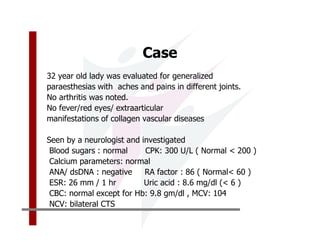
32 year old lady was evaluated for generalized
paraesthesias with aches and pains in different joints.
No arthritis was noted.
No fever/red eyes/ extraarticular
manifestations of collagen vascular diseases

Seen by a neurologist and investigated
 Blood sugars : normal     CPK: 300 U/L ( Normal < 200 )
 Calcium parameters: normal
 ANA/ dsDNA : negative     RA factor : 86 ( Normal< 60 )
 ESR: 26 mm / 1 hr         Uric acid : 8.6 mg/dl (< 6 )
 CBC: normal except for Hb: 9.8 gm/dl , MCV: 104
 NCV: bilateral CTS
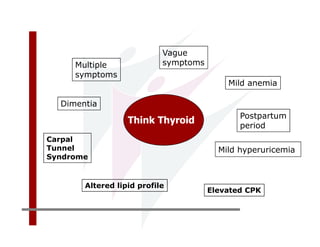
Vague
     Multiple              symptoms
     symptoms
                                          Mild anemia

  Dimentia
                                             Postpartum
                  Think Thyroid              period
Carpal
Tunnel                                  Mild hyperuricemia
Syndrome


       Altered lipid profile
                                      Elevated CPK
Hypothyroidism

• Diagnosis
• Etiology
• Treatment
What further to look before
      starting treatment ?
• Diagnosis
• Coexistent conditions
     age of patient
     severity of hypothyroidism
     coexistent drugs
     coexistent medical conditions
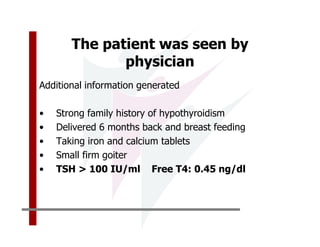
The patient was seen by
              physician
Additional information generated

•   Strong family history of hypothyroidism
•   Delivered 6 months back and breast feeding
•   Taking iron and calcium tablets
•   Small firm goiter
•   TSH > 100 IU/ml Free T4: 0.45 ng/dl
Diagnosis

Primary hypothyroidism
  Postpartum thyroiditis
Etiology
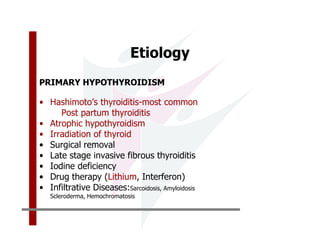
PRIMARY HYPOTHYROIDISM

• Hashimoto’s thyroiditis-most common
     Post partum thyroiditis
• Atrophic hypothyroidism
• Irradiation of thyroid
• Surgical removal
• Late stage invasive fibrous thyroiditis
• Iodine deficiency
• Drug therapy (Lithium, Interferon)
• Infiltrative Diseases:Sarcoidosis, Amyloidosis
   Scleroderma, Hemochromatosis
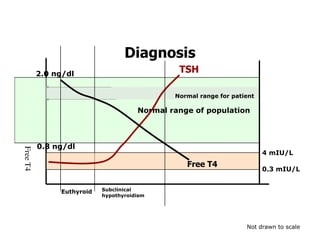
Diagnosis

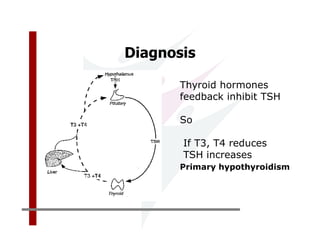
       Thyroid hormones
       feedback inhibit TSH

       So

       If T3, T4 reduces
       TSH increases
       Primary hypothyroidism
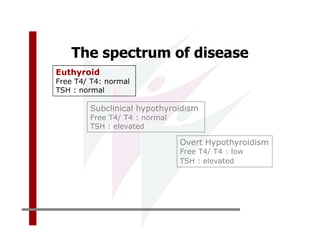
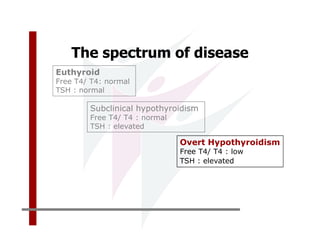
The spectrum of disease
Euthyroid
Free T4/ T4: normal
TSH : normal

        Subclinical hypothyroidism
        Free T4/ T4 : normal
        TSH : elevated

                               Overt Hypothyroidism
                               Free T4/ T4 : low
                               TSH : elevated
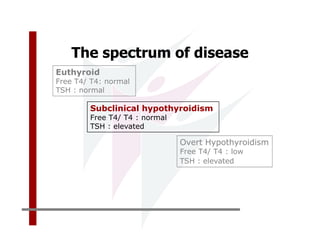
The spectrum of disease
Euthyroid
Free T4/ T4: normal
TSH : normal

        Subclinical hypothyroidism
        Free T4/ T4 : normal
        TSH : elevated

                               Overt Hypothyroidism
                               Free T4/ T4 : low
                               TSH : elevated
The spectrum of disease
Euthyroid
Free T4/ T4: normal
TSH : normal

        Subclinical hypothyroidism
        Free T4/ T4 : normal
        TSH : elevated

                               Overt Hypothyroidism
                               Free T4/ T4 : low
                               TSH : elevated
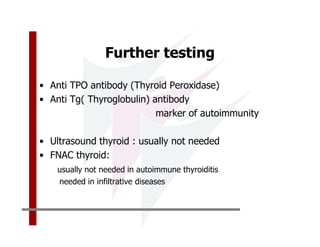
Further testing

• Anti TPO antibody (Thyroid Peroxidase)
• Anti Tg( Thyroglobulin) antibody
                           marker of autoimmunity

• Ultrasound thyroid : usually not needed
• FNAC thyroid:
    usually not needed in autoimmune thyroiditis
    needed in infiltrative diseases
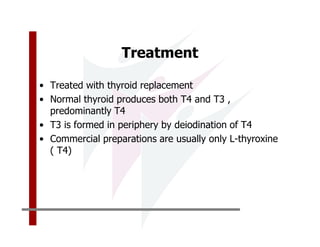
Treatment

• Treated with thyroid replacement
• Normal thyroid produces both T4 and T3 ,
  predominantly T4
• T3 is formed in periphery by deiodination of T4
• Commercial preparations are usually only L-thyroxine
  ( T4)
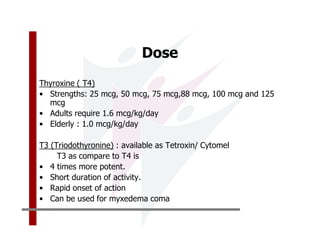
Dose
Thyroxine ( T4)
• Strengths: 25 mcg, 50 mcg, 75 mcg,88 mcg, 100 mcg and 125
  mcg
• Adults require 1.6 mcg/kg/day
• Elderly : 1.0 mcg/kg/day

T3 (Triodothyronine) : available as Tetroxin/ Cytomel
     T3 as compare to T4 is
• 4 times more potent.
• Short duration of activity.
• Rapid onset of action
• Can be used for myxedema coma
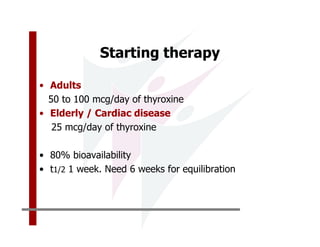
Starting therapy

• Adults
  50 to 100 mcg/day of thyroxine
• Elderly / Cardiac disease
   25 mcg/day of thyroxine

• 80% bioavailability
• t1/2 1 week. Need 6 weeks for equilibration
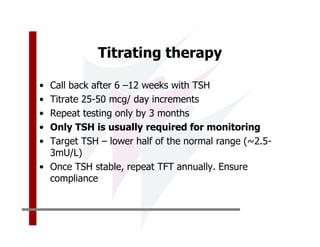
Titrating therapy

• Call back after 6 –12 weeks with TSH
• Titrate 25-50 mcg/ day increments
• Repeat testing only by 3 months
• Only TSH is usually required for monitoring
• Target TSH – lower half of the normal range (~2.5-
  3mU/L)
• Once TSH stable, repeat TFT annually. Ensure
  compliance
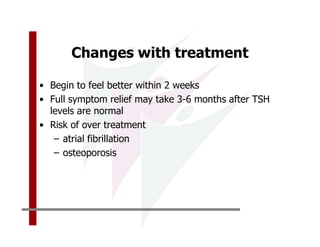
Changes with treatment

• Begin to feel better within 2 weeks
• Full symptom relief may take 3-6 months after TSH
  levels are normal
• Risk of over treatment
   – atrial fibrillation
   – osteoporosis
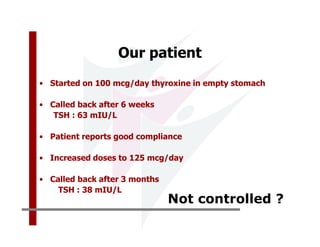
Our patient
• Started on 100 mcg/day thyroxine in empty stomach

• Called back after 6 weeks
   TSH : 63 mIU/L

• Patient reports good compliance

• Increased doses to 125 mcg/day

• Called back after 3 months
    TSH : 38 mIU/L
                               Not controlled ?
Follow up

• What are the cause for high dose requiremts ?
• Is thyroxine treatment during breast feeding harmful
  to baby ?
• How long to continue treatment ?
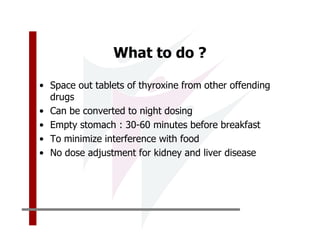
High dose requirement of
              thyroxine
• Malabsorption (celiac disease, small bowel surgery)
• Compliance

• Medications
   – Estrogen                     – Aluminium hydroxide
   – Cholestyramine               – Rifampicin
   – Ferrous sulfate              – Amiodarone
   – Calcium                      –Carbamazepine
   – Lovastatin                   – Phenytoin
   – Colsevelam                   –Magnesium containing laxatives
   – Lanthanum carbonate
                                  –Bulk laxatives with fiber
   – PPI ( ?)
What to do ?

• Space out tablets of thyroxine from other offending
  drugs
• Can be converted to night dosing
• Empty stomach : 30-60 minutes before breakfast
• To minimize interference with food
• No dose adjustment for kidney and liver disease
Hashimoto’s thyroiditis
            Chronic lymphocytic thyroiditis

• Most common cause of hypothyroidism
• Can be goitrous or non goitrous
• Anti TPO antibody positive
• Euthyroid Hashimoto’s : no treatment/ LT4 to reduce
  goiter size and antibody levels
• Very rarely associated with thyroid lymphoma
• Can have co-existent papillary carcinoma
Postpartum thyroiditis

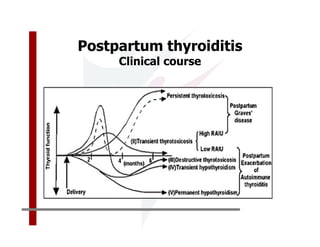
• Usually 2-6 months after delivery
• Transient thyrotoxicosis followed by hypothyroidism
  /hypothyroidism
• Silent thyroiditis in postpartum period
• 23 % progress to permanent hypothyroidism
• More common with
    severe hypothyroidism
    higher Anti TPO antibody titre
Postpartum thyroiditis
     Clinical course
Case continued

• Patient evaluated after spacing out the iron/calcium
  tablets
• TSH : reduced to 2.8 mU/L
• Continued same dose of LT4 125 mcg/day
• Asked to come back after 3 months
        TSH: < 0.01 mU/L


Next ?
Reversibility of primary
           hypothyroidism
•   Reversible hypothyroidism: Post partum
                    Drug induced( alfa interferon, Li )
                    Infectious ( Whipple’s disease, Sub acute thyroiditis) )
•   20 % of autoimmune hypothyroidism has been
    found to be reversible
•   Spontaneous disappearance of blocking antibodies
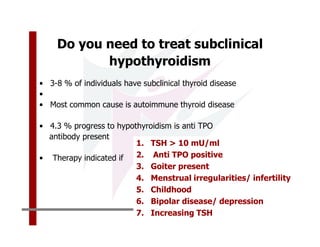
Do you need to treat subclinical
           hypothyroidism
• 3-8 % of individuals have subclinical thyroid disease
•
• Most common cause is autoimmune thyroid disease

• 4.3 % progress to hypothyroidism is anti TPO
  antibody present
                         1. TSH > 10 mU/ml
• Therapy indicated if   2. Anti TPO positive
                         3. Goiter present
                         4. Menstrual irregularities/ infertility
                         5. Childhood
                         6. Bipolar disease/ depression
                         7. Increasing TSH
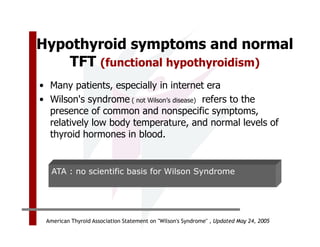
Hypothyroid symptoms and normal
    TFT (functional hypothyroidism)
• Many patients, especially in internet era
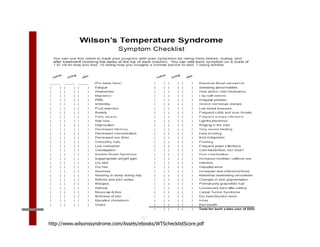
• Wilson's syndrome ( not Wilson’s disease) refers to the
  presence of common and nonspecific symptoms,
  relatively low body temperature, and normal levels of
  thyroid hormones in blood.


   ATA : no scientific basis for Wilson Syndrome


 American Thyroid Association Statement on "Wilson's Syndrome" , Updated May 24, 2005
http://www.wilsonssyndrome.com/Assets/ebooks/WTSchecklistScore.pdf
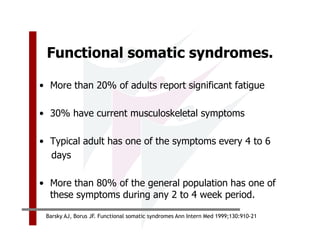
Functional somatic syndromes.

• More than 20% of adults report significant fatigue

• 30% have current musculoskeletal symptoms

• Typical adult has one of the symptoms every 4 to 6
  days

• More than 80% of the general population has one of
  these symptoms during any 2 to 4 week period.

 Barsky AJ, Borus JF. Functional somatic syndromes Ann Intern Med 1999;130:910-21
Deja vu

•   A lady with weight gain
•   A lady with lowish resting heart rates
•   Lady with tiredness
•   Lady with memory loss
•   Lady with “ low” pressure
•   A lazy boy with poor school performance


    Have you ever started thyroxine for these people ?
Messages

• Suspect hypothyroidism
• Thyroxine is the treatment for primary
  hypothyroidism
• Dose changes in thyroxine according to TSH
• Some causes of primary hypothyroidism are
  reversible
• Treat patients only with abnormal thyroid functions
Thank you

www.providence.co.in: for patient information materials

twitter.com/providenceendo : for slide presentations
Diagnosis
          2.0 ng/dl                            TSH

                                              Normal range for patient

                                      Normal range of population


          0.8 ng/dl
Free T4


                                                                         4 mIU/L
                                                 Free T4
                                                                         0.3 mIU/L


               Euthyroid   Subclinical
                           hypothyroidism


                                                                   Not drawn to scale
Disclaimer
The material for these slides were derived from various sources including
pictures and cartoons from the world wide web. I have tried my best to
acknowledge all possible sources and references. However, if I have overlooked
any particular reference, it is not done intentionally. Anyone reproducing
materials from this presentations should acknowledge the author of the original
work. The case given is imaginary and is given only to support the purpose of
this talk. Any similarity to published case report/ patient is unintentional.

Hypothyroidism

  • 1.
    Primary Hypothyroidism: Management Mathew John, MD, DM, DNB Consultant Endocrinologist Providence Endocrine & Diabetes Specialty Centre www.endocrinologydiabetes.com www.providence.co.in
  • 2.
    Case 32 year oldlady was evaluated for generalized paraesthesias with aches and pains in different joints. No arthritis was noted. No fever/red eyes/ extraarticular manifestations of collagen vascular diseases Seen by a neurologist and investigated Blood sugars : normal CPK: 300 U/L ( Normal < 200 ) Calcium parameters: normal ANA/ dsDNA : negative RA factor : 86 ( Normal< 60 ) ESR: 26 mm / 1 hr Uric acid : 8.6 mg/dl (< 6 ) CBC: normal except for Hb: 9.8 gm/dl , MCV: 104 NCV: bilateral CTS
  • 3.
    Vague Multiple symptoms symptoms Mild anemia Dimentia Postpartum Think Thyroid period Carpal Tunnel Mild hyperuricemia Syndrome Altered lipid profile Elevated CPK
  • 4.
  • 5.
    What further tolook before starting treatment ? • Diagnosis • Coexistent conditions age of patient severity of hypothyroidism coexistent drugs coexistent medical conditions
  • 6.
    The patient wasseen by physician Additional information generated • Strong family history of hypothyroidism • Delivered 6 months back and breast feeding • Taking iron and calcium tablets • Small firm goiter • TSH > 100 IU/ml Free T4: 0.45 ng/dl
  • 7.
    Diagnosis Primary hypothyroidism Postpartum thyroiditis
  • 8.
    Etiology PRIMARY HYPOTHYROIDISM • Hashimoto’sthyroiditis-most common Post partum thyroiditis • Atrophic hypothyroidism • Irradiation of thyroid • Surgical removal • Late stage invasive fibrous thyroiditis • Iodine deficiency • Drug therapy (Lithium, Interferon) • Infiltrative Diseases:Sarcoidosis, Amyloidosis Scleroderma, Hemochromatosis
  • 9.
    Diagnosis Thyroid hormones feedback inhibit TSH So If T3, T4 reduces TSH increases Primary hypothyroidism
  • 10.
    The spectrum ofdisease Euthyroid Free T4/ T4: normal TSH : normal Subclinical hypothyroidism Free T4/ T4 : normal TSH : elevated Overt Hypothyroidism Free T4/ T4 : low TSH : elevated
  • 11.
    The spectrum ofdisease Euthyroid Free T4/ T4: normal TSH : normal Subclinical hypothyroidism Free T4/ T4 : normal TSH : elevated Overt Hypothyroidism Free T4/ T4 : low TSH : elevated
  • 12.
    The spectrum ofdisease Euthyroid Free T4/ T4: normal TSH : normal Subclinical hypothyroidism Free T4/ T4 : normal TSH : elevated Overt Hypothyroidism Free T4/ T4 : low TSH : elevated
  • 13.
    Further testing • AntiTPO antibody (Thyroid Peroxidase) • Anti Tg( Thyroglobulin) antibody marker of autoimmunity • Ultrasound thyroid : usually not needed • FNAC thyroid: usually not needed in autoimmune thyroiditis needed in infiltrative diseases
  • 14.
    Treatment • Treated withthyroid replacement • Normal thyroid produces both T4 and T3 , predominantly T4 • T3 is formed in periphery by deiodination of T4 • Commercial preparations are usually only L-thyroxine ( T4)
  • 15.
    Dose Thyroxine ( T4) •Strengths: 25 mcg, 50 mcg, 75 mcg,88 mcg, 100 mcg and 125 mcg • Adults require 1.6 mcg/kg/day • Elderly : 1.0 mcg/kg/day T3 (Triodothyronine) : available as Tetroxin/ Cytomel T3 as compare to T4 is • 4 times more potent. • Short duration of activity. • Rapid onset of action • Can be used for myxedema coma
  • 16.
    Starting therapy • Adults 50 to 100 mcg/day of thyroxine • Elderly / Cardiac disease 25 mcg/day of thyroxine • 80% bioavailability • t1/2 1 week. Need 6 weeks for equilibration
  • 17.
    Titrating therapy • Callback after 6 –12 weeks with TSH • Titrate 25-50 mcg/ day increments • Repeat testing only by 3 months • Only TSH is usually required for monitoring • Target TSH – lower half of the normal range (~2.5- 3mU/L) • Once TSH stable, repeat TFT annually. Ensure compliance
  • 18.
    Changes with treatment •Begin to feel better within 2 weeks • Full symptom relief may take 3-6 months after TSH levels are normal • Risk of over treatment – atrial fibrillation – osteoporosis
  • 19.
    Our patient • Startedon 100 mcg/day thyroxine in empty stomach • Called back after 6 weeks TSH : 63 mIU/L • Patient reports good compliance • Increased doses to 125 mcg/day • Called back after 3 months TSH : 38 mIU/L Not controlled ?
  • 20.
    Follow up • Whatare the cause for high dose requiremts ? • Is thyroxine treatment during breast feeding harmful to baby ? • How long to continue treatment ?
  • 21.
    High dose requirementof thyroxine • Malabsorption (celiac disease, small bowel surgery) • Compliance • Medications – Estrogen – Aluminium hydroxide – Cholestyramine – Rifampicin – Ferrous sulfate – Amiodarone – Calcium –Carbamazepine – Lovastatin – Phenytoin – Colsevelam –Magnesium containing laxatives – Lanthanum carbonate –Bulk laxatives with fiber – PPI ( ?)
  • 22.
    What to do? • Space out tablets of thyroxine from other offending drugs • Can be converted to night dosing • Empty stomach : 30-60 minutes before breakfast • To minimize interference with food • No dose adjustment for kidney and liver disease
  • 23.
    Hashimoto’s thyroiditis Chronic lymphocytic thyroiditis • Most common cause of hypothyroidism • Can be goitrous or non goitrous • Anti TPO antibody positive • Euthyroid Hashimoto’s : no treatment/ LT4 to reduce goiter size and antibody levels • Very rarely associated with thyroid lymphoma • Can have co-existent papillary carcinoma
  • 24.
    Postpartum thyroiditis • Usually2-6 months after delivery • Transient thyrotoxicosis followed by hypothyroidism /hypothyroidism • Silent thyroiditis in postpartum period • 23 % progress to permanent hypothyroidism • More common with severe hypothyroidism higher Anti TPO antibody titre
  • 25.
    Postpartum thyroiditis Clinical course
  • 26.
    Case continued • Patientevaluated after spacing out the iron/calcium tablets • TSH : reduced to 2.8 mU/L • Continued same dose of LT4 125 mcg/day • Asked to come back after 3 months TSH: < 0.01 mU/L Next ?
  • 27.
    Reversibility of primary hypothyroidism • Reversible hypothyroidism: Post partum Drug induced( alfa interferon, Li ) Infectious ( Whipple’s disease, Sub acute thyroiditis) ) • 20 % of autoimmune hypothyroidism has been found to be reversible • Spontaneous disappearance of blocking antibodies
  • 28.
    Do you needto treat subclinical hypothyroidism • 3-8 % of individuals have subclinical thyroid disease • • Most common cause is autoimmune thyroid disease • 4.3 % progress to hypothyroidism is anti TPO antibody present 1. TSH > 10 mU/ml • Therapy indicated if 2. Anti TPO positive 3. Goiter present 4. Menstrual irregularities/ infertility 5. Childhood 6. Bipolar disease/ depression 7. Increasing TSH
  • 29.
    Hypothyroid symptoms andnormal TFT (functional hypothyroidism) • Many patients, especially in internet era • Wilson's syndrome ( not Wilson’s disease) refers to the presence of common and nonspecific symptoms, relatively low body temperature, and normal levels of thyroid hormones in blood. ATA : no scientific basis for Wilson Syndrome American Thyroid Association Statement on "Wilson's Syndrome" , Updated May 24, 2005
  • 30.
  • 31.
    Functional somatic syndromes. •More than 20% of adults report significant fatigue • 30% have current musculoskeletal symptoms • Typical adult has one of the symptoms every 4 to 6 days • More than 80% of the general population has one of these symptoms during any 2 to 4 week period. Barsky AJ, Borus JF. Functional somatic syndromes Ann Intern Med 1999;130:910-21
  • 32.
    Deja vu • A lady with weight gain • A lady with lowish resting heart rates • Lady with tiredness • Lady with memory loss • Lady with “ low” pressure • A lazy boy with poor school performance Have you ever started thyroxine for these people ?
  • 33.
    Messages • Suspect hypothyroidism •Thyroxine is the treatment for primary hypothyroidism • Dose changes in thyroxine according to TSH • Some causes of primary hypothyroidism are reversible • Treat patients only with abnormal thyroid functions
  • 34.
    Thank you www.providence.co.in: forpatient information materials twitter.com/providenceendo : for slide presentations
  • 35.
    Diagnosis 2.0 ng/dl TSH Normal range for patient Normal range of population 0.8 ng/dl Free T4 4 mIU/L Free T4 0.3 mIU/L Euthyroid Subclinical hypothyroidism Not drawn to scale
  • 36.
    Disclaimer The material forthese slides were derived from various sources including pictures and cartoons from the world wide web. I have tried my best to acknowledge all possible sources and references. However, if I have overlooked any particular reference, it is not done intentionally. Anyone reproducing materials from this presentations should acknowledge the author of the original work. The case given is imaginary and is given only to support the purpose of this talk. Any similarity to published case report/ patient is unintentional.