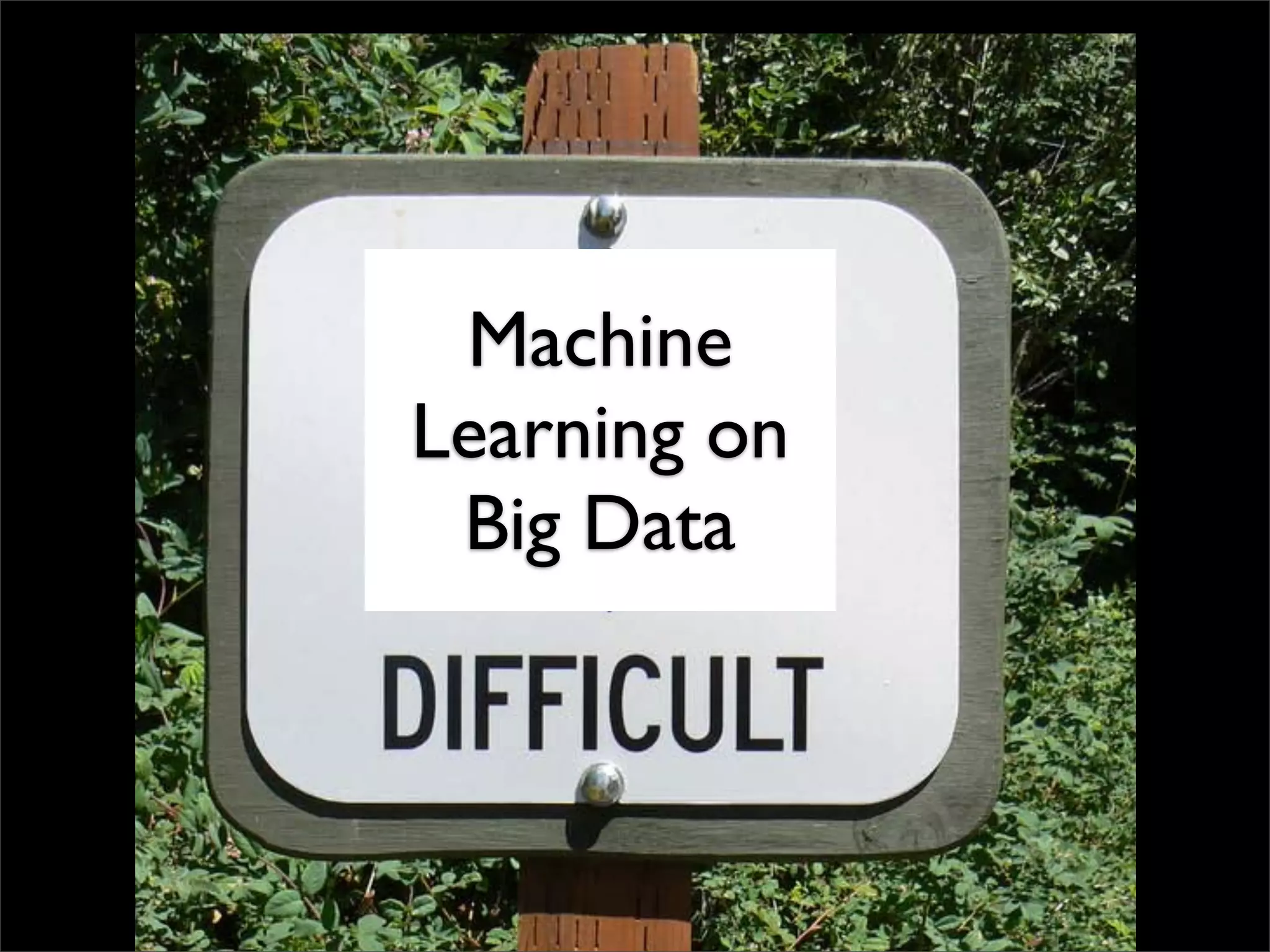
Machine Learning on Big Data
Lessons Learned from Google Projects

Max Lin
Software Engineer | Google Research

Massively Parallel Computing | Harvard CS 264
Guest Lecture | March 29th, 2011
Outline

• Machine Learning intro
• Scaling machine learning algorithms up
• Design choices of large scale ML systems
Outline

• Machine Learning intro
• Scaling machine learning algorithms up
• Design choices of large scale ML systems
“Machine Learning is a study
of computer algorithms that
   improve automatically
    through experience.”
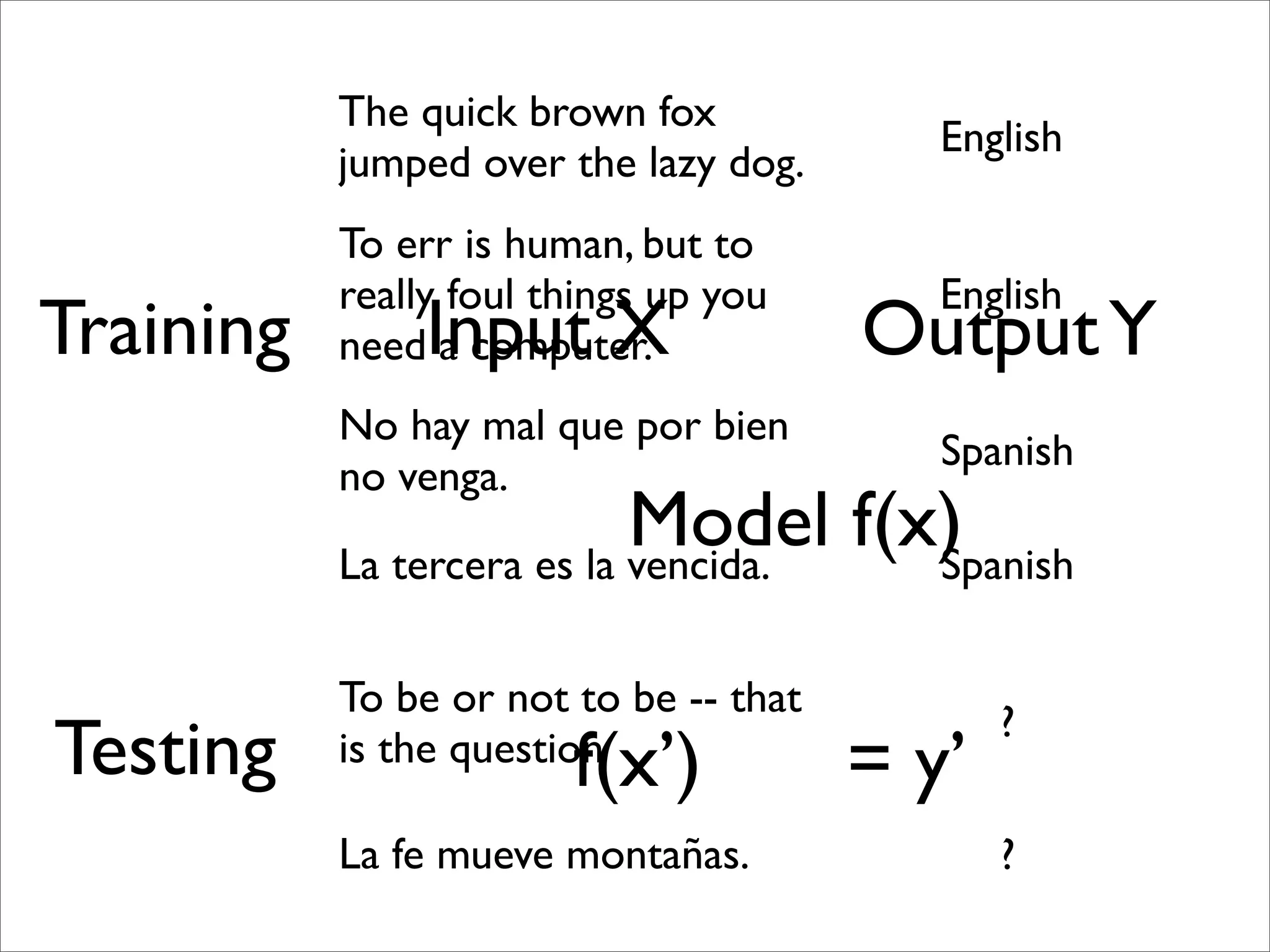
The quick brown fox
                                           English
           jumped over the lazy dog.
           To err is human, but to
           really foul things up you       English
Training        Input X
           need a computer.             Output Y
           No hay mal que por bien
                                           Spanish
           no venga.
                            Model f(x)
           La tercera es la vencida. Spanish

           To be or not to be -- that
                                               ?
Testing                 f(x’)
           is the question
                                        = y’
           La fe mueve montañas.               ?
Linear Classifier
       The quick brown fox jumped over the lazy dog.

    ‘a’ ... ‘aardvark’ ... ‘dog’ ... ‘the’ ... ‘montañas’ ...
x [ 0, ...      0,     ... 1, ... 1, ...          0,      ... ]

w [ 0.1, ...    132,     ... 150, ... 200, ...     -153,   ... ]
                                   P
                                   
                 f (x) = w · x =         wp ∗ xp
                                   p=1
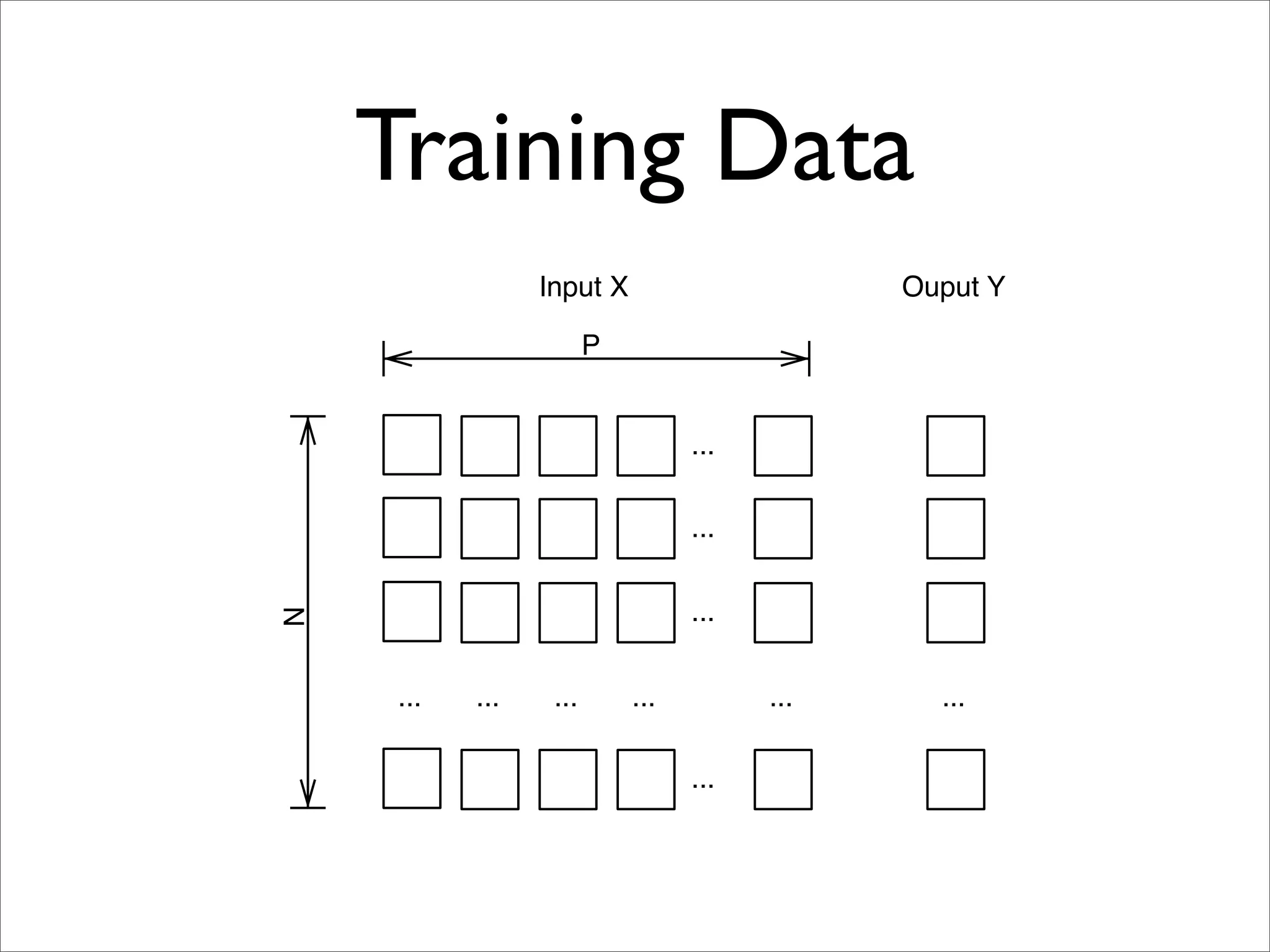
Training Data
                 Input X                      Ouput Y

                        P


                                  ...

                                  ...

                                  ...
N


     ...   ...    ...       ...         ...     ...

                                  ...
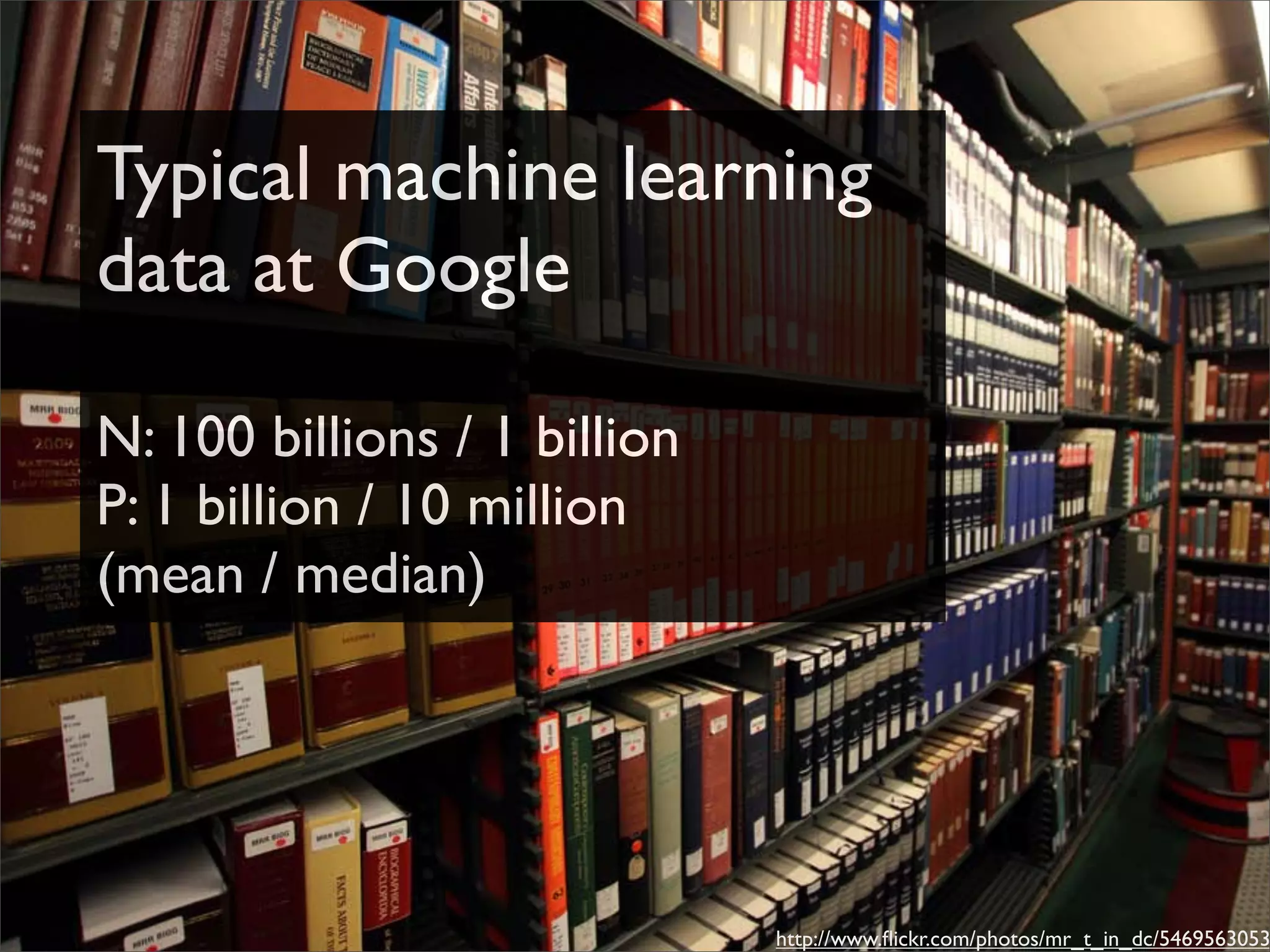
Typical machine learning
data at Google

N: 100 billions / 1 billion
P: 1 billion / 10 million
(mean / median)


                              http://www.flickr.com/photos/mr_t_in_dc/5469563053
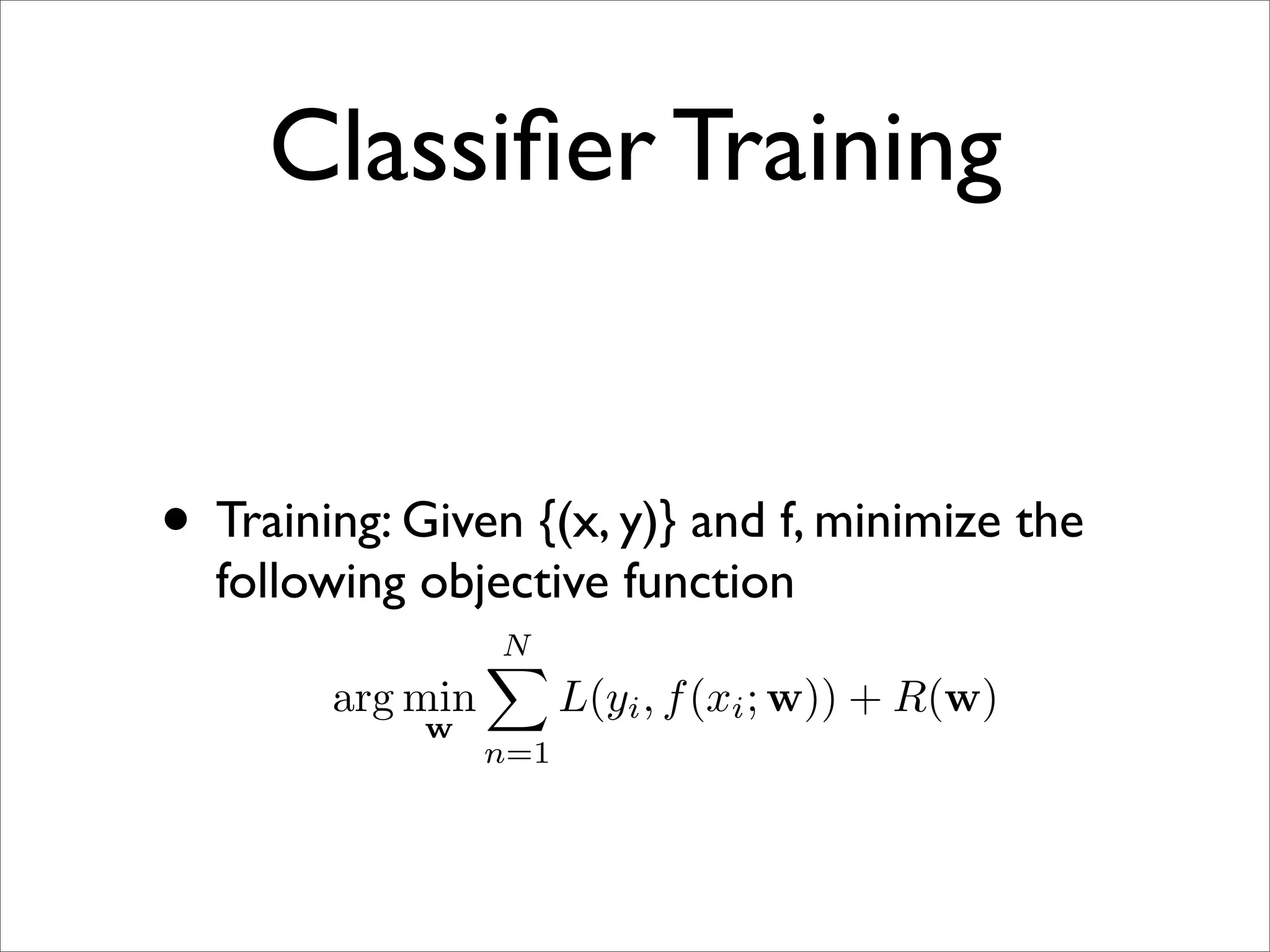
Classifier Training


• Training: Given {(x, y)} and f, minimize the
  following objective function
                  N
                  
        arg min         L(yi , f (xi ; w)) + R(w)
             w
                  n=1
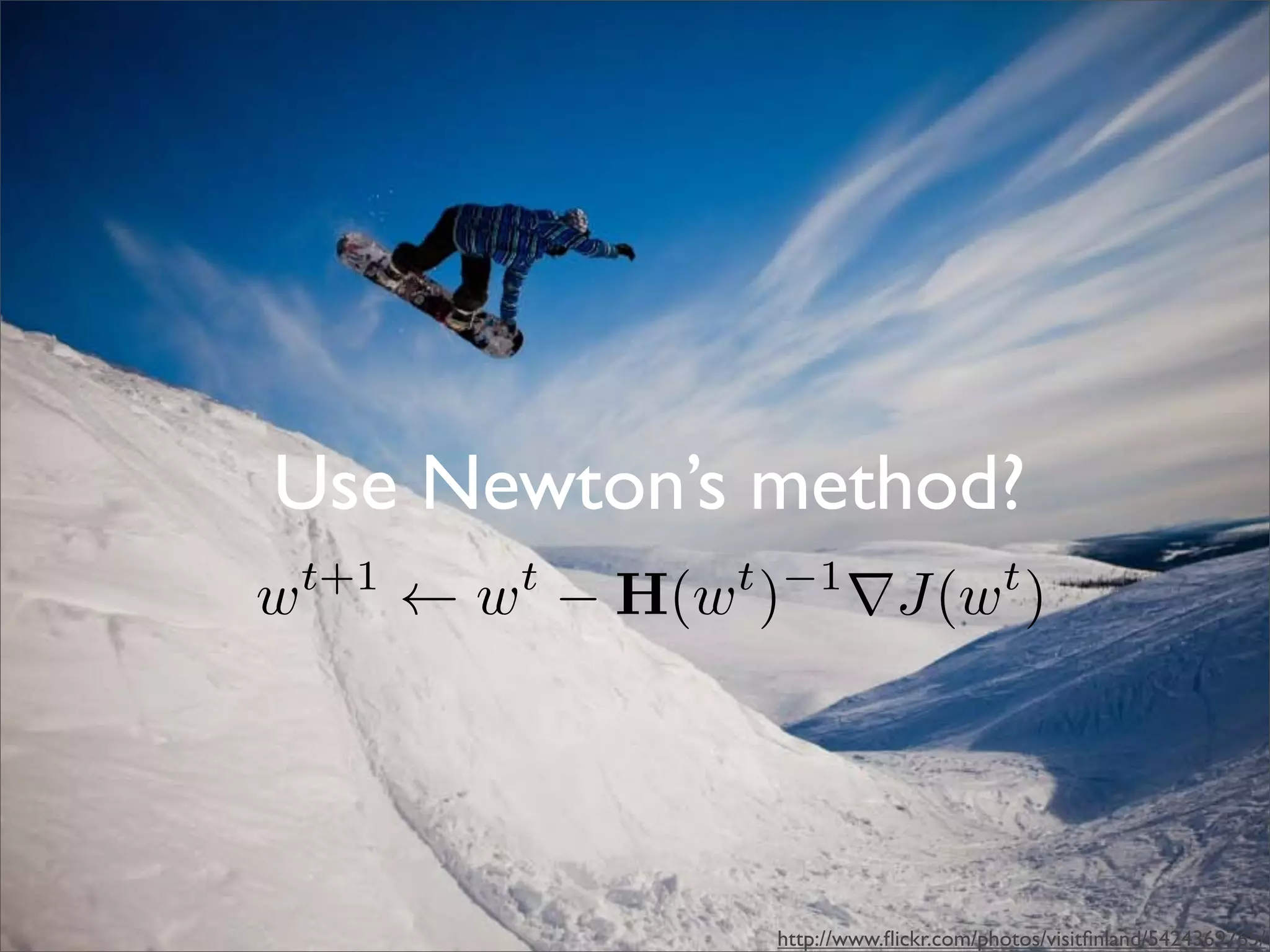
Use Newton’s method?
    t+1      t     t −1                    t
w         ← w − H(w )      ∇J(w )


                    http://www.flickr.com/photos/visitfinland/5424369765/
Outline

• Machine Learning intro
• Scaling machine learning algorithms up
• Design choices of large scale ML systems
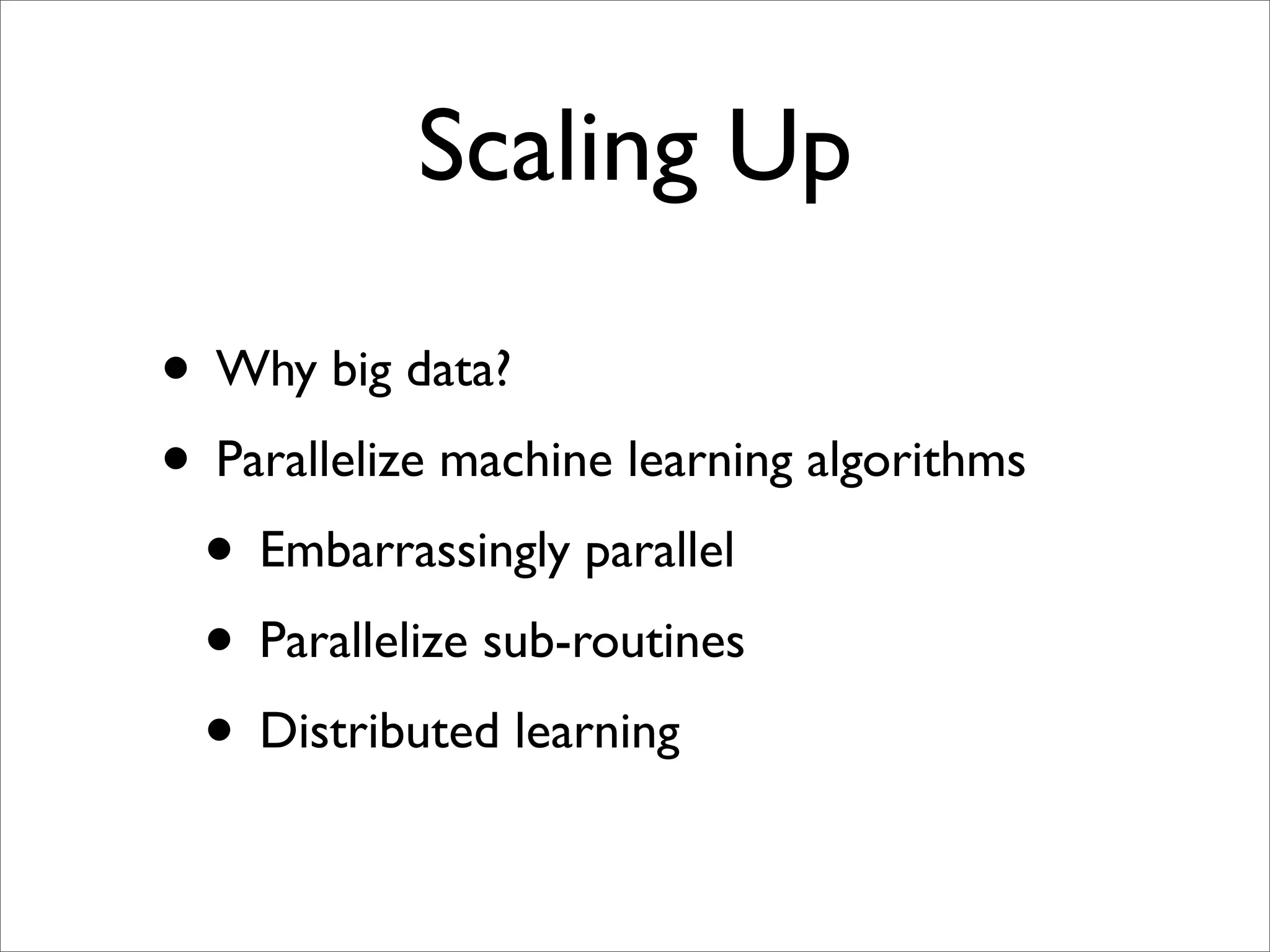
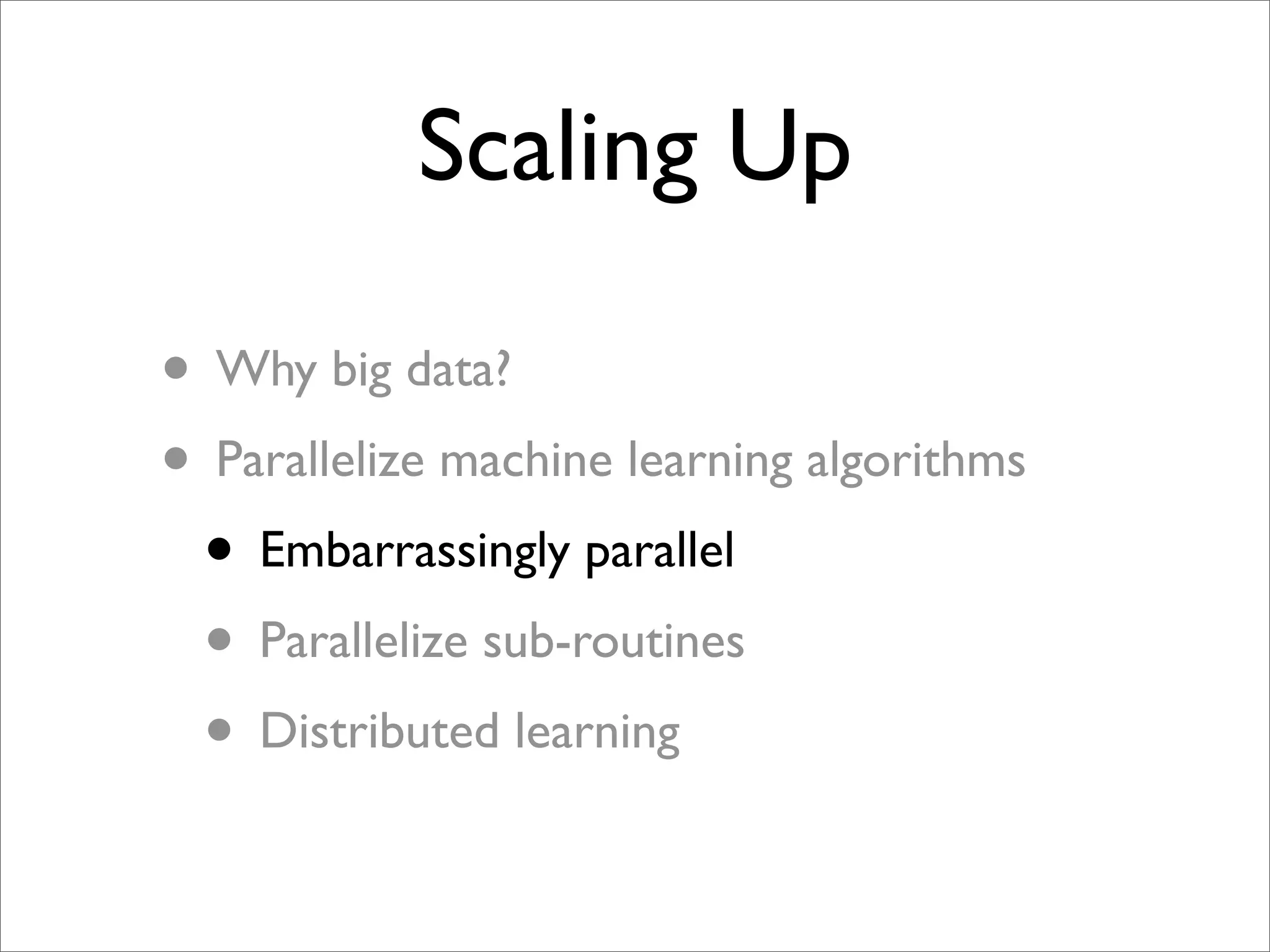
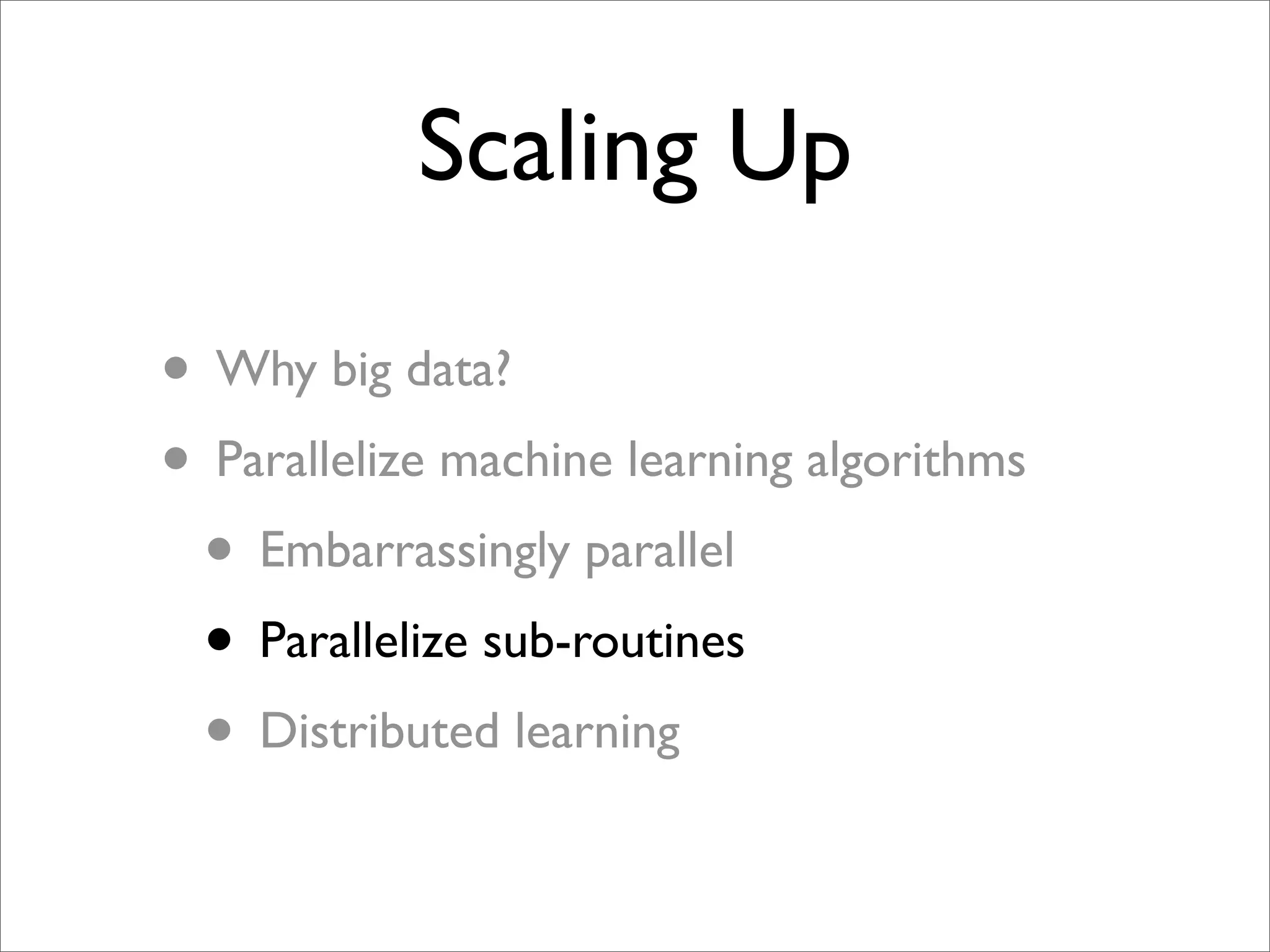
Scaling Up

• Why big data?
• Parallelize machine learning algorithms
 • Embarrassingly parallel
 • Parallelize sub-routines
 • Distributed learning
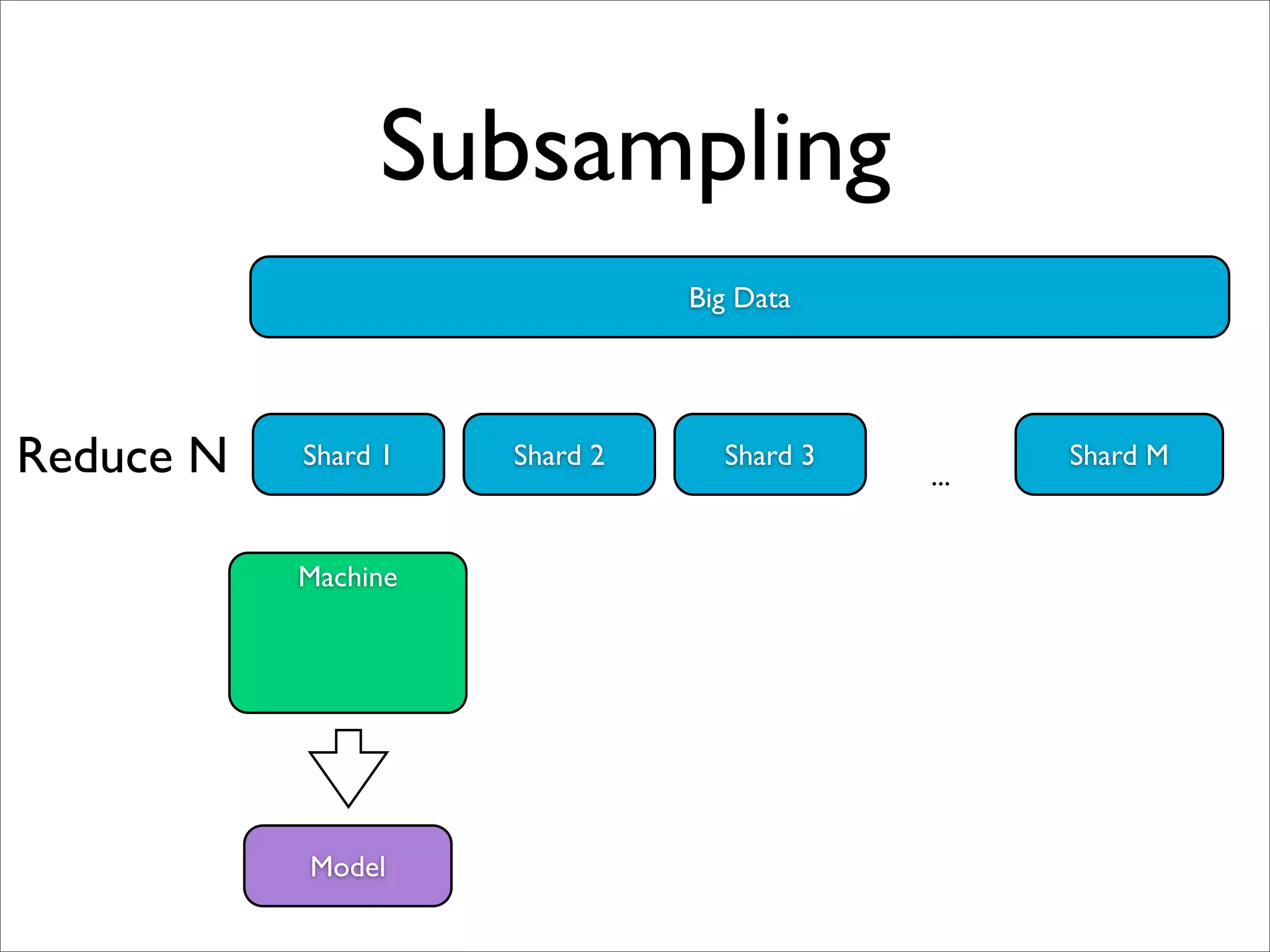
Subsampling
                               Big Data


Reduce N   Shard 1   Shard 2     Shard 3
                                           ...
                                                 Shard M


           Machine


           Model
Why not Small Data?


                [Banko and Brill, 2001]
Scaling Up

• Why big data?
• Parallelize machine learning algorithms
 • Embarrassingly parallel
 • Parallelize sub-routines
 • Distributed learning
Parallelize Estimates
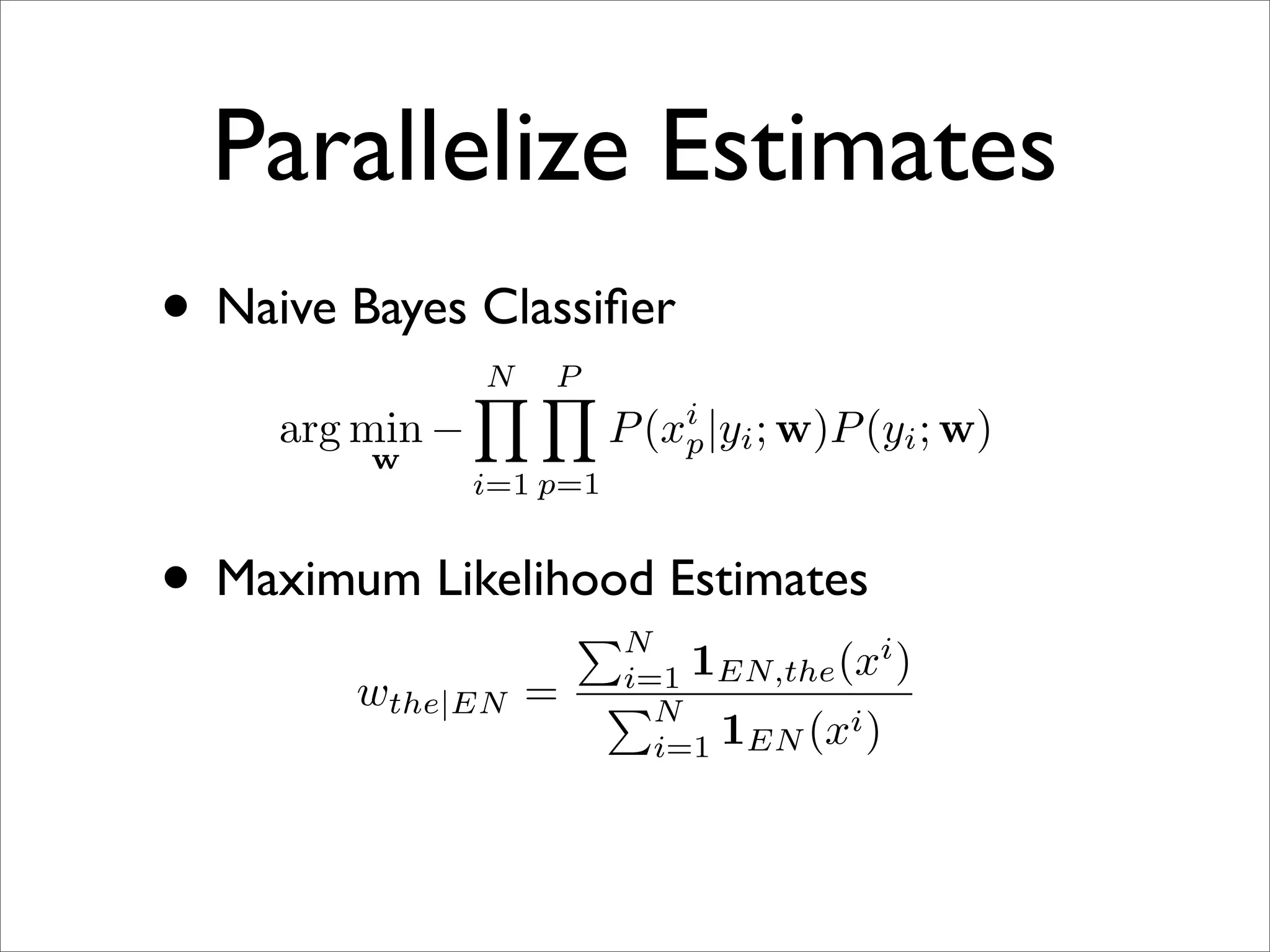
• Naive Bayes Classifier
                 N P
                 
                               i
     arg min −             P (xp |yi ; w)P (yi ; w)
         w
                 i=1 p=1


• Maximum Likelihood Estimates
                          N              i
                           i=1 1EN,the (x )
        wthe|EN =          N
                             i=1 1EN (xi )
Word Counting
                                            (‘the|EN’, 1)
         X: “The quick brown fox ...”
 Map                                        (‘quick|EN’, 1)
         Y: EN
                                            (‘brown|EN’, 1)

Reduce     [ (‘the|EN’, 1), (‘the|EN’, 1), (‘the|EN’, 1) ]
                C(‘the’|EN) = SUM of values = 3
                                
                           C( the |EN )
           w the |EN   =
                             C(EN )
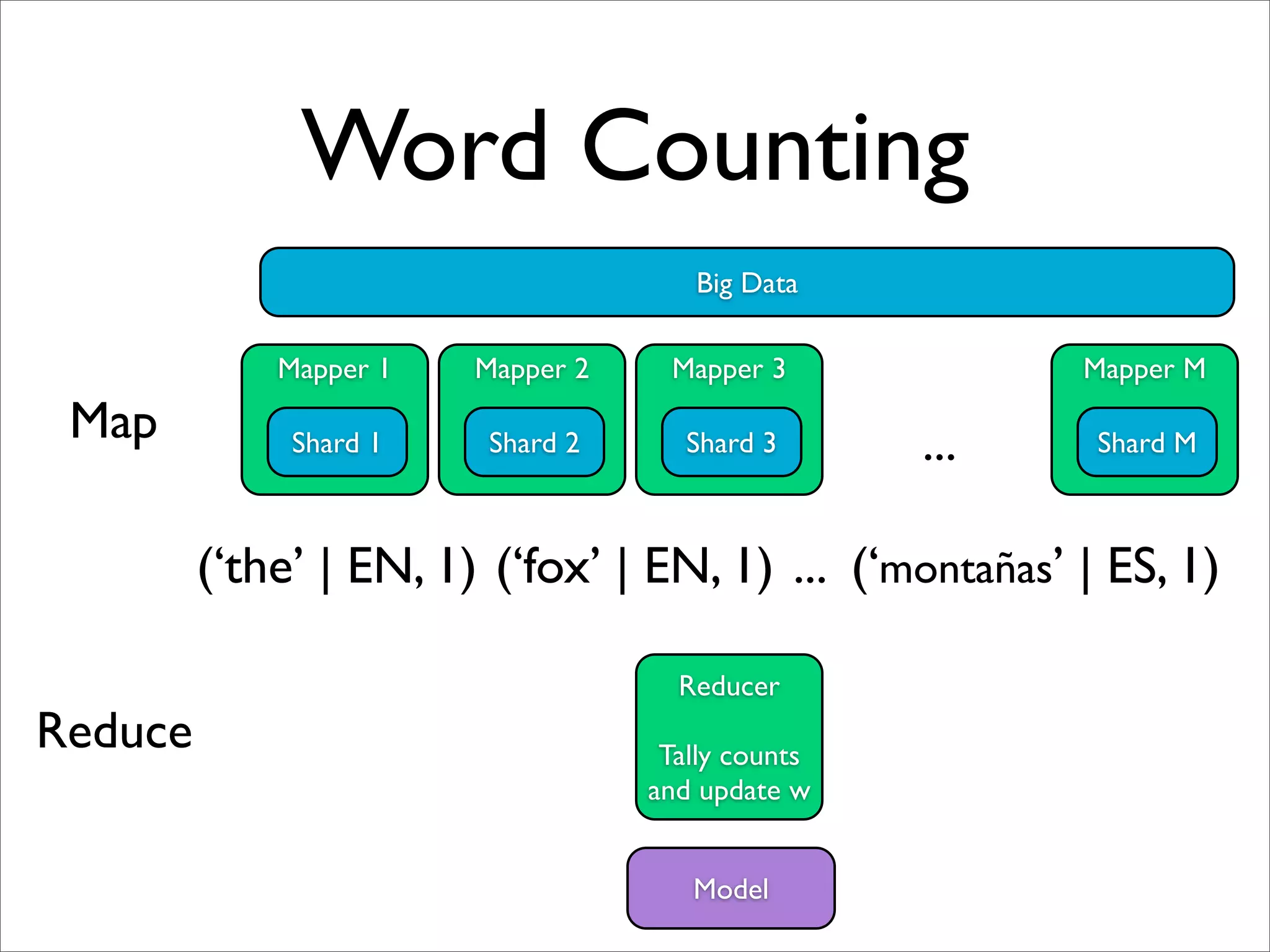
Word Counting
                                      Big Data

             Mapper 1   Mapper 2    Mapper 3             Mapper M

 Map          Shard 1    Shard 2      Shard 3      ...    Shard M


         (‘the’ | EN, 1) (‘fox’ | EN, 1) ... (‘montañas’ | ES, 1)

                                     Reducer
Reduce                              Tally counts
                                   and update w


                                      Model
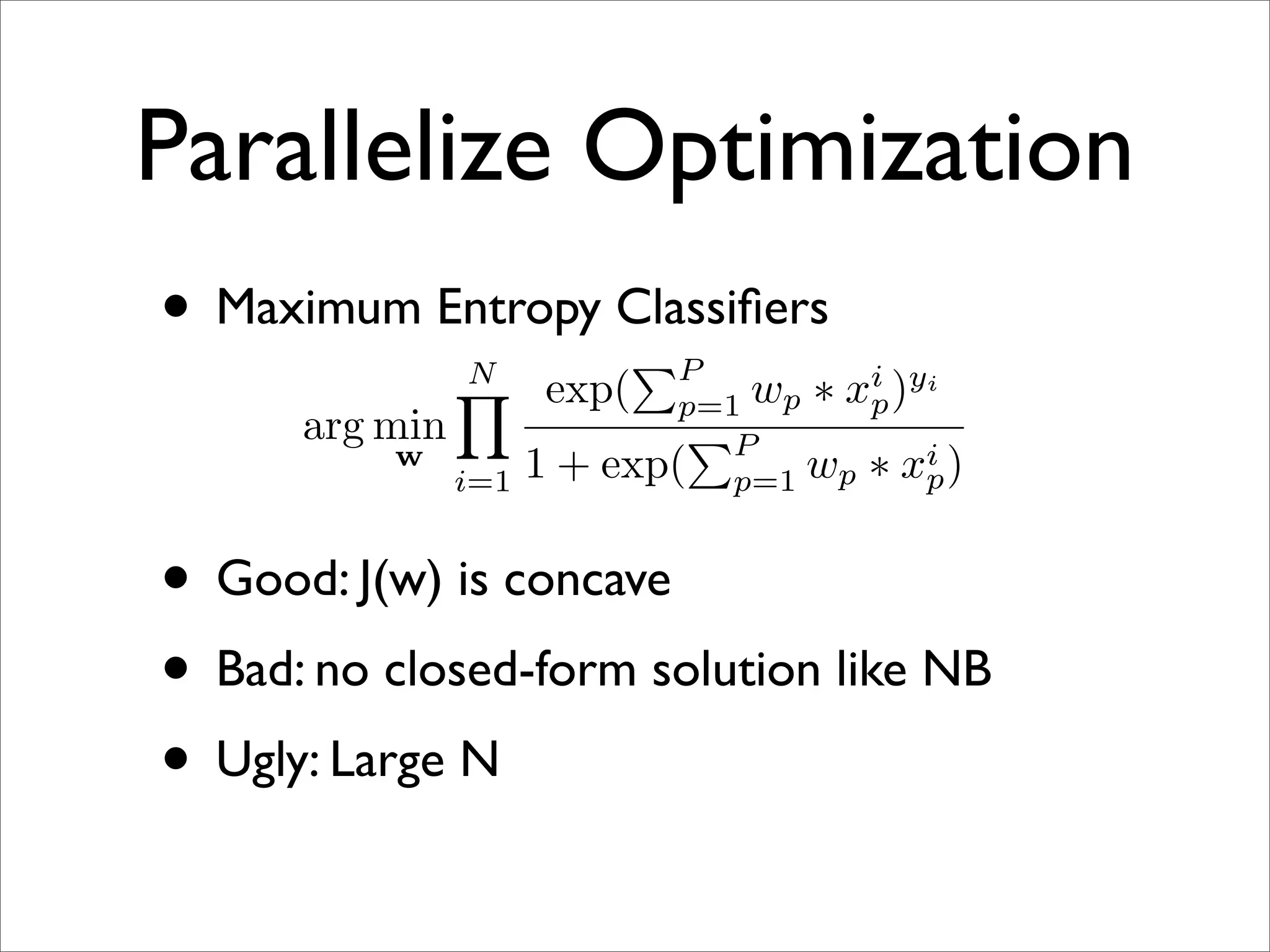
Parallelize Optimization
• Maximum Entropy Classifiers
                         P
             N
                                 i yi
                   exp( p=1 wp ∗ xp )
      arg min             P
           w
              i=1 1 + exp( p=1 wp ∗ xi )
                                      p


• Good: J(w) is concave
• Bad: no closed-form solution like NB
• Ugly: Large N
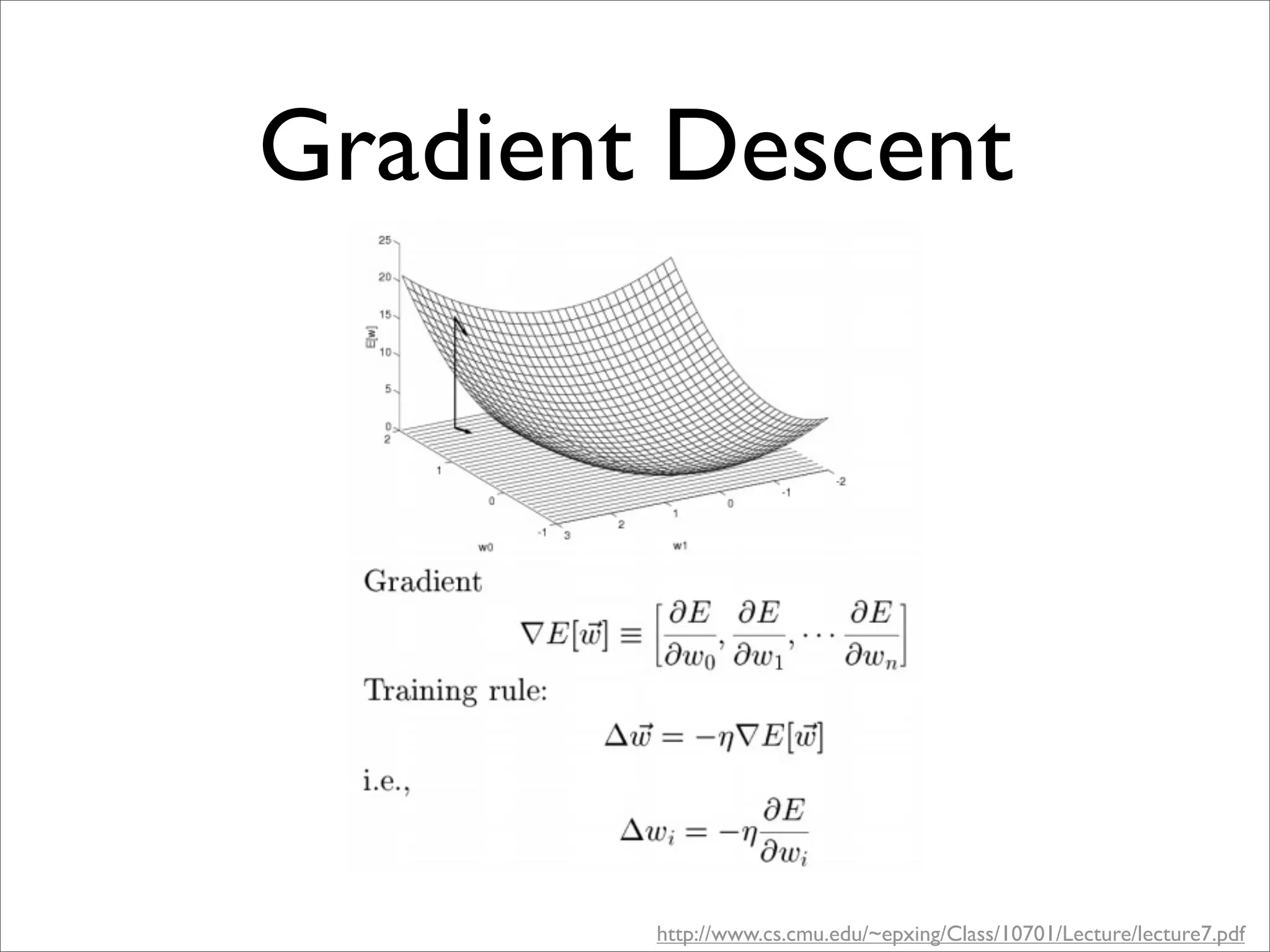
Gradient Descent


        http://www.cs.cmu.edu/~epxing/Class/10701/Lecture/lecture7.pdf
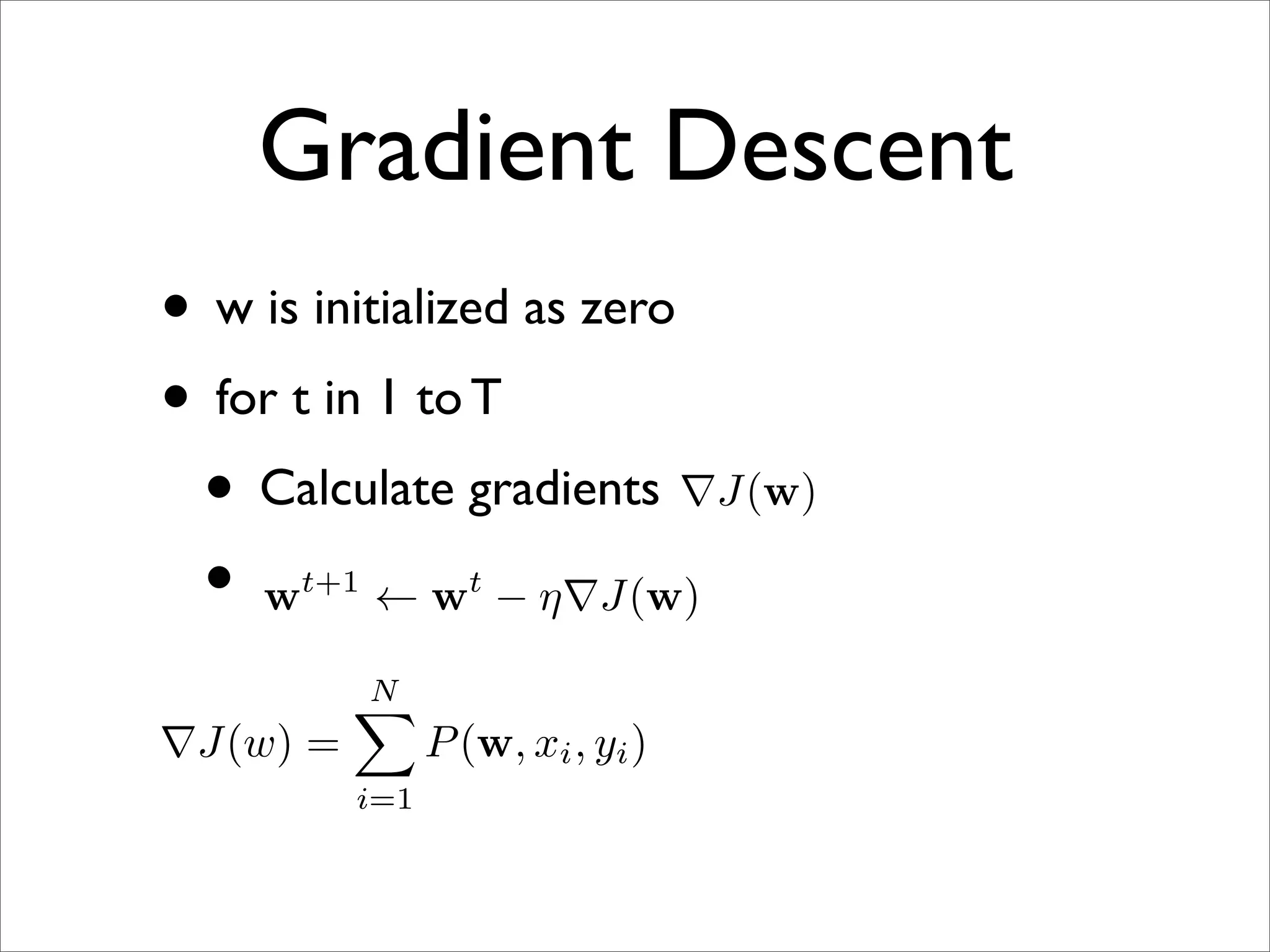
Gradient Descent
• w is initialized as zero
• for t in 1 to T
 • Calculate gradients ∇J(w)
 • w ← w − η∇J(w)
      t+1         t


          N
          
∇J(w) =         P (w, xi , yi )
          i=1
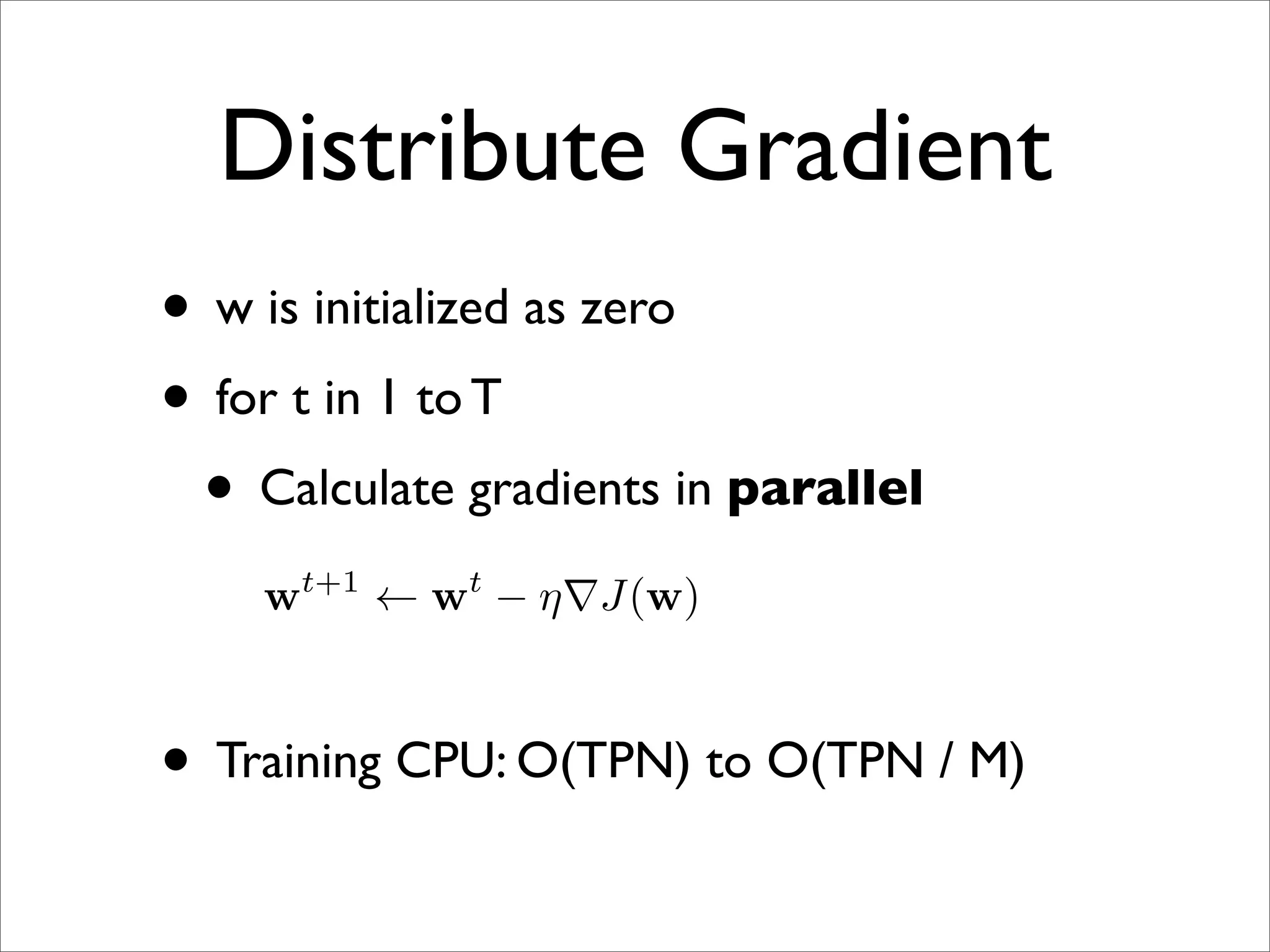
Distribute Gradient
• w is initialized as zero
• for t in 1 to T
 • Calculate gradients in parallel
    wt+1 ← wt − η∇J(w)


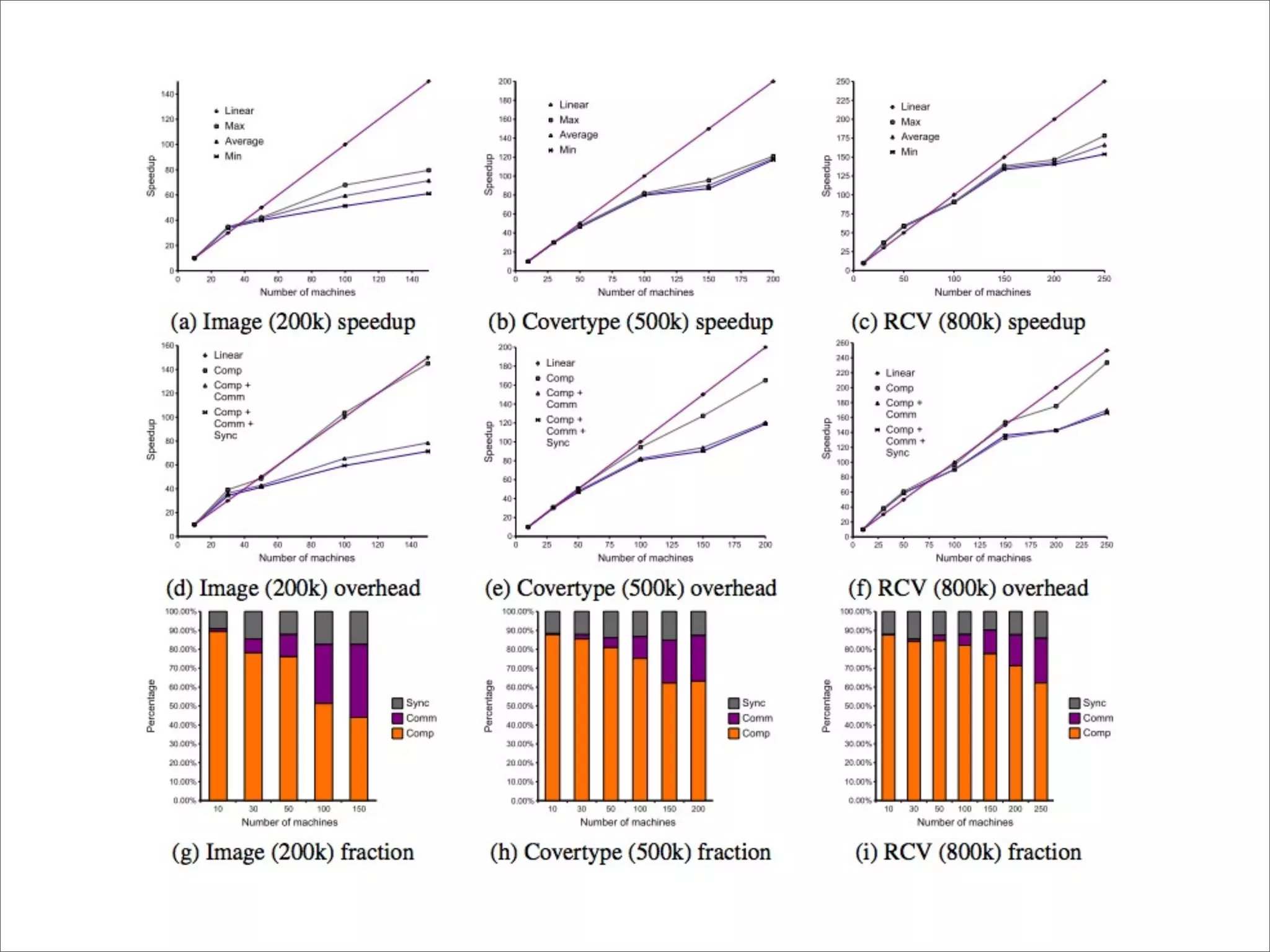
• Training CPU: O(TPN) to O(TPN / M)
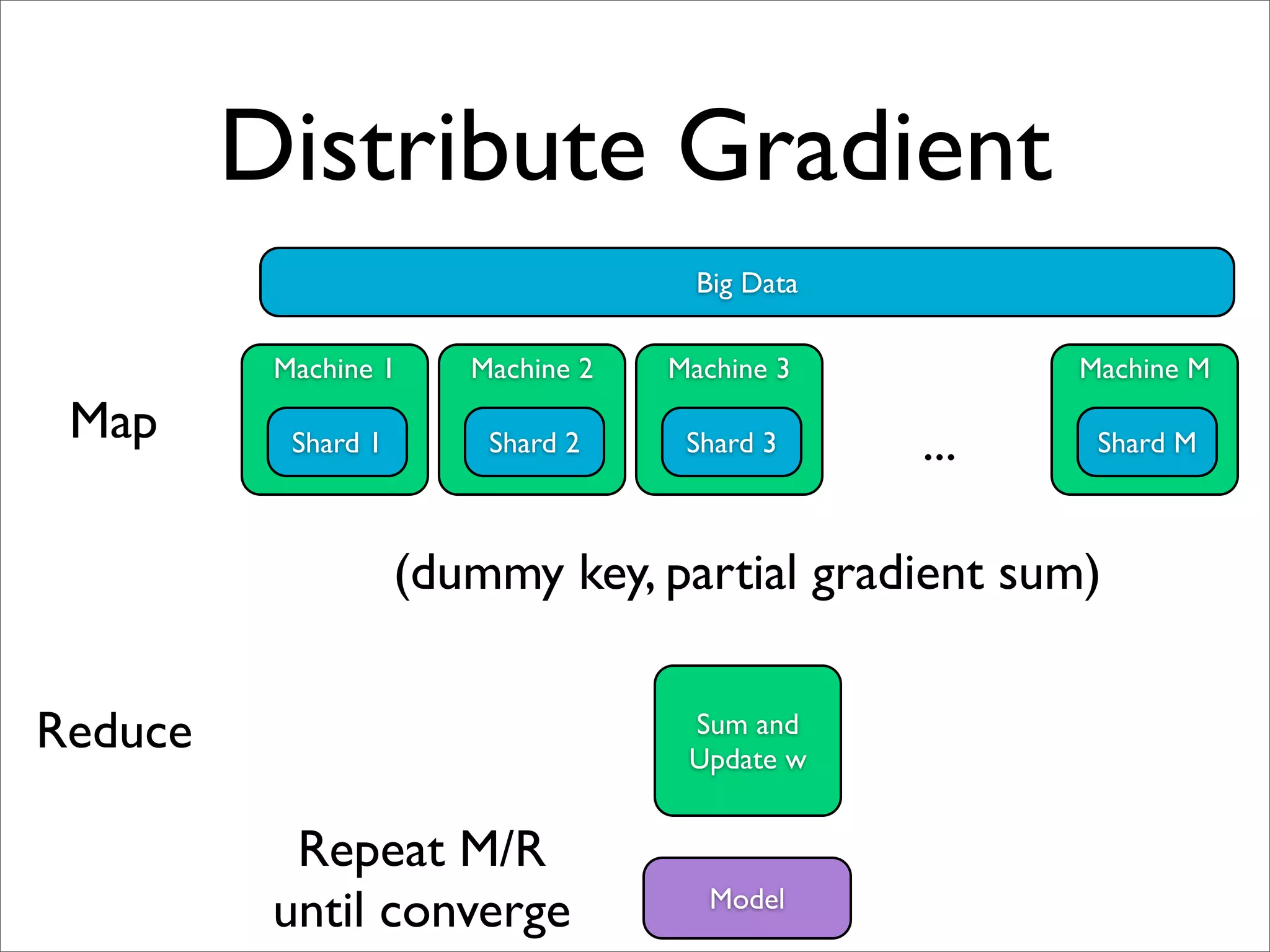
Distribute Gradient
                                      Big Data

          Machine 1     Machine 2   Machine 3          Machine M

 Map       Shard 1       Shard 2     Shard 3     ...    Shard M


                     (dummy key, partial gradient sum)


Reduce                               Sum and
                                     Update w


           Repeat M/R
          until converge               Model
Scaling Up

• Why big data?
• Parallelize machine learning algorithms
 • Embarrassingly parallel
 • Parallelize sub-routines
 • Distributed learning
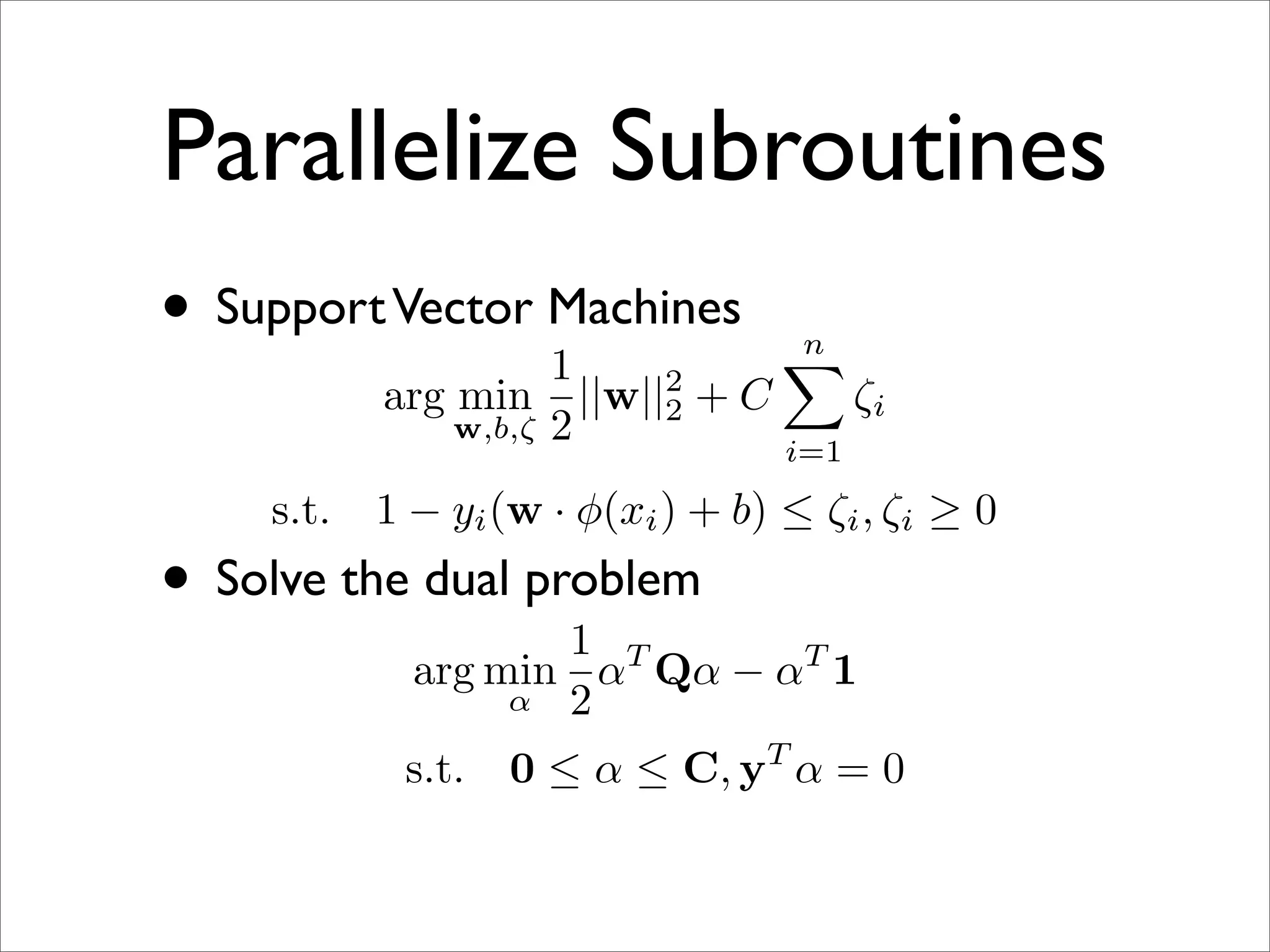
Parallelize Subroutines
• Support Vector Machines
                 1
                                         n
                                         
                                2
           arg min         ||w||2   +C         ζi
               w,b,ζ   2                 i=1

    s.t.   1 − yi (w · φ(xi ) + b) ≤ ζi , ζi ≥ 0
• Solve the dual problem
                    1 T
             arg min α Qα − αT 1
                  α 2

            s.t.   0 ≤ α ≤ C, yT α = 0
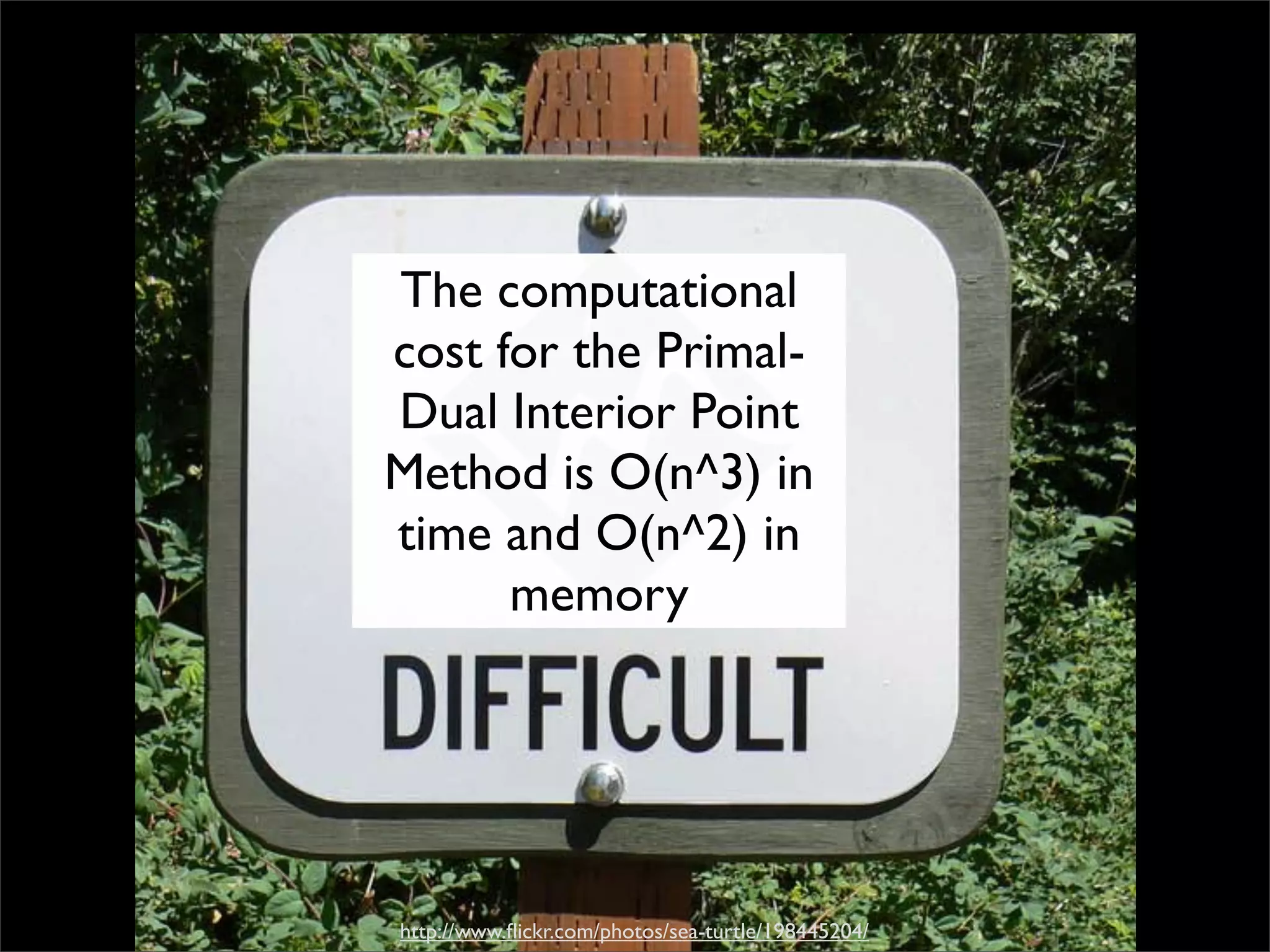
The computational
cost for the Primal-
Dual Interior Point
Method is O(n^3) in
time and O(n^2) in
      memory


http://www.flickr.com/photos/sea-turtle/198445204/
Parallel SVM                [Chang et al, 2007]


•   Parallel, row-wise incomplete Cholesky
    Factorization for Q
•   Parallel interior point method
    •   Time O(n^3) becomes O(n^2 / M)
                                   √
    •   Memory O(n^2) becomes O(n N / M)
•   Parallel Support Vector Machines (psvm) http://
    code.google.com/p/psvm/
    •   Implement in MPI
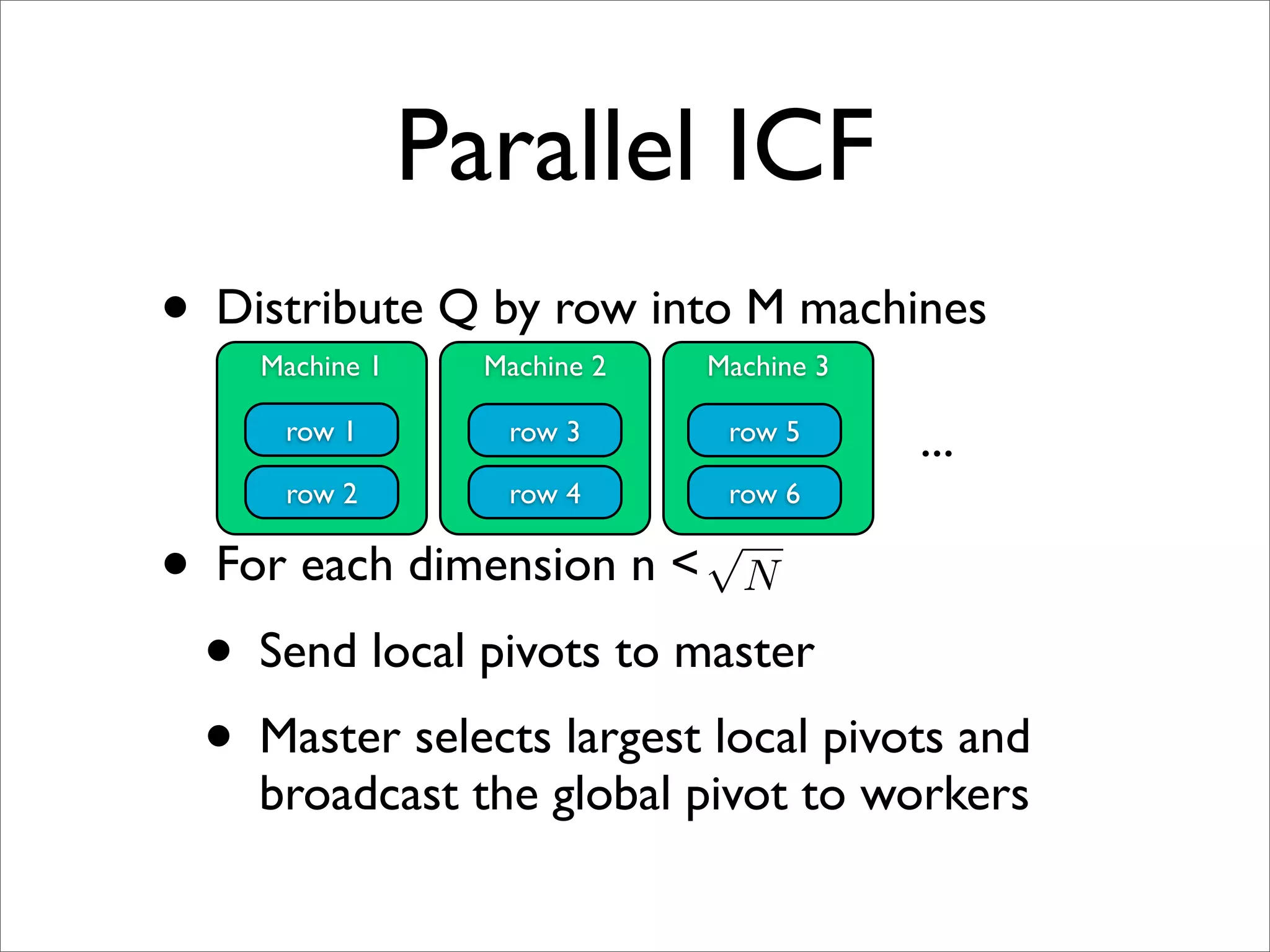
Parallel ICF
• Distribute Q by row into M machines
    Machine 1     Machine 2   Machine 3

      row 1        row 3       row 5      ...
      row 2        row 4       row 6


• For each dimension n  N    √

  • Send local pivots to master
  • Master selects largest local pivots and
    broadcast the global pivot to workers
Scaling Up

• Why big data?
• Parallelize machine learning algorithms
 • Embarrassingly parallel
 • Parallelize sub-routines
 • Distributed learning
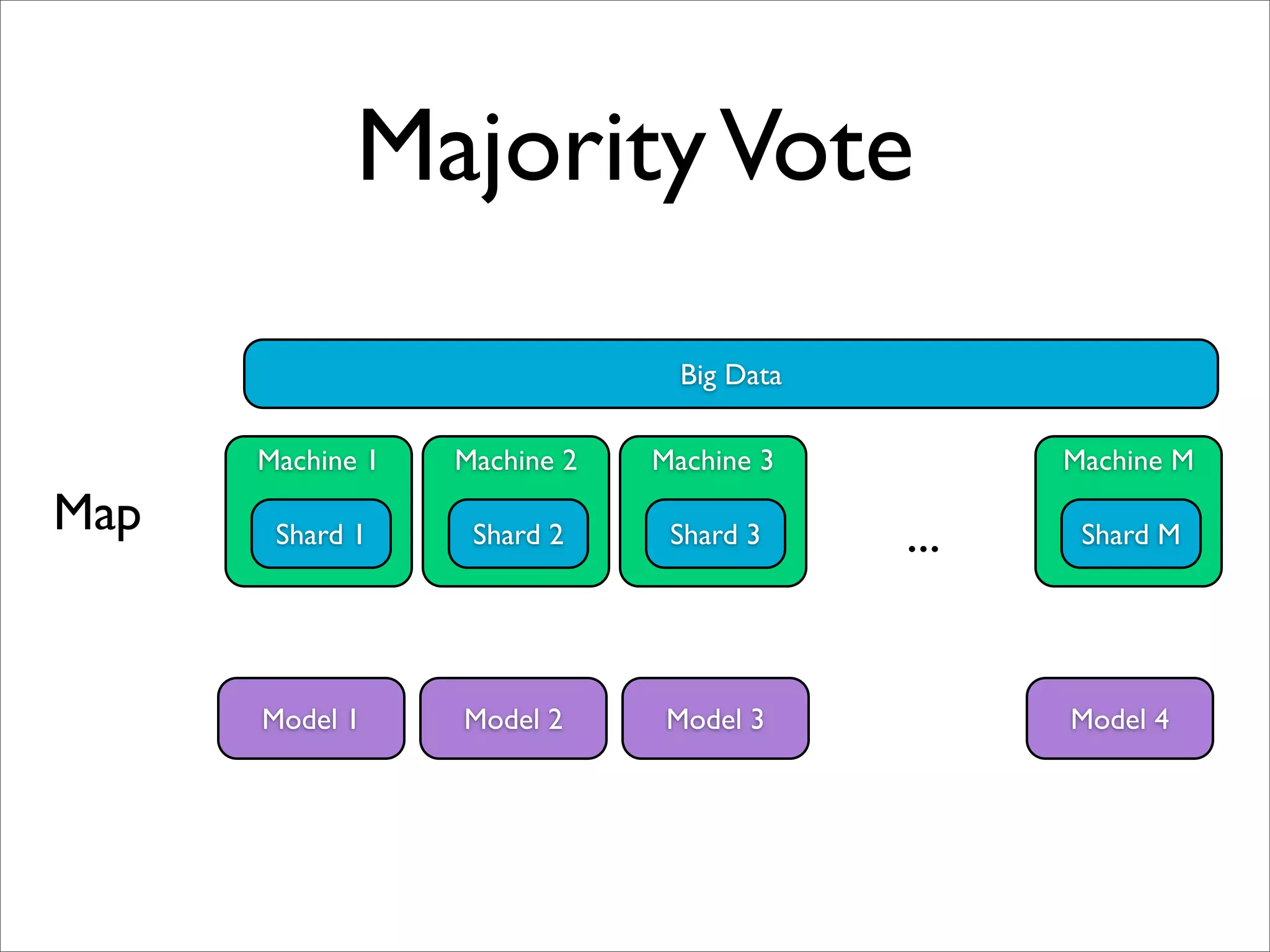
Majority Vote
                                Big Data

      Machine 1   Machine 2   Machine 3          Machine M

Map    Shard 1     Shard 2     Shard 3     ...    Shard M


      Model 1     Model 2      Model 3           Model 4
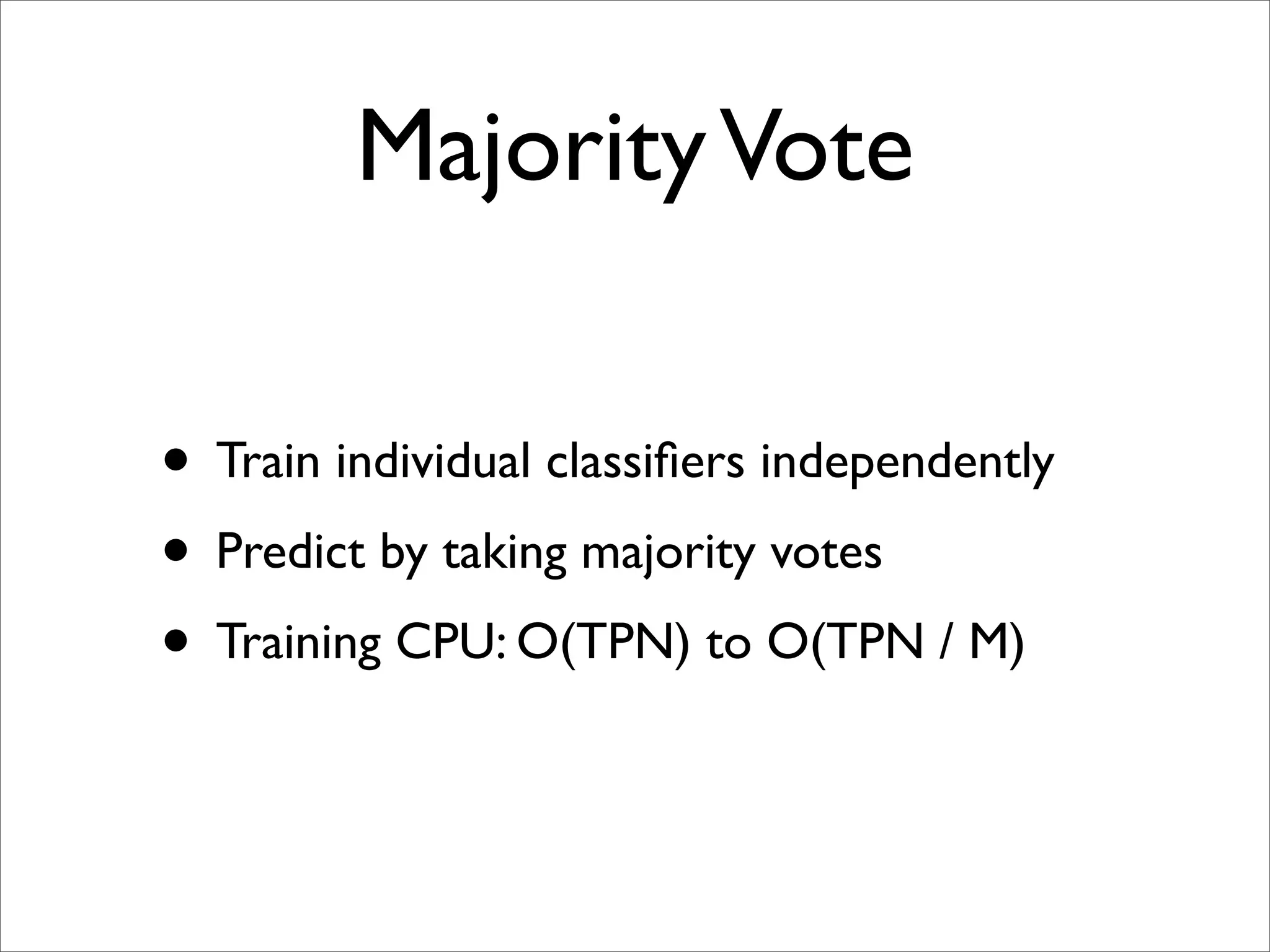
Majority Vote

• Train individual classifiers independently
• Predict by taking majority votes
• Training CPU: O(TPN) to O(TPN / M)
Parameter Mixture                          [Mann et al, 2009]

                                   Big Data

         Machine 1   Machine 2   Machine 3                   Machine M

 Map      Shard 1     Shard 2     Shard 3     ...             Shard M


             (dummy key, w1) (dummy key, w2) ...

Reduce                            Average w


                                    Model
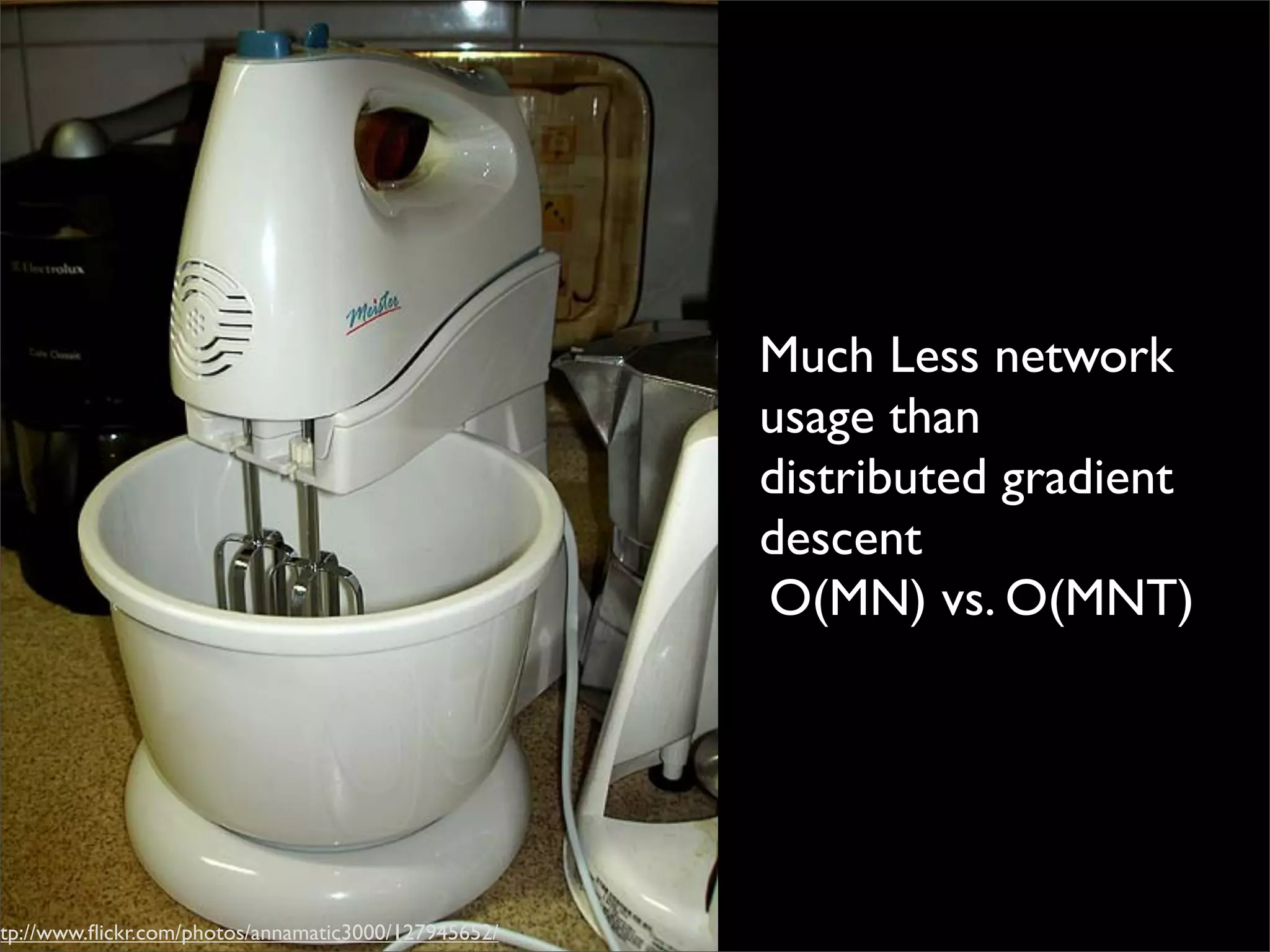
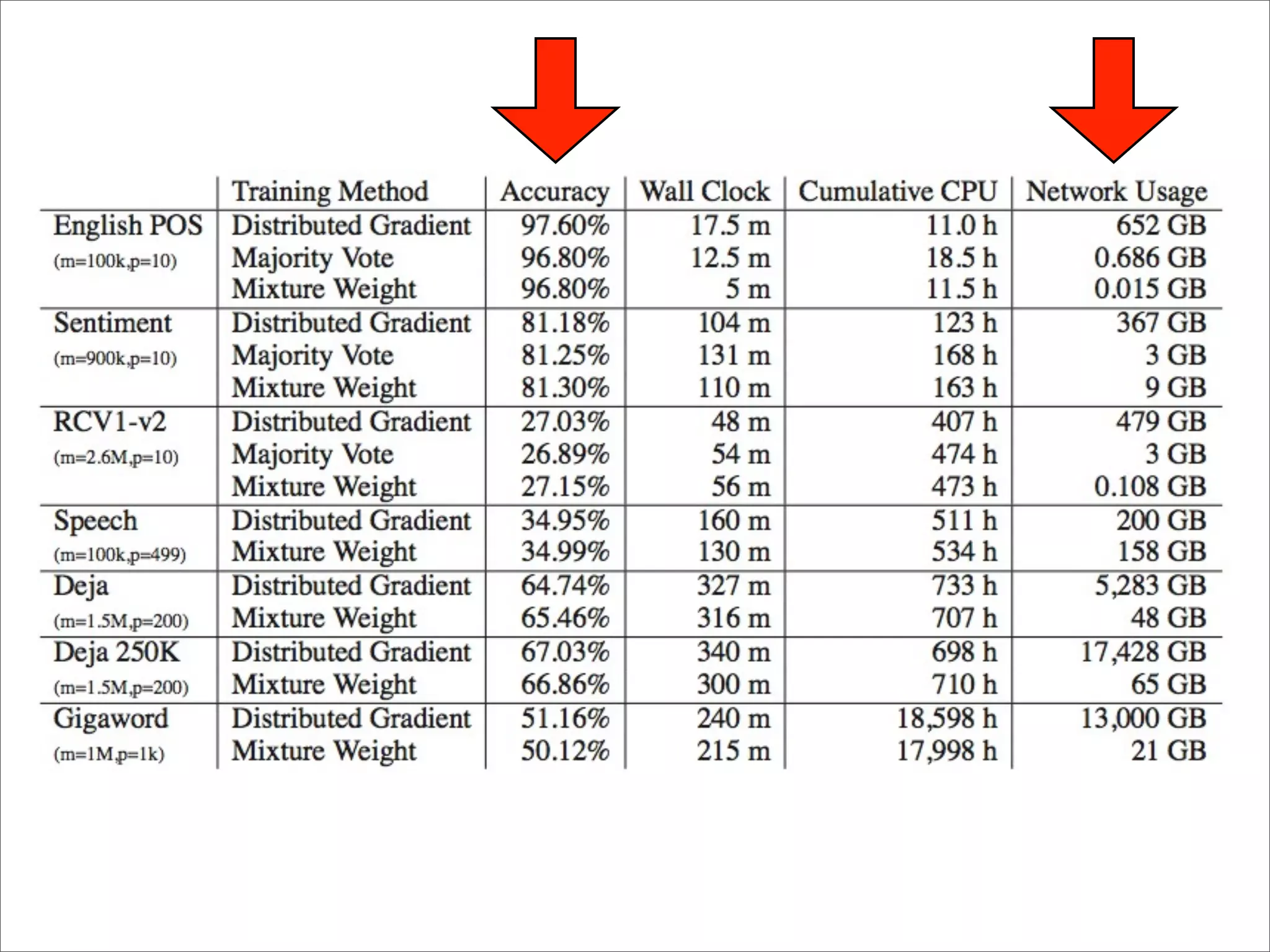
Much Less network
                                                      usage than
                                                      distributed gradient
                                                      descent
                                                      O(MN) vs. O(MNT)


ttp://www.flickr.com/photos/annamatic3000/127945652/
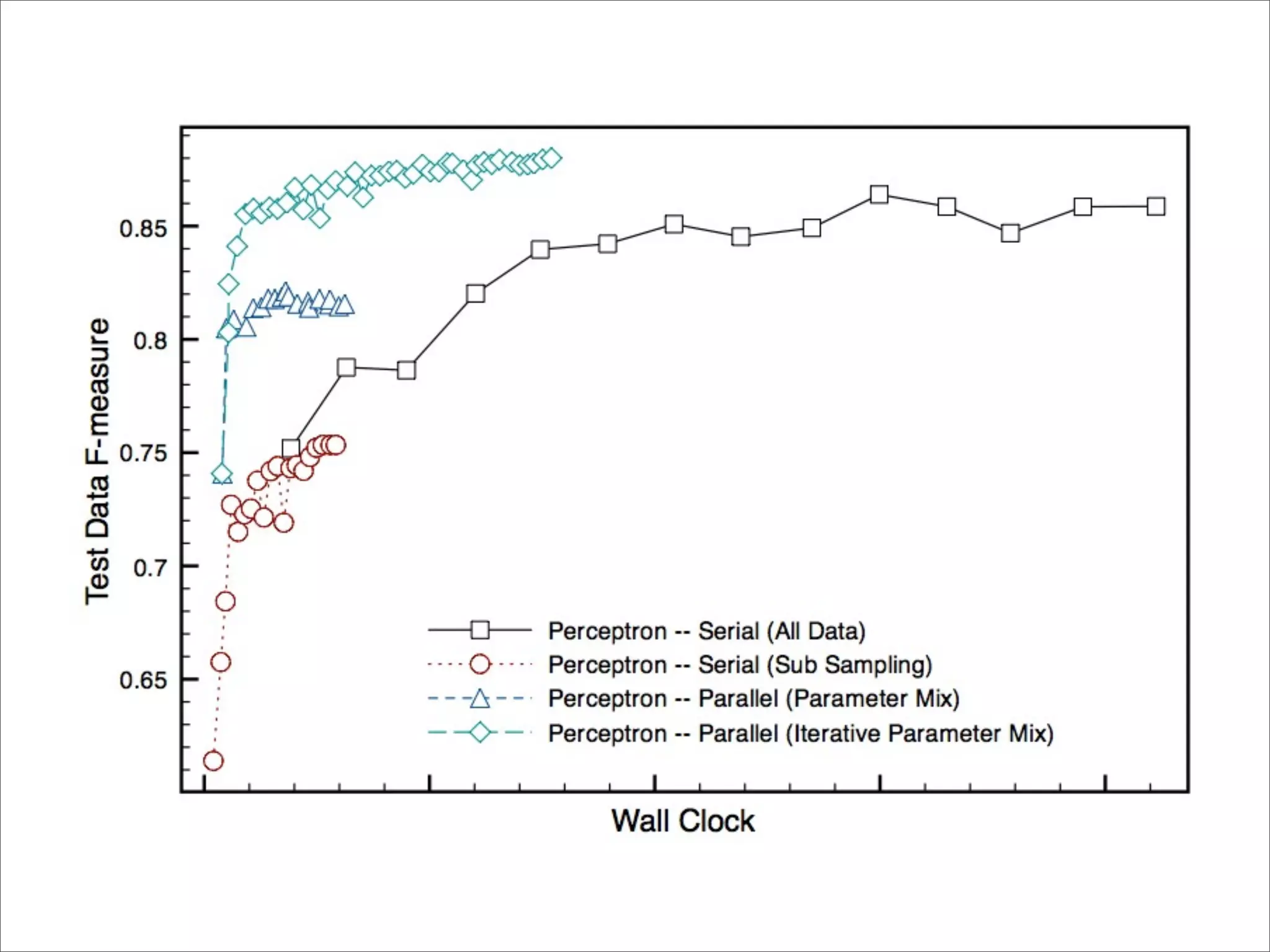
Iterative Param Mixture                       [McDonald et al., 2010]

                                       Big Data

             Machine 1   Machine 2   Machine 3                Machine M

  Map         Shard 1     Shard 2     Shard 3     ...           Shard M


                 (dummy key, w1) (dummy key, w2) ...
 Reduce
after each                            Average w

 epoch
                                        Model
Outline

• Machine Learning intro
• Scaling machine learning algorithms up
• Design choices of large scale ML systems
Scalable


           http://www.flickr.com/photos/mr_t_in_dc/5469563053
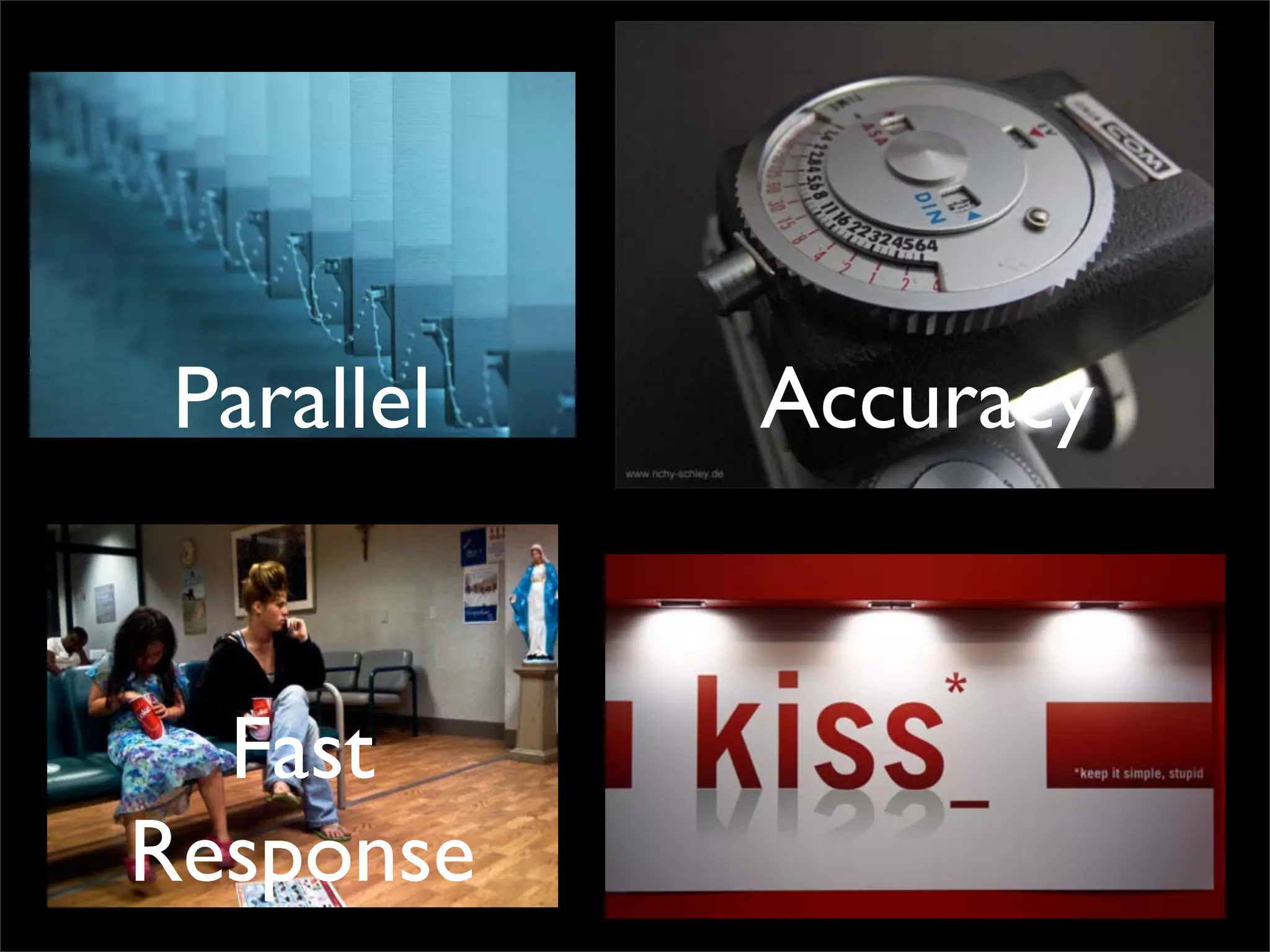
Parallel


http://www.flickr.com/photos/aloshbennett/3209564747/
Accuracy
http://www.flickr.com/photos/wanderlinse/4367261825/
http://www.flickr.com/photos/imagelink/4006753760/
Binary
                                                     Classification
http://www.flickr.com/photos/brenderous/4532934181/
Automatic
 Feature
Discovery


   http://www.flickr.com/photos/mararie/2340572508/
Fast
                                              Response

http://www.flickr.com/photos/prunejuice/3687192643/
Memory is new
      hard disk.


http://www.flickr.com/photos/jepoirrier/840415676/
Algorithm +
                                                Infrastructure

http://www.flickr.com/photos/neubie/854242030/
Design for
Multicores
             http://www.flickr.com/photos/geektechnique/2344029370/
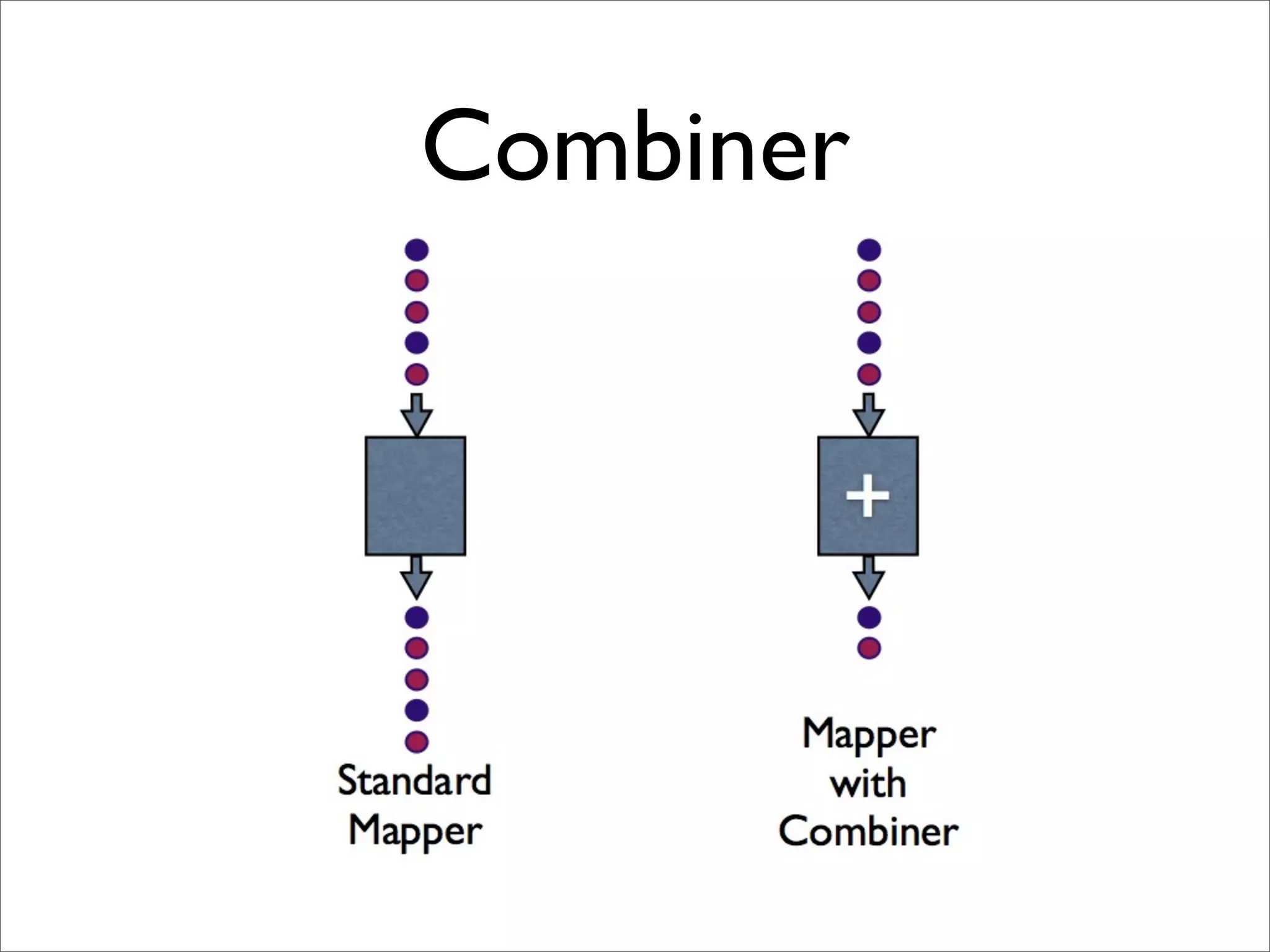
Combiner
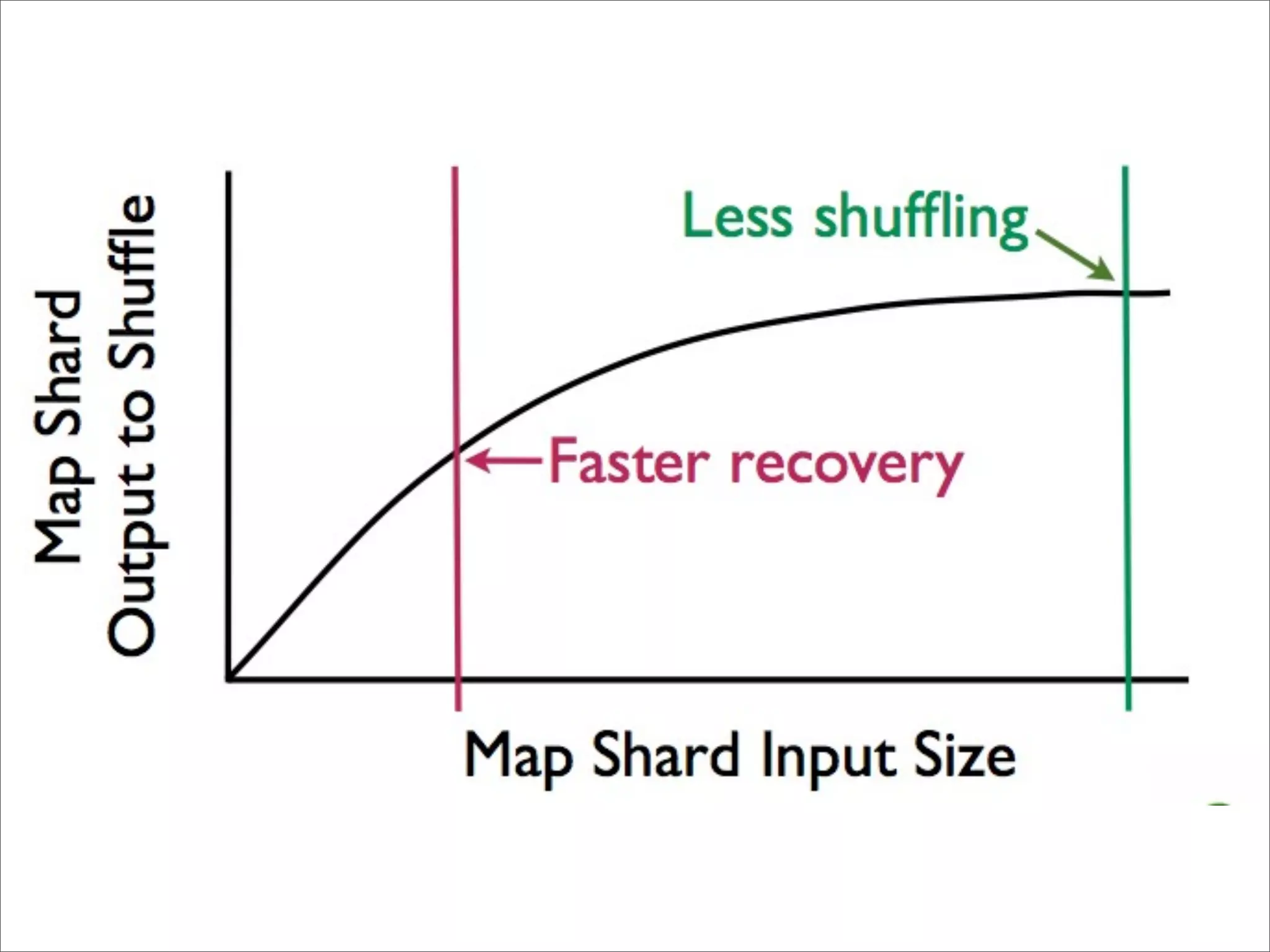
Multi-shard Combiner


[Chandra et al., 2010]
Machine
Learning on
 Big Data
Parallelize ML
         Algorithms

• Embarrassingly parallel
• Parallelize sub-routines
• Distributed learning
Parallel   Accuracy


  Fast
Response
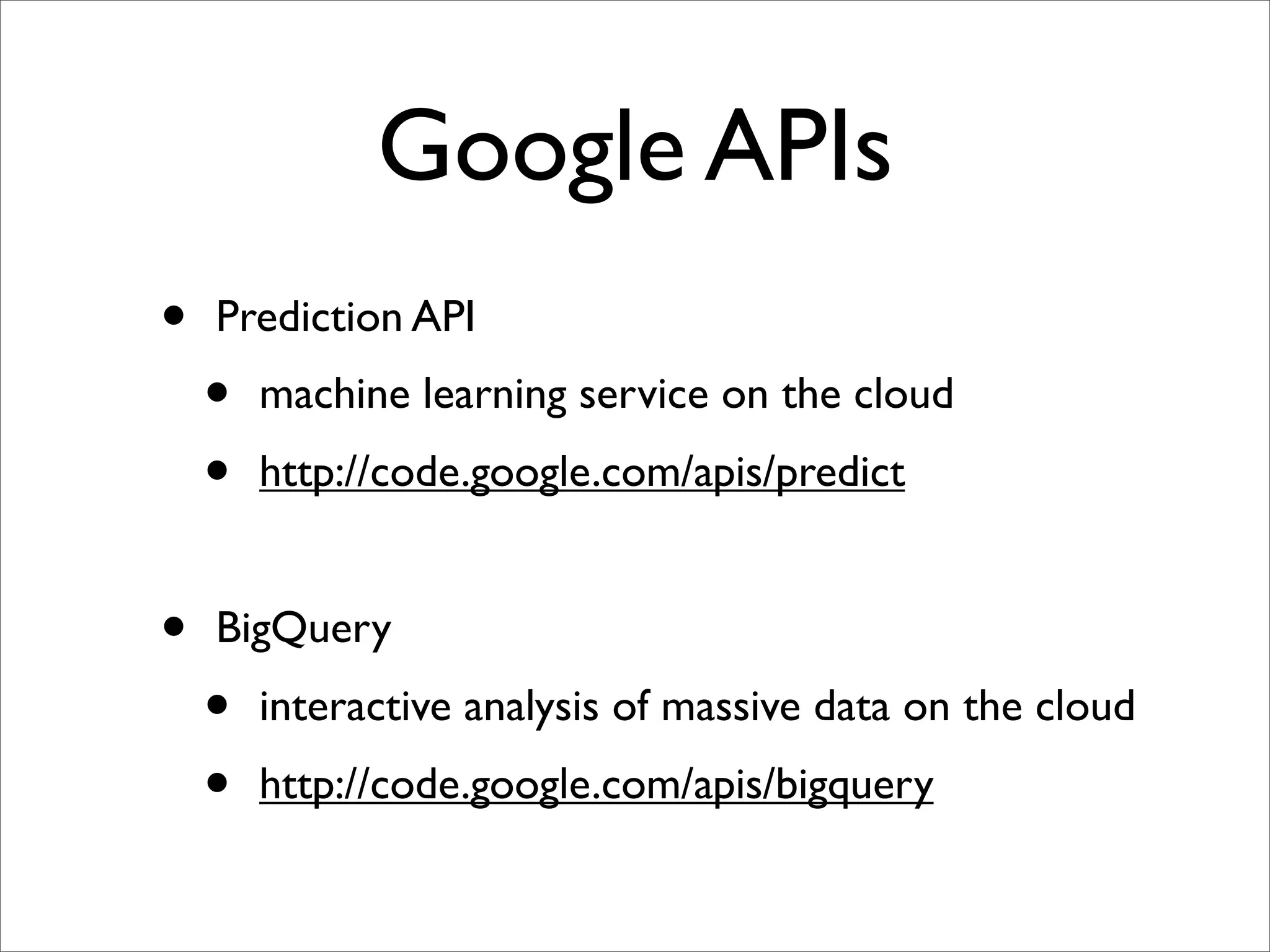
Google APIs
•   Prediction API
    •   machine learning service on the cloud
    •   http://code.google.com/apis/predict


•   BigQuery
    •   interactive analysis of massive data on the cloud
    •   http://code.google.com/apis/bigquery

[Harvard CS264] 09 - Machine Learning on Big Data: Lessons Learned from Google Projects (Max Lin, Google Research)

  • 1.
    Machine Learning onBig Data Lessons Learned from Google Projects Max Lin Software Engineer | Google Research Massively Parallel Computing | Harvard CS 264 Guest Lecture | March 29th, 2011
  • 2.
    Outline • Machine Learningintro • Scaling machine learning algorithms up • Design choices of large scale ML systems
  • 3.
    Outline • Machine Learningintro • Scaling machine learning algorithms up • Design choices of large scale ML systems
  • 4.
    “Machine Learning isa study of computer algorithms that improve automatically through experience.”
  • 10.
    The quick brownfox English jumped over the lazy dog. To err is human, but to really foul things up you English Training Input X need a computer. Output Y No hay mal que por bien Spanish no venga. Model f(x) La tercera es la vencida. Spanish To be or not to be -- that ? Testing f(x’) is the question = y’ La fe mueve montañas. ?
  • 11.
    Linear Classifier The quick brown fox jumped over the lazy dog. ‘a’ ... ‘aardvark’ ... ‘dog’ ... ‘the’ ... ‘montañas’ ... x [ 0, ... 0, ... 1, ... 1, ... 0, ... ] w [ 0.1, ... 132, ... 150, ... 200, ... -153, ... ] P f (x) = w · x = wp ∗ xp p=1
  • 12.
    Training Data Input X Ouput Y P ... ... ... N ... ... ... ... ... ... ...
  • 13.
    Typical machine learning dataat Google N: 100 billions / 1 billion P: 1 billion / 10 million (mean / median) http://www.flickr.com/photos/mr_t_in_dc/5469563053
  • 14.
    Classifier Training • Training:Given {(x, y)} and f, minimize the following objective function N arg min L(yi , f (xi ; w)) + R(w) w n=1
  • 15.
    Use Newton’s method? t+1 t t −1 t w ← w − H(w ) ∇J(w ) http://www.flickr.com/photos/visitfinland/5424369765/
  • 16.
    Outline • Machine Learningintro • Scaling machine learning algorithms up • Design choices of large scale ML systems
  • 17.
    Scaling Up • Whybig data? • Parallelize machine learning algorithms • Embarrassingly parallel • Parallelize sub-routines • Distributed learning
  • 18.
    Subsampling Big Data Reduce N Shard 1 Shard 2 Shard 3 ... Shard M Machine Model
  • 19.
    Why not SmallData? [Banko and Brill, 2001]
  • 20.
    Scaling Up • Whybig data? • Parallelize machine learning algorithms • Embarrassingly parallel • Parallelize sub-routines • Distributed learning
  • 21.
    Parallelize Estimates • NaiveBayes Classifier N P i arg min − P (xp |yi ; w)P (yi ; w) w i=1 p=1 • Maximum Likelihood Estimates N i i=1 1EN,the (x ) wthe|EN = N i=1 1EN (xi )
  • 22.
    Word Counting (‘the|EN’, 1) X: “The quick brown fox ...” Map (‘quick|EN’, 1) Y: EN (‘brown|EN’, 1) Reduce [ (‘the|EN’, 1), (‘the|EN’, 1), (‘the|EN’, 1) ] C(‘the’|EN) = SUM of values = 3 C( the |EN ) w the |EN = C(EN )
  • 23.
    Word Counting Big Data Mapper 1 Mapper 2 Mapper 3 Mapper M Map Shard 1 Shard 2 Shard 3 ... Shard M (‘the’ | EN, 1) (‘fox’ | EN, 1) ... (‘montañas’ | ES, 1) Reducer Reduce Tally counts and update w Model
  • 24.
    Parallelize Optimization • MaximumEntropy Classifiers P N i yi exp( p=1 wp ∗ xp ) arg min P w i=1 1 + exp( p=1 wp ∗ xi ) p • Good: J(w) is concave • Bad: no closed-form solution like NB • Ugly: Large N
  • 25.
    Gradient Descent http://www.cs.cmu.edu/~epxing/Class/10701/Lecture/lecture7.pdf
  • 26.
    Gradient Descent • wis initialized as zero • for t in 1 to T • Calculate gradients ∇J(w) • w ← w − η∇J(w) t+1 t N ∇J(w) = P (w, xi , yi ) i=1
  • 27.
    Distribute Gradient • wis initialized as zero • for t in 1 to T • Calculate gradients in parallel wt+1 ← wt − η∇J(w) • Training CPU: O(TPN) to O(TPN / M)
  • 28.
    Distribute Gradient Big Data Machine 1 Machine 2 Machine 3 Machine M Map Shard 1 Shard 2 Shard 3 ... Shard M (dummy key, partial gradient sum) Reduce Sum and Update w Repeat M/R until converge Model
  • 29.
    Scaling Up • Whybig data? • Parallelize machine learning algorithms • Embarrassingly parallel • Parallelize sub-routines • Distributed learning
  • 30.
    Parallelize Subroutines • SupportVector Machines 1 n 2 arg min ||w||2 +C ζi w,b,ζ 2 i=1 s.t. 1 − yi (w · φ(xi ) + b) ≤ ζi , ζi ≥ 0 • Solve the dual problem 1 T arg min α Qα − αT 1 α 2 s.t. 0 ≤ α ≤ C, yT α = 0
  • 31.
    The computational cost forthe Primal- Dual Interior Point Method is O(n^3) in time and O(n^2) in memory http://www.flickr.com/photos/sea-turtle/198445204/
  • 32.
    Parallel SVM [Chang et al, 2007] • Parallel, row-wise incomplete Cholesky Factorization for Q • Parallel interior point method • Time O(n^3) becomes O(n^2 / M) √ • Memory O(n^2) becomes O(n N / M) • Parallel Support Vector Machines (psvm) http:// code.google.com/p/psvm/ • Implement in MPI
  • 33.
    Parallel ICF • DistributeQ by row into M machines Machine 1 Machine 2 Machine 3 row 1 row 3 row 5 ... row 2 row 4 row 6 • For each dimension n N √ • Send local pivots to master • Master selects largest local pivots and broadcast the global pivot to workers
  • 35.
    Scaling Up • Whybig data? • Parallelize machine learning algorithms • Embarrassingly parallel • Parallelize sub-routines • Distributed learning
  • 36.
    Majority Vote Big Data Machine 1 Machine 2 Machine 3 Machine M Map Shard 1 Shard 2 Shard 3 ... Shard M Model 1 Model 2 Model 3 Model 4
  • 37.
    Majority Vote • Trainindividual classifiers independently • Predict by taking majority votes • Training CPU: O(TPN) to O(TPN / M)
  • 38.
    Parameter Mixture [Mann et al, 2009] Big Data Machine 1 Machine 2 Machine 3 Machine M Map Shard 1 Shard 2 Shard 3 ... Shard M (dummy key, w1) (dummy key, w2) ... Reduce Average w Model
  • 39.
    Much Less network usage than distributed gradient descent O(MN) vs. O(MNT) ttp://www.flickr.com/photos/annamatic3000/127945652/
  • 41.
    Iterative Param Mixture [McDonald et al., 2010] Big Data Machine 1 Machine 2 Machine 3 Machine M Map Shard 1 Shard 2 Shard 3 ... Shard M (dummy key, w1) (dummy key, w2) ... Reduce after each Average w epoch Model
  • 43.
    Outline • Machine Learningintro • Scaling machine learning algorithms up • Design choices of large scale ML systems
  • 44.
    Scalable http://www.flickr.com/photos/mr_t_in_dc/5469563053
  • 45.
  • 46.
  • 47.
  • 48.
    Binary Classification http://www.flickr.com/photos/brenderous/4532934181/
  • 49.
    Automatic Feature Discovery http://www.flickr.com/photos/mararie/2340572508/
  • 50.
    Fast Response http://www.flickr.com/photos/prunejuice/3687192643/
  • 51.
    Memory is new hard disk. http://www.flickr.com/photos/jepoirrier/840415676/
  • 52.
    Algorithm + Infrastructure http://www.flickr.com/photos/neubie/854242030/
  • 53.
    Design for Multicores http://www.flickr.com/photos/geektechnique/2344029370/
  • 54.
  • 56.
  • 57.
  • 58.
    Parallelize ML Algorithms • Embarrassingly parallel • Parallelize sub-routines • Distributed learning
  • 59.
    Parallel Accuracy Fast Response
  • 60.
    Google APIs • Prediction API • machine learning service on the cloud • http://code.google.com/apis/predict • BigQuery • interactive analysis of massive data on the cloud • http://code.google.com/apis/bigquery