Introduction to Machine Learning

                                                            Jinhyuk Choi
Human-Computer Interaction Lab @ Information and Communications University
Contents
   Concepts of Machine Learning

   Multilayer Perceptrons

   Decision Trees

   Bayesian Networks
What is Machine Learning?
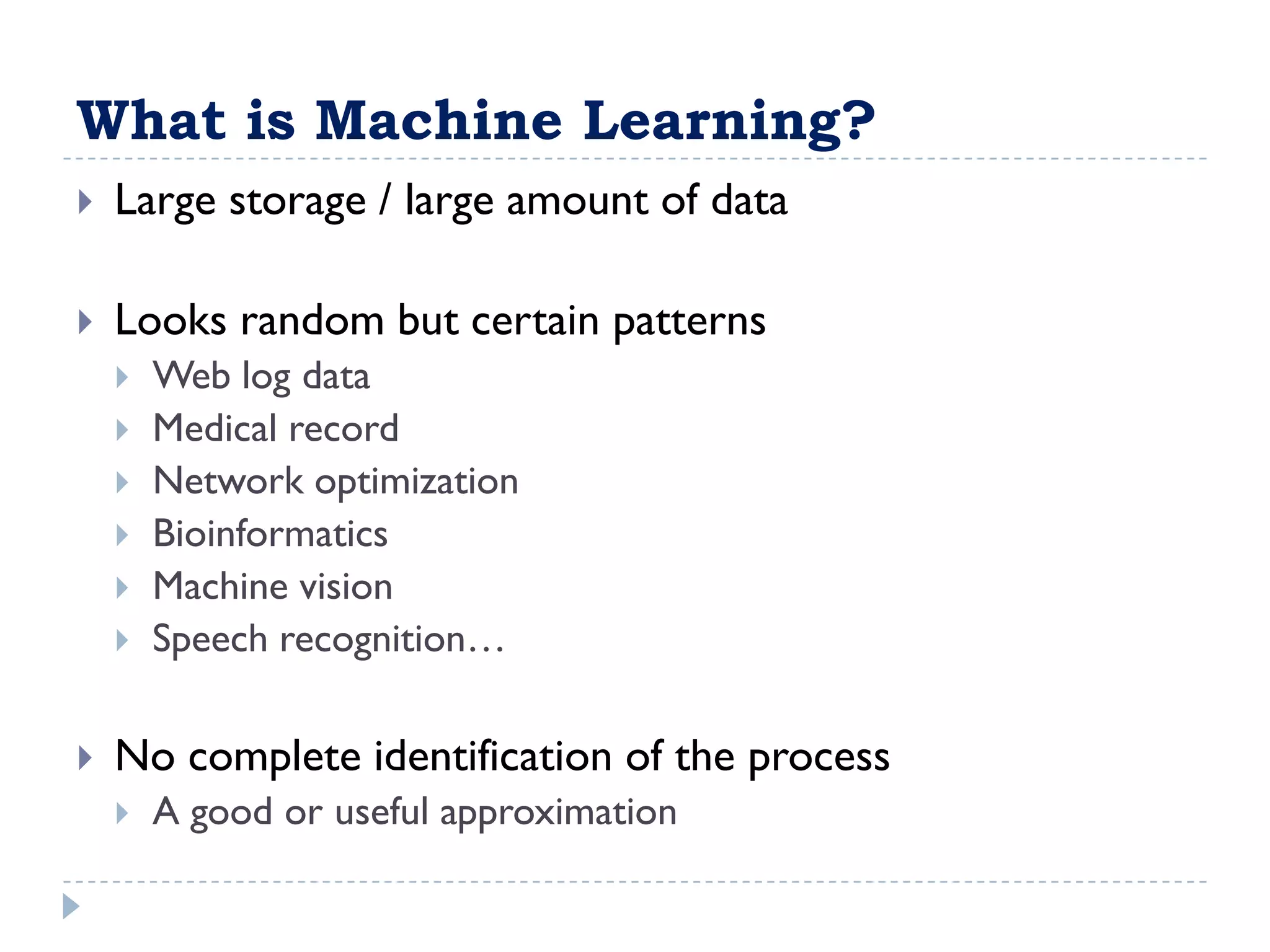
   Large storage / large amount of data

   Looks random but certain patterns
       Web log data
       Medical record
       Network optimization
       Bioinformatics
       Machine vision
       Speech recognition…

   No complete identification of the process
       A good or useful approximation
What is Machine Learning?
Definition
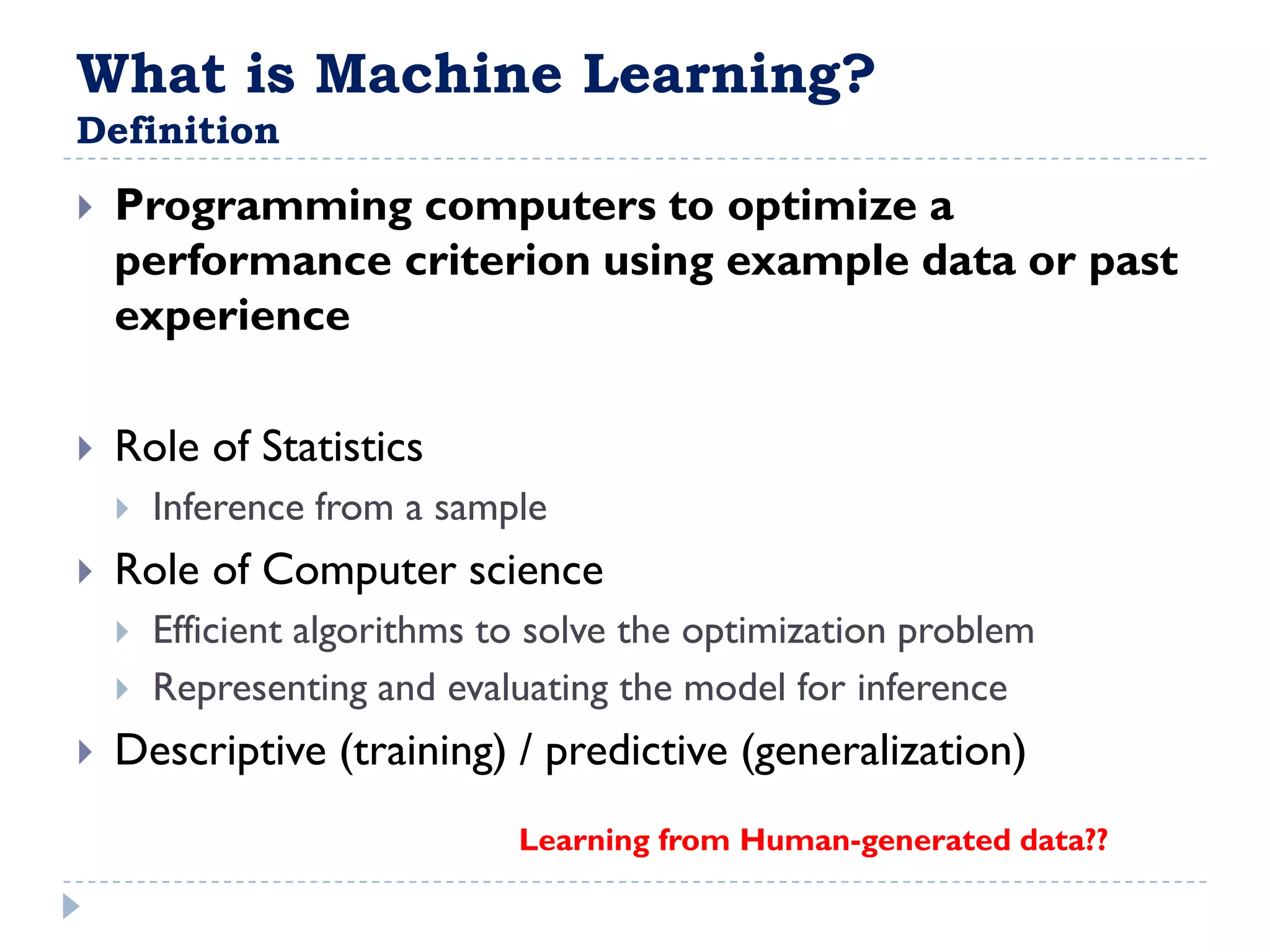
   Programming computers to optimize a
    performance criterion using example data or past
    experience

   Role of Statistics
       Inference from a sample
   Role of Computer science
       Efficient algorithms to solve the optimization problem
       Representing and evaluating the model for inference
   Descriptive (training) / predictive (generalization)
                              Learning from Human-generated data??
What is Machine Learning?
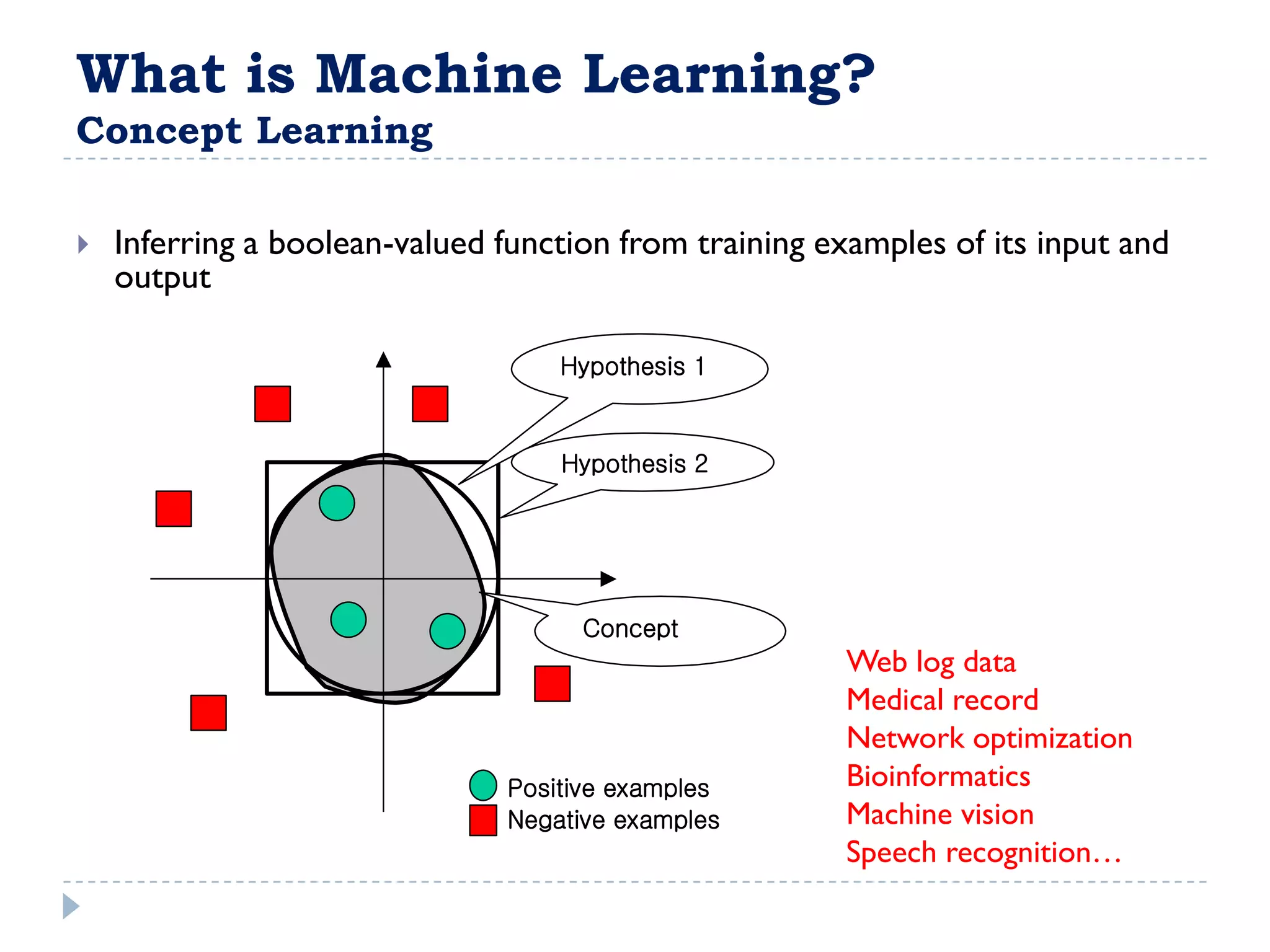
Concept Learning

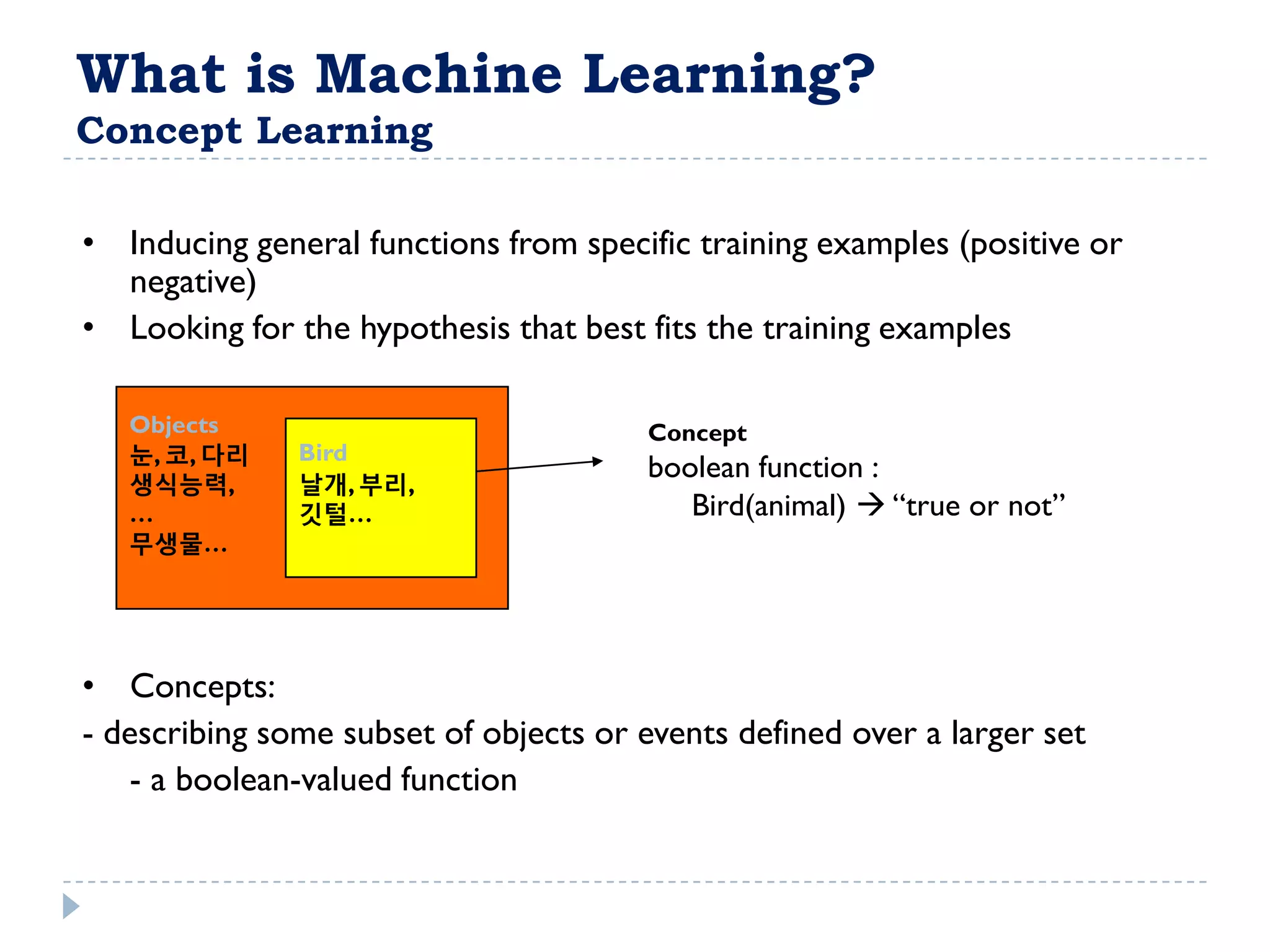
• Inducing general functions from specific training examples (positive or
  negative)
• Looking for the hypothesis that best fits the training examples

   Objects                              Concept
   눈, 코, 다리    Bird
   생식능력,       날개, 부리,
                                        boolean function :
   …           깃털…                         Bird(animal)  “true or not”
   무생물…


• Concepts:
- describing some subset of objects or events defined over a larger set
    - a boolean-valued function
What is Machine Learning?
Concept Learning

   Inferring a boolean-valued function from training examples of its input and
    output

                                   Hypothesis 1


                                   Hypothesis 2


                                     Concept
                                                        Web log data
                                                        Medical record
                                                        Network optimization
                               Positive examples        Bioinformatics
                               Negative examples        Machine vision
                                                        Speech recognition…
What is Machine Learning?
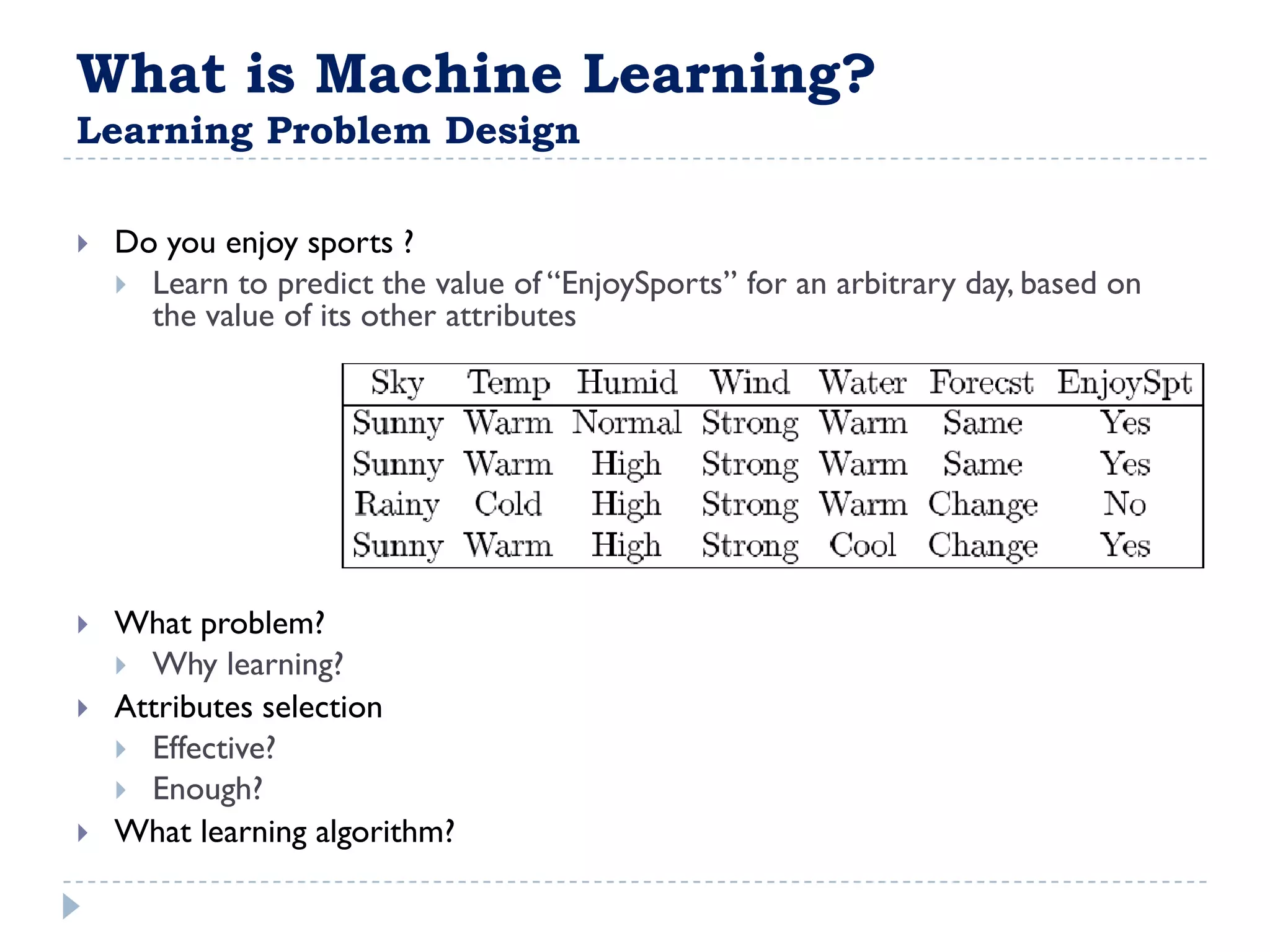
Learning Problem Design

   Do you enjoy sports ?
     Learn to predict the value of “EnjoySports” for an arbitrary day, based on
      the value of its other attributes


   What problem?
     Why learning?
   Attributes selection
     Effective?
     Enough?
   What learning algorithm?
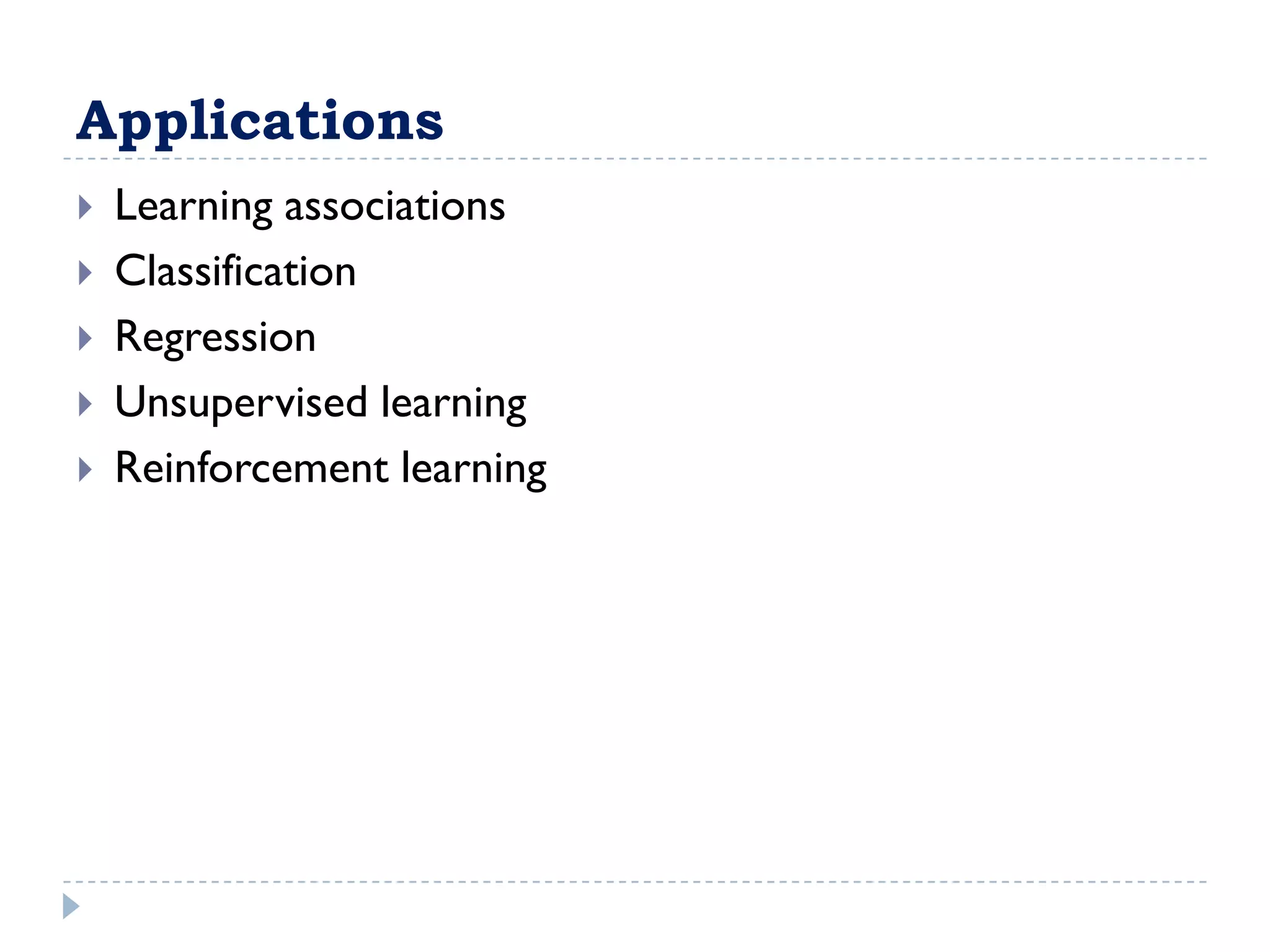
Applications
   Learning associations
   Classification
   Regression
   Unsupervised learning
   Reinforcement learning
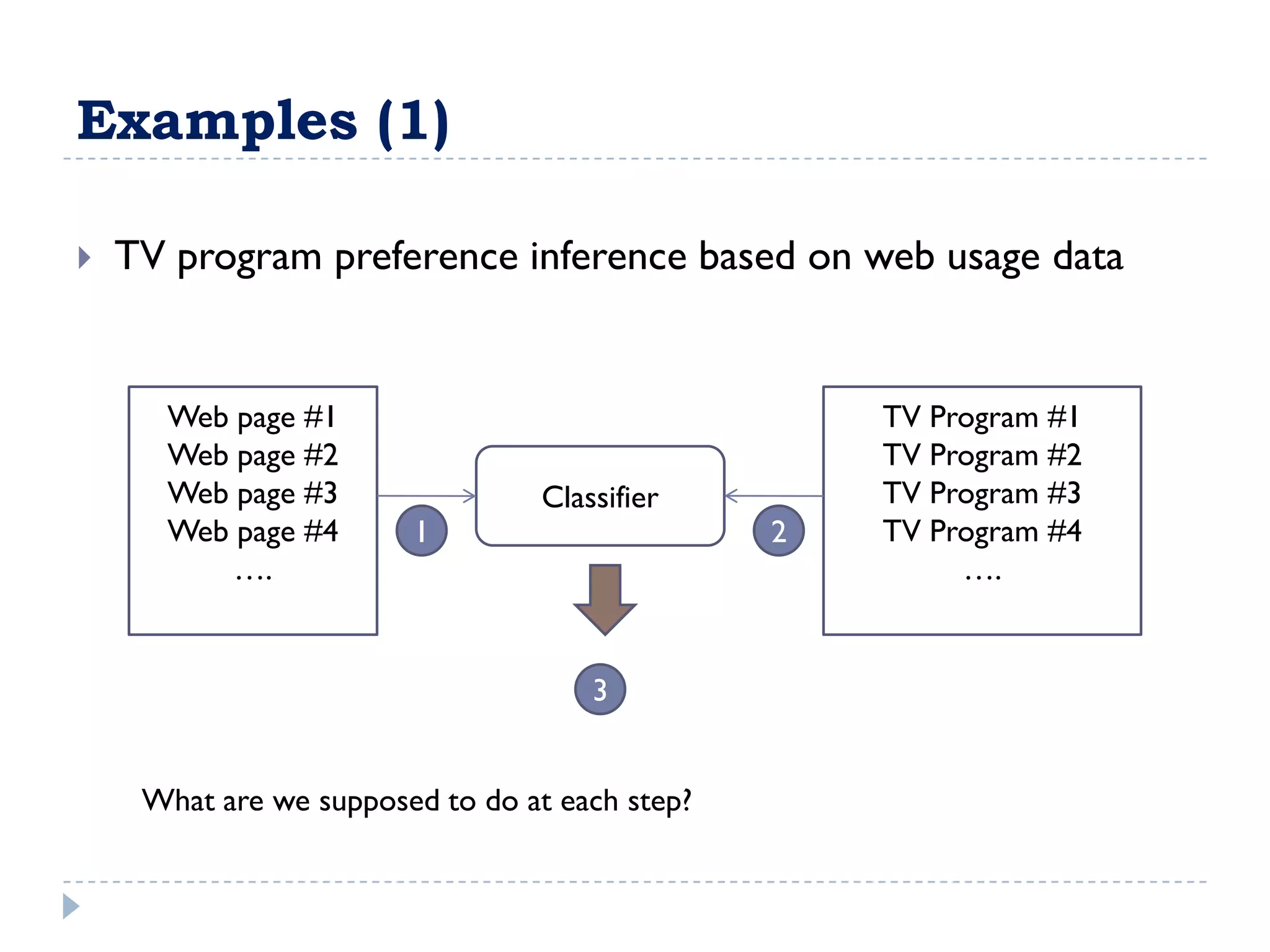
Examples (1)

   TV program preference inference based on web usage data


      Web page #1                                   TV Program #1
      Web page #2                                   TV Program #2
      Web page #3                 Classifier        TV Program #3
      Web page #4       1                       2   TV Program #4
          ….                                             ….


                                      3


     What are we supposed to do at each step?
Examples (2)
  from a HW of Neural Networks Class (KAIST-2002)

     Function approximation (Mexican hat)


                               
f3 ( x1 , x2 )  sin 2 x12  x2 ,
                               2
                                     x1 , x2 [1,1]
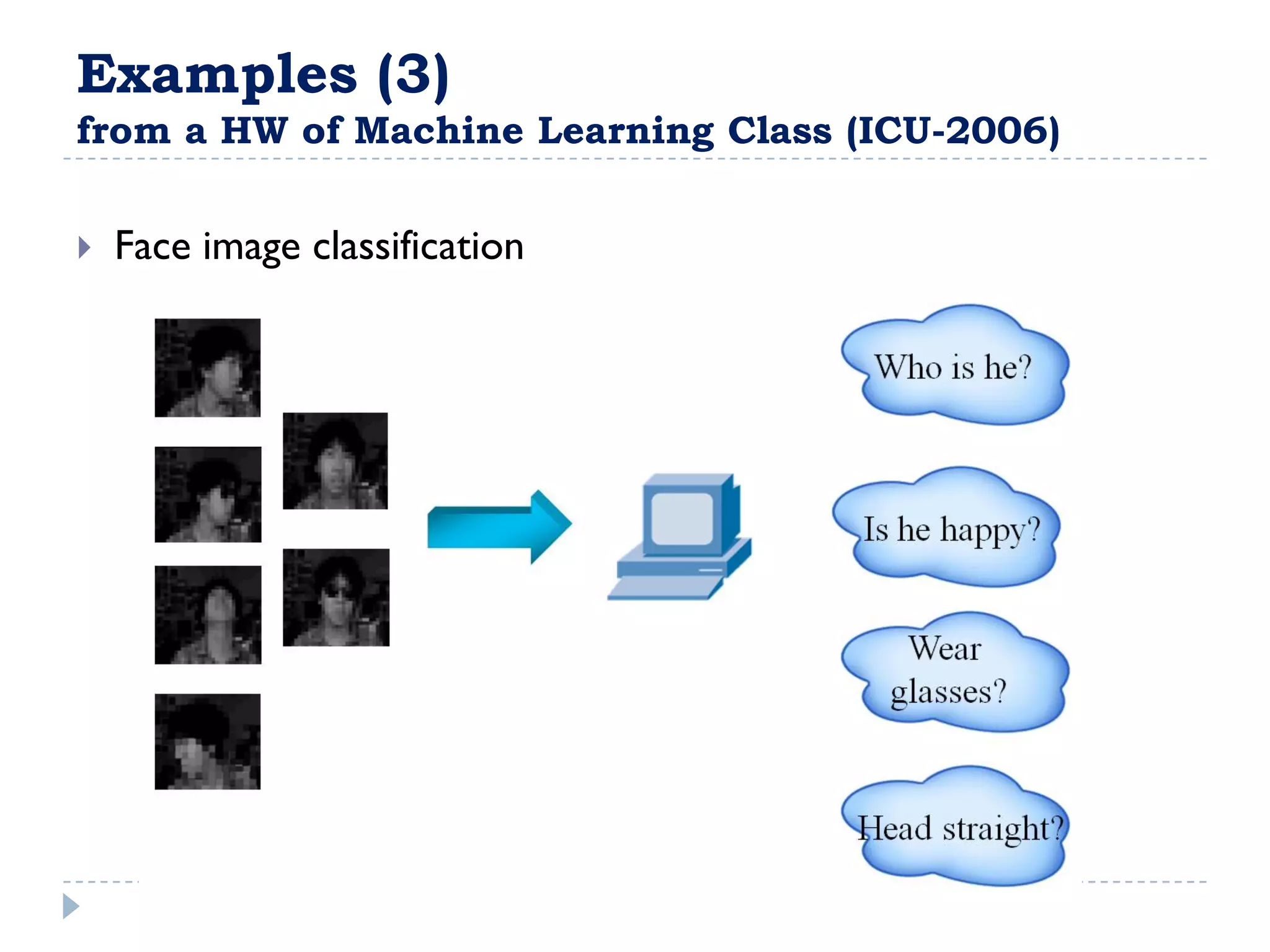
Examples (3)
from a HW of Machine Learning Class (ICU-2006)

   Face image classification
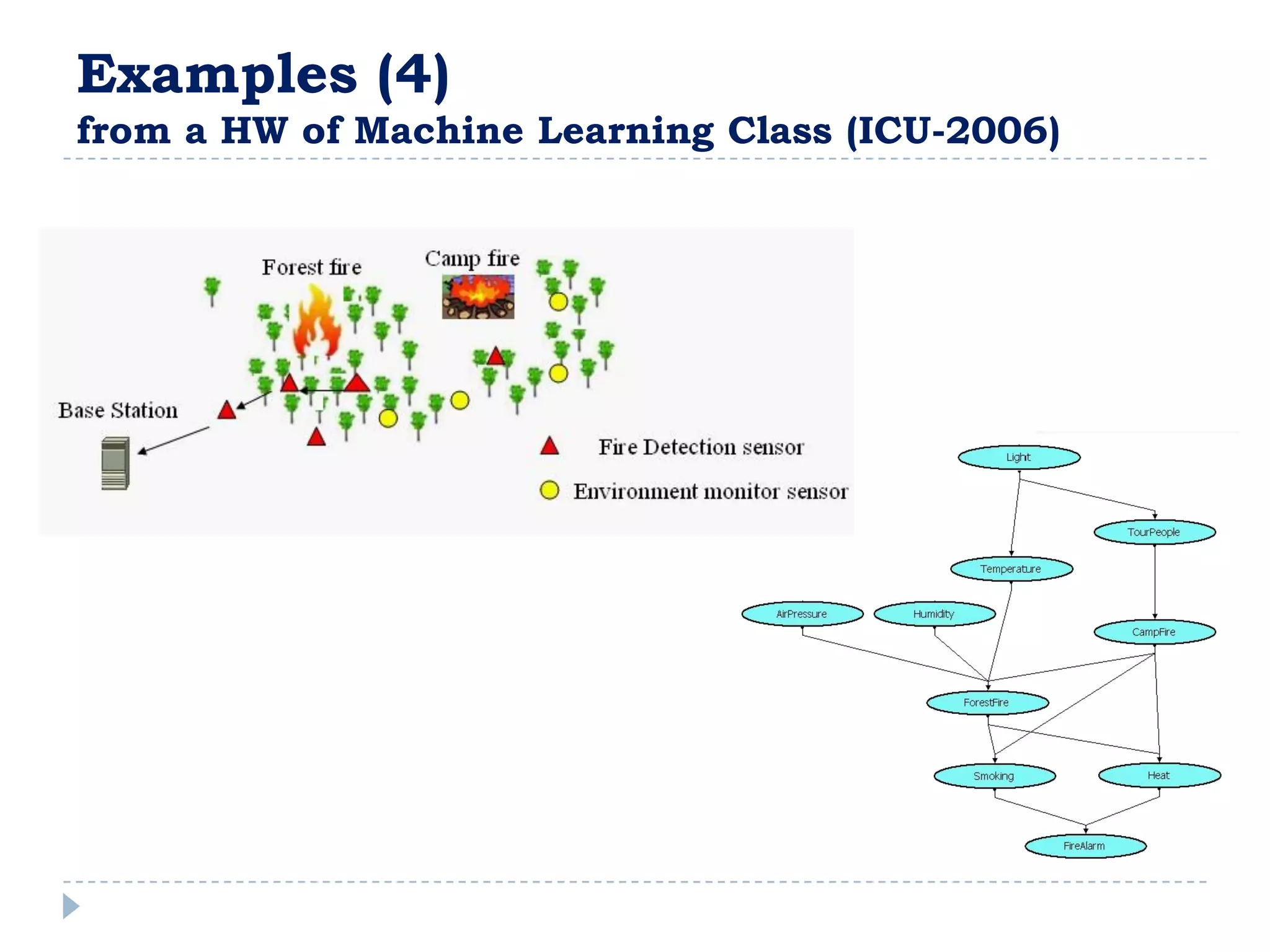
Examples (4)
from a HW of Machine Learning Class (ICU-2006)
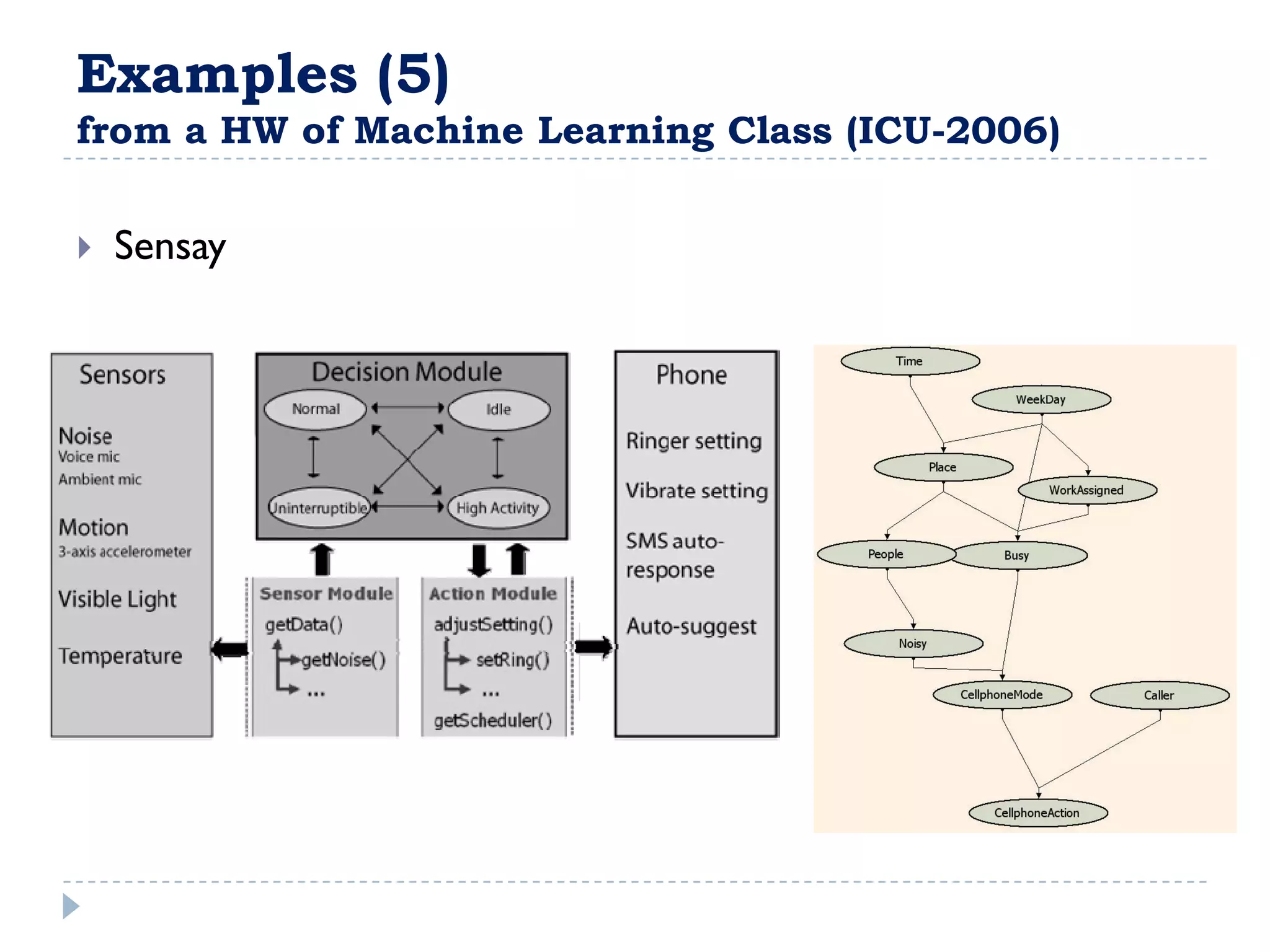
Examples (5)
from a HW of Machine Learning Class (ICU-2006)

   Sensay
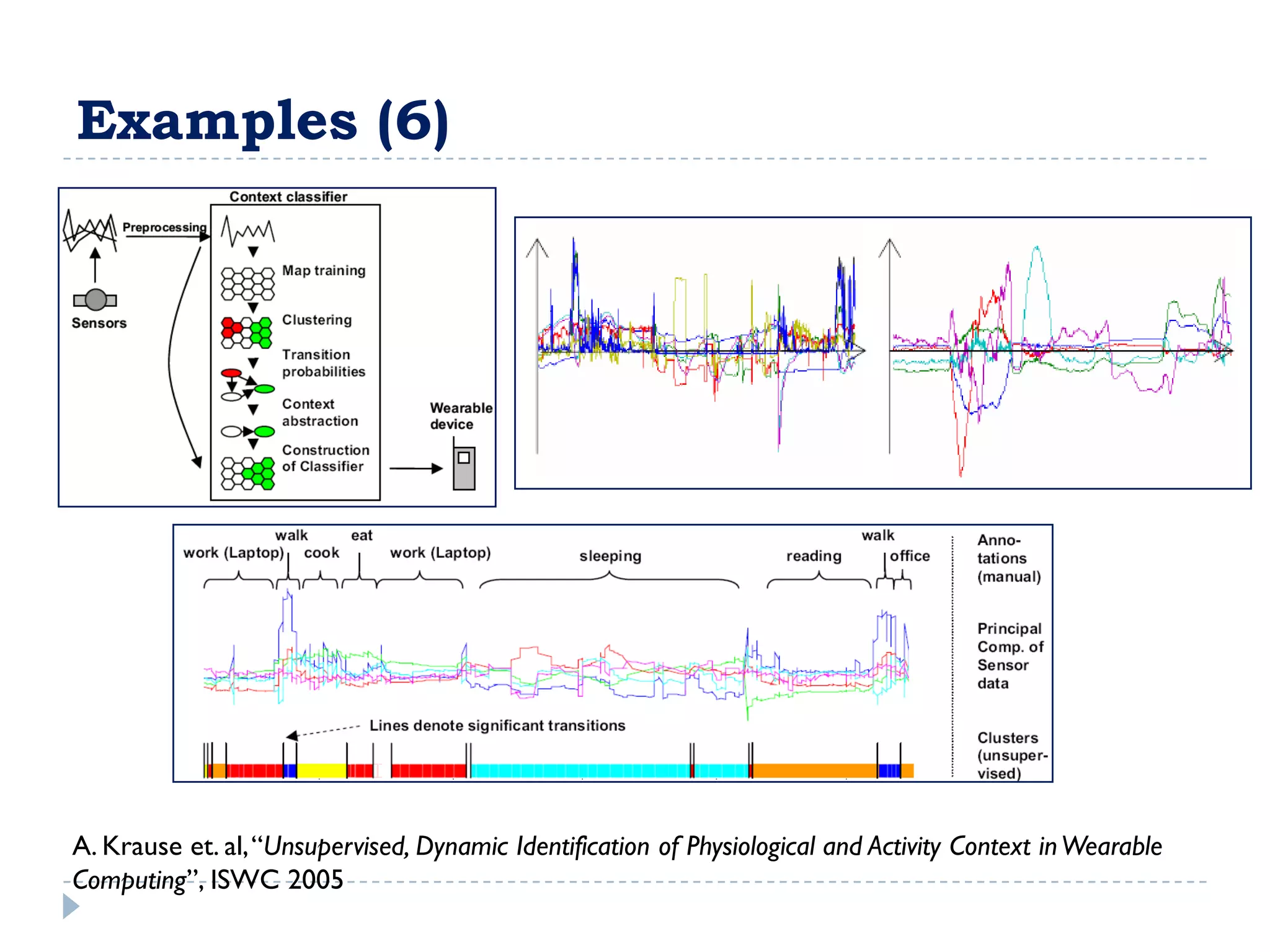
Examples (6)


A. Krause et. al, “Unsupervised, Dynamic Identification of Physiological and Activity Context in Wearable
Computing”, ISWC 2005
#1. Multilayer Perceptrons
Neural Network?


                  VS.   Adaline
                        MLP
                        SOM
                        Hopfield network
                        RDFN
                        Bifurcating neuron networks
                        …
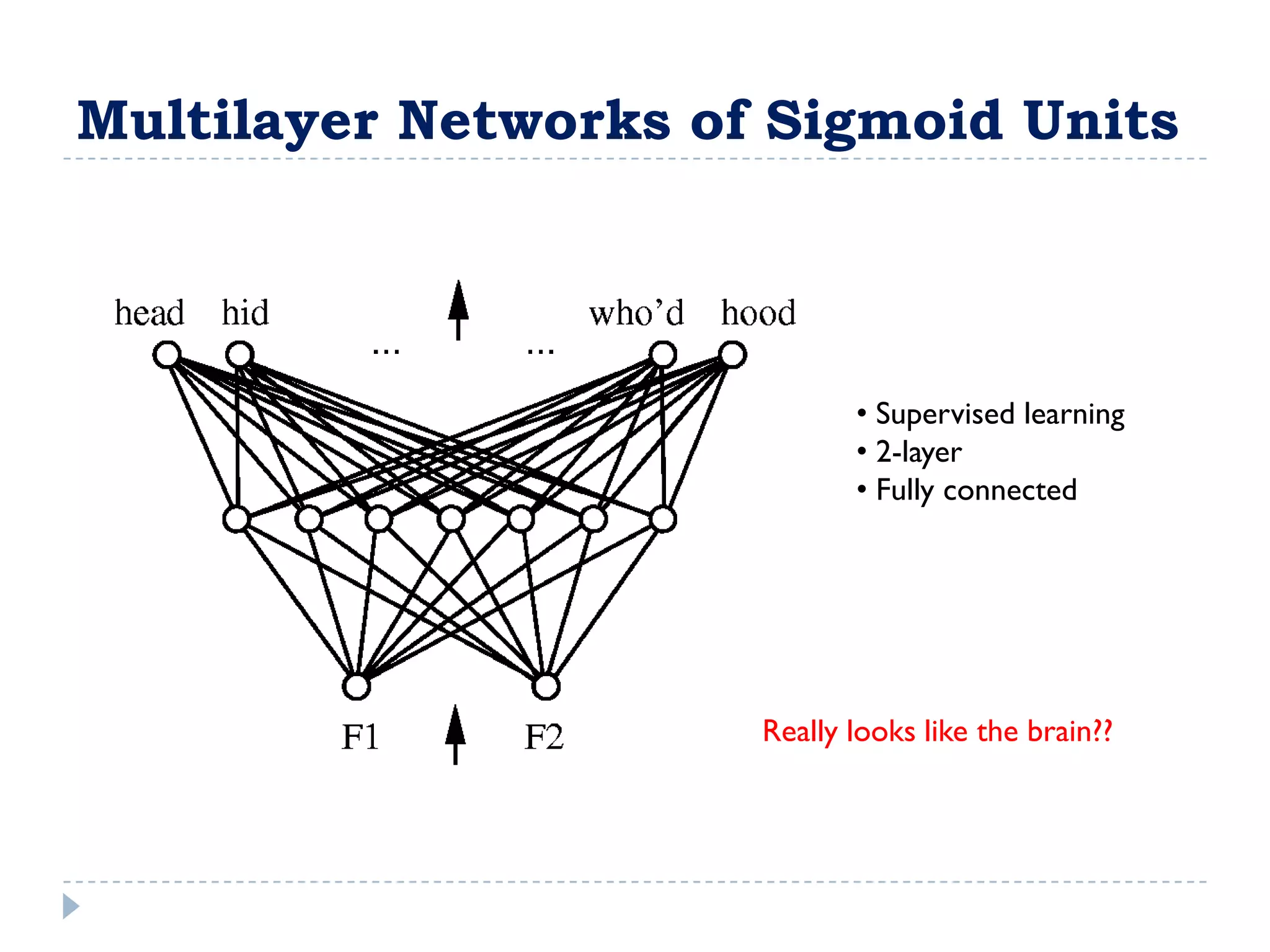
Multilayer Networks of Sigmoid Units


                             • Supervised learning
                             • 2-layer
                             • Fully connected


                      Really looks like the brain??
Sigmoid Unit
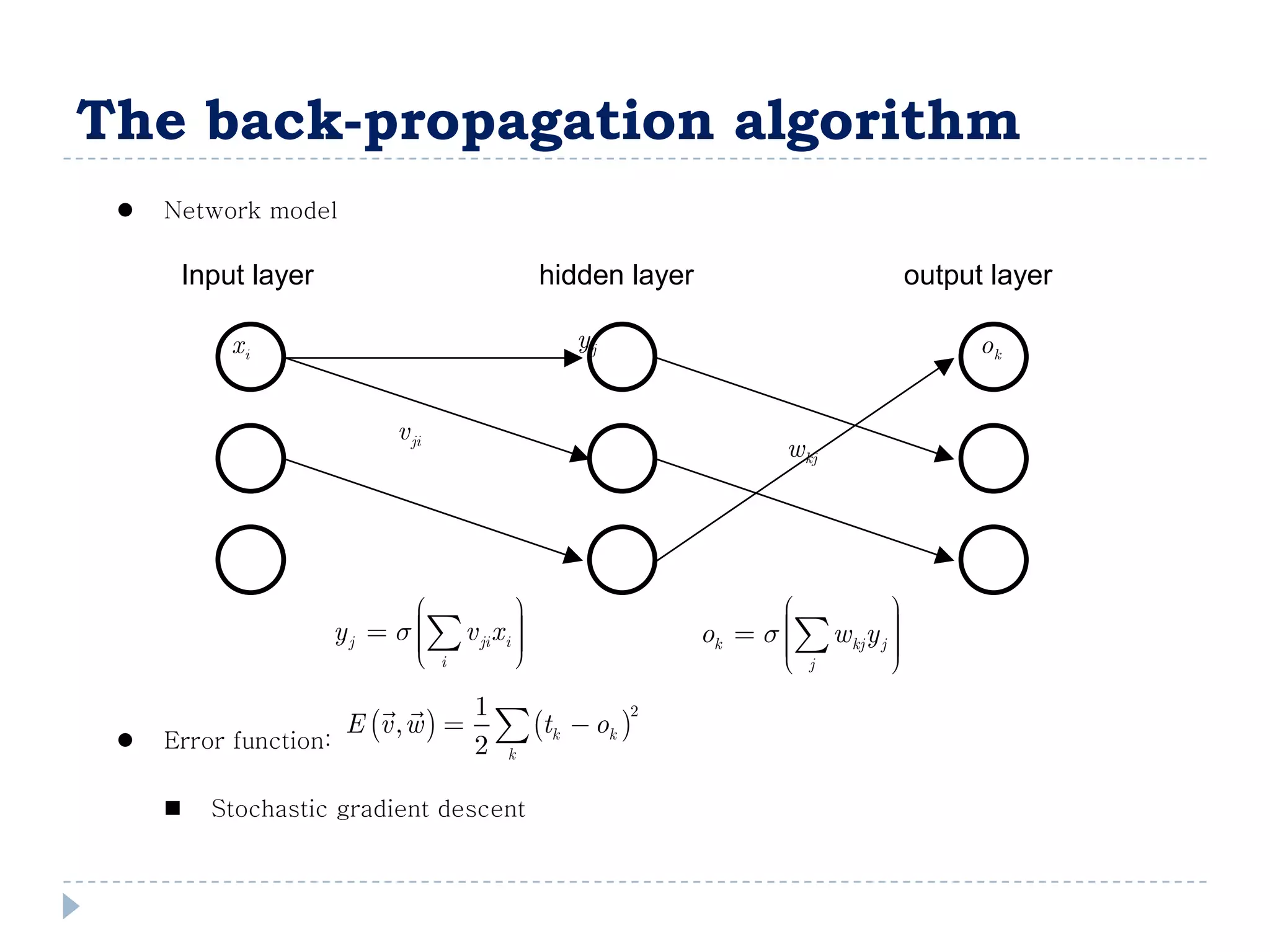
The back-propagation algorithm
  Network model

      Input layer                           hidden layer                      output layer

          xi                                  yj                                    ok


                           v ji
                                                                 wkj


                                                                       
                    y j  s  v ji x i 
                                                                 w y 
                                                           ok  s  kj j 
                                                                          
                             i
                                       
                                                                 
                                                                         
                                                                  j      
                              1
                    E v , w    tk  ok 
                                             2

  Error function:             2 k

      Stochastic gradient descent
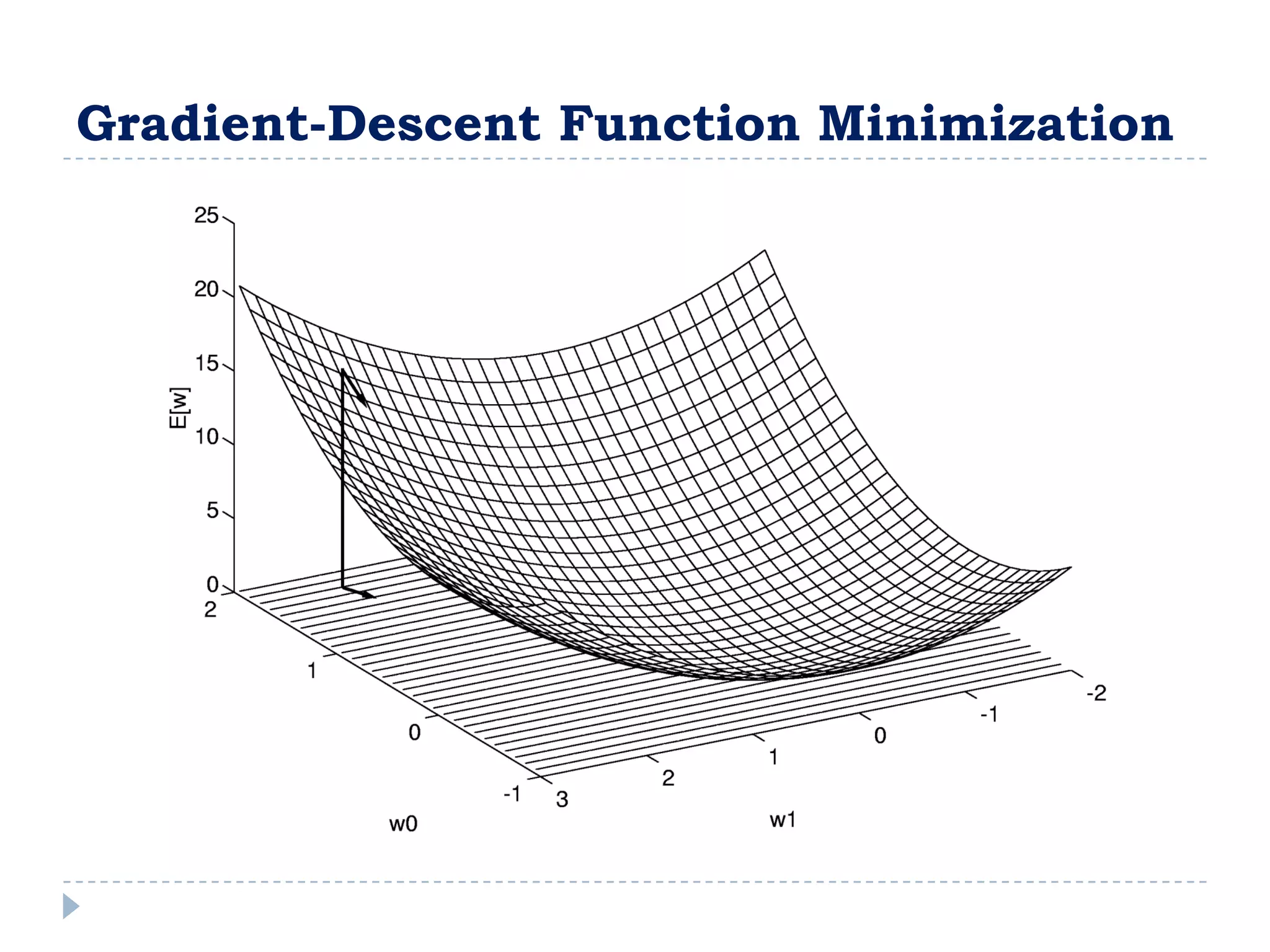
Gradient-Descent Function Minimization
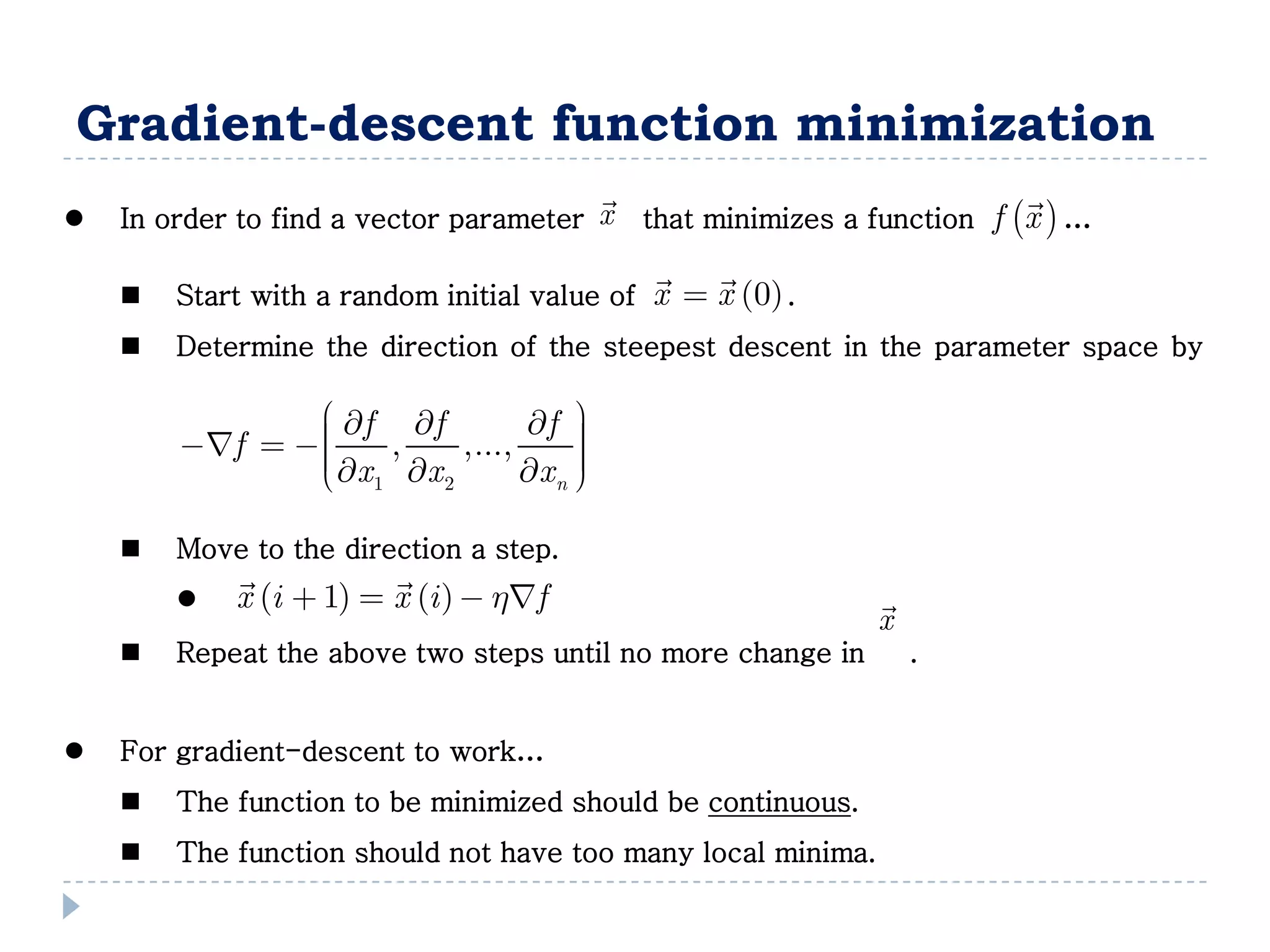
Gradient-descent function minimization
                                                                     
 In order to find a vector parameter x that minimizes a function f x  …
                                                 
     Start with a random initial value of   x  x 0 .
     Determine the direction of the steepest descent in the parameter space by

                 f f         f  
                
        f       ,    ,...,      
                 x x
                 1     2       x n 
                                     
                                     

     Move to the direction a step.
                        
           x i  1  x i   hf                        
                                                             x
     Repeat the above two steps until no more change in        .


 For gradient-descent to work…
     The function to be minimized should be continuous.
     The function should not have too many local minima.
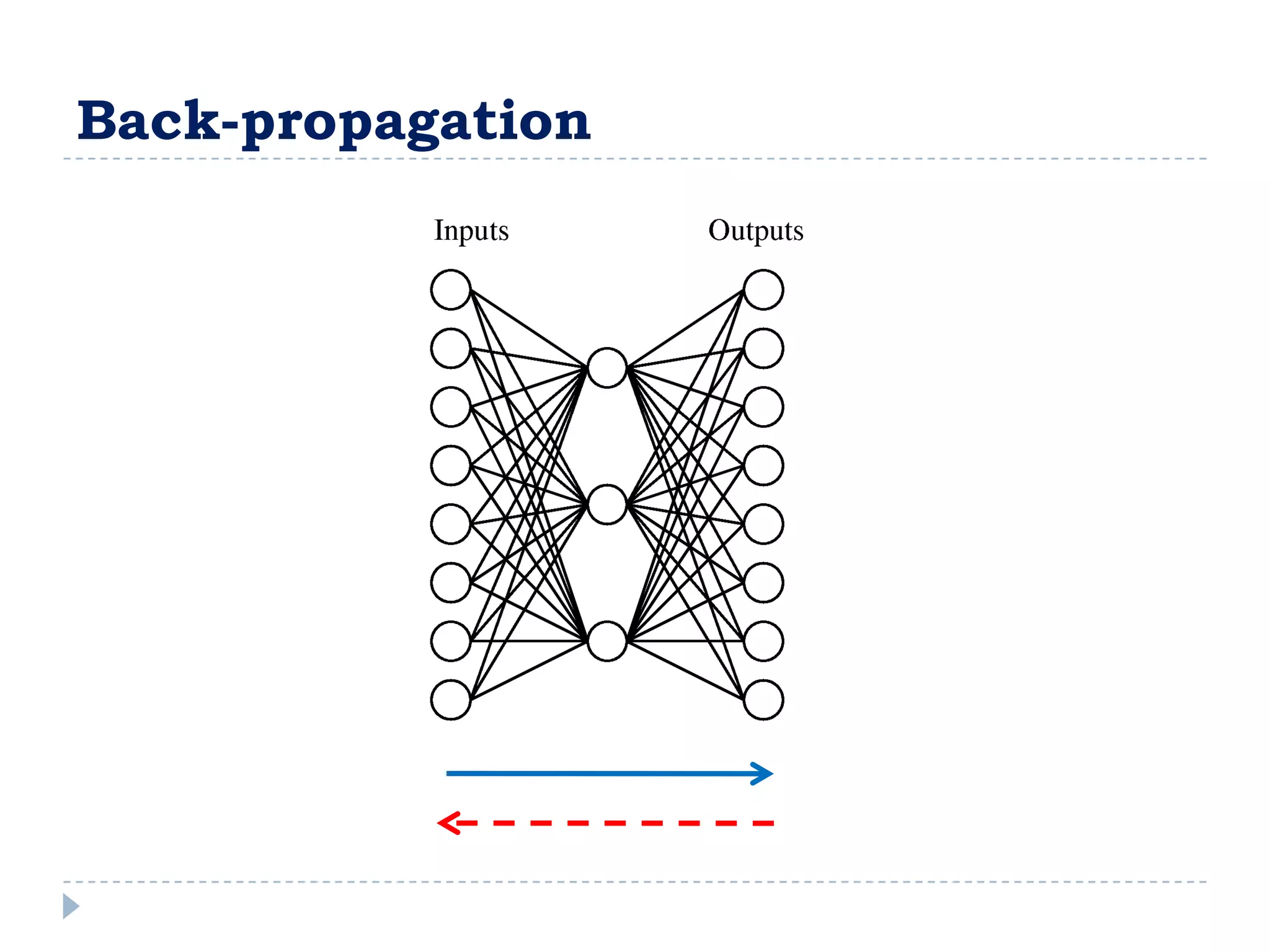
Back-propagation
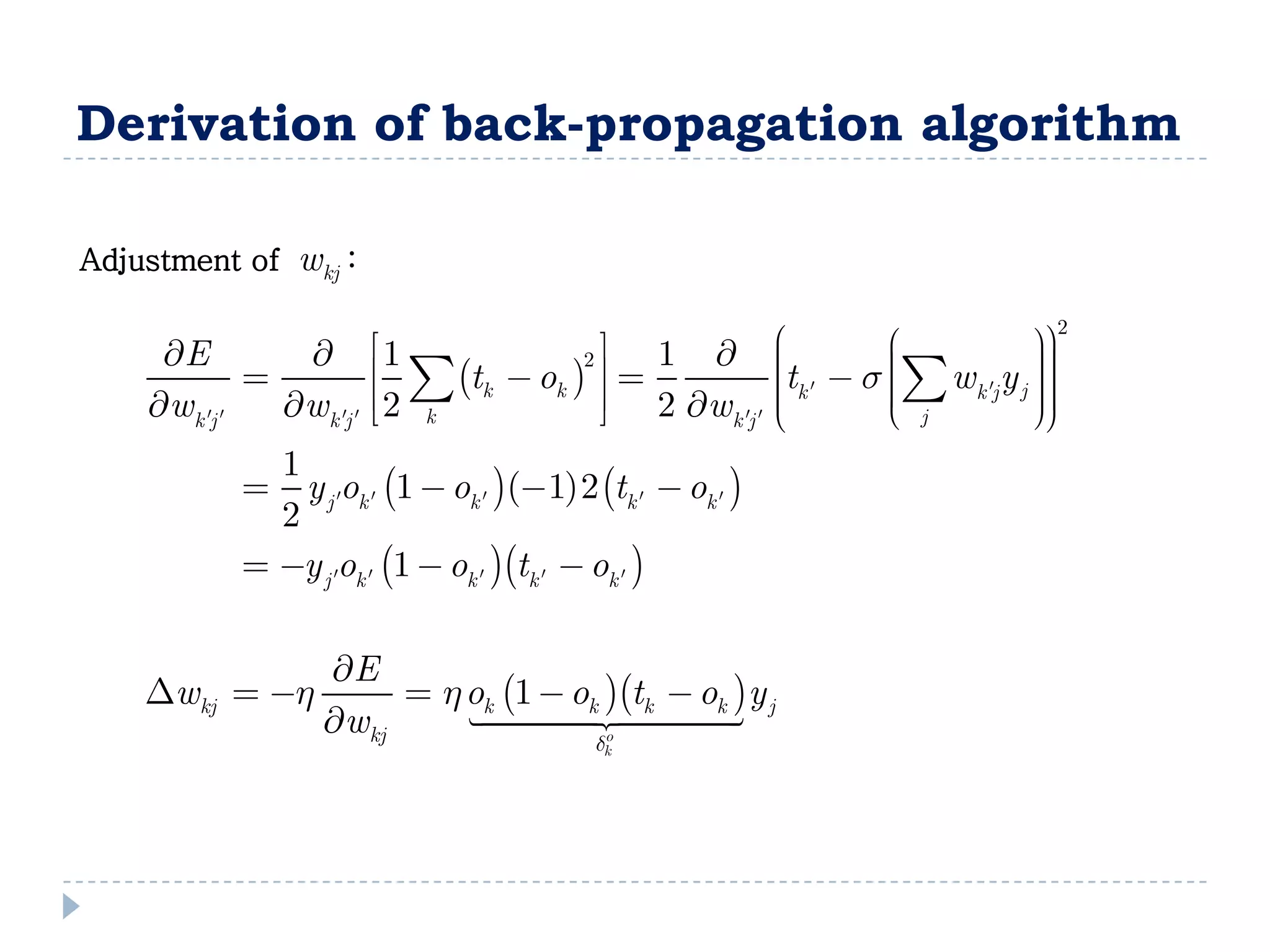
Derivation of back-propagation algorithm

Adjustment of    wkj :
                                                                         2
     E                  1            2   1       t  s  w y 
                                                              
                                                                        
                                                                        
                           tk  ok               k
                                                              k j j 
    wk j    wk j     2 k          2 wk j        
                                                               j
                                                                       
                                                                        
                                                       
              1
               y j ok  1  ok  1 2 tk   ok  
              2
             y j ok  1  ok  tk   ok  

                   E
    wkj  h            h ok 1  ok tk  ok y j
                   wkj     
                                     o        
                                      d      k
Derivation of back-propagation algorithm
   Adjustment of vji :
                                                                                  2
       E                     1            2  1           t  s  w y 
                                                                      
                                                                               
                                                                              
                                tk  ok                       kj j 
                                                                              
       v j i    v j i     2 k          2 k v j i   k
                                                               
                                                               
                                                                      
                                                                       j
                                                                             
                                                                              
                                                                    2
                 1            t  s  w s  v x 
                                                               
                              k
                                          kj  ji i 
                                                              
                 2 k v j i            j
                                                       i
                                                                
                                                                
                 1
                  x i y j  1  y j   wkj ok 1  ok 1 2 tk  ok 
                 2 k

                 x i y j  1  y j    wkj ok 1  ok tk  ok 
                                         k

                         E
       v ji  h               hy j 1  y j   wkjok 1  ok tk  ok x i
                         v ji                   k


                h y j 1  y j   wkj dko x i
                   
                             y k        
                                   dj
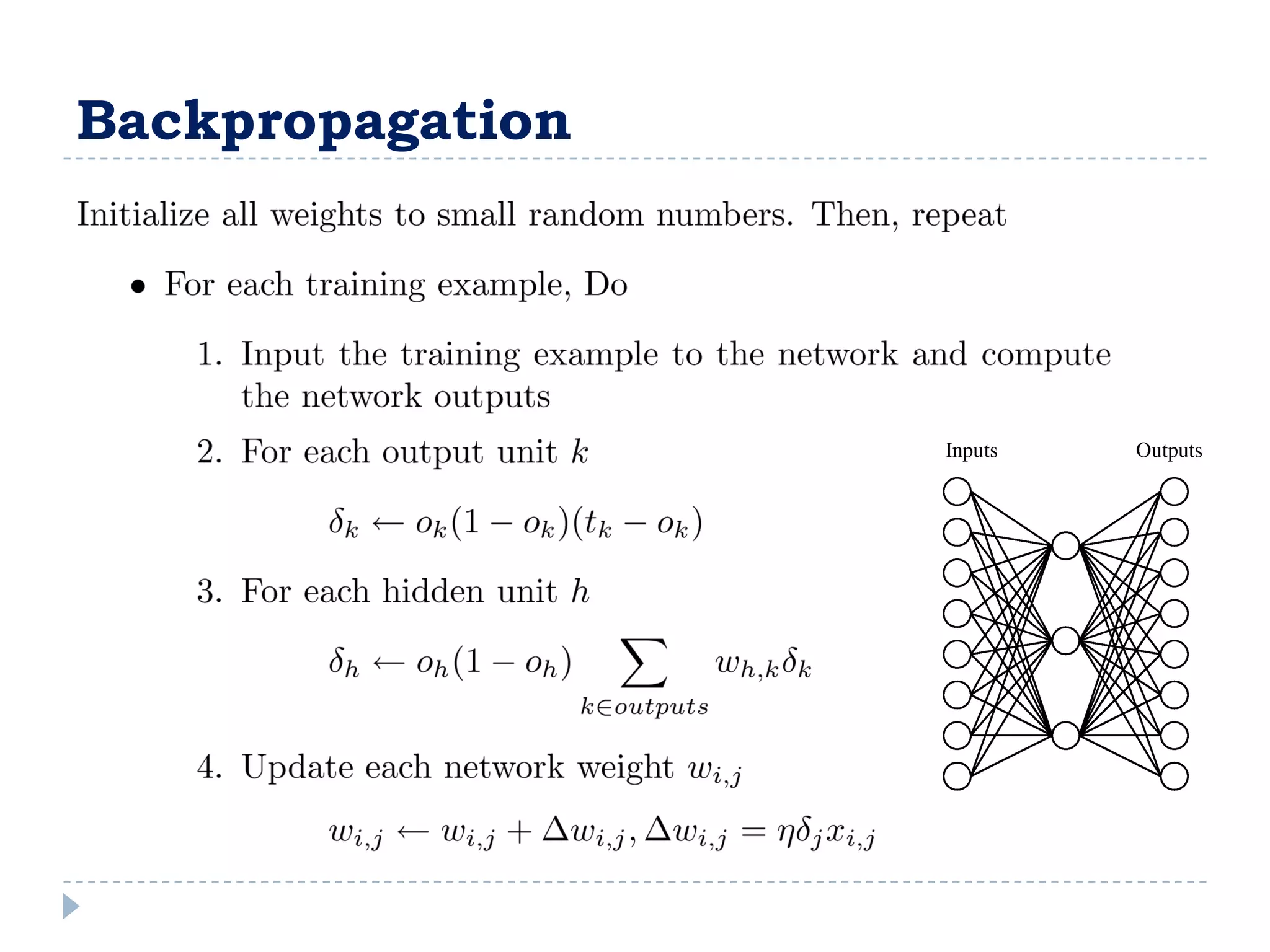
Backpropagation
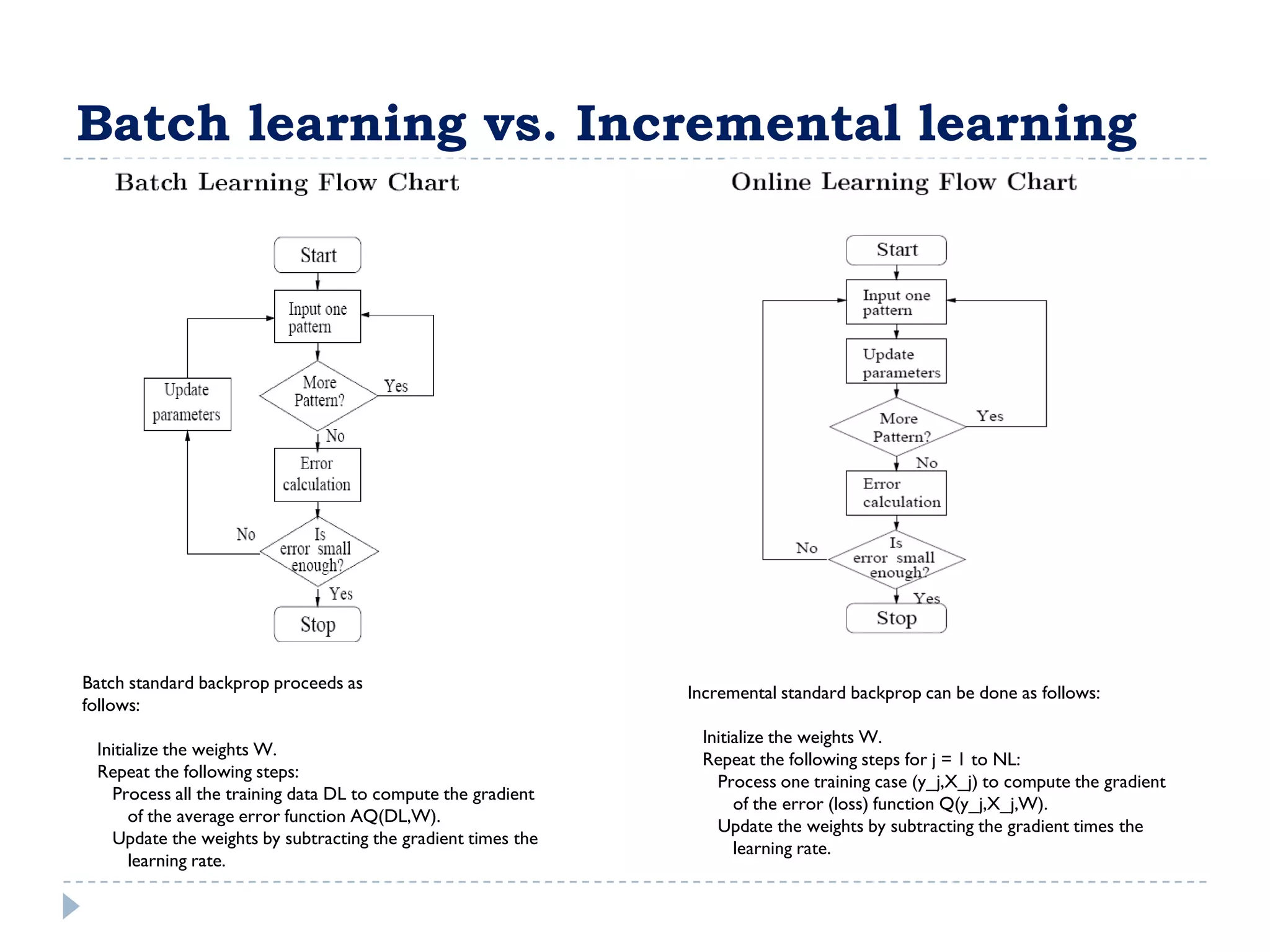
Batch learning vs. Incremental learning


Batch standard backprop proceeds as
                                                              Incremental standard backprop can be done as follows:
follows:
                                                               Initialize the weights W.
 Initialize the weights W.
                                                               Repeat the following steps for j = 1 to NL:
 Repeat the following steps:
                                                                 Process one training case (y_j,X_j) to compute the gradient
   Process all the training data DL to compute the gradient
                                                                    of the error (loss) function Q(y_j,X_j,W).
      of the average error function AQ(DL,W).
                                                                 Update the weights by subtracting the gradient times the
   Update the weights by subtracting the gradient times the
                                                                    learning rate.
      learning rate.
Training
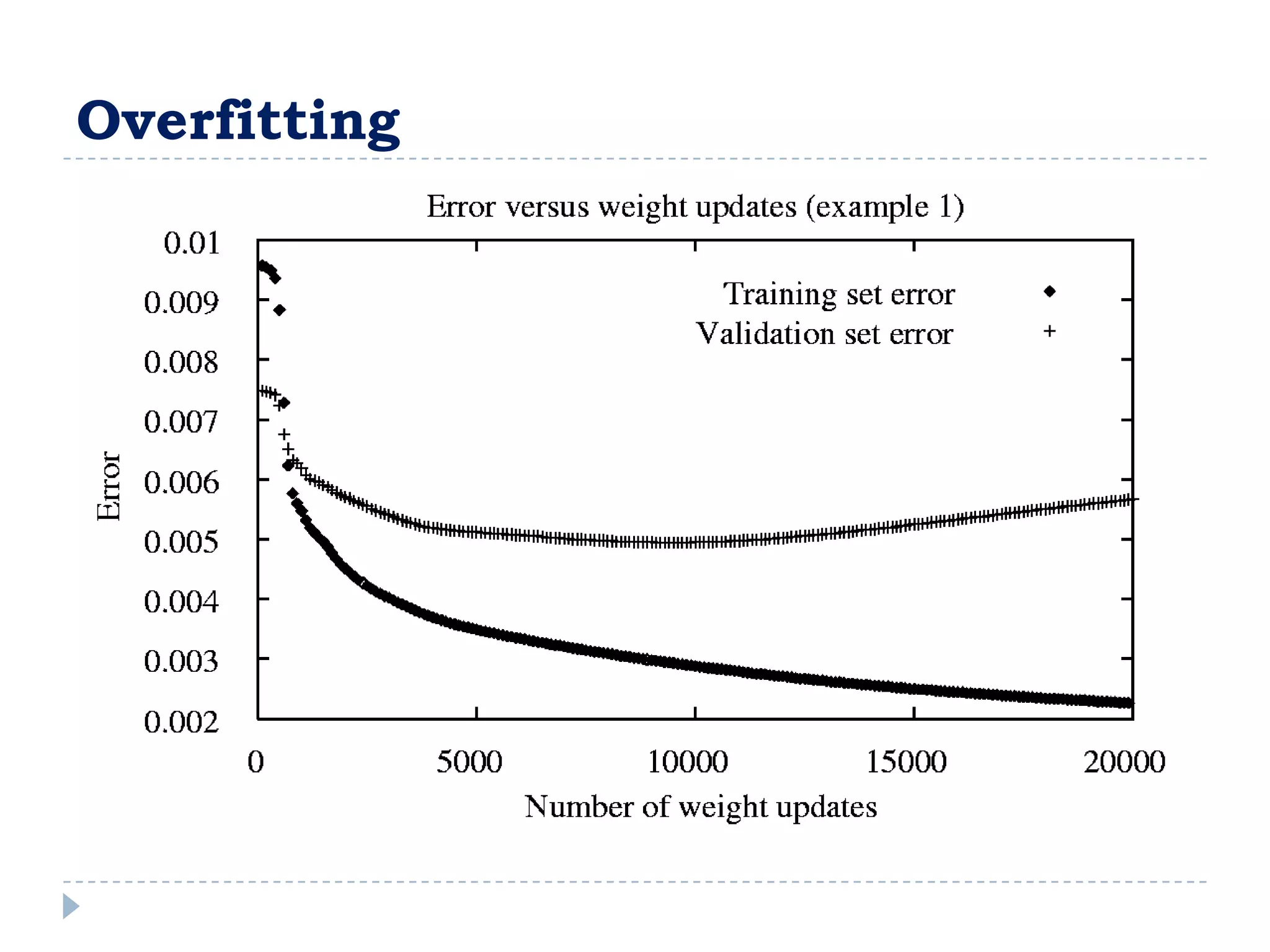
Overfitting
#2. Decision Trees
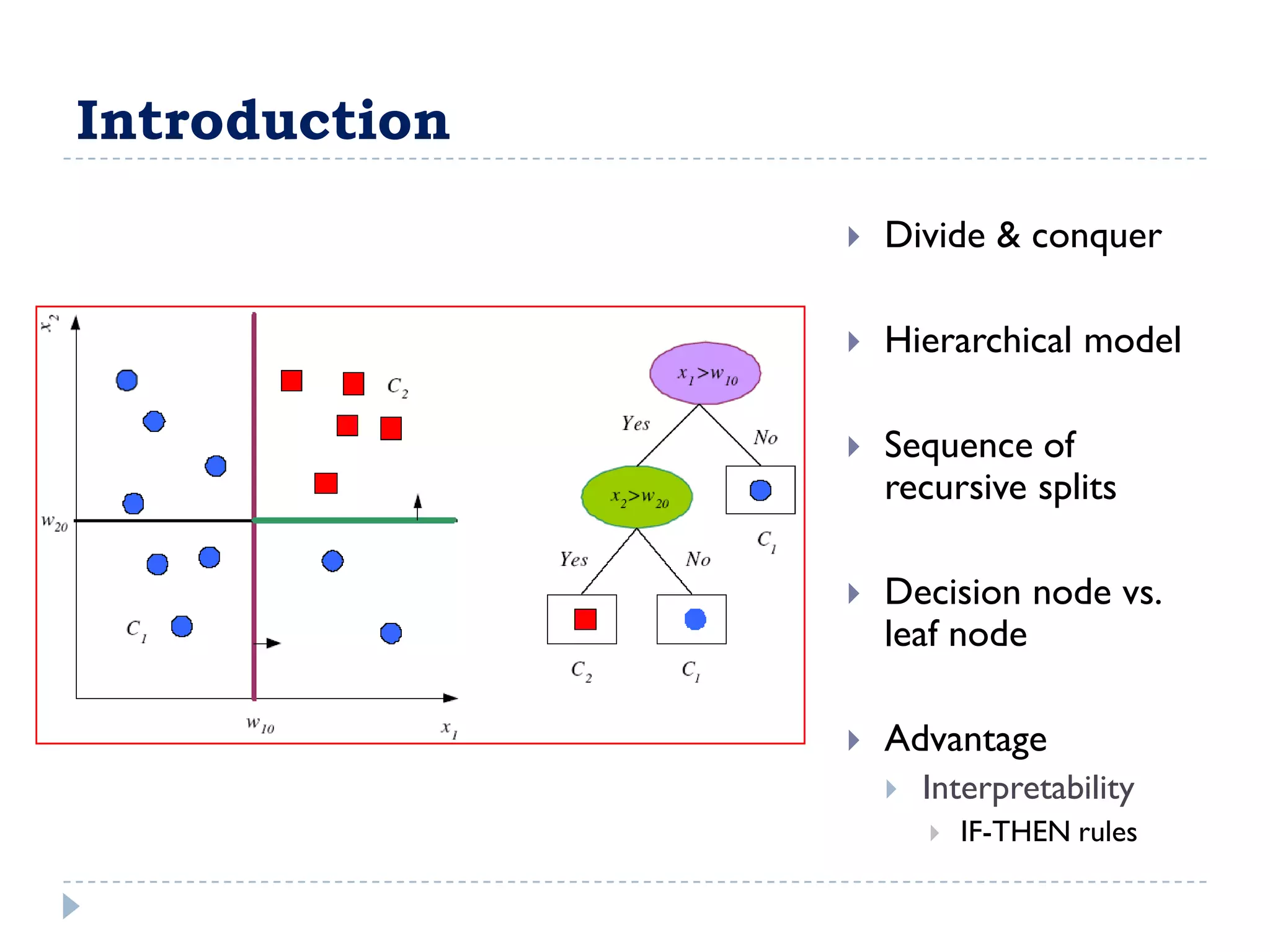
Introduction
                  Divide & conquer

                  Hierarchical model

                  Sequence of
                   recursive splits

                  Decision node vs.
                   leaf node

                  Advantage
                      Interpretability
                          IF-THEN rules
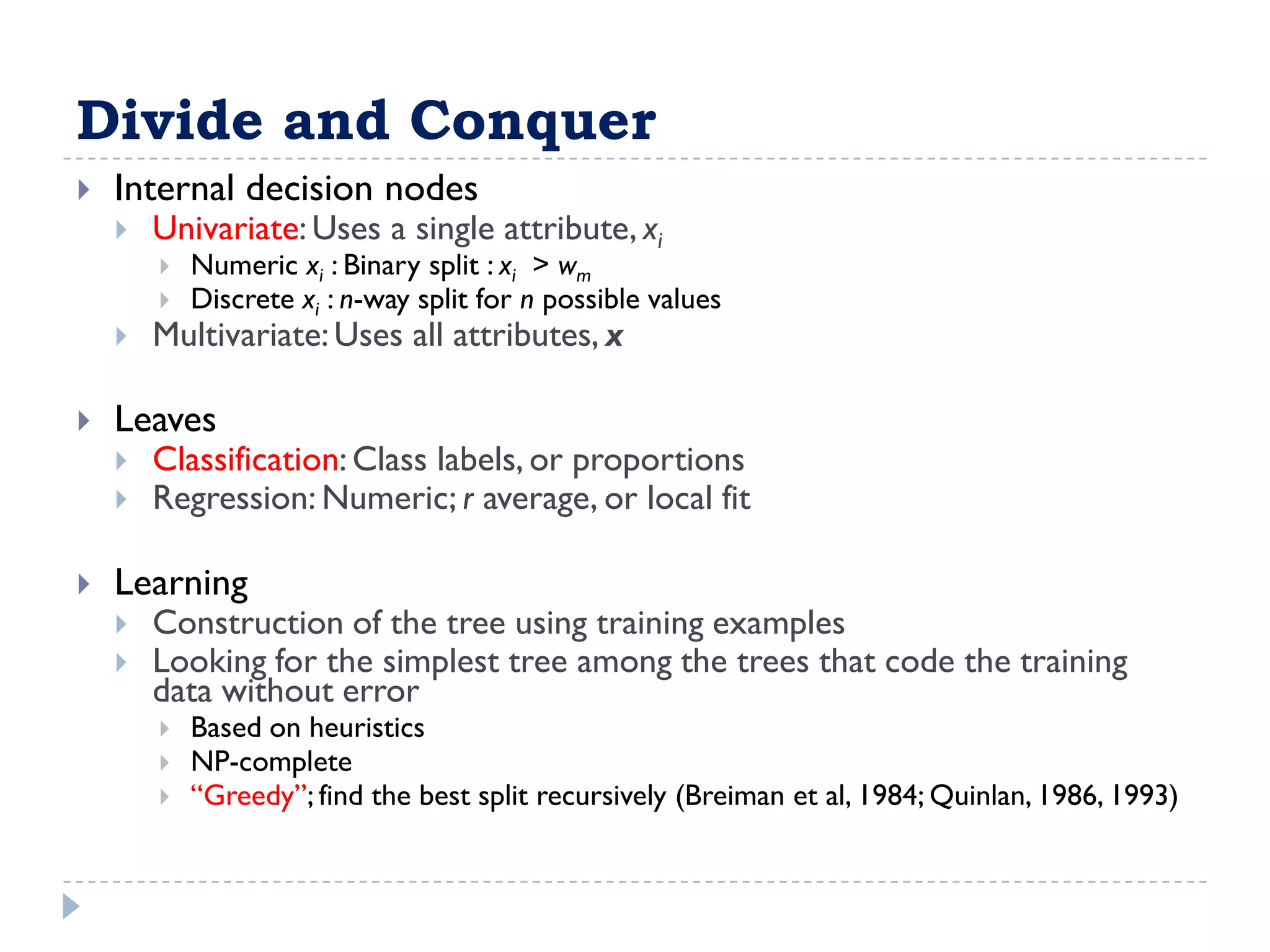
Divide and Conquer
   Internal decision nodes
       Univariate: Uses a single attribute, xi
           Numeric xi : Binary split : xi > wm
           Discrete xi : n-way split for n possible values
       Multivariate: Uses all attributes, x

   Leaves
       Classification: Class labels, or proportions
       Regression: Numeric; r average, or local fit

   Learning
       Construction of the tree using training examples
       Looking for the simplest tree among the trees that code the training
        data without error
           Based on heuristics
           NP-complete
           “Greedy”; find the best split recursively (Breiman et al, 1984; Quinlan, 1986, 1993)
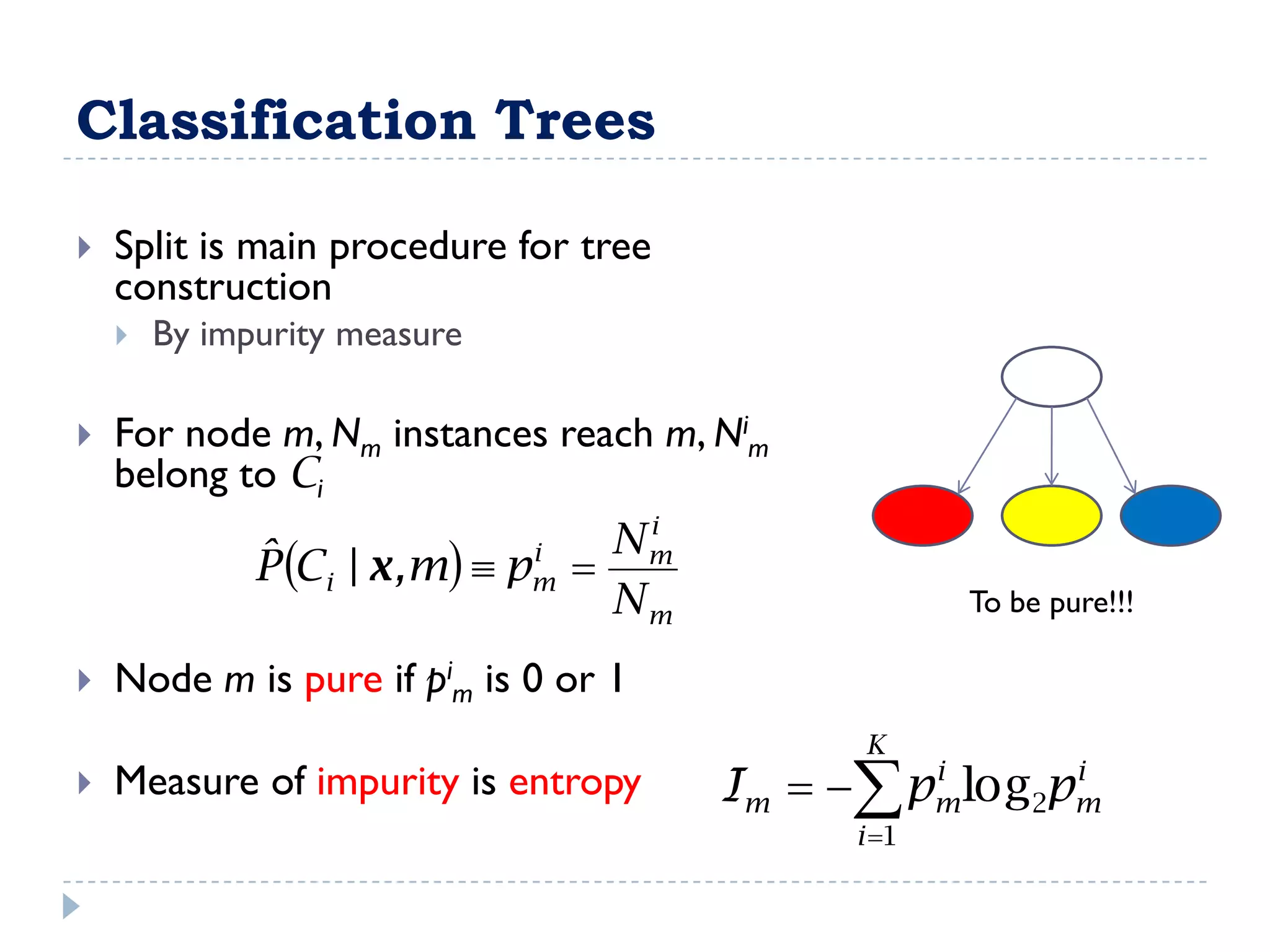
Classification Trees

   Split is main procedure for tree
    construction
       By impurity measure

   For node m, Nm instances reach m, Nim
    belong to Ci
                                    i
              ˆ Ci | x ,m  pm 
                               i   Nm
              P
                                   Nm                To be pure!!!

   Node m is pure if pim is 0 or 1
                                              K
   Measure of impurity is entropy      Im   pm log2pm
                                                 i      i

                                              i 1
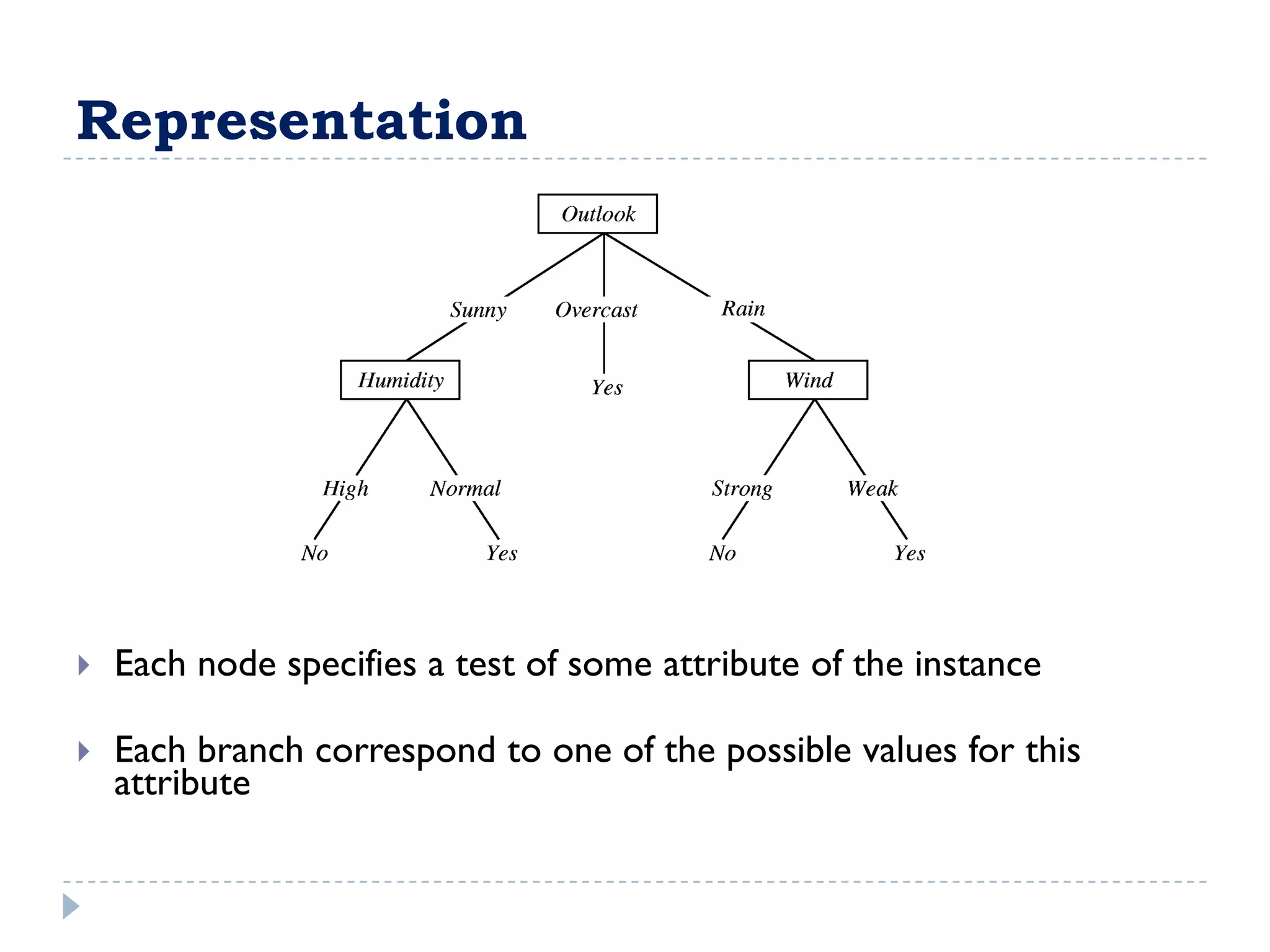
Representation


   Each node specifies a test of some attribute of the instance

   Each branch correspond to one of the possible values for this
    attribute
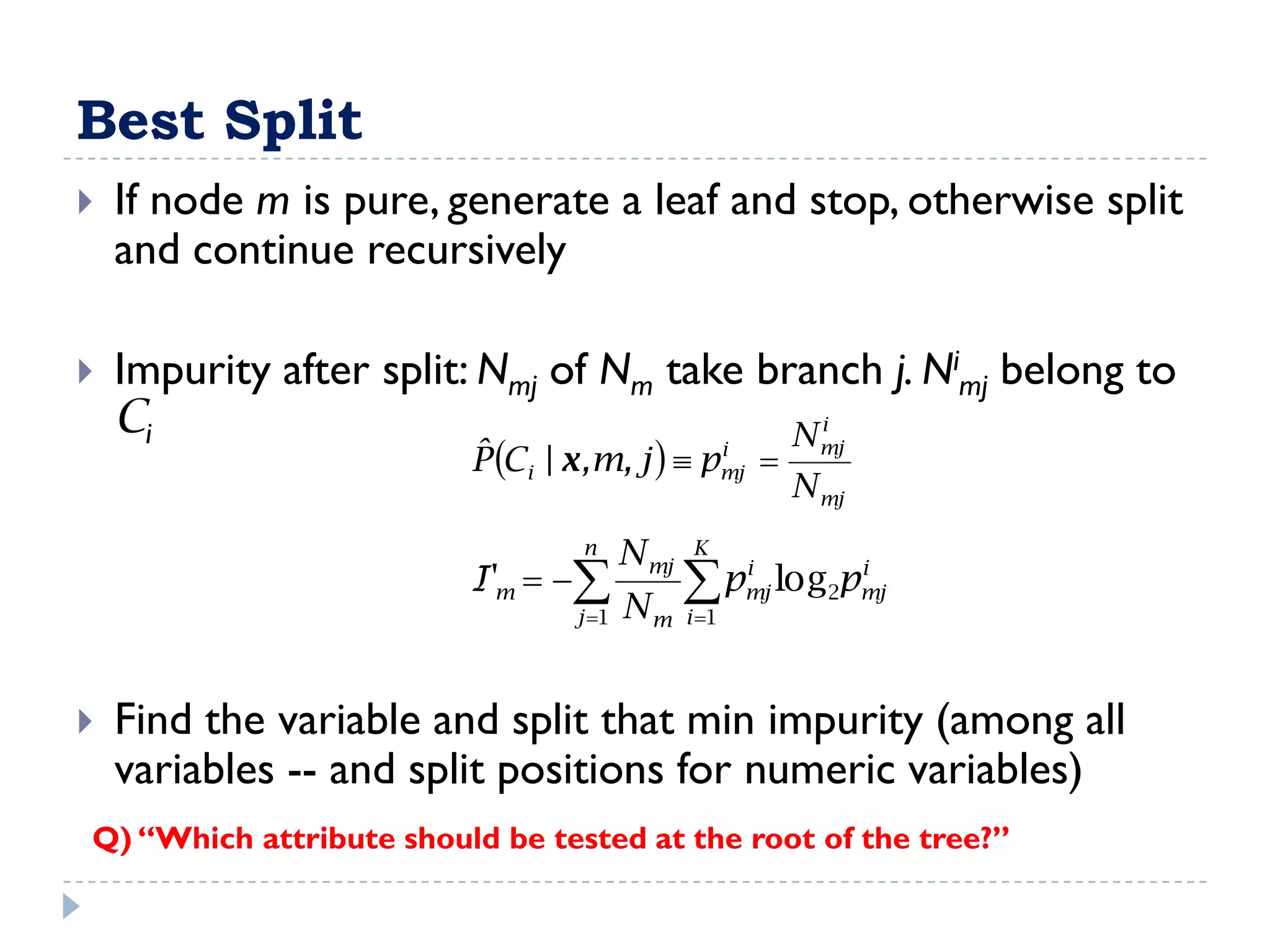
Best Split
   If node m is pure, generate a leaf and stop, otherwise split
    and continue recursively

   Impurity after split: Nmj of Nm take branch j. Nimj belong to
    Ci                                               i
                                                   N mj
                         ˆ Ci | x ,m, j   pmj 
                         P                    i

                                                           N mj
                                 n     N mj   K
                         I'm               p     i
                                                     mj
                                                               i
                                                          log2pmj
                                j 1   Nm     i 1


   Find the variable and split that min impurity (among all
    variables -- and split positions for numeric variables)
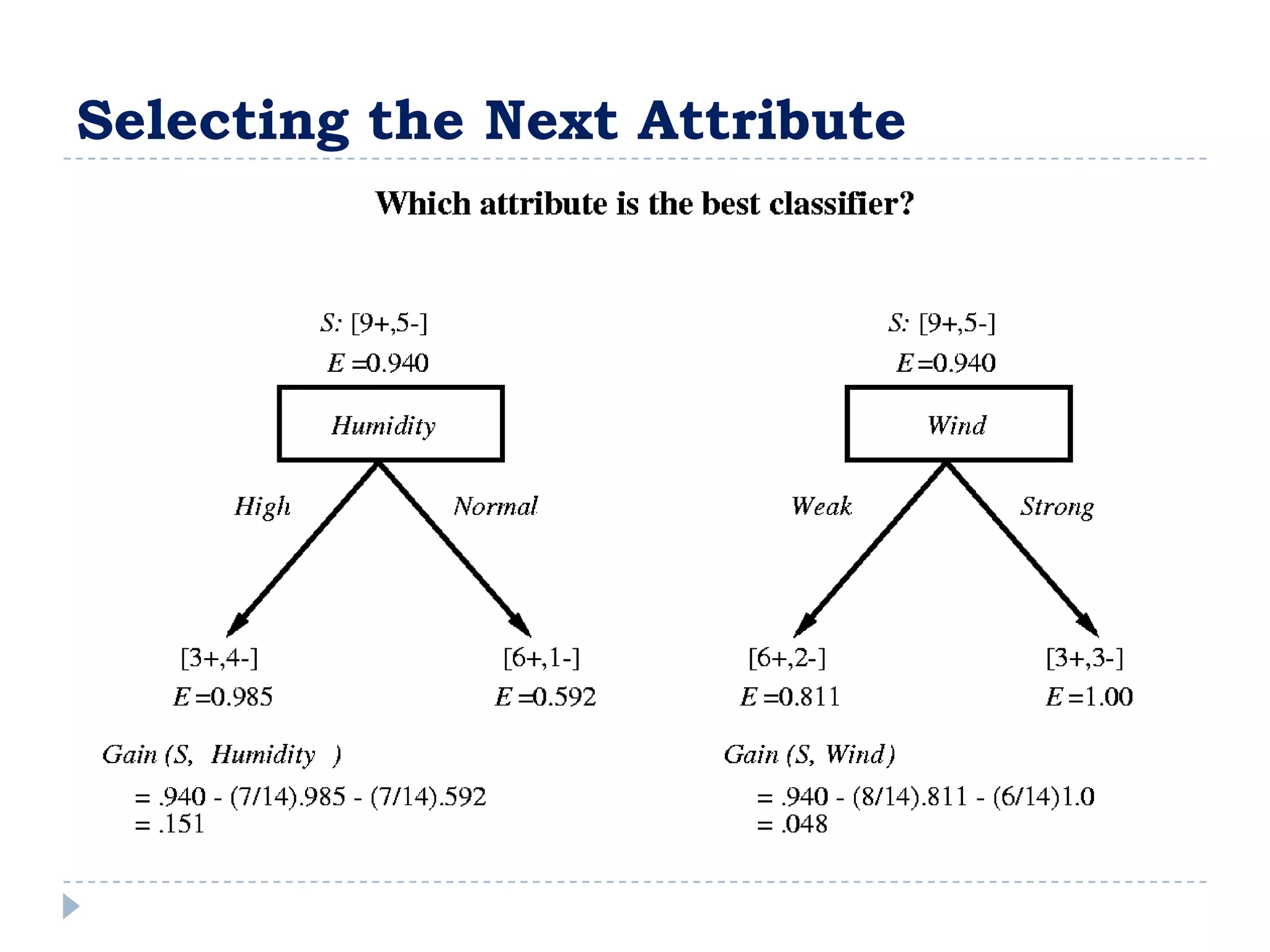
Q) “Which attribute should be tested at the root of the tree?”
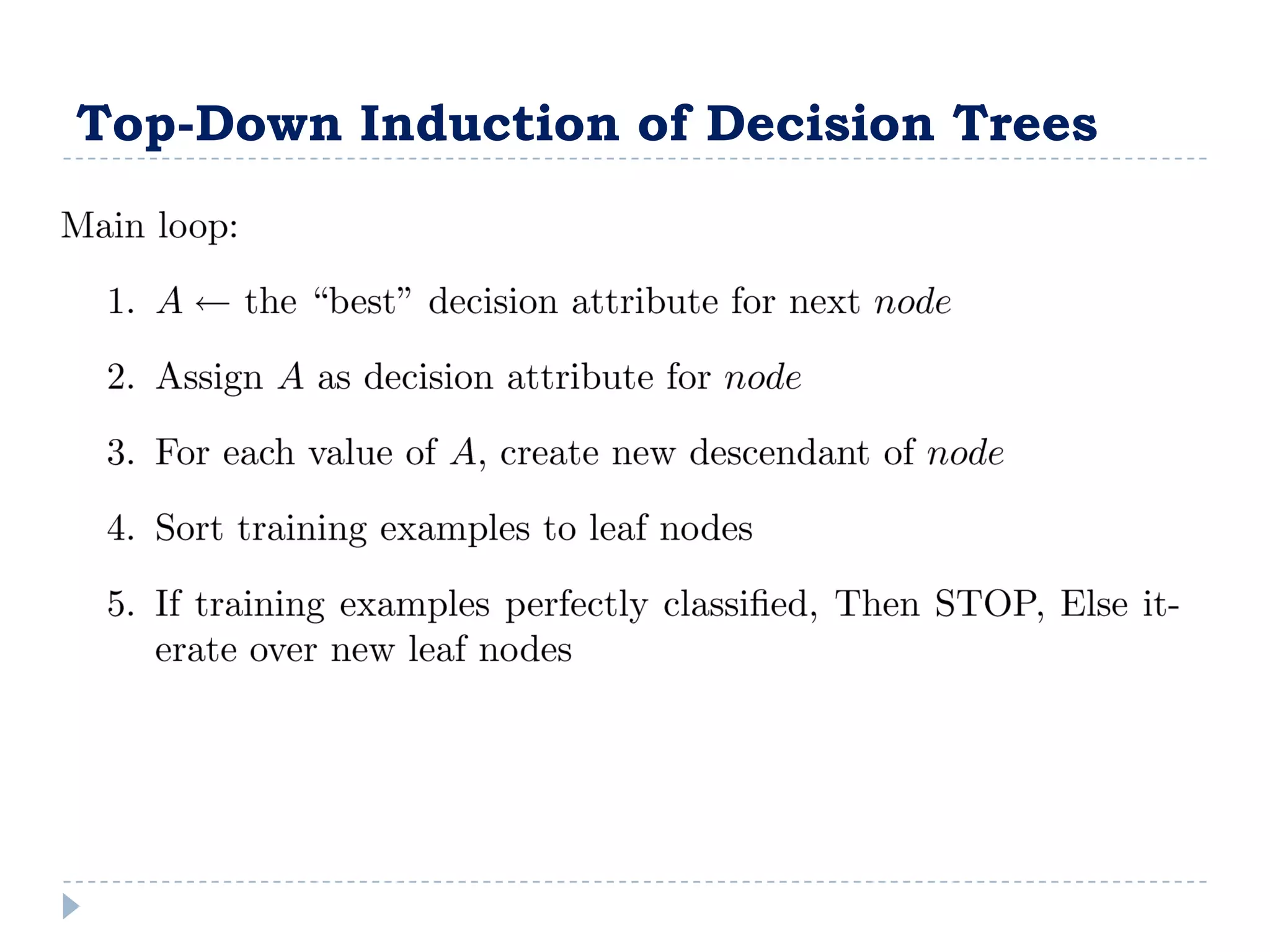
Top-Down Induction of Decision Trees
Entropy
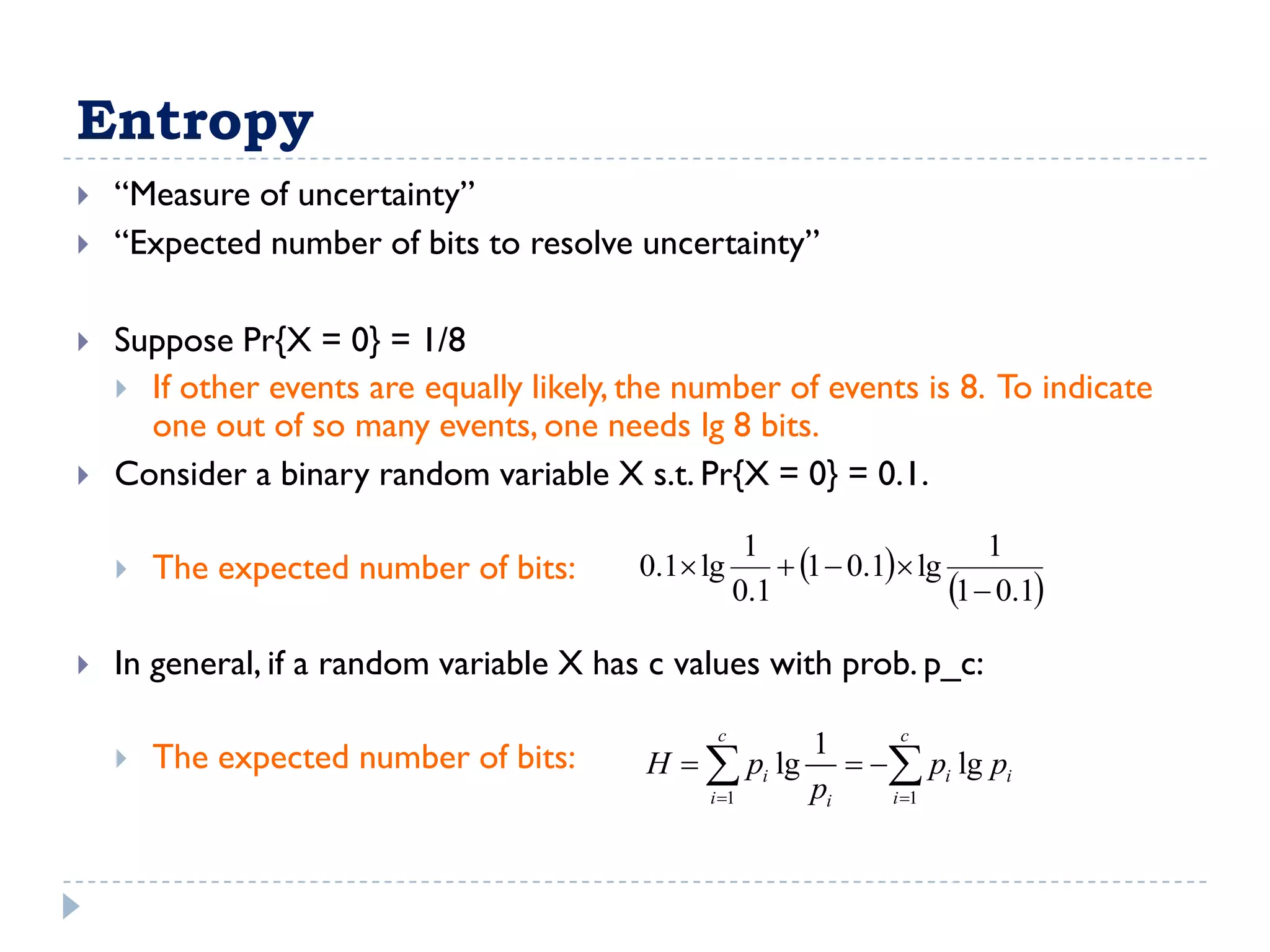
   “Measure of uncertainty”
   “Expected number of bits to resolve uncertainty”

   Suppose Pr{X = 0} = 1/8
     If other events are equally likely, the number of events is 8. To indicate
      one out of so many events, one needs lg 8 bits.
   Consider a binary random variable X s.t. Pr{X = 0} = 0.1.

                                                         1  0.1 lg
                                                     1                      1
       The expected number of bits:      0.1 lg
                                                    0.1                 1  0.1
   In general, if a random variable X has c values with prob. p_c:
                                                c          c
                                                     1
       The expected number of bits:      H   pi lg   pi lg pi
                                              i 1   pi  i 1
Entropy
Example

   14 examples
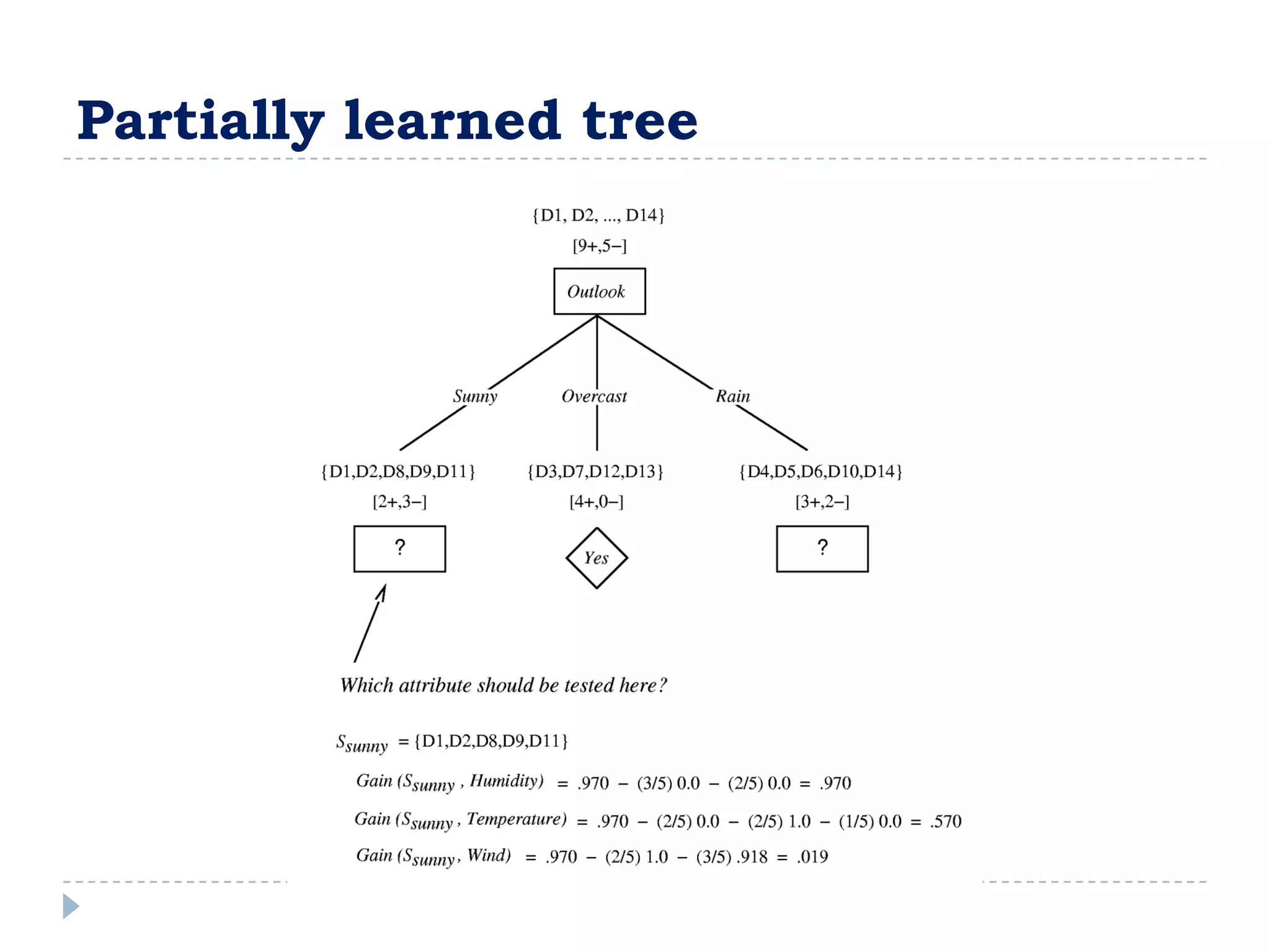
                  Entropy([9,5])
                   (9 /14) log 2 (9 /14)  (5 /14) log 2 (5 /14)  0.940

         Entropy 0 : all members positive or negative
         Entropy 1 : equal number of positive & negative
         0 < Entropy < 1 : unequal number of positive & negative
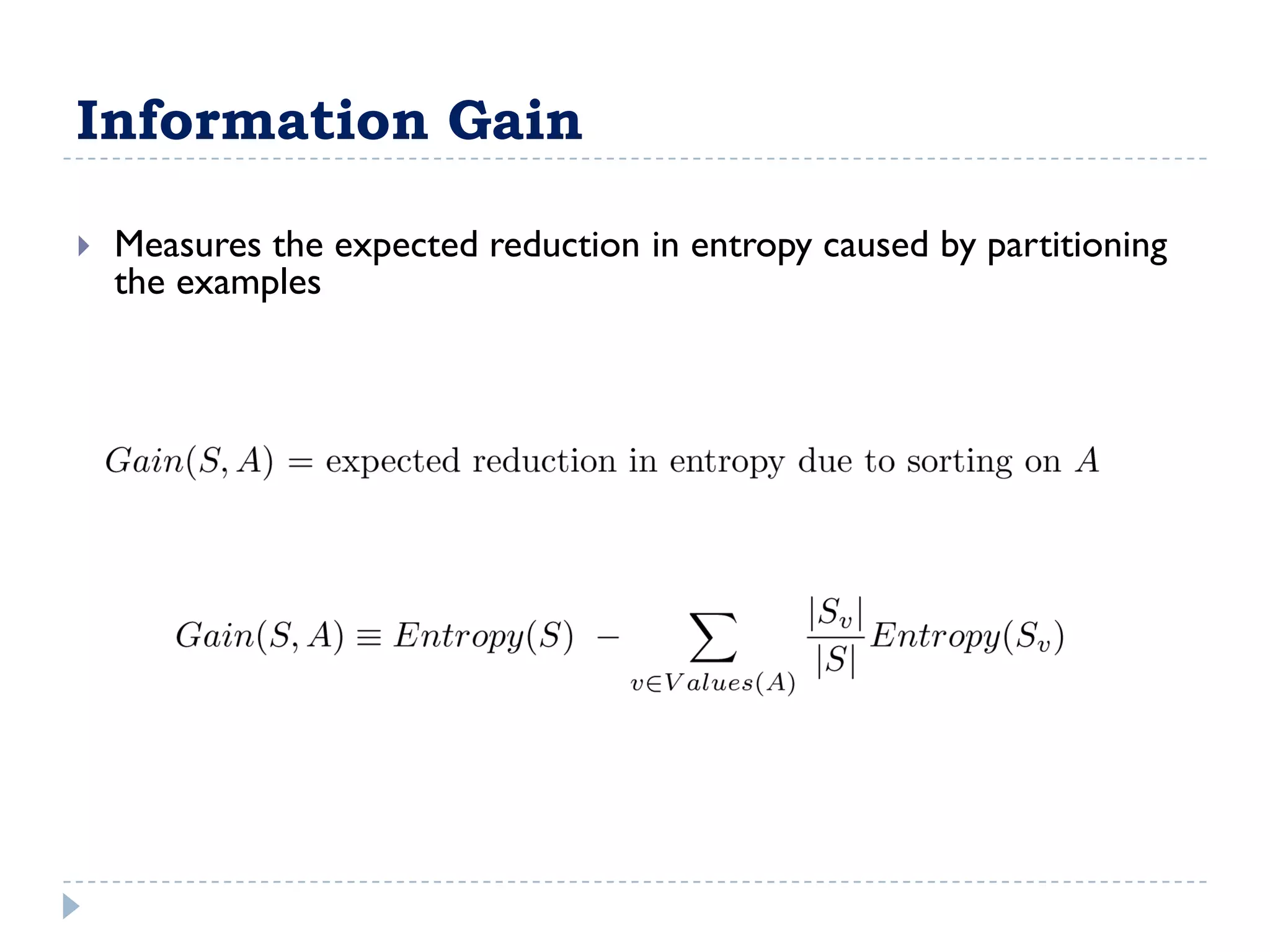
Information Gain

   Measures the expected reduction in entropy caused by partitioning
    the examples
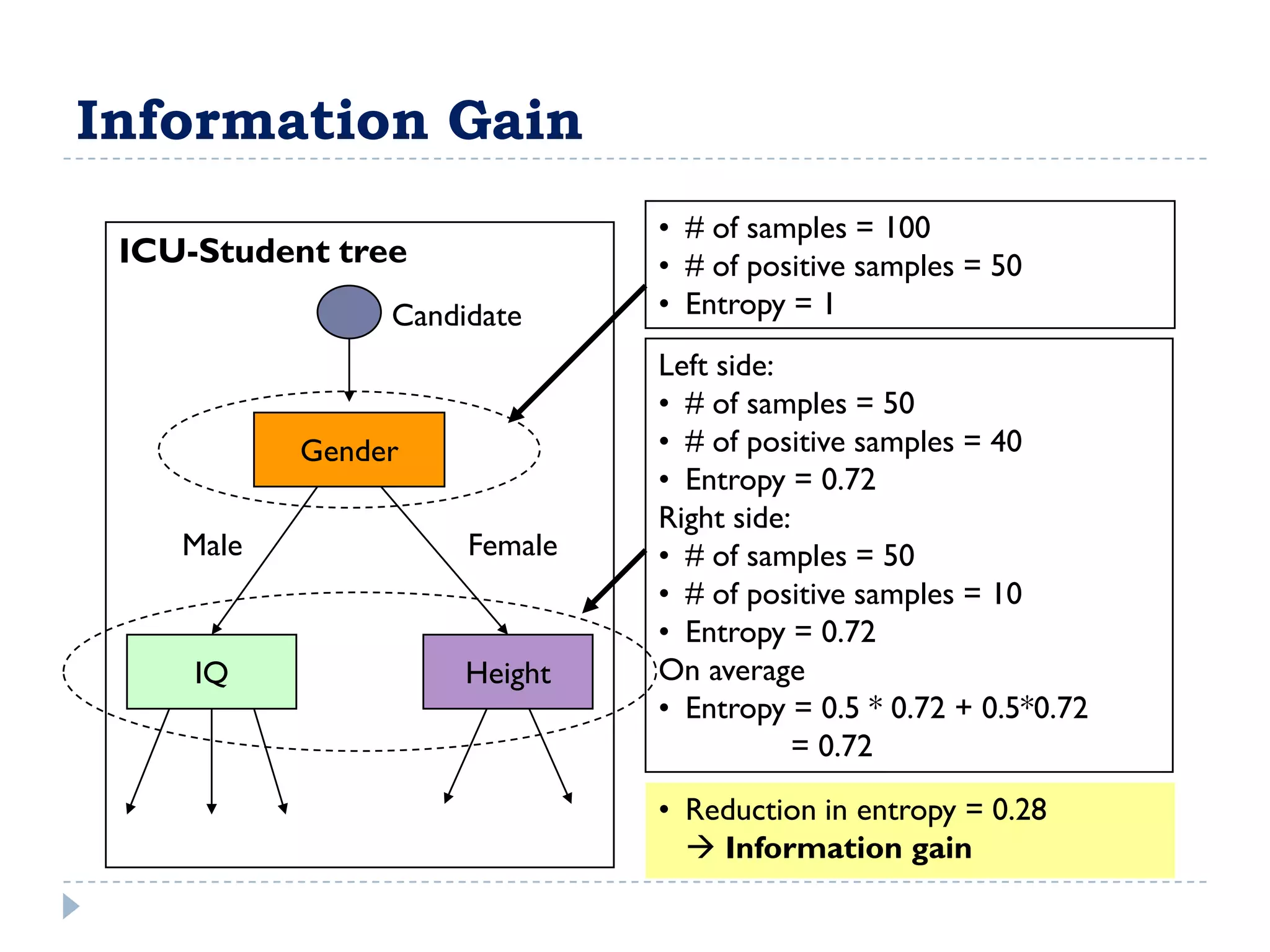
Information Gain
                              • # of samples = 100
 ICU-Student tree             • # of positive samples = 50
                Candidate     • Entropy = 1
                              Left side:
                              • # of samples = 50
           Gender             • # of positive samples = 40
                              • Entropy = 0.72
                              Right side:
    Male             Female   • # of samples = 50
                              • # of positive samples = 10
                              • Entropy = 0.72
     IQ              Height   On average
                              • Entropy = 0.5 * 0.72 + 0.5*0.72
                                          = 0.72
                              • Reduction in entropy = 0.28
                                 Information gain
Training Examples
Selecting the Next Attribute
Partially learned tree
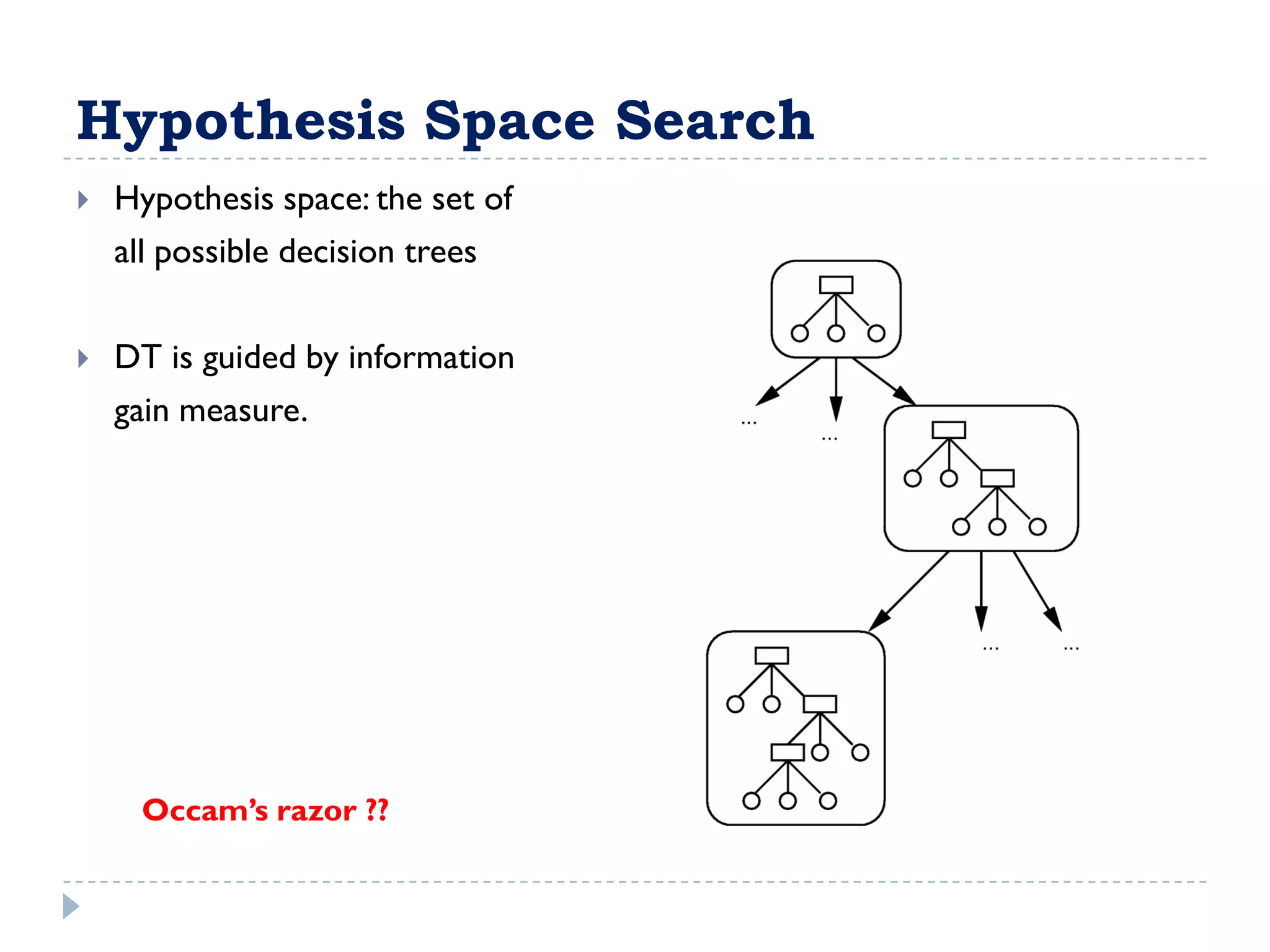
Hypothesis Space Search
   Hypothesis space: the set of
    all possible decision trees

   DT is guided by information
    gain measure.


     Occam’s razor ??
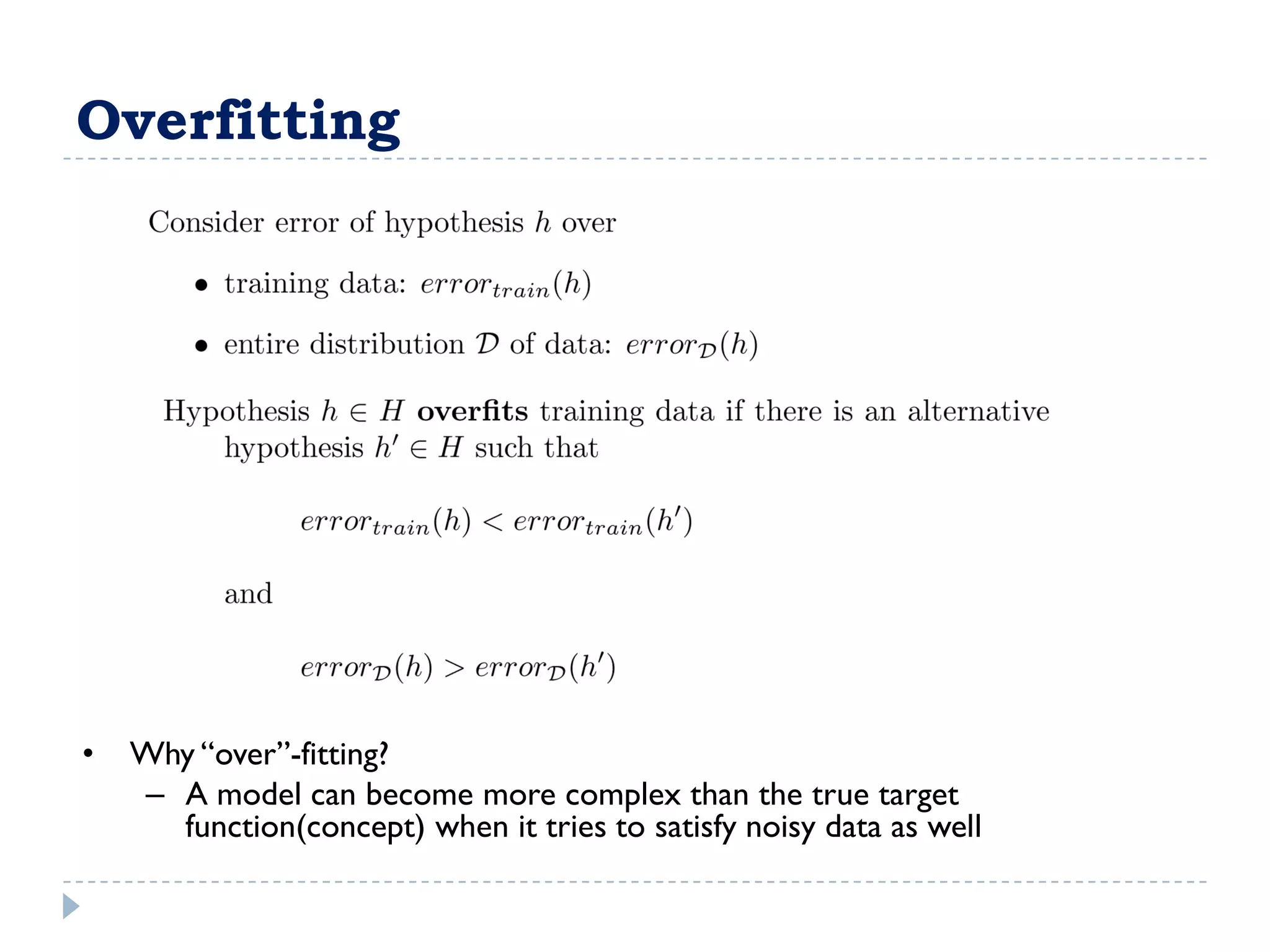
Overfitting


•   Why “over”-fitting?
    – A model can become more complex than the true target
      function(concept) when it tries to satisfy noisy data as well
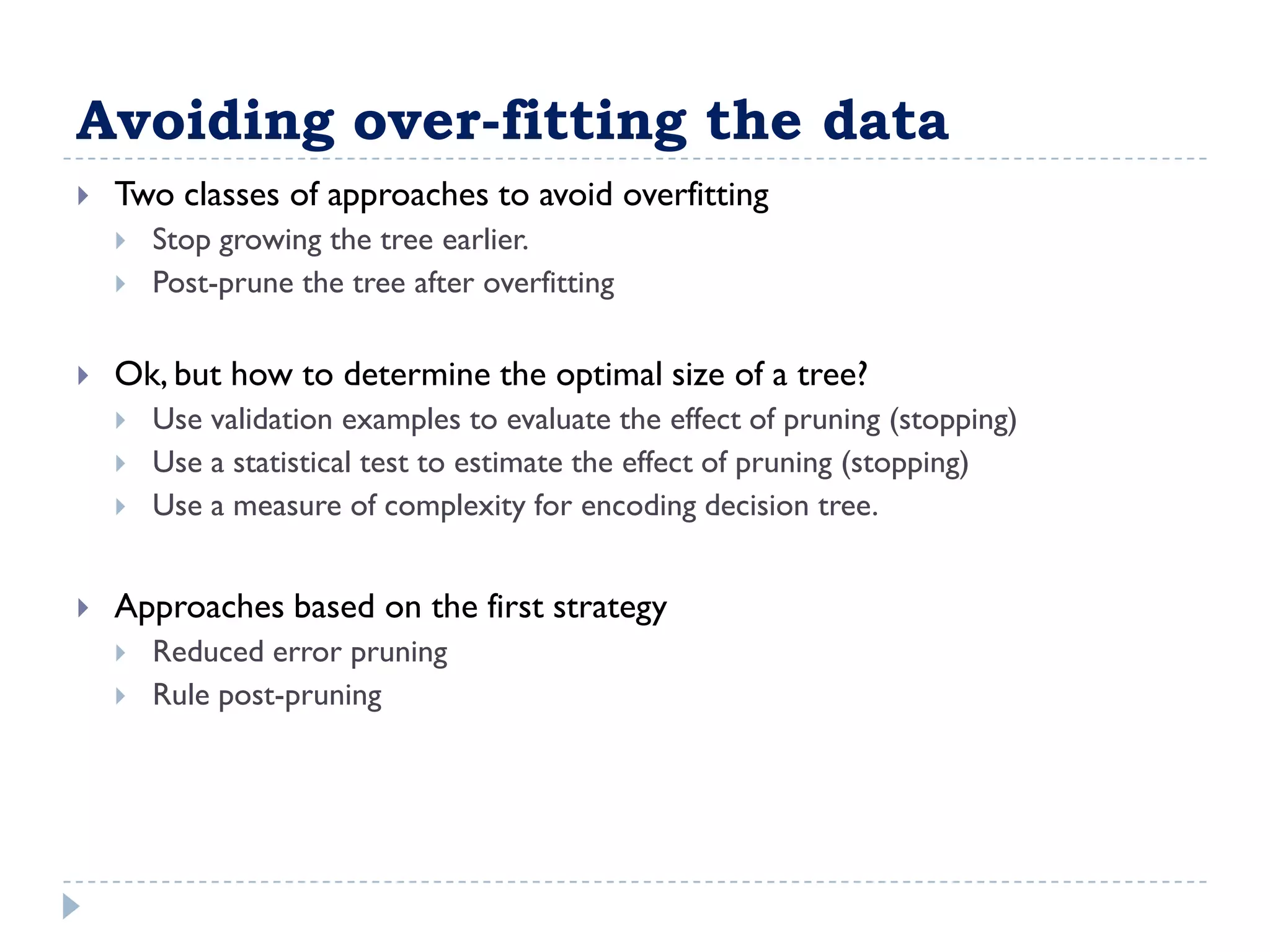
Avoiding over-fitting the data
   Two classes of approaches to avoid overfitting
       Stop growing the tree earlier.
       Post-prune the tree after overfitting

   Ok, but how to determine the optimal size of a tree?
       Use validation examples to evaluate the effect of pruning (stopping)
       Use a statistical test to estimate the effect of pruning (stopping)
       Use a measure of complexity for encoding decision tree.


   Approaches based on the first strategy
       Reduced error pruning
       Rule post-pruning
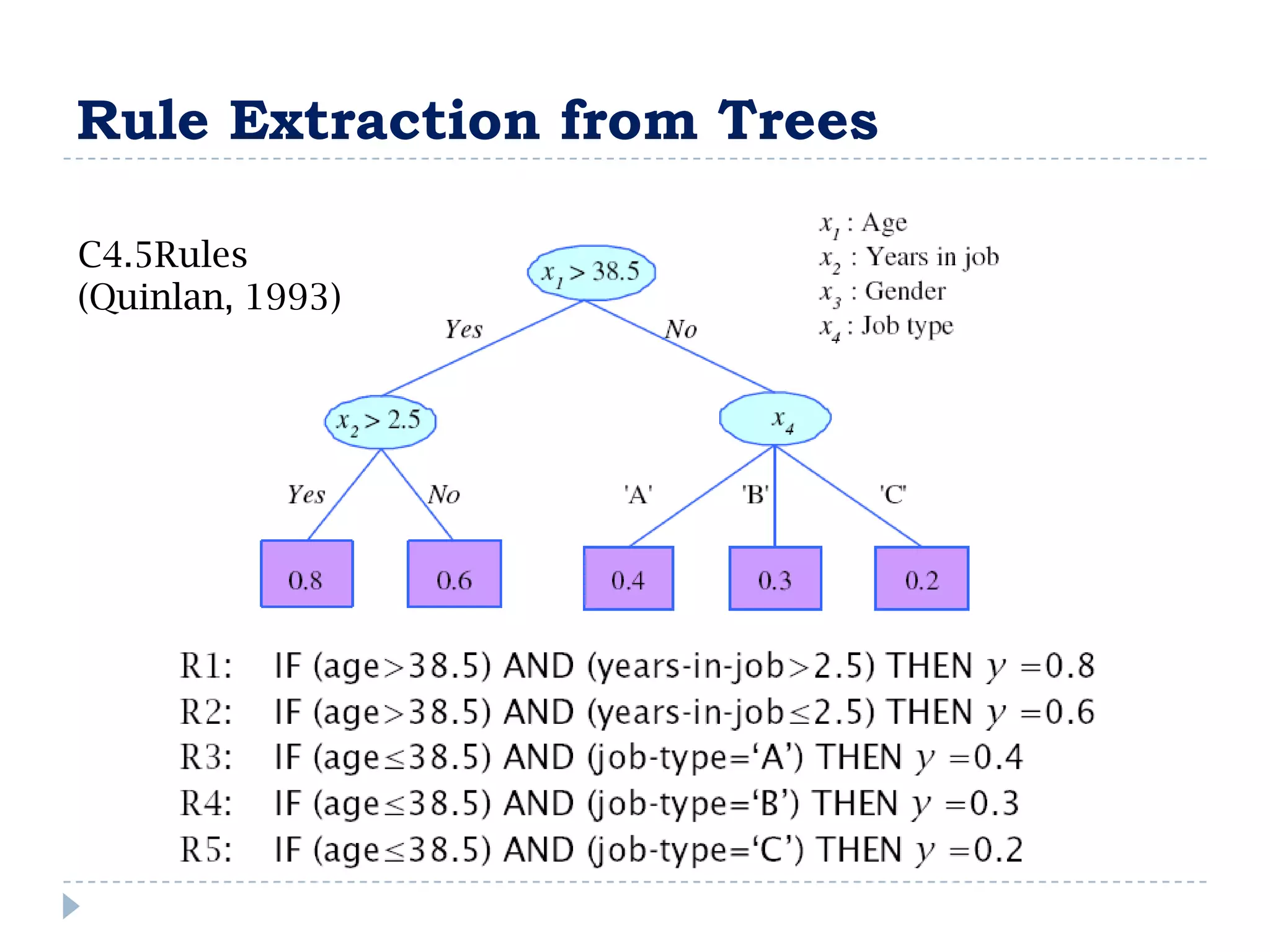
Rule Extraction from Trees

C4.5Rules
(Quinlan, 1993)
#3. Bayesian Networks
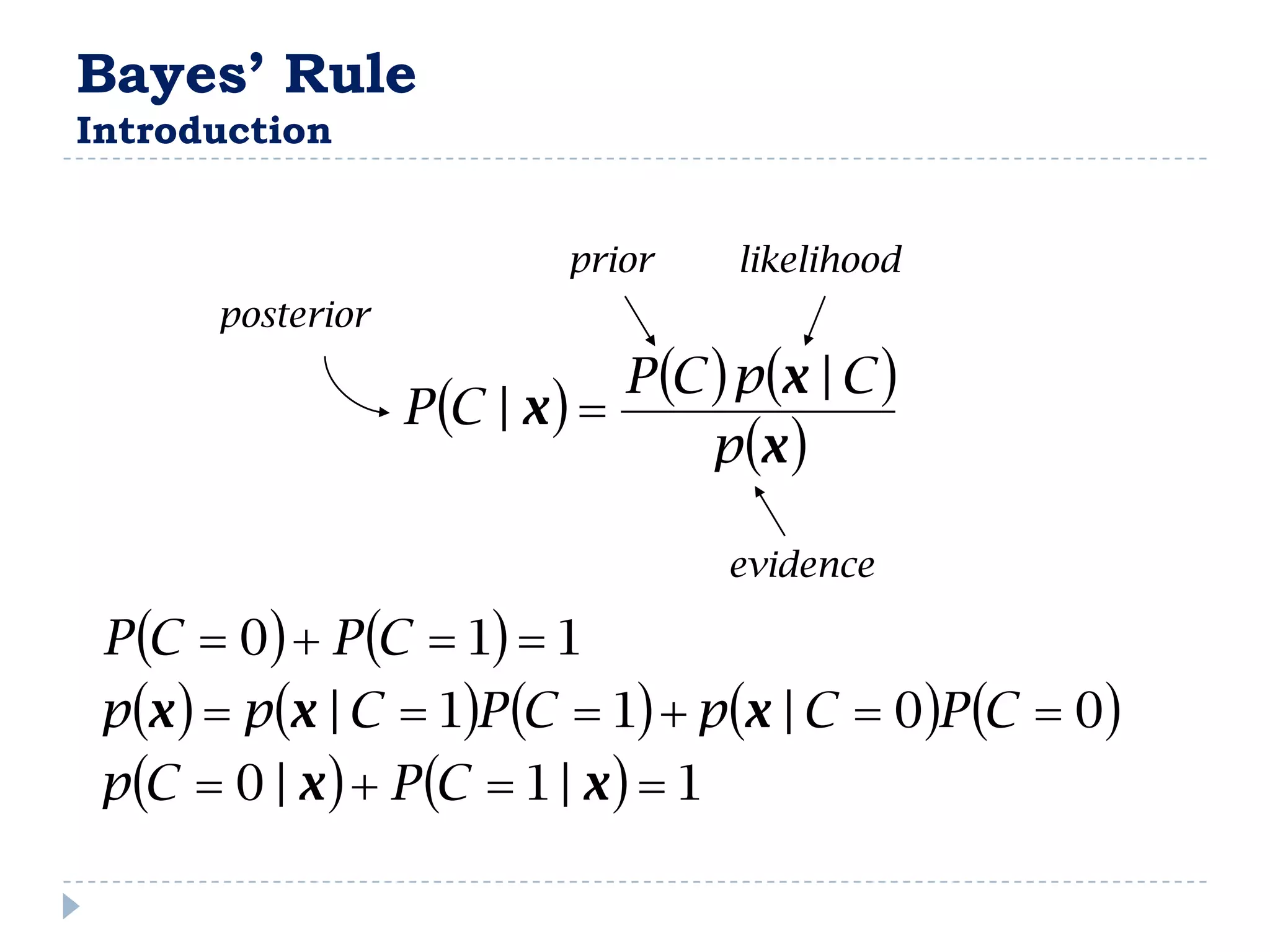
Bayes’ Rule
Introduction


                             prior     likelihood
       posterior
                                P C  p x | C 
                   P C | x  
                                     p x 

                                      evidence

 P C  0  P C  1  1
 p x   p x | C  1P C  1  p x | C  0P C  0
 p C  0 | x   P C  1 | x   1
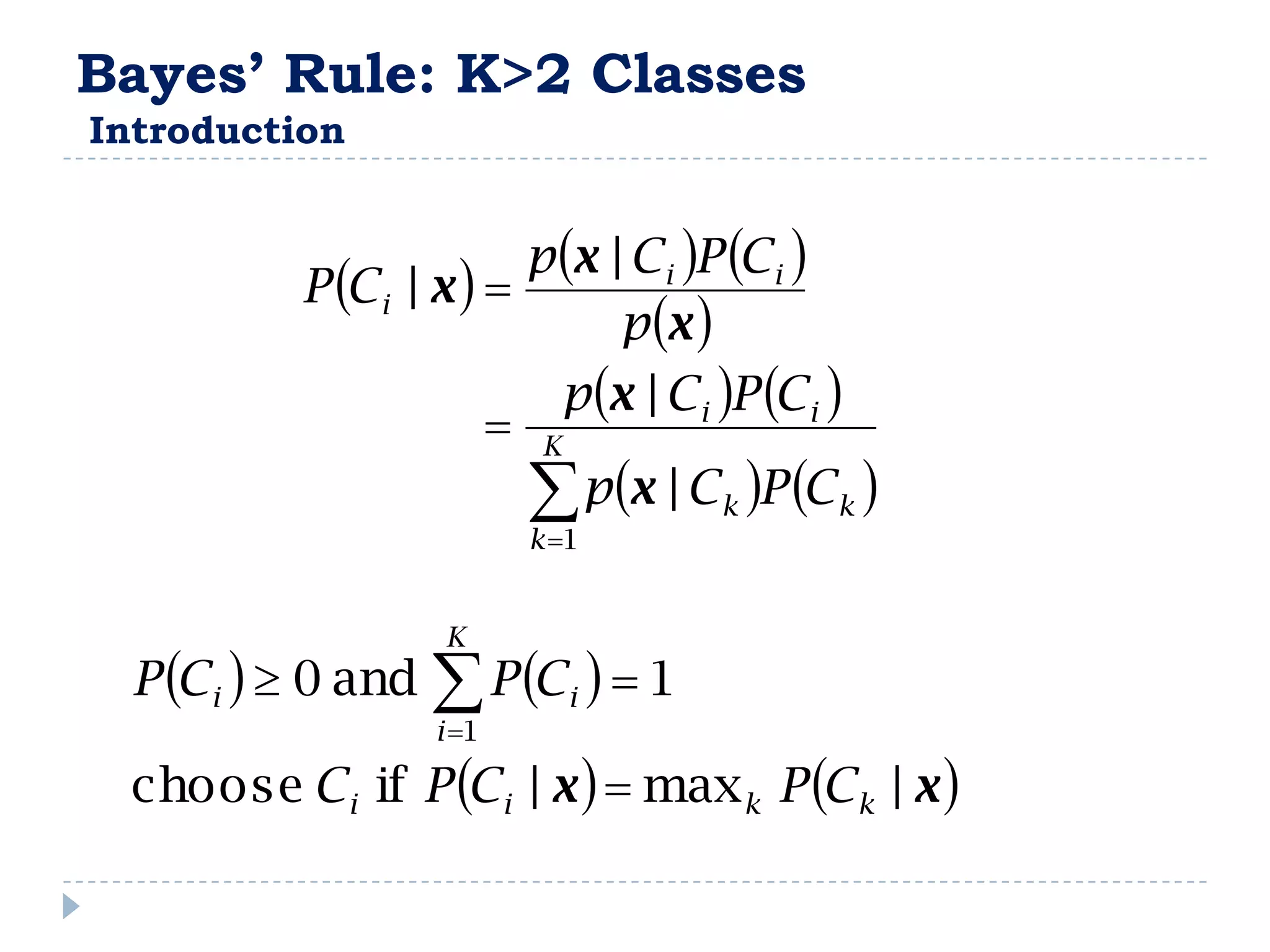
Bayes’ Rule: K>2 Classes
Introduction


                         p x | Ci P Ci 
           P Ci | x  
                               p x 
                           p x | Ci P Ci 
                        K
                          p x | Ck P Ck 
                         k 1


                   K
  P Ci   0 and  P Ci   1
                  i 1

 choose Ci if P Ci | x   max k P Ck | x 
Bayesian Networks
Introduction

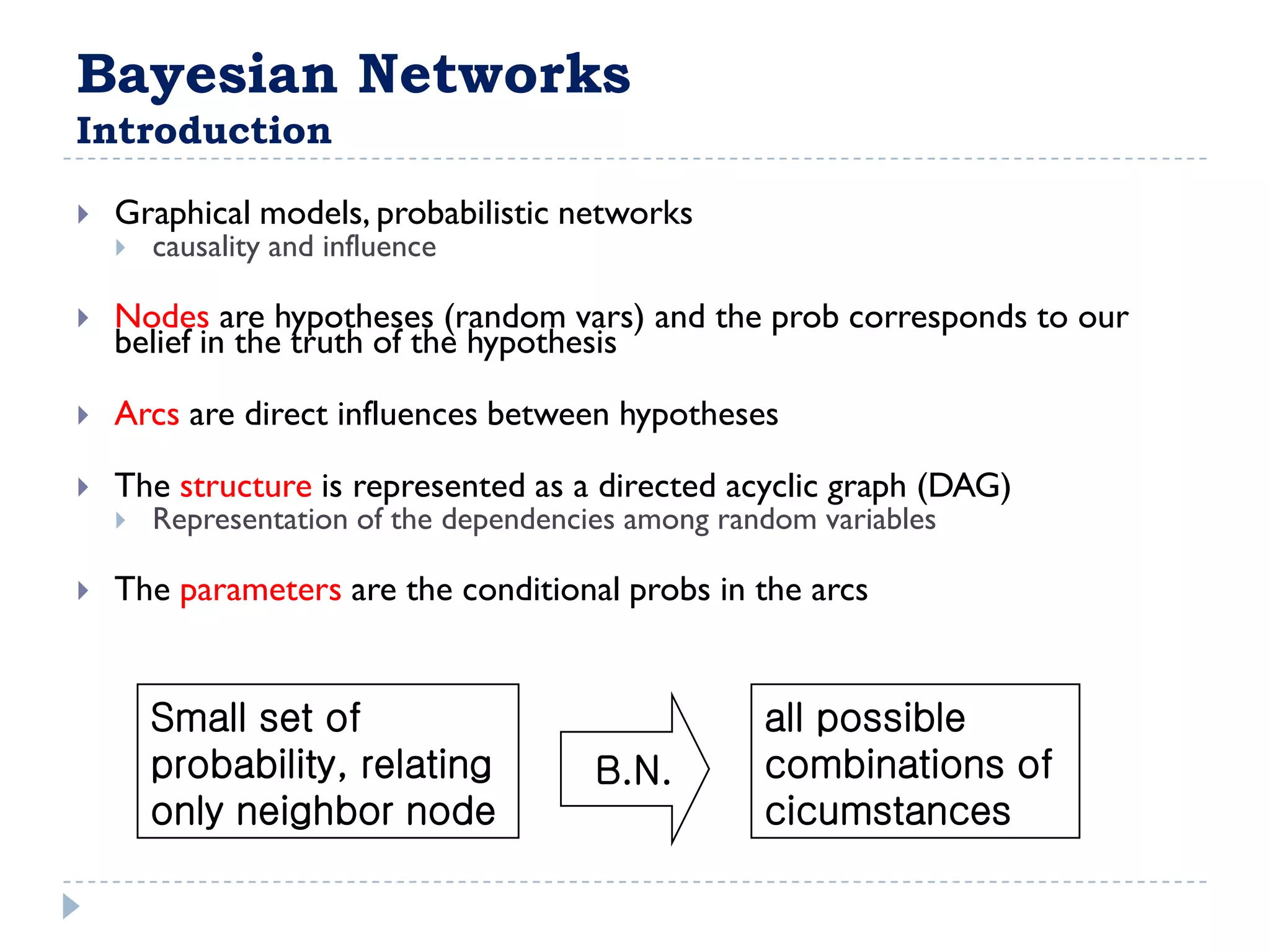
   Graphical models, probabilistic networks
       causality and influence

   Nodes are hypotheses (random vars) and the prob corresponds to our
    belief in the truth of the hypothesis

   Arcs are direct influences between hypotheses

   The structure is represented as a directed acyclic graph (DAG)
       Representation of the dependencies among random variables

   The parameters are the conditional probs in the arcs


        Small set of                                all possible
        probability, relating           B.N.        combinations of
        only neighbor node                          cicumstances
Bayesian Networks
Introduction


   Learning
       Inducing a graph
           From prior knowledge
           From structure learning
       Estimating parameters
           EM
   Inference
       Beliefs from evidences
           Especially among the nodes not directly connected
Structure
Introduction

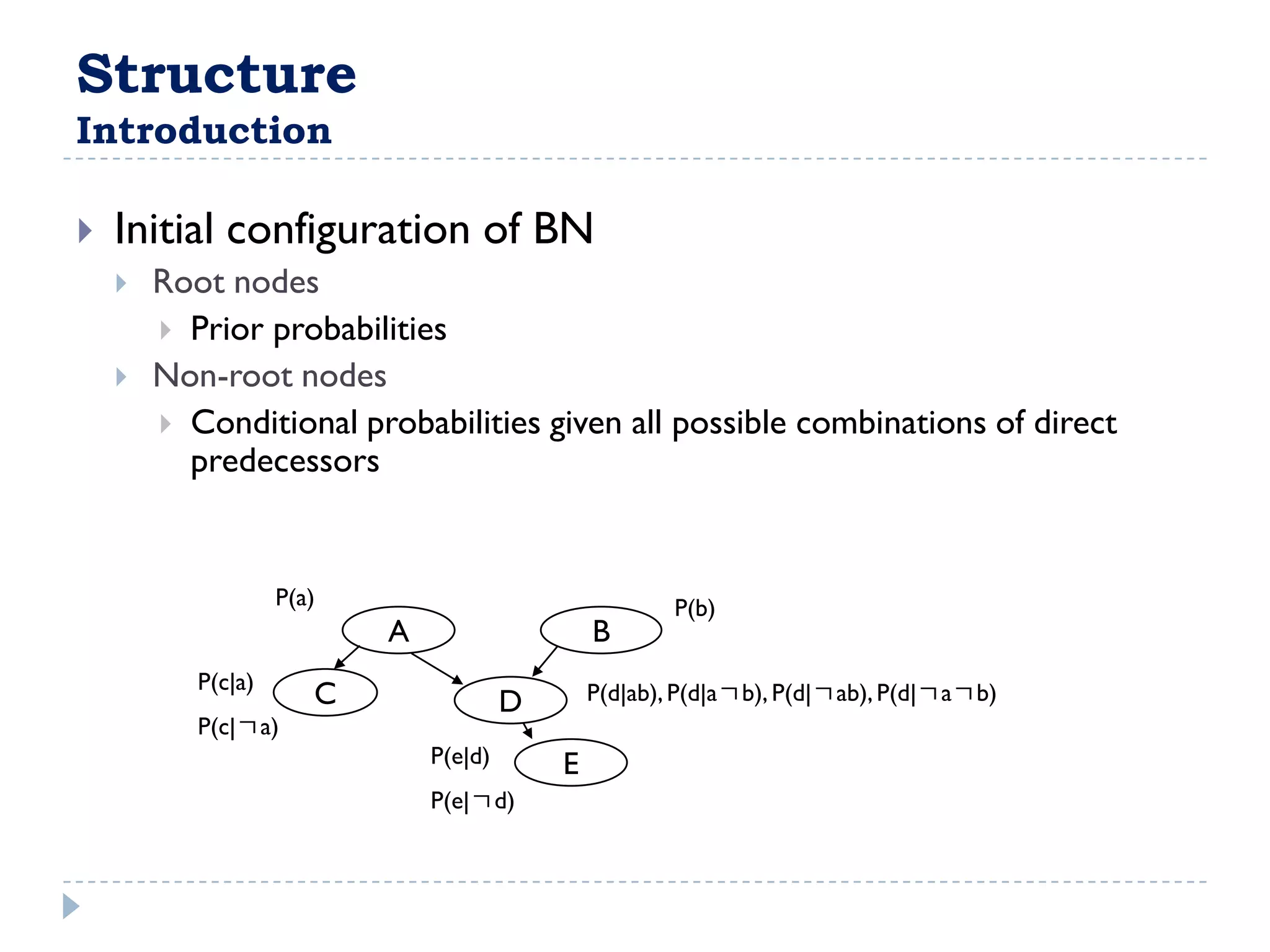
   Initial configuration of BN
       Root nodes
         Prior probabilities
       Non-root nodes
         Conditional probabilities given all possible combinations of direct
          predecessors


                    P(a)                                P(b)
                           A                    B
           P(c|a)
                       C                D       P(d|ab), P(d|aㄱb), P(d|ㄱab), P(d|ㄱaㄱb)
           P(c|ㄱa)
                               P(e|d)       E
                               P(e|ㄱd)
Causes and Bayes’ Rule
  Introduction


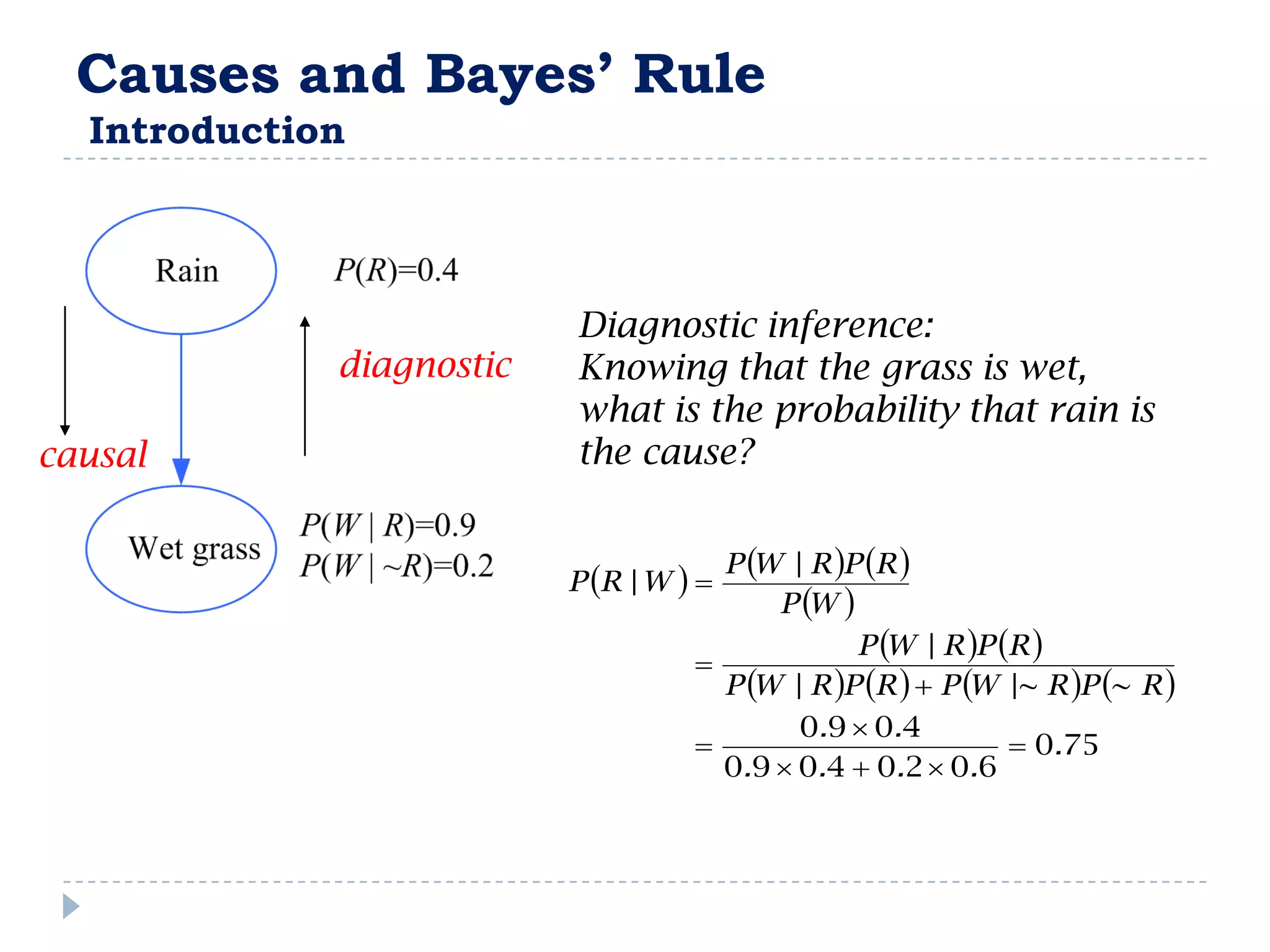
                          Diagnostic inference:
             diagnostic   Knowing that the grass is wet,
                          what is the probability that rain is
causal                    the cause?


                                      P W | R P R 
                          P R | W  
                                          P W 
                                                 P W | R P R 
                                    
                                      P W | R P R   P W |~ R P ~ R 
                                            0.9  0.4
                                                              0.75
                                      0.9  0.4  0.2  0.6
Causal vs Diagnostic Inference
Introduction


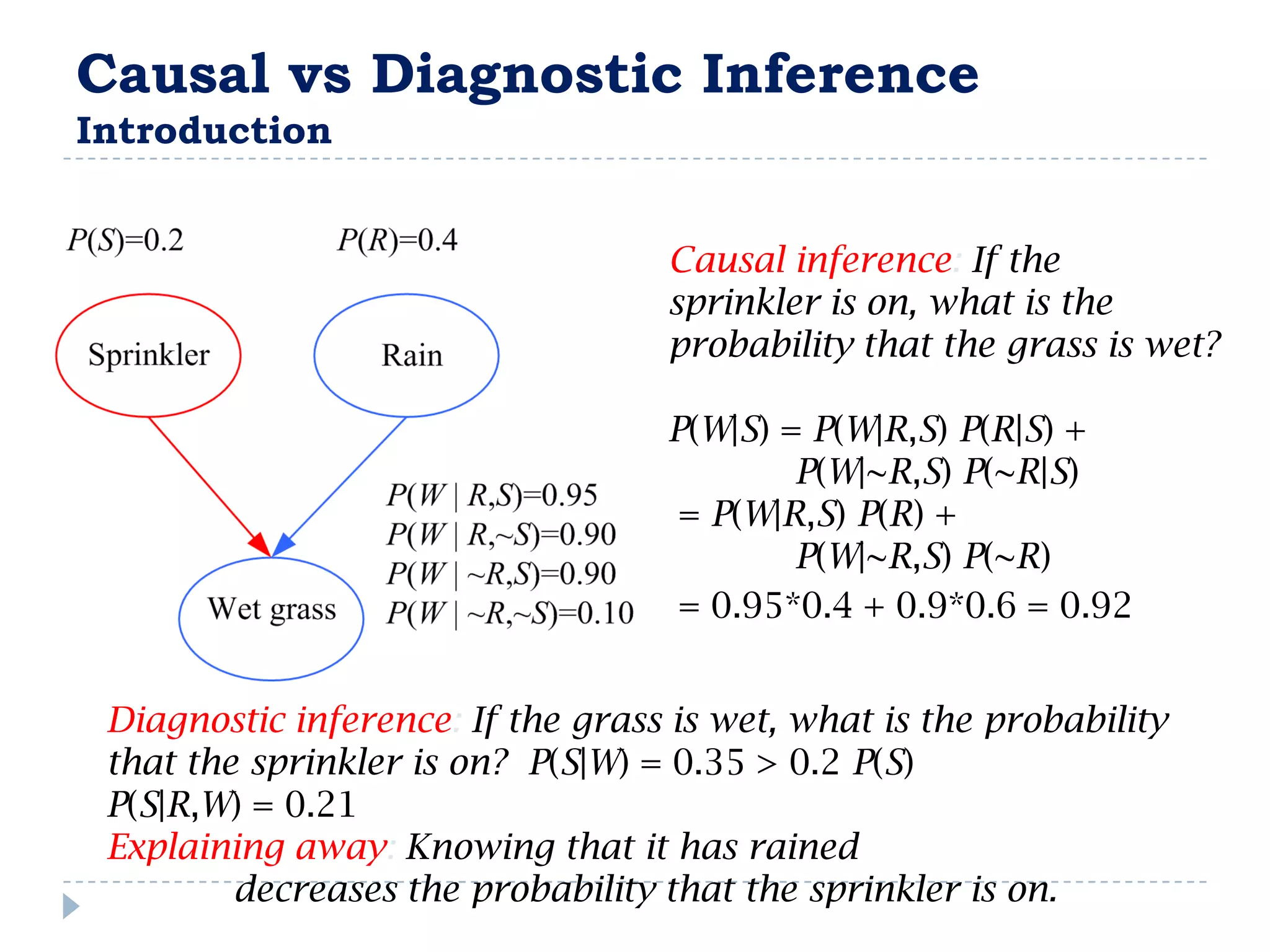
                                   Causal inference: If the
                                   sprinkler is on, what is the
                                   probability that the grass is wet?

                                   P(W|S) = P(W|R,S) P(R|S) +
                                           P(W|~R,S) P(~R|S)
                                    = P(W|R,S) P(R) +
                                           P(W|~R,S) P(~R)
                                    = 0.95*0.4 + 0.9*0.6 = 0.92


 Diagnostic inference: If the grass is wet, what is the probability
 that the sprinkler is on? P(S|W) = 0.35 > 0.2 P(S)
 P(S|R,W) = 0.21
 Explaining away: Knowing that it has rained
         decreases the probability that the sprinkler is on.
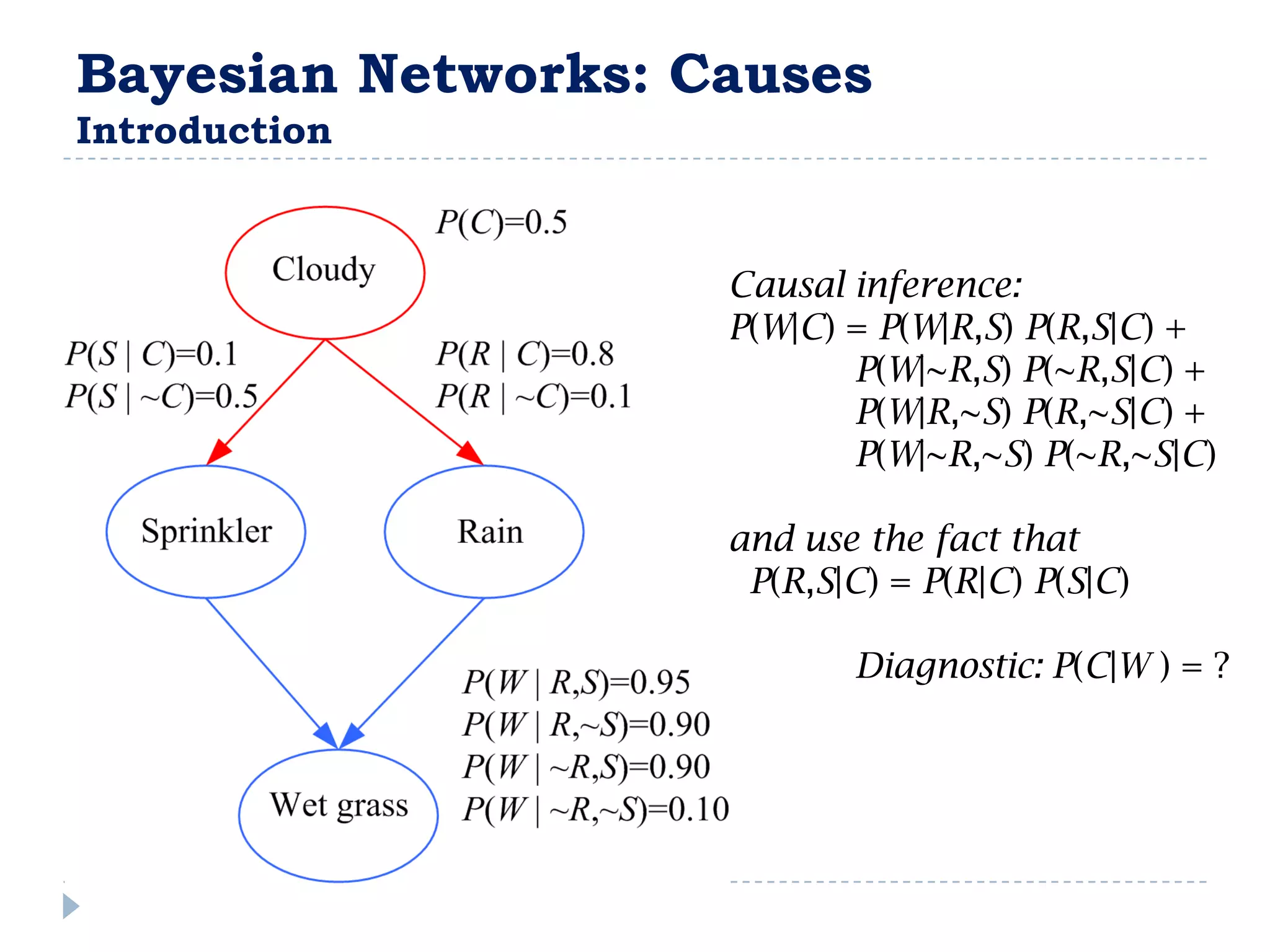
Bayesian Networks: Causes
Introduction


                    Causal inference:
                    P(W|C) = P(W|R,S) P(R,S|C) +
                           P(W|~R,S) P(~R,S|C) +
                           P(W|R,~S) P(R,~S|C) +
                           P(W|~R,~S) P(~R,~S|C)

                    and use the fact that
                     P(R,S|C) = P(R|C) P(S|C)

                           Diagnostic: P(C|W ) = ?
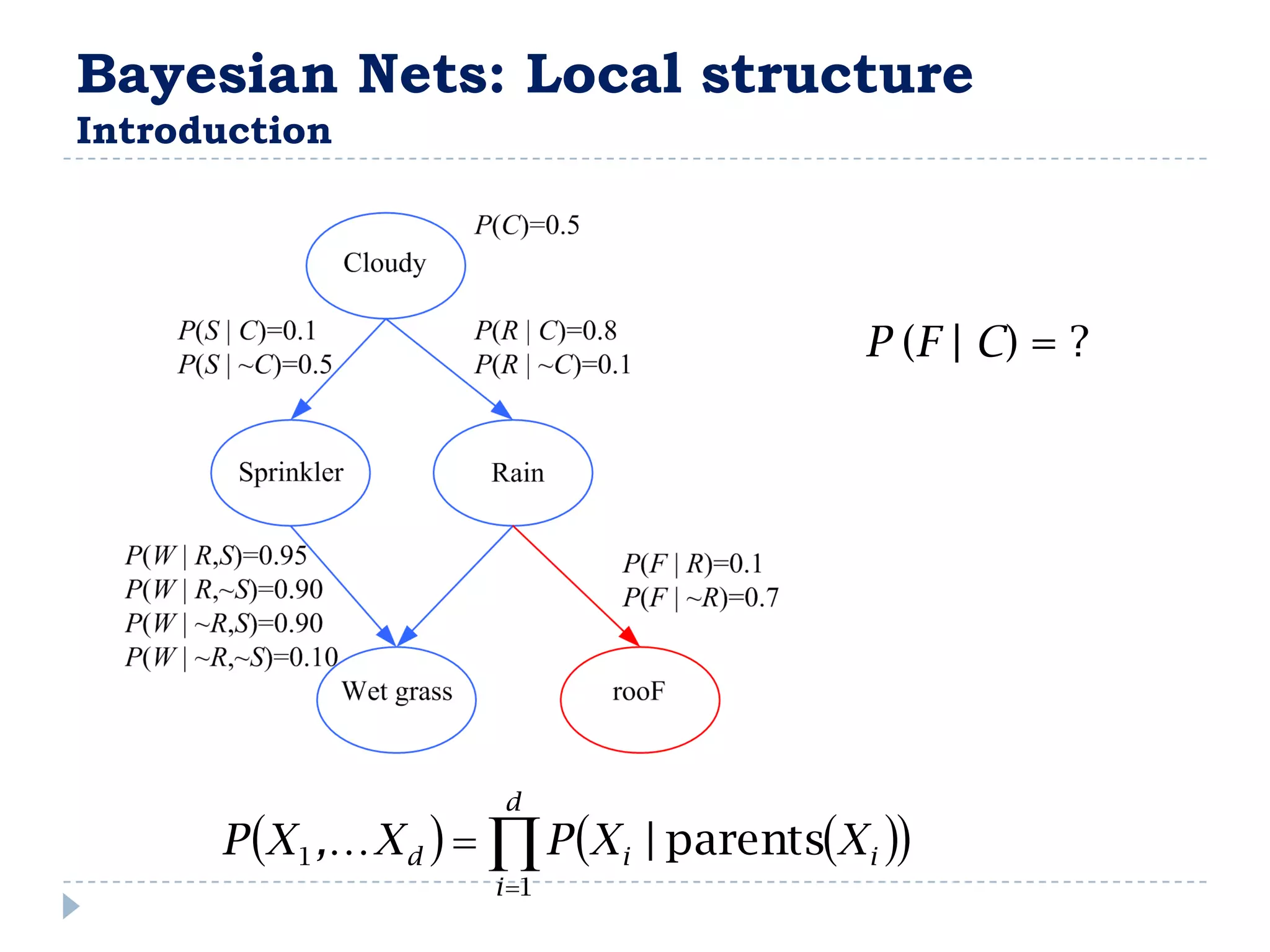
Bayesian Nets: Local structure
Introduction


                                              P (F | C) = ?


                        d
      P X 1 , X d    P X i | parentsX i 
                       i 1
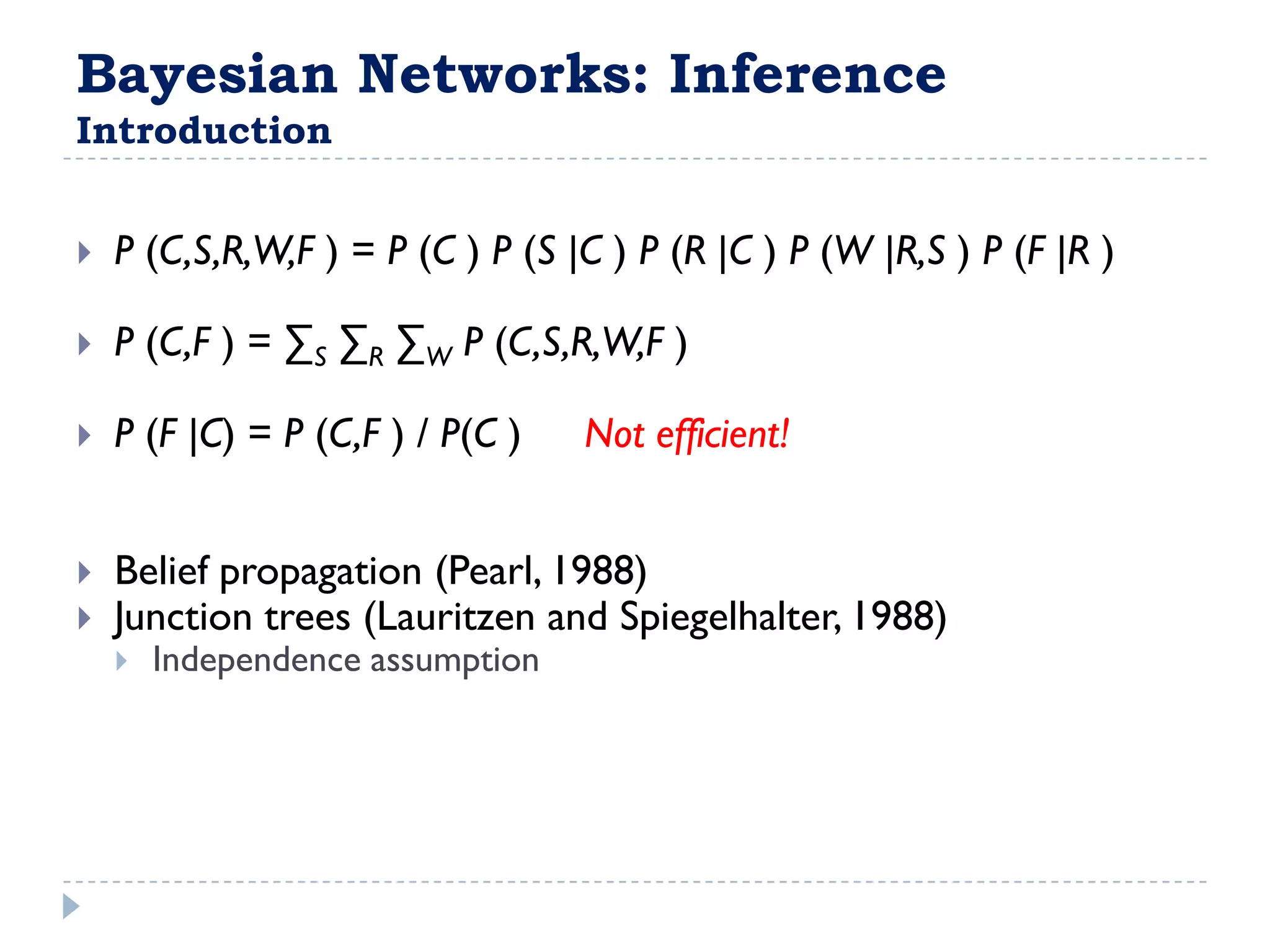
Bayesian Networks: Inference
Introduction


   P (C,S,R,W,F ) = P (C ) P (S |C ) P (R |C ) P (W |R,S ) P (F |R )

   P (C,F ) = ∑S ∑R ∑W P (C,S,R,W,F )

   P (F |C) = P (C,F ) / P(C )   Not efficient!


   Belief propagation (Pearl, 1988)
   Junction trees (Lauritzen and Spiegelhalter, 1988)
       Independence assumption
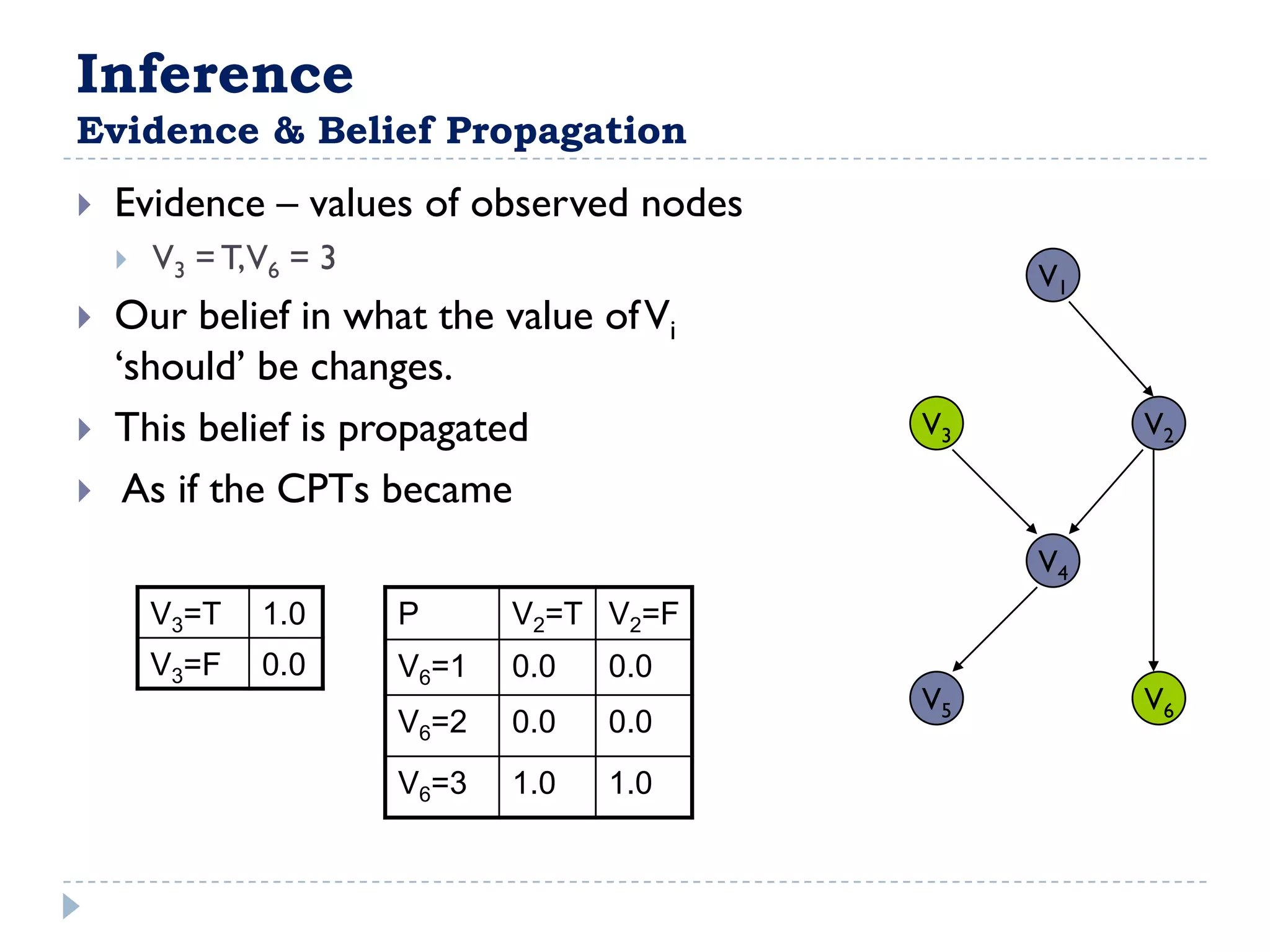
Inference
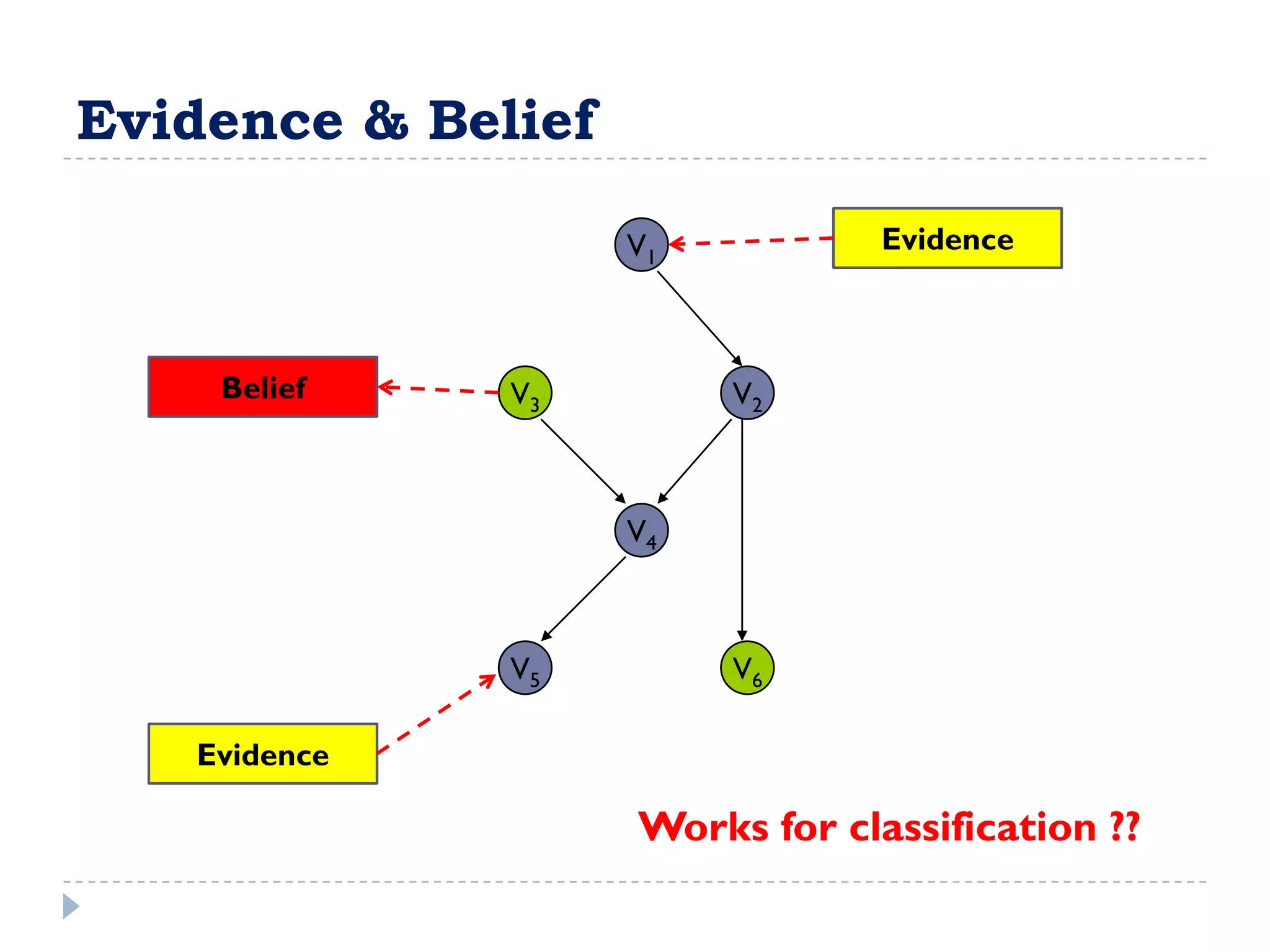
Evidence & Belief Propagation
   Evidence – values of observed nodes
       V3 = T,V6 = 3                           V1
   Our belief in what the value of Vi
    „should‟ be changes.
   This belief is propagated              V3        V2

    As if the CPTs became
                                                V4
        V3=T   1.0      P      V2=T V2=F
        V3=F   0.0      V6=1   0.0   0.0
                                           V5        V6
                        V6=2   0.0   0.0
                        V6=3   1.0   1.0
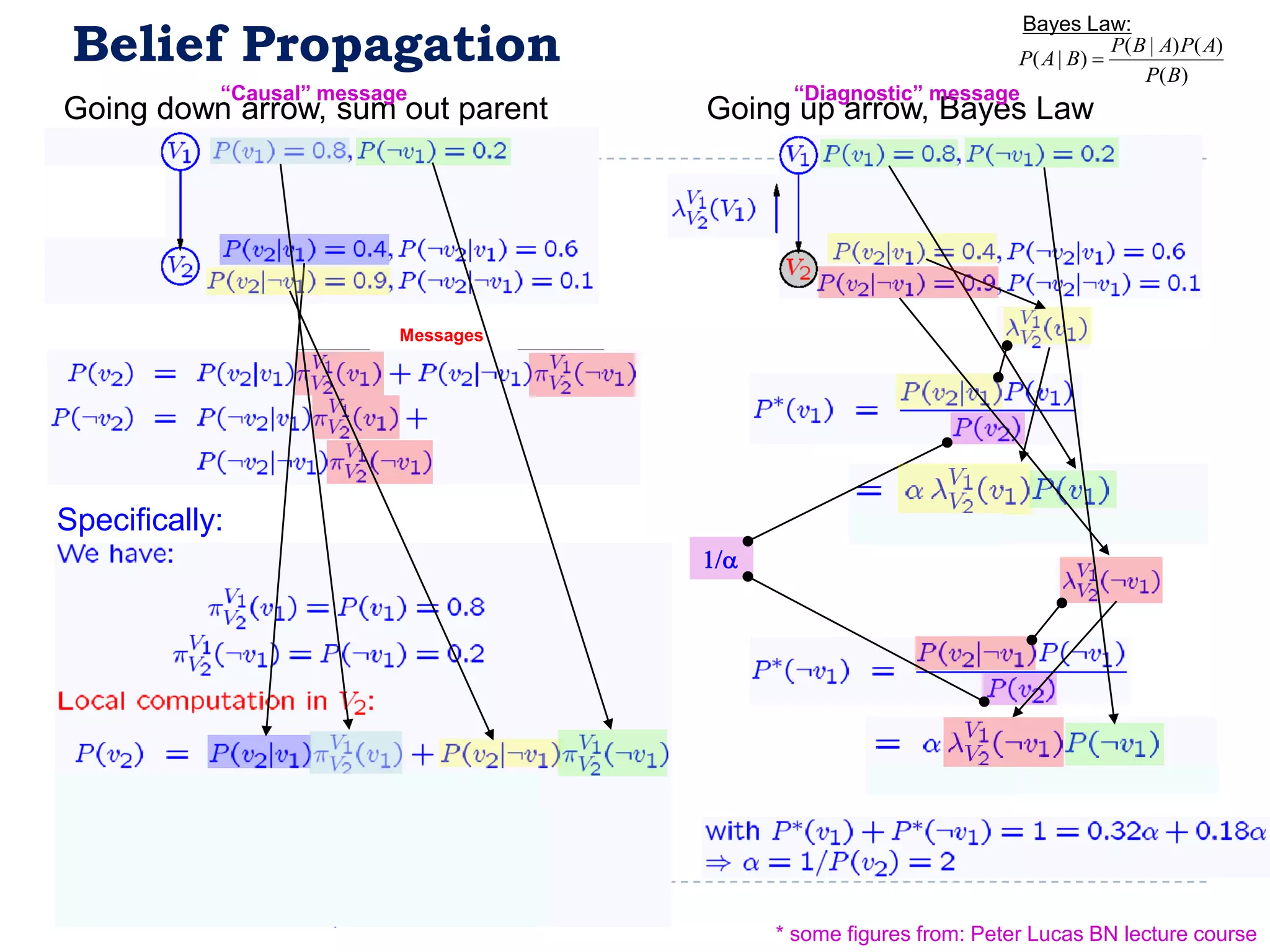
Belief Propagation
                                                                    Bayes Law:
                                                                               P( B | A) P( A)
                                                                   P( A | B) 
                                                                                   P( B)
            “Causal” message                   “Diagnostic” message
Going down arrow, sum out parent        Going up arrow, Bayes Law
Message


                             Messages


Specifically:
                                        1/a


                         9


                                              * some figures from: Peter Lucas BN lecture course
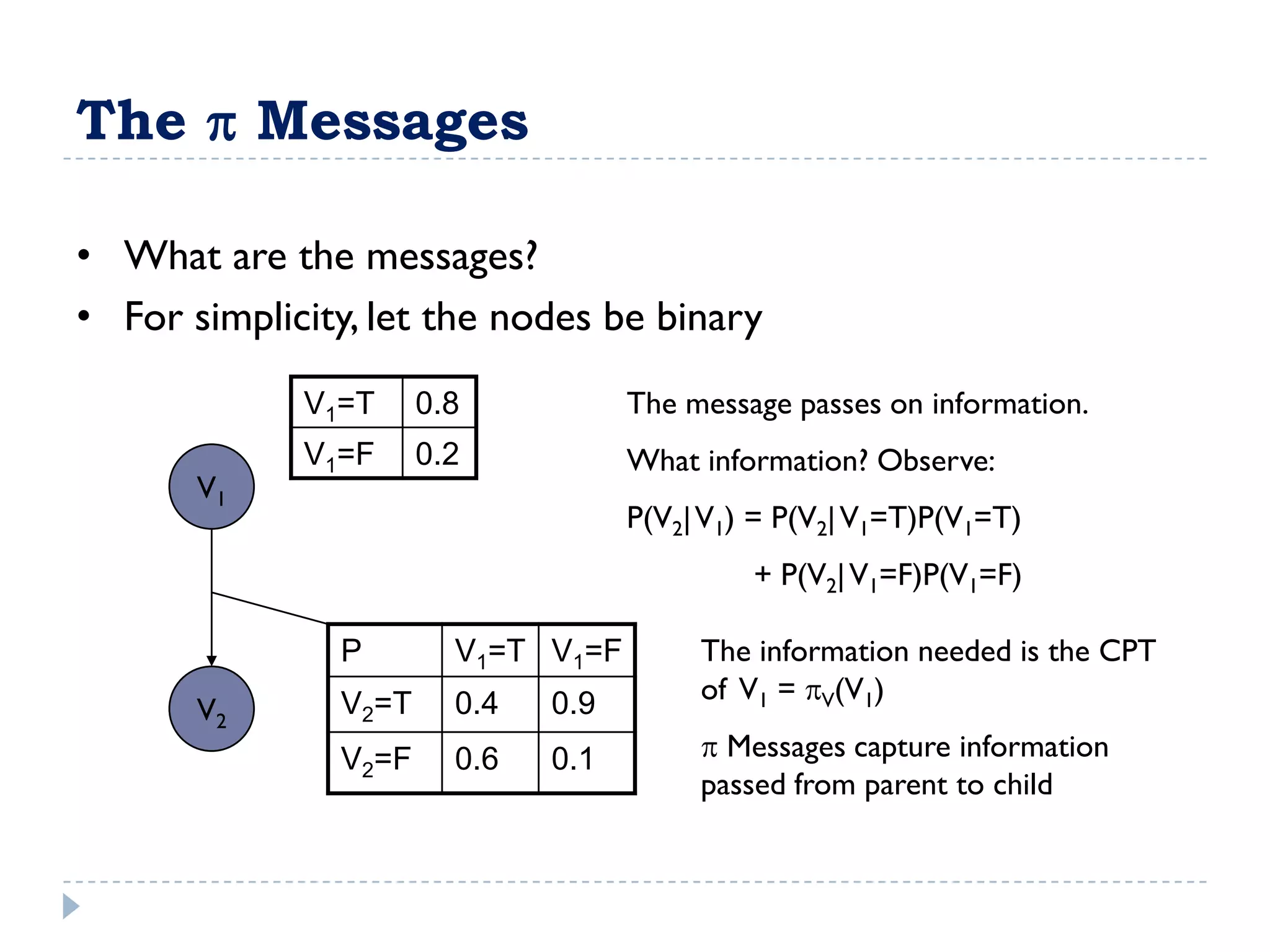
The  Messages

• What are the messages?
• For simplicity, let the nodes be binary
             V1=T     0.8           The message passes on information.
             V1=F     0.2           What information? Observe:
       V1
                                    P(V2| V1) = P(V2| V1=T)P(V1=T)
                                             + P(V2| V1=F)P(V1=F)

               P        V1=T V1=F        The information needed is the CPT
                                         of V1 = V(V1)
       V2      V2=T     0.4   0.9
               V2=F     0.6   0.1         Messages capture information
                                         passed from parent to child
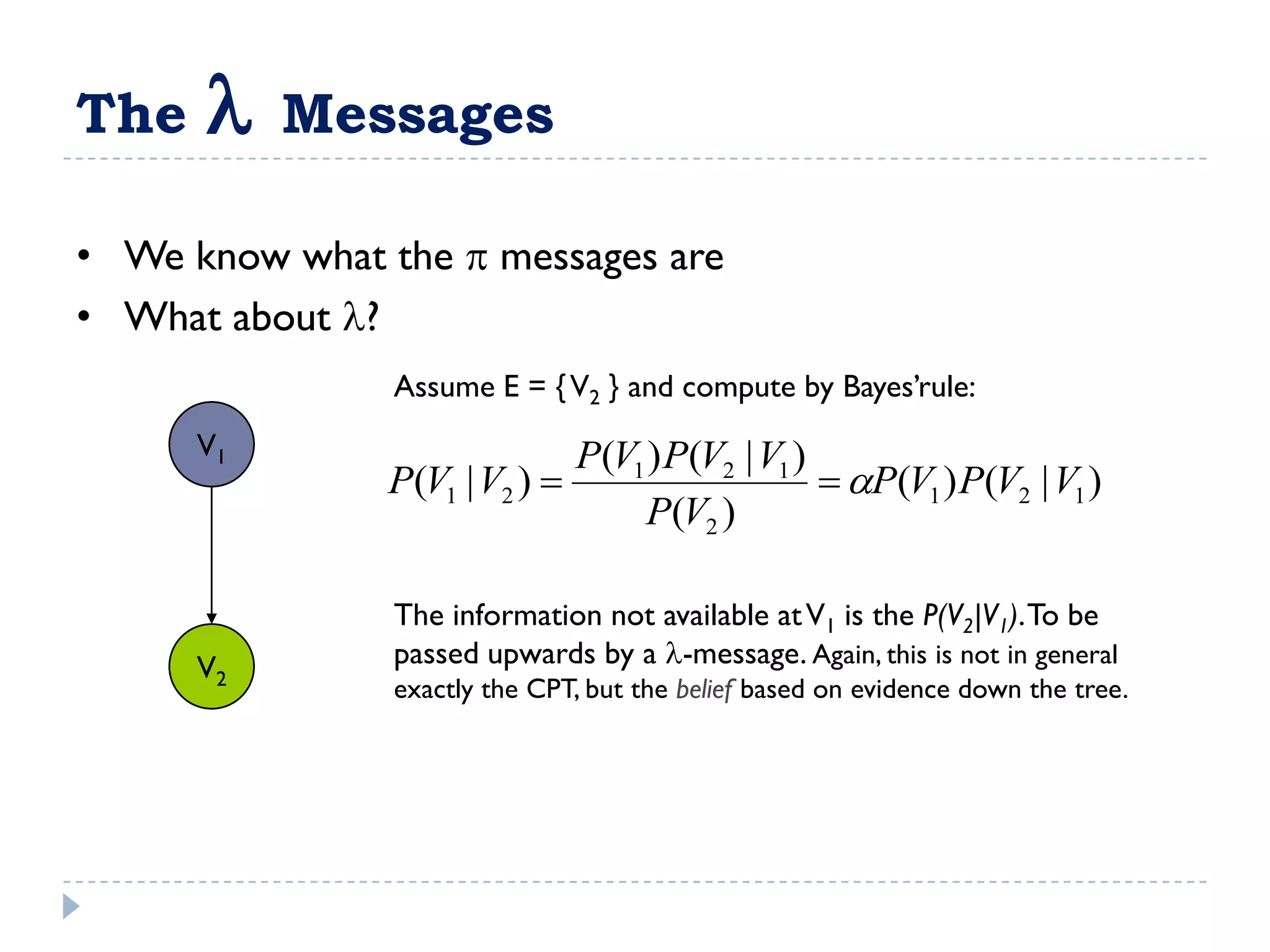
The       Messages

• We know what the  messages are
• What about ?
                Assume E = { V2 } and compute by Bayes‟rule:
      V1                       P(V1 ) P(V2 | V1 )
               P(V1 | V2 )                        aP(V1 ) P(V2 | V1 )
                                   P(V2 )

                The information not available at V1 is the P(V2|V1). To be
      V2        passed upwards by a -message. Again, this is not in general
                exactly the CPT, but the belief based on evidence down the tree.
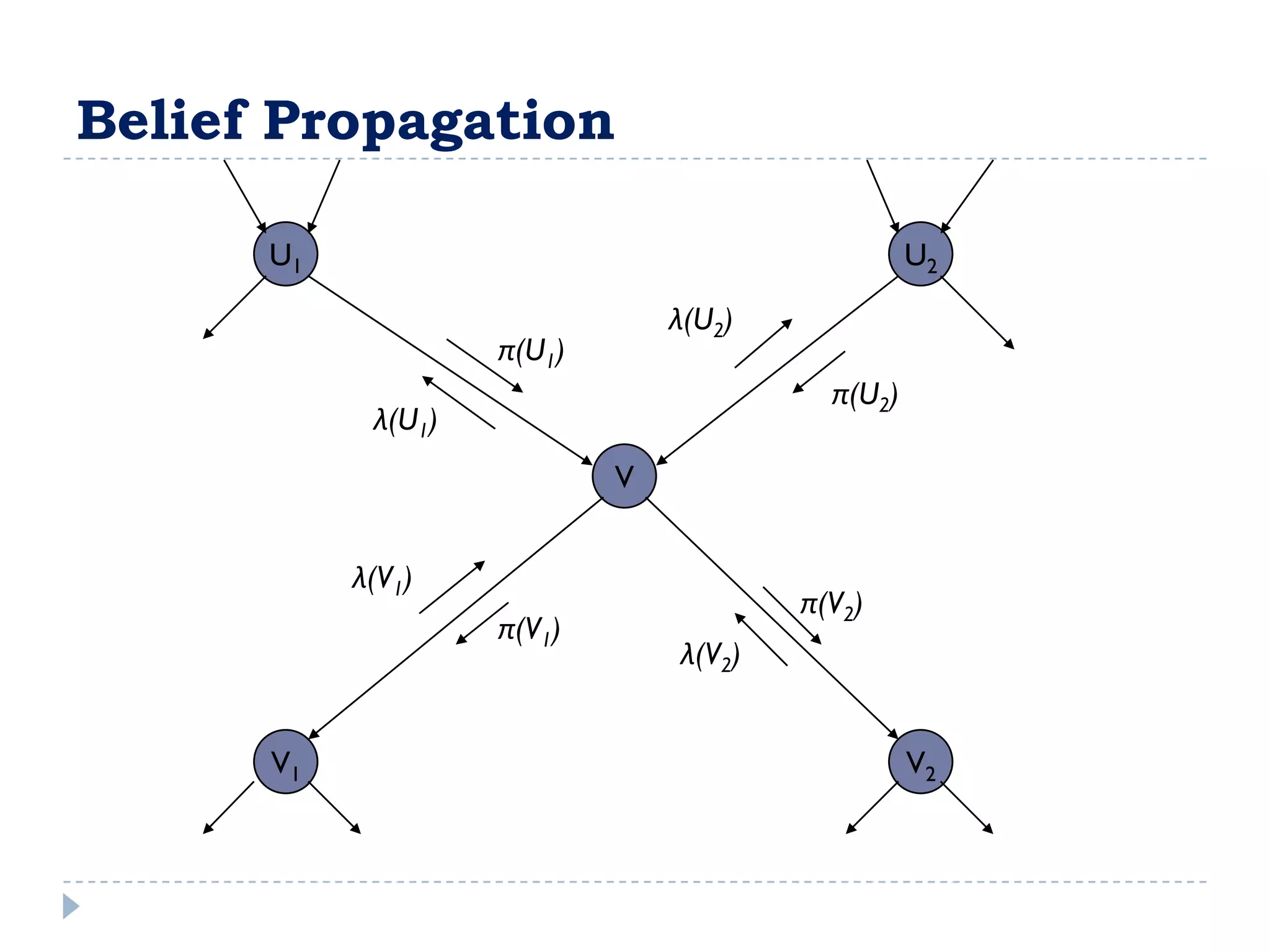
Belief Propagation

      U1                                          U2

                                λ(U2)
                    π(U1)
                                          π(U2)
            λ(U1)
                            V


           λ(V1)
                                        π(V2)
                    π(V1)
                                λ(V2)


      V1                                          V2
Evidence & Belief

                    V1           Evidence


    Belief    V3         V2


                    V4


              V5         V6

   Evidence

                    Works for classification ??
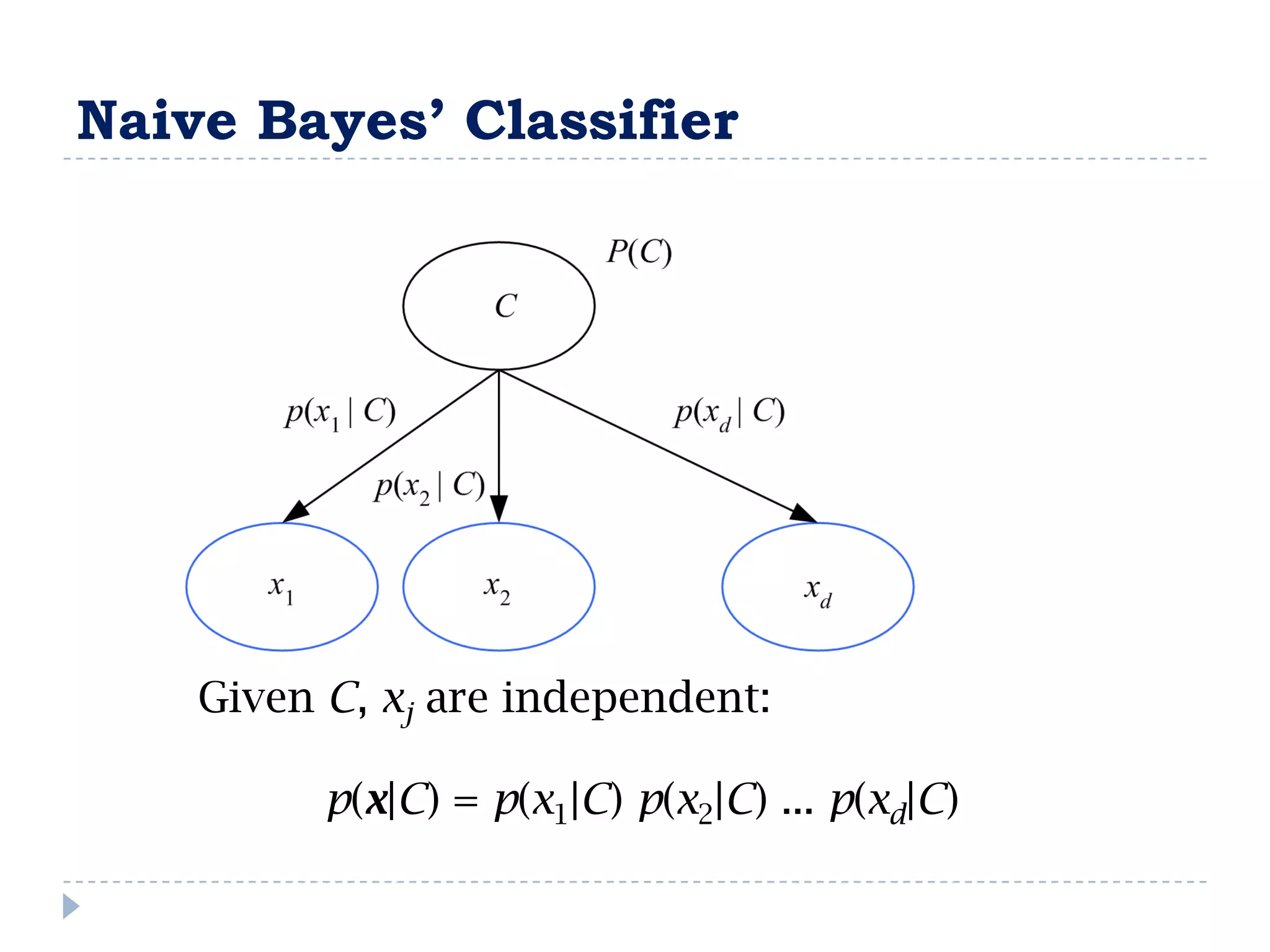
Naive Bayes’ Classifier


    Given C, xj are independent:

          p(x|C) = p(x1|C) p(x2|C) ... p(xd|C)
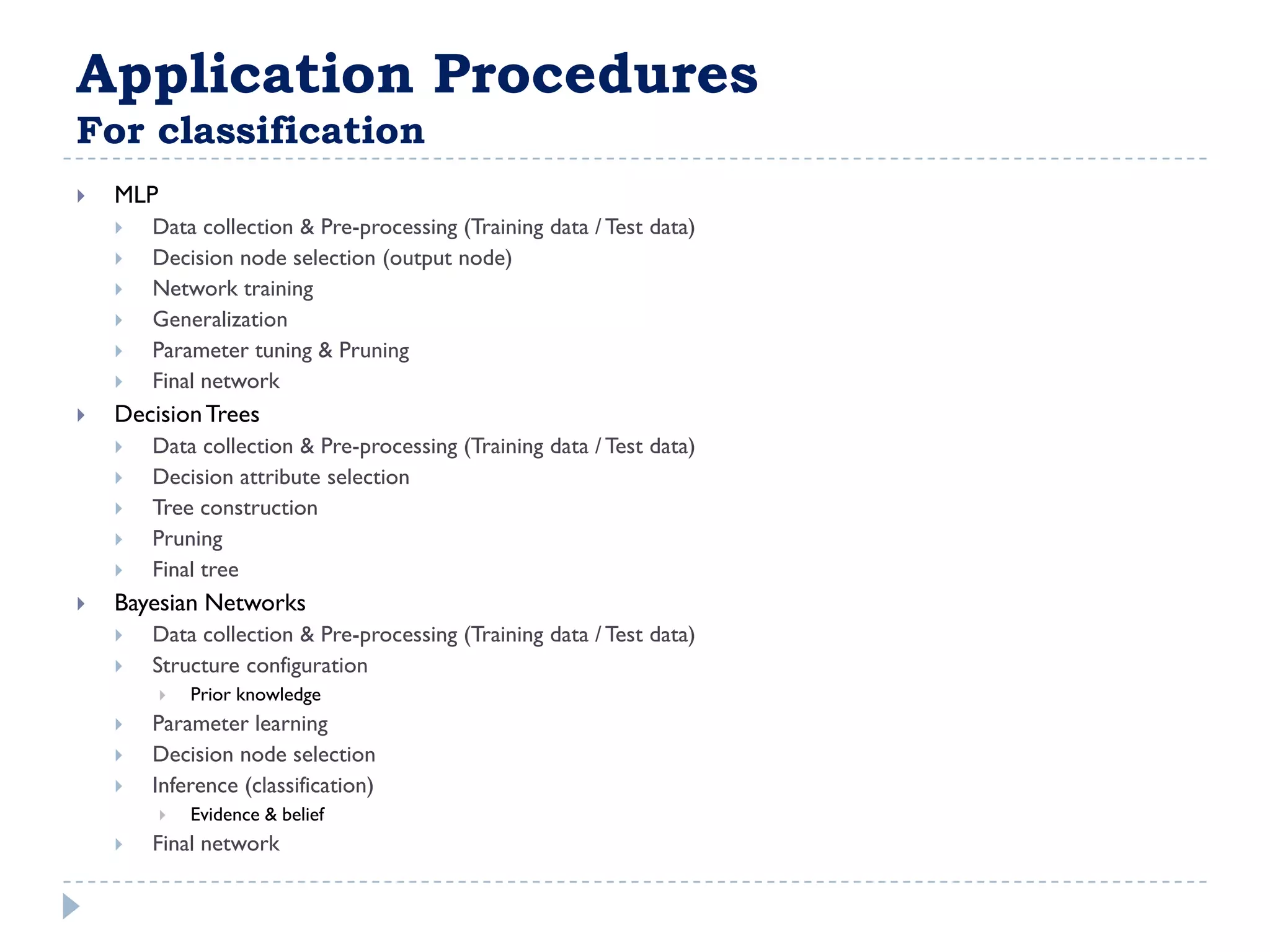
Application Procedures
For classification
   MLP
       Data collection & Pre-processing (Training data / Test data)
       Decision node selection (output node)
       Network training
       Generalization
       Parameter tuning & Pruning
       Final network
   Decision Trees
       Data collection & Pre-processing (Training data / Test data)
       Decision attribute selection
       Tree construction
       Pruning
       Final tree
   Bayesian Networks
       Data collection & Pre-processing (Training data / Test data)
       Structure configuration
             Prior knowledge
       Parameter learning
       Decision node selection
       Inference (classification)
             Evidence & belief
       Final network
Simulation
   Simulation Packages
       WEKA (JAVA)
           http://www.cs.waikato.ac.nz/ml/weka/
       FullBNT (MATLAB)
           http://www.cs.ubc.ca/~murphyk/Software/BNT/bnt.html
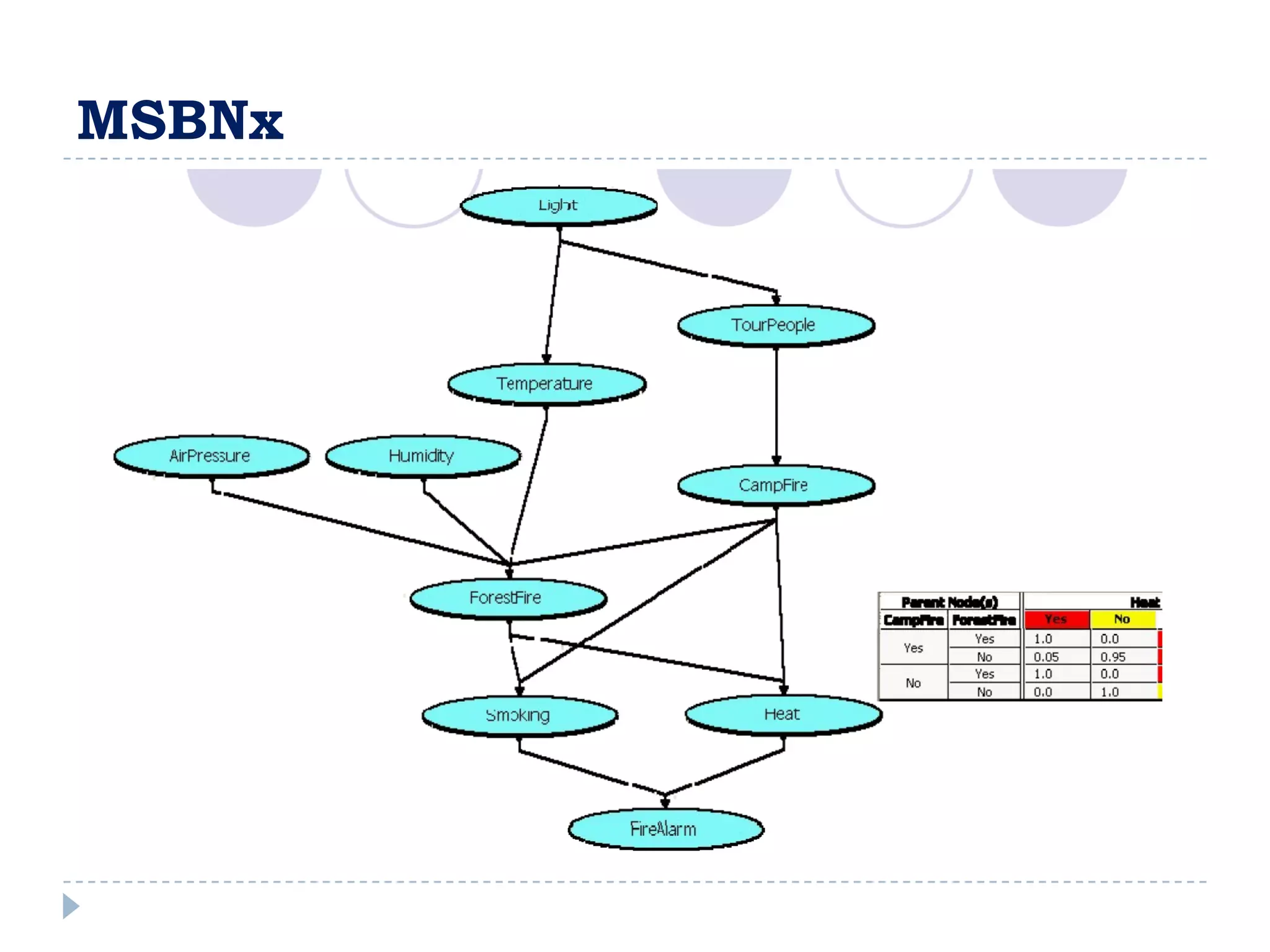
       MSBNx
           http://research.microsoft.com/msbn/
       MATLAB Neural Networks Toolbox
           http://www.mathworks.com/products/neuralnet/
       C4.5
           http://www.rulequest.com/Personal/
WEKA
FullBNT
   clear all


   N = 4;                      % 노드의 개수
   dag = zeros(N,N);                % 네크워크 구조 shell
   C = 1; S = 2; R = 3; W = 4;        % 각 노드 Naming
   dag(C,[R S]) = 1;              % 네트워크 구조 명시
   dag(R,W) = 1;
   dag(S,W)=1;


   %discrete_nodes = 1:N;
   node_sizes = 2*ones(1,N);           % 각 노드가 가질 수 있는 값의 개수
   %node_sizes = [4 2 3 5];
   %onodes = [];
   %bnet = mk_bnet(dag, node_sizes, 'discrete', discrete_nodes, 'observed', onodes);


   bnet = mk_bnet(dag, node_sizes, 'names', {'C','S','R','W'}, 'discrete', 1:4);
   %C = bnet.names('cloudy'); % bnet.names is an associative array
   %bnet.CPD{C} = tabular_CPD(bnet, C, [0.5 0.5]);


   %%%%%% Specified Parameters
   %bnet.CPD{C} = tabular_CPD(bnet, C, [0.5 0.5]);
   %bnet.CPD{R} = tabular_CPD(bnet, R, [0.8 0.2 0.2 0.8]);
   %bnet.CPD{S} = tabular_CPD(bnet, S, [0.5 0.9 0.5 0.1]);
   %bnet.CPD{W} = tabular_CPD(bnet, W, [1 0.1 0.1 0.01 0 0.9 0.9 0.99]);
MSBNx
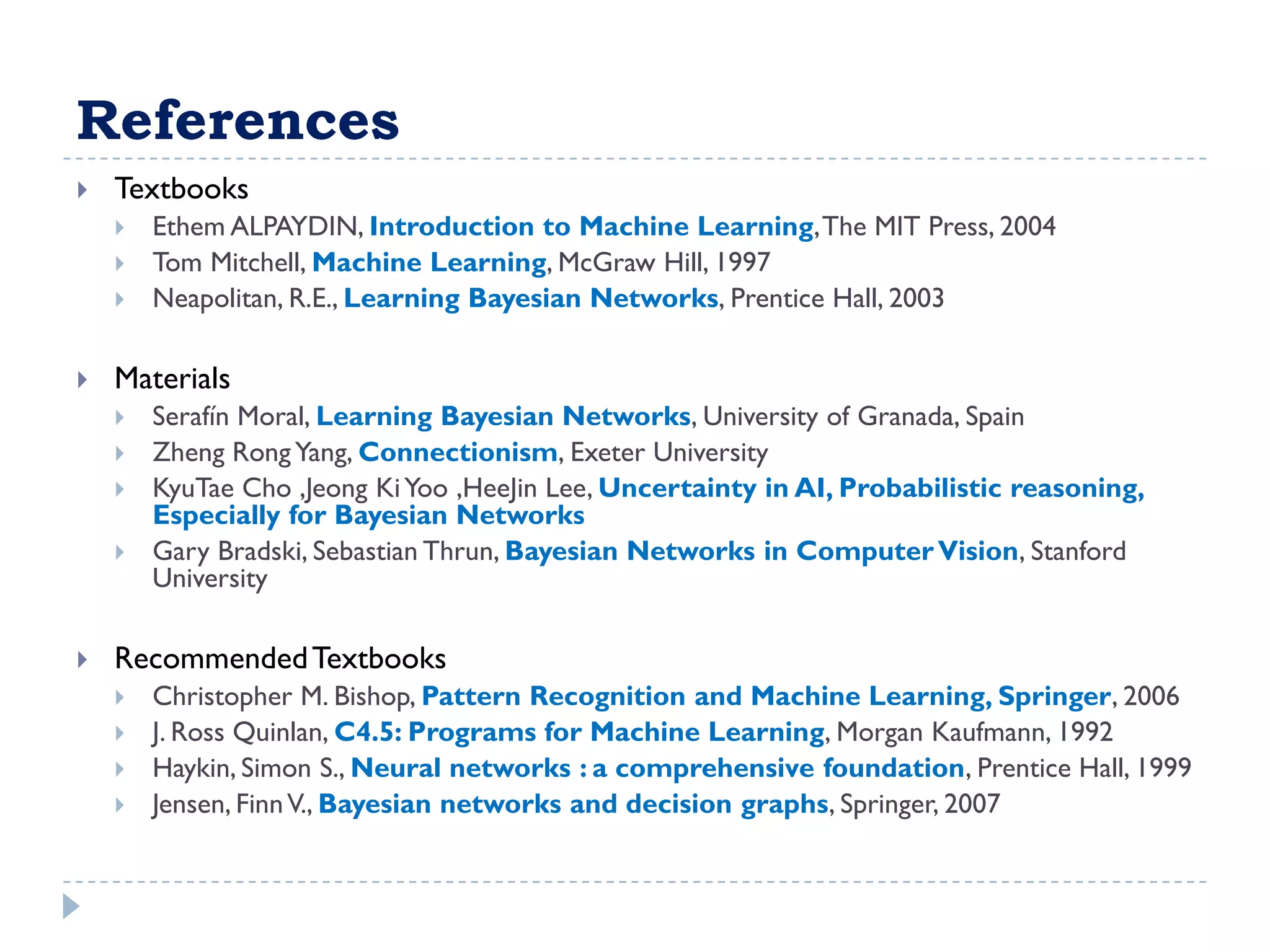
References
   Textbooks
       Ethem ALPAYDIN, Introduction to Machine Learning, The MIT Press, 2004
       Tom Mitchell, Machine Learning, McGraw Hill, 1997
       Neapolitan, R.E., Learning Bayesian Networks, Prentice Hall, 2003

   Materials
       Serafí Moral, Learning Bayesian Networks, University of Granada, Spain
             n
       Zheng Rong Yang, Connectionism, Exeter University
       KyuTae Cho ,Jeong Ki Yoo ,HeeJin Lee, Uncertainty in AI, Probabilistic reasoning,
        Especially for Bayesian Networks
       Gary Bradski, Sebastian Thrun, Bayesian Networks in Computer Vision, Stanford
        University

   Recommended Textbooks
       Christopher M. Bishop, Pattern Recognition and Machine Learning, Springer, 2006
       J. Ross Quinlan, C4.5: Programs for Machine Learning, Morgan Kaufmann, 1992
       Haykin, Simon S., Neural networks : a comprehensive foundation, Prentice Hall, 1999
       Jensen, Finn V., Bayesian networks and decision graphs, Springer, 2007

Introduction to Machine Learning

  • 1.
    Introduction to MachineLearning Jinhyuk Choi Human-Computer Interaction Lab @ Information and Communications University
  • 2.
    Contents  Concepts of Machine Learning  Multilayer Perceptrons  Decision Trees  Bayesian Networks
  • 3.
    What is MachineLearning?  Large storage / large amount of data  Looks random but certain patterns  Web log data  Medical record  Network optimization  Bioinformatics  Machine vision  Speech recognition…  No complete identification of the process  A good or useful approximation
  • 4.
    What is MachineLearning? Definition  Programming computers to optimize a performance criterion using example data or past experience  Role of Statistics  Inference from a sample  Role of Computer science  Efficient algorithms to solve the optimization problem  Representing and evaluating the model for inference  Descriptive (training) / predictive (generalization) Learning from Human-generated data??
  • 5.
    What is MachineLearning? Concept Learning • Inducing general functions from specific training examples (positive or negative) • Looking for the hypothesis that best fits the training examples Objects Concept 눈, 코, 다리 Bird 생식능력, 날개, 부리, boolean function : … 깃털… Bird(animal)  “true or not” 무생물… • Concepts: - describing some subset of objects or events defined over a larger set - a boolean-valued function
  • 6.
    What is MachineLearning? Concept Learning  Inferring a boolean-valued function from training examples of its input and output Hypothesis 1 Hypothesis 2 Concept Web log data Medical record Network optimization Positive examples Bioinformatics Negative examples Machine vision Speech recognition…
  • 7.
    What is MachineLearning? Learning Problem Design  Do you enjoy sports ?  Learn to predict the value of “EnjoySports” for an arbitrary day, based on the value of its other attributes  What problem?  Why learning?  Attributes selection  Effective?  Enough?  What learning algorithm?
  • 8.
    Applications  Learning associations  Classification  Regression  Unsupervised learning  Reinforcement learning
  • 9.
    Examples (1)  TV program preference inference based on web usage data Web page #1 TV Program #1 Web page #2 TV Program #2 Web page #3 Classifier TV Program #3 Web page #4 1 2 TV Program #4 …. …. 3 What are we supposed to do at each step?
  • 10.
    Examples (2) from a HW of Neural Networks Class (KAIST-2002)  Function approximation (Mexican hat)   f3 ( x1 , x2 )  sin 2 x12  x2 , 2 x1 , x2 [1,1]
  • 11.
    Examples (3) from aHW of Machine Learning Class (ICU-2006)  Face image classification
  • 12.
    Examples (4) from aHW of Machine Learning Class (ICU-2006)
  • 13.
    Examples (5) from aHW of Machine Learning Class (ICU-2006)  Sensay
  • 14.
    Examples (6) A. Krauseet. al, “Unsupervised, Dynamic Identification of Physiological and Activity Context in Wearable Computing”, ISWC 2005
  • 15.
  • 16.
    Neural Network? VS. Adaline MLP SOM Hopfield network RDFN Bifurcating neuron networks …
  • 17.
    Multilayer Networks ofSigmoid Units • Supervised learning • 2-layer • Fully connected Really looks like the brain??
  • 18.
  • 19.
    The back-propagation algorithm  Network model Input layer hidden layer output layer xi yj ok v ji wkj     y j  s  v ji x i     w y  ok  s  kj j    i       j    1 E v , w    tk  ok  2  Error function: 2 k  Stochastic gradient descent
  • 20.
  • 21.
    Gradient-descent function minimization    In order to find a vector parameter x that minimizes a function f x  …    Start with a random initial value of x  x 0 .  Determine the direction of the steepest descent in the parameter space by  f f f    f    , ,...,   x x  1 2 x n     Move to the direction a step.    x i  1  x i   hf  x  Repeat the above two steps until no more change in .  For gradient-descent to work…  The function to be minimized should be continuous.  The function should not have too many local minima.
  • 22.
  • 23.
    Derivation of back-propagationalgorithm Adjustment of wkj : 2 E  1 2 1   t  s  w y        tk  ok     k   k j j  wk j  wk j   2 k  2 wk j     j     1  y j ok  1  ok  1 2 tk   ok   2  y j ok  1  ok  tk   ok   E wkj  h  h ok 1  ok tk  ok y j wkj  o  d k
  • 24.
    Derivation of back-propagationalgorithm Adjustment of vji : 2 E  1 2 1   t  s  w y        tk  ok       kj j   v j i  v j i   2 k  2 k v j i   k     j    2 1   t  s  w s  v x      k   kj  ji i     2 k v j i    j   i    1   x i y j  1  y j   wkj ok 1  ok 1 2 tk  ok  2 k  x i y j  1  y j    wkj ok 1  ok tk  ok  k E v ji  h  hy j 1  y j   wkjok 1  ok tk  ok x i v ji k  h y j 1  y j   wkj dko x i  y k  dj
  • 25.
  • 26.
    Batch learning vs.Incremental learning Batch standard backprop proceeds as Incremental standard backprop can be done as follows: follows: Initialize the weights W. Initialize the weights W. Repeat the following steps for j = 1 to NL: Repeat the following steps: Process one training case (y_j,X_j) to compute the gradient Process all the training data DL to compute the gradient of the error (loss) function Q(y_j,X_j,W). of the average error function AQ(DL,W). Update the weights by subtracting the gradient times the Update the weights by subtracting the gradient times the learning rate. learning rate.
  • 27.
  • 28.
  • 29.
  • 30.
    Introduction  Divide & conquer  Hierarchical model  Sequence of recursive splits  Decision node vs. leaf node  Advantage  Interpretability  IF-THEN rules
  • 31.
    Divide and Conquer  Internal decision nodes  Univariate: Uses a single attribute, xi  Numeric xi : Binary split : xi > wm  Discrete xi : n-way split for n possible values  Multivariate: Uses all attributes, x  Leaves  Classification: Class labels, or proportions  Regression: Numeric; r average, or local fit  Learning  Construction of the tree using training examples  Looking for the simplest tree among the trees that code the training data without error  Based on heuristics  NP-complete  “Greedy”; find the best split recursively (Breiman et al, 1984; Quinlan, 1986, 1993)
  • 32.
    Classification Trees  Split is main procedure for tree construction  By impurity measure  For node m, Nm instances reach m, Nim belong to Ci i ˆ Ci | x ,m  pm  i Nm P Nm To be pure!!!  Node m is pure if pim is 0 or 1 K  Measure of impurity is entropy Im   pm log2pm i i i 1
  • 33.
    Representation  Each node specifies a test of some attribute of the instance  Each branch correspond to one of the possible values for this attribute
  • 34.
    Best Split  If node m is pure, generate a leaf and stop, otherwise split and continue recursively  Impurity after split: Nmj of Nm take branch j. Nimj belong to Ci i N mj ˆ Ci | x ,m, j   pmj  P i N mj n N mj K I'm   p i mj i log2pmj j 1 Nm i 1  Find the variable and split that min impurity (among all variables -- and split positions for numeric variables) Q) “Which attribute should be tested at the root of the tree?”
  • 35.
    Top-Down Induction ofDecision Trees
  • 36.
    Entropy  “Measure of uncertainty”  “Expected number of bits to resolve uncertainty”  Suppose Pr{X = 0} = 1/8  If other events are equally likely, the number of events is 8. To indicate one out of so many events, one needs lg 8 bits.  Consider a binary random variable X s.t. Pr{X = 0} = 0.1.  1  0.1 lg 1 1  The expected number of bits: 0.1 lg 0.1 1  0.1  In general, if a random variable X has c values with prob. p_c: c c 1  The expected number of bits: H   pi lg   pi lg pi i 1 pi i 1
  • 37.
    Entropy Example  14 examples Entropy([9,5])  (9 /14) log 2 (9 /14)  (5 /14) log 2 (5 /14)  0.940 Entropy 0 : all members positive or negative Entropy 1 : equal number of positive & negative 0 < Entropy < 1 : unequal number of positive & negative
  • 38.
    Information Gain  Measures the expected reduction in entropy caused by partitioning the examples
  • 39.
    Information Gain • # of samples = 100 ICU-Student tree • # of positive samples = 50 Candidate • Entropy = 1 Left side: • # of samples = 50 Gender • # of positive samples = 40 • Entropy = 0.72 Right side: Male Female • # of samples = 50 • # of positive samples = 10 • Entropy = 0.72 IQ Height On average • Entropy = 0.5 * 0.72 + 0.5*0.72 = 0.72 • Reduction in entropy = 0.28  Information gain
  • 40.
  • 41.
  • 42.
  • 43.
    Hypothesis Space Search  Hypothesis space: the set of all possible decision trees  DT is guided by information gain measure. Occam’s razor ??
  • 44.
    Overfitting • Why “over”-fitting? – A model can become more complex than the true target function(concept) when it tries to satisfy noisy data as well
  • 45.
    Avoiding over-fitting thedata  Two classes of approaches to avoid overfitting  Stop growing the tree earlier.  Post-prune the tree after overfitting  Ok, but how to determine the optimal size of a tree?  Use validation examples to evaluate the effect of pruning (stopping)  Use a statistical test to estimate the effect of pruning (stopping)  Use a measure of complexity for encoding decision tree.  Approaches based on the first strategy  Reduced error pruning  Rule post-pruning
  • 46.
    Rule Extraction fromTrees C4.5Rules (Quinlan, 1993)
  • 47.
  • 48.
    Bayes’ Rule Introduction prior likelihood posterior P C  p x | C  P C | x   p x  evidence P C  0  P C  1  1 p x   p x | C  1P C  1  p x | C  0P C  0 p C  0 | x   P C  1 | x   1
  • 49.
    Bayes’ Rule: K>2Classes Introduction p x | Ci P Ci  P Ci | x   p x  p x | Ci P Ci   K  p x | Ck P Ck  k 1 K P Ci   0 and  P Ci   1 i 1 choose Ci if P Ci | x   max k P Ck | x 
  • 50.
    Bayesian Networks Introduction  Graphical models, probabilistic networks  causality and influence  Nodes are hypotheses (random vars) and the prob corresponds to our belief in the truth of the hypothesis  Arcs are direct influences between hypotheses  The structure is represented as a directed acyclic graph (DAG)  Representation of the dependencies among random variables  The parameters are the conditional probs in the arcs Small set of all possible probability, relating B.N. combinations of only neighbor node cicumstances
  • 51.
    Bayesian Networks Introduction  Learning  Inducing a graph  From prior knowledge  From structure learning  Estimating parameters  EM  Inference  Beliefs from evidences  Especially among the nodes not directly connected
  • 52.
    Structure Introduction  Initial configuration of BN  Root nodes  Prior probabilities  Non-root nodes  Conditional probabilities given all possible combinations of direct predecessors P(a) P(b) A B P(c|a) C D P(d|ab), P(d|aㄱb), P(d|ㄱab), P(d|ㄱaㄱb) P(c|ㄱa) P(e|d) E P(e|ㄱd)
  • 53.
    Causes and Bayes’Rule Introduction Diagnostic inference: diagnostic Knowing that the grass is wet, what is the probability that rain is causal the cause? P W | R P R  P R | W   P W  P W | R P R   P W | R P R   P W |~ R P ~ R  0.9  0.4   0.75 0.9  0.4  0.2  0.6
  • 54.
    Causal vs DiagnosticInference Introduction Causal inference: If the sprinkler is on, what is the probability that the grass is wet? P(W|S) = P(W|R,S) P(R|S) + P(W|~R,S) P(~R|S) = P(W|R,S) P(R) + P(W|~R,S) P(~R) = 0.95*0.4 + 0.9*0.6 = 0.92 Diagnostic inference: If the grass is wet, what is the probability that the sprinkler is on? P(S|W) = 0.35 > 0.2 P(S) P(S|R,W) = 0.21 Explaining away: Knowing that it has rained decreases the probability that the sprinkler is on.
  • 55.
    Bayesian Networks: Causes Introduction Causal inference: P(W|C) = P(W|R,S) P(R,S|C) + P(W|~R,S) P(~R,S|C) + P(W|R,~S) P(R,~S|C) + P(W|~R,~S) P(~R,~S|C) and use the fact that P(R,S|C) = P(R|C) P(S|C) Diagnostic: P(C|W ) = ?
  • 56.
    Bayesian Nets: Localstructure Introduction P (F | C) = ? d P X 1 , X d    P X i | parentsX i  i 1
  • 57.
    Bayesian Networks: Inference Introduction  P (C,S,R,W,F ) = P (C ) P (S |C ) P (R |C ) P (W |R,S ) P (F |R )  P (C,F ) = ∑S ∑R ∑W P (C,S,R,W,F )  P (F |C) = P (C,F ) / P(C ) Not efficient!  Belief propagation (Pearl, 1988)  Junction trees (Lauritzen and Spiegelhalter, 1988)  Independence assumption
  • 58.
    Inference Evidence & BeliefPropagation  Evidence – values of observed nodes  V3 = T,V6 = 3 V1  Our belief in what the value of Vi „should‟ be changes.  This belief is propagated V3 V2  As if the CPTs became V4 V3=T 1.0 P V2=T V2=F V3=F 0.0 V6=1 0.0 0.0 V5 V6 V6=2 0.0 0.0 V6=3 1.0 1.0
  • 59.
    Belief Propagation Bayes Law: P( B | A) P( A) P( A | B)  P( B) “Causal” message “Diagnostic” message Going down arrow, sum out parent Going up arrow, Bayes Law Message Messages Specifically: 1/a 9 * some figures from: Peter Lucas BN lecture course
  • 60.
    The  Messages •What are the messages? • For simplicity, let the nodes be binary V1=T 0.8 The message passes on information. V1=F 0.2 What information? Observe: V1 P(V2| V1) = P(V2| V1=T)P(V1=T) + P(V2| V1=F)P(V1=F) P V1=T V1=F The information needed is the CPT of V1 = V(V1) V2 V2=T 0.4 0.9 V2=F 0.6 0.1  Messages capture information passed from parent to child
  • 61.
    The  Messages • We know what the  messages are • What about ? Assume E = { V2 } and compute by Bayes‟rule: V1 P(V1 ) P(V2 | V1 ) P(V1 | V2 )   aP(V1 ) P(V2 | V1 ) P(V2 ) The information not available at V1 is the P(V2|V1). To be V2 passed upwards by a -message. Again, this is not in general exactly the CPT, but the belief based on evidence down the tree.
  • 62.
    Belief Propagation U1 U2 λ(U2) π(U1) π(U2) λ(U1) V λ(V1) π(V2) π(V1) λ(V2) V1 V2
  • 63.
    Evidence & Belief V1 Evidence Belief V3 V2 V4 V5 V6 Evidence Works for classification ??
  • 64.
    Naive Bayes’ Classifier Given C, xj are independent: p(x|C) = p(x1|C) p(x2|C) ... p(xd|C)
  • 65.
    Application Procedures For classification  MLP  Data collection & Pre-processing (Training data / Test data)  Decision node selection (output node)  Network training  Generalization  Parameter tuning & Pruning  Final network  Decision Trees  Data collection & Pre-processing (Training data / Test data)  Decision attribute selection  Tree construction  Pruning  Final tree  Bayesian Networks  Data collection & Pre-processing (Training data / Test data)  Structure configuration  Prior knowledge  Parameter learning  Decision node selection  Inference (classification)  Evidence & belief  Final network
  • 66.
    Simulation  Simulation Packages  WEKA (JAVA)  http://www.cs.waikato.ac.nz/ml/weka/  FullBNT (MATLAB)  http://www.cs.ubc.ca/~murphyk/Software/BNT/bnt.html  MSBNx  http://research.microsoft.com/msbn/  MATLAB Neural Networks Toolbox  http://www.mathworks.com/products/neuralnet/  C4.5  http://www.rulequest.com/Personal/
  • 67.
  • 68.
    FullBNT  clear all  N = 4; % 노드의 개수  dag = zeros(N,N); % 네크워크 구조 shell  C = 1; S = 2; R = 3; W = 4; % 각 노드 Naming  dag(C,[R S]) = 1; % 네트워크 구조 명시  dag(R,W) = 1;  dag(S,W)=1;  %discrete_nodes = 1:N;  node_sizes = 2*ones(1,N); % 각 노드가 가질 수 있는 값의 개수  %node_sizes = [4 2 3 5];  %onodes = [];  %bnet = mk_bnet(dag, node_sizes, 'discrete', discrete_nodes, 'observed', onodes);  bnet = mk_bnet(dag, node_sizes, 'names', {'C','S','R','W'}, 'discrete', 1:4);  %C = bnet.names('cloudy'); % bnet.names is an associative array  %bnet.CPD{C} = tabular_CPD(bnet, C, [0.5 0.5]);  %%%%%% Specified Parameters  %bnet.CPD{C} = tabular_CPD(bnet, C, [0.5 0.5]);  %bnet.CPD{R} = tabular_CPD(bnet, R, [0.8 0.2 0.2 0.8]);  %bnet.CPD{S} = tabular_CPD(bnet, S, [0.5 0.9 0.5 0.1]);  %bnet.CPD{W} = tabular_CPD(bnet, W, [1 0.1 0.1 0.01 0 0.9 0.9 0.99]);
  • 69.
  • 70.
    References  Textbooks  Ethem ALPAYDIN, Introduction to Machine Learning, The MIT Press, 2004  Tom Mitchell, Machine Learning, McGraw Hill, 1997  Neapolitan, R.E., Learning Bayesian Networks, Prentice Hall, 2003  Materials  Serafí Moral, Learning Bayesian Networks, University of Granada, Spain n  Zheng Rong Yang, Connectionism, Exeter University  KyuTae Cho ,Jeong Ki Yoo ,HeeJin Lee, Uncertainty in AI, Probabilistic reasoning, Especially for Bayesian Networks  Gary Bradski, Sebastian Thrun, Bayesian Networks in Computer Vision, Stanford University  Recommended Textbooks  Christopher M. Bishop, Pattern Recognition and Machine Learning, Springer, 2006  J. Ross Quinlan, C4.5: Programs for Machine Learning, Morgan Kaufmann, 1992  Haykin, Simon S., Neural networks : a comprehensive foundation, Prentice Hall, 1999  Jensen, Finn V., Bayesian networks and decision graphs, Springer, 2007