Efficient end-to-end learning for quantizable
representation
Yeonwoo Jeong, Hyun Oh Song
Dept. of Computer Science and Engineering, Seoul National University
July 25, 2018
1
Outline
Background
Problem formulation
Methods
Experiments
Conclusion
Background 2
Classification
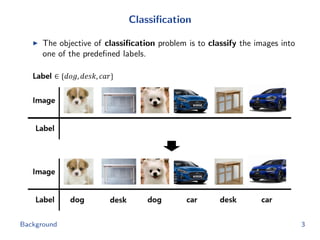
The objective of classification problem is to classify the images into
one of the predefined labels.
Background 3
The limitation of classifications
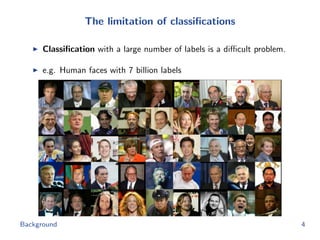
Classification with a large number of labels is a difficult problem.
e.g. Human faces with 7 billion labels
Background 4
The limitation of classifications
We have to train classifier again for the data with a new label.
Then, the notion of metric learning comes out.
Background 5
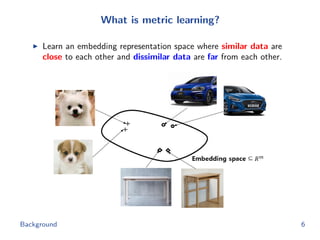
What is metric learning?
Learn an embedding representation space where similar data are
close to each other and dissimilar data are far from each other.
Background 6
Notation
X = {x1, · · · , xn} is a set of images and xi ∈ X is an image.
yi ∈ {0, 1, · · · , C − 1} is a class of image xi where C is the number
of classes.
g : X → Rm
is the embedding function where m is the embedding
dimension.
θ is the parameter to be learned in g( · ; θ)
Background 7
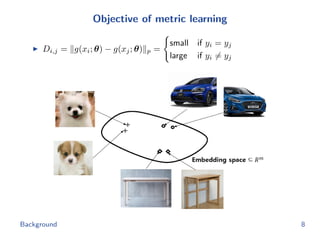
Objective of metric learning
Di,j = g(xi; θ) − g(xj; θ) p =
small if yi = yj
large if yi = yj
Background 8
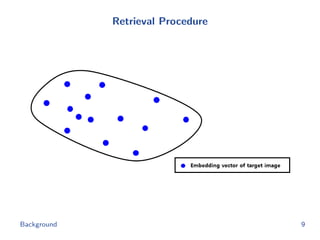
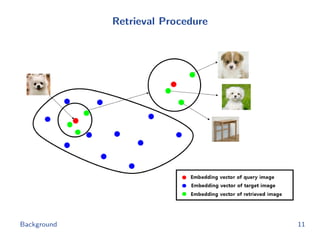
Retrieval Procedure
Background 9
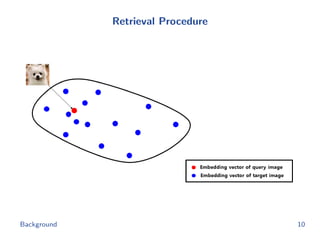
Retrieval Procedure
Background 10
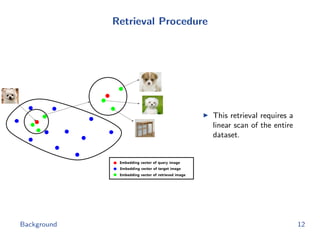
Retrieval Procedure
Background 11
Retrieval Procedure
This retrieval requires a
linear scan of the entire
dataset.
Background 12
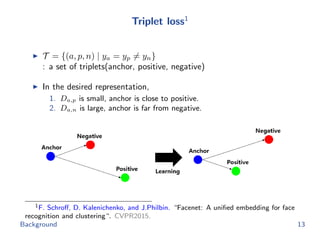
Triplet loss1
T = {(a, p, n) | ya = yp = yn}
: a set of triplets(anchor, positive, negative)
In the desired representation,
1. Da,p is small, anchor is close to positive.
2. Da,n is large, anchor is far from negative.
1F. Schroff, D. Kalenichenko, and J.Philbin. “Facenet: A unified embedding for face
recognition and clustering“. CVPR2015.
Background 13
Triplet loss
(X, y) =
1
T
(a,p,n)∈T
[D2
a,p + α − D2
a,n]+
X : a set of images
y : a set of classes
T : a set of triplets(anchor, positive, negative)
α : a margin which is constant
[·]+ = max(·, 0)
Training process reduces l(X, y) decreasing Da,p and increasing Da,n.
Background 14
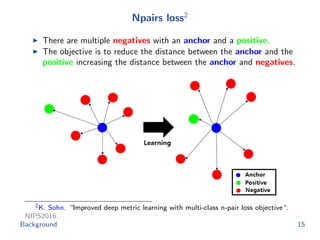
Npairs loss2
There are multiple negatives with an anchor and a positive.
The objective is to reduce the distance between the anchor and the
positive increasing the distance between the anchor and negatives.
2K. Sohn. “Improved deep metric learning with multi-class n-pair loss objective“.
NIPS2016.
Background 15
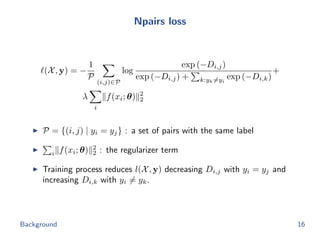
Npairs loss
(X, y) = −
1
P
(i,j)∈P
log
exp (−Di,j)
exp (−Di,j) + k:yk=yi
exp (−Di,k)
+
λ
i
f(xi; θ) 2
2
P = {(i, j) | yi = yj} : a set of pairs with the same label
i f(xi; θ) 2
2 : the regularizer term
Training process reduces l(X, y) decreasing Di,j with yi = yj and
increasing Di,k with yi = yk.
Background 16
Outline
Background
Problem formulation
Methods
Experiments
Conclusion
Problem formulation 17
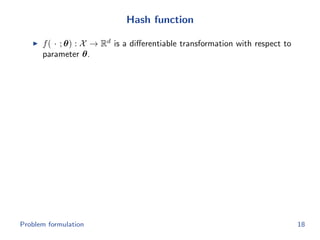
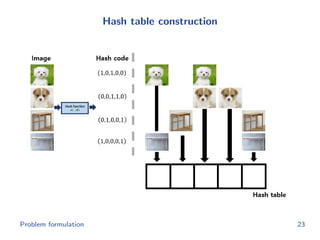
Hash function
f( · ; θ) : X → Rd
is a differentiable transformation with respect to
parameter θ.
Problem formulation 18
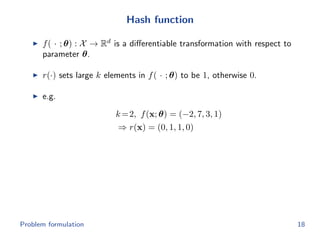
Hash function
f( · ; θ) : X → Rd
is a differentiable transformation with respect to
parameter θ.
r(·) sets large k elements in f( · ; θ) to be 1, otherwise 0.
e.g.
k=2, f(x; θ) = (−2, 7, 3, 1)
⇒ r(x) = (0, 1, 1, 0)
Problem formulation 18
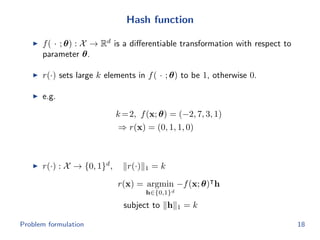
Hash function
f( · ; θ) : X → Rd
is a differentiable transformation with respect to
parameter θ.
r(·) sets large k elements in f( · ; θ) to be 1, otherwise 0.
e.g.
k=2, f(x; θ) = (−2, 7, 3, 1)
⇒ r(x) = (0, 1, 1, 0)
r(·) : X → {0, 1}d
, r(·) 1 = k
r(x) = argmin
h∈{0,1}d
−f(x; θ) h
subject to h 1 = k
Problem formulation 18
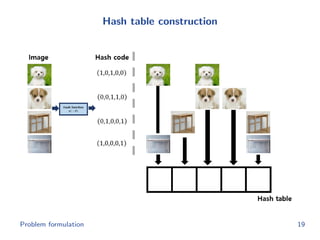
Hash table construction
Problem formulation 19
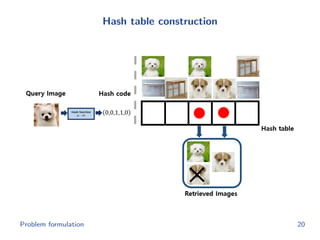
Hash table construction
Problem formulation 20
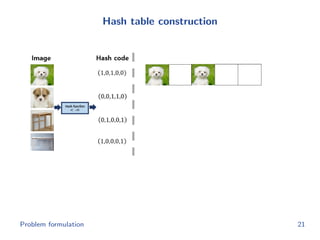
Hash table construction
Problem formulation 21
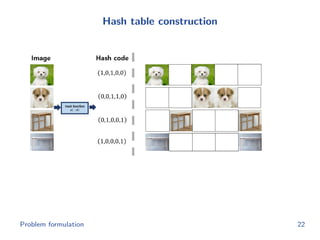
Hash table construction
Problem formulation 22
Hash table construction
Problem formulation 23
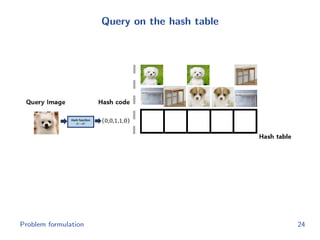
Query on the hash table
Problem formulation 24
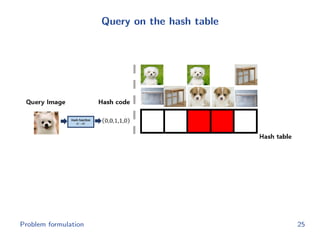
Query on the hash table
Problem formulation 25
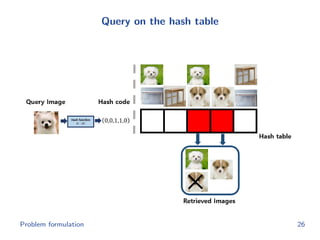
Query on the hash table
Problem formulation 26
Outline
Background
Problem formulation
Methods
Experiments
Conclusion
Methods 27
Intuition
Finding the optimal set of embedding representations and the
corresponding binary hash codes is a chicken and egg problem.
Methods 28
Intuition
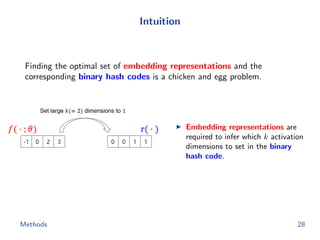
Finding the optimal set of embedding representations and the
corresponding binary hash codes is a chicken and egg problem.
Embedding representations are
required to infer which k activation
dimensions to set in the binary
hash code.
Methods 28
Intuition
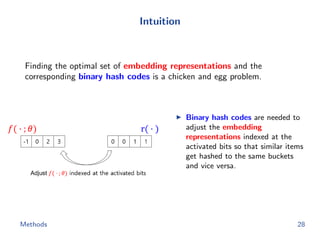
Finding the optimal set of embedding representations and the
corresponding binary hash codes is a chicken and egg problem.
Binary hash codes are needed to
adjust the embedding
representations indexed at the
activated bits so that similar items
get hashed to the same buckets
and vice versa.
Methods 28
Intuition
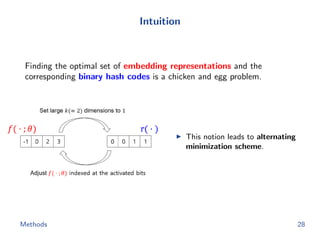
Finding the optimal set of embedding representations and the
corresponding binary hash codes is a chicken and egg problem.
This notion leads to alternating
minimization scheme.
Methods 28
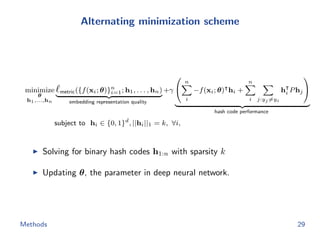
Alternating minimization scheme
minimize
θ
h1,...,hn
metric({f(xi; θ)}n
i=1; h1, . . . , hn)
embedding representation quality
+γ


n
i
−f(xi; θ) hi +
n
i j:yj =yi
hi Phj


hash code performance
subject to hi ∈ {0, 1}d
, ||hi||1 = k, ∀i,
Solving for binary hash codes h1:n with sparsity k
Updating θ, the parameter in deep neural network.
Methods 29
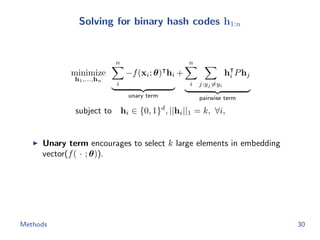
Solving for binary hash codes h1:n
minimize
h1,...,hn
n
i
−f(xi; θ) hi
unary term
+
n
i j:yj =yi
hi Phj
pairwise term
subject to hi ∈ {0, 1}d
, ||hi||1 = k, ∀i,
Unary term encourages to select k large elements in embedding
vector(f( · ; θ)).
Methods 30
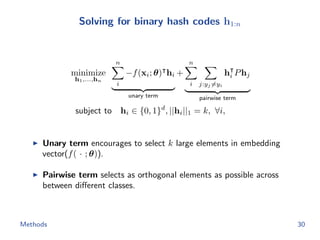
Solving for binary hash codes h1:n
minimize
h1,...,hn
n
i
−f(xi; θ) hi
unary term
+
n
i j:yj =yi
hi Phj
pairwise term
subject to hi ∈ {0, 1}d
, ||hi||1 = k, ∀i,
Unary term encourages to select k large elements in embedding
vector(f( · ; θ)).
Pairwise term selects as orthogonal elements as possible across
between different classes.
Methods 30
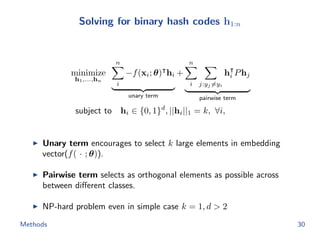
Solving for binary hash codes h1:n
minimize
h1,...,hn
n
i
−f(xi; θ) hi
unary term
+
n
i j:yj =yi
hi Phj
pairwise term
subject to hi ∈ {0, 1}d
, ||hi||1 = k, ∀i,
Unary term encourages to select k large elements in embedding
vector(f( · ; θ)).
Pairwise term selects as orthogonal elements as possible across
between different classes.
NP-hard problem even in simple case k = 1, d > 2
Methods 30
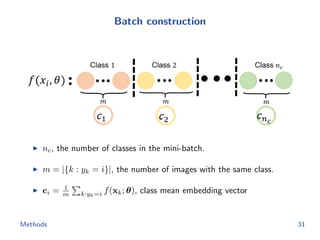
Batch construction
nc, the number of classes in the mini-batch.
m = |{k : yk = i}|, the number of images with the same class.
ci = 1
m k:yk=i f(xk; θ), class mean embedding vector
Methods 31
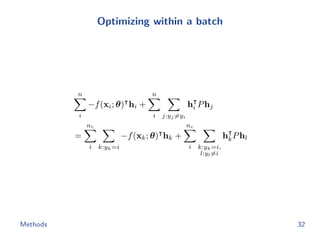
Optimizing within a batch
n
i
−f(xi; θ) hi +
n
i j:yj =yi
hi Phj
=
nc
i k:yk=i
−f(xk; θ) hk +
nc
i k:yk=i,
l:yl=i
hkPhl
Methods 32
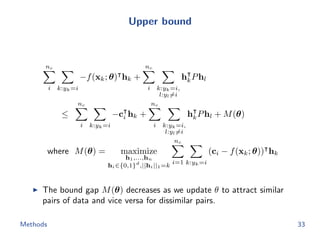
Upper bound
nc
i k:yk=i
−f(xk; θ) hk +
nc
i k:yk=i,
l:yl=i
hkPhl
≤
nc
i k:yk=i
−ci hk +
nc
i k:yk=i,
l:yl=i
hkPhl + M(θ)
where M(θ) = maximize
h1,...,hn
hi∈{0,1}d
,||hi||1=k
nc
i=1 k:yk=i
(ci − f(xk; θ)) hk
The bound gap M(θ) decreases as we update θ to attract similar
pairs of data and vice versa for dissimilar pairs.
Methods 33
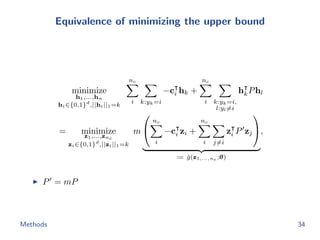
Equivalence of minimizing the upper bound
minimize
h1,...,hn
hi∈{0,1}d
,||hi||1=k
nc
i k:yk=i
−ci hk +
nc
i k:yk=i,
l:yl=i
hkPhl
= minimizez1,...,znc
zi∈{0,1}d
,||zi||1=k
m


nc
i
−ci zi +
nc
i j=i
zi P zj


:= ˆg(z1,...,nc ;θ)
,
P = mP
Methods 34
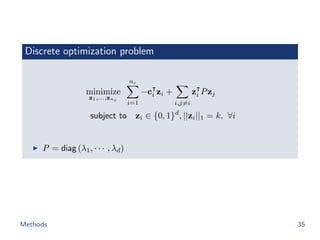
Discrete optimization problem
minimize
z1,...,znc
nc
i=1
−ci zi +
i,j=i
zi Pzj
subject to zi ∈ {0, 1}d
, ||zi||1 = k, ∀i
P = diag (λ1, · · · , λd)
Methods 35
Minimum-cost flow problem
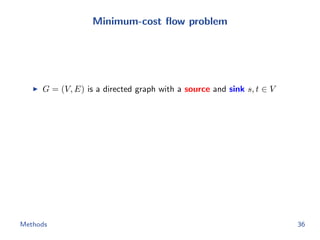
G = (V, E) is a directed graph with a source and sink s, t ∈ V
Methods 36
Minimum-cost flow problem
G = (V, E) is a directed graph with a source and sink s, t ∈ V
Capacity is a maximum possible flow for e ∈ E.
Cost is the cost required when flow passes e ∈ E.
Methods 36
Minimum-cost flow problem
G = (V, E) is a directed graph with a source and sink s, t ∈ V
Capacity is a maximum possible flow for e ∈ E.
Cost is the cost required when flow passes e ∈ E.
The amount of flow d to be sent from source s to sink t
Methods 36
Minimum-cost flow problem
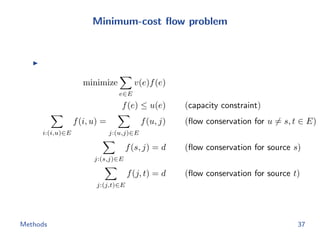
minimize
e∈E
v(e)f(e)
f(e) ≤ u(e) (capacity constraint)
i:(i,u)∈E
f(i, u) =
j:(u,j)∈E
f(u, j) (flow conservation for u = s, t ∈ E)
j:(s,j)∈E
f(s, j) = d (flow conservation for source s)
j:(j,t)∈E
f(j, t) = d (flow conservation for source t)
Methods 37
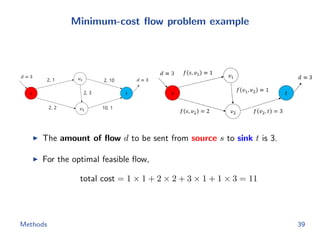
Minimum-cost flow problem example
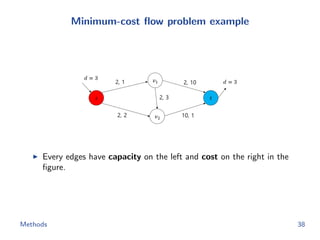
Every edges have capacity on the left and cost on the right in the
figure.
Methods 38
Minimum-cost flow problem example
The amount of flow d to be sent from source s to sink t is 3.
For the optimal feasible flow,
total cost = 1 × 1 + 2 × 2 + 3 × 1 + 1 × 3 = 11
Methods 39
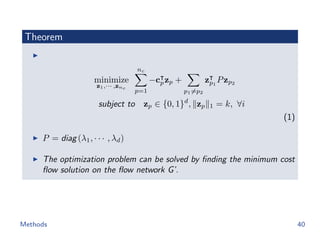
Theorem
minimize
z1,··· ,znc
nc
p=1
−cpzp +
p1=p2
zp1
Pzp2
subject to zp ∈ {0, 1}d
, zp 1 = k, ∀i
(1)
P = diag (λ1, · · · , λd)
The optimization problem can be solved by finding the minimum cost
flow solution on the flow network G’.
Methods 40
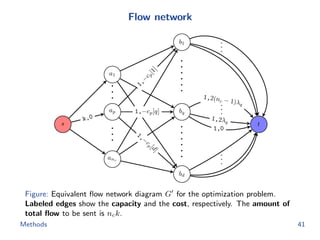
Flow network
Figure: Equivalent flow network diagram G for the optimization problem.
Labeled edges show the capacity and the cost, respectively. The amount of
total flow to be sent is nck.
Methods 41
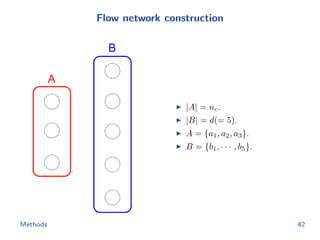
Flow network construction
|A| = nc.
|B| = d(= 5).
A = {a1, a2, a3}.
B = {b1, · · · , b5}.
Methods 42
Flow network construction
c1 = (1, 2, −1, 3, −2)
Capacity of every edge is 1.
Cost of edge(=(ap, bq)) is
−cp[q].
Methods 43
Flow network construction
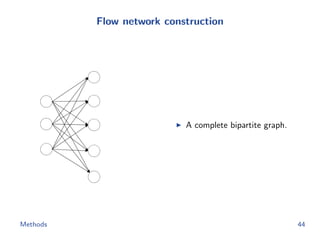
A complete bipartite graph.
Methods 44
Flow network construction
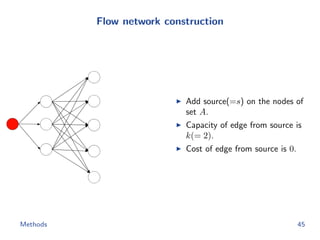
Add source(=s) on the nodes of
set A.
Capacity of edge from source is
k(= 2).
Cost of edge from source is 0.
Methods 45
Flow network construction
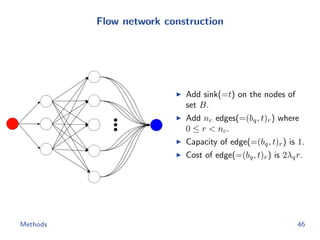
Add sink(=t) on the nodes of
set B.
Add nc edges(=(bq, t)r) where
0 ≤ r < nc.
Capacity of edge(=(bq, t)r) is 1.
Cost of edge(=(bq, t)r) is 2λqr.
Methods 46
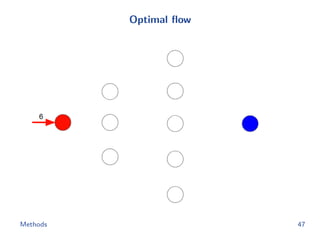
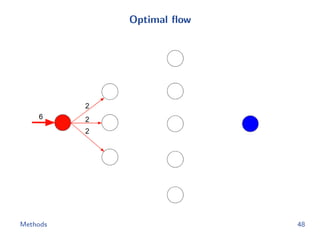
Optimal flow
Methods 47
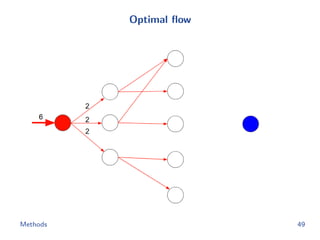
Optimal flow
Methods 48
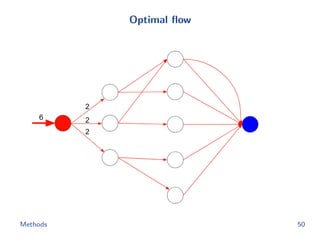
Optimal flow
Methods 49
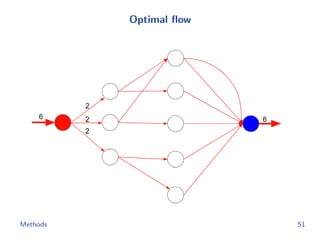
Optimal flow
Methods 50
Optimal flow
Methods 51
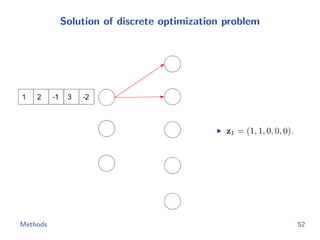
Solution of discrete optimization problem
z1 = (1, 1, 0, 0, 0).
Methods 52
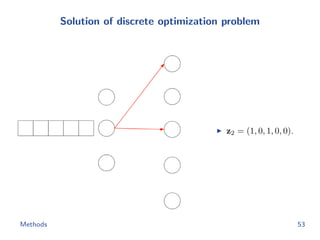
Solution of discrete optimization problem
z2 = (1, 0, 1, 0, 0).
Methods 53
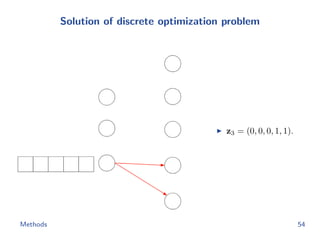
Solution of discrete optimization problem
z3 = (0, 0, 0, 1, 1).
Methods 54
Time complexity
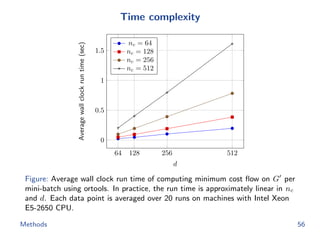
We solve minimum cost flow problem within the mini-batch not
on the entire dataset.
The practical running time is O (ncd).
Methods 55
Time complexity
64 128 256 512
0
0.5
1
1.5
d
Averagewallclockruntime(sec)
nc = 64
nc = 128
nc = 256
nc = 512
Figure: Average wall clock run time of computing minimum cost flow on G per
mini-batch using ortools. In practice, the run time is approximately linear in nc
and d. Each data point is averaged over 20 runs on machines with Intel Xeon
E5-2650 CPU.
Methods 56
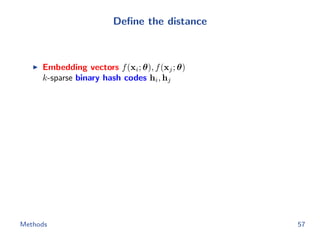
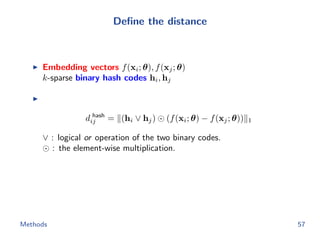
Define the distance
Embedding vectors f(xi; θ), f(xj; θ)
k-sparse binary hash codes hi, hj
Methods 57
Define the distance
Embedding vectors f(xi; θ), f(xj; θ)
k-sparse binary hash codes hi, hj
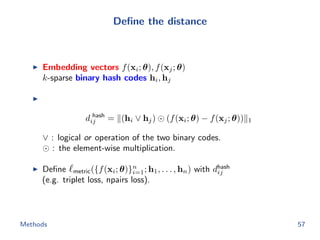
d hash
ij = (hi ∨ hj) (f(xi; θ) − f(xj; θ)) 1
∨ : logical or operation of the two binary codes.
: the element-wise multiplication.
Methods 57
Define the distance
Embedding vectors f(xi; θ), f(xj; θ)
k-sparse binary hash codes hi, hj
d hash
ij = (hi ∨ hj) (f(xi; θ) − f(xj; θ)) 1
∨ : logical or operation of the two binary codes.
: the element-wise multiplication.
Define metric({f(xi; θ)}n
i=1; h1, . . . , hn) with dhash
ij
(e.g. triplet loss, npairs loss).
Methods 57
Metric learning losses
Triplet loss
minimize
θ
1
|T |
(i,j,k)∈T
[d hash
ij + α − d hash
ik ]+
triplet(θ; h1,...,n)
subject to ||f(x; θ)||2 = 1
We apply the semi-hard negative mining to construct triplet.
Npairs loss
minimize
θ
−1
|P|
(i,j)∈P
log
exp(−d hash
ij )
exp(−d hash
ij ) + k:yk=yi
exp(−d hash
ik )
npairs(θ; h1,...,n)
+
λ
m i
||f(xi; θ)||2
2
Methods 58
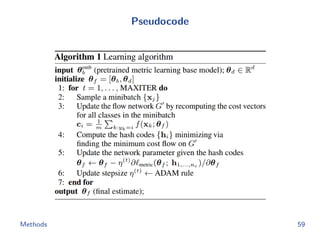
Pseudocode
Methods 59
Outline
Background
Problem formulation
Methods
Experiments
Conclusion
Experiments 60
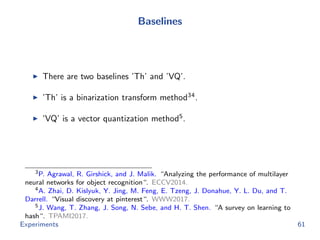
Baselines
There are two baselines ’Th’ and ’VQ’.
’Th’ is a binarization transform method34
.
’VQ’ is a vector quantization method5
.
3P. Agrawal, R. Girshick, and J. Malik. “Analyzing the performance of multilayer
neural networks for object recognition“. ECCV2014.
4A. Zhai, D. Kislyuk, Y. Jing, M. Feng, E. Tzeng, J. Donahue, Y. L. Du, and T.
Darrell. “Visual discovery at pinterest“. WWW2017.
5J. Wang, T. Zhang, J. Song, N. Sebe, and H. T. Shen. “A survey on learning to
hash“. TPAMI2017.
Experiments 61
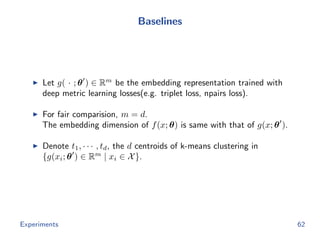
Baselines
Let g( · ; θ ) ∈ Rm
be the embedding representation trained with
deep metric learning losses(e.g. triplet loss, npairs loss).
For fair comparision, m = d.
The embedding dimension of f(x; θ) is same with that of g(x; θ ).
Denote t1, · · · , td, the d centroids of k-means clustering in
{g(xi; θ ) ∈ Rm
| xi ∈ X}.
Experiments 62
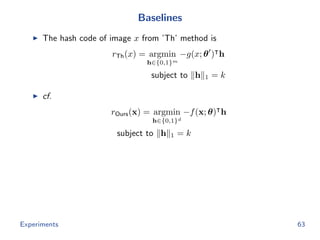
Baselines
The hash code of image x from ’Th’ method is
rTh(x) = argmin
h∈{0,1}m
−g(x; θ ) h
subject to h 1 = k
cf.
rOurs(x) = argmin
h∈{0,1}d
−f(x; θ) h
subject to h 1 = k
Experiments 63
Baselines
The hash code of image x from ’Th’ method is
rTh(x) = argmin
h∈{0,1}m
−g(x; θ ) h
subject to h 1 = k
cf.
rOurs(x) = argmin
h∈{0,1}d
−f(x; θ) h
subject to h 1 = k
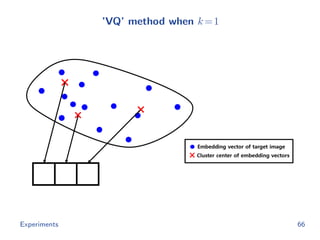
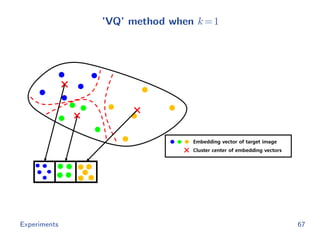
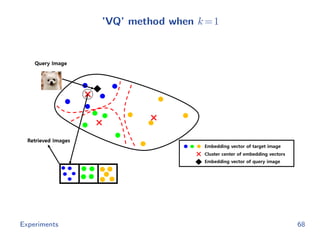
The hash code of image x from ’VQ’ method is
rVQ(x) = argmin
h∈{0,1}d
[ g(x; θ ) − t1 2, · · · , g(x; θ ) − td 2]h
subject to h 1 = k
Experiments 63
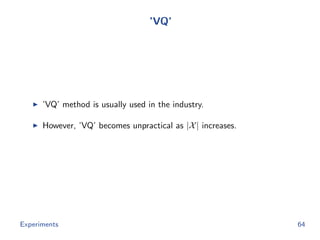
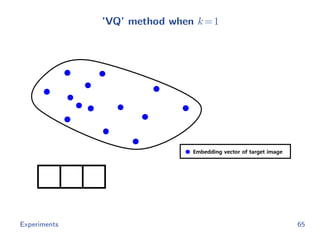
’VQ’
’VQ’ method is usually used in the industry.
However, ’VQ’ becomes unpractical as |X| increases.
Experiments 64
’VQ’ method when k=1
Experiments 65
’VQ’ method when k=1
Experiments 66
’VQ’ method when k=1
Experiments 67
’VQ’ method when k=1
Experiments 68
Evaluation metric
’NMI’ is normalized mutual information which measures clustering
quality when k=1 treating each bucket as an individual cluster.
’Pr@k’ is precision@k which is computed based on the reranking based
on g(x; θ ) after the retrieval with hash codes.
Experiments 69
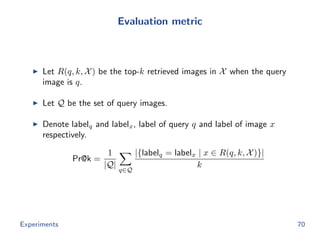
Evaluation metric
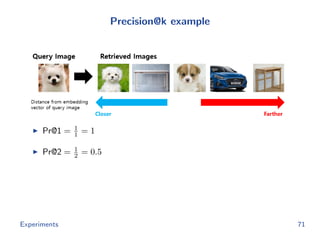
Let R(q, k, X) be the top-k retrieved images in X when the query
image is q.
Let Q be the set of query images.
Denote labelq and labelx, label of query q and label of image x
respectively.
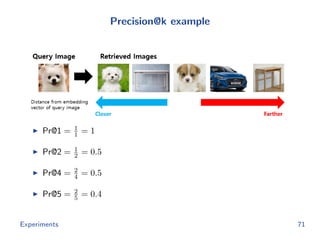
Pr@k =
1
|Q|
q∈Q
|{labelq = labelx | x ∈ R(q, k, X)}|
k
Experiments 70
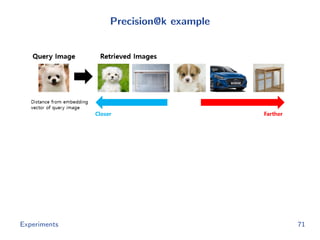
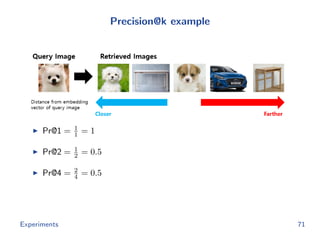
Precision@k example
Experiments 71
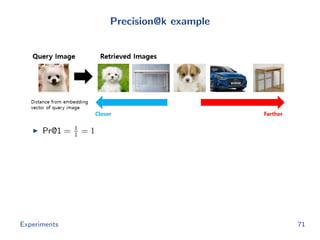
Precision@k example
Pr@1 = 1
1 = 1
Experiments 71
Precision@k example
Pr@1 = 1
1 = 1
Pr@2 = 1
2 = 0.5
Experiments 71
Precision@k example
Pr@1 = 1
1 = 1
Pr@2 = 1
2 = 0.5
Pr@4 = 2
4 = 0.5
Experiments 71
Precision@k example
Pr@1 = 1
1 = 1
Pr@2 = 1
2 = 0.5
Pr@4 = 2
4 = 0.5
Pr@5 = 2
5 = 0.4
Experiments 71
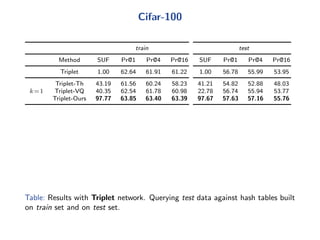
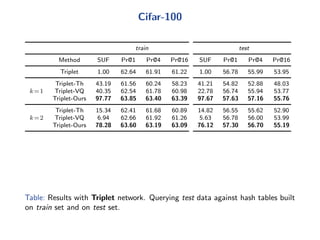
Cifar-100
train test
Method SUF Pr@1 Pr@4 Pr@16 SUF Pr@1 Pr@4 Pr@16
Triplet 1.00 62.64 61.91 61.22 1.00 56.78 55.99 53.95
k=1
Triplet-Th 43.19 61.56 60.24 58.23 41.21 54.82 52.88 48.03
Triplet-VQ 40.35 62.54 61.78 60.98 22.78 56.74 55.94 53.77
Triplet-Ours 97.77 63.85 63.40 63.39 97.67 57.63 57.16 55.76
Table: Results with Triplet network. Querying test data against hash tables built
on train set and on test set.
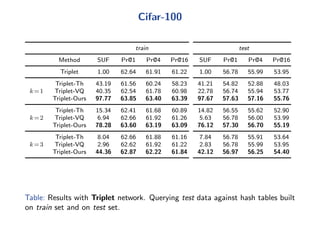
Cifar-100
train test
Method SUF Pr@1 Pr@4 Pr@16 SUF Pr@1 Pr@4 Pr@16
Triplet 1.00 62.64 61.91 61.22 1.00 56.78 55.99 53.95
k=1
Triplet-Th 43.19 61.56 60.24 58.23 41.21 54.82 52.88 48.03
Triplet-VQ 40.35 62.54 61.78 60.98 22.78 56.74 55.94 53.77
Triplet-Ours 97.77 63.85 63.40 63.39 97.67 57.63 57.16 55.76
k=2
Triplet-Th 15.34 62.41 61.68 60.89 14.82 56.55 55.62 52.90
Triplet-VQ 6.94 62.66 61.92 61.26 5.63 56.78 56.00 53.99
Triplet-Ours 78.28 63.60 63.19 63.09 76.12 57.30 56.70 55.19
Table: Results with Triplet network. Querying test data against hash tables built
on train set and on test set.
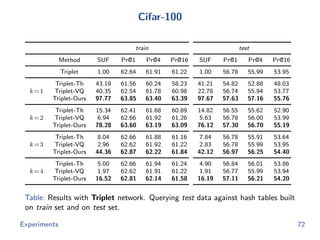
Cifar-100
train test
Method SUF Pr@1 Pr@4 Pr@16 SUF Pr@1 Pr@4 Pr@16
Triplet 1.00 62.64 61.91 61.22 1.00 56.78 55.99 53.95
k=1
Triplet-Th 43.19 61.56 60.24 58.23 41.21 54.82 52.88 48.03
Triplet-VQ 40.35 62.54 61.78 60.98 22.78 56.74 55.94 53.77
Triplet-Ours 97.77 63.85 63.40 63.39 97.67 57.63 57.16 55.76
k=2
Triplet-Th 15.34 62.41 61.68 60.89 14.82 56.55 55.62 52.90
Triplet-VQ 6.94 62.66 61.92 61.26 5.63 56.78 56.00 53.99
Triplet-Ours 78.28 63.60 63.19 63.09 76.12 57.30 56.70 55.19
k=3
Triplet-Th 8.04 62.66 61.88 61.16 7.84 56.78 55.91 53.64
Triplet-VQ 2.96 62.62 61.92 61.22 2.83 56.78 55.99 53.95
Triplet-Ours 44.36 62.87 62.22 61.84 42.12 56.97 56.25 54.40
Table: Results with Triplet network. Querying test data against hash tables built
on train set and on test set.
Cifar-100
train test
Method SUF Pr@1 Pr@4 Pr@16 SUF Pr@1 Pr@4 Pr@16
Triplet 1.00 62.64 61.91 61.22 1.00 56.78 55.99 53.95
k=1
Triplet-Th 43.19 61.56 60.24 58.23 41.21 54.82 52.88 48.03
Triplet-VQ 40.35 62.54 61.78 60.98 22.78 56.74 55.94 53.77
Triplet-Ours 97.77 63.85 63.40 63.39 97.67 57.63 57.16 55.76
k=2
Triplet-Th 15.34 62.41 61.68 60.89 14.82 56.55 55.62 52.90
Triplet-VQ 6.94 62.66 61.92 61.26 5.63 56.78 56.00 53.99
Triplet-Ours 78.28 63.60 63.19 63.09 76.12 57.30 56.70 55.19
k=3
Triplet-Th 8.04 62.66 61.88 61.16 7.84 56.78 55.91 53.64
Triplet-VQ 2.96 62.62 61.92 61.22 2.83 56.78 55.99 53.95
Triplet-Ours 44.36 62.87 62.22 61.84 42.12 56.97 56.25 54.40
k=4
Triplet-Th 5.00 62.66 61.94 61.24 4.90 56.84 56.01 53.86
Triplet-VQ 1.97 62.62 61.91 61.22 1.91 56.77 55.99 53.94
Triplet-Ours 16.52 62.81 62.14 61.58 16.19 57.11 56.21 54.20
Table: Results with Triplet network. Querying test data against hash tables built
on train set and on test set.
Experiments 72
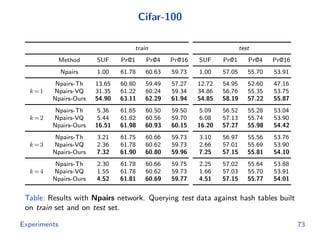
Cifar-100
train test
Method SUF Pr@1 Pr@4 Pr@16 SUF Pr@1 Pr@4 Pr@16
Npairs 1.00 61.78 60.63 59.73 1.00 57.05 55.70 53.91
k=1
Npairs-Th 13.65 60.80 59.49 57.27 12.72 54.95 52.60 47.16
Npairs-VQ 31.35 61.22 60.24 59.34 34.86 56.76 55.35 53.75
Npairs-Ours 54.90 63.11 62.29 61.94 54.85 58.19 57.22 55.87
k=2
Npairs-Th 5.36 61.65 60.50 59.50 5.09 56.52 55.28 53.04
Npairs-VQ 5.44 61.82 60.56 59.70 6.08 57.13 55.74 53.90
Npairs-Ours 16.51 61.98 60.93 60.15 16.20 57.27 55.98 54.42
k=3
Npairs-Th 3.21 61.75 60.66 59.73 3.10 56.97 55.56 53.76
Npairs-VQ 2.36 61.78 60.62 59.73 2.66 57.01 55.69 53.90
Npairs-Ours 7.32 61.90 60.80 59.96 7.25 57.15 55.81 54.10
k=4
Npairs-Th 2.30 61.78 60.66 59.75 2.25 57.02 55.64 53.88
Npairs-VQ 1.55 61.78 60.62 59.73 1.66 57.03 55.70 53.91
Npairs-Ours 4.52 61.81 60.69 59.77 4.51 57.15 55.77 54.01
Table: Results with Npairs network. Querying test data against hash tables built
on train set and on test set.
Experiments 73
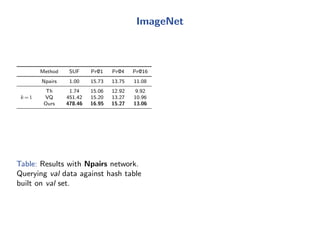
ImageNet
Method SUF Pr@1 Pr@4 Pr@16
Npairs 1.00 15.73 13.75 11.08
k=1
Th 1.74 15.06 12.92 9.92
VQ 451.42 15.20 13.27 10.96
Ours 478.46 16.95 15.27 13.06
Table: Results with Npairs network.
Querying val data against hash table
built on val set.
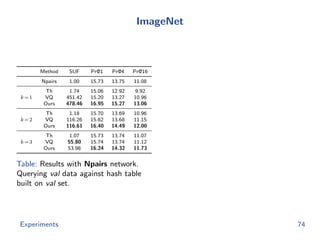
ImageNet
Method SUF Pr@1 Pr@4 Pr@16
Npairs 1.00 15.73 13.75 11.08
k=1
Th 1.74 15.06 12.92 9.92
VQ 451.42 15.20 13.27 10.96
Ours 478.46 16.95 15.27 13.06
k=2
Th 1.18 15.70 13.69 10.96
VQ 116.26 15.62 13.68 11.15
Ours 116.61 16.40 14.49 12.00
k=3
Th 1.07 15.73 13.74 11.07
VQ 55.80 15.74 13.74 11.12
Ours 53.98 16.24 14.32 11.73
Table: Results with Npairs network.
Querying val data against hash table
built on val set.
Experiments 74
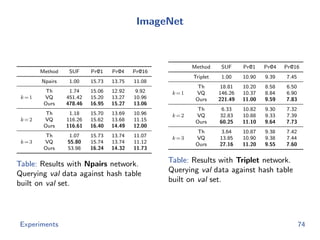
ImageNet
Method SUF Pr@1 Pr@4 Pr@16
Npairs 1.00 15.73 13.75 11.08
k=1
Th 1.74 15.06 12.92 9.92
VQ 451.42 15.20 13.27 10.96
Ours 478.46 16.95 15.27 13.06
k=2
Th 1.18 15.70 13.69 10.96
VQ 116.26 15.62 13.68 11.15
Ours 116.61 16.40 14.49 12.00
k=3
Th 1.07 15.73 13.74 11.07
VQ 55.80 15.74 13.74 11.12
Ours 53.98 16.24 14.32 11.73
Table: Results with Npairs network.
Querying val data against hash table
built on val set.
Method SUF Pr@1 Pr@4 Pr@16
Triplet 1.00 10.90 9.39 7.45
k=1
Th 18.81 10.20 8.58 6.50
VQ 146.26 10.37 8.84 6.90
Ours 221.49 11.00 9.59 7.83
k=2
Th 6.33 10.82 9.30 7.32
VQ 32.83 10.88 9.33 7.39
Ours 60.25 11.10 9.64 7.73
k=3
Th 3.64 10.87 9.38 7.42
VQ 13.85 10.90 9.38 7.44
Ours 27.16 11.20 9.55 7.60
Table: Results with Triplet network.
Querying val data against hash table
built on val set.
Experiments 74
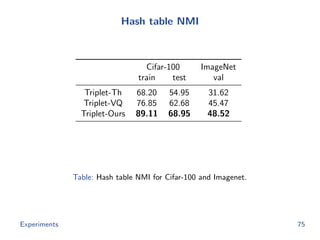
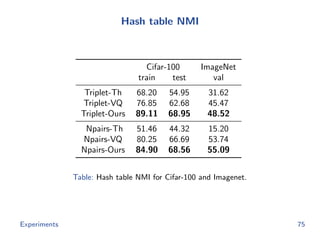
Hash table NMI
Cifar-100 ImageNet
train test val
Triplet-Th 68.20 54.95 31.62
Triplet-VQ 76.85 62.68 45.47
Triplet-Ours 89.11 68.95 48.52
Table: Hash table NMI for Cifar-100 and Imagenet.
Experiments 75
Hash table NMI
Cifar-100 ImageNet
train test val
Triplet-Th 68.20 54.95 31.62
Triplet-VQ 76.85 62.68 45.47
Triplet-Ours 89.11 68.95 48.52
Npairs-Th 51.46 44.32 15.20
Npairs-VQ 80.25 66.69 53.74
Npairs-Ours 84.90 68.56 55.09
Table: Hash table NMI for Cifar-100 and Imagenet.
Experiments 75
Outline
Background
Problem formulation
Methods
Experiments
Conclusion
Conclusion 76
Conclusion
We have presented a novel end-to-end optimization algorithm for
jointly learning a quantizable embedding representation and the
sparse binary hash code for efficient inference.
Conclusion 77
Conclusion
We have presented a novel end-to-end optimization algorithm for
jointly learning a quantizable embedding representation and the
sparse binary hash code for efficient inference.
We show an interesting connection between finding the optimal
sparse binary hash code and solving a minimum cost flow
problem.
Conclusion 77
Conclusion
Proposed algorithm not only achieves the state of the art search
accuracy outperforming the previous state of the art deep metric
learning approaches but also provides up to 98× and 478× search
speedup on Cifar-100 and ImageNet datasets, respectively.
Conclusion 78
Conclusion
Proposed algorithm not only achieves the state of the art search
accuracy outperforming the previous state of the art deep metric
learning approaches but also provides up to 98× and 478× search
speedup on Cifar-100 and ImageNet datasets, respectively.
The source code is available at
https://github.com/maestrojeong/Deep-Hash-Table-ICML18.
Conclusion 78

Efficient end-to-end learning for quantizable representations

  • 1.
    Efficient end-to-end learningfor quantizable representation Yeonwoo Jeong, Hyun Oh Song Dept. of Computer Science and Engineering, Seoul National University July 25, 2018 1
  • 2.
  • 3.
    Classification The objective ofclassification problem is to classify the images into one of the predefined labels. Background 3
  • 4.
    The limitation ofclassifications Classification with a large number of labels is a difficult problem. e.g. Human faces with 7 billion labels Background 4
  • 5.
    The limitation ofclassifications We have to train classifier again for the data with a new label. Then, the notion of metric learning comes out. Background 5
  • 6.
    What is metriclearning? Learn an embedding representation space where similar data are close to each other and dissimilar data are far from each other. Background 6
  • 7.
    Notation X = {x1,· · · , xn} is a set of images and xi ∈ X is an image. yi ∈ {0, 1, · · · , C − 1} is a class of image xi where C is the number of classes. g : X → Rm is the embedding function where m is the embedding dimension. θ is the parameter to be learned in g( · ; θ) Background 7
  • 8.
    Objective of metriclearning Di,j = g(xi; θ) − g(xj; θ) p = small if yi = yj large if yi = yj Background 8
  • 9.
  • 10.
  • 11.
  • 12.
    Retrieval Procedure This retrievalrequires a linear scan of the entire dataset. Background 12
  • 13.
    Triplet loss1 T ={(a, p, n) | ya = yp = yn} : a set of triplets(anchor, positive, negative) In the desired representation, 1. Da,p is small, anchor is close to positive. 2. Da,n is large, anchor is far from negative. 1F. Schroff, D. Kalenichenko, and J.Philbin. “Facenet: A unified embedding for face recognition and clustering“. CVPR2015. Background 13
  • 14.
    Triplet loss (X, y)= 1 T (a,p,n)∈T [D2 a,p + α − D2 a,n]+ X : a set of images y : a set of classes T : a set of triplets(anchor, positive, negative) α : a margin which is constant [·]+ = max(·, 0) Training process reduces l(X, y) decreasing Da,p and increasing Da,n. Background 14
  • 15.
    Npairs loss2 There aremultiple negatives with an anchor and a positive. The objective is to reduce the distance between the anchor and the positive increasing the distance between the anchor and negatives. 2K. Sohn. “Improved deep metric learning with multi-class n-pair loss objective“. NIPS2016. Background 15
  • 16.
    Npairs loss (X, y)= − 1 P (i,j)∈P log exp (−Di,j) exp (−Di,j) + k:yk=yi exp (−Di,k) + λ i f(xi; θ) 2 2 P = {(i, j) | yi = yj} : a set of pairs with the same label i f(xi; θ) 2 2 : the regularizer term Training process reduces l(X, y) decreasing Di,j with yi = yj and increasing Di,k with yi = yk. Background 16
  • 17.
  • 18.
    Hash function f( ·; θ) : X → Rd is a differentiable transformation with respect to parameter θ. Problem formulation 18
  • 19.
    Hash function f( ·; θ) : X → Rd is a differentiable transformation with respect to parameter θ. r(·) sets large k elements in f( · ; θ) to be 1, otherwise 0. e.g. k=2, f(x; θ) = (−2, 7, 3, 1) ⇒ r(x) = (0, 1, 1, 0) Problem formulation 18
  • 20.
    Hash function f( ·; θ) : X → Rd is a differentiable transformation with respect to parameter θ. r(·) sets large k elements in f( · ; θ) to be 1, otherwise 0. e.g. k=2, f(x; θ) = (−2, 7, 3, 1) ⇒ r(x) = (0, 1, 1, 0) r(·) : X → {0, 1}d , r(·) 1 = k r(x) = argmin h∈{0,1}d −f(x; θ) h subject to h 1 = k Problem formulation 18
  • 21.
  • 22.
  • 23.
  • 24.
  • 25.
  • 26.
    Query on thehash table Problem formulation 24
  • 27.
    Query on thehash table Problem formulation 25
  • 28.
    Query on thehash table Problem formulation 26
  • 29.
  • 30.
    Intuition Finding the optimalset of embedding representations and the corresponding binary hash codes is a chicken and egg problem. Methods 28
  • 31.
    Intuition Finding the optimalset of embedding representations and the corresponding binary hash codes is a chicken and egg problem. Embedding representations are required to infer which k activation dimensions to set in the binary hash code. Methods 28
  • 32.
    Intuition Finding the optimalset of embedding representations and the corresponding binary hash codes is a chicken and egg problem. Binary hash codes are needed to adjust the embedding representations indexed at the activated bits so that similar items get hashed to the same buckets and vice versa. Methods 28
  • 33.
    Intuition Finding the optimalset of embedding representations and the corresponding binary hash codes is a chicken and egg problem. This notion leads to alternating minimization scheme. Methods 28
  • 34.
    Alternating minimization scheme minimize θ h1,...,hn metric({f(xi;θ)}n i=1; h1, . . . , hn) embedding representation quality +γ   n i −f(xi; θ) hi + n i j:yj =yi hi Phj   hash code performance subject to hi ∈ {0, 1}d , ||hi||1 = k, ∀i, Solving for binary hash codes h1:n with sparsity k Updating θ, the parameter in deep neural network. Methods 29
  • 35.
    Solving for binaryhash codes h1:n minimize h1,...,hn n i −f(xi; θ) hi unary term + n i j:yj =yi hi Phj pairwise term subject to hi ∈ {0, 1}d , ||hi||1 = k, ∀i, Unary term encourages to select k large elements in embedding vector(f( · ; θ)). Methods 30
  • 36.
    Solving for binaryhash codes h1:n minimize h1,...,hn n i −f(xi; θ) hi unary term + n i j:yj =yi hi Phj pairwise term subject to hi ∈ {0, 1}d , ||hi||1 = k, ∀i, Unary term encourages to select k large elements in embedding vector(f( · ; θ)). Pairwise term selects as orthogonal elements as possible across between different classes. Methods 30
  • 37.
    Solving for binaryhash codes h1:n minimize h1,...,hn n i −f(xi; θ) hi unary term + n i j:yj =yi hi Phj pairwise term subject to hi ∈ {0, 1}d , ||hi||1 = k, ∀i, Unary term encourages to select k large elements in embedding vector(f( · ; θ)). Pairwise term selects as orthogonal elements as possible across between different classes. NP-hard problem even in simple case k = 1, d > 2 Methods 30
  • 38.
    Batch construction nc, thenumber of classes in the mini-batch. m = |{k : yk = i}|, the number of images with the same class. ci = 1 m k:yk=i f(xk; θ), class mean embedding vector Methods 31
  • 39.
    Optimizing within abatch n i −f(xi; θ) hi + n i j:yj =yi hi Phj = nc i k:yk=i −f(xk; θ) hk + nc i k:yk=i, l:yl=i hkPhl Methods 32
  • 40.
    Upper bound nc i k:yk=i −f(xk;θ) hk + nc i k:yk=i, l:yl=i hkPhl ≤ nc i k:yk=i −ci hk + nc i k:yk=i, l:yl=i hkPhl + M(θ) where M(θ) = maximize h1,...,hn hi∈{0,1}d ,||hi||1=k nc i=1 k:yk=i (ci − f(xk; θ)) hk The bound gap M(θ) decreases as we update θ to attract similar pairs of data and vice versa for dissimilar pairs. Methods 33
  • 41.
    Equivalence of minimizingthe upper bound minimize h1,...,hn hi∈{0,1}d ,||hi||1=k nc i k:yk=i −ci hk + nc i k:yk=i, l:yl=i hkPhl = minimizez1,...,znc zi∈{0,1}d ,||zi||1=k m   nc i −ci zi + nc i j=i zi P zj   := ˆg(z1,...,nc ;θ) , P = mP Methods 34
  • 42.
    Discrete optimization problem minimize z1,...,znc nc i=1 −cizi + i,j=i zi Pzj subject to zi ∈ {0, 1}d , ||zi||1 = k, ∀i P = diag (λ1, · · · , λd) Methods 35
  • 43.
    Minimum-cost flow problem G= (V, E) is a directed graph with a source and sink s, t ∈ V Methods 36
  • 44.
    Minimum-cost flow problem G= (V, E) is a directed graph with a source and sink s, t ∈ V Capacity is a maximum possible flow for e ∈ E. Cost is the cost required when flow passes e ∈ E. Methods 36
  • 45.
    Minimum-cost flow problem G= (V, E) is a directed graph with a source and sink s, t ∈ V Capacity is a maximum possible flow for e ∈ E. Cost is the cost required when flow passes e ∈ E. The amount of flow d to be sent from source s to sink t Methods 36
  • 46.
    Minimum-cost flow problem minimize e∈E v(e)f(e) f(e)≤ u(e) (capacity constraint) i:(i,u)∈E f(i, u) = j:(u,j)∈E f(u, j) (flow conservation for u = s, t ∈ E) j:(s,j)∈E f(s, j) = d (flow conservation for source s) j:(j,t)∈E f(j, t) = d (flow conservation for source t) Methods 37
  • 47.
    Minimum-cost flow problemexample Every edges have capacity on the left and cost on the right in the figure. Methods 38
  • 48.
    Minimum-cost flow problemexample The amount of flow d to be sent from source s to sink t is 3. For the optimal feasible flow, total cost = 1 × 1 + 2 × 2 + 3 × 1 + 1 × 3 = 11 Methods 39
  • 49.
    Theorem minimize z1,··· ,znc nc p=1 −cpzp + p1=p2 zp1 Pzp2 subjectto zp ∈ {0, 1}d , zp 1 = k, ∀i (1) P = diag (λ1, · · · , λd) The optimization problem can be solved by finding the minimum cost flow solution on the flow network G’. Methods 40
  • 50.
    Flow network Figure: Equivalentflow network diagram G for the optimization problem. Labeled edges show the capacity and the cost, respectively. The amount of total flow to be sent is nck. Methods 41
  • 51.
    Flow network construction |A|= nc. |B| = d(= 5). A = {a1, a2, a3}. B = {b1, · · · , b5}. Methods 42
  • 52.
    Flow network construction c1= (1, 2, −1, 3, −2) Capacity of every edge is 1. Cost of edge(=(ap, bq)) is −cp[q]. Methods 43
  • 53.
    Flow network construction Acomplete bipartite graph. Methods 44
  • 54.
    Flow network construction Addsource(=s) on the nodes of set A. Capacity of edge from source is k(= 2). Cost of edge from source is 0. Methods 45
  • 55.
    Flow network construction Addsink(=t) on the nodes of set B. Add nc edges(=(bq, t)r) where 0 ≤ r < nc. Capacity of edge(=(bq, t)r) is 1. Cost of edge(=(bq, t)r) is 2λqr. Methods 46
  • 56.
  • 57.
  • 58.
  • 59.
  • 60.
  • 61.
    Solution of discreteoptimization problem z1 = (1, 1, 0, 0, 0). Methods 52
  • 62.
    Solution of discreteoptimization problem z2 = (1, 0, 1, 0, 0). Methods 53
  • 63.
    Solution of discreteoptimization problem z3 = (0, 0, 0, 1, 1). Methods 54
  • 64.
    Time complexity We solveminimum cost flow problem within the mini-batch not on the entire dataset. The practical running time is O (ncd). Methods 55
  • 65.
    Time complexity 64 128256 512 0 0.5 1 1.5 d Averagewallclockruntime(sec) nc = 64 nc = 128 nc = 256 nc = 512 Figure: Average wall clock run time of computing minimum cost flow on G per mini-batch using ortools. In practice, the run time is approximately linear in nc and d. Each data point is averaged over 20 runs on machines with Intel Xeon E5-2650 CPU. Methods 56
  • 66.
    Define the distance Embeddingvectors f(xi; θ), f(xj; θ) k-sparse binary hash codes hi, hj Methods 57
  • 67.
    Define the distance Embeddingvectors f(xi; θ), f(xj; θ) k-sparse binary hash codes hi, hj d hash ij = (hi ∨ hj) (f(xi; θ) − f(xj; θ)) 1 ∨ : logical or operation of the two binary codes. : the element-wise multiplication. Methods 57
  • 68.
    Define the distance Embeddingvectors f(xi; θ), f(xj; θ) k-sparse binary hash codes hi, hj d hash ij = (hi ∨ hj) (f(xi; θ) − f(xj; θ)) 1 ∨ : logical or operation of the two binary codes. : the element-wise multiplication. Define metric({f(xi; θ)}n i=1; h1, . . . , hn) with dhash ij (e.g. triplet loss, npairs loss). Methods 57
  • 69.
    Metric learning losses Tripletloss minimize θ 1 |T | (i,j,k)∈T [d hash ij + α − d hash ik ]+ triplet(θ; h1,...,n) subject to ||f(x; θ)||2 = 1 We apply the semi-hard negative mining to construct triplet. Npairs loss minimize θ −1 |P| (i,j)∈P log exp(−d hash ij ) exp(−d hash ij ) + k:yk=yi exp(−d hash ik ) npairs(θ; h1,...,n) + λ m i ||f(xi; θ)||2 2 Methods 58
  • 70.
  • 71.
  • 72.
    Baselines There are twobaselines ’Th’ and ’VQ’. ’Th’ is a binarization transform method34 . ’VQ’ is a vector quantization method5 . 3P. Agrawal, R. Girshick, and J. Malik. “Analyzing the performance of multilayer neural networks for object recognition“. ECCV2014. 4A. Zhai, D. Kislyuk, Y. Jing, M. Feng, E. Tzeng, J. Donahue, Y. L. Du, and T. Darrell. “Visual discovery at pinterest“. WWW2017. 5J. Wang, T. Zhang, J. Song, N. Sebe, and H. T. Shen. “A survey on learning to hash“. TPAMI2017. Experiments 61
  • 73.
    Baselines Let g( ·; θ ) ∈ Rm be the embedding representation trained with deep metric learning losses(e.g. triplet loss, npairs loss). For fair comparision, m = d. The embedding dimension of f(x; θ) is same with that of g(x; θ ). Denote t1, · · · , td, the d centroids of k-means clustering in {g(xi; θ ) ∈ Rm | xi ∈ X}. Experiments 62
  • 74.
    Baselines The hash codeof image x from ’Th’ method is rTh(x) = argmin h∈{0,1}m −g(x; θ ) h subject to h 1 = k cf. rOurs(x) = argmin h∈{0,1}d −f(x; θ) h subject to h 1 = k Experiments 63
  • 75.
    Baselines The hash codeof image x from ’Th’ method is rTh(x) = argmin h∈{0,1}m −g(x; θ ) h subject to h 1 = k cf. rOurs(x) = argmin h∈{0,1}d −f(x; θ) h subject to h 1 = k The hash code of image x from ’VQ’ method is rVQ(x) = argmin h∈{0,1}d [ g(x; θ ) − t1 2, · · · , g(x; θ ) − td 2]h subject to h 1 = k Experiments 63
  • 76.
    ’VQ’ ’VQ’ method isusually used in the industry. However, ’VQ’ becomes unpractical as |X| increases. Experiments 64
  • 77.
    ’VQ’ method whenk=1 Experiments 65
  • 78.
    ’VQ’ method whenk=1 Experiments 66
  • 79.
    ’VQ’ method whenk=1 Experiments 67
  • 80.
    ’VQ’ method whenk=1 Experiments 68
  • 81.
    Evaluation metric ’NMI’ isnormalized mutual information which measures clustering quality when k=1 treating each bucket as an individual cluster. ’Pr@k’ is precision@k which is computed based on the reranking based on g(x; θ ) after the retrieval with hash codes. Experiments 69
  • 82.
    Evaluation metric Let R(q,k, X) be the top-k retrieved images in X when the query image is q. Let Q be the set of query images. Denote labelq and labelx, label of query q and label of image x respectively. Pr@k = 1 |Q| q∈Q |{labelq = labelx | x ∈ R(q, k, X)}| k Experiments 70
  • 83.
  • 84.
    Precision@k example Pr@1 =1 1 = 1 Experiments 71
  • 85.
    Precision@k example Pr@1 =1 1 = 1 Pr@2 = 1 2 = 0.5 Experiments 71
  • 86.
    Precision@k example Pr@1 =1 1 = 1 Pr@2 = 1 2 = 0.5 Pr@4 = 2 4 = 0.5 Experiments 71
  • 87.
    Precision@k example Pr@1 =1 1 = 1 Pr@2 = 1 2 = 0.5 Pr@4 = 2 4 = 0.5 Pr@5 = 2 5 = 0.4 Experiments 71
  • 88.
    Cifar-100 train test Method SUFPr@1 Pr@4 Pr@16 SUF Pr@1 Pr@4 Pr@16 Triplet 1.00 62.64 61.91 61.22 1.00 56.78 55.99 53.95 k=1 Triplet-Th 43.19 61.56 60.24 58.23 41.21 54.82 52.88 48.03 Triplet-VQ 40.35 62.54 61.78 60.98 22.78 56.74 55.94 53.77 Triplet-Ours 97.77 63.85 63.40 63.39 97.67 57.63 57.16 55.76 Table: Results with Triplet network. Querying test data against hash tables built on train set and on test set.
  • 89.
    Cifar-100 train test Method SUFPr@1 Pr@4 Pr@16 SUF Pr@1 Pr@4 Pr@16 Triplet 1.00 62.64 61.91 61.22 1.00 56.78 55.99 53.95 k=1 Triplet-Th 43.19 61.56 60.24 58.23 41.21 54.82 52.88 48.03 Triplet-VQ 40.35 62.54 61.78 60.98 22.78 56.74 55.94 53.77 Triplet-Ours 97.77 63.85 63.40 63.39 97.67 57.63 57.16 55.76 k=2 Triplet-Th 15.34 62.41 61.68 60.89 14.82 56.55 55.62 52.90 Triplet-VQ 6.94 62.66 61.92 61.26 5.63 56.78 56.00 53.99 Triplet-Ours 78.28 63.60 63.19 63.09 76.12 57.30 56.70 55.19 Table: Results with Triplet network. Querying test data against hash tables built on train set and on test set.
  • 90.
    Cifar-100 train test Method SUFPr@1 Pr@4 Pr@16 SUF Pr@1 Pr@4 Pr@16 Triplet 1.00 62.64 61.91 61.22 1.00 56.78 55.99 53.95 k=1 Triplet-Th 43.19 61.56 60.24 58.23 41.21 54.82 52.88 48.03 Triplet-VQ 40.35 62.54 61.78 60.98 22.78 56.74 55.94 53.77 Triplet-Ours 97.77 63.85 63.40 63.39 97.67 57.63 57.16 55.76 k=2 Triplet-Th 15.34 62.41 61.68 60.89 14.82 56.55 55.62 52.90 Triplet-VQ 6.94 62.66 61.92 61.26 5.63 56.78 56.00 53.99 Triplet-Ours 78.28 63.60 63.19 63.09 76.12 57.30 56.70 55.19 k=3 Triplet-Th 8.04 62.66 61.88 61.16 7.84 56.78 55.91 53.64 Triplet-VQ 2.96 62.62 61.92 61.22 2.83 56.78 55.99 53.95 Triplet-Ours 44.36 62.87 62.22 61.84 42.12 56.97 56.25 54.40 Table: Results with Triplet network. Querying test data against hash tables built on train set and on test set.
  • 91.
    Cifar-100 train test Method SUFPr@1 Pr@4 Pr@16 SUF Pr@1 Pr@4 Pr@16 Triplet 1.00 62.64 61.91 61.22 1.00 56.78 55.99 53.95 k=1 Triplet-Th 43.19 61.56 60.24 58.23 41.21 54.82 52.88 48.03 Triplet-VQ 40.35 62.54 61.78 60.98 22.78 56.74 55.94 53.77 Triplet-Ours 97.77 63.85 63.40 63.39 97.67 57.63 57.16 55.76 k=2 Triplet-Th 15.34 62.41 61.68 60.89 14.82 56.55 55.62 52.90 Triplet-VQ 6.94 62.66 61.92 61.26 5.63 56.78 56.00 53.99 Triplet-Ours 78.28 63.60 63.19 63.09 76.12 57.30 56.70 55.19 k=3 Triplet-Th 8.04 62.66 61.88 61.16 7.84 56.78 55.91 53.64 Triplet-VQ 2.96 62.62 61.92 61.22 2.83 56.78 55.99 53.95 Triplet-Ours 44.36 62.87 62.22 61.84 42.12 56.97 56.25 54.40 k=4 Triplet-Th 5.00 62.66 61.94 61.24 4.90 56.84 56.01 53.86 Triplet-VQ 1.97 62.62 61.91 61.22 1.91 56.77 55.99 53.94 Triplet-Ours 16.52 62.81 62.14 61.58 16.19 57.11 56.21 54.20 Table: Results with Triplet network. Querying test data against hash tables built on train set and on test set. Experiments 72
  • 92.
    Cifar-100 train test Method SUFPr@1 Pr@4 Pr@16 SUF Pr@1 Pr@4 Pr@16 Npairs 1.00 61.78 60.63 59.73 1.00 57.05 55.70 53.91 k=1 Npairs-Th 13.65 60.80 59.49 57.27 12.72 54.95 52.60 47.16 Npairs-VQ 31.35 61.22 60.24 59.34 34.86 56.76 55.35 53.75 Npairs-Ours 54.90 63.11 62.29 61.94 54.85 58.19 57.22 55.87 k=2 Npairs-Th 5.36 61.65 60.50 59.50 5.09 56.52 55.28 53.04 Npairs-VQ 5.44 61.82 60.56 59.70 6.08 57.13 55.74 53.90 Npairs-Ours 16.51 61.98 60.93 60.15 16.20 57.27 55.98 54.42 k=3 Npairs-Th 3.21 61.75 60.66 59.73 3.10 56.97 55.56 53.76 Npairs-VQ 2.36 61.78 60.62 59.73 2.66 57.01 55.69 53.90 Npairs-Ours 7.32 61.90 60.80 59.96 7.25 57.15 55.81 54.10 k=4 Npairs-Th 2.30 61.78 60.66 59.75 2.25 57.02 55.64 53.88 Npairs-VQ 1.55 61.78 60.62 59.73 1.66 57.03 55.70 53.91 Npairs-Ours 4.52 61.81 60.69 59.77 4.51 57.15 55.77 54.01 Table: Results with Npairs network. Querying test data against hash tables built on train set and on test set. Experiments 73
  • 93.
    ImageNet Method SUF Pr@1Pr@4 Pr@16 Npairs 1.00 15.73 13.75 11.08 k=1 Th 1.74 15.06 12.92 9.92 VQ 451.42 15.20 13.27 10.96 Ours 478.46 16.95 15.27 13.06 Table: Results with Npairs network. Querying val data against hash table built on val set.
  • 94.
    ImageNet Method SUF Pr@1Pr@4 Pr@16 Npairs 1.00 15.73 13.75 11.08 k=1 Th 1.74 15.06 12.92 9.92 VQ 451.42 15.20 13.27 10.96 Ours 478.46 16.95 15.27 13.06 k=2 Th 1.18 15.70 13.69 10.96 VQ 116.26 15.62 13.68 11.15 Ours 116.61 16.40 14.49 12.00 k=3 Th 1.07 15.73 13.74 11.07 VQ 55.80 15.74 13.74 11.12 Ours 53.98 16.24 14.32 11.73 Table: Results with Npairs network. Querying val data against hash table built on val set. Experiments 74
  • 95.
    ImageNet Method SUF Pr@1Pr@4 Pr@16 Npairs 1.00 15.73 13.75 11.08 k=1 Th 1.74 15.06 12.92 9.92 VQ 451.42 15.20 13.27 10.96 Ours 478.46 16.95 15.27 13.06 k=2 Th 1.18 15.70 13.69 10.96 VQ 116.26 15.62 13.68 11.15 Ours 116.61 16.40 14.49 12.00 k=3 Th 1.07 15.73 13.74 11.07 VQ 55.80 15.74 13.74 11.12 Ours 53.98 16.24 14.32 11.73 Table: Results with Npairs network. Querying val data against hash table built on val set. Method SUF Pr@1 Pr@4 Pr@16 Triplet 1.00 10.90 9.39 7.45 k=1 Th 18.81 10.20 8.58 6.50 VQ 146.26 10.37 8.84 6.90 Ours 221.49 11.00 9.59 7.83 k=2 Th 6.33 10.82 9.30 7.32 VQ 32.83 10.88 9.33 7.39 Ours 60.25 11.10 9.64 7.73 k=3 Th 3.64 10.87 9.38 7.42 VQ 13.85 10.90 9.38 7.44 Ours 27.16 11.20 9.55 7.60 Table: Results with Triplet network. Querying val data against hash table built on val set. Experiments 74
  • 96.
    Hash table NMI Cifar-100ImageNet train test val Triplet-Th 68.20 54.95 31.62 Triplet-VQ 76.85 62.68 45.47 Triplet-Ours 89.11 68.95 48.52 Table: Hash table NMI for Cifar-100 and Imagenet. Experiments 75
  • 97.
    Hash table NMI Cifar-100ImageNet train test val Triplet-Th 68.20 54.95 31.62 Triplet-VQ 76.85 62.68 45.47 Triplet-Ours 89.11 68.95 48.52 Npairs-Th 51.46 44.32 15.20 Npairs-VQ 80.25 66.69 53.74 Npairs-Ours 84.90 68.56 55.09 Table: Hash table NMI for Cifar-100 and Imagenet. Experiments 75
  • 98.
  • 99.
    Conclusion We have presenteda novel end-to-end optimization algorithm for jointly learning a quantizable embedding representation and the sparse binary hash code for efficient inference. Conclusion 77
  • 100.
    Conclusion We have presenteda novel end-to-end optimization algorithm for jointly learning a quantizable embedding representation and the sparse binary hash code for efficient inference. We show an interesting connection between finding the optimal sparse binary hash code and solving a minimum cost flow problem. Conclusion 77
  • 101.
    Conclusion Proposed algorithm notonly achieves the state of the art search accuracy outperforming the previous state of the art deep metric learning approaches but also provides up to 98× and 478× search speedup on Cifar-100 and ImageNet datasets, respectively. Conclusion 78
  • 102.
    Conclusion Proposed algorithm notonly achieves the state of the art search accuracy outperforming the previous state of the art deep metric learning approaches but also provides up to 98× and 478× search speedup on Cifar-100 and ImageNet datasets, respectively. The source code is available at https://github.com/maestrojeong/Deep-Hash-Table-ICML18. Conclusion 78