A Terascale Learning Algorithm

Alekh Agarwal, Olivier Chapelle, Miroslav Dudik, and John
                        Langford


           ... And the Vowpal Wabbit project.
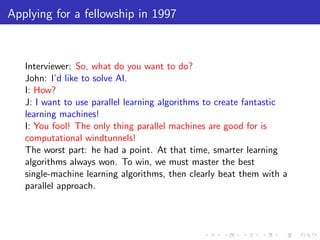
Applying for a fellowship in 1997


   Interviewer: So, what do you want to do?
Applying for a fellowship in 1997


   Interviewer: So, what do you want to do?
   John: I’d like to solve AI.
Applying for a fellowship in 1997


   Interviewer: So, what do you want to do?
   John: I’d like to solve AI.
   I: How?
Applying for a fellowship in 1997


   Interviewer: So, what do you want to do?
   John: I’d like to solve AI.
   I: How?
   J: I want to use parallel learning algorithms to create fantastic
   learning machines!
Applying for a fellowship in 1997


   Interviewer: So, what do you want to do?
   John: I’d like to solve AI.
   I: How?
   J: I want to use parallel learning algorithms to create fantastic
   learning machines!
   I: You fool! The only thing parallel machines are good for is
   computational windtunnels!
Applying for a fellowship in 1997


   Interviewer: So, what do you want to do?
   John: I’d like to solve AI.
   I: How?
   J: I want to use parallel learning algorithms to create fantastic
   learning machines!
   I: You fool! The only thing parallel machines are good for is
   computational windtunnels!
   The worst part: he had a point. At that time, smarter learning
   algorithms always won. To win, we must master the best
   single-machine learning algorithms, then clearly beat them with a
   parallel approach.
Demonstration
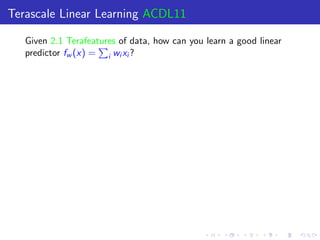
Terascale Linear Learning ACDL11

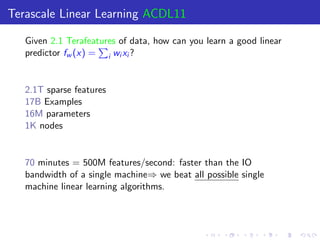
   Given 2.1 Terafeatures of data, how can you learn a good linear
   predictor fw (x) = i wi xi ?
Terascale Linear Learning ACDL11

   Given 2.1 Terafeatures of data, how can you learn a good linear
   predictor fw (x) = i wi xi ?


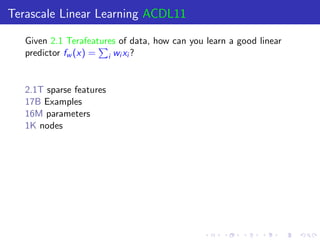
   2.1T sparse features
   17B Examples
   16M parameters
   1K nodes
Terascale Linear Learning ACDL11

   Given 2.1 Terafeatures of data, how can you learn a good linear
   predictor fw (x) = i wi xi ?


   2.1T sparse features
   17B Examples
   16M parameters
   1K nodes


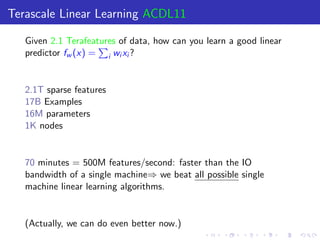
   70 minutes = 500M features/second: faster than the IO
   bandwidth of a single machine⇒ we beat all possible single
   machine linear learning algorithms.
Terascale Linear Learning ACDL11

   Given 2.1 Terafeatures of data, how can you learn a good linear
   predictor fw (x) = i wi xi ?


   2.1T sparse features
   17B Examples
   16M parameters
   1K nodes


   70 minutes = 500M features/second: faster than the IO
   bandwidth of a single machine⇒ we beat all possible single
   machine linear learning algorithms.

   (Actually, we can do even better now.)
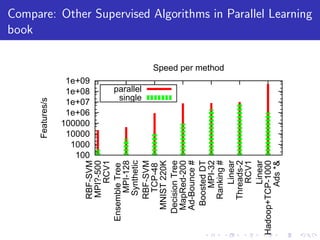
book
                     Features/s


                       100
                      1000
                     10000
                    100000
                     1e+06
                     1e+07
                     1e+08
                     1e+09
       RBF-SVM
        MPI?-500
            RCV1
   Ensemble Tree
         MPI-128
        Synthetic
                              single
                             parallel


       RBF-SVM
         TCP-48
     MNIST 220K
    Decision Tree
     MapRed-200
     Ad-Bounce #
      Boosted DT
          MPI-32
                                        Speed per method


       Ranking #
           Linear
       Threads-2
            RCV1
           Linear
Hadoop+TCP-1000
           Ads *&
                                                           Compare: Other Supervised Algorithms in Parallel Learning
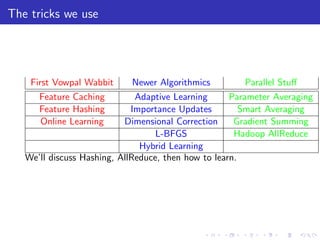
The tricks we use


    First Vowpal Wabbit       Newer Algorithmics         Parallel Stuff
      Feature Caching         Adaptive Learning      Parameter Averaging
      Feature Hashing        Importance Updates         Smart Averaging
       Online Learning     Dimensional Correction     Gradient Summing
                                   L-BFGS             Hadoop AllReduce
                               Hybrid Learning
   We’ll discuss Hashing, AllReduce, then how to learn.
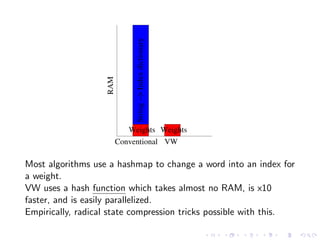
String −> Index dictionary
                   RAM

                            Weights Weights
                         Conventional VW

Most algorithms use a hashmap to change a word into an index for
a weight.
VW uses a hash function which takes almost no RAM, is x10
faster, and is easily parallelized.
Empirically, radical state compression tricks possible with this.
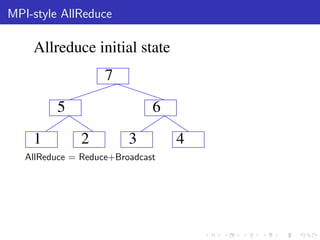
MPI-style AllReduce

    Allreduce initial state
                    7

         5                    6

    1          2         3        4
   AllReduce = Reduce+Broadcast
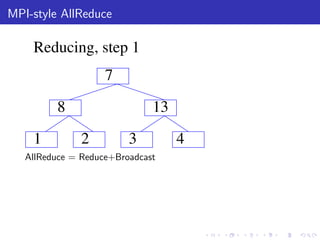
MPI-style AllReduce

    Reducing, step 1
                    7

         8                    13

    1          2         3         4
   AllReduce = Reduce+Broadcast
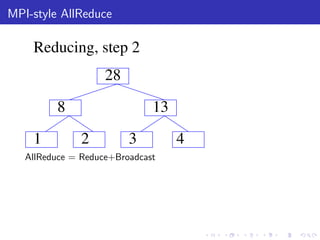
MPI-style AllReduce

    Reducing, step 2
                    28

         8                    13

    1          2         3         4
   AllReduce = Reduce+Broadcast
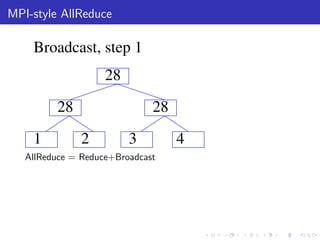
MPI-style AllReduce

    Broadcast, step 1
                    28

         28                   28

    1          2         3         4
   AllReduce = Reduce+Broadcast
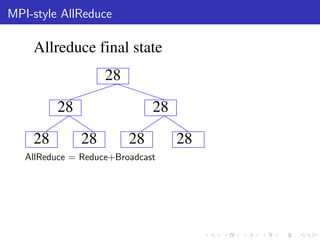
MPI-style AllReduce

    Allreduce final state
                    28

         28                   28
    28         28        28        28
   AllReduce = Reduce+Broadcast
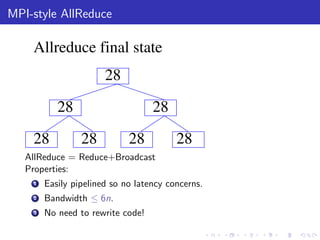
MPI-style AllReduce

    Allreduce final state
                       28

           28                      28
    28           28          28          28
   AllReduce = Reduce+Broadcast
   Properties:
    1   Easily pipelined so no latency concerns.
    2   Bandwidth ≤ 6n.
    3   No need to rewrite code!
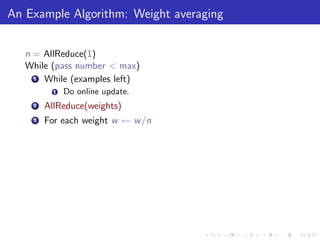
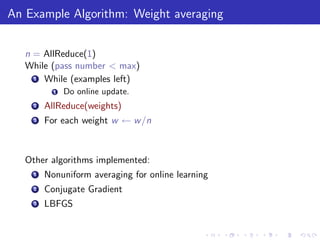
An Example Algorithm: Weight averaging


   n = AllReduce(1)
   While (pass number < max)
     1 While (examples left)

          1   Do online update.
    2   AllReduce(weights)
    3   For each weight w ← w /n
An Example Algorithm: Weight averaging


   n = AllReduce(1)
   While (pass number < max)
     1 While (examples left)

           1   Do online update.
     2   AllReduce(weights)
     3   For each weight w ← w /n


   Other algorithms implemented:
     1   Nonuniform averaging for online learning
     2   Conjugate Gradient
     3   LBFGS
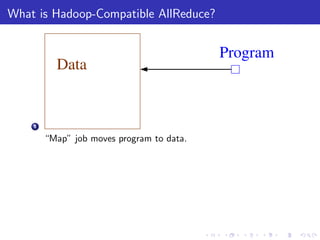
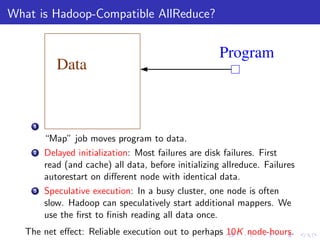
What is Hadoop-Compatible AllReduce?


                                           Program
          Data


    1

        “Map” job moves program to data.
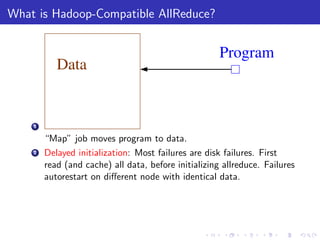
What is Hadoop-Compatible AllReduce?


                                                      Program
           Data


    1

        “Map” job moves program to data.
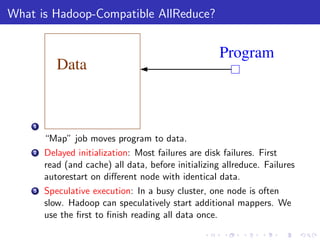
    2   Delayed initialization: Most failures are disk failures. First
        read (and cache) all data, before initializing allreduce. Failures
        autorestart on different node with identical data.
What is Hadoop-Compatible AllReduce?


                                                      Program
           Data


    1

        “Map” job moves program to data.
    2   Delayed initialization: Most failures are disk failures. First
        read (and cache) all data, before initializing allreduce. Failures
        autorestart on different node with identical data.
    3   Speculative execution: In a busy cluster, one node is often
        slow. Hadoop can speculatively start additional mappers. We
        use the first to finish reading all data once.
What is Hadoop-Compatible AllReduce?


                                                       Program
            Data


     1

         “Map” job moves program to data.
     2   Delayed initialization: Most failures are disk failures. First
         read (and cache) all data, before initializing allreduce. Failures
         autorestart on different node with identical data.
     3   Speculative execution: In a busy cluster, one node is often
         slow. Hadoop can speculatively start additional mappers. We
         use the first to finish reading all data once.
   The net effect: Reliable execution out to perhaps 10K node-hours.
Algorithms: Preliminaries


   Optimize so few data passes required ⇒ Smart algorithms.
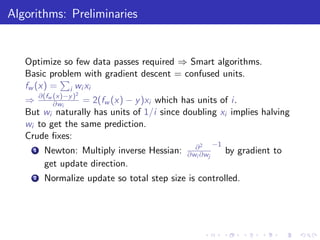
   Basic problem with gradient descent = confused units.
   fw (x) = i wi xi
          (x)−y 2
   ⇒ ∂(fw ∂wi ) = 2(fw (x) − y )xi which has units of i.
   But wi naturally has units of 1/i since doubling xi implies halving
   wi to get the same prediction.
   Crude fixes:
                                               ∂ 2 −1
     1   Newton: Multiply inverse Hessian:   ∂wi ∂wj    by gradient to
         get update direction.
     2   Normalize update so total step size is controlled.
Algorithms: Preliminaries


   Optimize so few data passes required ⇒ Smart algorithms.
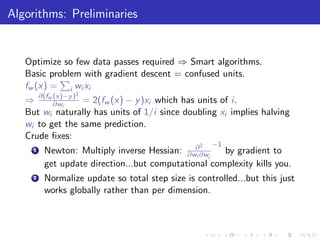
   Basic problem with gradient descent = confused units.
   fw (x) = i wi xi
          (x)−y 2
   ⇒ ∂(fw ∂wi ) = 2(fw (x) − y )xi which has units of i.
   But wi naturally has units of 1/i since doubling xi implies halving
   wi to get the same prediction.
   Crude fixes:
                                                 2   −1
     1   Newton: Multiply inverse Hessian: ∂w∂∂wj
                                              i
                                                     by gradient to
         get update direction...but computational complexity kills you.
     2   Normalize update so total step size is controlled...but this just
         works globally rather than per dimension.
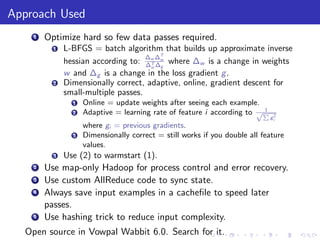
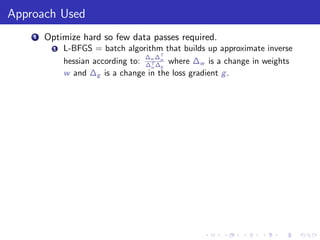
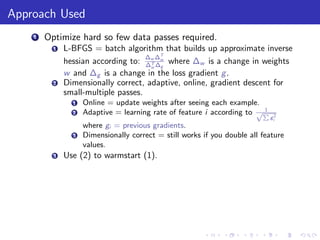
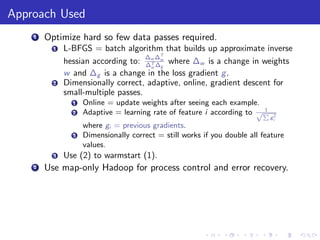
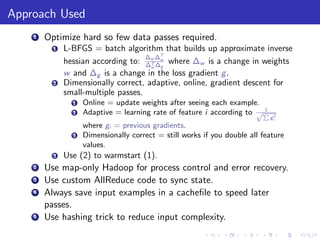
Approach Used
    1   Optimize hard so few data passes required.
          1   L-BFGS = batch algorithm that builds up approximate inverse
                                    ∆ ∆T
              hessian according to: ∆w ∆w where ∆w is a change in weights
                                     T
                                     w g
              w and ∆g is a change in the loss gradient g .
Approach Used
    1   Optimize hard so few data passes required.
          1   L-BFGS = batch algorithm that builds up approximate inverse
                                     ∆ ∆T
              hessian according to: ∆w ∆w where ∆w is a change in weights
                                      T
                                      w g
              w and ∆g is a change in the loss gradient g .
          2   Dimensionally correct, adaptive, online, gradient descent for
              small-multiple passes.
                1   Online = update weights after seeing each example.
                                                                        1
                2   Adaptive = learning rate of feature i according to √P
                                                                            gi2
                    where gi = previous gradients.
                3   Dimensionally correct = still works if you double all feature
                    values.
          3   Use (2) to warmstart (1).
Approach Used
    1   Optimize hard so few data passes required.
          1   L-BFGS = batch algorithm that builds up approximate inverse
                                     ∆ ∆T
              hessian according to: ∆w ∆w where ∆w is a change in weights
                                      T
                                      w g
              w and ∆g is a change in the loss gradient g .
          2   Dimensionally correct, adaptive, online, gradient descent for
              small-multiple passes.
                1   Online = update weights after seeing each example.
                                                                        1
                2   Adaptive = learning rate of feature i according to √P
                                                                            gi2
                    where gi = previous gradients.
                3   Dimensionally correct = still works if you double all feature
                    values.
          3   Use (2) to warmstart (1).
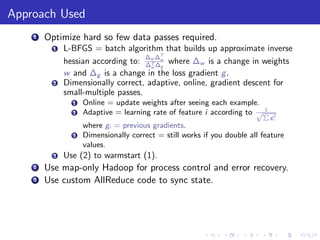
    2   Use map-only Hadoop for process control and error recovery.
Approach Used
    1   Optimize hard so few data passes required.
          1   L-BFGS = batch algorithm that builds up approximate inverse
                                     ∆ ∆T
              hessian according to: ∆w ∆w where ∆w is a change in weights
                                      T
                                      w g
              w and ∆g is a change in the loss gradient g .
          2   Dimensionally correct, adaptive, online, gradient descent for
              small-multiple passes.
                1   Online = update weights after seeing each example.
                                                                        1
                2   Adaptive = learning rate of feature i according to √P
                                                                            gi2
                    where gi = previous gradients.
                3   Dimensionally correct = still works if you double all feature
                    values.
          3   Use (2) to warmstart (1).
    2   Use map-only Hadoop for process control and error recovery.
    3   Use custom AllReduce code to sync state.
Approach Used
    1   Optimize hard so few data passes required.
          1   L-BFGS = batch algorithm that builds up approximate inverse
                                     ∆ ∆T
              hessian according to: ∆w ∆w where ∆w is a change in weights
                                      T
                                      w g
              w and ∆g is a change in the loss gradient g .
          2   Dimensionally correct, adaptive, online, gradient descent for
              small-multiple passes.
                1   Online = update weights after seeing each example.
                                                                        1
                2   Adaptive = learning rate of feature i according to √P
                                                                            gi2
                    where gi = previous gradients.
                3   Dimensionally correct = still works if you double all feature
                    values.
          3   Use (2) to warmstart (1).
    2   Use map-only Hadoop for process control and error recovery.
    3   Use custom AllReduce code to sync state.
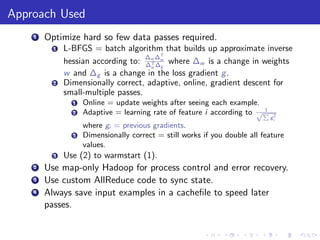
    4   Always save input examples in a cachefile to speed later
        passes.
Approach Used
    1   Optimize hard so few data passes required.
          1   L-BFGS = batch algorithm that builds up approximate inverse
                                     ∆ ∆T
              hessian according to: ∆w ∆w where ∆w is a change in weights
                                      T
                                      w g
              w and ∆g is a change in the loss gradient g .
          2   Dimensionally correct, adaptive, online, gradient descent for
              small-multiple passes.
                1   Online = update weights after seeing each example.
                                                                        1
                2   Adaptive = learning rate of feature i according to √P
                                                                            gi2
                    where gi = previous gradients.
                3   Dimensionally correct = still works if you double all feature
                    values.
          3   Use (2) to warmstart (1).
    2   Use map-only Hadoop for process control and error recovery.
    3   Use custom AllReduce code to sync state.
    4   Always save input examples in a cachefile to speed later
        passes.
    5   Use hashing trick to reduce input complexity.
Approach Used
    1   Optimize hard so few data passes required.
          1   L-BFGS = batch algorithm that builds up approximate inverse
                                     ∆ ∆T
              hessian according to: ∆w ∆w where ∆w is a change in weights
                                      T
                                      w g
              w and ∆g is a change in the loss gradient g .
          2   Dimensionally correct, adaptive, online, gradient descent for
              small-multiple passes.
                1   Online = update weights after seeing each example.
                                                                        1
                2   Adaptive = learning rate of feature i according to √P
                                                                            gi2
                    where gi = previous gradients.
                3   Dimensionally correct = still works if you double all feature
                    values.
          3   Use (2) to warmstart (1).
    2   Use map-only Hadoop for process control and error recovery.
    3   Use custom AllReduce code to sync state.
    4   Always save input examples in a cachefile to speed later
        passes.
    5   Use hashing trick to reduce input complexity.
  Open source in Vowpal Wabbit 6.0. Search for it.
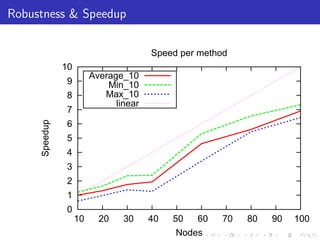
Robustness & Speedup


                                        Speed per method
               10
                         Average_10
                9            Min_10
                8           Max_10
                               linear
                7
     Speedup


                6
                5
                4
                3
                2
                1
                0
                    10     20    30     40   50   60   70   80   90   100
                                              Nodes
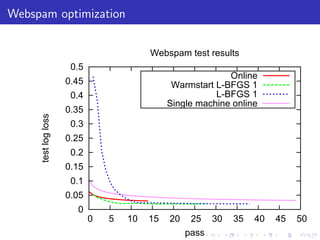
Webspam optimization


                                         Webspam test results
                      0.5
                                                            Online
                     0.45                      Warmstart L-BFGS 1
                      0.4                                L-BFGS 1
                                              Single machine online
                     0.35
     test log loss


                      0.3
                     0.25
                      0.2
                     0.15
                      0.1
                     0.05
                       0
                            0   5   10   15   20    25 30    35   40   45   50
                                                   pass
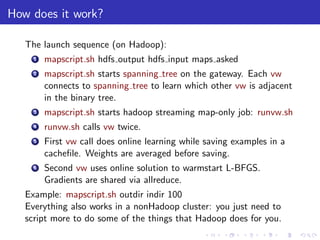
How does it work?

   The launch sequence (on Hadoop):
     1   mapscript.sh hdfs output hdfs input maps asked
     2   mapscript.sh starts spanning tree on the gateway. Each vw
         connects to spanning tree to learn which other vw is adjacent
         in the binary tree.
     3   mapscript.sh starts hadoop streaming map-only job: runvw.sh
     4   runvw.sh calls vw twice.
     5   First vw call does online learning while saving examples in a
         cachefile. Weights are averaged before saving.
     6   Second vw uses online solution to warmstart L-BFGS.
         Gradients are shared via allreduce.
   Example: mapscript.sh outdir indir 100
   Everything also works in a nonHadoop cluster: you just need to
   script more to do some of the things that Hadoop does for you.
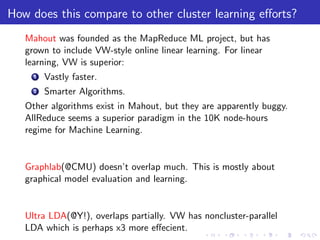
How does this compare to other cluster learning efforts?
   Mahout was founded as the MapReduce ML project, but has
   grown to include VW-style online linear learning. For linear
   learning, VW is superior:
     1   Vastly faster.
     2   Smarter Algorithms.
   Other algorithms exist in Mahout, but they are apparently buggy.
   AllReduce seems a superior paradigm in the 10K node-hours
   regime for Machine Learning.


   Graphlab(@CMU) doesn’t overlap much. This is mostly about
   graphical model evaluation and learning.


   Ultra LDA(@Y!), overlaps partially. VW has noncluster-parallel
   LDA which is perhaps x3 more effecient.
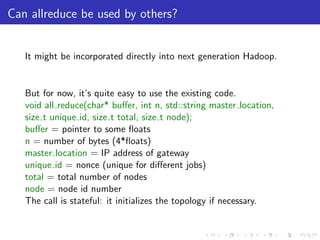
Can allreduce be used by others?


   It might be incorporated directly into next generation Hadoop.


   But for now, it’s quite easy to use the existing code.
   void all reduce(char* buffer, int n, std::string master location,
   size t unique id, size t total, size t node);
   buffer = pointer to some floats
   n = number of bytes (4*floats)
   master location = IP address of gateway
   unique id = nonce (unique for different jobs)
   total = total number of nodes
   node = node id number
   The call is stateful: it initializes the topology if necessary.
Further Pointers


   search://Vowpal Wabbit


   mailing list: vowpal wabbit@yahoogroups.com


   VW tutorial (Preparallel): http://videolectures.net


   Machine Learning (Theory) blog: http://hunch.net
Bibliography: Original VW


Caching L. Bottou. Stochastic Gradient Descent Examples on Toy
        Problems, http://leon.bottou.org/projects/sgd, 2007.
Release Vowpal Wabbit open source project,
        http://github.com/JohnLangford/vowpal_wabbit/wiki,
        2007.
Hashing Q. Shi, J. Petterson, G. Dror, J. Langford, A. Smola, and
        SVN Vishwanathan, Hash Kernels for Structured Data,
        AISTAT 2009.
Hashing K. Weinberger, A. Dasgupta, J. Langford, A. Smola, and J.
        Attenberg, Feature Hashing for Large Scale Multitask
        Learning, ICML 2009.
Bibliography: Algorithmics


L-BFGS J. Nocedal, Updating Quasi-Newton Matrices with Limited
       Storage, Mathematics of Computation 35:773–782, 1980.
Adaptive H. B. McMahan and M. Streeter, Adaptive Bound
         Optimization for Online Convex Optimization, COLT 2010.
Adaptive J. Duchi, E. Hazan, and Y. Singer, Adaptive Subgradient
         Methods for Online Learning and Stochastic Optimization,
         COLT 2010.
 Import. N. Karampatziakis, and J. Langford, Online Importance
         Weight Aware Updates, UAI 2011.
Bibliography: Parallel


grad sum C. Teo, Q. Le, A. Smola, V. Vishwanathan, A Scalable
         Modular Convex Solver for Regularized Risk Minimization,
         KDD 2007.
averaging G. Mann, R. Mcdonald, M. Mohri, N. Silberman, and D.
          Walker. Efficient large-scale distributed training of conditional
          maximum entropy models, NIPS 2009.
averaging K. Hall, S. Gilpin, and G. Mann, MapReduce/Bigtable for
          Distributed Optimization, LCCC 2010.
     (More forthcoming, of course)

Terascale Learning

  • 1.
    A Terascale LearningAlgorithm Alekh Agarwal, Olivier Chapelle, Miroslav Dudik, and John Langford ... And the Vowpal Wabbit project.
  • 2.
    Applying for afellowship in 1997
  • 3.
    Applying for afellowship in 1997 Interviewer: So, what do you want to do?
  • 4.
    Applying for afellowship in 1997 Interviewer: So, what do you want to do? John: I’d like to solve AI.
  • 5.
    Applying for afellowship in 1997 Interviewer: So, what do you want to do? John: I’d like to solve AI. I: How?
  • 6.
    Applying for afellowship in 1997 Interviewer: So, what do you want to do? John: I’d like to solve AI. I: How? J: I want to use parallel learning algorithms to create fantastic learning machines!
  • 7.
    Applying for afellowship in 1997 Interviewer: So, what do you want to do? John: I’d like to solve AI. I: How? J: I want to use parallel learning algorithms to create fantastic learning machines! I: You fool! The only thing parallel machines are good for is computational windtunnels!
  • 8.
    Applying for afellowship in 1997 Interviewer: So, what do you want to do? John: I’d like to solve AI. I: How? J: I want to use parallel learning algorithms to create fantastic learning machines! I: You fool! The only thing parallel machines are good for is computational windtunnels! The worst part: he had a point. At that time, smarter learning algorithms always won. To win, we must master the best single-machine learning algorithms, then clearly beat them with a parallel approach.
  • 9.
  • 10.
    Terascale Linear LearningACDL11 Given 2.1 Terafeatures of data, how can you learn a good linear predictor fw (x) = i wi xi ?
  • 11.
    Terascale Linear LearningACDL11 Given 2.1 Terafeatures of data, how can you learn a good linear predictor fw (x) = i wi xi ? 2.1T sparse features 17B Examples 16M parameters 1K nodes
  • 12.
    Terascale Linear LearningACDL11 Given 2.1 Terafeatures of data, how can you learn a good linear predictor fw (x) = i wi xi ? 2.1T sparse features 17B Examples 16M parameters 1K nodes 70 minutes = 500M features/second: faster than the IO bandwidth of a single machine⇒ we beat all possible single machine linear learning algorithms.
  • 13.
    Terascale Linear LearningACDL11 Given 2.1 Terafeatures of data, how can you learn a good linear predictor fw (x) = i wi xi ? 2.1T sparse features 17B Examples 16M parameters 1K nodes 70 minutes = 500M features/second: faster than the IO bandwidth of a single machine⇒ we beat all possible single machine linear learning algorithms. (Actually, we can do even better now.)
  • 14.
    book Features/s 100 1000 10000 100000 1e+06 1e+07 1e+08 1e+09 RBF-SVM MPI?-500 RCV1 Ensemble Tree MPI-128 Synthetic single parallel RBF-SVM TCP-48 MNIST 220K Decision Tree MapRed-200 Ad-Bounce # Boosted DT MPI-32 Speed per method Ranking # Linear Threads-2 RCV1 Linear Hadoop+TCP-1000 Ads *& Compare: Other Supervised Algorithms in Parallel Learning
  • 15.
    The tricks weuse First Vowpal Wabbit Newer Algorithmics Parallel Stuff Feature Caching Adaptive Learning Parameter Averaging Feature Hashing Importance Updates Smart Averaging Online Learning Dimensional Correction Gradient Summing L-BFGS Hadoop AllReduce Hybrid Learning We’ll discuss Hashing, AllReduce, then how to learn.
  • 16.
    String −> Indexdictionary RAM Weights Weights Conventional VW Most algorithms use a hashmap to change a word into an index for a weight. VW uses a hash function which takes almost no RAM, is x10 faster, and is easily parallelized. Empirically, radical state compression tricks possible with this.
  • 17.
    MPI-style AllReduce Allreduce initial state 7 5 6 1 2 3 4 AllReduce = Reduce+Broadcast
  • 18.
    MPI-style AllReduce Reducing, step 1 7 8 13 1 2 3 4 AllReduce = Reduce+Broadcast
  • 19.
    MPI-style AllReduce Reducing, step 2 28 8 13 1 2 3 4 AllReduce = Reduce+Broadcast
  • 20.
    MPI-style AllReduce Broadcast, step 1 28 28 28 1 2 3 4 AllReduce = Reduce+Broadcast
  • 21.
    MPI-style AllReduce Allreduce final state 28 28 28 28 28 28 28 AllReduce = Reduce+Broadcast
  • 22.
    MPI-style AllReduce Allreduce final state 28 28 28 28 28 28 28 AllReduce = Reduce+Broadcast Properties: 1 Easily pipelined so no latency concerns. 2 Bandwidth ≤ 6n. 3 No need to rewrite code!
  • 23.
    An Example Algorithm:Weight averaging n = AllReduce(1) While (pass number < max) 1 While (examples left) 1 Do online update. 2 AllReduce(weights) 3 For each weight w ← w /n
  • 24.
    An Example Algorithm:Weight averaging n = AllReduce(1) While (pass number < max) 1 While (examples left) 1 Do online update. 2 AllReduce(weights) 3 For each weight w ← w /n Other algorithms implemented: 1 Nonuniform averaging for online learning 2 Conjugate Gradient 3 LBFGS
  • 25.
    What is Hadoop-CompatibleAllReduce? Program Data 1 “Map” job moves program to data.
  • 26.
    What is Hadoop-CompatibleAllReduce? Program Data 1 “Map” job moves program to data. 2 Delayed initialization: Most failures are disk failures. First read (and cache) all data, before initializing allreduce. Failures autorestart on different node with identical data.
  • 27.
    What is Hadoop-CompatibleAllReduce? Program Data 1 “Map” job moves program to data. 2 Delayed initialization: Most failures are disk failures. First read (and cache) all data, before initializing allreduce. Failures autorestart on different node with identical data. 3 Speculative execution: In a busy cluster, one node is often slow. Hadoop can speculatively start additional mappers. We use the first to finish reading all data once.
  • 28.
    What is Hadoop-CompatibleAllReduce? Program Data 1 “Map” job moves program to data. 2 Delayed initialization: Most failures are disk failures. First read (and cache) all data, before initializing allreduce. Failures autorestart on different node with identical data. 3 Speculative execution: In a busy cluster, one node is often slow. Hadoop can speculatively start additional mappers. We use the first to finish reading all data once. The net effect: Reliable execution out to perhaps 10K node-hours.
  • 29.
    Algorithms: Preliminaries Optimize so few data passes required ⇒ Smart algorithms. Basic problem with gradient descent = confused units. fw (x) = i wi xi (x)−y 2 ⇒ ∂(fw ∂wi ) = 2(fw (x) − y )xi which has units of i. But wi naturally has units of 1/i since doubling xi implies halving wi to get the same prediction. Crude fixes: ∂ 2 −1 1 Newton: Multiply inverse Hessian: ∂wi ∂wj by gradient to get update direction. 2 Normalize update so total step size is controlled.
  • 30.
    Algorithms: Preliminaries Optimize so few data passes required ⇒ Smart algorithms. Basic problem with gradient descent = confused units. fw (x) = i wi xi (x)−y 2 ⇒ ∂(fw ∂wi ) = 2(fw (x) − y )xi which has units of i. But wi naturally has units of 1/i since doubling xi implies halving wi to get the same prediction. Crude fixes: 2 −1 1 Newton: Multiply inverse Hessian: ∂w∂∂wj i by gradient to get update direction...but computational complexity kills you. 2 Normalize update so total step size is controlled...but this just works globally rather than per dimension.
  • 31.
    Approach Used 1 Optimize hard so few data passes required. 1 L-BFGS = batch algorithm that builds up approximate inverse ∆ ∆T hessian according to: ∆w ∆w where ∆w is a change in weights T w g w and ∆g is a change in the loss gradient g .
  • 32.
    Approach Used 1 Optimize hard so few data passes required. 1 L-BFGS = batch algorithm that builds up approximate inverse ∆ ∆T hessian according to: ∆w ∆w where ∆w is a change in weights T w g w and ∆g is a change in the loss gradient g . 2 Dimensionally correct, adaptive, online, gradient descent for small-multiple passes. 1 Online = update weights after seeing each example. 1 2 Adaptive = learning rate of feature i according to √P gi2 where gi = previous gradients. 3 Dimensionally correct = still works if you double all feature values. 3 Use (2) to warmstart (1).
  • 33.
    Approach Used 1 Optimize hard so few data passes required. 1 L-BFGS = batch algorithm that builds up approximate inverse ∆ ∆T hessian according to: ∆w ∆w where ∆w is a change in weights T w g w and ∆g is a change in the loss gradient g . 2 Dimensionally correct, adaptive, online, gradient descent for small-multiple passes. 1 Online = update weights after seeing each example. 1 2 Adaptive = learning rate of feature i according to √P gi2 where gi = previous gradients. 3 Dimensionally correct = still works if you double all feature values. 3 Use (2) to warmstart (1). 2 Use map-only Hadoop for process control and error recovery.
  • 34.
    Approach Used 1 Optimize hard so few data passes required. 1 L-BFGS = batch algorithm that builds up approximate inverse ∆ ∆T hessian according to: ∆w ∆w where ∆w is a change in weights T w g w and ∆g is a change in the loss gradient g . 2 Dimensionally correct, adaptive, online, gradient descent for small-multiple passes. 1 Online = update weights after seeing each example. 1 2 Adaptive = learning rate of feature i according to √P gi2 where gi = previous gradients. 3 Dimensionally correct = still works if you double all feature values. 3 Use (2) to warmstart (1). 2 Use map-only Hadoop for process control and error recovery. 3 Use custom AllReduce code to sync state.
  • 35.
    Approach Used 1 Optimize hard so few data passes required. 1 L-BFGS = batch algorithm that builds up approximate inverse ∆ ∆T hessian according to: ∆w ∆w where ∆w is a change in weights T w g w and ∆g is a change in the loss gradient g . 2 Dimensionally correct, adaptive, online, gradient descent for small-multiple passes. 1 Online = update weights after seeing each example. 1 2 Adaptive = learning rate of feature i according to √P gi2 where gi = previous gradients. 3 Dimensionally correct = still works if you double all feature values. 3 Use (2) to warmstart (1). 2 Use map-only Hadoop for process control and error recovery. 3 Use custom AllReduce code to sync state. 4 Always save input examples in a cachefile to speed later passes.
  • 36.
    Approach Used 1 Optimize hard so few data passes required. 1 L-BFGS = batch algorithm that builds up approximate inverse ∆ ∆T hessian according to: ∆w ∆w where ∆w is a change in weights T w g w and ∆g is a change in the loss gradient g . 2 Dimensionally correct, adaptive, online, gradient descent for small-multiple passes. 1 Online = update weights after seeing each example. 1 2 Adaptive = learning rate of feature i according to √P gi2 where gi = previous gradients. 3 Dimensionally correct = still works if you double all feature values. 3 Use (2) to warmstart (1). 2 Use map-only Hadoop for process control and error recovery. 3 Use custom AllReduce code to sync state. 4 Always save input examples in a cachefile to speed later passes. 5 Use hashing trick to reduce input complexity.
  • 37.
    Approach Used 1 Optimize hard so few data passes required. 1 L-BFGS = batch algorithm that builds up approximate inverse ∆ ∆T hessian according to: ∆w ∆w where ∆w is a change in weights T w g w and ∆g is a change in the loss gradient g . 2 Dimensionally correct, adaptive, online, gradient descent for small-multiple passes. 1 Online = update weights after seeing each example. 1 2 Adaptive = learning rate of feature i according to √P gi2 where gi = previous gradients. 3 Dimensionally correct = still works if you double all feature values. 3 Use (2) to warmstart (1). 2 Use map-only Hadoop for process control and error recovery. 3 Use custom AllReduce code to sync state. 4 Always save input examples in a cachefile to speed later passes. 5 Use hashing trick to reduce input complexity. Open source in Vowpal Wabbit 6.0. Search for it.
  • 38.
    Robustness & Speedup Speed per method 10 Average_10 9 Min_10 8 Max_10 linear 7 Speedup 6 5 4 3 2 1 0 10 20 30 40 50 60 70 80 90 100 Nodes
  • 39.
    Webspam optimization Webspam test results 0.5 Online 0.45 Warmstart L-BFGS 1 0.4 L-BFGS 1 Single machine online 0.35 test log loss 0.3 0.25 0.2 0.15 0.1 0.05 0 0 5 10 15 20 25 30 35 40 45 50 pass
  • 40.
    How does itwork? The launch sequence (on Hadoop): 1 mapscript.sh hdfs output hdfs input maps asked 2 mapscript.sh starts spanning tree on the gateway. Each vw connects to spanning tree to learn which other vw is adjacent in the binary tree. 3 mapscript.sh starts hadoop streaming map-only job: runvw.sh 4 runvw.sh calls vw twice. 5 First vw call does online learning while saving examples in a cachefile. Weights are averaged before saving. 6 Second vw uses online solution to warmstart L-BFGS. Gradients are shared via allreduce. Example: mapscript.sh outdir indir 100 Everything also works in a nonHadoop cluster: you just need to script more to do some of the things that Hadoop does for you.
  • 41.
    How does thiscompare to other cluster learning efforts? Mahout was founded as the MapReduce ML project, but has grown to include VW-style online linear learning. For linear learning, VW is superior: 1 Vastly faster. 2 Smarter Algorithms. Other algorithms exist in Mahout, but they are apparently buggy. AllReduce seems a superior paradigm in the 10K node-hours regime for Machine Learning. Graphlab(@CMU) doesn’t overlap much. This is mostly about graphical model evaluation and learning. Ultra LDA(@Y!), overlaps partially. VW has noncluster-parallel LDA which is perhaps x3 more effecient.
  • 42.
    Can allreduce beused by others? It might be incorporated directly into next generation Hadoop. But for now, it’s quite easy to use the existing code. void all reduce(char* buffer, int n, std::string master location, size t unique id, size t total, size t node); buffer = pointer to some floats n = number of bytes (4*floats) master location = IP address of gateway unique id = nonce (unique for different jobs) total = total number of nodes node = node id number The call is stateful: it initializes the topology if necessary.
  • 43.
    Further Pointers search://Vowpal Wabbit mailing list: vowpal wabbit@yahoogroups.com VW tutorial (Preparallel): http://videolectures.net Machine Learning (Theory) blog: http://hunch.net
  • 44.
    Bibliography: Original VW CachingL. Bottou. Stochastic Gradient Descent Examples on Toy Problems, http://leon.bottou.org/projects/sgd, 2007. Release Vowpal Wabbit open source project, http://github.com/JohnLangford/vowpal_wabbit/wiki, 2007. Hashing Q. Shi, J. Petterson, G. Dror, J. Langford, A. Smola, and SVN Vishwanathan, Hash Kernels for Structured Data, AISTAT 2009. Hashing K. Weinberger, A. Dasgupta, J. Langford, A. Smola, and J. Attenberg, Feature Hashing for Large Scale Multitask Learning, ICML 2009.
  • 45.
    Bibliography: Algorithmics L-BFGS J.Nocedal, Updating Quasi-Newton Matrices with Limited Storage, Mathematics of Computation 35:773–782, 1980. Adaptive H. B. McMahan and M. Streeter, Adaptive Bound Optimization for Online Convex Optimization, COLT 2010. Adaptive J. Duchi, E. Hazan, and Y. Singer, Adaptive Subgradient Methods for Online Learning and Stochastic Optimization, COLT 2010. Import. N. Karampatziakis, and J. Langford, Online Importance Weight Aware Updates, UAI 2011.
  • 46.
    Bibliography: Parallel grad sumC. Teo, Q. Le, A. Smola, V. Vishwanathan, A Scalable Modular Convex Solver for Regularized Risk Minimization, KDD 2007. averaging G. Mann, R. Mcdonald, M. Mohri, N. Silberman, and D. Walker. Efficient large-scale distributed training of conditional maximum entropy models, NIPS 2009. averaging K. Hall, S. Gilpin, and G. Mann, MapReduce/Bigtable for Distributed Optimization, LCCC 2010. (More forthcoming, of course)