HAPTIC TECHNOLOGY
Presented by,
siva priya.s
117011013968
INTRODUCTION
 Haptics,is the technology od adding the
sensation of touch and feeling.
 when virtual objects are touched,they seem real
and tangible.
 haptic senses links to the bain’s sensing position
and movement of the body by means of sensory
nerves withinthe muscles and joints.
HAPTICS.....???
Derived rom greek word ‘Haptikos’ meaning
“ABLE TO COME INTO CONTACT WITH”.
 Haptics=touch=connection.
 touch is at the core of personal experience.
 of the five senses, touch is the most proficient,
the only one capable of simultaneous input and
output.
HISTORY OF HAPTICS
 One of the earliest applications of haptic
technology was in large aircraft that
use servomechanism systems to operate control
surfaces.
 In 2015 Apple started to sell a wrist watch which
included skin tap sensing of notifications and alerts
to mobile phone of the watch wearer.
HAPTIC INFORMATION
COMBINATION OF:-
 Tractile Information :
refer to the informatin acquired by the
sensor connected to the body.
 Kinesthetic Information:
refers to thr information acquired by
the sensors in the joints.
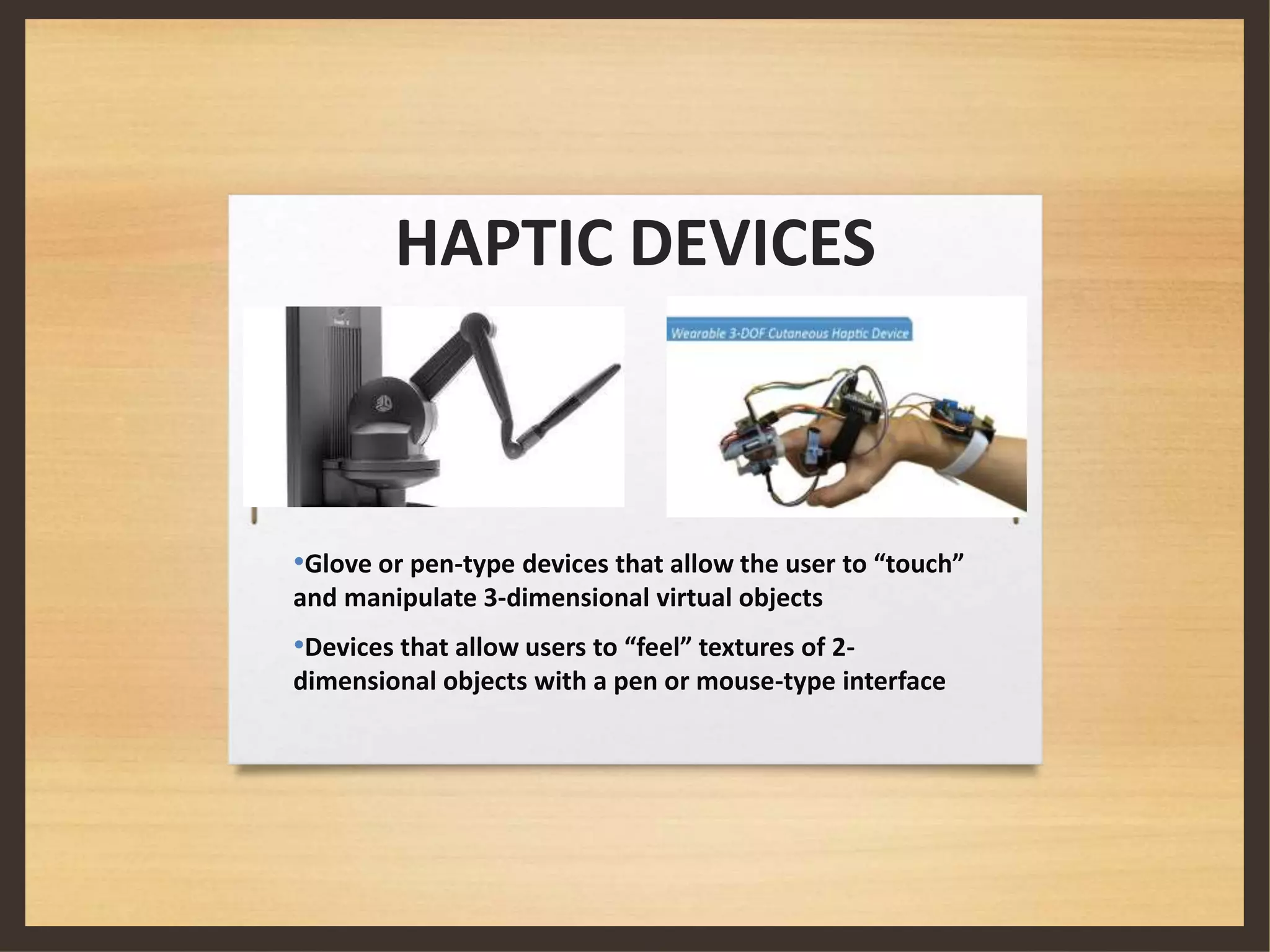
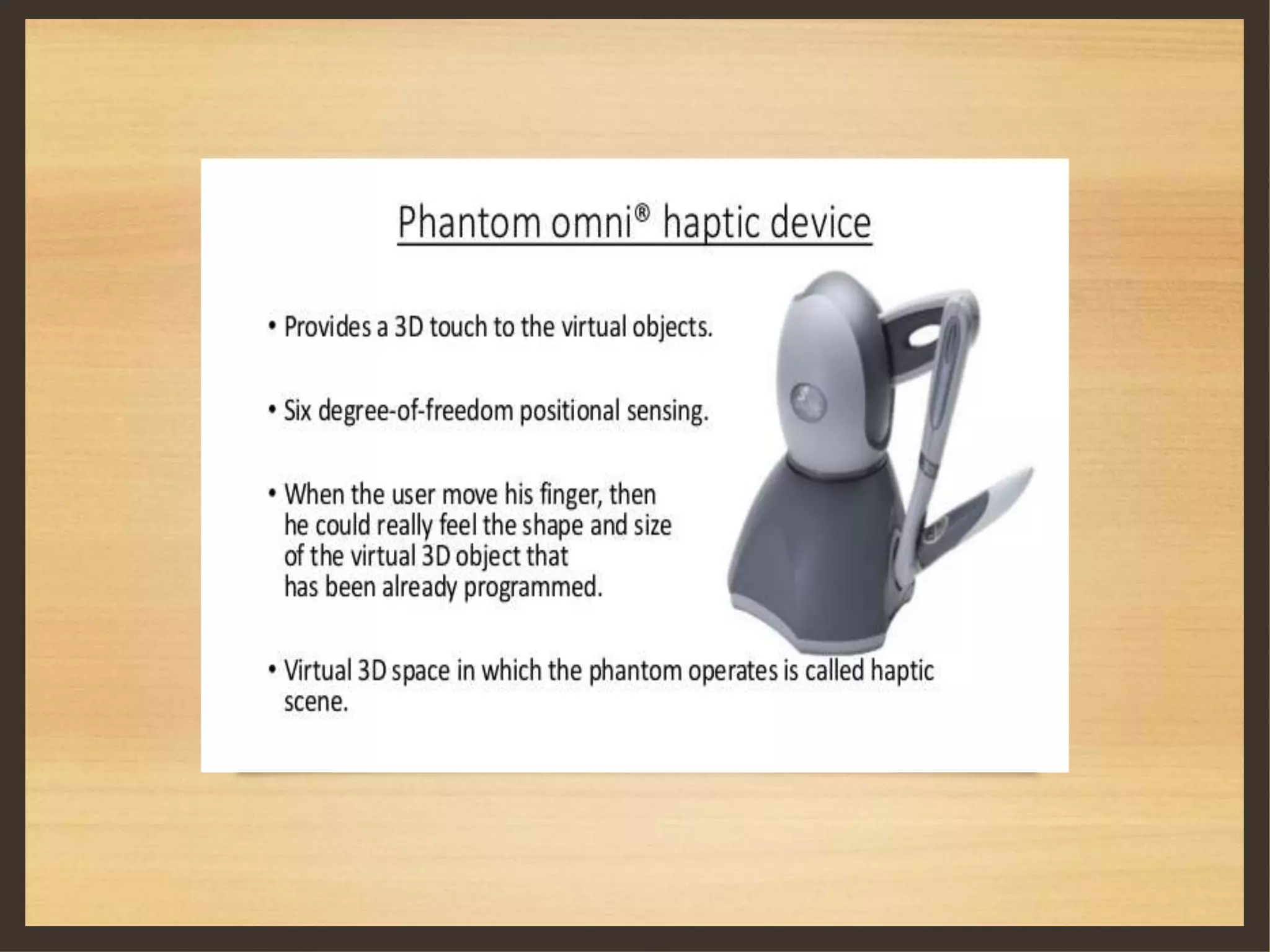
HAPTIC DEVICES
•Glove or pen-type devices that allow the user to “touch”
and manipulate 3-dimensional virtual objects
•Devices that allow users to “feel” textures of 2-
dimensional objects with a pen or mouse-type interface
Haptic application development via
the application builder
LIMITATIONS
 High cost involved.
 large weight and size of haptic devices.
 haptic iterfaces can only exert forces with
limited magnitude and not equally well in all
directions.
 haptic – rendering algorithms operate in
discrete time whereas user operate in continuous
time.
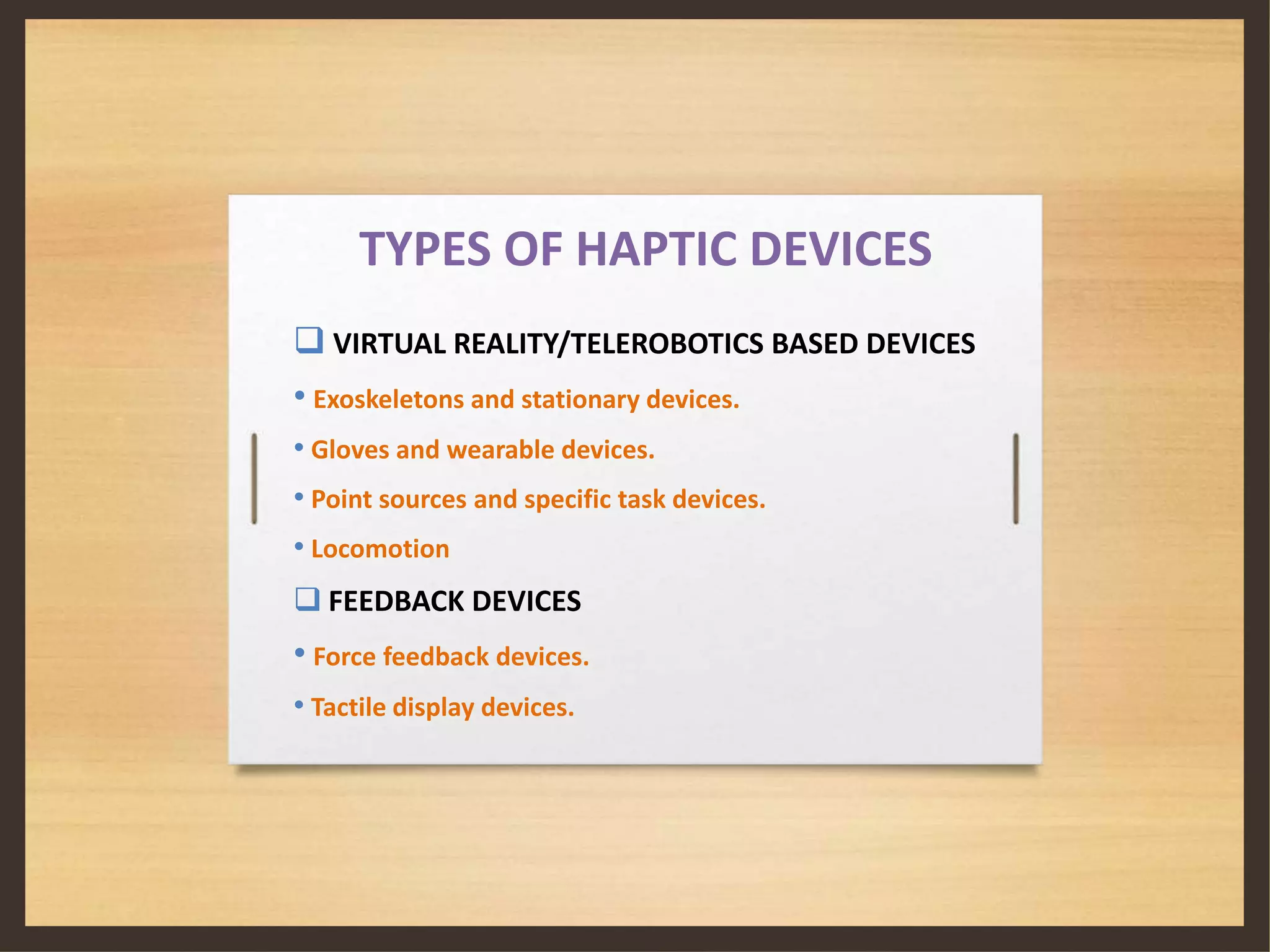
TYPES OF HAPTIC DEVICES
 VIRTUAL REALITY/TELEROBOTICS BASED DEVICES
• Exoskeletons and stationary devices.
• Gloves and wearable devices.
• Point sources and specific task devices.
• Locomotion
 FEEDBACK DEVICES
• Force feedback devices.
• Tactile display devices.
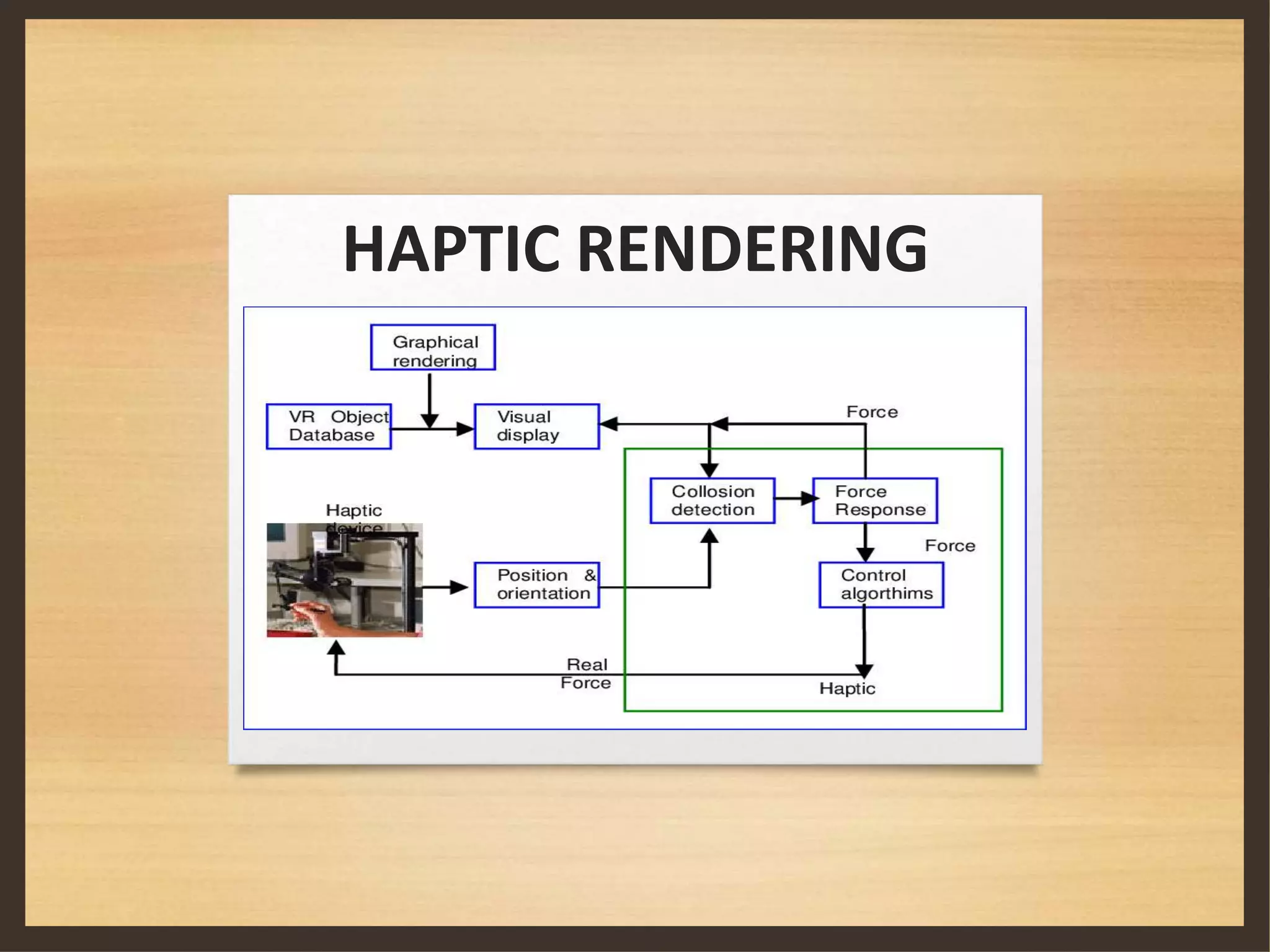
HAPTIC RENDERING
THANK YOU…..

Haptic technology

  • 1.
  • 2.
    INTRODUCTION  Haptics,is thetechnology od adding the sensation of touch and feeling.  when virtual objects are touched,they seem real and tangible.  haptic senses links to the bain’s sensing position and movement of the body by means of sensory nerves withinthe muscles and joints.
  • 3.
    HAPTICS.....??? Derived rom greekword ‘Haptikos’ meaning “ABLE TO COME INTO CONTACT WITH”.  Haptics=touch=connection.  touch is at the core of personal experience.  of the five senses, touch is the most proficient, the only one capable of simultaneous input and output.
  • 4.
    HISTORY OF HAPTICS One of the earliest applications of haptic technology was in large aircraft that use servomechanism systems to operate control surfaces.  In 2015 Apple started to sell a wrist watch which included skin tap sensing of notifications and alerts to mobile phone of the watch wearer.
  • 6.
    HAPTIC INFORMATION COMBINATION OF:- Tractile Information : refer to the informatin acquired by the sensor connected to the body.  Kinesthetic Information: refers to thr information acquired by the sensors in the joints.
  • 7.
    HAPTIC DEVICES •Glove orpen-type devices that allow the user to “touch” and manipulate 3-dimensional virtual objects •Devices that allow users to “feel” textures of 2- dimensional objects with a pen or mouse-type interface
  • 11.
    Haptic application developmentvia the application builder
  • 12.
    LIMITATIONS  High costinvolved.  large weight and size of haptic devices.  haptic iterfaces can only exert forces with limited magnitude and not equally well in all directions.  haptic – rendering algorithms operate in discrete time whereas user operate in continuous time.
  • 13.
    TYPES OF HAPTICDEVICES  VIRTUAL REALITY/TELEROBOTICS BASED DEVICES • Exoskeletons and stationary devices. • Gloves and wearable devices. • Point sources and specific task devices. • Locomotion  FEEDBACK DEVICES • Force feedback devices. • Tactile display devices.
  • 14.
  • 15.