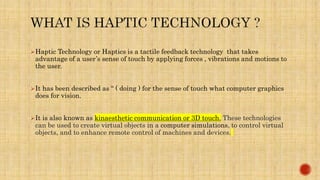
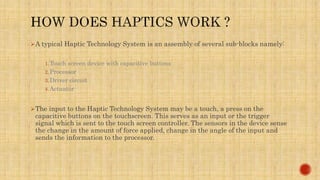
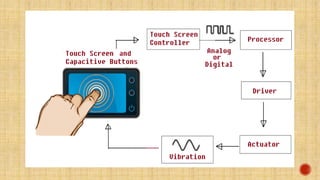
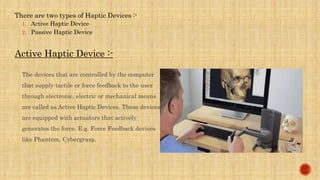
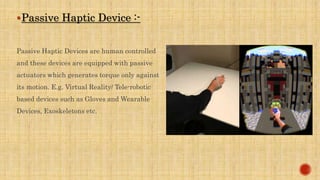
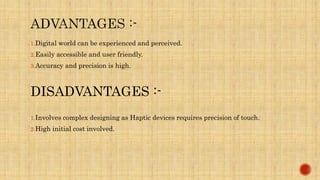
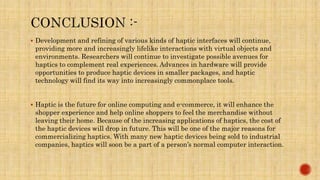
Haptic technology uses tactile feedback and forces to allow users to interact with virtual objects. It works by using touch screens, processors, driver circuits and actuators. There are two types: active haptic devices which supply force feedback, and passive devices which generate torque against motion. Haptics has applications in gaming, medicine, military, assistive technology, museums and more. Advantages include experiencing the digital world accurately, while disadvantages include complex design and high initial costs.
![Presented by:
Harsh Poriya [ IU1882820038 ]
Aashish Pethani [ IU1882820036 ]
IMCA-5th Semester
Department Of Computer Science
IICT , Indus University](https://image.slidesharecdn.com/haptictechnology-200723091021/85/Haptic-technology-1-320.jpg)
![Presented by:
Harsh Poriya [ IU1882820038 ]
Aashish Pethani [ IU1882820036 ]
IMCA-5th Semester
Department Of Computer Science
IICT , Indus University](https://image.slidesharecdn.com/haptictechnology-200723091021/75/Haptic-technology-1-2048.jpg)





![HAPTIC_TECHNOLOGY[1].pptx](https://cdn.slidesharecdn.com/ss_thumbnails/haptictechnology1-221123114420-d6c7e987-thumbnail.jpg?width=640&height=640&fit=bounds)


![谷歌留痕技术 [ 𝙩𝙤𝙥 𝟮𝟯𝟯. 𝙘 𝙤𝙢 ]](https://cdn.slidesharecdn.com/ss_thumbnails/top233-260130174328-3833018c-thumbnail.jpg?width=640&height=640&fit=bounds)


