Haptic
Technology
Content
> Introduction
> Design
> Future Application
> Haptic in Robotics
> Holographic Interaction
> Conclusion
Introduction:
Haptic technology, or haptic, is a tactile feedback
technology which takes advantage of the sense of
touch by applying forces, vibrations, or motions to
the user.
Haptic technology has made it possible to
investigate how the human sense of touch works by
allowing the creation of carefully controlled haptic
virtual objects
Design:
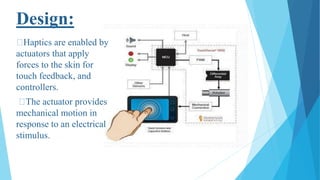
Haptics are enabled by
actuators that apply
forces to the skin for
touch feedback, and
controllers.
The actuator provides
mechanical motion in
response to an electrical
stimulus.
Future Applications:
Current research focuses on the mastery of tactile
interaction with holograms and distant objects, which if
successful may result in applications and advancements in
gaming, movies, manufacturing, medical, and other
industries.
Future advancements in haptic technology may create new
industries that were previously not feasible or realistic.
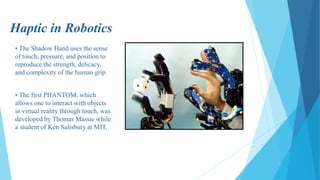
Haptic in Robotics
• The Shadow Hand uses the sense
of touch, pressure, and position to
reproduce the strength, delicacy,
and complexity of the human grip.
• The first PHANTOM, which
allows one to interact with objects
in virtual reality through touch, was
developed by Thomas Massie while
a student of Ken Salisbury at MIT.
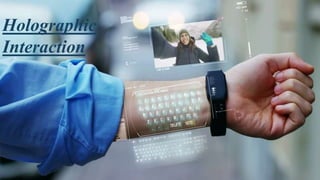
Holographic interaction :Holographic
Interaction
conclusion
Advances in hardware will provide
opportunities to produce haptic devices
in smaller packages, and haptic technology
will find its way into increasingly common
place tools.
Haptic  Technology slideshare

Haptic Technology slideshare

  • 1.
  • 2.
    Content > Introduction > Design >Future Application > Haptic in Robotics > Holographic Interaction > Conclusion
  • 3.
    Introduction: Haptic technology, orhaptic, is a tactile feedback technology which takes advantage of the sense of touch by applying forces, vibrations, or motions to the user. Haptic technology has made it possible to investigate how the human sense of touch works by allowing the creation of carefully controlled haptic virtual objects
  • 4.
    Design: Haptics are enabledby actuators that apply forces to the skin for touch feedback, and controllers. The actuator provides mechanical motion in response to an electrical stimulus.
  • 5.
    Future Applications: Current researchfocuses on the mastery of tactile interaction with holograms and distant objects, which if successful may result in applications and advancements in gaming, movies, manufacturing, medical, and other industries. Future advancements in haptic technology may create new industries that were previously not feasible or realistic.
  • 6.
    Haptic in Robotics •The Shadow Hand uses the sense of touch, pressure, and position to reproduce the strength, delicacy, and complexity of the human grip. • The first PHANTOM, which allows one to interact with objects in virtual reality through touch, was developed by Thomas Massie while a student of Ken Salisbury at MIT.
  • 7.
  • 8.
    conclusion Advances in hardwarewill provide opportunities to produce haptic devices in smaller packages, and haptic technology will find its way into increasingly common place tools.