What Is Haptics?
 ‘Haptics’ is derived from the Greek word ‘haptikos’
which means – ‘being able to come into contact’.
 Haptics is the science of applying touch (tactile) sensation
and control to interact with computer applications.
 Haptics refers to sensing and manipulation throgh touch.
Haptics Technology
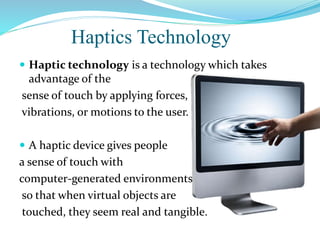
 Haptic technology is a technology which takes
advantage of the
sense of touch by applying forces,
vibrations, or motions to the user.
 A haptic device gives people
a sense of touch with
computer-generated environments,
so that when virtual objects are
touched, they seem real and tangible.
HAPTIC
DEVICES
Virtual
reality/
Telerobotics
based
devices
Feedback
devices
Types of haptic devices
 Exo skeletons and stationary devices
 Gloves and wearable devices
 Point source and specific task devices
 Locomotion interface
 Tactile feedback devices
 Force feedback devices
Exo skeletons
 Current haptic devices that are
classified as exoskeletons are large &
Immoble systems that
the user must attach him- or herself to.
Gloves & wearable devices
 The user can move naturally
without being weighted down
by a large exoskeleton or immobile
device
Point sources&specific task devices
 An interesting application of haptic
feedback is in the form of full body
force feedback called locomotion
interfaces.
 movement of force restriction devices
in a confined space,simulate
unrestrained human mobility such as
walking and running for virtual
reality.
Locomotion interface
 This is a class of devices that are very specialized for performing
a particular given task
 Specialized for performing a particular task.
Haptic devices
1.Phantom
• providing a 3D touch to
the virtual objects
• when the user move
his finger, then he could
really feel the shape and size of the virtual 3D object that
has been already programmed.
• It works monitoring the position of user fingertip or
hand by optical encoder
2.Cyber grasp
• The Cyber Grasp system fits
over the user's entire hand like
an exoskeleton and adds
resistive force feedback to each
finger
• Adapted to different size of the
fingers
• Located on the back of the
hand
Haptics Feedback
 Haptics is implemented through different type of
interactions with a haptic device communicating with
the computer. These interactions can be categorized
into the different types of touch sensations a user can
receive:
1)Tactile Feedback
2)Force Feedback
Tactile Feedback
 Refers to the sensations
felt by the skin.
 It allows the
user to feel things
such as the texture
of surfaces,
temperature and
vibration.
Force Feedback
 Force feedback devices give us some feedback as a type of force
during the interaction. There are many types of devices:
game pads, joysticks, gloves, steering wheels, trackball, mice, etc.
 It reproduces the directional forces that can result from solid
boundaries.
E.g. the weight of virtual objects, inertia, etc.
Uses
 Simulators
 Video games
 Mobile technology
 Robotics
 Medicine
 Research
The application of this technology is used in many fields
such as:
Teleoperators and simulators
 Teleoperators are remote controlled robotic tools.
When robotic tool comes in contact with the object of interest,
then “force feedbacks” are sent back. This haptic technology is
generally used when a scientist wants to investigate a
dangerous substance
e.g. Radioactive material.
A robotic tool is sent instead
and a scientist will get feedback
through force.
 Simulations are commonly used to give a feel of the real event
to a person.
 Haptic simulators are currently used in
medical simulators and flight simulators for pilot training.
Video Games
 Video games
such as car racing games,
using peripherals such as joystics
and steering wheels,
create motion,
give you a virtual simulation of driving a car.
This is done through the use of haptic technology
Medicine
 Haptic teleoperators are used by
surgeons to carry out operations
with the least trauma and
better outcomes for the patient
 Telepresence surgery
Surgeons perform operations
remotely
 “spider-sense” bodysuit,
equipped with ultrasonic sensors and haptic feedback systems, which
alerts the wearer of incoming threats
allowing them to respond to attackers even when blindfolded
Mobile Consumer Technologies
 Haptic feed back (response) is becoming common in
mobile phones.
It enables users to feel
clicks, vibrations and
other tactile input.
 Samsung, dubbed the
Anycall Haptic, features a large touch-screen display just
like the iPhone but provides the user with 22 kinds of
touch sensations.
Military & Robotics
 Military Training in
virtual environment.
 Haptic technology is also
widely used in tele
operation or tele robotics
RoboticsMilitary
Future scope
Holographic interaction
The feedback allows user to interaction the
feedback allows the user to ineract with a
hologram and actually receive tactile
response using acoustic radiation presure
Medical applications
Use of a central workstation from which
surgeons would perform operations in
various locations,with machine set up &
patient preparation performed by local
nursing staff
Textile industry
 User could study & feel the texture and
quality of material during the sale of
cloth through internet
HAPTICS
HAPTICS

HAPTICS

  • 2.
    What Is Haptics? ‘Haptics’ is derived from the Greek word ‘haptikos’ which means – ‘being able to come into contact’.  Haptics is the science of applying touch (tactile) sensation and control to interact with computer applications.  Haptics refers to sensing and manipulation throgh touch.
  • 3.
    Haptics Technology  Haptictechnology is a technology which takes advantage of the sense of touch by applying forces, vibrations, or motions to the user.  A haptic device gives people a sense of touch with computer-generated environments, so that when virtual objects are touched, they seem real and tangible.
  • 4.
  • 5.
    Types of hapticdevices  Exo skeletons and stationary devices  Gloves and wearable devices  Point source and specific task devices  Locomotion interface  Tactile feedback devices  Force feedback devices
  • 6.
    Exo skeletons  Currenthaptic devices that are classified as exoskeletons are large & Immoble systems that the user must attach him- or herself to. Gloves & wearable devices  The user can move naturally without being weighted down by a large exoskeleton or immobile device
  • 7.
    Point sources&specific taskdevices  An interesting application of haptic feedback is in the form of full body force feedback called locomotion interfaces.  movement of force restriction devices in a confined space,simulate unrestrained human mobility such as walking and running for virtual reality. Locomotion interface  This is a class of devices that are very specialized for performing a particular given task  Specialized for performing a particular task.
  • 8.
    Haptic devices 1.Phantom • providinga 3D touch to the virtual objects • when the user move his finger, then he could really feel the shape and size of the virtual 3D object that has been already programmed. • It works monitoring the position of user fingertip or hand by optical encoder
  • 9.
    2.Cyber grasp • TheCyber Grasp system fits over the user's entire hand like an exoskeleton and adds resistive force feedback to each finger • Adapted to different size of the fingers • Located on the back of the hand
  • 10.
    Haptics Feedback  Hapticsis implemented through different type of interactions with a haptic device communicating with the computer. These interactions can be categorized into the different types of touch sensations a user can receive: 1)Tactile Feedback 2)Force Feedback
  • 11.
    Tactile Feedback  Refersto the sensations felt by the skin.  It allows the user to feel things such as the texture of surfaces, temperature and vibration.
  • 12.
    Force Feedback  Forcefeedback devices give us some feedback as a type of force during the interaction. There are many types of devices: game pads, joysticks, gloves, steering wheels, trackball, mice, etc.  It reproduces the directional forces that can result from solid boundaries. E.g. the weight of virtual objects, inertia, etc.
  • 13.
    Uses  Simulators  Videogames  Mobile technology  Robotics  Medicine  Research The application of this technology is used in many fields such as:
  • 14.
    Teleoperators and simulators Teleoperators are remote controlled robotic tools. When robotic tool comes in contact with the object of interest, then “force feedbacks” are sent back. This haptic technology is generally used when a scientist wants to investigate a dangerous substance e.g. Radioactive material. A robotic tool is sent instead and a scientist will get feedback through force.  Simulations are commonly used to give a feel of the real event to a person.  Haptic simulators are currently used in medical simulators and flight simulators for pilot training.
  • 15.
    Video Games  Videogames such as car racing games, using peripherals such as joystics and steering wheels, create motion, give you a virtual simulation of driving a car. This is done through the use of haptic technology
  • 16.
    Medicine  Haptic teleoperatorsare used by surgeons to carry out operations with the least trauma and better outcomes for the patient  Telepresence surgery Surgeons perform operations remotely  “spider-sense” bodysuit, equipped with ultrasonic sensors and haptic feedback systems, which alerts the wearer of incoming threats allowing them to respond to attackers even when blindfolded
  • 17.
    Mobile Consumer Technologies Haptic feed back (response) is becoming common in mobile phones. It enables users to feel clicks, vibrations and other tactile input.  Samsung, dubbed the Anycall Haptic, features a large touch-screen display just like the iPhone but provides the user with 22 kinds of touch sensations.
  • 18.
    Military & Robotics Military Training in virtual environment.  Haptic technology is also widely used in tele operation or tele robotics RoboticsMilitary
  • 19.
    Future scope Holographic interaction Thefeedback allows user to interaction the feedback allows the user to ineract with a hologram and actually receive tactile response using acoustic radiation presure Medical applications Use of a central workstation from which surgeons would perform operations in various locations,with machine set up & patient preparation performed by local nursing staff Textile industry  User could study & feel the texture and quality of material during the sale of cloth through internet