HAPTICS 
TECHNOLOGY 
(TOUCH THE VIRTUAL)
INTRODUCTION 
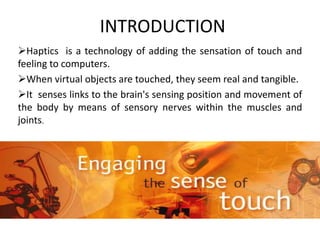
Haptics is a technology of adding the sensation of touch and 
feeling to computers. 
When virtual objects are touched, they seem real and tangible. 
It senses links to the brain's sensing position and movement of 
the body by means of sensory nerves within the muscles and 
joints.
HAPTICS…??? 
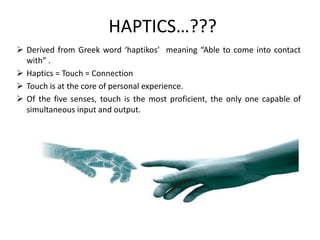
 Derived from Greek word ‘haptikos’ meaning “Able to come into contact 
with” . 
 Haptics = Touch = Connection 
 Touch is at the core of personal experience. 
 Of the five senses, touch is the most proficient, the only one capable of 
simultaneous input and output.
VIRTUAL REALITY 
 Virtual reality is a form of human-computer interaction 
providing a virtual environment that one can explore through 
direct interaction with our senses.
THE REAL WORLD 
 User should be able to touch the virtual object and feel a 
response from it. 
 In order to complete the imitation of the real world one 
should be able to interact with the environment and get a 
feedback. 
 This feedback is called Haptic Feedback.
SYSTEM CONFIGURATION 
4 
3 
2 
2 
4 3 
1 
1 
End effector 
Hand 
Actuators 
Muscles 
Sensors 
Virtual object 
Machine 
Human 
Computer 
haptics 
Sensors
WORKING PRINCIPLE 
 Basically a haptic system consist of two parts namely the 
human part and the machine part. 
 In the figure shown above, the human part (left) senses and 
controls the position of the hand, while the machine part 
(right) exerts forces from the hand to simulate contact with a 
virtual object. 
 Also both the systems will be provided with necessary 
sensors, processors and actuators.
WORKING PRINCIPLE 
 In the case of the human system, nerve receptors performs 
sensing, brain performs processing and muscles performs 
actuation of the motion performed by the hand. 
 While in the case of the machine system, the above 
mentioned functions are performed by the encoders, 
computer and motors respectively.
HAPTIC DEVICES 
PHANTOM INTERFACE CYBER GRASP SYSTEM
COMMONLY USED HAPTIC DEVICES 
1. PHANTOM 
 providing a 3D touch to the 
virtual objects 
 provides 6 d.o.f 
 when the user move his finger, 
then he could really feel the 
shape and size of the virtual 3D 
object that has been already 
programmed 
 virtual 3 dimensional space in 
which the phantom operates is 
called haptic scene
PHANTOM WORKING
CYBER GRASP 
 The Cyber Grasp system fits over the 
user's entire hand like an exoskeleton 
and adds resistive force feedback to 
each finger 
 Allows 4 dof for each finger 
 Adapted to different size of the fingers 
 Located on the back of the hand. 
 Measure finger angular flexion (The 
measure of the joint angles are 
independent and can have a good 
resolution given the important paths 
traveled by the cables when the finger 
shut
INTERESTING FACTS 
 Most of us would have experience the use of this technology 
in movies like iron man ,avatar . 
 Disney Research, Pittsburg (DRP) has shown off a 
revolutionary technology called ‘Surround Haptic’ that can 
bring real life experience in video gaming and film watching. 
 In Apple IPhone 6 For advance vibration unit they have used 
haptic technology . 
 Haptic is designed to give tactile sensations to people who 
are using motion control devices. The device can track a 
target, like a user's hand, and send a compressed ring of air 
quickly through the intervening space to provide haptic 
feedback.
LIMITATIONS 
 High cost involved 
 Large weight and size of haptic devices (especially wearable 
ones) 
 Haptic interfaces can only exert forces with limited magnitude 
and not equally well in all directions 
 Haptic-rendering algorithms operate in discrete time whereas 
users operate in continuous time
FUTURE VISION 
 Holographic Interaction 
The feedback allows the user to interact with a hologram and 
actually receive tactile response using acoustic radiation 
pressure. 
 Medical Application 
Use of a central workstation from which surgeons would 
perform operations in various locations; with machine setup and 
patient preparation performed by local nursing staff . 
 Textile Industry 
User could study and feel the texture and quality of material 
during the sale of cloth through internet.
APPLICATIONS 
 Entertainment- 
Computer and video games - 
It is used to enhance the gaming 
experience .Haptic feedback is 
commonly used in arcade games, 
especially racing video games. It is also 
used in movies. 
 Virtual Surgery – we can do virtual 
surgery by using haptic technology .
APPLICATIONS
APPLICATIONS 
 Personal computers- 
Apple's MacBook and 
MacBook Pro started 
incorporating a 
"Tactile Touchpad" design. 
 Mobile devices- 
Tactile haptic feedback 
is becoming common 
in cellular devices. Nokia 
and LG implemented 
it using piezoelectric 
sensor pads.
CONCLUSION 
 Haptic Technology is the only solution which provides high 
range of interaction that cannot be provided by virtual reality. 
 Continued implementation of tactile devices to aid people 
with disabilities will advance further. 
 Todays, commercial success of haptic has been in the areas of 
entertainment, medical simulation, and design, although new 
devices and applications are regularly appearing. 
 Haptic technology will make the future world as a sensible 
one.

HAPTICS TECHNOLOGY

  • 1.
  • 2.
    INTRODUCTION Haptics isa technology of adding the sensation of touch and feeling to computers. When virtual objects are touched, they seem real and tangible. It senses links to the brain's sensing position and movement of the body by means of sensory nerves within the muscles and joints.
  • 3.
    HAPTICS…???  Derivedfrom Greek word ‘haptikos’ meaning “Able to come into contact with” .  Haptics = Touch = Connection  Touch is at the core of personal experience.  Of the five senses, touch is the most proficient, the only one capable of simultaneous input and output.
  • 4.
    VIRTUAL REALITY Virtual reality is a form of human-computer interaction providing a virtual environment that one can explore through direct interaction with our senses.
  • 5.
    THE REAL WORLD  User should be able to touch the virtual object and feel a response from it.  In order to complete the imitation of the real world one should be able to interact with the environment and get a feedback.  This feedback is called Haptic Feedback.
  • 6.
    SYSTEM CONFIGURATION 4 3 2 2 4 3 1 1 End effector Hand Actuators Muscles Sensors Virtual object Machine Human Computer haptics Sensors
  • 7.
    WORKING PRINCIPLE Basically a haptic system consist of two parts namely the human part and the machine part.  In the figure shown above, the human part (left) senses and controls the position of the hand, while the machine part (right) exerts forces from the hand to simulate contact with a virtual object.  Also both the systems will be provided with necessary sensors, processors and actuators.
  • 8.
    WORKING PRINCIPLE In the case of the human system, nerve receptors performs sensing, brain performs processing and muscles performs actuation of the motion performed by the hand.  While in the case of the machine system, the above mentioned functions are performed by the encoders, computer and motors respectively.
  • 9.
    HAPTIC DEVICES PHANTOMINTERFACE CYBER GRASP SYSTEM
  • 10.
    COMMONLY USED HAPTICDEVICES 1. PHANTOM  providing a 3D touch to the virtual objects  provides 6 d.o.f  when the user move his finger, then he could really feel the shape and size of the virtual 3D object that has been already programmed  virtual 3 dimensional space in which the phantom operates is called haptic scene
  • 11.
  • 12.
    CYBER GRASP The Cyber Grasp system fits over the user's entire hand like an exoskeleton and adds resistive force feedback to each finger  Allows 4 dof for each finger  Adapted to different size of the fingers  Located on the back of the hand.  Measure finger angular flexion (The measure of the joint angles are independent and can have a good resolution given the important paths traveled by the cables when the finger shut
  • 13.
    INTERESTING FACTS Most of us would have experience the use of this technology in movies like iron man ,avatar .  Disney Research, Pittsburg (DRP) has shown off a revolutionary technology called ‘Surround Haptic’ that can bring real life experience in video gaming and film watching.  In Apple IPhone 6 For advance vibration unit they have used haptic technology .  Haptic is designed to give tactile sensations to people who are using motion control devices. The device can track a target, like a user's hand, and send a compressed ring of air quickly through the intervening space to provide haptic feedback.
  • 14.
    LIMITATIONS  Highcost involved  Large weight and size of haptic devices (especially wearable ones)  Haptic interfaces can only exert forces with limited magnitude and not equally well in all directions  Haptic-rendering algorithms operate in discrete time whereas users operate in continuous time
  • 15.
    FUTURE VISION Holographic Interaction The feedback allows the user to interact with a hologram and actually receive tactile response using acoustic radiation pressure.  Medical Application Use of a central workstation from which surgeons would perform operations in various locations; with machine setup and patient preparation performed by local nursing staff .  Textile Industry User could study and feel the texture and quality of material during the sale of cloth through internet.
  • 16.
    APPLICATIONS  Entertainment- Computer and video games - It is used to enhance the gaming experience .Haptic feedback is commonly used in arcade games, especially racing video games. It is also used in movies.  Virtual Surgery – we can do virtual surgery by using haptic technology .
  • 17.
  • 18.
    APPLICATIONS  Personalcomputers- Apple's MacBook and MacBook Pro started incorporating a "Tactile Touchpad" design.  Mobile devices- Tactile haptic feedback is becoming common in cellular devices. Nokia and LG implemented it using piezoelectric sensor pads.
  • 19.
    CONCLUSION  HapticTechnology is the only solution which provides high range of interaction that cannot be provided by virtual reality.  Continued implementation of tactile devices to aid people with disabilities will advance further.  Todays, commercial success of haptic has been in the areas of entertainment, medical simulation, and design, although new devices and applications are regularly appearing.  Haptic technology will make the future world as a sensible one.