Under the guidance of
Mr. P. Srinivas
Associate Professor
PRESENTED BY
G.UTTAM NETHA
20J21A1211
TECHNICAL SEMINAR ON
HAPTIC TECHNOLOGY
DEPARTMENT OF INFORMATION TECHNOLOGY
CONTENTS
1. INTRODUCTION
2. HAPTICS
3. HISTORY
4. MECHANISM
5. GENEARTION OF HAPTIC
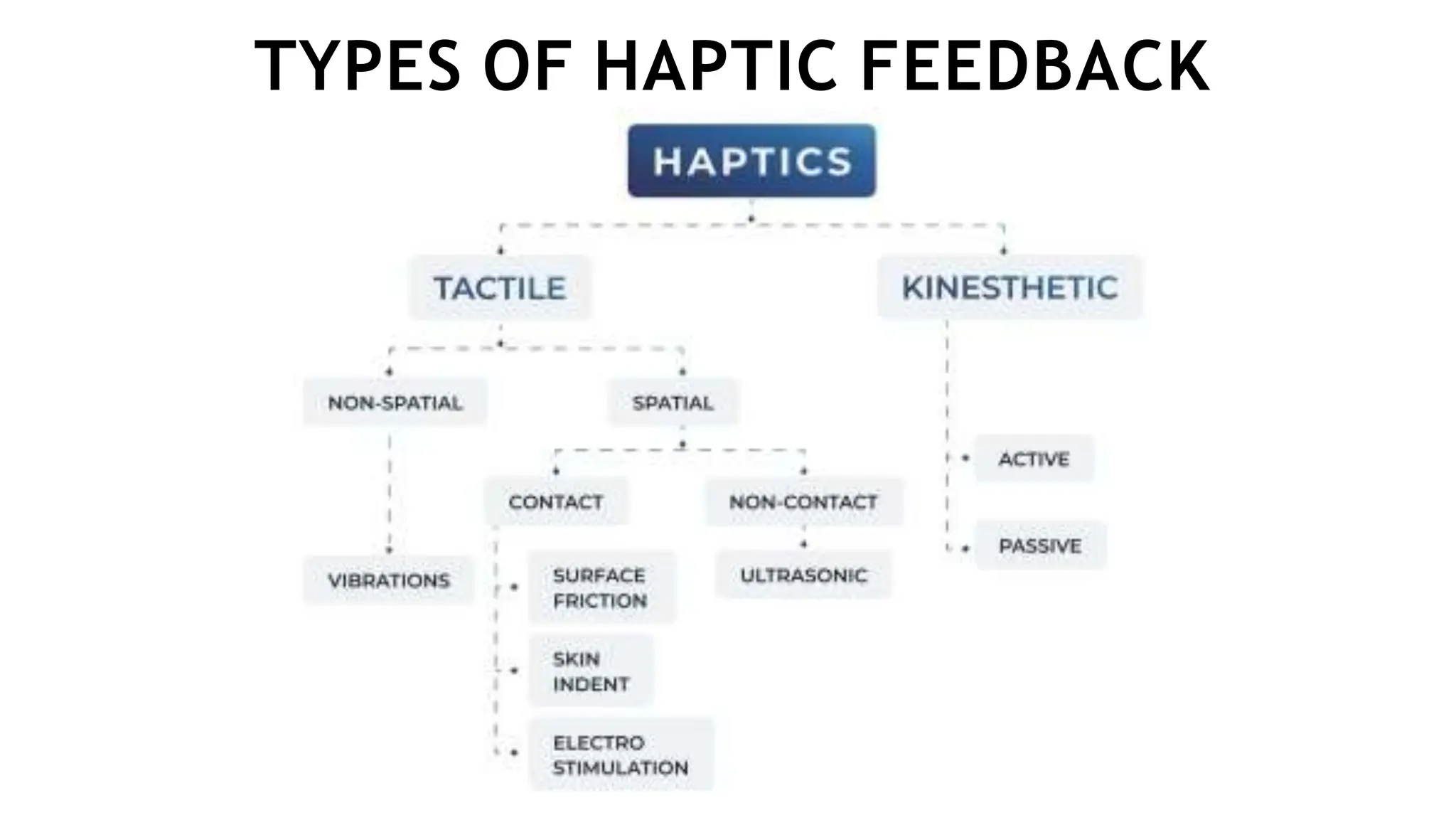
6. TYPES OF HAPTIC FEEDBACK
7. APPLICATIONS
8. ADVANTAGES
9. DISADVANTAGES
10. FUTURE DEVELOPMENTS
11. CONCLUSION
INTRODUCTION
Haptic technology, also
known askinaestheticcommunication
or3D touch ,refers to any technology
that can create an experience of
touch by applying forces,vibrations or
motions to the user
These technologies can be used to
create virtual objects in a
computer simulation, to control
virtual objects, and to enhance
remote control of machines and
devices telerobotics.
HAPTICS
Derived from Greek word
“haptikos” meaning “able to into
contact with.” Haptic = touch =
connection.
Touch is at the core of
personal experience.
Touch is the most
proficient, the only one
capable of simultaneous input
and output.
HISTORY
RADIOACTIVE BEGINNINGS
The beginning of Haptics Technology can be
traced back to a mechanical solution created
in response to the problem of an abundance
of radioactive material post-WWII.
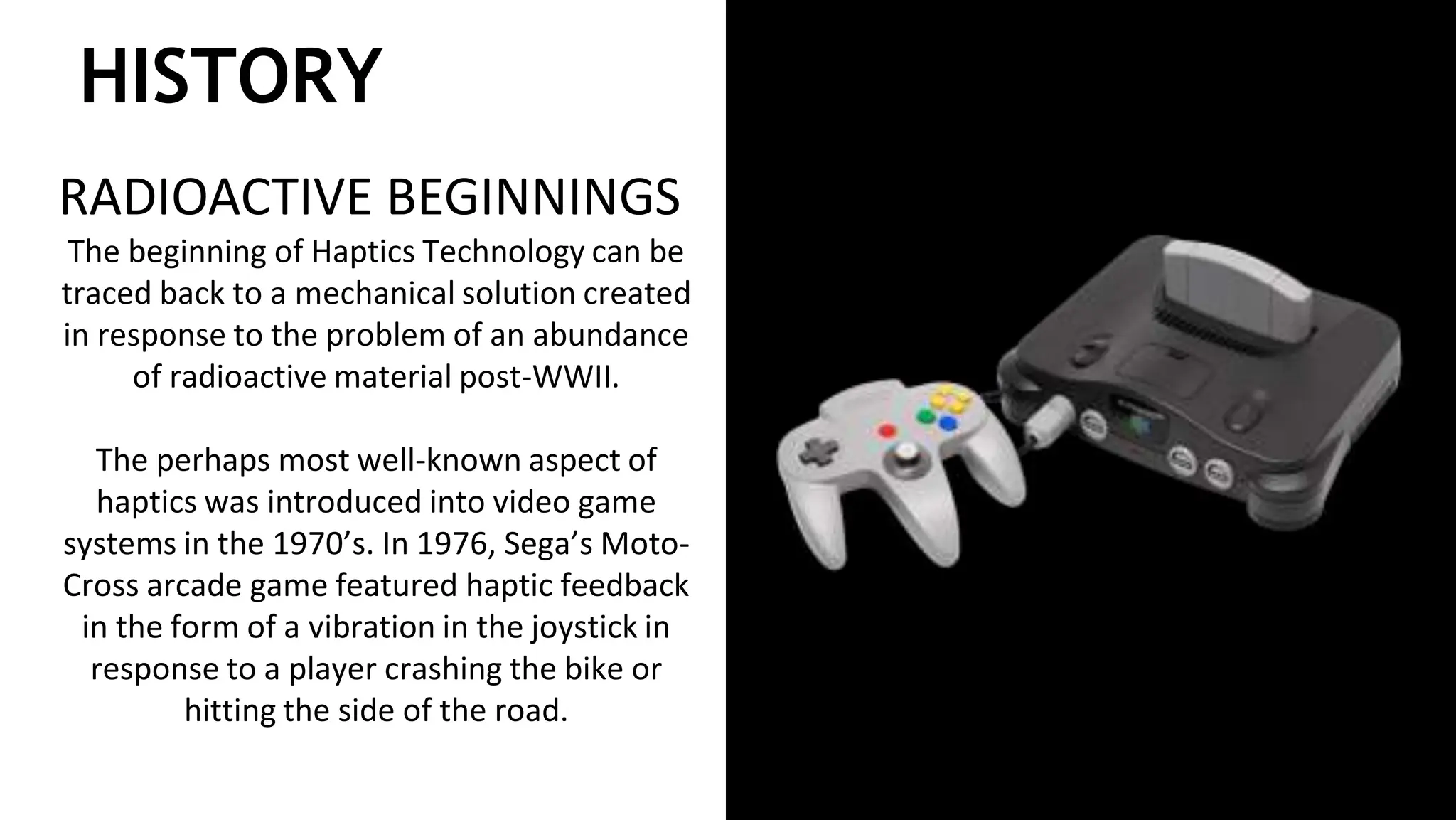
The perhaps most well-known aspect of
haptics was introduced into video game
systems in the 1970’s. In 1976, Sega’s Moto-
Cross arcade game featured haptic feedback
in the form of a vibration in the joystick in
response to a player crashing the bike or
hitting the side of the road.
MECHANISM
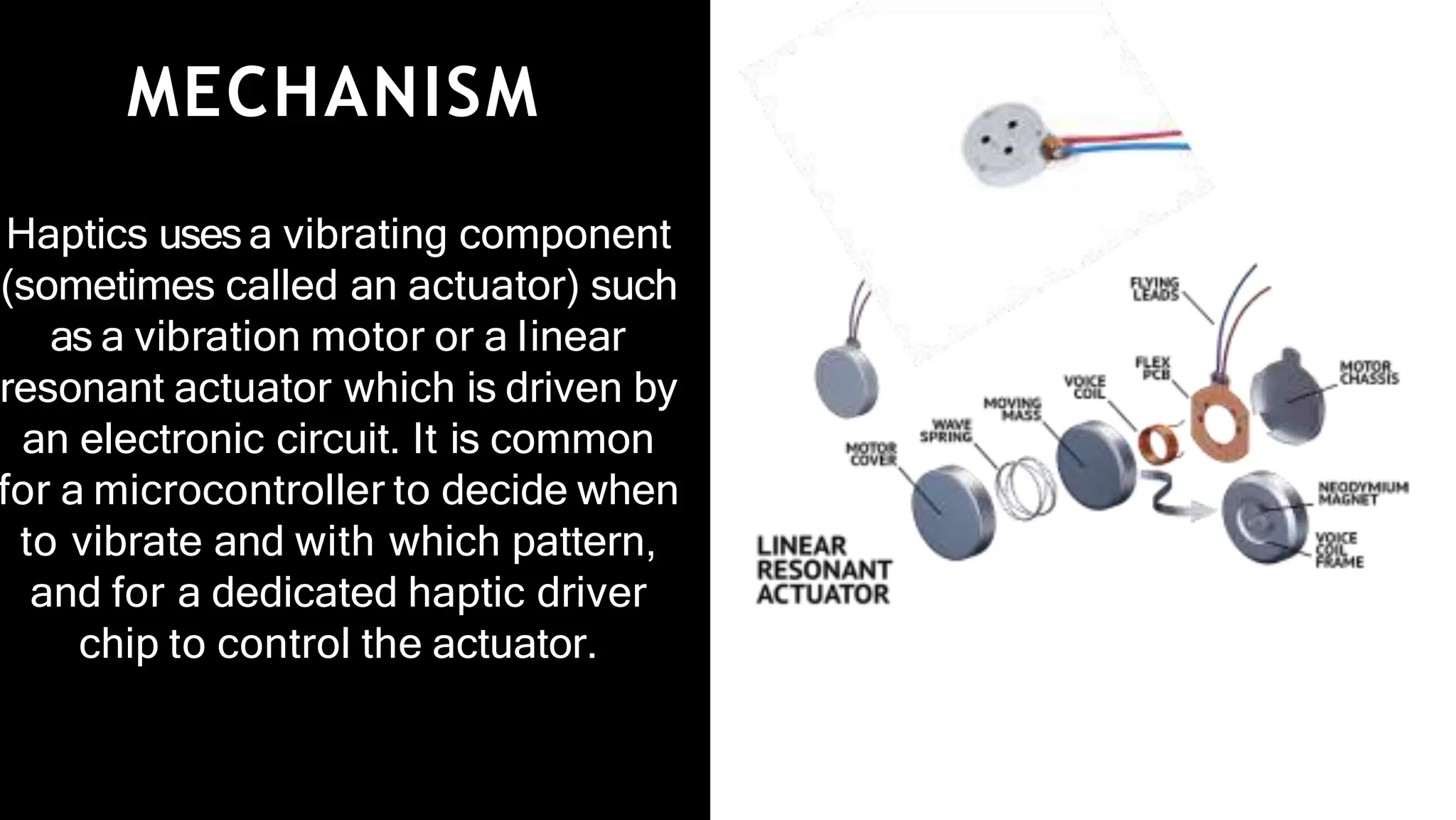
Haptics usesa vibrating component
(sometimes called an actuator) such
as a vibration motor or a linear
resonant actuator which is driven by
an electronic circuit. It is common
for a microcontroller to decide when
to vibrate and with which pattern,
and for a dedicated haptic driver
chip to control the actuator.
GENERATION OF
HAPTICS
First generation - use of electromagnetic
technologies which produce a limited
range of sensations
Second generation-touch-coordinate
specific responses allowing the haptic
e‫ل‬ects to be localized to the position on a
screen or touch panel, rather than the
whole device
Third generation - delivers
both touch-coordinate
specific responses and
customizable haptics
Fourth generation - pressure
sensitivity, i.e. how hard you
press on a flat surface can
a‫ل‬ect the response
TYPES OF HAPTIC FEEDBACK
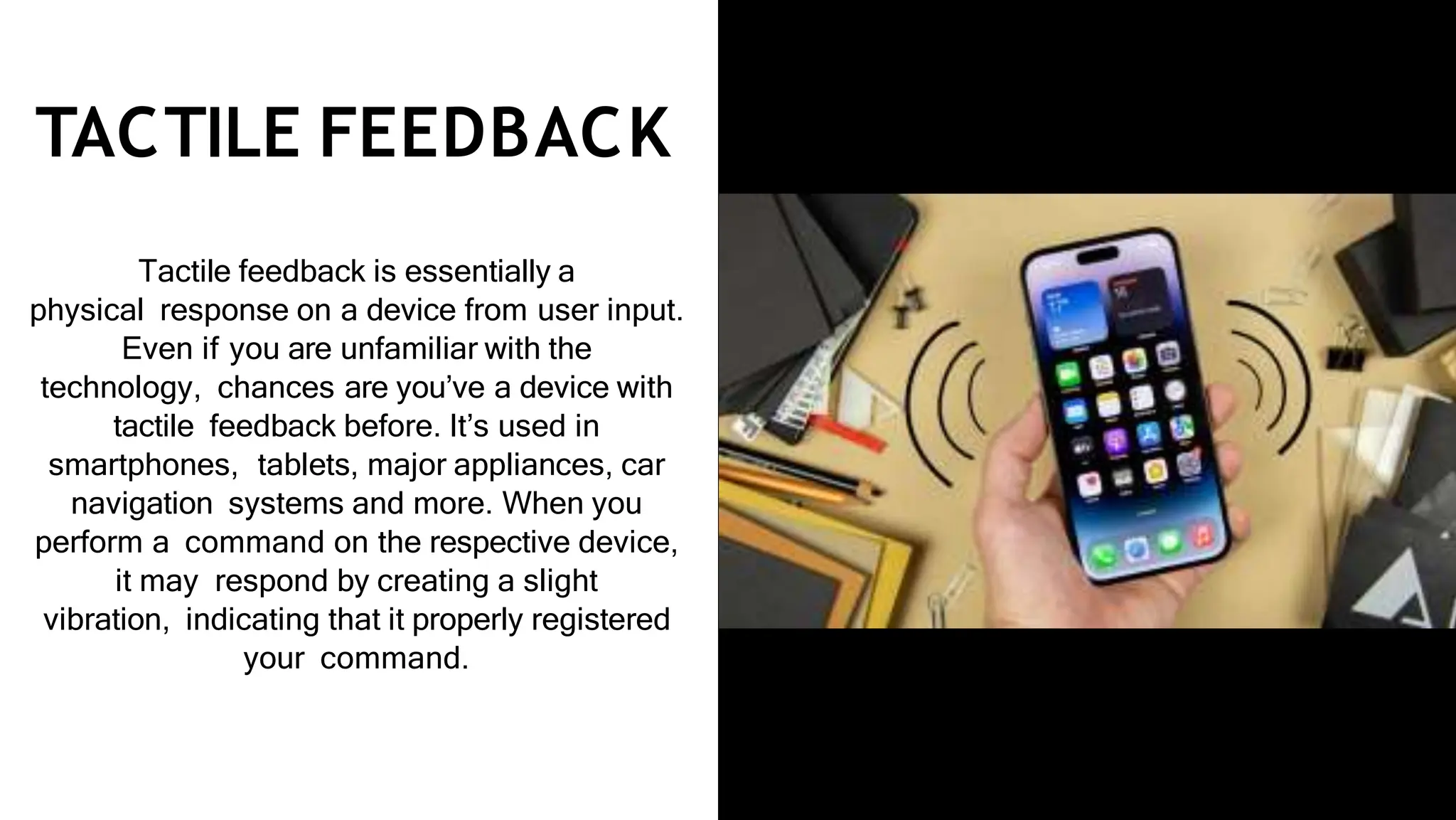
TACTILE FEEDBACK
Tactile feedback is essentially a
physical response on a device from user input.
Even if you are unfamiliar with the
technology, chances are you’ve a device with
tactile feedback before. It’s used in
smartphones, tablets, major appliances, car
navigation systems and more. When you
perform a command on the respective device,
it may respond by creating a slight
vibration, indicating that it properly registered
your command.
KINESTHETIC
FEEDBACK
Kinesthetic haptic feedback is actually a type of
contact that imitates real-world factors
or weight loads. This can be beneficial
when controlling a vehicle or perhaps
controlling online objects in a game.
Vibrotactile feedback is yet another common
sort of haptic technology. It’s employed in
mobile phones, steering wheels, and
game controllers. It uses heurt to mimic the
skin’s movement.
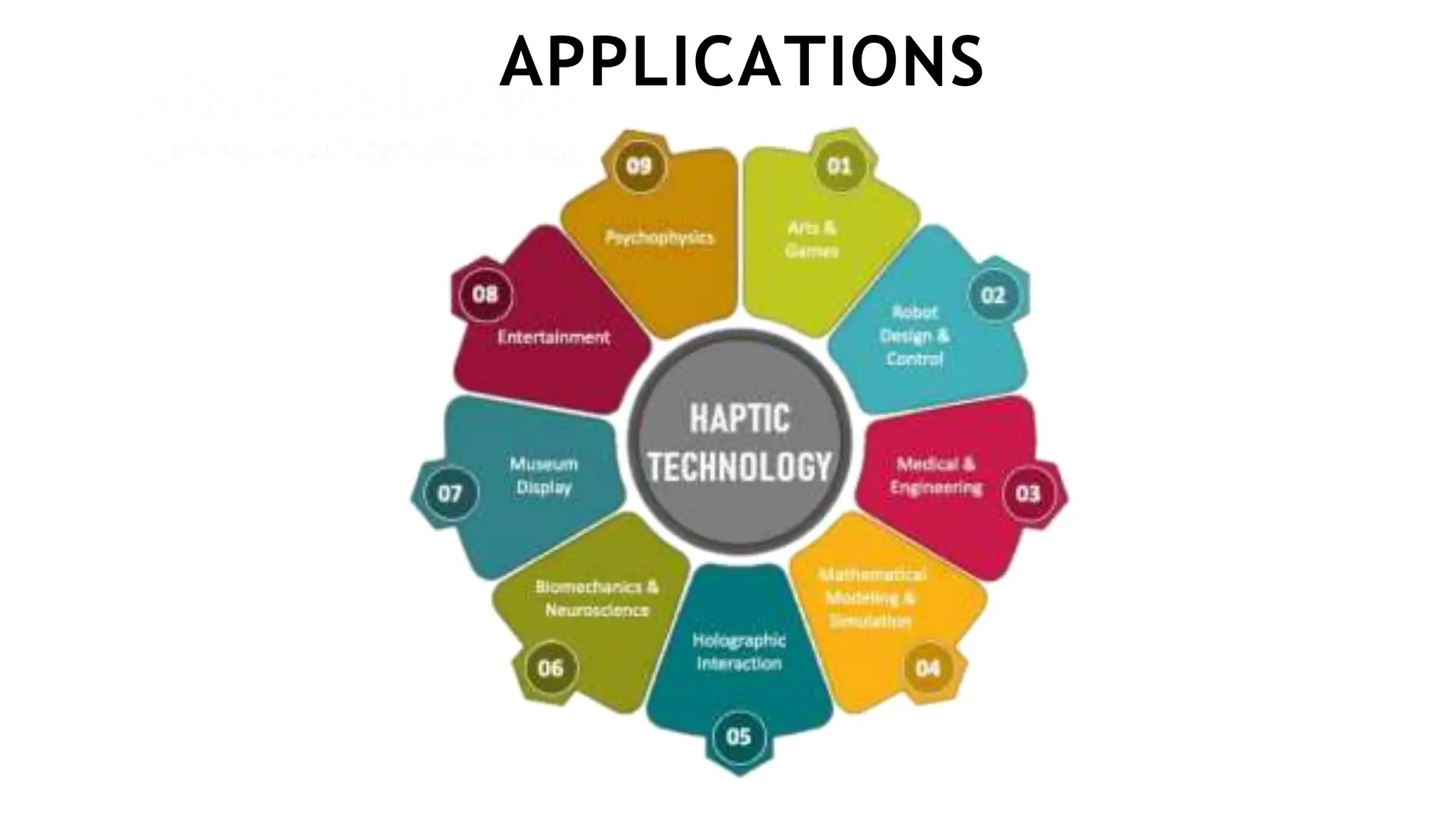
APPLICATIONS
GAMING
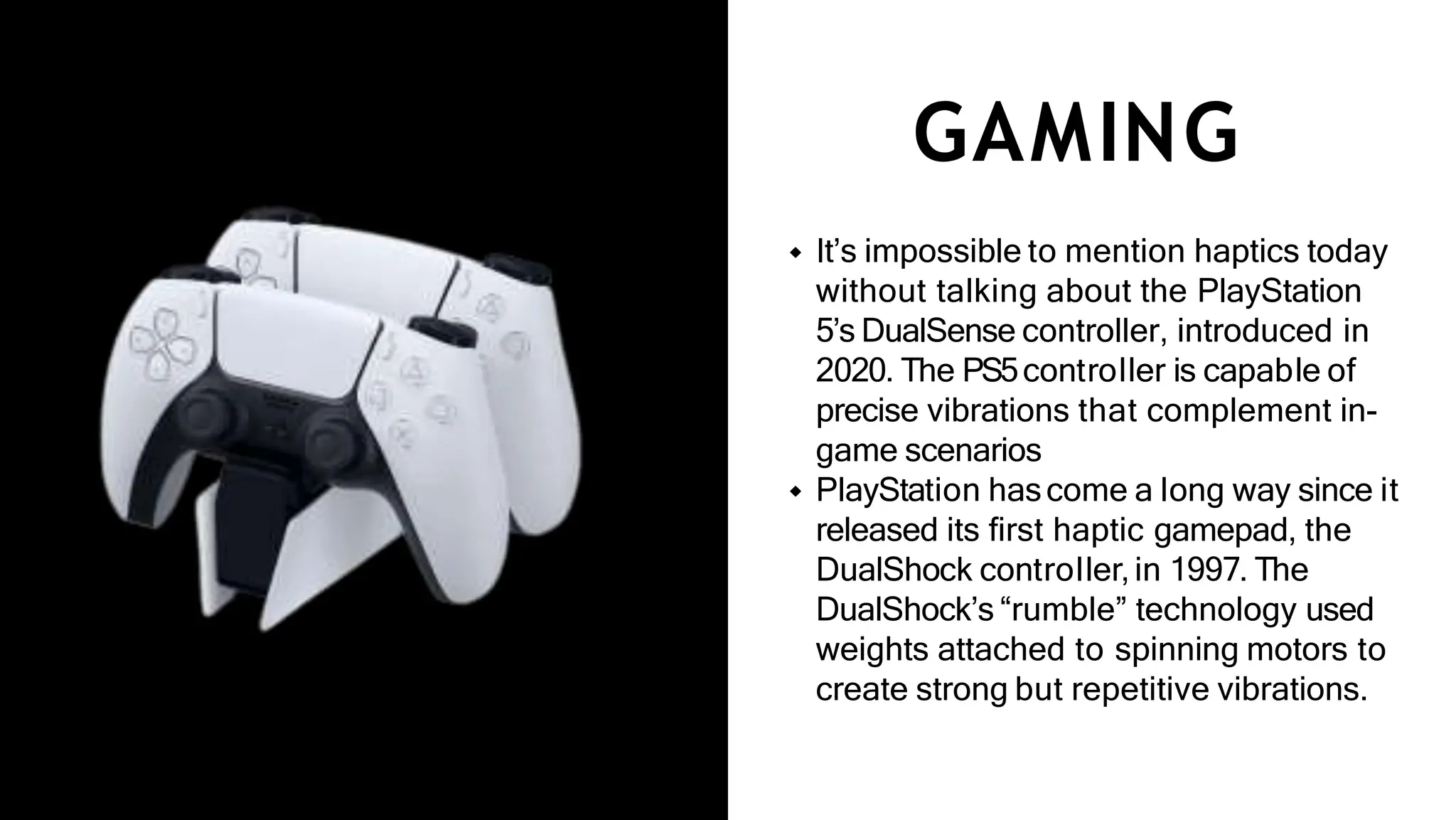
It’s impossible to mention haptics today
without talking about the PlayStation
5’s DualSense controller, introduced in
2020. The PS5controller is capable of
precise vibrations that complement in-
game scenarios
PlayStation hascome a long way since it
released its first haptic gamepad, the
DualShock controller,in 1997. The
DualShock’s “rumble” technology used
weights attached to spinning motors to
create strong but repetitive vibrations.
VIRTUAL REALITY
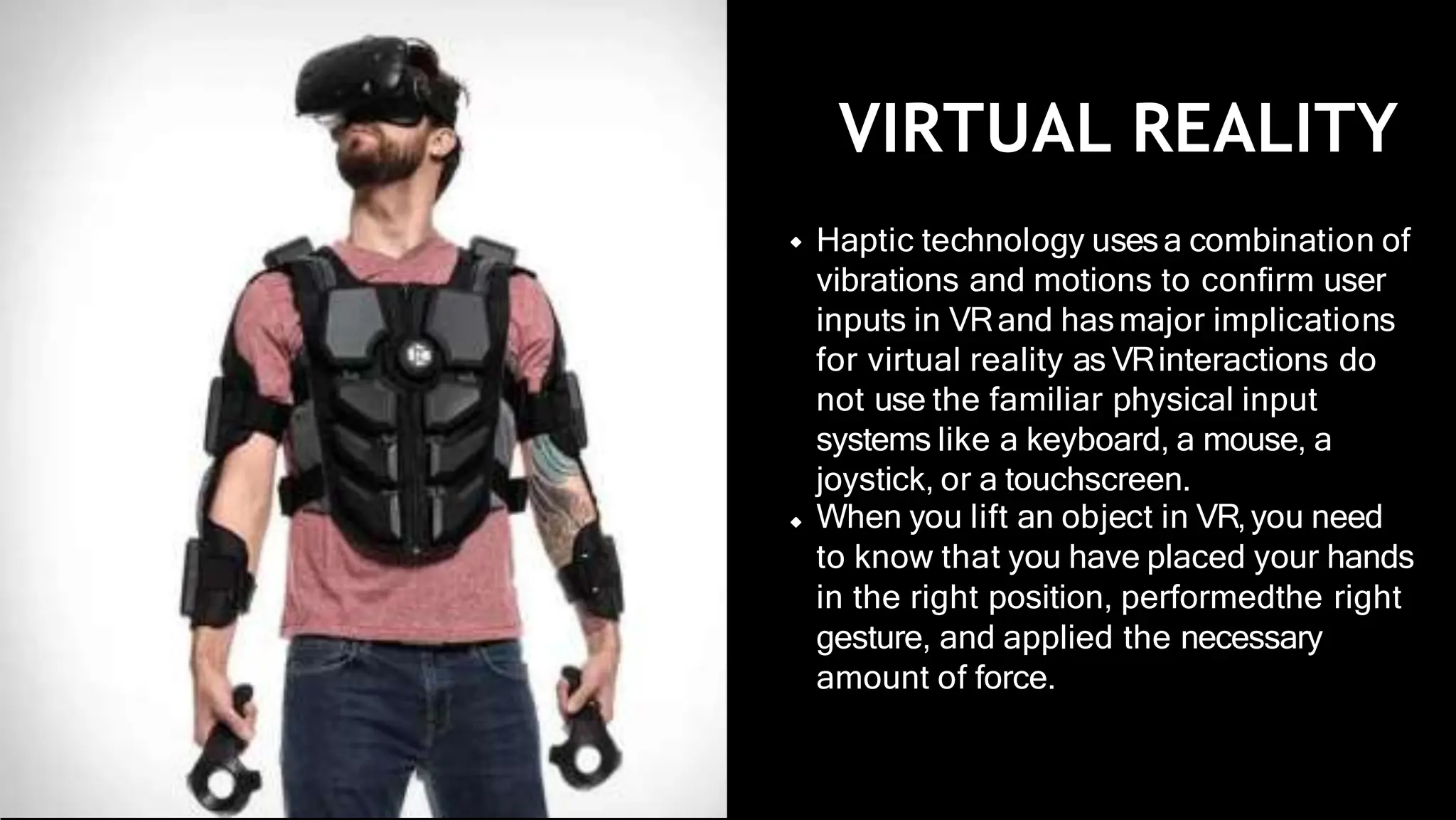
Haptic technology usesa combination of
vibrations and motions to confirm user
inputs in VRand hasmajor implications
for virtual reality as VRinteractions do
not use the familiar physical input
systems like a keyboard, a mouse, a
joystick, or a touchscreen.
When you lift an object in VR,you need
to know that you have placed your hands
in the right position, performedthe right
gesture, and applied the necessary
amount of force.
MEDICAL FIELD
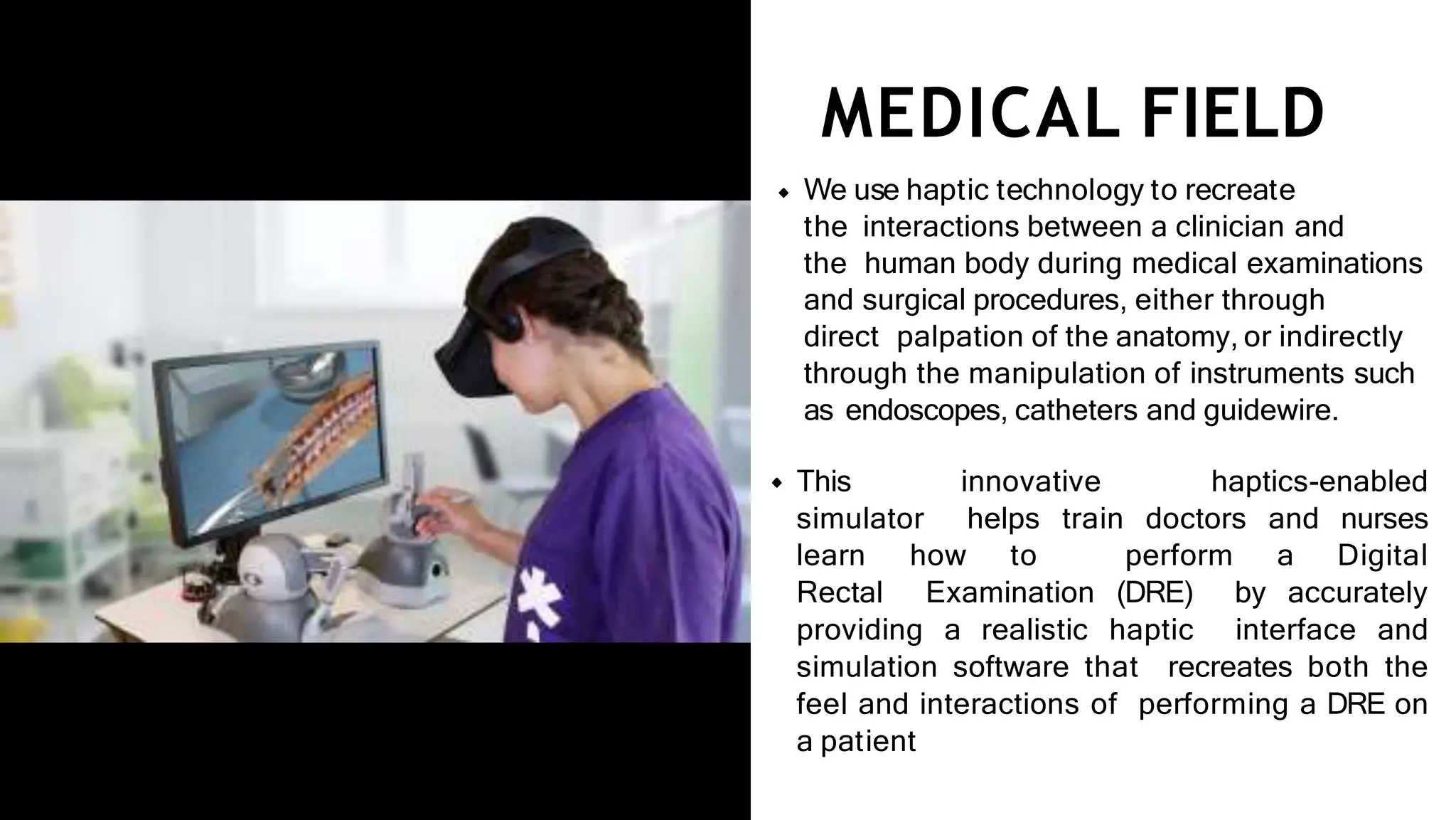
We use haptic technology to recreate
the interactions between a clinician and
the human body during medical examinations
and surgical procedures, either through
direct palpation of the anatomy, or indirectly
through the manipulation of instruments such
as endoscopes, catheters and guidewire.
This innovative haptics-enabled
simulator helps train doctors and nurses
learn how to perform a Digital
Rectal Examination (DRE) by accurately
providing a realistic haptic interface and
simulation software that recreates both the
feel and interactions of performing a DRE on
a patient
AUTOMOTIVE INDUSTRY
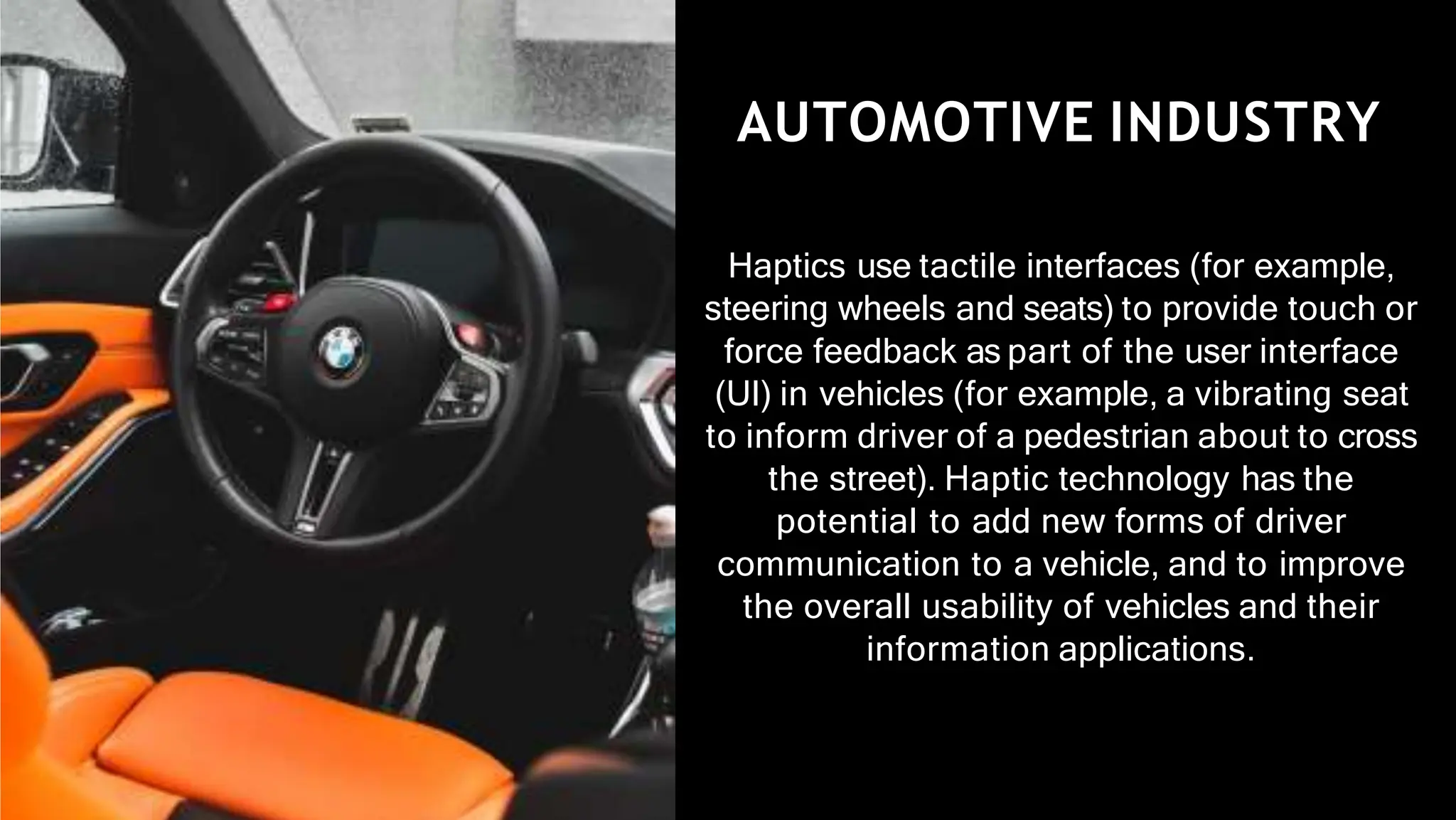
Haptics use tactile interfaces (for example,
steering wheels and seats) to provide touch or
force feedback as part of the user interface
(UI) in vehicles (for example, a vibrating seat
to inform driver of a pedestrian about to cross
the street). Haptic technology has the
potential to add new forms of driver
communication to a vehicle, and to improve
the overall usability of vehicles and their
information applications.
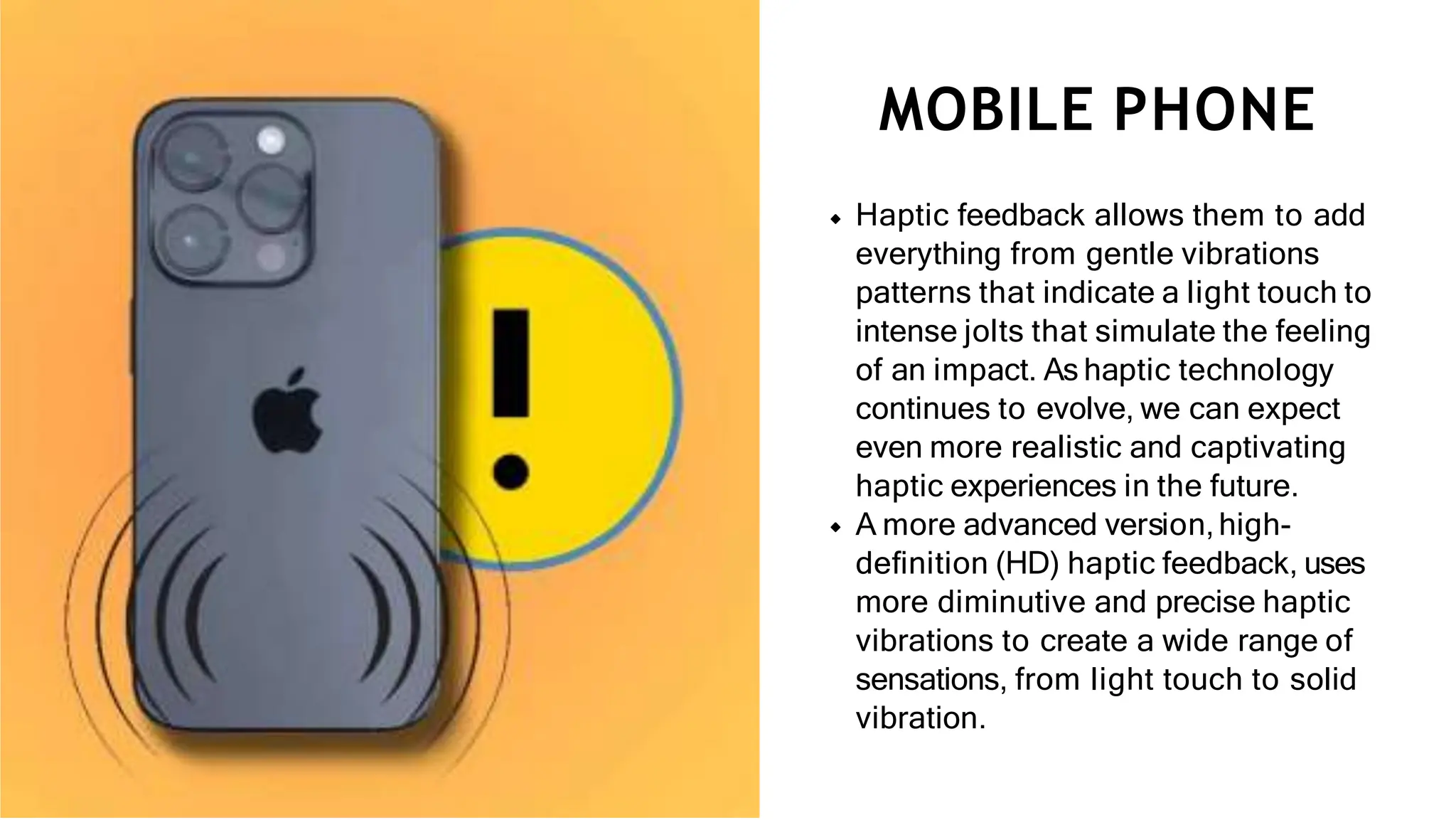
Haptic feedback allows them to add
everything from gentle vibrations
patterns that indicate a light touch to
intense jolts that simulate the feeling
of an impact. As haptic technology
continues to evolve, we can expect
even more realistic and captivating
haptic experiences in the future.
A more advanced version,high-
definition (HD) haptic feedback, uses
more diminutive and precise haptic
vibrations to create a wide range of
sensations, from light touch to solid
vibration.
MOBILE PHONE
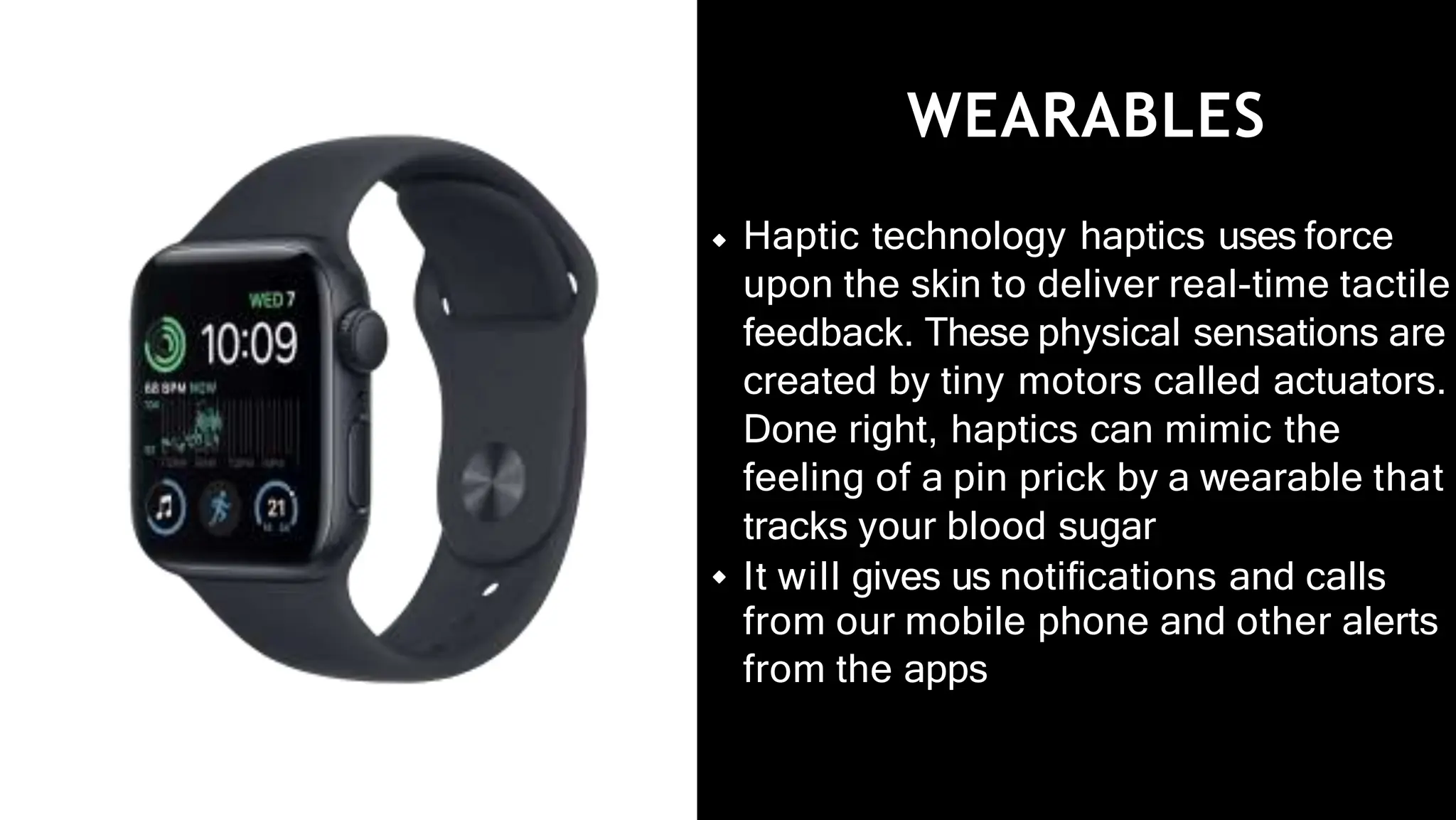
WEARABLES
Haptic technology haptics uses force
upon the skin to deliver real-time tactile
feedback. These physical sensations are
created by tiny motors called actuators.
Done right, haptics can mimic the
feeling of a pin prick by a wearable that
tracks your blood sugar
It will gives us notifications and calls
from our mobile phone and other alerts
from the apps
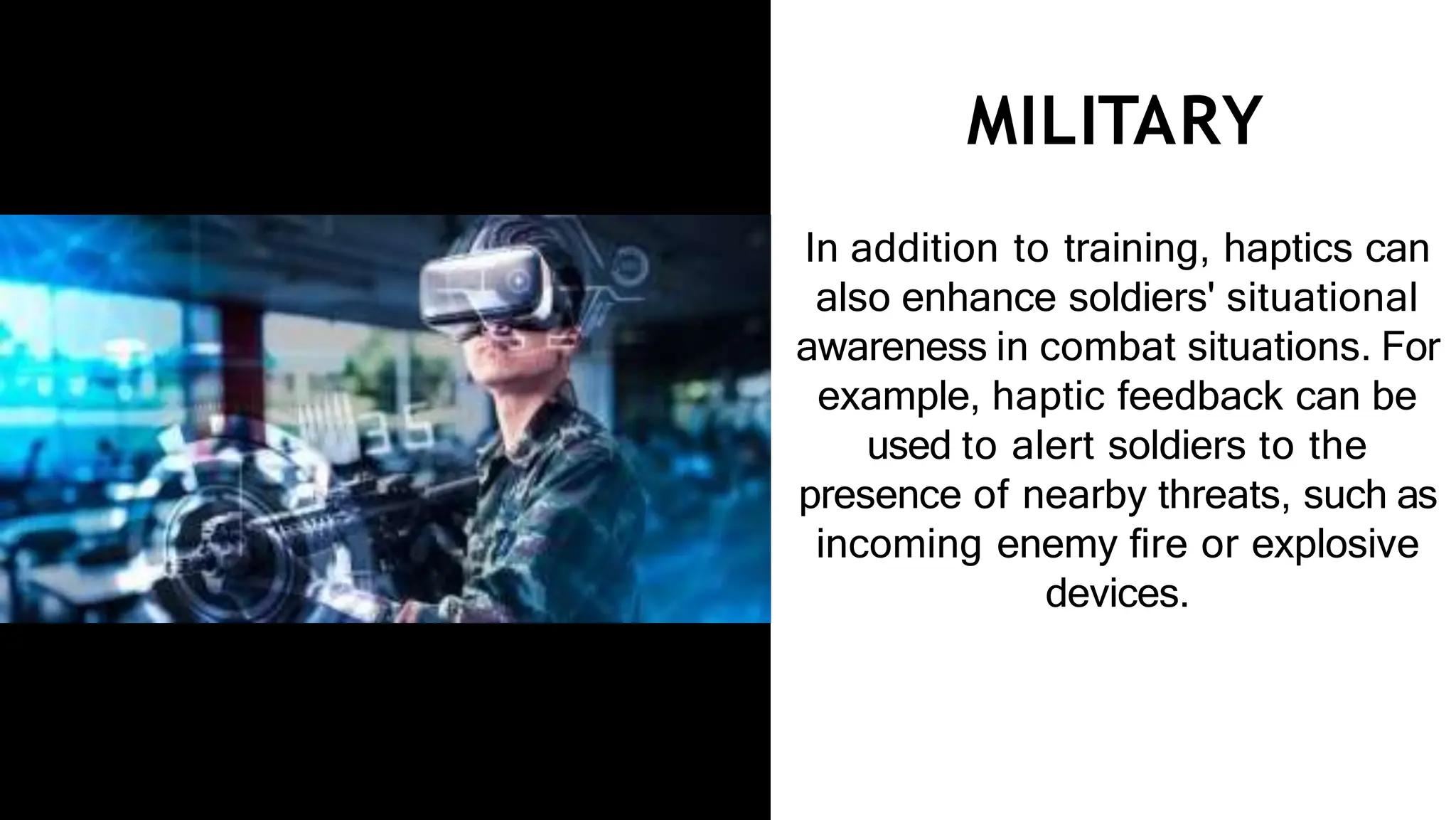
MILITARY
In addition to training, haptics can
also enhance soldiers' situational
awareness in combat situations. For
example, haptic feedback can be
used to alert soldiers to the
presence of nearby threats, such as
incoming enemy fire or explosive
devices.
AVIATION
Haptic feedback can be used to alert
passengers to safety instructions, such as
fastening their seatbelt or the correct
use of emergency equipment. This can
help to reduce the risk of accidents and
improve the overall safety of air travel.
Additionally, haptic feedback can be used
to provide information to pilots, such as
warnings about potential hazards or
flight information.
ADVANTAGES
Working time is reduced.
Communication is centered through touch and the
digital world can behave like the real world.
Increase confidence in medical field.
With haptic hardware and software designer can feel
the result as if he were handling physical objects.
DISADVANTAGES
Higher cost.
From point of algorithm, output is not saturate.
The precision of touch require a lots of advance
design.
Haptic interfaces can only exert forces with limited
magnitude and not equally well in all directions.
CHALLENGES AND FUTURE
DEVELOPMENTS
Discussing the current challenges in haptic technology,
such as battery life and form factor. Exploring future
developments in creating more realistic touch
experiences.
CONCLUSION
Continued implementation of tactiledevices to aid people with
disabilities will advance further
.
Future generations of mobile devices and game
console accessories will implement more haptic feedback.
Advances in hardware will provide opportunities to produce haptic
devices in smaller packages, and haptic technology
will find its way into increasingly common place tools.
ANY QUESTIONS ?
THANKYOU

here we present a presentation on haptic technology

  • 1.
    Under the guidanceof Mr. P. Srinivas Associate Professor PRESENTED BY G.UTTAM NETHA 20J21A1211 TECHNICAL SEMINAR ON HAPTIC TECHNOLOGY DEPARTMENT OF INFORMATION TECHNOLOGY
  • 2.
    CONTENTS 1. INTRODUCTION 2. HAPTICS 3.HISTORY 4. MECHANISM 5. GENEARTION OF HAPTIC 6. TYPES OF HAPTIC FEEDBACK 7. APPLICATIONS 8. ADVANTAGES 9. DISADVANTAGES 10. FUTURE DEVELOPMENTS 11. CONCLUSION
  • 3.
    INTRODUCTION Haptic technology, also knownaskinaestheticcommunication or3D touch ,refers to any technology that can create an experience of touch by applying forces,vibrations or motions to the user These technologies can be used to create virtual objects in a computer simulation, to control virtual objects, and to enhance remote control of machines and devices telerobotics.
  • 4.
    HAPTICS Derived from Greekword “haptikos” meaning “able to into contact with.” Haptic = touch = connection. Touch is at the core of personal experience. Touch is the most proficient, the only one capable of simultaneous input and output.
  • 5.
    HISTORY RADIOACTIVE BEGINNINGS The beginningof Haptics Technology can be traced back to a mechanical solution created in response to the problem of an abundance of radioactive material post-WWII. The perhaps most well-known aspect of haptics was introduced into video game systems in the 1970’s. In 1976, Sega’s Moto- Cross arcade game featured haptic feedback in the form of a vibration in the joystick in response to a player crashing the bike or hitting the side of the road.
  • 6.
    MECHANISM Haptics usesa vibratingcomponent (sometimes called an actuator) such as a vibration motor or a linear resonant actuator which is driven by an electronic circuit. It is common for a microcontroller to decide when to vibrate and with which pattern, and for a dedicated haptic driver chip to control the actuator.
  • 7.
    GENERATION OF HAPTICS First generation- use of electromagnetic technologies which produce a limited range of sensations Second generation-touch-coordinate specific responses allowing the haptic e‫ل‬ects to be localized to the position on a screen or touch panel, rather than the whole device
  • 8.
    Third generation -delivers both touch-coordinate specific responses and customizable haptics Fourth generation - pressure sensitivity, i.e. how hard you press on a flat surface can a‫ل‬ect the response
  • 9.
  • 10.
    TACTILE FEEDBACK Tactile feedbackis essentially a physical response on a device from user input. Even if you are unfamiliar with the technology, chances are you’ve a device with tactile feedback before. It’s used in smartphones, tablets, major appliances, car navigation systems and more. When you perform a command on the respective device, it may respond by creating a slight vibration, indicating that it properly registered your command.
  • 11.
    KINESTHETIC FEEDBACK Kinesthetic haptic feedbackis actually a type of contact that imitates real-world factors or weight loads. This can be beneficial when controlling a vehicle or perhaps controlling online objects in a game. Vibrotactile feedback is yet another common sort of haptic technology. It’s employed in mobile phones, steering wheels, and game controllers. It uses heurt to mimic the skin’s movement.
  • 12.
  • 13.
    GAMING It’s impossible tomention haptics today without talking about the PlayStation 5’s DualSense controller, introduced in 2020. The PS5controller is capable of precise vibrations that complement in- game scenarios PlayStation hascome a long way since it released its first haptic gamepad, the DualShock controller,in 1997. The DualShock’s “rumble” technology used weights attached to spinning motors to create strong but repetitive vibrations.
  • 14.
    VIRTUAL REALITY Haptic technologyusesa combination of vibrations and motions to confirm user inputs in VRand hasmajor implications for virtual reality as VRinteractions do not use the familiar physical input systems like a keyboard, a mouse, a joystick, or a touchscreen. When you lift an object in VR,you need to know that you have placed your hands in the right position, performedthe right gesture, and applied the necessary amount of force.
  • 15.
    MEDICAL FIELD We usehaptic technology to recreate the interactions between a clinician and the human body during medical examinations and surgical procedures, either through direct palpation of the anatomy, or indirectly through the manipulation of instruments such as endoscopes, catheters and guidewire. This innovative haptics-enabled simulator helps train doctors and nurses learn how to perform a Digital Rectal Examination (DRE) by accurately providing a realistic haptic interface and simulation software that recreates both the feel and interactions of performing a DRE on a patient
  • 16.
    AUTOMOTIVE INDUSTRY Haptics usetactile interfaces (for example, steering wheels and seats) to provide touch or force feedback as part of the user interface (UI) in vehicles (for example, a vibrating seat to inform driver of a pedestrian about to cross the street). Haptic technology has the potential to add new forms of driver communication to a vehicle, and to improve the overall usability of vehicles and their information applications.
  • 17.
    Haptic feedback allowsthem to add everything from gentle vibrations patterns that indicate a light touch to intense jolts that simulate the feeling of an impact. As haptic technology continues to evolve, we can expect even more realistic and captivating haptic experiences in the future. A more advanced version,high- definition (HD) haptic feedback, uses more diminutive and precise haptic vibrations to create a wide range of sensations, from light touch to solid vibration. MOBILE PHONE
  • 18.
    WEARABLES Haptic technology hapticsuses force upon the skin to deliver real-time tactile feedback. These physical sensations are created by tiny motors called actuators. Done right, haptics can mimic the feeling of a pin prick by a wearable that tracks your blood sugar It will gives us notifications and calls from our mobile phone and other alerts from the apps
  • 19.
    MILITARY In addition totraining, haptics can also enhance soldiers' situational awareness in combat situations. For example, haptic feedback can be used to alert soldiers to the presence of nearby threats, such as incoming enemy fire or explosive devices.
  • 20.
    AVIATION Haptic feedback canbe used to alert passengers to safety instructions, such as fastening their seatbelt or the correct use of emergency equipment. This can help to reduce the risk of accidents and improve the overall safety of air travel. Additionally, haptic feedback can be used to provide information to pilots, such as warnings about potential hazards or flight information.
  • 21.
    ADVANTAGES Working time isreduced. Communication is centered through touch and the digital world can behave like the real world. Increase confidence in medical field. With haptic hardware and software designer can feel the result as if he were handling physical objects.
  • 22.
    DISADVANTAGES Higher cost. From pointof algorithm, output is not saturate. The precision of touch require a lots of advance design. Haptic interfaces can only exert forces with limited magnitude and not equally well in all directions.
  • 23.
    CHALLENGES AND FUTURE DEVELOPMENTS Discussingthe current challenges in haptic technology, such as battery life and form factor. Exploring future developments in creating more realistic touch experiences.
  • 24.
    CONCLUSION Continued implementation oftactiledevices to aid people with disabilities will advance further . Future generations of mobile devices and game console accessories will implement more haptic feedback. Advances in hardware will provide opportunities to produce haptic devices in smaller packages, and haptic technology will find its way into increasingly common place tools.
  • 25.
  • 26.