HAPTIC
TECHNOLOGY
Guided by:­
Prof. CHANDAN PATRA
Prof. PRASHANT KUMAR DASH
Presented by :­
SUPRIYA KUMARI
ROLL NO: 121103
CSE­2
OUTLINE
• Introduction
• Definition
• Technology
• Working
• Haptic devices
• Applications
• Disadvantages
• Conclusion
INTRODUCTION

Haptics , is the technology of adding the sensation of touch
feeling to computers.

When virtual objects are touched, they seem real and
tangible

Haptics refers to sensing and manipulation through touch.

The touching process can be made by humans,machines, or
a combination of both.
HAPTIC???
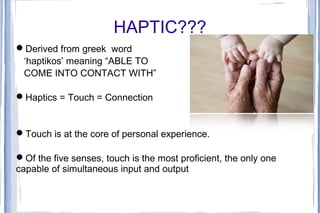
Derived from greek word
‘haptikos’ meaning “ABLE TO
COME INTO CONTACT WITH”
Haptics = Touch = Connection
Touch is at the core of personal experience.
Of the five senses, touch is the most proficient, the only one
capable of simultaneous input and output
HAPTIC INFORMATION
Combination Of :
− Tactile Information
 Refers to the information acquired by the
sensors connected to the body
− Kinesthetic Information
 Refers to the information acquired by the
sensors in the joints
Haptic interaction loop with user and
Virtual Environment
Human hand Haptic device Virtual environment
Basic system configuration
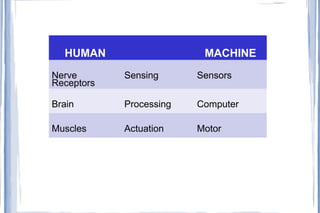
HUMAN MACHINE
Nerve
Receptors
Sensing Sensors
Brain Processing Computer
Muscles Actuation Motor
HAPTIC FEEDBACK
The application’s main elements are:
1) Simulation engine: responsible for computing the virtual
environments behavior over time;
2) Visual, auditory, and haptic rendering: compute the
virtual environment’s graphic, sound, and force responses
toward the user;
3) Transducers: convert visual, audio, and force signals from
the computer into a form the operator can perceive.
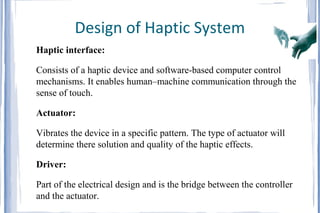
Design of Haptic System
Haptic interface:
Consists of a haptic device and software-based computer control
mechanisms. It enables human–machine communication through the
sense of touch.
Actuator:
Vibrates the device in a specific pattern. The type of actuator will
determine there solution and quality of the haptic effects.
Driver:
Part of the electrical design and is the bridge between the controller
and the actuator.
Sensors:
It is responsible for sensing the haptic information exerted by
the user on a certain object and sending these force readings
to the haptic rendering module.
Haptic rendering:
The process of calculating the sense of touch, especially
force.
Software:
The software generates the haptic waveforms and can reside
on an applications processor, microcontroller, or integrated
driver.
a) Devices that allow users to touch and
manipulate 3-dimentional virtual object.
b) Devices that allow users to "feel" texture
of 2-dimension objects.
Types of Haptic devices:
COMMONLY USED HAPTIC 
DEVICES
PHANTOM
Developed by Sensible Technologies
It allows the user to feel the texture and shape of the
virtual object
It can model free floating 3 dimensional objects.
CYBERGLOVE
Cyber glove can sense the
position and movement of
fingers and wrist.
It fits over the user's entire hand
and adds resistive force
feedback to each finger.
Applications of Haptics Technology
COMPUTER AND VIDEO GAMES
CELLULAR DEVICES
ASSISTIVE TECHNOLOGY
for visually impaired
MUSEUM DISPLAY
MEDICAL APPLICATION-
Training,remote surgery etc
ROBOTICS
Teleoperation, telerobotics
ART AND DESIGN
Graphics design,animation,real-time images
FUTURE VISION
1.Holographic Interaction
The feedback allows the user to interact with a hologram.
2.Medical Application
Use of a central workstation from which surgeons would perform
operations in various locations; with machine setup and patient
preparation performed by local nursing staff
3. Textile Industry
User could study and feel the texture and quality of materail during
the sale of cloth through internet
LIMITATIONS
High cost involved
Large weight and size of haptic devices (especially
wearable ones)
Haptic interfaces can only exert forces with limited
magnitude and not equally well in all directions
Haptic device position sensors have finite resolution.
CONCLUSION

Although haptic interface devices are available,
further improvements are needed to match the
performance of the human user.

Tactile display is one of the most challenging
technologies that needs to be developed in
moving towards realistic haptic displays.
REFERENCES

www.immersion.com/haptics-technology/

http://electronics.howstuffworks.com/everyday-tech/haptic-
technology.htm

http://en.wikipedia.org/wiki/Haptic_technology

http://www.123seminarsonly.com/Seminar-
Reports/009/50525962-Haptic-Report.pdf
QUERIES

Haptic Technology