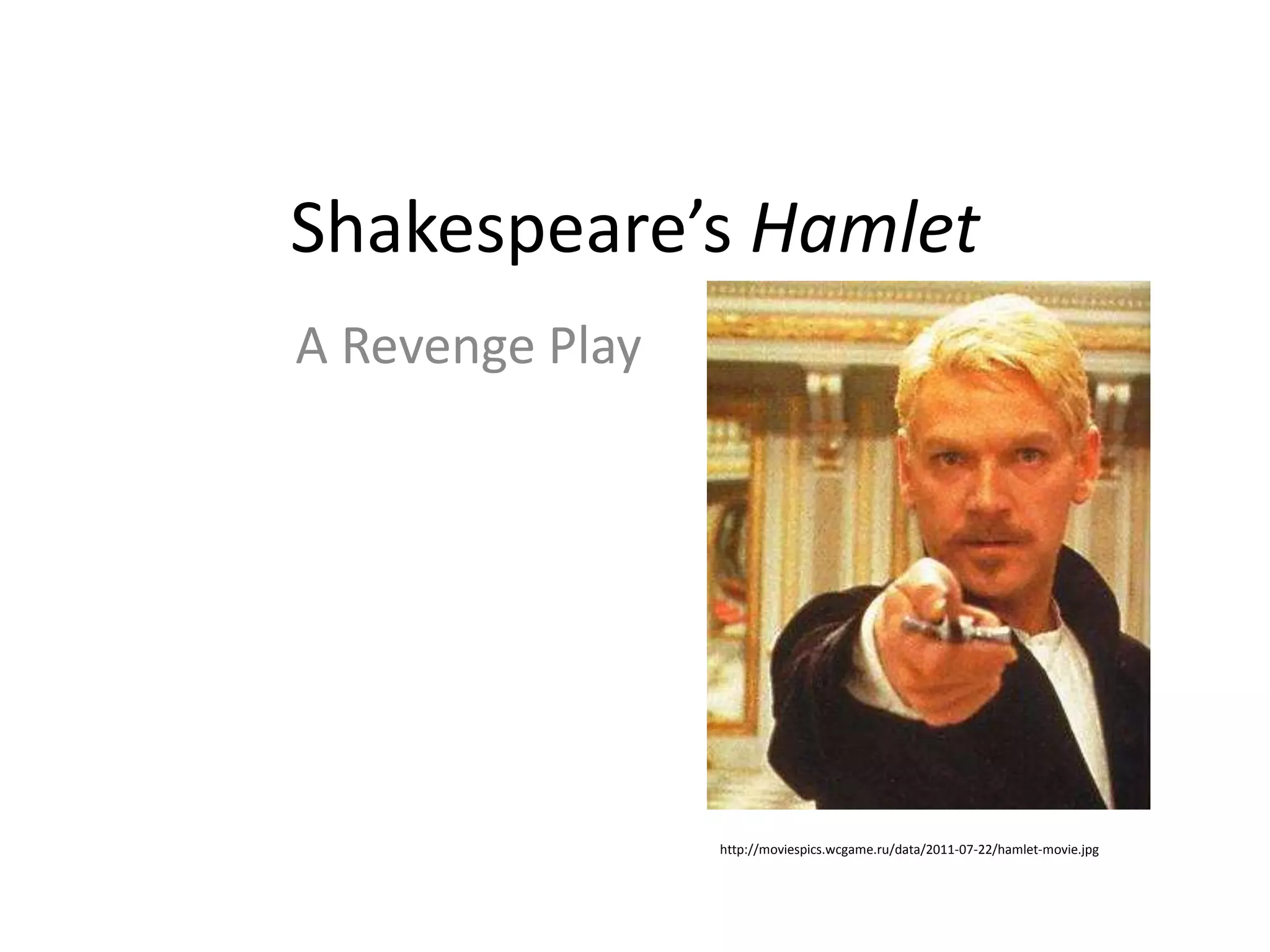
Shakespeare’s Hamlet
A Revenge Play


                 http://moviespics.wcgame.ru/data/2011-07-22/hamlet-movie.jpg
Definition
• Shakespearian scholar Ashley Thorndike
  defines a revenge play as this:
• “A tragedy whose leading motive is revenge
  and whose main action deals with the
  progress of this revenge, leading to the death
  of the murderers and often to the death of the
  avenger himself” (125).
Earliest precursor
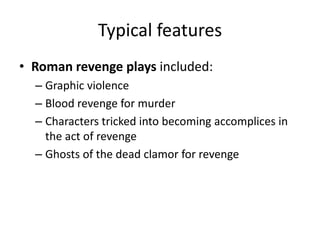
• Roman Playwright
  – Playwright Lucius
    Seneca (4BC – 65AD)
  – The Renaissance:
    Latin plays were
    popular at English
    universities during
    the latter half of the
    sixteenth century        http://media-1.web.britannica.com/eb-media/33/9433-
                             004-DD3A0405.jpg
Typical features
• Roman revenge plays included:
  – Graphic violence
  – Blood revenge for murder
  – Characters tricked into becoming accomplices in
    the act of revenge
  – Ghosts of the dead clamor for revenge
Chain of events
• Exposition (usually by the ghost)
• Anticipation (detailed planning)
• Confrontation (of the avenger and the
  intended victim)
• Partial Execution (or temporary thwarting of
  the plan)
• Completion (of the act of vengeance)
Precursors to Hamlet
• Thyestes by Lucius
  Seneca
• Gorboducby Thomas
  Norton and Thomas
  Sackville
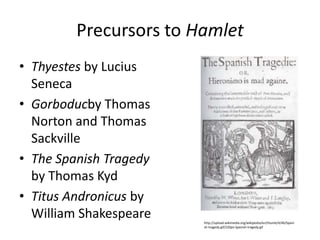
• The Spanish Tragedy
  by Thomas Kyd
• Titus Andronicus by
  William Shakespeare   http://upload.wikimedia.org/wikipedia/en/thumb/4/46/Spani
                        sh-tragedy.gif/220px-Spanish-tragedy.gif
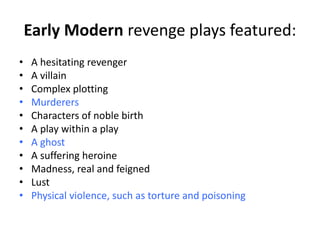
Early Modern revenge plays featured:
•   A hesitating revenger
•   A villain
•   Complex plotting
•   Murderers
•   Characters of noble birth
•   A play within a play
•   A ghost
•   A suffering heroine
•   Madness, real and feigned
•   Lust
•   Physical violence, such as torture and poisoning
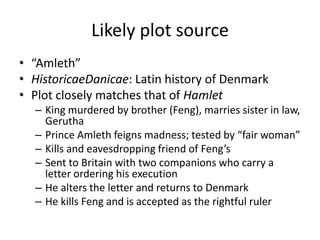
Likely plot source
• “Amleth”
• HistoricaeDanicae: Latin history of Denmark
• Plot closely matches that of Hamlet
  – King murdered by brother (Feng), marries sister in law,
    Gerutha
  – Prince Amleth feigns madness; tested by “fair woman”
  – Kills and eavesdropping friend of Feng’s
  – Sent to Britain with two companions who carry a
    letter ordering his execution
  – He alters the letter and returns to Denmark
  – He kills Feng and is accepted as the rightful ruler
Shakespeare’s genius
• Thorndike writes, “We may conclude that in
  building on an old story and reconstructing an old
  play [the original Hamlet, possibly authored by
  Thomas Kyd], Shakespeare used the old dramatic
  motives because they were still popular on the
  stage and because they stirred him as they did
  other poets to imaginative expression. He
  developed these motives without fundamental
  change but with a power of expression and
  characterization which they tried in vain to
  attain *emphasis mine+” (206).
Leaning on his forefathers
• “Shakespeare’s Hamlet is final, not only in the
  sense that he is made for all time, but also in
  the sense that he is the complete and final
  representative of a type that grew up among
  peculiar stage conventions and was developed
  by poets of no mean imaginative power. The
  final Hamlet is the result of a growth which
  other men than Shakespeare planted and
  which others fostered” (Thorndike 217).
Works Cited
Mellor, Bronwyn. Reading Hamlet. Urbana, IL:
 National Council of Teachers of English, 1999.
 Print.

Thorndike, Ashley H. "The Relations of Hamlet to
  Contemporary Revenge Plays.” PMLA 17.2
  (n.d.): 125-220. JSTOR. Web. 10 Dec. 2012.

Hamlet: A revenge play

  • 1.
    Shakespeare’s Hamlet A RevengePlay http://moviespics.wcgame.ru/data/2011-07-22/hamlet-movie.jpg
  • 2.
    Definition • Shakespearian scholarAshley Thorndike defines a revenge play as this: • “A tragedy whose leading motive is revenge and whose main action deals with the progress of this revenge, leading to the death of the murderers and often to the death of the avenger himself” (125).
  • 3.
    Earliest precursor • RomanPlaywright – Playwright Lucius Seneca (4BC – 65AD) – The Renaissance: Latin plays were popular at English universities during the latter half of the sixteenth century http://media-1.web.britannica.com/eb-media/33/9433- 004-DD3A0405.jpg
  • 4.
    Typical features • Romanrevenge plays included: – Graphic violence – Blood revenge for murder – Characters tricked into becoming accomplices in the act of revenge – Ghosts of the dead clamor for revenge
  • 5.
    Chain of events •Exposition (usually by the ghost) • Anticipation (detailed planning) • Confrontation (of the avenger and the intended victim) • Partial Execution (or temporary thwarting of the plan) • Completion (of the act of vengeance)
  • 6.
    Precursors to Hamlet •Thyestes by Lucius Seneca • Gorboducby Thomas Norton and Thomas Sackville • The Spanish Tragedy by Thomas Kyd • Titus Andronicus by William Shakespeare http://upload.wikimedia.org/wikipedia/en/thumb/4/46/Spani sh-tragedy.gif/220px-Spanish-tragedy.gif
  • 7.
    Early Modern revengeplays featured: • A hesitating revenger • A villain • Complex plotting • Murderers • Characters of noble birth • A play within a play • A ghost • A suffering heroine • Madness, real and feigned • Lust • Physical violence, such as torture and poisoning
  • 8.
    Likely plot source •“Amleth” • HistoricaeDanicae: Latin history of Denmark • Plot closely matches that of Hamlet – King murdered by brother (Feng), marries sister in law, Gerutha – Prince Amleth feigns madness; tested by “fair woman” – Kills and eavesdropping friend of Feng’s – Sent to Britain with two companions who carry a letter ordering his execution – He alters the letter and returns to Denmark – He kills Feng and is accepted as the rightful ruler
  • 9.
    Shakespeare’s genius • Thorndikewrites, “We may conclude that in building on an old story and reconstructing an old play [the original Hamlet, possibly authored by Thomas Kyd], Shakespeare used the old dramatic motives because they were still popular on the stage and because they stirred him as they did other poets to imaginative expression. He developed these motives without fundamental change but with a power of expression and characterization which they tried in vain to attain *emphasis mine+” (206).
  • 10.
    Leaning on hisforefathers • “Shakespeare’s Hamlet is final, not only in the sense that he is made for all time, but also in the sense that he is the complete and final representative of a type that grew up among peculiar stage conventions and was developed by poets of no mean imaginative power. The final Hamlet is the result of a growth which other men than Shakespeare planted and which others fostered” (Thorndike 217).
  • 11.
    Works Cited Mellor, Bronwyn.Reading Hamlet. Urbana, IL: National Council of Teachers of English, 1999. Print. Thorndike, Ashley H. "The Relations of Hamlet to Contemporary Revenge Plays.” PMLA 17.2 (n.d.): 125-220. JSTOR. Web. 10 Dec. 2012.

Editor's Notes

  • #8 Blue text: shared features with Roman revenge plays
  • #10 Takes a model and creates an immortal