Plot – Structure of the Play: 
Hamlet 
Is ‘Hamlet’ artistic failure? 
Source: 
* Eliot, T.S. Hamlet and His Problems. The 
Sacred Wood: Essays on Poetry and 
Criticism. 1922. 
* Freytag, Gustav. Die Technik des Dramas 
(Technique of the Drama). 1863.
T.S.Eliot:(1888–1965). The Sacred Wood: Essays on 
Poetry and Criticism. 1922. Hamlet and His Problems 
 “So far from being Shakespeare's 
masterpiece, the play is most certainly 
an artistic failure. In several ways the 
play is puzzling, and disquieting as is 
none of the others. Of all the plays it is 
the longest and is possibly the one on 
which Shakespeare spent most pains; 
and yet he has left in it superfluous 
and inconsistent scenes which even 
hasty revision should have noticed.”
T.S. Eliot: 
 Both workmanship and thought are in 
an unstable condition. 
 And probably more people have 
thought Hamlet a work of art because 
they found it interesting, than have 
found it interesting because it is a 
work of art. 
 It is the "Mona Lisa" of literature.
The grounds of Hamlet's 
failure 
 Mr. Robertson is undoubtedly correct in 
concluding that the essential emotion of 
the play is the feeling of a son towards a 
guilty mother: 
 “[Hamlet's] tone is that of one who has 
suffered tortures on the score of his 
mother's degradation.... The guilt of a 
mother is an almost intolerable motive 
for drama, but it had to be maintained 
and emphasized to supply a 
psychological solution, or rather a hint of 
one.”
 It is not merely the "guilt of a mother" 
that cannot be handled as 
Shakespeare handled the suspicion of 
Othello… ambition of Macbeth….. 
 Hamlet, like the sonnets, is full of 
some stuff that the writer could not 
drag to light, contemplate, or 
manipulate into art. 
 And when we search for this feeling, 
we find it, as in the sonnets, very 
difficult to localize.
 Eliot first advances the "objective 
correlative" in his infamous essay 
"Hamlet" in which he denounces the 
inability of the protagonist to 
understand his faults--that he is 
"dominated by an emotion which is 
inexpressible, because it is in excess 
of the facts"; unable to find a suitable 
outlet of action for his emotions, 
Hamlet fails to objectify his emotion.
Does it mean that ‘Hamlet’ is 
artistic failure? 
 In spite of such critical observations of 
critics, we may say that Hamlet is not 
without form or structure. It is a work 
of art with definite structure. The 
workmanship is not unstable. It has 
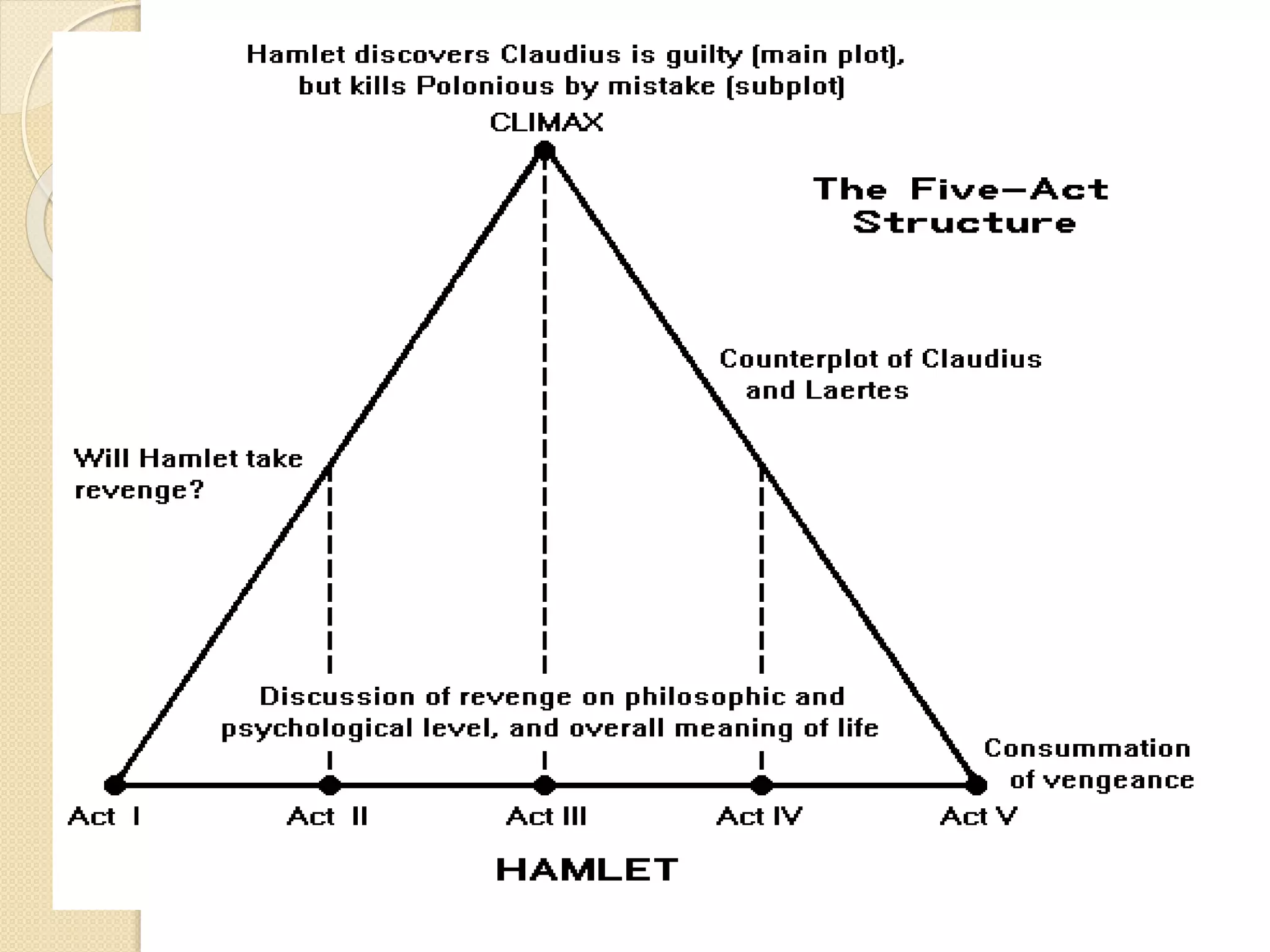
structure of pyramid and is very near 
to what Aristotle has defined.
Freytag’s Pyramid 
 In his book Die Technik des Dramas 
(Technique of the Drama) (1863), the 
German journalist and writer, Gustav 
Freytag, described the classical five-act 
structure of plays in the shape of a 
pyramid, and he attributed a particular 
function to each of the five acts.
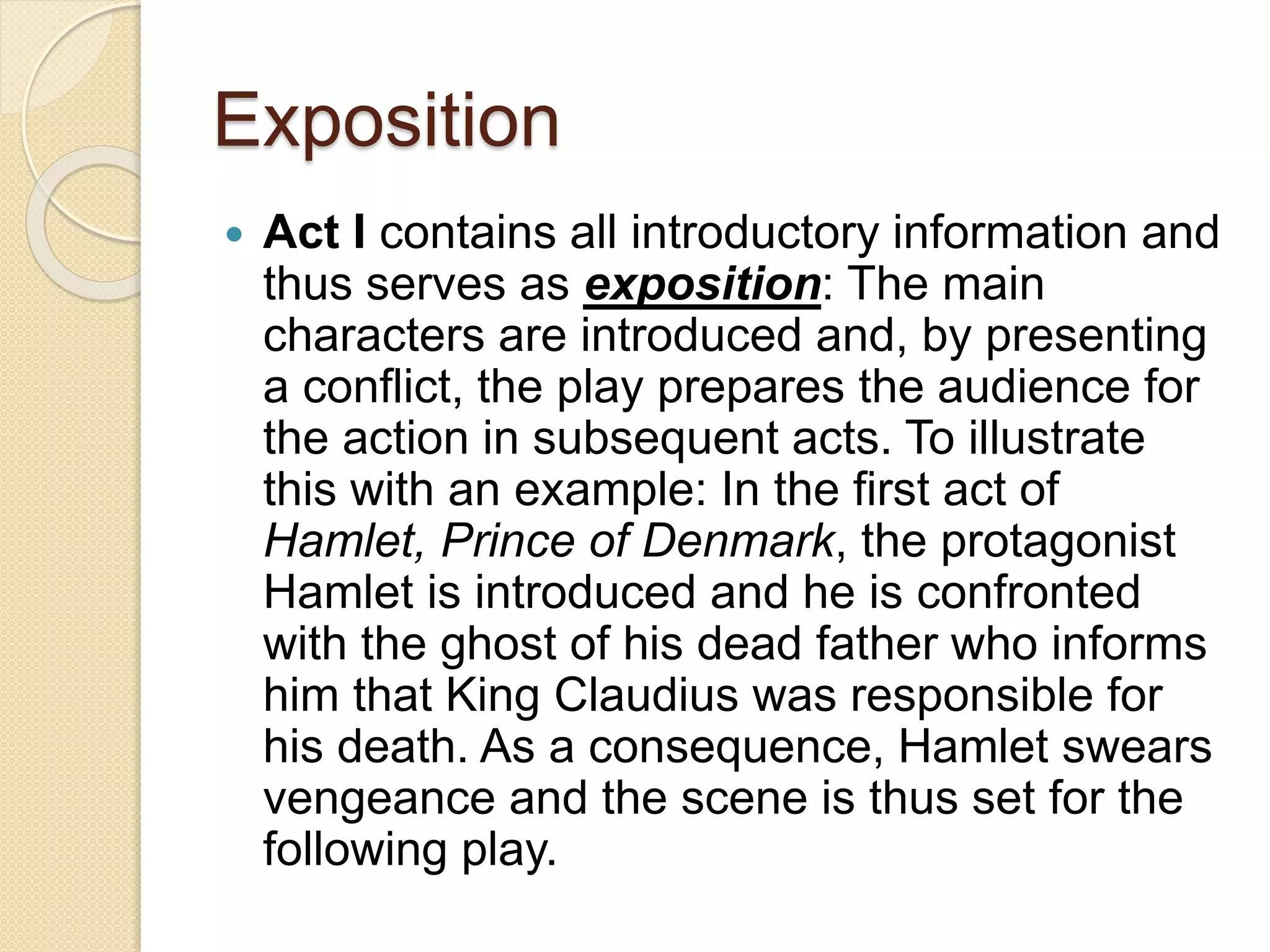
Exposition 
 Act I contains all introductory information and 
thus serves as exposition: The main 
characters are introduced and, by presenting 
a conflict, the play prepares the audience for 
the action in subsequent acts. To illustrate 
this with an example: In the first act of 
Hamlet, Prince of Denmark, the protagonist 
Hamlet is introduced and he is confronted 
with the ghost of his dead father who informs 
him that King Claudius was responsible for 
his death. As a consequence, Hamlet swears 
vengeance and the scene is thus set for the 
following play.
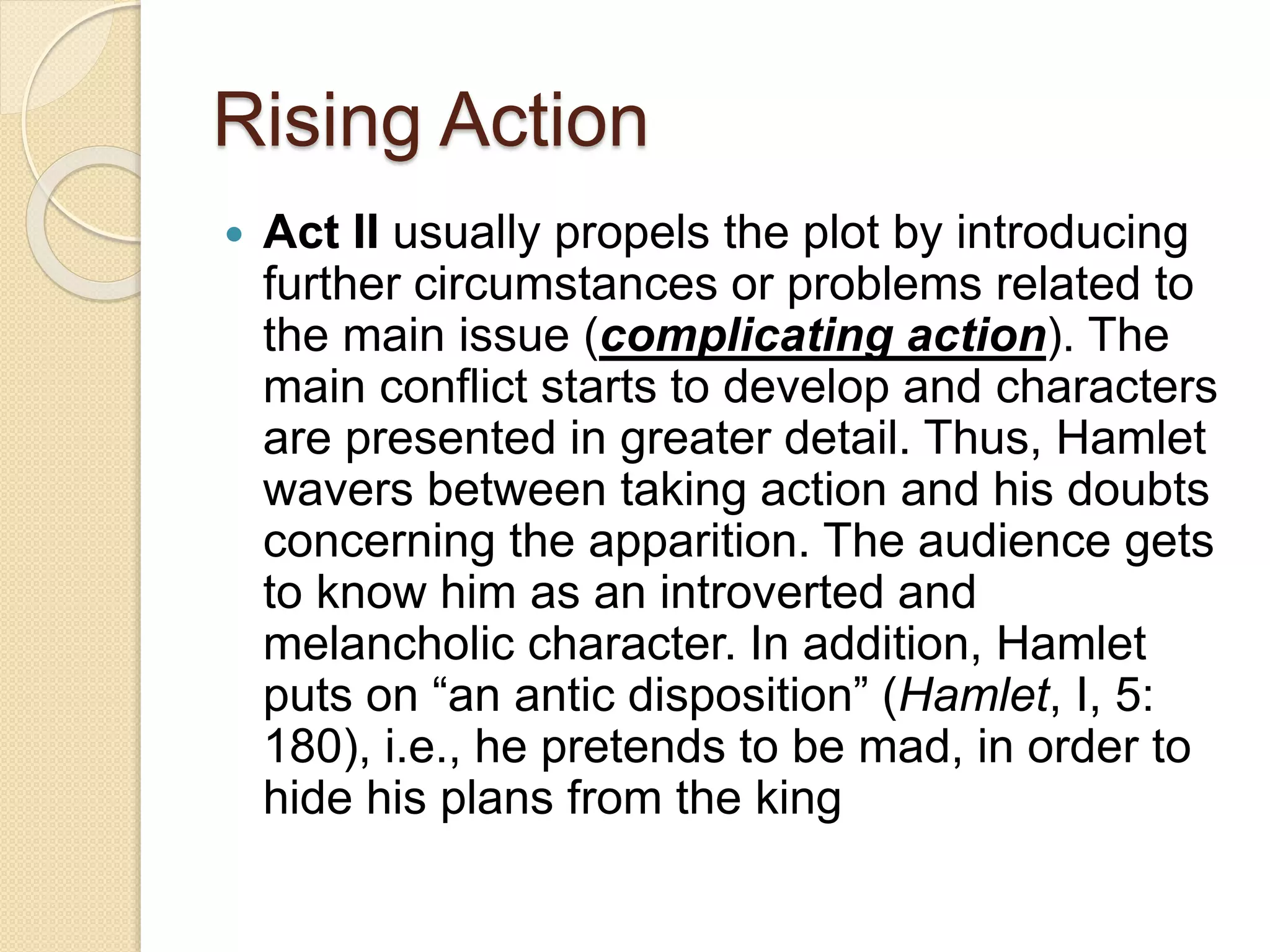
Rising Action 
 Act II usually propels the plot by introducing 
further circumstances or problems related to 
the main issue (complicating action). The 
main conflict starts to develop and characters 
are presented in greater detail. Thus, Hamlet 
wavers between taking action and his doubts 
concerning the apparition. The audience gets 
to know him as an introverted and 
melancholic character. In addition, Hamlet 
puts on “an antic disposition” (Hamlet, I, 5: 
180), i.e., he pretends to be mad, in order to 
hide his plans from the king
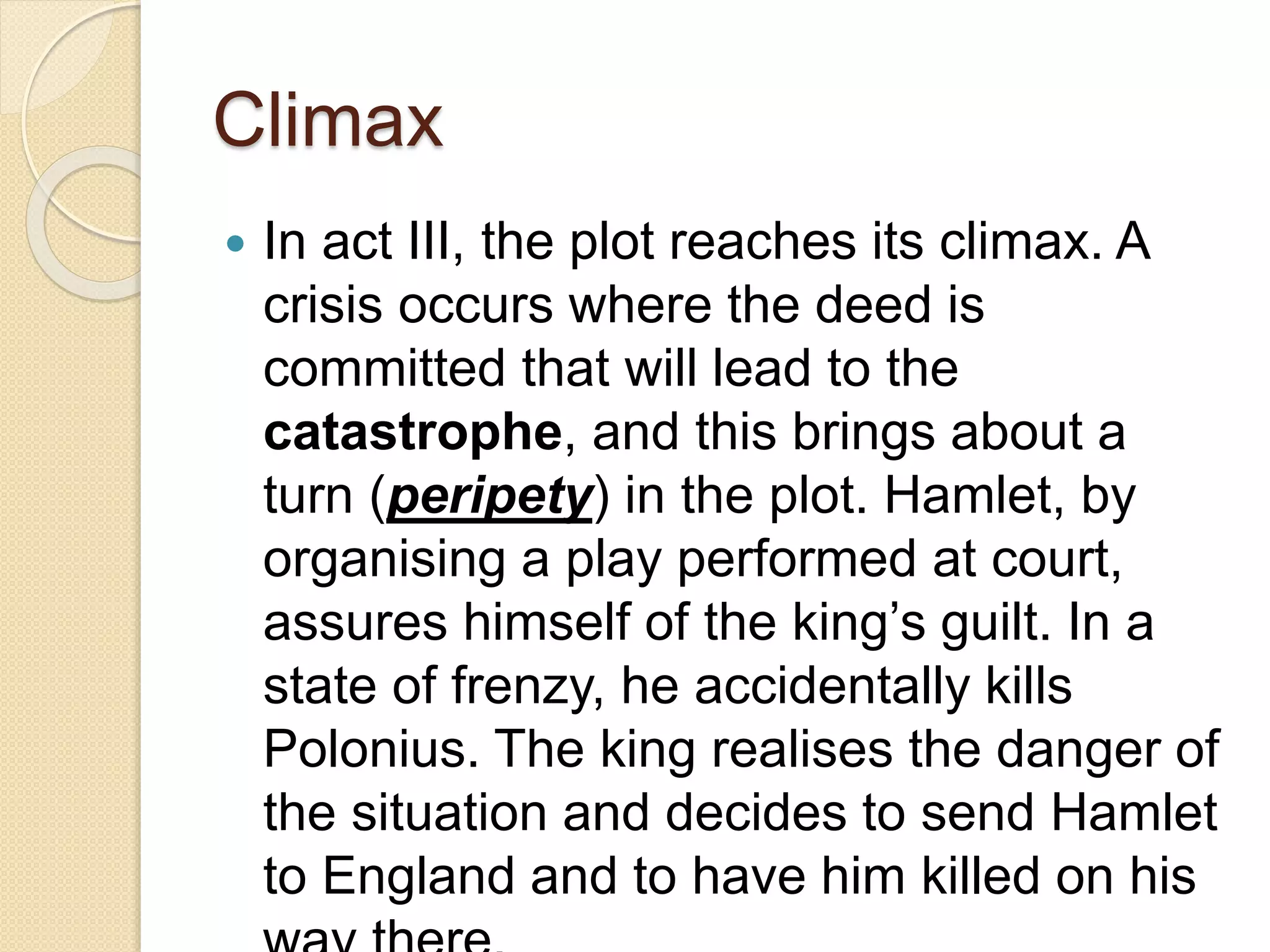
Climax 
 In act III, the plot reaches its climax. A 
crisis occurs where the deed is 
committed that will lead to the 
catastrophe, and this brings about a 
turn (peripety) in the plot. Hamlet, by 
organising a play performed at court, 
assures himself of the king’s guilt. In a 
state of frenzy, he accidentally kills 
Polonius. The king realises the danger of 
the situation and decides to send Hamlet 
to England and to have him killed on his 
way there.
Falling Action 
 The fourth act creates new tension in 
that it delays the final catastrophe by 
further events (falling action). In 
Hamlet, the dramatic effect of the plot is 
reinforced by a number of incidents: 
Polonius’ daughter, Ophelia, commits 
suicide and her brother, Laertes, swears 
vengeance against Hamlet. He and the 
king conspire to arrange a duel between 
Hamlet and Laertes. Having escaped his 
murderers, Hamlet returns to court.
Catastrophe 
 The fifth act finally offers a solution to the 
conflict presented in the play. While tragedies 
end in a catastrophe, usually the death of the 
protagonist, comedies are simply ‘resolved’ 
(traditionally in a wedding or another type of 
festivity). A term that is applicable to both 
types of ending is the French dénouement, 
which literally means the ‘unknotting’ of the 
plot. In the final duel, Hamlet is killed by 
Laertes but before that he stabs Laertes and 
wounds and poisons the king. The queen is 
poisoned by mistake when she drinks from a 
cup intended for Hamlet.
Thank You! 
 Dilip Barad 
 dilipbarad@gmail.com 
 www.dilipbarad.com 
 www.dilipbarad.blogspot.in

Is Hamlet Artistic Failure? Structure of the Play

  • 1.
    Plot – Structureof the Play: Hamlet Is ‘Hamlet’ artistic failure? Source: * Eliot, T.S. Hamlet and His Problems. The Sacred Wood: Essays on Poetry and Criticism. 1922. * Freytag, Gustav. Die Technik des Dramas (Technique of the Drama). 1863.
  • 2.
    T.S.Eliot:(1888–1965). The SacredWood: Essays on Poetry and Criticism. 1922. Hamlet and His Problems  “So far from being Shakespeare's masterpiece, the play is most certainly an artistic failure. In several ways the play is puzzling, and disquieting as is none of the others. Of all the plays it is the longest and is possibly the one on which Shakespeare spent most pains; and yet he has left in it superfluous and inconsistent scenes which even hasty revision should have noticed.”
  • 3.
    T.S. Eliot: Both workmanship and thought are in an unstable condition.  And probably more people have thought Hamlet a work of art because they found it interesting, than have found it interesting because it is a work of art.  It is the "Mona Lisa" of literature.
  • 4.
    The grounds ofHamlet's failure  Mr. Robertson is undoubtedly correct in concluding that the essential emotion of the play is the feeling of a son towards a guilty mother:  “[Hamlet's] tone is that of one who has suffered tortures on the score of his mother's degradation.... The guilt of a mother is an almost intolerable motive for drama, but it had to be maintained and emphasized to supply a psychological solution, or rather a hint of one.”
  • 5.
     It isnot merely the "guilt of a mother" that cannot be handled as Shakespeare handled the suspicion of Othello… ambition of Macbeth…..  Hamlet, like the sonnets, is full of some stuff that the writer could not drag to light, contemplate, or manipulate into art.  And when we search for this feeling, we find it, as in the sonnets, very difficult to localize.
  • 6.
     Eliot firstadvances the "objective correlative" in his infamous essay "Hamlet" in which he denounces the inability of the protagonist to understand his faults--that he is "dominated by an emotion which is inexpressible, because it is in excess of the facts"; unable to find a suitable outlet of action for his emotions, Hamlet fails to objectify his emotion.
  • 7.
    Does it meanthat ‘Hamlet’ is artistic failure?  In spite of such critical observations of critics, we may say that Hamlet is not without form or structure. It is a work of art with definite structure. The workmanship is not unstable. It has structure of pyramid and is very near to what Aristotle has defined.
  • 8.
    Freytag’s Pyramid In his book Die Technik des Dramas (Technique of the Drama) (1863), the German journalist and writer, Gustav Freytag, described the classical five-act structure of plays in the shape of a pyramid, and he attributed a particular function to each of the five acts.
  • 10.
    Exposition  ActI contains all introductory information and thus serves as exposition: The main characters are introduced and, by presenting a conflict, the play prepares the audience for the action in subsequent acts. To illustrate this with an example: In the first act of Hamlet, Prince of Denmark, the protagonist Hamlet is introduced and he is confronted with the ghost of his dead father who informs him that King Claudius was responsible for his death. As a consequence, Hamlet swears vengeance and the scene is thus set for the following play.
  • 11.
    Rising Action Act II usually propels the plot by introducing further circumstances or problems related to the main issue (complicating action). The main conflict starts to develop and characters are presented in greater detail. Thus, Hamlet wavers between taking action and his doubts concerning the apparition. The audience gets to know him as an introverted and melancholic character. In addition, Hamlet puts on “an antic disposition” (Hamlet, I, 5: 180), i.e., he pretends to be mad, in order to hide his plans from the king
  • 12.
    Climax  Inact III, the plot reaches its climax. A crisis occurs where the deed is committed that will lead to the catastrophe, and this brings about a turn (peripety) in the plot. Hamlet, by organising a play performed at court, assures himself of the king’s guilt. In a state of frenzy, he accidentally kills Polonius. The king realises the danger of the situation and decides to send Hamlet to England and to have him killed on his way there.
  • 13.
    Falling Action The fourth act creates new tension in that it delays the final catastrophe by further events (falling action). In Hamlet, the dramatic effect of the plot is reinforced by a number of incidents: Polonius’ daughter, Ophelia, commits suicide and her brother, Laertes, swears vengeance against Hamlet. He and the king conspire to arrange a duel between Hamlet and Laertes. Having escaped his murderers, Hamlet returns to court.
  • 14.
    Catastrophe  Thefifth act finally offers a solution to the conflict presented in the play. While tragedies end in a catastrophe, usually the death of the protagonist, comedies are simply ‘resolved’ (traditionally in a wedding or another type of festivity). A term that is applicable to both types of ending is the French dénouement, which literally means the ‘unknotting’ of the plot. In the final duel, Hamlet is killed by Laertes but before that he stabs Laertes and wounds and poisons the king. The queen is poisoned by mistake when she drinks from a cup intended for Hamlet.
  • 15.
    Thank You! Dilip Barad  dilipbarad@gmail.com  www.dilipbarad.com  www.dilipbarad.blogspot.in