Presented for:
Jahidul Alam
Assistant Professor
Department of English
Comilla University
Presented By:
Monir Hossen
Masters: 1st Semester
Roll: 0900152
Session : 2012-2013
Department of English
Course Code: Eng: 514; Title: Film and Literature
Date of Presentation: August 3, 2015
The treatment of Kingship in Shakespearian Plays
Introduction
 William Shakespeare through 'Hamlet' exposes the corruption amongst rulers
both through his use of disease imagery and in Hamlets continuous
comparisons between Old Hamlet and King Claudius. Shakespeare portrays
Claudius as a typical Machiavellian king, in his exploration of the necessary
qualities of a King, made clear in Claudius' astuteness as a politician.
Shakespeare brings to question the traditional view of the King being above the
law, punishment and correction, exposing Claudius' human faults, as well as
pushing the audience to morally question whether Claudius' means of
accession was acceptable. A Shakespearean king differs from that of the
Revengers Tradegy, as unlike the Duke, Claudius still has some
acknowledgment of his wrongs as seen in his prayer scene, whereas the Duke is
openly lecherous and unjust seen in the delay the Youngest sons punishment
despite his lack of remorse.
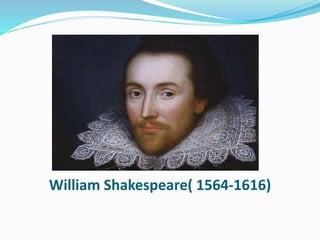
Biography of William Shakespeare
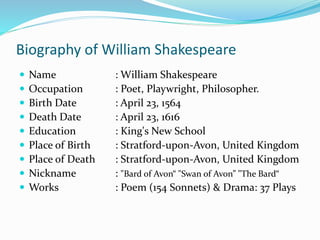
 Name : William Shakespeare
 Occupation : Poet, Playwright, Philosopher.
 Birth Date : April 23, 1564
 Death Date : April 23, 1616
 Education : King's New School
 Place of Birth : Stratford-upon-Avon, United Kingdom
 Place of Death : Stratford-upon-Avon, United Kingdom
 Nickname : "Bard of Avon“ "Swan of Avon” "The Bard“
 Works : Poem (154 Sonnets) & Drama: 37 Plays
William Shakespeare( 1564-1616)
Original Identity of HAMLET Drama
 Full title : The Tragedy of
Hamlet, Prince of Denmark
 Author : William Shakespeare
 Type of work : Play
 Genre : Tragedy
 Language : English
 Written : ( 1600 or 1601)
 Performed : July 1602
 Published : 1603 (Printed)
 Age : The Renaissance
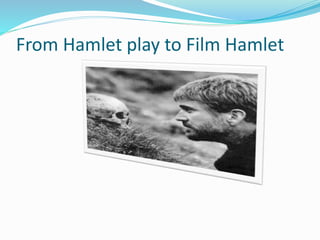
From Hamlet play to Film Hamlet
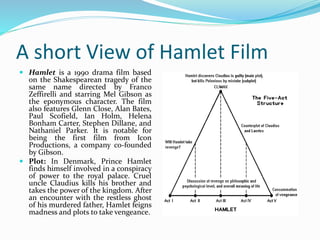
A short View of Hamlet Film
 Hamlet is a 1990 drama film based
on the Shakespearean tragedy of the
same name directed by Franco
Zeffirelli and starring Mel Gibson as
the eponymous character. The film
also features Glenn Close, Alan Bates,
Paul Scofield, Ian Holm, Helena
Bonham Carter, Stephen Dillane, and
Nathaniel Parker. It is notable for
being the first film from Icon
Productions, a company co-founded
by Gibson.
 Plot: In Denmark, Prince Hamlet
finds himself involved in a conspiracy
of power to the royal palace. Cruel
uncle Claudius kills his brother and
takes the power of the kingdom. After
an encounter with the restless ghost
of his murdered father, Hamlet feigns
madness and plots to take vengeance.
Cast:
 Mel Gibson as Prince Hamlet
 Glenn Close as Queen Gertrude
 Alan Bates as King Claudius
 Paul Scofield as the ghost of King Hamlet
 Ian Holm as Polonius
 Helena Bonham Carter as Ophelia
 Stephen Dillane as Horatio
 Nathaniel Parker as Laertes
 Michael Maloney and Sean Murray as Rosencrantz and Guildenstern
 Trevor Peacock as The Gravedigger
 Pete Postlethwaite as the Player King
 Christopher Fairbank as the Player Queen
 John McEnery as Osric
 Richard Warwick as Bernardo
 Christien Anholt as Marcellus
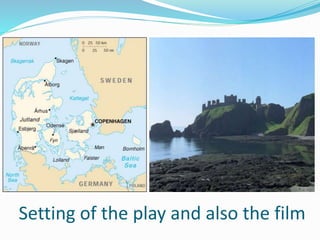
Setting of the play and also the film
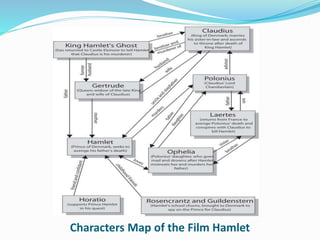
Characters Map of the Film Hamlet
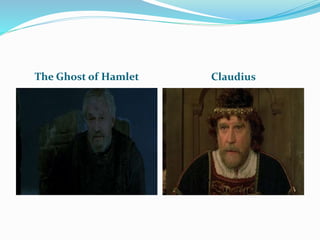
The Ghost of Hamlet Claudius
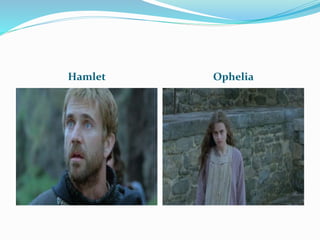
Hamlet Ophelia
The Story in Brief
 Hamlet’s father, king of Denmark has just dead. His brother Claudius takes the
throne and married Gertrude, Hamlet’s mother.
 Horatio sees king Hamlet’s ghost and tells it to Hamlet. A night king’s ghost
appears to Hamlet and tells him that Claudius murdered him, so Hamlet
decides to avenge him.
 Hamlet pretends to be mad so Claudius and Gertrude give to Polonius the task
of discovering the cause of his madness.
 Polonius attributes the cause of madness to Hamlet’s love for Ophelia, Polonius
daughter
 Hamlet tries to stage a play with a company of actors, in order to re-enact his
father’s murder and determine Claudius guilt or innocence.
 Gertrude asks to Hamlet the reason of his behaviour and he tells her the truth
about his father’s death
 Hamlet believing to kill Claudius murders Polonius while he is hidden
 Ophelia goes mad for her father’s death and drowns in a river.
 After this, Claudius sent Hamlet with his close friend, Horatio to England to
study there, even though the real goal is to expel Hamlet from Denmark.
 At the Ophelia’s funeral procession her brother Laertes and Hamlet brave
themselves
 When Hamlet returned back to Denmark. There was an Ophelia’s funeral
procession. Hamlet was very sad for losing her and suddenly he jumped into
Ophelia’s grave when the funeral took place. Laertes, her brother was angry of
what Hamlet did.
 Laertes decided to kill Hamlet in revenge for his father’s death. He challenged
Hamlet to a sword fight. Laertes pierces Hamlet with a poisoned blade but is
wounded by it himself
 Gertrude drinks a poisoned wine and dies
 Hamlet manages to kill Claudius and names Fortimbras as his heir
 Finally, the film is ended with morning song
Kingship in Hamlet
 Shakespeare exposes through Hamlet the corruption amongst rulers. Accordingly,
Shakespeare explores the different types of kings through Hamlets continuous
comparison of Old Hamlet and Claudius.
 Shakespeare through Hamlet puts up for the debate the rights of a king to the
throne, allowing the audience to question whether Claudius' accession to the throne
was acceptable.
 In 'Hamlet' Shakespeare explores the necessary qualities of a king and compares
and contrasts these with the necessary qualities put forward by King James I,
Machiavelli and Erasmus.
 Shakespeare questions the traditional view of whether or not the king was above the
law and so could do whatever he willed.
 Shakespeare draws connections with the state of the court and kings land and the
state, with the power of a king and his control over his people.
 Shakespeare looks at whether a morally inept king is beyond punishment or
correction.
 Shakespeare criticizes above-humanity and the almost super-human view of kings
and through Claudius reiterates the human element of Kings.
 Through the violence and the way in which Claudius gained the throne,
Shakespeare presumably is questioning/criticizing the conventional view that
Kingship is a God-given rights.
Kingship in the Renaissance
 In Shakespeare’s time kingship was a complicated concept which varied from country to
country in Europe, accounting for hereditary monarchy, the divine right of kings,
primogeniture and elective monarchy.
 Within those divisions were subdivisions of where the king’s power came from, for example,
from God, from the state, or from documents which regulated and checked the king’s power
such as the Magna Carta in England.
 Niccolo Machiavelli’s work Il Principe (The Prince) (c.1513) muddied these unclear waters even
further as his concept of kingship was divorced from any moral obligations which an individual
ruler felt he had to either himself or his people, and instead was located solely on how to gain
and retain power, by any means necessary.
 This situation is similar to the one facing the young Prince in Hamlet. While absent at
university in Wittenburg he is ‘usurped’ by Claudius despite being the hereditary heir to the
throne. To an English Renaissance audience who had become accustomed to the hereditary
monarchy of the Tudors, such an action would have the ring of a Machiavellian plot.
 However, the Danish throne itself was not subject to the same rules of kingship as the English
throne. Instead, the Danes had a form of elective monarchy; therefore under their own rules
the election of Claudius to the throne would not, in itself, be illegal.
 The main problem is that Claudius has killed the king in order to obtain his position. It is the
gross action of regicide which is the catalyst for the cataclysmic events that will result in the
destruction of the entire Danish royal family.
 For most of the European monarchies of the seventeenth century the divine right of kings, and
the proposition, that all their powers were ordained by God was common ground across
virtually the entire spectrum of political thinking in early modern Europe.
 The phrase: The King is dead, long live the King, was a poignant declaration of the
perpetual nature of kingship and was first introduced into English royal funerals with the
Tudors.
 This understanding of the transference of power from king to king helps to explain Hamlet’s
enigmatic lines, ‘The body is with the king, but the king is not with the body. The king is
a thing –.’
 Under the Renaissance idea of kingship the body politic was joined to the king, but the king
was not joined to the body politic, but a thing apart.
 This political interpretation of the two roles accounts for Hamlet’s words, but it also
demonstrates awareness of the Tudor attempts to cement the hereditary line into English
political consciousness.
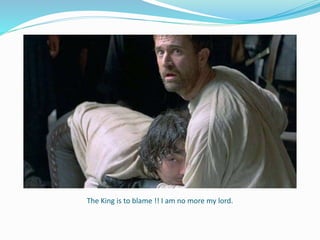
The King is to blame !! I am no more my lord.
Conclusion:
 William Shakespeare is regarded by many as the greatest dramatist of
all times. An Englishman, Shakespeare was also a poet and an actor. His
works such as Hamlet and Romeo and Juliet hold a significant place in
world literature and occupy a major part of literary academics. Often
referred to as England’s national poet, Shakespeare is one author whose
works have been translated into every major language of the world and
his plays are performed more than that of any other playwright living
or dead. However, Shakespeare’s great skill is that in Hamlet he is aware
not only of English concepts of kingship, but is conscious of, and adept
at including, European ideas on kingship to add levels of political
theory which complicates the play even further.
Thank you

Presentation on Hamlet by William Shakespeare

  • 1.
    Presented for: Jahidul Alam AssistantProfessor Department of English Comilla University Presented By: Monir Hossen Masters: 1st Semester Roll: 0900152 Session : 2012-2013 Department of English Course Code: Eng: 514; Title: Film and Literature Date of Presentation: August 3, 2015
  • 2.
    The treatment ofKingship in Shakespearian Plays
  • 3.
    Introduction  William Shakespearethrough 'Hamlet' exposes the corruption amongst rulers both through his use of disease imagery and in Hamlets continuous comparisons between Old Hamlet and King Claudius. Shakespeare portrays Claudius as a typical Machiavellian king, in his exploration of the necessary qualities of a King, made clear in Claudius' astuteness as a politician. Shakespeare brings to question the traditional view of the King being above the law, punishment and correction, exposing Claudius' human faults, as well as pushing the audience to morally question whether Claudius' means of accession was acceptable. A Shakespearean king differs from that of the Revengers Tradegy, as unlike the Duke, Claudius still has some acknowledgment of his wrongs as seen in his prayer scene, whereas the Duke is openly lecherous and unjust seen in the delay the Youngest sons punishment despite his lack of remorse.
  • 4.
    Biography of WilliamShakespeare  Name : William Shakespeare  Occupation : Poet, Playwright, Philosopher.  Birth Date : April 23, 1564  Death Date : April 23, 1616  Education : King's New School  Place of Birth : Stratford-upon-Avon, United Kingdom  Place of Death : Stratford-upon-Avon, United Kingdom  Nickname : "Bard of Avon“ "Swan of Avon” "The Bard“  Works : Poem (154 Sonnets) & Drama: 37 Plays
  • 5.
  • 6.
    Original Identity ofHAMLET Drama  Full title : The Tragedy of Hamlet, Prince of Denmark  Author : William Shakespeare  Type of work : Play  Genre : Tragedy  Language : English  Written : ( 1600 or 1601)  Performed : July 1602  Published : 1603 (Printed)  Age : The Renaissance
  • 7.
    From Hamlet playto Film Hamlet
  • 8.
    A short Viewof Hamlet Film  Hamlet is a 1990 drama film based on the Shakespearean tragedy of the same name directed by Franco Zeffirelli and starring Mel Gibson as the eponymous character. The film also features Glenn Close, Alan Bates, Paul Scofield, Ian Holm, Helena Bonham Carter, Stephen Dillane, and Nathaniel Parker. It is notable for being the first film from Icon Productions, a company co-founded by Gibson.  Plot: In Denmark, Prince Hamlet finds himself involved in a conspiracy of power to the royal palace. Cruel uncle Claudius kills his brother and takes the power of the kingdom. After an encounter with the restless ghost of his murdered father, Hamlet feigns madness and plots to take vengeance.
  • 9.
    Cast:  Mel Gibsonas Prince Hamlet  Glenn Close as Queen Gertrude  Alan Bates as King Claudius  Paul Scofield as the ghost of King Hamlet  Ian Holm as Polonius  Helena Bonham Carter as Ophelia  Stephen Dillane as Horatio  Nathaniel Parker as Laertes  Michael Maloney and Sean Murray as Rosencrantz and Guildenstern  Trevor Peacock as The Gravedigger  Pete Postlethwaite as the Player King  Christopher Fairbank as the Player Queen  John McEnery as Osric  Richard Warwick as Bernardo  Christien Anholt as Marcellus
  • 10.
    Setting of theplay and also the film
  • 11.
    Characters Map ofthe Film Hamlet
  • 12.
    The Ghost ofHamlet Claudius
  • 13.
  • 14.
    The Story inBrief  Hamlet’s father, king of Denmark has just dead. His brother Claudius takes the throne and married Gertrude, Hamlet’s mother.  Horatio sees king Hamlet’s ghost and tells it to Hamlet. A night king’s ghost appears to Hamlet and tells him that Claudius murdered him, so Hamlet decides to avenge him.  Hamlet pretends to be mad so Claudius and Gertrude give to Polonius the task of discovering the cause of his madness.  Polonius attributes the cause of madness to Hamlet’s love for Ophelia, Polonius daughter  Hamlet tries to stage a play with a company of actors, in order to re-enact his father’s murder and determine Claudius guilt or innocence.  Gertrude asks to Hamlet the reason of his behaviour and he tells her the truth about his father’s death
  • 15.
     Hamlet believingto kill Claudius murders Polonius while he is hidden  Ophelia goes mad for her father’s death and drowns in a river.  After this, Claudius sent Hamlet with his close friend, Horatio to England to study there, even though the real goal is to expel Hamlet from Denmark.  At the Ophelia’s funeral procession her brother Laertes and Hamlet brave themselves  When Hamlet returned back to Denmark. There was an Ophelia’s funeral procession. Hamlet was very sad for losing her and suddenly he jumped into Ophelia’s grave when the funeral took place. Laertes, her brother was angry of what Hamlet did.  Laertes decided to kill Hamlet in revenge for his father’s death. He challenged Hamlet to a sword fight. Laertes pierces Hamlet with a poisoned blade but is wounded by it himself  Gertrude drinks a poisoned wine and dies  Hamlet manages to kill Claudius and names Fortimbras as his heir  Finally, the film is ended with morning song
  • 16.
    Kingship in Hamlet Shakespeare exposes through Hamlet the corruption amongst rulers. Accordingly, Shakespeare explores the different types of kings through Hamlets continuous comparison of Old Hamlet and Claudius.  Shakespeare through Hamlet puts up for the debate the rights of a king to the throne, allowing the audience to question whether Claudius' accession to the throne was acceptable.  In 'Hamlet' Shakespeare explores the necessary qualities of a king and compares and contrasts these with the necessary qualities put forward by King James I, Machiavelli and Erasmus.  Shakespeare questions the traditional view of whether or not the king was above the law and so could do whatever he willed.
  • 17.
     Shakespeare drawsconnections with the state of the court and kings land and the state, with the power of a king and his control over his people.  Shakespeare looks at whether a morally inept king is beyond punishment or correction.  Shakespeare criticizes above-humanity and the almost super-human view of kings and through Claudius reiterates the human element of Kings.  Through the violence and the way in which Claudius gained the throne, Shakespeare presumably is questioning/criticizing the conventional view that Kingship is a God-given rights.
  • 18.
    Kingship in theRenaissance  In Shakespeare’s time kingship was a complicated concept which varied from country to country in Europe, accounting for hereditary monarchy, the divine right of kings, primogeniture and elective monarchy.  Within those divisions were subdivisions of where the king’s power came from, for example, from God, from the state, or from documents which regulated and checked the king’s power such as the Magna Carta in England.  Niccolo Machiavelli’s work Il Principe (The Prince) (c.1513) muddied these unclear waters even further as his concept of kingship was divorced from any moral obligations which an individual ruler felt he had to either himself or his people, and instead was located solely on how to gain and retain power, by any means necessary.  This situation is similar to the one facing the young Prince in Hamlet. While absent at university in Wittenburg he is ‘usurped’ by Claudius despite being the hereditary heir to the throne. To an English Renaissance audience who had become accustomed to the hereditary monarchy of the Tudors, such an action would have the ring of a Machiavellian plot.  However, the Danish throne itself was not subject to the same rules of kingship as the English throne. Instead, the Danes had a form of elective monarchy; therefore under their own rules the election of Claudius to the throne would not, in itself, be illegal.
  • 19.
     The mainproblem is that Claudius has killed the king in order to obtain his position. It is the gross action of regicide which is the catalyst for the cataclysmic events that will result in the destruction of the entire Danish royal family.  For most of the European monarchies of the seventeenth century the divine right of kings, and the proposition, that all their powers were ordained by God was common ground across virtually the entire spectrum of political thinking in early modern Europe.  The phrase: The King is dead, long live the King, was a poignant declaration of the perpetual nature of kingship and was first introduced into English royal funerals with the Tudors.  This understanding of the transference of power from king to king helps to explain Hamlet’s enigmatic lines, ‘The body is with the king, but the king is not with the body. The king is a thing –.’  Under the Renaissance idea of kingship the body politic was joined to the king, but the king was not joined to the body politic, but a thing apart.  This political interpretation of the two roles accounts for Hamlet’s words, but it also demonstrates awareness of the Tudor attempts to cement the hereditary line into English political consciousness.
  • 20.
    The King isto blame !! I am no more my lord.
  • 21.
    Conclusion:  William Shakespeareis regarded by many as the greatest dramatist of all times. An Englishman, Shakespeare was also a poet and an actor. His works such as Hamlet and Romeo and Juliet hold a significant place in world literature and occupy a major part of literary academics. Often referred to as England’s national poet, Shakespeare is one author whose works have been translated into every major language of the world and his plays are performed more than that of any other playwright living or dead. However, Shakespeare’s great skill is that in Hamlet he is aware not only of English concepts of kingship, but is conscious of, and adept at including, European ideas on kingship to add levels of political theory which complicates the play even further.
  • 22.