The Moor of Venice
William Shakespeare
Writing style in Othello
 Verse
 Prose
 Irony
Verse:
• Othello is written in blank verse
• Blank verse consists of unrhymed iambic pentameters,
with five stressed syllables and five unstressed syllables
to each line
• He uses this traditional form of flexibly, varying the
pace of his writing to achieve specific effects
• He creates specific idioms for each of his character
Prose:
• Ordinary written language with no rhyme; organized in
sentences
• Prose used for low status characters
• Proclamation, written challenges , letters, comedic
moments and to express madness
• Shakespeare uses prose for familiar relationship
Irony:
• Othello is an essentially ironic play
• Shakespeare offers Iago some of the best language in
the play wright’s whole body of work
• His language makes him someone they trust
• Iago doesn’t look like the villain he is
About play
• Shakespeare’s play Othello written in 1904 and based
on the Italian short story Un Capitano Moro ( A Moorish
Captain)
• Othello is one of Shakespeare’s most highly
concentrated, tightly constructed tragedies with no
subplots and little humor to relieve the tension
• Othello is set in a private world and focuses on the
passions and personal lives of its major figures
Theme In Othello
• Jealousy
• Warfare
• Hate
• Identity
• Race
• Manipulation
• Marriage
Main Characters
• General of the Venice army
• The position of General is the highly
respected position of power
• Othello is a Moor ( a native of North
Africa, usually a Muslim)
• Eloquent and powerful figure
 Othello:
 Desdemona:
• The daughter of the Venetian
senator Brabantio
• Othello’s wife
• Desdemona is also determined
and self possessed
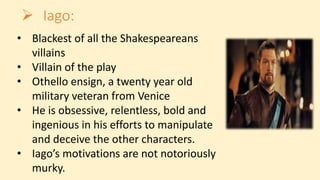
 Iago:
• Blackest of all the Shakespeareans
villains
• Villain of the play
• Othello ensign, a twenty year old
military veteran from Venice
• He is obsessive, relentless, bold and
ingenious in his efforts to manipulate
and deceive the other characters.
• Iago’s motivations are not notoriously
murky.
• Iago’s wife and Desdemona’s
attendant
• A cynical and worldly woman
• She is deeply attached to her
mistress and distrustful to her
husband
 Emilia:
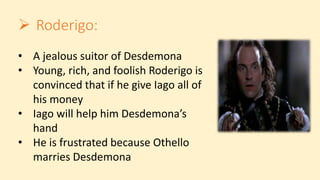
 Roderigo:
• A jealous suitor of Desdemona
• Young, rich, and foolish Roderigo is
convinced that if he give Iago all of
his money
• Iago will help him Desdemona’s
hand
• He is frustrated because Othello
marries Desdemona
Othello Symbols
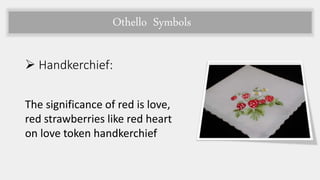
 Handkerchief:
The significance of red is love,
red strawberries like red heart
on love token handkerchief
 Candle
The candle Othello blows
out just before the murder
of Desdemona
 Location
• Shakespeare uses
different locations to
represent the mindset
• In Othello Venice
represent civilization
while Cyprus symbolize
wilderness
Summary
• On a street in Venice, there is an argument between
Roderigo, a noble man and Iago, a Captain in the defense
of forces
• Roderigo in love with the noble lady Desdemona, has
paid large sums of money to Iago on the understanding
that Iago would give her gifts from him and praise him to
her. Roderigo hopes to win Desdemona’s love and marry
her
• However, they now have news that Desdemona has
left the house of her father, Brabantio and eloped with
Othello
• Roderigo fears he has lost both his lady and his money
• Iago reveals Roderigo that it is in his (Iago’s) nature to
plot and tell lies to what he wants and that he has a
plan
• He hates Othello for promoting Cassio to the position
of lieutenant, a position that Iago wanted for himself
• Iago plans to bring about Othello’s downfall and
Roderigo( he says) will have Desdemona
• Othello mistakenly places his trust in Iago, who is
Othello’s close friend and confident
• Iago carefully weaves trap after trap Othello’s trusted
aides, turning him against them and eventually even
turns Othello against his wife
• Iago also plays Roderigo false; instead of winning
Desdemona for Roderigo , he betrays him and murders
him
Quotations
“ I am not what I am ”
( Shakespeare , Othello)
“ The robbed that smile , steals
something from the thief ”
( Shakespeare , Othello)
Shakespearean tragedy
• Tragedy is concerned primarily with the tragic hero.
• Tragedy involves a person of high estate therefore, his or
her fate affects the welfare of whole nation or empire.
• The hero is undergoes to a sudden reversal of fortune.
• Shakespeare often introduces abnormal conditions of
mind (such as , insanity)
• Supernatural elements are also introduced.
• The ultimate power in the tragic world is moral order;
more specifically the struggle between good and evil
• Much of plot seems to hinge on “chance’’ or “accident’’.
• Besides the outward conflict between the individuals or
group of individuals, there is also an inner conflict and
torment within the soul of tragic hero.
• The central impression of the tragedy is one of waste.
Presented by
 Tazeem Sana
 Sania Saeed
 Huma Ch.
 Safia Ramzan
 Attiya Abdullah

Othello

  • 1.
    The Moor ofVenice William Shakespeare
  • 2.
    Writing style inOthello  Verse  Prose  Irony
  • 3.
    Verse: • Othello iswritten in blank verse • Blank verse consists of unrhymed iambic pentameters, with five stressed syllables and five unstressed syllables to each line • He uses this traditional form of flexibly, varying the pace of his writing to achieve specific effects • He creates specific idioms for each of his character
  • 4.
    Prose: • Ordinary writtenlanguage with no rhyme; organized in sentences • Prose used for low status characters • Proclamation, written challenges , letters, comedic moments and to express madness • Shakespeare uses prose for familiar relationship
  • 5.
    Irony: • Othello isan essentially ironic play • Shakespeare offers Iago some of the best language in the play wright’s whole body of work • His language makes him someone they trust • Iago doesn’t look like the villain he is
  • 6.
    About play • Shakespeare’splay Othello written in 1904 and based on the Italian short story Un Capitano Moro ( A Moorish Captain) • Othello is one of Shakespeare’s most highly concentrated, tightly constructed tragedies with no subplots and little humor to relieve the tension • Othello is set in a private world and focuses on the passions and personal lives of its major figures
  • 7.
  • 8.
    • Jealousy • Warfare •Hate • Identity • Race • Manipulation • Marriage
  • 9.
    Main Characters • Generalof the Venice army • The position of General is the highly respected position of power • Othello is a Moor ( a native of North Africa, usually a Muslim) • Eloquent and powerful figure  Othello:
  • 10.
     Desdemona: • Thedaughter of the Venetian senator Brabantio • Othello’s wife • Desdemona is also determined and self possessed
  • 11.
     Iago: • Blackestof all the Shakespeareans villains • Villain of the play • Othello ensign, a twenty year old military veteran from Venice • He is obsessive, relentless, bold and ingenious in his efforts to manipulate and deceive the other characters. • Iago’s motivations are not notoriously murky.
  • 12.
    • Iago’s wifeand Desdemona’s attendant • A cynical and worldly woman • She is deeply attached to her mistress and distrustful to her husband  Emilia:
  • 13.
     Roderigo: • Ajealous suitor of Desdemona • Young, rich, and foolish Roderigo is convinced that if he give Iago all of his money • Iago will help him Desdemona’s hand • He is frustrated because Othello marries Desdemona
  • 14.
    Othello Symbols  Handkerchief: Thesignificance of red is love, red strawberries like red heart on love token handkerchief
  • 15.
     Candle The candleOthello blows out just before the murder of Desdemona
  • 16.
     Location • Shakespeareuses different locations to represent the mindset • In Othello Venice represent civilization while Cyprus symbolize wilderness
  • 17.
  • 18.
    • On astreet in Venice, there is an argument between Roderigo, a noble man and Iago, a Captain in the defense of forces • Roderigo in love with the noble lady Desdemona, has paid large sums of money to Iago on the understanding that Iago would give her gifts from him and praise him to her. Roderigo hopes to win Desdemona’s love and marry her
  • 19.
    • However, theynow have news that Desdemona has left the house of her father, Brabantio and eloped with Othello • Roderigo fears he has lost both his lady and his money • Iago reveals Roderigo that it is in his (Iago’s) nature to plot and tell lies to what he wants and that he has a plan • He hates Othello for promoting Cassio to the position of lieutenant, a position that Iago wanted for himself
  • 20.
    • Iago plansto bring about Othello’s downfall and Roderigo( he says) will have Desdemona • Othello mistakenly places his trust in Iago, who is Othello’s close friend and confident • Iago carefully weaves trap after trap Othello’s trusted aides, turning him against them and eventually even turns Othello against his wife
  • 21.
    • Iago alsoplays Roderigo false; instead of winning Desdemona for Roderigo , he betrays him and murders him
  • 22.
    Quotations “ I amnot what I am ” ( Shakespeare , Othello)
  • 23.
    “ The robbedthat smile , steals something from the thief ” ( Shakespeare , Othello)
  • 24.
    Shakespearean tragedy • Tragedyis concerned primarily with the tragic hero. • Tragedy involves a person of high estate therefore, his or her fate affects the welfare of whole nation or empire. • The hero is undergoes to a sudden reversal of fortune. • Shakespeare often introduces abnormal conditions of mind (such as , insanity) • Supernatural elements are also introduced.
  • 25.
    • The ultimatepower in the tragic world is moral order; more specifically the struggle between good and evil • Much of plot seems to hinge on “chance’’ or “accident’’. • Besides the outward conflict between the individuals or group of individuals, there is also an inner conflict and torment within the soul of tragic hero. • The central impression of the tragedy is one of waste.
  • 26.
    Presented by  TazeemSana  Sania Saeed  Huma Ch.  Safia Ramzan  Attiya Abdullah