Downloaded 35 times

![The character and quality
of genius
In his essay from Table-Talk, ‘On Genius and Common Sense’, Hazlitt defines genius or
originality as ‘some strong quality in the mind, answering to and bringing out some new and
striking quality in nature’ (Howe, VIII, 42)
In The Spirit of the Age Scott's prose novels and romances come closest to embodying this
kind of genius. Scott has achieved the ability to ‘borrow of others’ and in so doing has
‘enriched his own genius with everlasting variety, truth, and freedom’ and has enriched
his audience with ‘a new edition of human nature’ (Howe, XI, 61, 64). Hence, Scott, like
Shakespeare, has the potential to lose his authorial-self in his subject.
On the other hand, there is what Hazlitt identifies as ‘genius in ordinary’, a genius which is
exclusive, self-willed, egotistical, and reflects the author more than the object he looks upon
(‘On Genius’, Howe, VIII, 42). This kind of genius Hazlitt finds typical of Wordsworth, who
‘stamps [his] character, that deep individual interest, on whatever he meets’, which in Lyrical
Ballads includes ingrafting ‘his own conscious reflections on the casual thought of hinds and
shepherds’ (Howe, XI, 89).
Between these two definitive poles, however, Hazlitt comprehends many varieties of genius.
Romantic Conflicts](https://image.slidesharecdn.com/hazlittsl-170902201454/85/Hazlitt-sl-10-320.jpg)
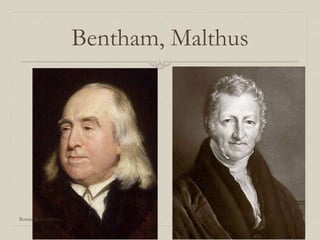

William Hazlitt (1778-1830) was a prominent essayist who critiqued various aspects of English literature, painting, and politics, ultimately publishing 'The Spirit of the Age' in 1825, which critiques major literary and political figures of his time. His work reflects a tension between reason and imagination, positing that an individual's imaginative capacity is shaped by the prevailing cultural climate, while he also examines differing types of genius represented by figures like Wordsworth and Coleridge. Hazlitt's approach unearths a masculine perspective that has faced scrutiny, and he notably emphasizes the significance of imagination against the backdrop of strict rationalism represented by figures such as Bentham and Malthus.


