The
Playwright…
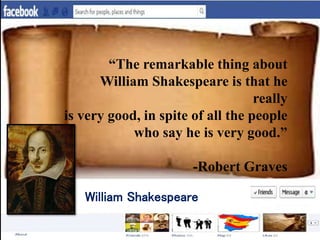
“The remarkable thing about
William Shakespeare is that he
really
is very good, in spite of all the people
who say he is very good.”
-Robert Graves
William Shakespeare
Elements
of a
Play
Elements of a Play
1.) PLOT
-the arrangement of events or
incidents on the stage.
-composed of “clearly defined
problems for characters to solve.”
PLOT
• Exposition- background information.
• Inciting Incident or Conflict- the event
that’s sets in motion the action of the play.
• Rising Action- Complications and
discoveries, which create conflict.
• Climax- turning point of the plot,
emotional intensity of play.
• Falling Action- series of events
following the climax.
• Denouement- “unknotting” resolution of
the conflicts.
2. CHARACTER
– The agents of the plot.
– Characters provide the
motivations (reasons) for the events
of the plot.
– “Vivid characters” face and
overcome “obstacles that we can
recognize.”
– they provide the vehicle for conflict.
CHARACTER
a) Protagonist- main character
b) Antagonist- person, situation, or
inner conflict in opposition to the main
character’s goals.
c) Secondary Characters- all other
characters other than protagonist and
antagonist.
3. SETTING
-When and where does it happen?
a) Viewable elements
b) Common sights and sounds to
enhance time and place
c) Sound effects and or music contribute
to time and place
4. THEME
-The playwright’s message
-The theme is expressed through
words and actions of the
characters in a series of situations
that make up the plot. Each
situation takes place in a setting.
5. LANGUAGE
- “Vivid characters” facing and
overcoming recognizable obstacles need
to express themselves in “heightened
language.”
–Dramatic dialogue consists of two parts:
narrative and dramatic.
6. RHYTHM
 The heart of the play. Plot,
character, language, and spectacle all
have their individual rhythms in time.
 The combination of all these
rhythms create the impelling force of
the play leading to a final climax and
denouement.
 Rhythm creates mood.
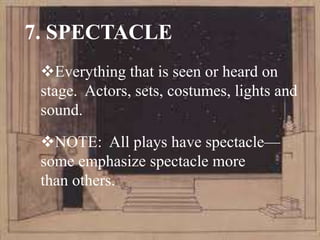
7. SPECTACLE
Everything that is seen or heard on
stage. Actors, sets, costumes, lights and
sound.
NOTE: All plays have spectacle—
some emphasize spectacle more
than others.
The Tragedy of
Hamlet,
Prince of Denmark
By: William Shakespeare
Characters
• Hamlet – Son of the former King, and
nephew of the present King.
• Claudius – King of Denmark, and Hamlet's
uncle.
• Gertrude– Queen of Denmark, and mother
to Hamlet.
• Polonius– Lord Chamberlain
• Ophelia – Daughter to Polonius
• Horatio – Friend to Hamlet
• Laertes – Son to Polonius
• Voltimand and Cornelius – Courtiers
• Rosencrantz and Guildenstern
– Courtiers, friends to Hamlet.
• Osric – a Courtier
• Marcellus – an Officer
• Bernardo – an Officer
• Francisco – a Soldier
• Reynaldo – Servant to Polonius
• Ghost of Hamlet’s Father
• Fortinbras – Prince of Norway
• Gravediggers – a Sexton, and a clown.
• Player King, Player Queen, Lucianus, etc. –
Players
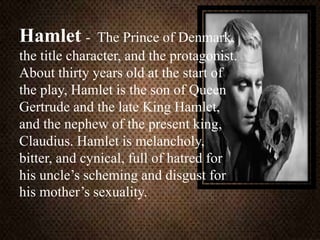
Hamlet - The Prince of Denmark,
the title character, and the protagonist.
About thirty years old at the start of
the play, Hamlet is the son of Queen
Gertrude and the late King Hamlet,
and the nephew of the present king,
Claudius. Hamlet is melancholy,
bitter, and cynical, full of hatred for
his uncle’s scheming and disgust for
his mother’s sexuality.
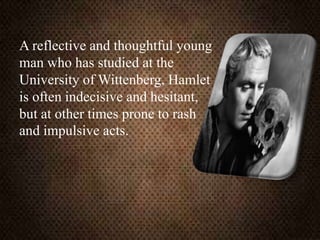
A reflective and thoughtful young
man who has studied at the
University of Wittenberg, Hamlet
is often indecisive and hesitant,
but at other times prone to rash
and impulsive acts.
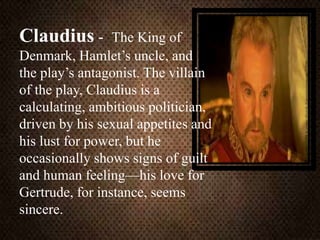
Claudius - The King of
Denmark, Hamlet’s uncle, and
the play’s antagonist. The villain
of the play, Claudius is a
calculating, ambitious politician,
driven by his sexual appetites and
his lust for power, but he
occasionally shows signs of guilt
and human feeling—his love for
Gertrude, for instance, seems
sincere.
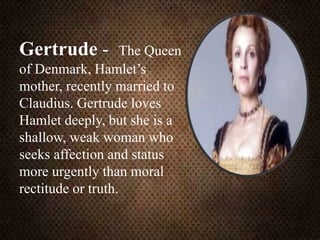
Gertrude - The Queen
of Denmark, Hamlet’s
mother, recently married to
Claudius. Gertrude loves
Hamlet deeply, but she is a
shallow, weak woman who
seeks affection and status
more urgently than moral
rectitude or truth.
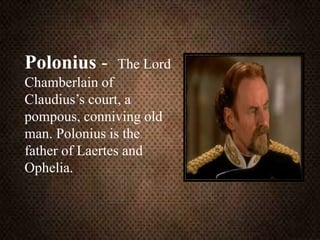
Polonius - The Lord
Chamberlain of
Claudius’s court, a
pompous, conniving old
man. Polonius is the
father of Laertes and
Ophelia.
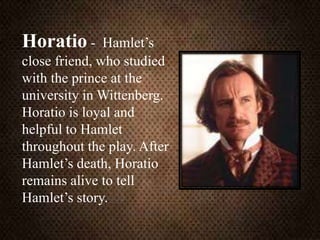
Horatio - Hamlet’s
close friend, who studied
with the prince at the
university in Wittenberg.
Horatio is loyal and
helpful to Hamlet
throughout the play. After
Hamlet’s death, Horatio
remains alive to tell
Hamlet’s story.
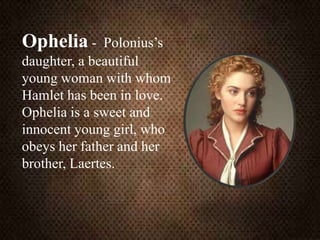
Ophelia - Polonius’s
daughter, a beautiful
young woman with whom
Hamlet has been in love.
Ophelia is a sweet and
innocent young girl, who
obeys her father and her
brother, Laertes.
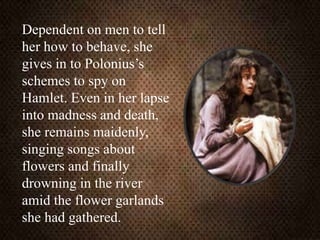
Dependent on men to tell
her how to behave, she
gives in to Polonius’s
schemes to spy on
Hamlet. Even in her lapse
into madness and death,
she remains maidenly,
singing songs about
flowers and finally
drowning in the river
amid the flower garlands
she had gathered.
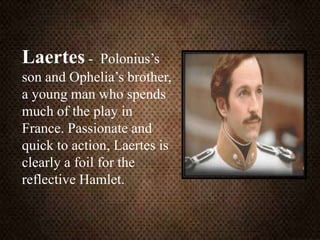
Laertes - Polonius’s
son and Ophelia’s brother,
a young man who spends
much of the play in
France. Passionate and
quick to action, Laertes is
clearly a foil for the
reflective Hamlet.
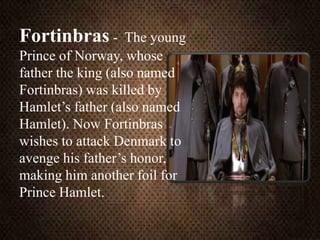
Fortinbras - The young
Prince of Norway, whose
father the king (also named
Fortinbras) was killed by
Hamlet’s father (also named
Hamlet). Now Fortinbras
wishes to attack Denmark to
avenge his father’s honor,
making him another foil for
Prince Hamlet.
The Ghost - The specter of
Hamlet’s recently deceased
father. The ghost, who
claims to have been
murdered by Claudius, calls
upon Hamlet to avenge him.
However, it is not entirely
certain whether the ghost is
what it appears to be, or
whether it is something else.
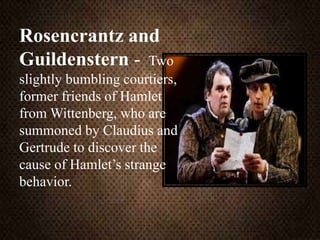
Rosencrantz and
Guildenstern - Two
slightly bumbling courtiers,
former friends of Hamlet
from Wittenberg, who are
summoned by Claudius and
Gertrude to discover the
cause of Hamlet’s strange
behavior.
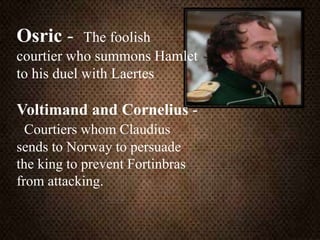
Osric - The foolish
courtier who summons Hamlet
to his duel with Laertes
Voltimand and Cornelius -
Courtiers whom Claudius
sends to Norway to persuade
the king to prevent Fortinbras
from attacking.
Marcellus and Bernardo - The
officers who first see the ghost walking the
ramparts of Elsinore and who summon Horatio
to witness it. Marcellus is present when Hamlet
first encounters the ghost.
Francisco - A soldier and guardsman at
Elsinore.
Reynaldo - Polonius’s servant, who is sent
to France by Polonius to check up on and spy
on Laertes.
Plot
Exposition information – In the story Hamlet is a
prince of Denmark, his father was the king. The King had
died, before anything could have happened. Hamlet’s
uncle Claudius had his marriage with the queen Gertrude
or Hamlet’s mother, and then soon he owned the throne.
Then one day Hamlet’s father appear in a form of ghost in
front of hamlet’s eye and informed him that Claudius was
the one who murdered him and so hamlets swore to take
the revenge.
Plot
Inciting incident or conflict –
Hamlet’s king was murdered by Claudius
and Hamlet’s swore to take revenge for
his father.
Rising Action –Hamlet then got the idea to let
the actors performed the murdered situation of his
father’s case. As he was told from the ghost and
observed how will Claudius respond. After the play
displayed the scene of how his father’s was murdered,
Claudius stood up with anger then left to be alone. He
then pray to the lord to ask for forgiveness then
admitted that he did murdered Hamlet’s father. Hamlet
hesitated to kill Claudius with his sword behind him,
but he feared that if he were to kill Claudius while he is
praying he’ll sure go to heaven but Hamlet’s wanted
him to go to hell.
Climax – First climax: When Hamlet stabs
Polonius after the talk with his mother on trying to
tell her why she’s wrong in sleeping with Claudius,
as then he committed himself due to his violent
action and brings himself into a conflict with the
king.
Second Climax: In the fencing match
when Gertrude started to drink the poisonous drink
that Claudius intentionally made for Hamlet’s, then
they all started to fight and died.
Falling action – Ophelia decided to suicide
due because of her father’s death. Hamlet then
was sent to England by Claudius and was meant
to put to death, but soon people realized that
Hamlet was alive because he maintained to
retrieve the death sentence letter. Hamlet then
fought the fencing match.
Denouement – Hamlet told Rachael to
remain and announce the truth, later Prince
of Norway, Fortinbras arrived with his army
and so he saw that the whole family had
died, he claim the kingdom for himself.
Setting
- Late middle ages in
Denmark at the royal palace.
Genre
-Revenge Tragedy, Tragedy
THEME
a. The Impossibility of Certainty
This play poses many questions that other
plays would simply take for granted.
 About the ghost’s apparition; Hamlet’s
father’s death; Hamlet’s insanity
The play shows us how many uncertainties
our lives are built upon, how many unknown
quantities are taken for granted when people act or
when they evaluate one another’s actions.
THEME
b. The Complexity of Action
 In Hamlet, the question of how to act is
affected not only by rational considerations,
such as the need for certainty, but also by
emotional, ethical, and psychological factors.
 Hamlet himself appears to distrust the idea that
it’s even possible to act in a controlled,
purposeful way.
THEME
c. The Mystery of Death
 Throughout, the idea of death is closely tied to
the themes of spirituality, truth, and uncertainty
in that death may bring the answers to
Hamlet’s deepest questions, ending once and
for all the problem of trying to determine truth
in an ambiguous world.
 And, since death is both the cause and the
consequence of revenge, it is intimately tied to
the theme of revenge and justice.
THEME
d. The Nation as a Diseased Body
Throughout the play, characters draw explicit
connections between the moral legitimacy of a
ruler and the health of the nation.
Denmark is frequently described as a physical
body made ill by the moral corruption of Claudius
and Gertrude.
(“something is rotten in Denmark”)
Tone
 Dark
 Uncertain
 Introspective
Tortured
Hamlet Writing Style
Verse and Prose
 Hamlet, like Shakespeare's other plays, is
written in a combination of verse (poetry) and
prose (how we talk every day).
Verse
In Hamlet—like in most of Shakespeare's
plays—the nobles typically speak in unrhymed
“iambic pentameter" (also called “blank verse").
 An "iamb" is an unaccented syllable
followed by an accented one.
 "Penta" means "five," and "meter" refers
to a regular rhythmic pattern.
 So "iambic pentameter" is a kind of
rhythmic pattern that consist of five iambs
per line.
 It's the most common rhythm in English poetry
and sounds like five heartbeats: ba-DUM, ba-
DUM, ba-DUM, ba-DUM, ba-DUM.
“and BY opposing END them? To DIE to
SLEEP;
no MORE; and BY a SLEEP to SAY we END”
Prose
 Characters who aren't so high-class—
like the gravediggers—don't get to speak
in verse; they just talk. Hamlet himself,
however, sometimes speaks in prose,
even when he's being awfully poetic.
Take, for instance, the following line:
“How noble in reason! how infinite
in faculty! in form, in moving, how
express and admirable! in action
how like an angel! in apprehension
how like a god! the beauty of the
world! the paragon of animals! And
yet, to me, what is this quintessence
of dust? ”
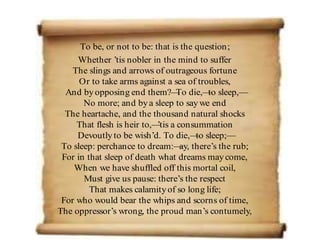
To be, or not to be: that is the question;
Whether ’tis nobler in the mind to suffer
The slings and arrows of outrageous fortune
Or to take arms against a sea of troubles,
And byopposing end them?—
To die,—
to sleep,—
No more; and bya sleep to say we end
The heartache, and the thousand natural shocks
That flesh is heir to,—
’tis a consummation
Devoutlyto be wish’d. To die,—
to sleep;—
To sleep: perchance to dream:—
ay, there’s the rub;
For in that sleep of death what dreams maycome,
When we have shuffled off this mortal coil,
Must give us pause: there’s the respect
That makes calamityof so long life;
For who would bear the whips and scorns of time,
The oppressor’s wrong, the proud man’s contumely,
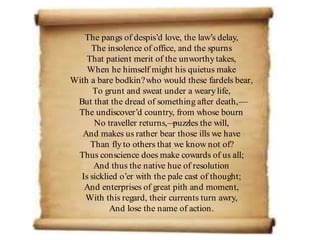
The pangs of despis’d love, the law’s delay,
The insolence of office, and the spurns
That patient merit of the unworthytakes,
When he himself might his quietus make
With a bare bodkin?who would these fardels bear,
To grunt and sweat under a wearylife,
But that the dread of something after death,—
The undiscover’d country, from whose bourn
No traveller returns,—
puzzles the will,
And makes us rather bear those ills we have
Than flyto others that we know not of?
Thus conscience does make cowards of us all;
And thus the native hue of resolution
Is sicklied o’er with the pale cast of thought;
And enterprises of great pith and moment,
With this regard, their currents turn awry,
And lose the name of action.
 This soliloquy, probably the most
famous speech in the English language, is
spoken by Hamlet in Act III, scene i (58–
90). His most logical and powerful
examination of the theme of the moral
legitimacy of suicide in an unbearably
painful world, it touches on several of the
other important themes of the play.
 Hamlet poses the problem of whether
to commit suicide as a logical question:
“To be, or not to be,” that is, to live or not
to live. He then weighs the moral
ramifications of living and dying. Is it
nobler to suffer life, “the slings and
arrows of outrageous fortune,” passively
or to actively seek to end one’s suffering?
 He compares death to sleep and thinks of
the end to suffering, pain, and uncertainty it
might bring, “[t]he heartache, and the
thousand natural shocks / That flesh is heir
to.” Based on this metaphor, he decides that
suicide is a desirable course of action, “a
consummation / Devoutly to be wished.”
But, as the religious word “devoutly”
signifies, there is more to the question,
namely, what will happen in the afterlife.
 Hamlet immediately realizes as
much, and he reconfigures his
metaphor of sleep to include the
possibility of dreaming; he says that the
dreams that may come in the sleep of
death are daunting, that they “must give
us pause.”
He then decides that the uncertainty of
the afterlife, which is intimately related
to the theme of the difficulty of
attaining truth in a spiritually
ambiguous world, is essentially what
prevents all of humanity from
committing suicide to end the pain of
life.
He outlines a long list of the miseries
of experience, ranging from
lovesickness to hard work to political
oppression, and asks who would
choose to bear those miseries if he
could bring himself peace with a knife,
“[w]hen he himself might his quietus
make / With a bare bodkin?”
He answers himself again, saying no
one would choose to live, except that
“the dread of something after death”
makes people submit to the suffering
of their lives rather than go to another
state of existence which might be even
more miserable.
The dread of the afterlife, Hamlet
concludes, leads to excessive moral
sensitivity that makes action
impossible: “conscience does make
cowards of us all . . . thus the native
hue of resolution / Is sicklied o’er with
the pale cast of thought.”
In this way, this speech connects many
of the play’s main themes, including the
idea of suicide and death, the difficulty
of knowing the truth in a spiritually
ambiguous universe, and the connection
between thought and action. In addition
to its crucial thematic content, this
speech is important for what it reveals
about the quality of Hamlet’s mind.
His deeply passionate nature is
complemented by a relentlessly logical
intellect, which works furiously to find a
solution to his misery. He has turned to
religion and found it inadequate to help
him either kill himself or resolve to kill
Claudius. Here, he turns to a logical
philosophical inquiry and finds it
equally frustrating.
HAMLET (excellent reference to students).pptx

HAMLET (excellent reference to students).pptx

  • 1.
  • 2.
    “The remarkable thingabout William Shakespeare is that he really is very good, in spite of all the people who say he is very good.” -Robert Graves William Shakespeare
  • 4.
  • 5.
    Elements of aPlay 1.) PLOT -the arrangement of events or incidents on the stage. -composed of “clearly defined problems for characters to solve.”
  • 6.
    PLOT • Exposition- backgroundinformation. • Inciting Incident or Conflict- the event that’s sets in motion the action of the play. • Rising Action- Complications and discoveries, which create conflict. • Climax- turning point of the plot, emotional intensity of play.
  • 7.
    • Falling Action-series of events following the climax. • Denouement- “unknotting” resolution of the conflicts.
  • 8.
    2. CHARACTER – Theagents of the plot. – Characters provide the motivations (reasons) for the events of the plot. – “Vivid characters” face and overcome “obstacles that we can recognize.” – they provide the vehicle for conflict.
  • 9.
    CHARACTER a) Protagonist- maincharacter b) Antagonist- person, situation, or inner conflict in opposition to the main character’s goals. c) Secondary Characters- all other characters other than protagonist and antagonist.
  • 10.
    3. SETTING -When andwhere does it happen? a) Viewable elements b) Common sights and sounds to enhance time and place c) Sound effects and or music contribute to time and place
  • 11.
    4. THEME -The playwright’smessage -The theme is expressed through words and actions of the characters in a series of situations that make up the plot. Each situation takes place in a setting.
  • 12.
    5. LANGUAGE - “Vividcharacters” facing and overcoming recognizable obstacles need to express themselves in “heightened language.” –Dramatic dialogue consists of two parts: narrative and dramatic.
  • 13.
    6. RHYTHM  Theheart of the play. Plot, character, language, and spectacle all have their individual rhythms in time.  The combination of all these rhythms create the impelling force of the play leading to a final climax and denouement.  Rhythm creates mood.
  • 14.
    7. SPECTACLE Everything thatis seen or heard on stage. Actors, sets, costumes, lights and sound. NOTE: All plays have spectacle— some emphasize spectacle more than others.
  • 15.
    The Tragedy of Hamlet, Princeof Denmark By: William Shakespeare
  • 16.
    Characters • Hamlet –Son of the former King, and nephew of the present King. • Claudius – King of Denmark, and Hamlet's uncle. • Gertrude– Queen of Denmark, and mother to Hamlet. • Polonius– Lord Chamberlain • Ophelia – Daughter to Polonius • Horatio – Friend to Hamlet • Laertes – Son to Polonius
  • 17.
    • Voltimand andCornelius – Courtiers • Rosencrantz and Guildenstern – Courtiers, friends to Hamlet. • Osric – a Courtier • Marcellus – an Officer • Bernardo – an Officer • Francisco – a Soldier • Reynaldo – Servant to Polonius • Ghost of Hamlet’s Father • Fortinbras – Prince of Norway • Gravediggers – a Sexton, and a clown. • Player King, Player Queen, Lucianus, etc. – Players
  • 18.
    Hamlet - ThePrince of Denmark, the title character, and the protagonist. About thirty years old at the start of the play, Hamlet is the son of Queen Gertrude and the late King Hamlet, and the nephew of the present king, Claudius. Hamlet is melancholy, bitter, and cynical, full of hatred for his uncle’s scheming and disgust for his mother’s sexuality.
  • 19.
    A reflective andthoughtful young man who has studied at the University of Wittenberg, Hamlet is often indecisive and hesitant, but at other times prone to rash and impulsive acts.
  • 20.
    Claudius - TheKing of Denmark, Hamlet’s uncle, and the play’s antagonist. The villain of the play, Claudius is a calculating, ambitious politician, driven by his sexual appetites and his lust for power, but he occasionally shows signs of guilt and human feeling—his love for Gertrude, for instance, seems sincere.
  • 21.
    Gertrude - TheQueen of Denmark, Hamlet’s mother, recently married to Claudius. Gertrude loves Hamlet deeply, but she is a shallow, weak woman who seeks affection and status more urgently than moral rectitude or truth.
  • 22.
    Polonius - TheLord Chamberlain of Claudius’s court, a pompous, conniving old man. Polonius is the father of Laertes and Ophelia.
  • 23.
    Horatio - Hamlet’s closefriend, who studied with the prince at the university in Wittenberg. Horatio is loyal and helpful to Hamlet throughout the play. After Hamlet’s death, Horatio remains alive to tell Hamlet’s story.
  • 24.
    Ophelia - Polonius’s daughter,a beautiful young woman with whom Hamlet has been in love. Ophelia is a sweet and innocent young girl, who obeys her father and her brother, Laertes.
  • 25.
    Dependent on mento tell her how to behave, she gives in to Polonius’s schemes to spy on Hamlet. Even in her lapse into madness and death, she remains maidenly, singing songs about flowers and finally drowning in the river amid the flower garlands she had gathered.
  • 26.
    Laertes - Polonius’s sonand Ophelia’s brother, a young man who spends much of the play in France. Passionate and quick to action, Laertes is clearly a foil for the reflective Hamlet.
  • 27.
    Fortinbras - Theyoung Prince of Norway, whose father the king (also named Fortinbras) was killed by Hamlet’s father (also named Hamlet). Now Fortinbras wishes to attack Denmark to avenge his father’s honor, making him another foil for Prince Hamlet.
  • 28.
    The Ghost -The specter of Hamlet’s recently deceased father. The ghost, who claims to have been murdered by Claudius, calls upon Hamlet to avenge him. However, it is not entirely certain whether the ghost is what it appears to be, or whether it is something else.
  • 29.
    Rosencrantz and Guildenstern -Two slightly bumbling courtiers, former friends of Hamlet from Wittenberg, who are summoned by Claudius and Gertrude to discover the cause of Hamlet’s strange behavior.
  • 30.
    Osric - Thefoolish courtier who summons Hamlet to his duel with Laertes Voltimand and Cornelius - Courtiers whom Claudius sends to Norway to persuade the king to prevent Fortinbras from attacking.
  • 31.
    Marcellus and Bernardo- The officers who first see the ghost walking the ramparts of Elsinore and who summon Horatio to witness it. Marcellus is present when Hamlet first encounters the ghost. Francisco - A soldier and guardsman at Elsinore. Reynaldo - Polonius’s servant, who is sent to France by Polonius to check up on and spy on Laertes.
  • 32.
    Plot Exposition information –In the story Hamlet is a prince of Denmark, his father was the king. The King had died, before anything could have happened. Hamlet’s uncle Claudius had his marriage with the queen Gertrude or Hamlet’s mother, and then soon he owned the throne. Then one day Hamlet’s father appear in a form of ghost in front of hamlet’s eye and informed him that Claudius was the one who murdered him and so hamlets swore to take the revenge.
  • 33.
    Plot Inciting incident orconflict – Hamlet’s king was murdered by Claudius and Hamlet’s swore to take revenge for his father.
  • 34.
    Rising Action –Hamletthen got the idea to let the actors performed the murdered situation of his father’s case. As he was told from the ghost and observed how will Claudius respond. After the play displayed the scene of how his father’s was murdered, Claudius stood up with anger then left to be alone. He then pray to the lord to ask for forgiveness then admitted that he did murdered Hamlet’s father. Hamlet hesitated to kill Claudius with his sword behind him, but he feared that if he were to kill Claudius while he is praying he’ll sure go to heaven but Hamlet’s wanted him to go to hell.
  • 35.
    Climax – Firstclimax: When Hamlet stabs Polonius after the talk with his mother on trying to tell her why she’s wrong in sleeping with Claudius, as then he committed himself due to his violent action and brings himself into a conflict with the king. Second Climax: In the fencing match when Gertrude started to drink the poisonous drink that Claudius intentionally made for Hamlet’s, then they all started to fight and died.
  • 36.
    Falling action –Ophelia decided to suicide due because of her father’s death. Hamlet then was sent to England by Claudius and was meant to put to death, but soon people realized that Hamlet was alive because he maintained to retrieve the death sentence letter. Hamlet then fought the fencing match.
  • 37.
    Denouement – Hamlettold Rachael to remain and announce the truth, later Prince of Norway, Fortinbras arrived with his army and so he saw that the whole family had died, he claim the kingdom for himself.
  • 38.
    Setting - Late middleages in Denmark at the royal palace. Genre -Revenge Tragedy, Tragedy
  • 39.
    THEME a. The Impossibilityof Certainty This play poses many questions that other plays would simply take for granted.  About the ghost’s apparition; Hamlet’s father’s death; Hamlet’s insanity The play shows us how many uncertainties our lives are built upon, how many unknown quantities are taken for granted when people act or when they evaluate one another’s actions.
  • 40.
    THEME b. The Complexityof Action  In Hamlet, the question of how to act is affected not only by rational considerations, such as the need for certainty, but also by emotional, ethical, and psychological factors.  Hamlet himself appears to distrust the idea that it’s even possible to act in a controlled, purposeful way.
  • 41.
    THEME c. The Mysteryof Death  Throughout, the idea of death is closely tied to the themes of spirituality, truth, and uncertainty in that death may bring the answers to Hamlet’s deepest questions, ending once and for all the problem of trying to determine truth in an ambiguous world.  And, since death is both the cause and the consequence of revenge, it is intimately tied to the theme of revenge and justice.
  • 42.
    THEME d. The Nationas a Diseased Body Throughout the play, characters draw explicit connections between the moral legitimacy of a ruler and the health of the nation. Denmark is frequently described as a physical body made ill by the moral corruption of Claudius and Gertrude. (“something is rotten in Denmark”)
  • 43.
    Tone  Dark  Uncertain Introspective Tortured
  • 44.
    Hamlet Writing Style Verseand Prose  Hamlet, like Shakespeare's other plays, is written in a combination of verse (poetry) and prose (how we talk every day). Verse In Hamlet—like in most of Shakespeare's plays—the nobles typically speak in unrhymed “iambic pentameter" (also called “blank verse").
  • 45.
     An "iamb"is an unaccented syllable followed by an accented one.  "Penta" means "five," and "meter" refers to a regular rhythmic pattern.  So "iambic pentameter" is a kind of rhythmic pattern that consist of five iambs per line.
  • 46.
     It's themost common rhythm in English poetry and sounds like five heartbeats: ba-DUM, ba- DUM, ba-DUM, ba-DUM, ba-DUM. “and BY opposing END them? To DIE to SLEEP; no MORE; and BY a SLEEP to SAY we END”
  • 47.
    Prose  Characters whoaren't so high-class— like the gravediggers—don't get to speak in verse; they just talk. Hamlet himself, however, sometimes speaks in prose, even when he's being awfully poetic. Take, for instance, the following line:
  • 48.
    “How noble inreason! how infinite in faculty! in form, in moving, how express and admirable! in action how like an angel! in apprehension how like a god! the beauty of the world! the paragon of animals! And yet, to me, what is this quintessence of dust? ”
  • 49.
    To be, ornot to be: that is the question; Whether ’tis nobler in the mind to suffer The slings and arrows of outrageous fortune Or to take arms against a sea of troubles, And byopposing end them?— To die,— to sleep,— No more; and bya sleep to say we end The heartache, and the thousand natural shocks That flesh is heir to,— ’tis a consummation Devoutlyto be wish’d. To die,— to sleep;— To sleep: perchance to dream:— ay, there’s the rub; For in that sleep of death what dreams maycome, When we have shuffled off this mortal coil, Must give us pause: there’s the respect That makes calamityof so long life; For who would bear the whips and scorns of time, The oppressor’s wrong, the proud man’s contumely,
  • 50.
    The pangs ofdespis’d love, the law’s delay, The insolence of office, and the spurns That patient merit of the unworthytakes, When he himself might his quietus make With a bare bodkin?who would these fardels bear, To grunt and sweat under a wearylife, But that the dread of something after death,— The undiscover’d country, from whose bourn No traveller returns,— puzzles the will, And makes us rather bear those ills we have Than flyto others that we know not of? Thus conscience does make cowards of us all; And thus the native hue of resolution Is sicklied o’er with the pale cast of thought; And enterprises of great pith and moment, With this regard, their currents turn awry, And lose the name of action.
  • 51.
     This soliloquy,probably the most famous speech in the English language, is spoken by Hamlet in Act III, scene i (58– 90). His most logical and powerful examination of the theme of the moral legitimacy of suicide in an unbearably painful world, it touches on several of the other important themes of the play.
  • 52.
     Hamlet posesthe problem of whether to commit suicide as a logical question: “To be, or not to be,” that is, to live or not to live. He then weighs the moral ramifications of living and dying. Is it nobler to suffer life, “the slings and arrows of outrageous fortune,” passively or to actively seek to end one’s suffering?
  • 53.
     He comparesdeath to sleep and thinks of the end to suffering, pain, and uncertainty it might bring, “[t]he heartache, and the thousand natural shocks / That flesh is heir to.” Based on this metaphor, he decides that suicide is a desirable course of action, “a consummation / Devoutly to be wished.” But, as the religious word “devoutly” signifies, there is more to the question, namely, what will happen in the afterlife.
  • 54.
     Hamlet immediatelyrealizes as much, and he reconfigures his metaphor of sleep to include the possibility of dreaming; he says that the dreams that may come in the sleep of death are daunting, that they “must give us pause.”
  • 55.
    He then decidesthat the uncertainty of the afterlife, which is intimately related to the theme of the difficulty of attaining truth in a spiritually ambiguous world, is essentially what prevents all of humanity from committing suicide to end the pain of life.
  • 56.
    He outlines along list of the miseries of experience, ranging from lovesickness to hard work to political oppression, and asks who would choose to bear those miseries if he could bring himself peace with a knife, “[w]hen he himself might his quietus make / With a bare bodkin?”
  • 57.
    He answers himselfagain, saying no one would choose to live, except that “the dread of something after death” makes people submit to the suffering of their lives rather than go to another state of existence which might be even more miserable.
  • 58.
    The dread ofthe afterlife, Hamlet concludes, leads to excessive moral sensitivity that makes action impossible: “conscience does make cowards of us all . . . thus the native hue of resolution / Is sicklied o’er with the pale cast of thought.”
  • 59.
    In this way,this speech connects many of the play’s main themes, including the idea of suicide and death, the difficulty of knowing the truth in a spiritually ambiguous universe, and the connection between thought and action. In addition to its crucial thematic content, this speech is important for what it reveals about the quality of Hamlet’s mind.
  • 60.
    His deeply passionatenature is complemented by a relentlessly logical intellect, which works furiously to find a solution to his misery. He has turned to religion and found it inadequate to help him either kill himself or resolve to kill Claudius. Here, he turns to a logical philosophical inquiry and finds it equally frustrating.