Frame & Explain
Using Quotations in Your Writing
Let’s Operate Under this Claim
• In Night, Wiesel goes to great lengths to show
how faith is tested in difficult times.
Select the quotes to use.
Selecting Quotes
• Choose the best examples to support your ideas.
• Weak quotes lead to weak writing, so make sure
your examples are strong!
For example
• “I did not fast. First of all, to please my father
who had forbidden me to do so. And then, there
was no longer any reason for me to fast. I no
longer accepted God’s silence. As I swallowed
my ration of soup, I turned that act into a
symbol of rebellion, of protest against Him. And
I nibbled on my crust of bread. Deep inside me, I
felt a great void opening” (69).
• This quote is essential to my argument.
Frame your quote.
Framing
• You can’t just plot a quote in your paper. It must
be “framed”.
Provide Context
One way Wiesel proved his faith was tested
throughout the Holocaust was through the inner
conflict he shared with us during his journey. When
Yom Kippur came around, Elie struggled to decide
whether or not to uphold the tradition of fasting. He
writes, “I did not fast. First of all, to please my father
who had forbidden me to do so. And then, there was
no longer any reason for me to fast. I no longer
accepted Gods’ silence. As I swallowed my ration of
soup, I turned that act into a symbol of rebellion, of
protest against Him. And I nibbled on my crust of
bread. Deep inside me, I felt a great void opening”
(69).
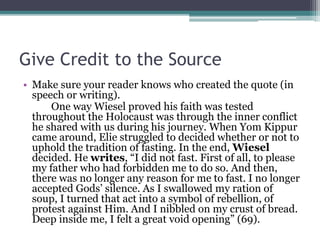
Give Credit to the Source
• Make sure your reader knows who created the quote (in
speech or writing).
One way Wiesel proved his faith was tested
throughout the Holocaust was through the inner conflict
he shared with us during his journey. When Yom Kippur
came around, Elie struggled to decided whether or not to
uphold the tradition of fasting. In the end, Wiesel
decided. He writes, “I did not fast. First of all, to please
my father who had forbidden me to do so. And then,
there was no longer any reason for me to fast. I no longer
accepted Gods’ silence. As I swallowed my ration of
soup, I turned that act into a symbol of rebellion, of
protest against Him. And I nibbled on my crust of bread.
Deep inside me, I felt a great void opening” (69).
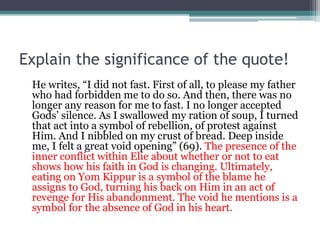
Explain the significance of the quote!
He writes, “I did not fast. First of all, to please my father
who had forbidden me to do so. And then, there was no
longer any reason for me to fast. I no longer accepted
Gods’ silence. As I swallowed my ration of soup, I turned
that act into a symbol of rebellion, of protest against
Him. And I nibbled on my crust of bread. Deep inside
me, I felt a great void opening” (69). The presence of the
inner conflict within Elie about whether or not to eat
shows how his faith in God is changing. Ultimately,
eating on Yom Kippur is a symbol of the blame he
assigns to God, turning his back on Him in an act of
revenge for His abandonment. The void he mentions is a
symbol for the absence of God in his heart.
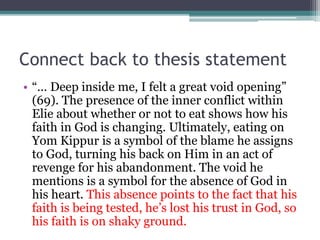
Connect back to thesis statement
• “… Deep inside me, I felt a great void opening”
(69). The presence of the inner conflict within
Elie about whether or not to eat shows how his
faith in God is changing. Ultimately, eating on
Yom Kippur is a symbol of the blame he assigns
to God, turning his back on Him in an act of
revenge for his abandonment. The void he
mentions is a symbol for the absence of God in
his heart. This absence points to the fact that his
faith is being tested, he’s lost his trust in God, so
his faith is on shaky ground.
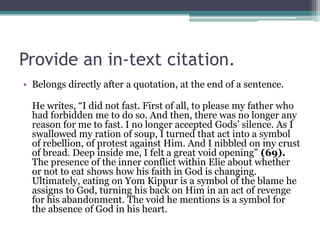
Provide an in-text citation.
• Belongs directly after a quotation, at the end of a sentence.
He writes, “I did not fast. First of all, to please my father who
had forbidden me to do so. And then, there was no longer any
reason for me to fast. I no longer accepted Gods’ silence. As I
swallowed my ration of soup, I turned that act into a symbol
of rebellion, of protest against Him. And I nibbled on my crust
of bread. Deep inside me, I felt a great void opening” (69).
The presence of the inner conflict within Elie about whether
or not to eat shows how his faith in God is changing.
Ultimately, eating on Yom Kippur is a symbol of the blame he
assigns to God, turning his back on Him in an act of revenge
for his abandonment. The void he mentions is a symbol for
the absence of God in his heart.
A Sample Paragraph
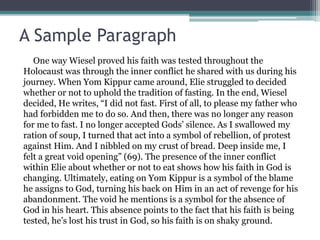
One way Wiesel proved his faith was tested throughout the
Holocaust was through the inner conflict he shared with us during his
journey. When Yom Kippur came around, Elie struggled to decided
whether or not to uphold the tradition of fasting. In the end, Wiesel
decided, He writes, “I did not fast. First of all, to please my father who
had forbidden me to do so. And then, there was no longer any reason
for me to fast. I no longer accepted Gods’ silence. As I swallowed my
ration of soup, I turned that act into a symbol of rebellion, of protest
against Him. And I nibbled on my crust of bread. Deep inside me, I
felt a great void opening” (69). The presence of the inner conflict
within Elie about whether or not to eat shows how his faith in God is
changing. Ultimately, eating on Yom Kippur is a symbol of the blame
he assigns to God, turning his back on Him in an act of revenge for his
abandonment. The void he mentions is a symbol for the absence of
God in his heart. This absence points to the fact that his faith is being
tested, he’s lost his trust in God, so his faith is on shaky ground.
There are rules, so get it right…
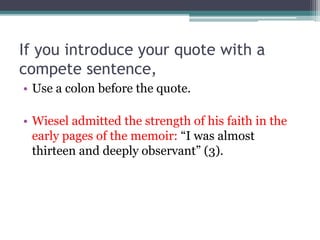
If you introduce your quote with a
compete sentence,
• Use a colon before the quote.
• Wiesel admitted the strength of his faith in the
early pages of the memoir: “I was almost
thirteen and deeply observant” (3).
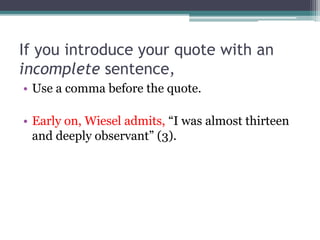
If you introduce your quote with an
incomplete sentence,
• Use a comma before the quote.
• Early on, Wiesel admits, “I was almost thirteen
and deeply observant” (3).
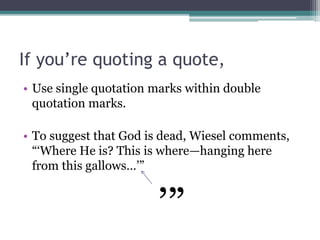
If you’re quoting a quote,
• Use single quotation marks within double
quotation marks.
• To suggest that God is dead, Wiesel comments,
“‘Where He is? This is where—hanging here
from this gallows…’”
’”
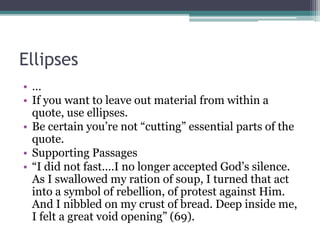
Ellipses
• …
• If you want to leave out material from within a
quote, use ellipses.
• Be certain you’re not “cutting” essential parts of the
quote.
• Supporting Passages
• “I did not fast.…I no longer accepted God’s silence.
As I swallowed my ration of soup, I turned that act
into a symbol of rebellion, of protest against Him.
And I nibbled on my crust of bread. Deep inside me,
I felt a great void opening” (69).
Writing: Frame and Explain

Writing: Frame and Explain

  • 1.
    Frame & Explain UsingQuotations in Your Writing
  • 2.
    Let’s Operate Underthis Claim • In Night, Wiesel goes to great lengths to show how faith is tested in difficult times.
  • 3.
  • 4.
    Selecting Quotes • Choosethe best examples to support your ideas. • Weak quotes lead to weak writing, so make sure your examples are strong!
  • 5.
    For example • “Idid not fast. First of all, to please my father who had forbidden me to do so. And then, there was no longer any reason for me to fast. I no longer accepted God’s silence. As I swallowed my ration of soup, I turned that act into a symbol of rebellion, of protest against Him. And I nibbled on my crust of bread. Deep inside me, I felt a great void opening” (69). • This quote is essential to my argument.
  • 6.
  • 7.
    Framing • You can’tjust plot a quote in your paper. It must be “framed”.
  • 8.
    Provide Context One wayWiesel proved his faith was tested throughout the Holocaust was through the inner conflict he shared with us during his journey. When Yom Kippur came around, Elie struggled to decide whether or not to uphold the tradition of fasting. He writes, “I did not fast. First of all, to please my father who had forbidden me to do so. And then, there was no longer any reason for me to fast. I no longer accepted Gods’ silence. As I swallowed my ration of soup, I turned that act into a symbol of rebellion, of protest against Him. And I nibbled on my crust of bread. Deep inside me, I felt a great void opening” (69).
  • 9.
    Give Credit tothe Source • Make sure your reader knows who created the quote (in speech or writing). One way Wiesel proved his faith was tested throughout the Holocaust was through the inner conflict he shared with us during his journey. When Yom Kippur came around, Elie struggled to decided whether or not to uphold the tradition of fasting. In the end, Wiesel decided. He writes, “I did not fast. First of all, to please my father who had forbidden me to do so. And then, there was no longer any reason for me to fast. I no longer accepted Gods’ silence. As I swallowed my ration of soup, I turned that act into a symbol of rebellion, of protest against Him. And I nibbled on my crust of bread. Deep inside me, I felt a great void opening” (69).
  • 10.
    Explain the significanceof the quote! He writes, “I did not fast. First of all, to please my father who had forbidden me to do so. And then, there was no longer any reason for me to fast. I no longer accepted Gods’ silence. As I swallowed my ration of soup, I turned that act into a symbol of rebellion, of protest against Him. And I nibbled on my crust of bread. Deep inside me, I felt a great void opening” (69). The presence of the inner conflict within Elie about whether or not to eat shows how his faith in God is changing. Ultimately, eating on Yom Kippur is a symbol of the blame he assigns to God, turning his back on Him in an act of revenge for His abandonment. The void he mentions is a symbol for the absence of God in his heart.
  • 11.
    Connect back tothesis statement • “… Deep inside me, I felt a great void opening” (69). The presence of the inner conflict within Elie about whether or not to eat shows how his faith in God is changing. Ultimately, eating on Yom Kippur is a symbol of the blame he assigns to God, turning his back on Him in an act of revenge for his abandonment. The void he mentions is a symbol for the absence of God in his heart. This absence points to the fact that his faith is being tested, he’s lost his trust in God, so his faith is on shaky ground.
  • 12.
    Provide an in-textcitation. • Belongs directly after a quotation, at the end of a sentence. He writes, “I did not fast. First of all, to please my father who had forbidden me to do so. And then, there was no longer any reason for me to fast. I no longer accepted Gods’ silence. As I swallowed my ration of soup, I turned that act into a symbol of rebellion, of protest against Him. And I nibbled on my crust of bread. Deep inside me, I felt a great void opening” (69). The presence of the inner conflict within Elie about whether or not to eat shows how his faith in God is changing. Ultimately, eating on Yom Kippur is a symbol of the blame he assigns to God, turning his back on Him in an act of revenge for his abandonment. The void he mentions is a symbol for the absence of God in his heart.
  • 13.
    A Sample Paragraph Oneway Wiesel proved his faith was tested throughout the Holocaust was through the inner conflict he shared with us during his journey. When Yom Kippur came around, Elie struggled to decided whether or not to uphold the tradition of fasting. In the end, Wiesel decided, He writes, “I did not fast. First of all, to please my father who had forbidden me to do so. And then, there was no longer any reason for me to fast. I no longer accepted Gods’ silence. As I swallowed my ration of soup, I turned that act into a symbol of rebellion, of protest against Him. And I nibbled on my crust of bread. Deep inside me, I felt a great void opening” (69). The presence of the inner conflict within Elie about whether or not to eat shows how his faith in God is changing. Ultimately, eating on Yom Kippur is a symbol of the blame he assigns to God, turning his back on Him in an act of revenge for his abandonment. The void he mentions is a symbol for the absence of God in his heart. This absence points to the fact that his faith is being tested, he’s lost his trust in God, so his faith is on shaky ground.
  • 14.
    There are rules,so get it right…
  • 15.
    If you introduceyour quote with a compete sentence, • Use a colon before the quote. • Wiesel admitted the strength of his faith in the early pages of the memoir: “I was almost thirteen and deeply observant” (3).
  • 16.
    If you introduceyour quote with an incomplete sentence, • Use a comma before the quote. • Early on, Wiesel admits, “I was almost thirteen and deeply observant” (3).
  • 17.
    If you’re quotinga quote, • Use single quotation marks within double quotation marks. • To suggest that God is dead, Wiesel comments, “‘Where He is? This is where—hanging here from this gallows…’” ’”
  • 18.
    Ellipses • … • Ifyou want to leave out material from within a quote, use ellipses. • Be certain you’re not “cutting” essential parts of the quote. • Supporting Passages • “I did not fast.…I no longer accepted God’s silence. As I swallowed my ration of soup, I turned that act into a symbol of rebellion, of protest against Him. And I nibbled on my crust of bread. Deep inside me, I felt a great void opening” (69).