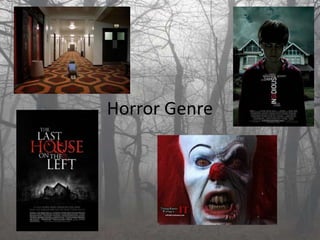
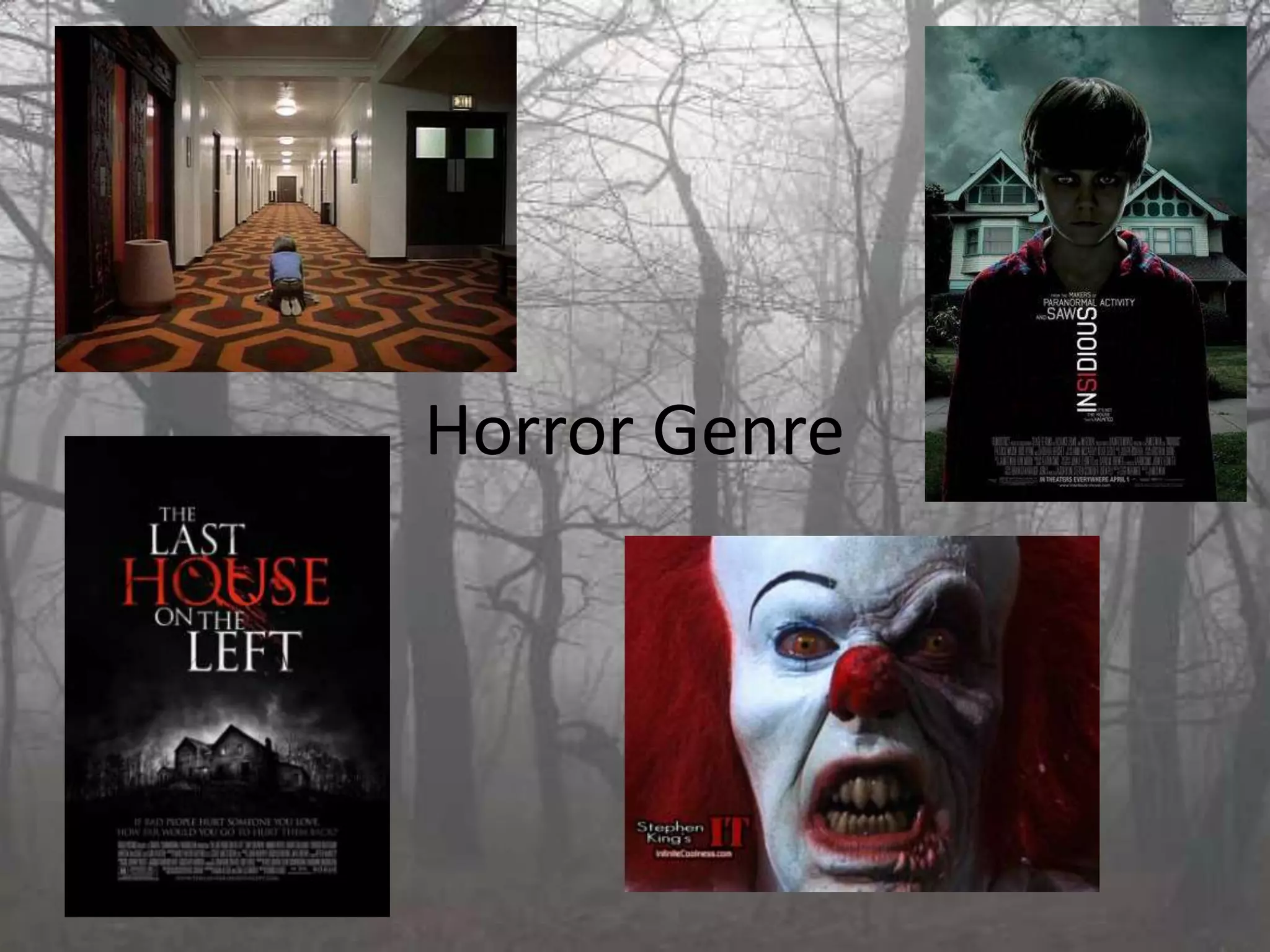
Horror Genre
What is Horror?
       Horror films aim to trigger
         an emotional response
         from their audience. They
         do this by playing on the
         audience's most primal
         fears. They often have
         scenes which may startle
         the audience through
         supernatural or macabre.
         Horror films also usually
         overlap the thriller genre.
What is the difference between a
          horror and a thriller?
A lot of people get confused between what the
  difference is with a horror and a thriller film. A
  thriller film is something that contains a lot of
  excitement, suspense and mystery, which our piece
  contains. A horror is something that is an
  overwhelming feeling that is caused by shock and
  usually plays on people fears and contains things
  such as monsters and blood. Our piece does contain
  elements of both the two genres; however, we see it
  more as a horror, especially when studying other
  horror films such as Jennifer’s Body and Scream 4,
  two films we think are quite similar to our own.
The History of the Horror Genre
Horror films from the start have had a supernatural
  appeal, and the first ones started off as silent shorts.
  The horror film genre came to light in the late 1980s,
  one from the time and the most well known is Le
  Manoir du diable, also known as The Haunted Castle
  made in 1896. This was said to be the first ever horror
  film and was the first vampire film.
Budgets for horror films rose during the 1960s and the
  publics interest in horror’s led to a range of serious
  supernatural-themed films, for example The Exorcist
  (1973) was and is said to be the most feared movie to
  watch from the audience and was able to break the
  record for horror films.
Horror Sub-genre
There isn’t just one type of Horror, horror comes in a range of different shapes, and here are the types
    of horror genres out there:
• Body horror – shows realistic obliteration or deterioration of the body, for example, the Human
    Centipede(First Sequence) (2010)
• Comedy horror - this combines both themes of comedy and horror fiction, for example Beetlejuice
    (1988)
• Gothic horror - contains elements from both gothic and horror fiction, for example The Phantom of
    the Opera (1925)
• Kiddie horror – this is aimed at a younger audience that only play on common fears . It contains less
    gore, and usually has a young protagonist, for example Monster House (2006)
• Monster movie – contains creature or monsters, for example Cloverfield (2008)
• Natural horror - contains mutated beasts, carnivorous insects, and animal and plants that are
    usually harmless, into killers, for example The Birds (1963)
• Psychological horror contains supernatural and ghosts and uses such things as fears, beliefs and
    eerie music to create suspense and tension, for example The Ring (2002)
• Science Fiction horror - contains murderous aliens, mad scientists, and or experiments gone wrong,
    for example Alien (1979)
• Slasher film - involves a psychopathic killer who goes round killing a series of different people using
    a knife or axe, for example Scream 1996)
• Splatter film - focus on the gore, usually contains a lot of special effects and a lot of blood splat, for
    example Saw (2004)
• Zombie film - contains creatures who either corpses or mindless humans, for example Resident Evil
    (2002)
Conventions of a Horror Genre
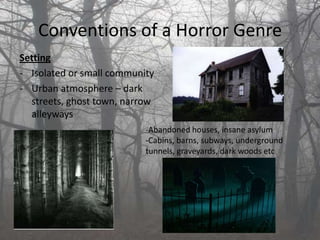
Setting
- Isolated or small community
- Urban atmosphere – dark
  streets, ghost town, narrow
  alleyways
                           -Abandoned houses, insane asylum
                           -Cabins, barns, subways, underground
                           tunnels, graveyards, dark woods etc
Conventions of a Horror Genre
Technical Conventions
- High and low angles – dominance and innocence
- Point of view shots – see it through the monsters eye
- Handheld – feel of terror and unknown (like Cloverfield)
- Ambient diegetic sound and non diegetic – footsteps and
   heartbeats
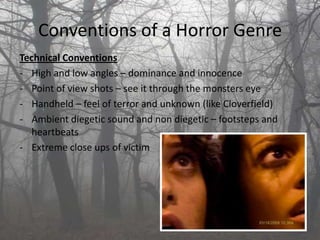
- Extreme close ups of victim
Conventions of a Horror Genre
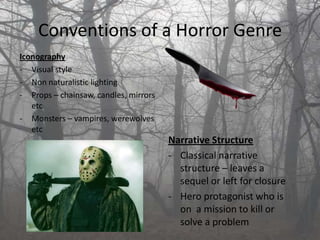
Iconography
- Visual style
- Non naturalistic lighting
- Props – chainsaw, candles, mirrors
   etc
- Monsters – vampires, werewolves
   etc
                                       Narrative Structure
                                       - Classical narrative
                                         structure – leaves a
                                         sequel or left for closure
                                       - Hero protagonist who is
                                         on a mission to kill or
                                         solve a problem
Conventions of a Horror Genre
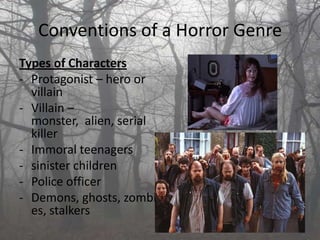
Types of Characters
- Protagonist – hero or
  villain
- Villain –
  monster, alien, serial
  killer
- Immoral teenagers
- sinister children
- Police officer
- Demons, ghosts, zombi
  es, stalkers
Conventions of a Horror Genre
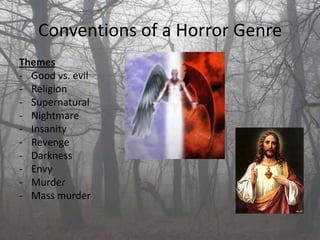
Themes
- Good vs. evil
- Religion
- Supernatural
- Nightmare
- Insanity
- Revenge
- Darkness
- Envy
- Murder
- Mass murder
Looking at horror film certificates –
              The Descent


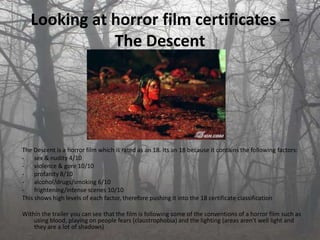
The Descent is a horror film which is rated as an 18. Its an 18 because it contains the following factors:
- sex & nudity 4/10
- violence & gore 10/10
- profanity 8/10
- alcohol/drugs/smoking 6/10
- frightening/intense scenes 10/10
This shows high levels of each factor, therefore pushing it into the 18 certificate classification

Within the trailer you can see that the film is following some of the conventions of a horror film such as
    using blood, playing on people fears (claustrophobia) and the lighting (areas aren't well light and
    they are a lot of shadows)
Looking at horror film certificates –
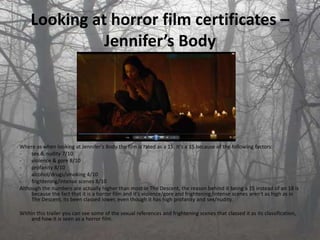
              Jennifer’s Body


Where as when looking at Jennifer's Body the film is rated as a 15. It's a 15 because of the following factors:
-    sex & nudity 7/10
-    violence & gore 8/10
-    profanity 8/10
-    alcohol/drugs/smoking 4/10
-    frightening/intense scenes 8/10
Although the numbers are actually higher than most in The Descent, the reason behind it being a 15 instead of an 18 is
     because the fact that it is a horror film and it's violence/gore and frightening/intense scenes aren't as high as in
     The Descent, its been classed lower, even though it has high profanity and sex/nudity.

Within this trailer you can see some of the sexual references and frightening scenes that classed it as its classification,
    and how it is seen as a horror film.
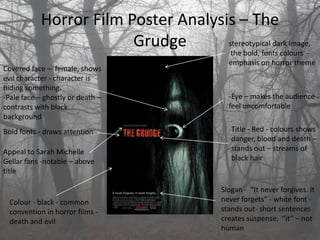
Horror Film Poster Analysis – The
                        Grudge       stereotypical dark image,
                                               the bold, fonts colours -
                                               emphasis on horror theme
Covered face – female, shows
evil character - character is
hiding something.
-Pale face – ghostly or death –                -Eye – makes the audience
contrasts with black                           feel uncomfortable
background
Bold fonts - draws attention                    Title - Red - colours shows
                                                danger, blood and death –
Appeal to Sarah Michelle                        stands out – streams of
Gellar fans -notable – above                    black hair
title

                                             Slogan - “It never forgives. It
 Colour - black - common                     never forgets” - white font -
 convention in horror films -                stands out- short sentences
 death and evil                              creates suspense. “it” – not
                                             human
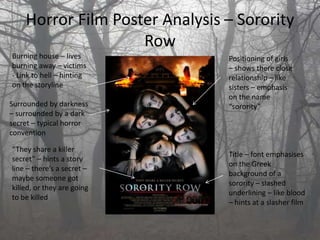
Horror Film Poster Analysis – Sorority
                    Row
Burning house – lives           Positioning of girls
burning away – victims          – shows there close
- Link to hell – hinting        relationship – like
on the storyline                sisters – emphasis
                                on the name
Surrounded by darkness          “sorority”
– surrounded by a dark
secret – typical horror
convention

“They share a killer
                                Title – font emphasises
secret” – hints a story
                                on the Greek
line – there’s a secret –
                                background of a
maybe someone got
                                sorority – slashed
killed, or they are going
                                underlining – like blood
to be killed
                                – hints at a slasher film

Horror Genre

  • 1.
  • 2.
    What is Horror? Horror films aim to trigger an emotional response from their audience. They do this by playing on the audience's most primal fears. They often have scenes which may startle the audience through supernatural or macabre. Horror films also usually overlap the thriller genre.
  • 3.
    What is thedifference between a horror and a thriller? A lot of people get confused between what the difference is with a horror and a thriller film. A thriller film is something that contains a lot of excitement, suspense and mystery, which our piece contains. A horror is something that is an overwhelming feeling that is caused by shock and usually plays on people fears and contains things such as monsters and blood. Our piece does contain elements of both the two genres; however, we see it more as a horror, especially when studying other horror films such as Jennifer’s Body and Scream 4, two films we think are quite similar to our own.
  • 4.
    The History ofthe Horror Genre Horror films from the start have had a supernatural appeal, and the first ones started off as silent shorts. The horror film genre came to light in the late 1980s, one from the time and the most well known is Le Manoir du diable, also known as The Haunted Castle made in 1896. This was said to be the first ever horror film and was the first vampire film. Budgets for horror films rose during the 1960s and the publics interest in horror’s led to a range of serious supernatural-themed films, for example The Exorcist (1973) was and is said to be the most feared movie to watch from the audience and was able to break the record for horror films.
  • 5.
    Horror Sub-genre There isn’tjust one type of Horror, horror comes in a range of different shapes, and here are the types of horror genres out there: • Body horror – shows realistic obliteration or deterioration of the body, for example, the Human Centipede(First Sequence) (2010) • Comedy horror - this combines both themes of comedy and horror fiction, for example Beetlejuice (1988) • Gothic horror - contains elements from both gothic and horror fiction, for example The Phantom of the Opera (1925) • Kiddie horror – this is aimed at a younger audience that only play on common fears . It contains less gore, and usually has a young protagonist, for example Monster House (2006) • Monster movie – contains creature or monsters, for example Cloverfield (2008) • Natural horror - contains mutated beasts, carnivorous insects, and animal and plants that are usually harmless, into killers, for example The Birds (1963) • Psychological horror contains supernatural and ghosts and uses such things as fears, beliefs and eerie music to create suspense and tension, for example The Ring (2002) • Science Fiction horror - contains murderous aliens, mad scientists, and or experiments gone wrong, for example Alien (1979) • Slasher film - involves a psychopathic killer who goes round killing a series of different people using a knife or axe, for example Scream 1996) • Splatter film - focus on the gore, usually contains a lot of special effects and a lot of blood splat, for example Saw (2004) • Zombie film - contains creatures who either corpses or mindless humans, for example Resident Evil (2002)
  • 6.
    Conventions of aHorror Genre Setting - Isolated or small community - Urban atmosphere – dark streets, ghost town, narrow alleyways -Abandoned houses, insane asylum -Cabins, barns, subways, underground tunnels, graveyards, dark woods etc
  • 7.
    Conventions of aHorror Genre Technical Conventions - High and low angles – dominance and innocence - Point of view shots – see it through the monsters eye - Handheld – feel of terror and unknown (like Cloverfield) - Ambient diegetic sound and non diegetic – footsteps and heartbeats - Extreme close ups of victim
  • 8.
    Conventions of aHorror Genre Iconography - Visual style - Non naturalistic lighting - Props – chainsaw, candles, mirrors etc - Monsters – vampires, werewolves etc Narrative Structure - Classical narrative structure – leaves a sequel or left for closure - Hero protagonist who is on a mission to kill or solve a problem
  • 9.
    Conventions of aHorror Genre Types of Characters - Protagonist – hero or villain - Villain – monster, alien, serial killer - Immoral teenagers - sinister children - Police officer - Demons, ghosts, zombi es, stalkers
  • 10.
    Conventions of aHorror Genre Themes - Good vs. evil - Religion - Supernatural - Nightmare - Insanity - Revenge - Darkness - Envy - Murder - Mass murder
  • 11.
    Looking at horrorfilm certificates – The Descent The Descent is a horror film which is rated as an 18. Its an 18 because it contains the following factors: - sex & nudity 4/10 - violence & gore 10/10 - profanity 8/10 - alcohol/drugs/smoking 6/10 - frightening/intense scenes 10/10 This shows high levels of each factor, therefore pushing it into the 18 certificate classification Within the trailer you can see that the film is following some of the conventions of a horror film such as using blood, playing on people fears (claustrophobia) and the lighting (areas aren't well light and they are a lot of shadows)
  • 12.
    Looking at horrorfilm certificates – Jennifer’s Body Where as when looking at Jennifer's Body the film is rated as a 15. It's a 15 because of the following factors: - sex & nudity 7/10 - violence & gore 8/10 - profanity 8/10 - alcohol/drugs/smoking 4/10 - frightening/intense scenes 8/10 Although the numbers are actually higher than most in The Descent, the reason behind it being a 15 instead of an 18 is because the fact that it is a horror film and it's violence/gore and frightening/intense scenes aren't as high as in The Descent, its been classed lower, even though it has high profanity and sex/nudity. Within this trailer you can see some of the sexual references and frightening scenes that classed it as its classification, and how it is seen as a horror film.
  • 13.
    Horror Film PosterAnalysis – The Grudge stereotypical dark image, the bold, fonts colours - emphasis on horror theme Covered face – female, shows evil character - character is hiding something. -Pale face – ghostly or death – -Eye – makes the audience contrasts with black feel uncomfortable background Bold fonts - draws attention Title - Red - colours shows danger, blood and death – Appeal to Sarah Michelle stands out – streams of Gellar fans -notable – above black hair title Slogan - “It never forgives. It Colour - black - common never forgets” - white font - convention in horror films - stands out- short sentences death and evil creates suspense. “it” – not human
  • 14.
    Horror Film PosterAnalysis – Sorority Row Burning house – lives Positioning of girls burning away – victims – shows there close - Link to hell – hinting relationship – like on the storyline sisters – emphasis on the name Surrounded by darkness “sorority” – surrounded by a dark secret – typical horror convention “They share a killer Title – font emphasises secret” – hints a story on the Greek line – there’s a secret – background of a maybe someone got sorority – slashed killed, or they are going underlining – like blood to be killed – hints at a slasher film