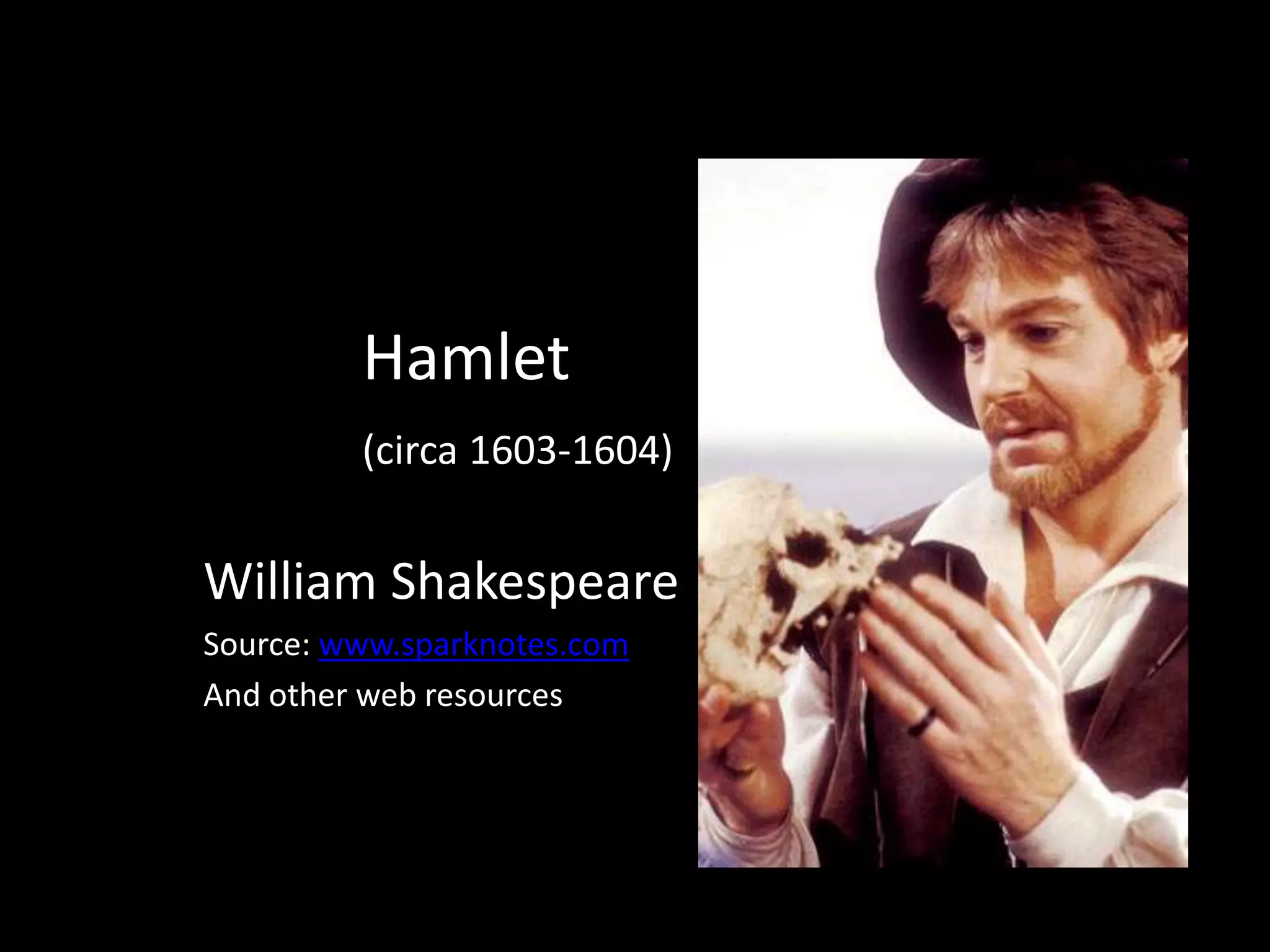
Hamlet 
(circa 1603-1604) 
William Shakespeare 
Source: www.sparknotes.com 
And other web resources
• FULL TITLE · The Tragedy of Hamlet, Prince of 
Denmark 
• TYPE OF WORK · Play 
• GENRE · Tragedy, revenge tragedy 
• LANGUAGE · English 
• TIME AND PLACE WRITTEN · London, England, 
early seventeenth century (probably 1600– 
1602) 
• DATE OF FIRST PUBLICATION · 1603, in a pirated 
quarto edition titled The Tragicall Historie of 
Hamlet; 1604 in a superior quarto edition
Source of the play 
• As was common practice during the sixteenth and 
seventeenth centuries, Shakespeare borrowed for his 
plays ideas and stories from earlier literary works. 
• He could have taken the story of Hamlet from several 
possible sources, including a twelfth-century Latin 
history of Denmark compiled by Saxo Grammaticus 
‘Gesta Danorum’(History of Danes) and a prose work 
by the French writer François de Belleforest, entitled 
Histoires Tragiques. 
• Thomas Kyd’s Ur-Hamlet
Original story of Hamlet… 
• The raw material that Shakespeare 
appropriated in writing Hamlet is the story of 
a Danish prince whose uncle murders the 
prince’s father, marries his mother, and claims 
the throne. The prince pretends to be feeble-minded 
to throw his uncle off guard, then 
manages to kill his uncle in revenge.
Shakespearean touch… 
• Shakespeare’s poetic imagination gave 
universal characteristics to tropical prince of 
Denmark. 
• He changed the emphasis of this story 
entirely, making his Hamlet a philosophical-minded 
prince who delays taking action 
because his knowledge of his uncle’s crime is 
so uncertain.
Hamlet: Characters • PROTAGONIST · Hamlet 
• Other Characters: 
Claudius is the King of Denmark, elected to the throne after the death of his 
brother, King Hamlet. Claudius has married Gertrude, his brother's widow. 
• Gertrude is the Queen of Denmark, and King Hamlet's widow, now married to 
Claudius, and mother to Hamlet. 
• The Ghost appears in the image of Hamlet's father, the late King Hamlet (Old 
Hamlet). 
• Polonius ("Corambis" in "Q1") is Claudius's chief counsellor, and the father of Ophelia 
and Laertes. 
• Laertes is the son of Polonius, and has returned to Elsinore from Paris. 
• Ophelia is the daughter of Polonius, and Laertes's sister, who lives with her father 
at Elsinore. She is in love with Hamlet. 
• Horatio is a good friend of Hamlet, from the university at Wittenberg, who came to 
Elsinore Castle to attend King Hamlet's funeral. 
• Rosencrantz and Guildenstern are childhood friends and schoolmates of Hamlet, 
who were summoned to Elsinore by Claudius and Gertrude. 
• Fortinbras Norwegian crown prince, who assumes the throne of Denmark after 
Hamlet's death.
Plot Overview 
• Plot Overview: 
• MAJOR CONFLICT · Hamlet feels a responsibility 
to avenge his father’s murder by his uncle 
Claudius, but Claudius is now the king and 
thus well protected. Moreover, Hamlet 
struggles with his doubts about whether he 
can trust the ghost and whether killing 
Claudius is morally appropriate thing to do.
• RISING ACTION · The ghost appears to Hamlet 
and tells Hamlet to revenge his murder; 
Hamlet feigns madness to his intentions; 
Hamlet stages the mousetrap play(play-within- 
play); Hamlet forgoes the opportunity 
to kill Claudius while he is praying.
• CLIMAX · When Hamlet stabs Polonius through 
the arras in Act III, scene iv, he commits 
himself to overtly violent action and brings 
himself into unavoidable conflict with the 
king. Another possible climax comes at the 
end of Act IV, scene iv, when Hamlet resolves 
to commit himself fully to violent revenge.
• FALLING ACTION · Hamlet is sent to England to 
be killed; Hamlet returns to Denmark and 
confronts Laertes at Ophelia’s funeral; the 
fencing match; the deaths of the royal family
Play full of unresolved mysteries… 
• Shakespeare went far beyond making 
uncertainty a personal idiosyncrasy of 
Hamlet’s, introducing a number of important 
ambiguities into the play that even the 
audience cannot resolve with certainty. 
• For instance:
• whether Hamlet’s mother, Gertrude, shares in 
Claudius’s guilt; 
• whether Hamlet continues to love Ophelia even as he 
spurns her, in Act III; 
• whether Ophelia’s death is suicide or accident; 
• whether the ghost offers reliable knowledge, or seeks 
to deceive and tempt Hamlet; and, perhaps most 
importantly, 
• whether Hamlet would be morally justified in taking 
revenge on his uncle. 
• Whether there is after life with rewards & punishment 
• Whether justice can be found in this life or after death 
• Whether we can ever know the truth of our situation 
and then act with moral responsibility
• Shakespeare makes it clear that the stakes 
riding on some of these questions are 
enormous—the actions of these characters 
bring disaster upon an entire kingdom. 
• At the end of the play, it is not even clear 
whether justice has been achieved.
Questions: 
• By modifying unremarkable revenge story of 
Prince of Denmark into a tragic play, how did 
Shakespeare made it universally appealing 
Tragedy? 
– Renaissance spirit of Humanism 
– Philosophical and meta-physical questions 
pertaining to life & death, life after death…
Renaissance spirit infused in revenge story… 
• By modifying his source materials in this way, 
Shakespeare was able to take an 
unremarkable revenge story and make it 
resonate with the most fundamental themes 
and problems of the Renaissance. 
• Renaissance Humanism:
Rise of Humanism… 
• The Renaissance is a vast cultural phenomenon 
that began in fifteenth-century Italy with the 
recovery of classical Greek and Latin texts that 
had been lost to the Middle Ages. 
• The scholars who enthusiastically rediscovered 
these classical texts were motivated by an 
educational and political ideal called (in Latin) 
humanitas—the idea that all of the capabilities 
and virtues peculiar to human beings should be 
studied and developed to their furthest extent.
• Renaissance humanism, as this movement is now 
called, generated a new interest in human 
experience, and also an enormous optimism 
about the potential scope of human 
understanding. 
• Hamlet’s famous speech in Act II, 
• “What a piece of work is a man! How noble in 
reason, how infinite in faculty, in form and 
moving how express and admirable, in action 
how like an angel, in apprehension how like a 
god—the beauty of the world, the paragon of 
animals!” (II.ii.293–297) 
• Directly based upon one of the major texts of the 
Italian humanists, Pico della Mirandola’s Oration 
on the Dignity of Man.
Main objective of Humanism… 
• For the humanists, the purpose of cultivating 
reason was to lead to a better understanding 
of how to act, and their fondest hope was that 
the coordination of action and understanding 
would lead to great benefits for society as a 
whole.
Its spread and skepticism…. 
• As the Renaissance spread to other countries 
in the sixteenth and seventeenth centuries, 
however, a more skeptical strain of humanism 
developed, stressing the limitations of human 
understanding. 
• For example,…
Limitations of human experience… 
• the sixteenth-century French humanist, Michel de 
Montaigne, was no less interested in studying 
human experiences than the earlier humanists 
were, but he maintained that the world of 
experience was a world of appearances, and 
that human beings could never hope to see past 
those appearances into the “realities” that lie 
behind them. 
• This is the world in which Shakespeare places his 
characters.
• Hamlet is faced with the difficult task of correcting an 
injustice that he can never have sufficient knowledge of—a 
dilemma that is by no means unique, or even uncommon. 
“The time is out of joint, O cursed spite, 
That ever I was born to set it right.” 
• And while Hamlet is fond of pointing out questions that 
cannot be answered because they concern supernatural and 
metaphysical matters, the play as a whole chiefly 
demonstrates the difficulty of knowing the truth about other 
people—their guilt or innocence, their motivations, their 
feelings, their relative states of sanity or insanity. 
“To be or not to be, that is the question” 
• The world of other people is a world of appearances, and 
Hamlet is, fundamentally, a play about the difficulty of living 
in that world. 
“There are more things in heaven and earth, Horatio, 
Than are dreamt of in your philosophy.” (I v). 
Thus Conscience does make Cowards of us all
Question: 
• Write brief note on various theme, motifs and 
symbols in the play ‘Hamlet’. 
– THEMES · The impossibility of certainty; the complexity 
of action; the mystery of death; the nation as a 
diseased body 
– MOTIFS · Incest and incestuous desire; ears and 
hearing; death and suicide; darkness and the 
supernatural; misogyny 
– SYMBOLS · The ghost (the spiritual consequences of 
death); Yorick’s skull (the physical consequences of 
death)

Introduction to the Play: Hamlet

  • 1.
    Hamlet (circa 1603-1604) William Shakespeare Source: www.sparknotes.com And other web resources
  • 2.
    • FULL TITLE· The Tragedy of Hamlet, Prince of Denmark • TYPE OF WORK · Play • GENRE · Tragedy, revenge tragedy • LANGUAGE · English • TIME AND PLACE WRITTEN · London, England, early seventeenth century (probably 1600– 1602) • DATE OF FIRST PUBLICATION · 1603, in a pirated quarto edition titled The Tragicall Historie of Hamlet; 1604 in a superior quarto edition
  • 3.
    Source of theplay • As was common practice during the sixteenth and seventeenth centuries, Shakespeare borrowed for his plays ideas and stories from earlier literary works. • He could have taken the story of Hamlet from several possible sources, including a twelfth-century Latin history of Denmark compiled by Saxo Grammaticus ‘Gesta Danorum’(History of Danes) and a prose work by the French writer François de Belleforest, entitled Histoires Tragiques. • Thomas Kyd’s Ur-Hamlet
  • 4.
    Original story ofHamlet… • The raw material that Shakespeare appropriated in writing Hamlet is the story of a Danish prince whose uncle murders the prince’s father, marries his mother, and claims the throne. The prince pretends to be feeble-minded to throw his uncle off guard, then manages to kill his uncle in revenge.
  • 5.
    Shakespearean touch… •Shakespeare’s poetic imagination gave universal characteristics to tropical prince of Denmark. • He changed the emphasis of this story entirely, making his Hamlet a philosophical-minded prince who delays taking action because his knowledge of his uncle’s crime is so uncertain.
  • 6.
    Hamlet: Characters •PROTAGONIST · Hamlet • Other Characters: Claudius is the King of Denmark, elected to the throne after the death of his brother, King Hamlet. Claudius has married Gertrude, his brother's widow. • Gertrude is the Queen of Denmark, and King Hamlet's widow, now married to Claudius, and mother to Hamlet. • The Ghost appears in the image of Hamlet's father, the late King Hamlet (Old Hamlet). • Polonius ("Corambis" in "Q1") is Claudius's chief counsellor, and the father of Ophelia and Laertes. • Laertes is the son of Polonius, and has returned to Elsinore from Paris. • Ophelia is the daughter of Polonius, and Laertes's sister, who lives with her father at Elsinore. She is in love with Hamlet. • Horatio is a good friend of Hamlet, from the university at Wittenberg, who came to Elsinore Castle to attend King Hamlet's funeral. • Rosencrantz and Guildenstern are childhood friends and schoolmates of Hamlet, who were summoned to Elsinore by Claudius and Gertrude. • Fortinbras Norwegian crown prince, who assumes the throne of Denmark after Hamlet's death.
  • 7.
    Plot Overview •Plot Overview: • MAJOR CONFLICT · Hamlet feels a responsibility to avenge his father’s murder by his uncle Claudius, but Claudius is now the king and thus well protected. Moreover, Hamlet struggles with his doubts about whether he can trust the ghost and whether killing Claudius is morally appropriate thing to do.
  • 8.
    • RISING ACTION· The ghost appears to Hamlet and tells Hamlet to revenge his murder; Hamlet feigns madness to his intentions; Hamlet stages the mousetrap play(play-within- play); Hamlet forgoes the opportunity to kill Claudius while he is praying.
  • 9.
    • CLIMAX ·When Hamlet stabs Polonius through the arras in Act III, scene iv, he commits himself to overtly violent action and brings himself into unavoidable conflict with the king. Another possible climax comes at the end of Act IV, scene iv, when Hamlet resolves to commit himself fully to violent revenge.
  • 10.
    • FALLING ACTION· Hamlet is sent to England to be killed; Hamlet returns to Denmark and confronts Laertes at Ophelia’s funeral; the fencing match; the deaths of the royal family
  • 11.
    Play full ofunresolved mysteries… • Shakespeare went far beyond making uncertainty a personal idiosyncrasy of Hamlet’s, introducing a number of important ambiguities into the play that even the audience cannot resolve with certainty. • For instance:
  • 12.
    • whether Hamlet’smother, Gertrude, shares in Claudius’s guilt; • whether Hamlet continues to love Ophelia even as he spurns her, in Act III; • whether Ophelia’s death is suicide or accident; • whether the ghost offers reliable knowledge, or seeks to deceive and tempt Hamlet; and, perhaps most importantly, • whether Hamlet would be morally justified in taking revenge on his uncle. • Whether there is after life with rewards & punishment • Whether justice can be found in this life or after death • Whether we can ever know the truth of our situation and then act with moral responsibility
  • 13.
    • Shakespeare makesit clear that the stakes riding on some of these questions are enormous—the actions of these characters bring disaster upon an entire kingdom. • At the end of the play, it is not even clear whether justice has been achieved.
  • 14.
    Questions: • Bymodifying unremarkable revenge story of Prince of Denmark into a tragic play, how did Shakespeare made it universally appealing Tragedy? – Renaissance spirit of Humanism – Philosophical and meta-physical questions pertaining to life & death, life after death…
  • 15.
    Renaissance spirit infusedin revenge story… • By modifying his source materials in this way, Shakespeare was able to take an unremarkable revenge story and make it resonate with the most fundamental themes and problems of the Renaissance. • Renaissance Humanism:
  • 16.
    Rise of Humanism… • The Renaissance is a vast cultural phenomenon that began in fifteenth-century Italy with the recovery of classical Greek and Latin texts that had been lost to the Middle Ages. • The scholars who enthusiastically rediscovered these classical texts were motivated by an educational and political ideal called (in Latin) humanitas—the idea that all of the capabilities and virtues peculiar to human beings should be studied and developed to their furthest extent.
  • 17.
    • Renaissance humanism,as this movement is now called, generated a new interest in human experience, and also an enormous optimism about the potential scope of human understanding. • Hamlet’s famous speech in Act II, • “What a piece of work is a man! How noble in reason, how infinite in faculty, in form and moving how express and admirable, in action how like an angel, in apprehension how like a god—the beauty of the world, the paragon of animals!” (II.ii.293–297) • Directly based upon one of the major texts of the Italian humanists, Pico della Mirandola’s Oration on the Dignity of Man.
  • 18.
    Main objective ofHumanism… • For the humanists, the purpose of cultivating reason was to lead to a better understanding of how to act, and their fondest hope was that the coordination of action and understanding would lead to great benefits for society as a whole.
  • 19.
    Its spread andskepticism…. • As the Renaissance spread to other countries in the sixteenth and seventeenth centuries, however, a more skeptical strain of humanism developed, stressing the limitations of human understanding. • For example,…
  • 20.
    Limitations of humanexperience… • the sixteenth-century French humanist, Michel de Montaigne, was no less interested in studying human experiences than the earlier humanists were, but he maintained that the world of experience was a world of appearances, and that human beings could never hope to see past those appearances into the “realities” that lie behind them. • This is the world in which Shakespeare places his characters.
  • 21.
    • Hamlet isfaced with the difficult task of correcting an injustice that he can never have sufficient knowledge of—a dilemma that is by no means unique, or even uncommon. “The time is out of joint, O cursed spite, That ever I was born to set it right.” • And while Hamlet is fond of pointing out questions that cannot be answered because they concern supernatural and metaphysical matters, the play as a whole chiefly demonstrates the difficulty of knowing the truth about other people—their guilt or innocence, their motivations, their feelings, their relative states of sanity or insanity. “To be or not to be, that is the question” • The world of other people is a world of appearances, and Hamlet is, fundamentally, a play about the difficulty of living in that world. “There are more things in heaven and earth, Horatio, Than are dreamt of in your philosophy.” (I v). Thus Conscience does make Cowards of us all
  • 22.
    Question: • Writebrief note on various theme, motifs and symbols in the play ‘Hamlet’. – THEMES · The impossibility of certainty; the complexity of action; the mystery of death; the nation as a diseased body – MOTIFS · Incest and incestuous desire; ears and hearing; death and suicide; darkness and the supernatural; misogyny – SYMBOLS · The ghost (the spiritual consequences of death); Yorick’s skull (the physical consequences of death)