Publication
Publication
Written during thefirst part of the
Written during the first part of the
seventeenth century (probably in 1600
seventeenth century (probably in 1600
or 1601),
or 1601), Hamlet
Hamlet was probably first
was probably first
performed in July 1602. It was first
performed in July 1602. It was first
published in printed form in 1603 and
published in printed form in 1603 and
appeared in an enlarged edition in 1604.
appeared in an enlarged edition in 1604.
3.
Setting
Setting
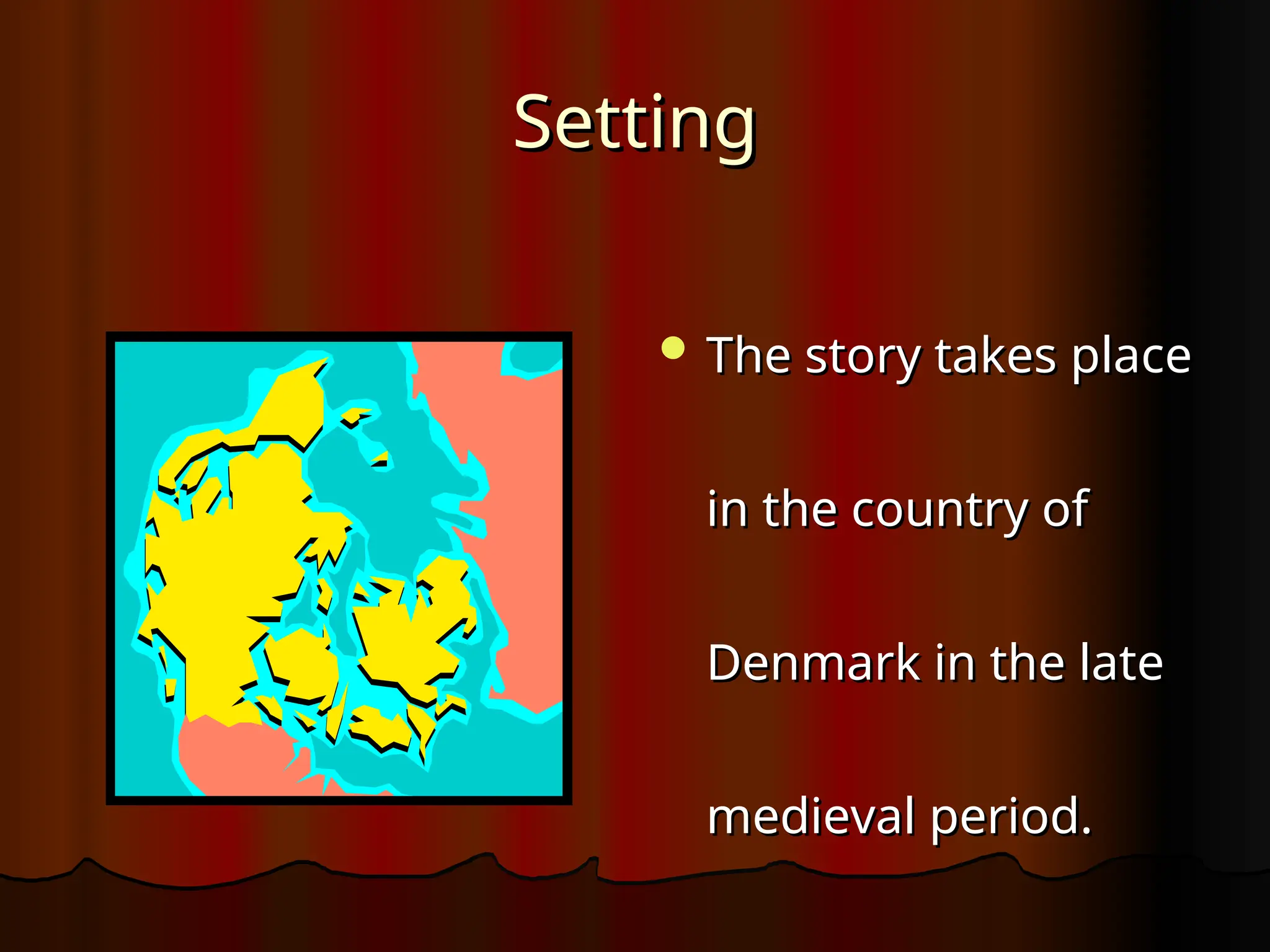
The storytakes place
The story takes place
in the country of
in the country of
Denmark in the late
Denmark in the late
medieval period.
medieval period.
4.
The Story
The Story
Theraw material that Shakespeare
The raw material that Shakespeare
appropriated in writing
appropriated in writing Hamlet
Hamlet is the
is the
story of a Danish prince whose uncle
story of a Danish prince whose uncle
murders the prince's father, marries his
murders the prince's father, marries his
mother, and claims the throne. The
mother, and claims the throne. The
prince pretends to be feeble-minded to
prince pretends to be feeble-minded to
throw his uncle off guard, then
throw his uncle off guard, then
manages to kill his uncle in revenge.
manages to kill his uncle in revenge.
5.
Hamlet
Hamlet
The Princeof Denmark,
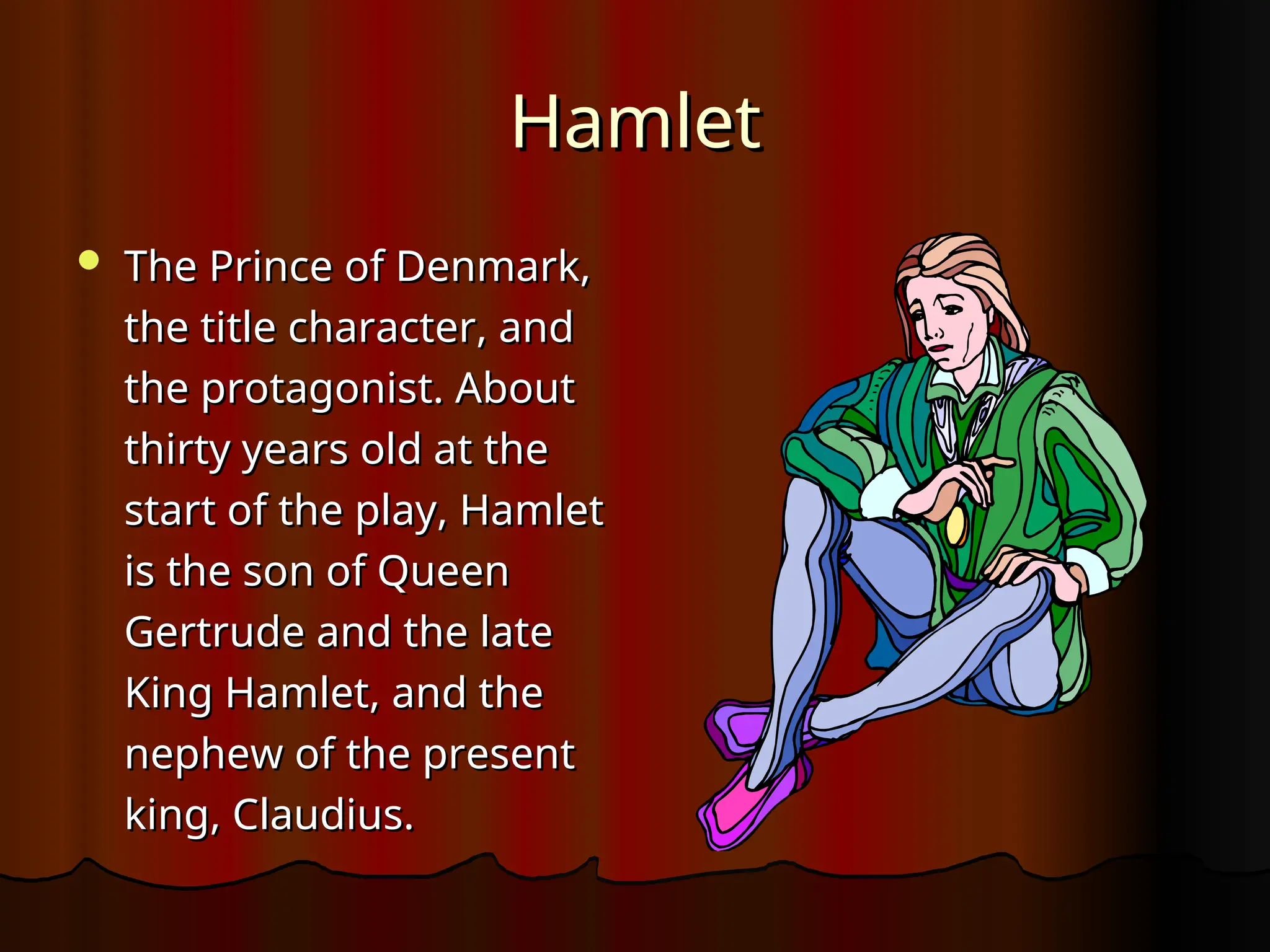
The Prince of Denmark,
the title character, and
the title character, and
the protagonist. About
the protagonist. About
thirty years old at the
thirty years old at the
start of the play, Hamlet
start of the play, Hamlet
is the son of Queen
is the son of Queen
Gertrude and the late
Gertrude and the late
King Hamlet, and the
King Hamlet, and the
nephew of the present
nephew of the present
king, Claudius.
king, Claudius.
6.
Hamlet continued
Hamlet continued
Hamletis melancholy, bitter, and cynical,
Hamlet is melancholy, bitter, and cynical,
full of hatred for his uncle's scheming and
full of hatred for his uncle's scheming and
disgust for his mother's sexuality. A
disgust for his mother's sexuality. A
reflective and thoughtful young man who
reflective and thoughtful young man who
has studied at the University of Wittenberg,
has studied at the University of Wittenberg,
Hamlet is sometimes indecisive and
Hamlet is sometimes indecisive and
hesitant, but at other times prone to rash
hesitant, but at other times prone to rash
and impulsive acts (lapses into insanity,
and impulsive acts (lapses into insanity,
maybe?).
maybe?).
7.
Claudius
Claudius
The Kingof Denmark,
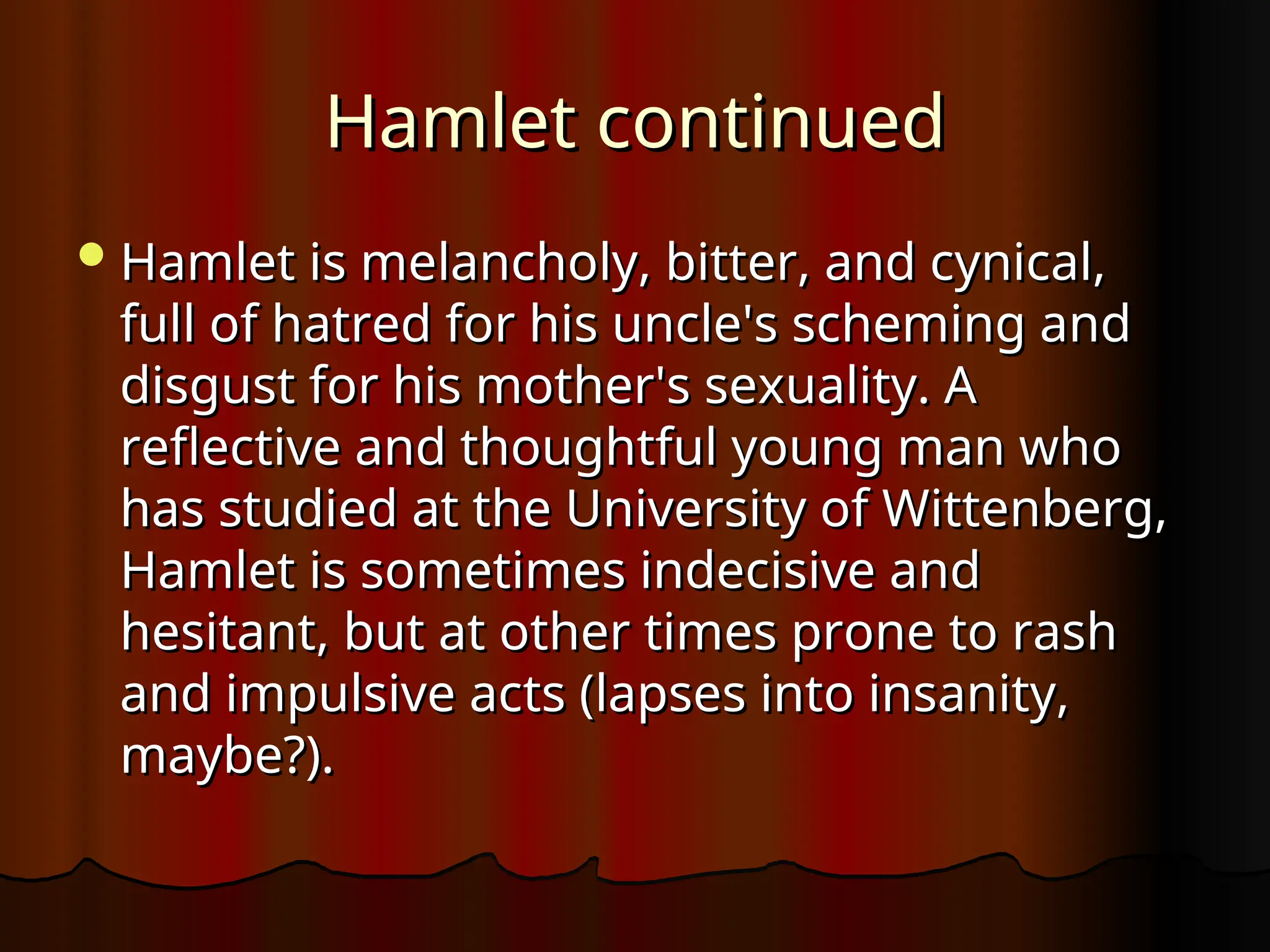
The King of Denmark,
Hamlet's uncle, and the
Hamlet's uncle, and the
play's antagonist. The
play's antagonist. The
villain of the play,
villain of the play,
Claudius is a calculating,
Claudius is a calculating,
ambitious politician,
ambitious politician,
driven by his sexual
driven by his sexual
appetites and his lust for
appetites and his lust for
power, but he
power, but he
occasionally shows signs
occasionally shows signs
of guilt and human
of guilt and human
feeling—his love for
feeling—his love for
Gertrude, for instance,
Gertrude, for instance,
seems sincere.
seems sincere.
8.
Gertrude
Gertrude
The Queenof Denmark,
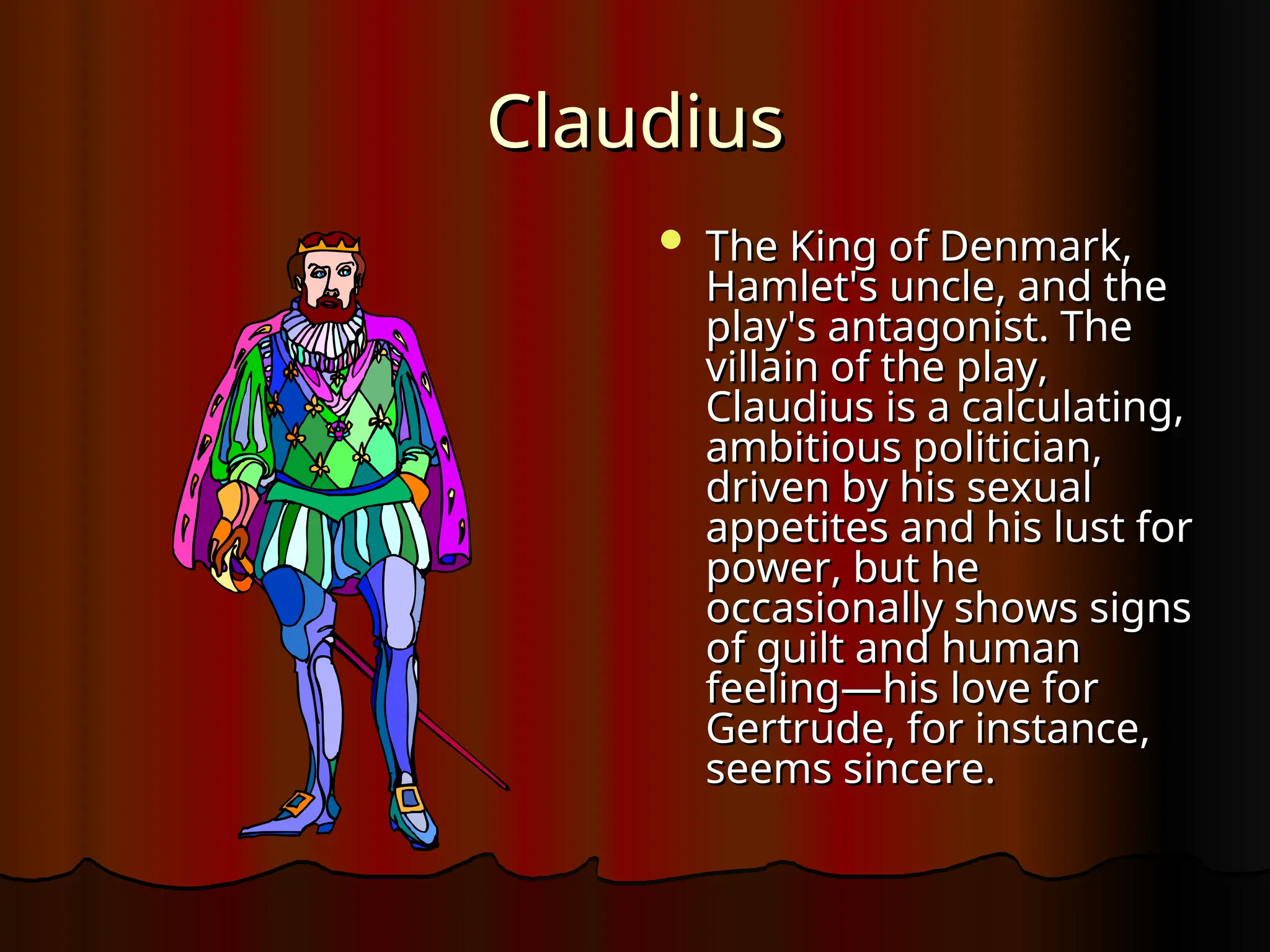
The Queen of Denmark,
Hamlet's mother, recently
Hamlet's mother, recently
married to Claudius.
married to Claudius.
Gertrude loves Hamlet
Gertrude loves Hamlet
deeply, but she is a
deeply, but she is a
shallow, weak woman
shallow, weak woman
who seeks affection and
who seeks affection and
status more urgently than
status more urgently than
moral rectitude or truth.
moral rectitude or truth.
9.
Polonius
Polonius
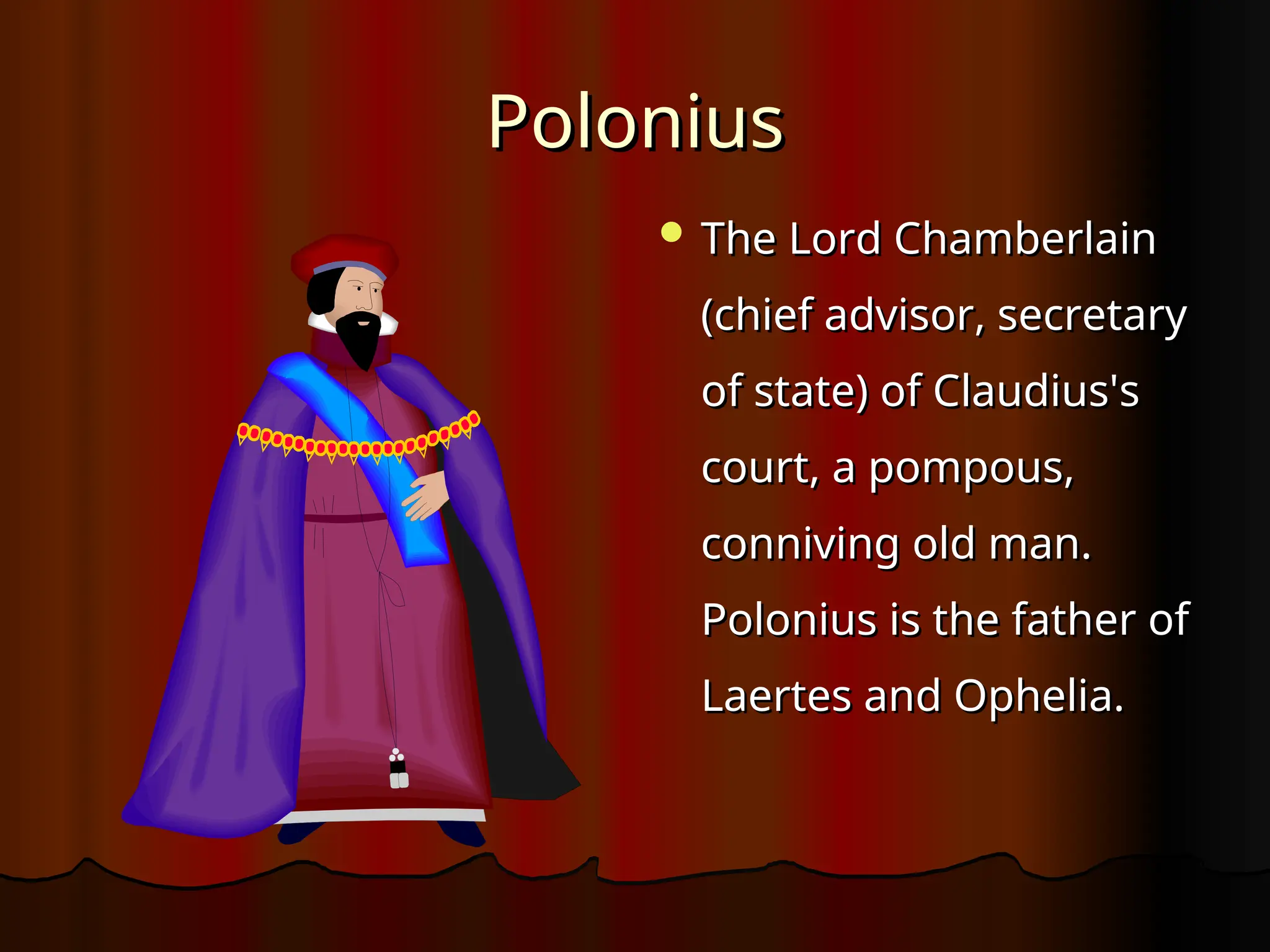
The LordChamberlain
The Lord Chamberlain
(chief advisor, secretary
(chief advisor, secretary
of state) of Claudius's
of state) of Claudius's
court, a pompous,
court, a pompous,
conniving old man.
conniving old man.
Polonius is the father of
Polonius is the father of
Laertes and Ophelia.
Laertes and Ophelia.
10.
Horatio
Horatio
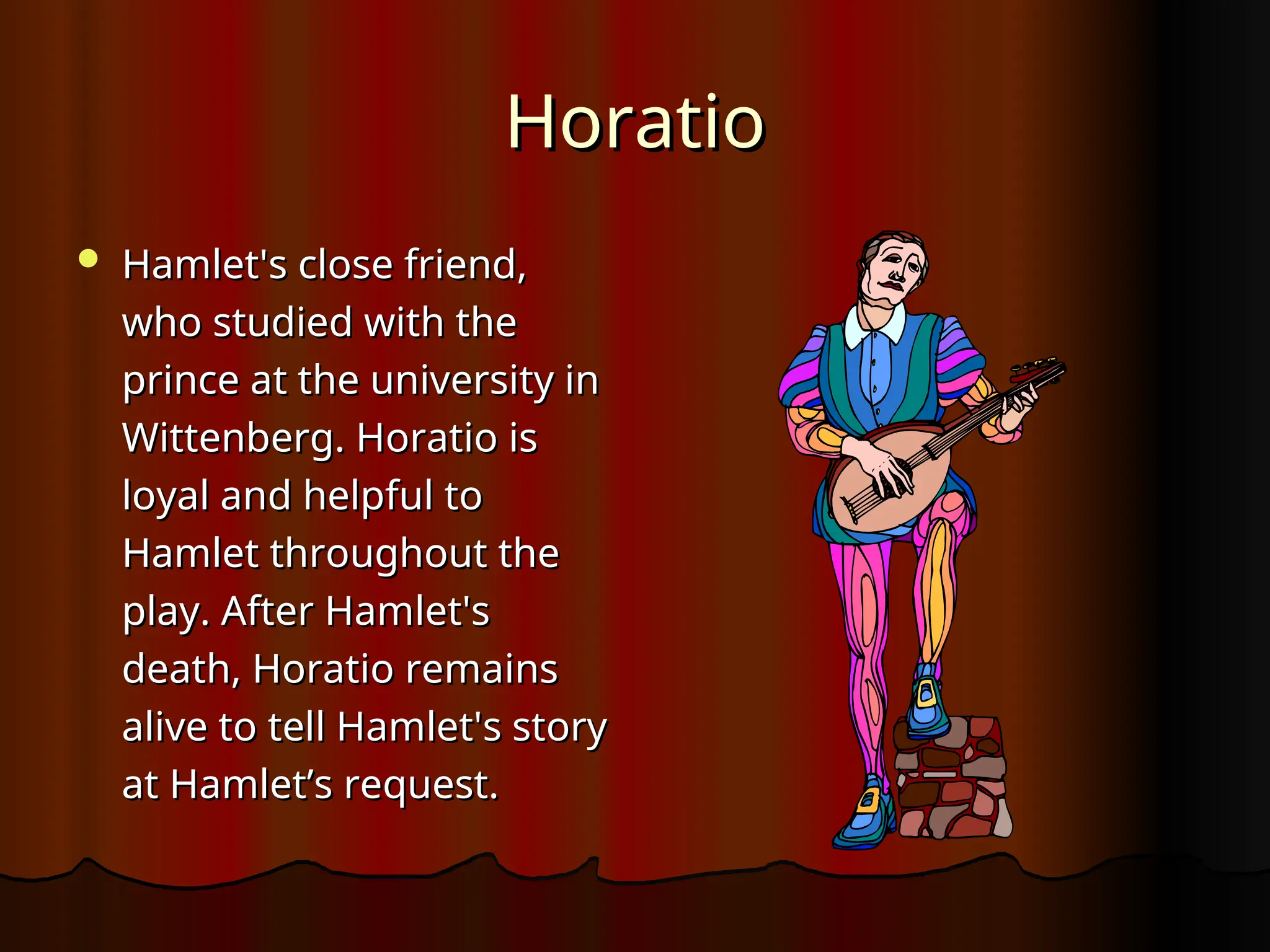
Hamlet's closefriend,
Hamlet's close friend,
who studied with the
who studied with the
prince at the university in
prince at the university in
Wittenberg. Horatio is
Wittenberg. Horatio is
loyal and helpful to
loyal and helpful to
Hamlet throughout the
Hamlet throughout the
play. After Hamlet's
play. After Hamlet's
death, Horatio remains
death, Horatio remains
alive to tell Hamlet's story
alive to tell Hamlet's story
at Hamlet’s request.
at Hamlet’s request.
11.
Ophelia
Ophelia
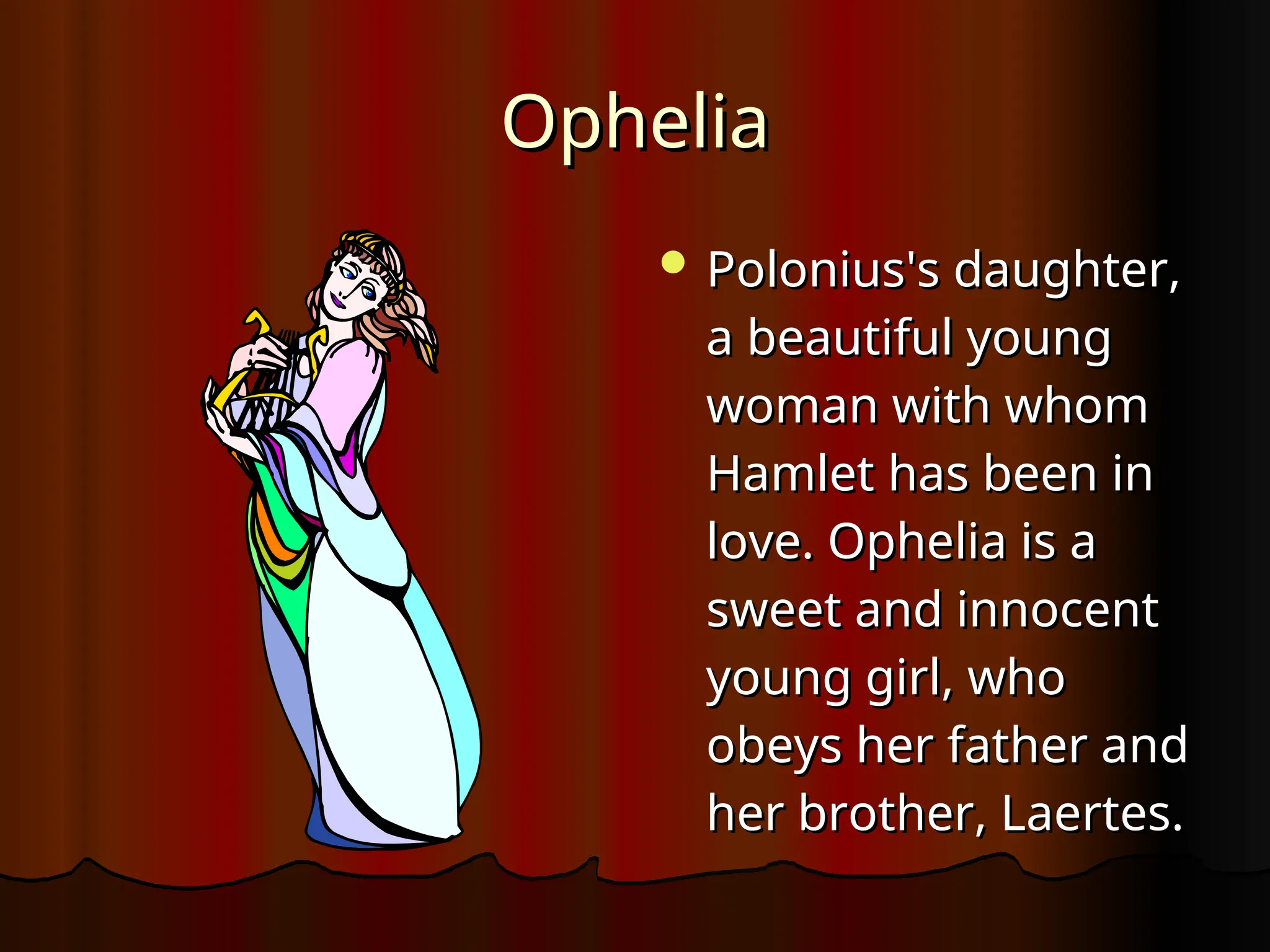
Polonius's daughter,
Polonius'sdaughter,
a beautiful young
a beautiful young
woman with whom
woman with whom
Hamlet has been in
Hamlet has been in
love. Ophelia is a
love. Ophelia is a
sweet and innocent
sweet and innocent
young girl, who
young girl, who
obeys her father and
obeys her father and
her brother, Laertes.
her brother, Laertes.
12.
Ophelia continued
Ophelia continued
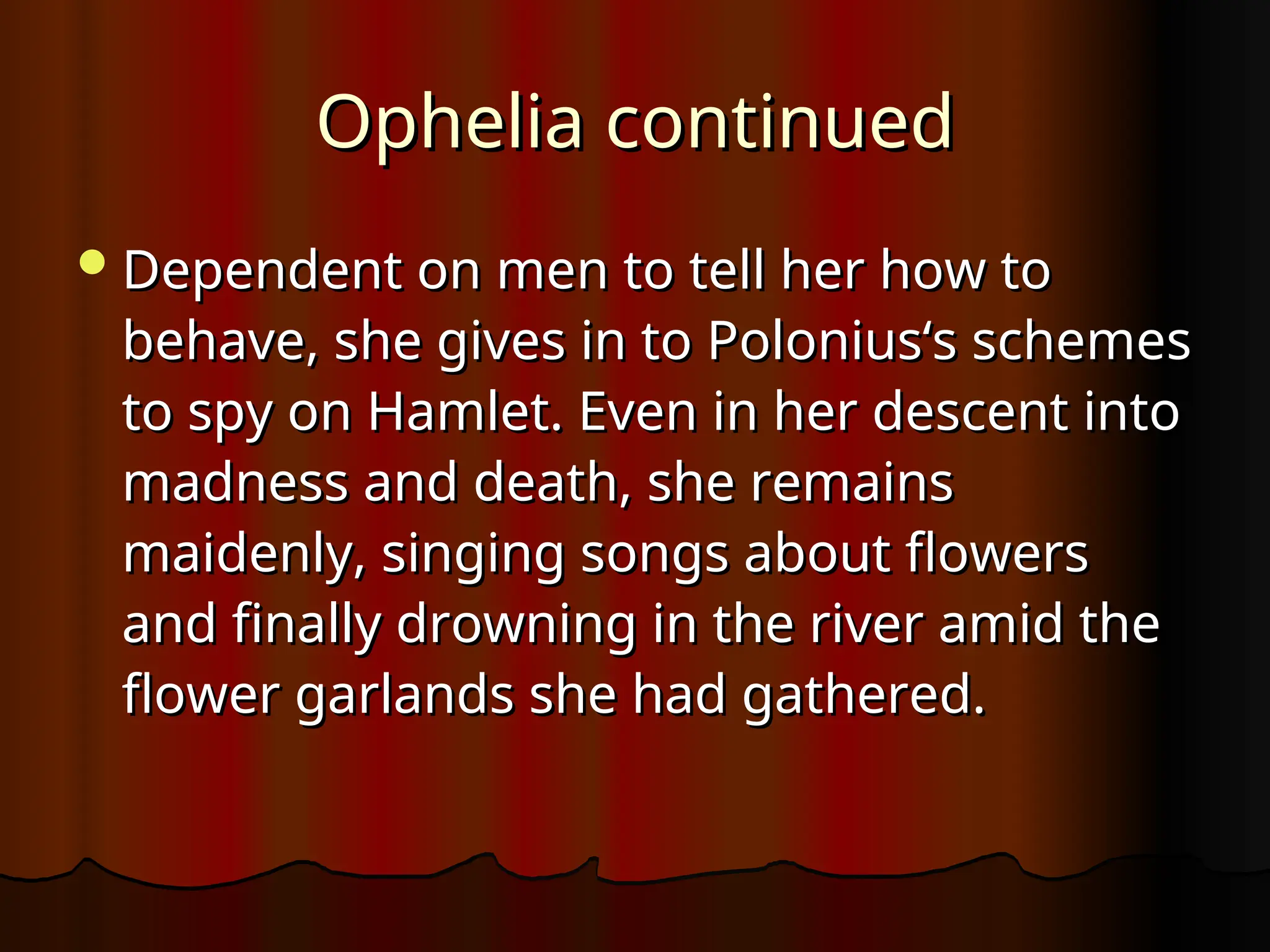
Dependenton men to tell her how to
Dependent on men to tell her how to
behave, she gives in to Polonius‘s schemes
behave, she gives in to Polonius‘s schemes
to spy on Hamlet. Even in her descent into
to spy on Hamlet. Even in her descent into
madness and death, she remains
madness and death, she remains
maidenly, singing songs about flowers
maidenly, singing songs about flowers
and finally drowning in the river amid the
and finally drowning in the river amid the
flower garlands she had gathered.
flower garlands she had gathered.
13.
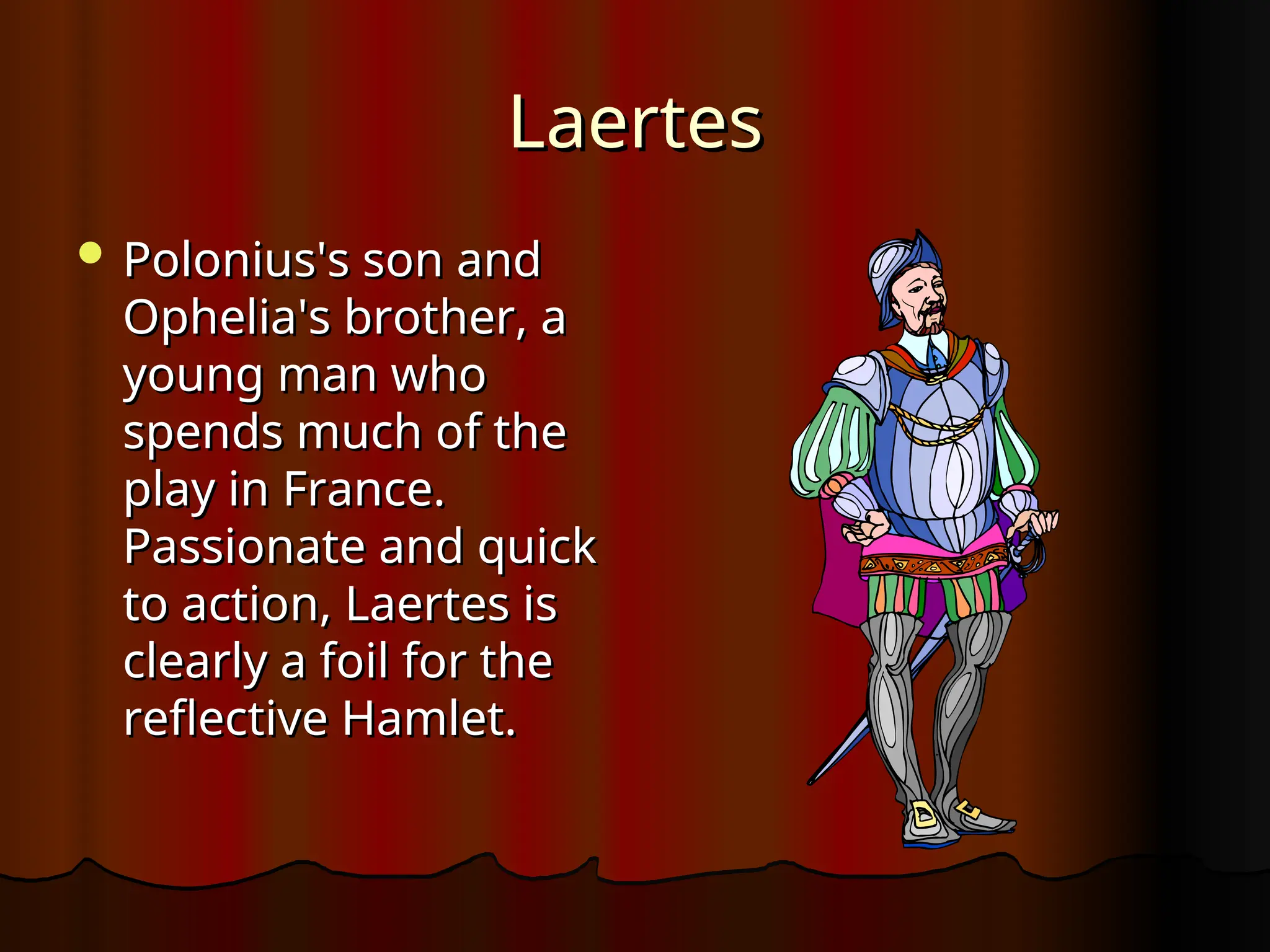
Laertes
Laertes
Polonius's sonand
Polonius's son and
Ophelia's brother, a
Ophelia's brother, a
young man who
young man who
spends much of the
spends much of the
play in France.
play in France.
Passionate and quick
Passionate and quick
to action, Laertes is
to action, Laertes is
clearly a foil for the
clearly a foil for the
reflective Hamlet.
reflective Hamlet.
14.
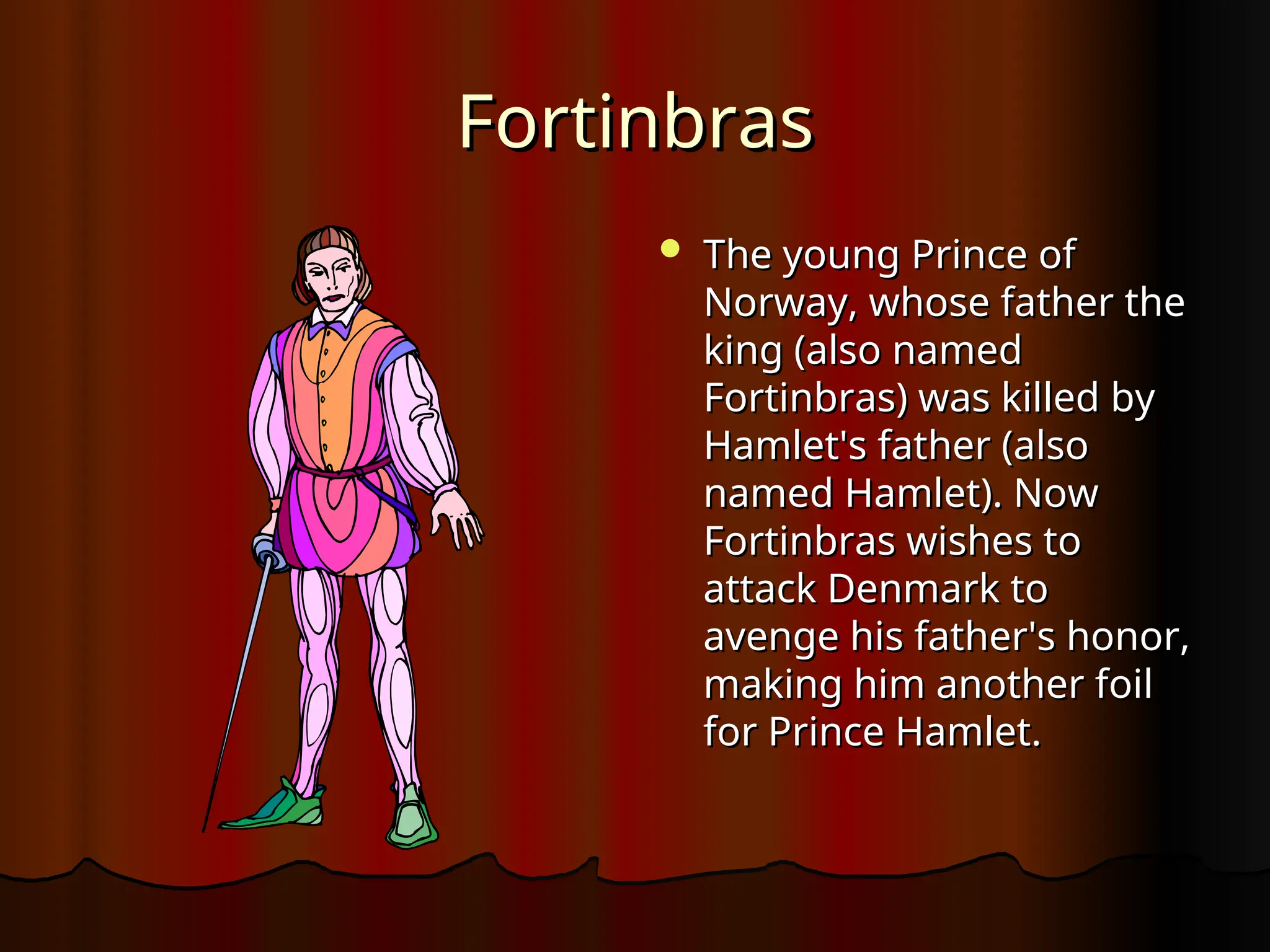
Fortinbras
Fortinbras
The youngPrince of
The young Prince of
Norway, whose father the
Norway, whose father the
king (also named
king (also named
Fortinbras) was killed by
Fortinbras) was killed by
Hamlet's father (also
Hamlet's father (also
named Hamlet). Now
named Hamlet). Now
Fortinbras wishes to
Fortinbras wishes to
attack Denmark to
attack Denmark to
avenge his father's honor,
avenge his father's honor,
making him another foil
making him another foil
for Prince Hamlet.
for Prince Hamlet.
15.
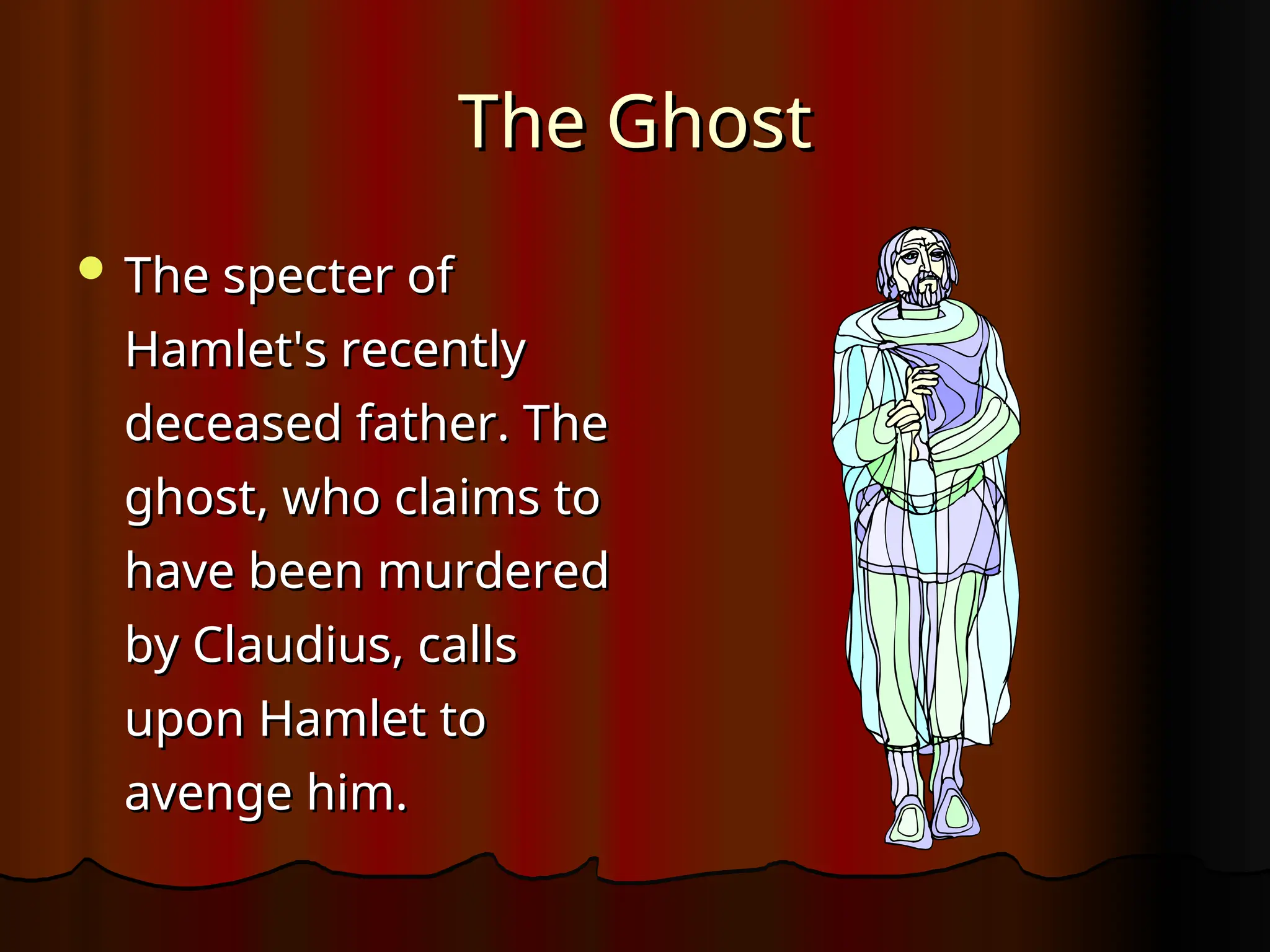
The Ghost
The Ghost
The specter of
The specter of
Hamlet's recently
Hamlet's recently
deceased father. The
deceased father. The
ghost, who claims to
ghost, who claims to
have been murdered
have been murdered
by Claudius, calls
by Claudius, calls
upon Hamlet to
upon Hamlet to
avenge him.
avenge him.
16.
The Ghost continued
TheGhost continued
It is not entirely certain whether the ghost
It is not entirely certain whether the ghost
is what it appears to be, or whether it is
is what it appears to be, or whether it is
something else. Hamlet speculates that
something else. Hamlet speculates that
the ghost might be a devil sent to deceive
the ghost might be a devil sent to deceive
him and tempt him into murder, and the
him and tempt him into murder, and the
question of what the ghost is or where it
question of what the ghost is or where it
comes from is never definitively resolved.
comes from is never definitively resolved.
17.
Rosencrantz
Rosencrantz and
and Guildenstern
Guildenstern
Two slightly bumbling
Two slightly bumbling
courtiers, former
courtiers, former
friends of Hamlet
friends of Hamlet
from Wittenberg,
from Wittenberg,
who are summoned
who are summoned
by Claudius and
by Claudius and
Gertrude to discover
Gertrude to discover
the cause of Hamlet's
the cause of Hamlet's
strange behavior.
strange behavior.
18.
Themes
Themes
Themes arethe
Themes are the
fundamental and
fundamental and
often universal ideas
often universal ideas
explored in a literary
explored in a literary
work.
work.
19.
Theme of Certainty
Themeof Certainty
What separates
What separates Hamlet
Hamlet from other
from other
revenge plays (and maybe from every
revenge plays (and maybe from every
play written before it) is that the action
play written before it) is that the action
we expect to see, particularly from
we expect to see, particularly from
Hamlet himself, is continually postponed
Hamlet himself, is continually postponed
while Hamlet tries to obtain more certain
while Hamlet tries to obtain more certain
knowledge about what he is doing. This
knowledge about what he is doing. This
play poses many questions that other
play poses many questions that other
plays would simply take for granted.
plays would simply take for granted.
20.
Questions
Questions
Can wehave certain
Can we have certain
knowledge about
knowledge about
ghosts? Is the ghost
ghosts? Is the ghost
what it appears to
what it appears to
be, or is it really a
be, or is it really a
misleading fiend?
misleading fiend?
Does the ghost have
Does the ghost have
reliable knowledge
reliable knowledge
about its own death,
about its own death,
or is the ghost itself
or is the ghost itself
deluded?
deluded?
21.
More Questions
More Questions
Moving to more earthly matters: How can we
Moving to more earthly matters: How can we
know for certain the facts about a crime that
know for certain the facts about a crime that
has no witnesses? Can Hamlet know the state
has no witnesses? Can Hamlet know the state
of Claudius's soul by watching his behavior? If
of Claudius's soul by watching his behavior? If
so, can he know the facts of what Claudius did
so, can he know the facts of what Claudius did
by observing the state of his soul? Can
by observing the state of his soul? Can
Claudius (or the audience) know the state of
Claudius (or the audience) know the state of
Hamlet's mind by observing his behavior and
Hamlet's mind by observing his behavior and
listening to his speech? Can we know whether
listening to his speech? Can we know whether
our actions will have the consequences we
our actions will have the consequences we
want them to have? Can we know anything
want them to have? Can we know anything
about the afterlife?
about the afterlife?
22.
Uncertainty
Uncertainty
Many people haveseen
Many people have seen Hamlet
Hamlet as a play
as a play
about indecisiveness, and thus about
about indecisiveness, and thus about
Hamlet's failure to act appropriately. It
Hamlet's failure to act appropriately. It
might be more interesting to consider
might be more interesting to consider
that the play shows us how many
that the play shows us how many
uncertainties our lives are built upon,
uncertainties our lives are built upon,
how many unknown quantities are taken
how many unknown quantities are taken
for granted when people act or when
for granted when people act or when
they evaluate one another's actions.
they evaluate one another's actions.
23.
Theme of Action
Themeof Action
Directly related to the
Directly related to the
theme of certainty is the
theme of certainty is the
theme of action. How is
theme of action. How is
it possible to take
it possible to take
reasonable, effective,
reasonable, effective,
purposeful action? In
purposeful action? In
Hamlet,
Hamlet, the question of
the question of
how to act is affected
how to act is affected
not only by rational
not only by rational
considerations, such as
considerations, such as
the need for certainty,
the need for certainty,
but also by emotional,
but also by emotional,
ethical, and
ethical, and
psychological factors.
psychological factors.
24.
Acting Recklessly
Acting Recklessly
Hamlet himself appears to distrust the idea
Hamlet himself appears to distrust the idea
that it's even possible to act in a controlled,
that it's even possible to act in a controlled,
purposeful way. When he does act, he prefers
purposeful way. When he does act, he prefers
to do it blindly, recklessly, and violently. The
to do it blindly, recklessly, and violently. The
other characters obviously think much less
other characters obviously think much less
about "action" in the abstract than Hamlet
about "action" in the abstract than Hamlet
does, and are therefore less troubled about
does, and are therefore less troubled about
the possibility of acting effectively. They
the possibility of acting effectively. They
simply act as they feel is appropriate. But in
simply act as they feel is appropriate. But in
some sense they prove that Hamlet is right,
some sense they prove that Hamlet is right,
because all of their actions miscarry.
because all of their actions miscarry.
25.
Acting Foolishly
Acting Foolishly
Claudius possesses himself of queen and crown
Claudius possesses himself of queen and crown
through bold action, but his conscience torments
through bold action, but his conscience torments
him, and he is beset by threats to his authority
him, and he is beset by threats to his authority
(and, of course, he dies). Laertes resolves that
(and, of course, he dies). Laertes resolves that
nothing will distract him from acting out his
nothing will distract him from acting out his
revenge, but he is easily influenced and
revenge, but he is easily influenced and
manipulated into serving Claudius's ends, and
manipulated into serving Claudius's ends, and
his poisoned sword is turned back upon himself.
his poisoned sword is turned back upon himself.
26.
Death
Death
In theaftermath of
In the aftermath of
his father's murder,
his father's murder,
Hamlet is obsessed
Hamlet is obsessed
with the idea of
with the idea of
death, and over the
death, and over the
course of the play he
course of the play he
considers death
considers death
from a great many
from a great many
perspectives.
perspectives.
27.
Aftermath of Death
Aftermathof Death
Hamlet ponders both the spiritual aftermath
Hamlet ponders both the spiritual aftermath
of death, embodied in the ghost, and the
of death, embodied in the ghost, and the
physical remainders of the dead, such as by
physical remainders of the dead, such as by
Yorick's skull and the decaying corpses in the
Yorick's skull and the decaying corpses in the
cemetery. Throughout, the idea of death is
cemetery. Throughout, the idea of death is
closely tied to the themes of spirituality, truth,
closely tied to the themes of spirituality, truth,
and uncertainty in that death may bring the
and uncertainty in that death may bring the
answers to Hamlet's deepest questions,
answers to Hamlet's deepest questions,
ending once and for all the problem of trying
ending once and for all the problem of trying
to determine truth in an ambiguous world.
to determine truth in an ambiguous world.
28.
Revenge
Revenge
Since deathis both the
Since death is both the
cause and the
cause and the
consequence of revenge,
consequence of revenge,
it is intimately tied to the
it is intimately tied to the
theme of revenge and
theme of revenge and
justice—Claudius's
justice—Claudius's
murder of King Hamlet
murder of King Hamlet
initiates Hamlet's quest
initiates Hamlet's quest
for revenge, and
for revenge, and
Claudius's death is the
Claudius's death is the
end of that quest.
end of that quest.
29.
Suicide
Suicide
The question ofhis own death plagues
The question of his own death plagues
Hamlet as well, as he repeatedly
Hamlet as well, as he repeatedly
contemplates whether or not suicide is a
contemplates whether or not suicide is a
morally legitimate action in an unbearably
morally legitimate action in an unbearably
painful world. Hamlet's grief and misery is
painful world. Hamlet's grief and misery is
such that he frequently longs for death to
such that he frequently longs for death to
end to his suffering, but he fears that if he
end to his suffering, but he fears that if he
commits suicide, he will be consigned to
commits suicide, he will be consigned to
eternal suffering in hell because of the
eternal suffering in hell because of the
Christian religion's prohibition of suicide.
Christian religion's prohibition of suicide.
30.
“
“To be ornot to be”
To be or not to be”
In his famous "To be or
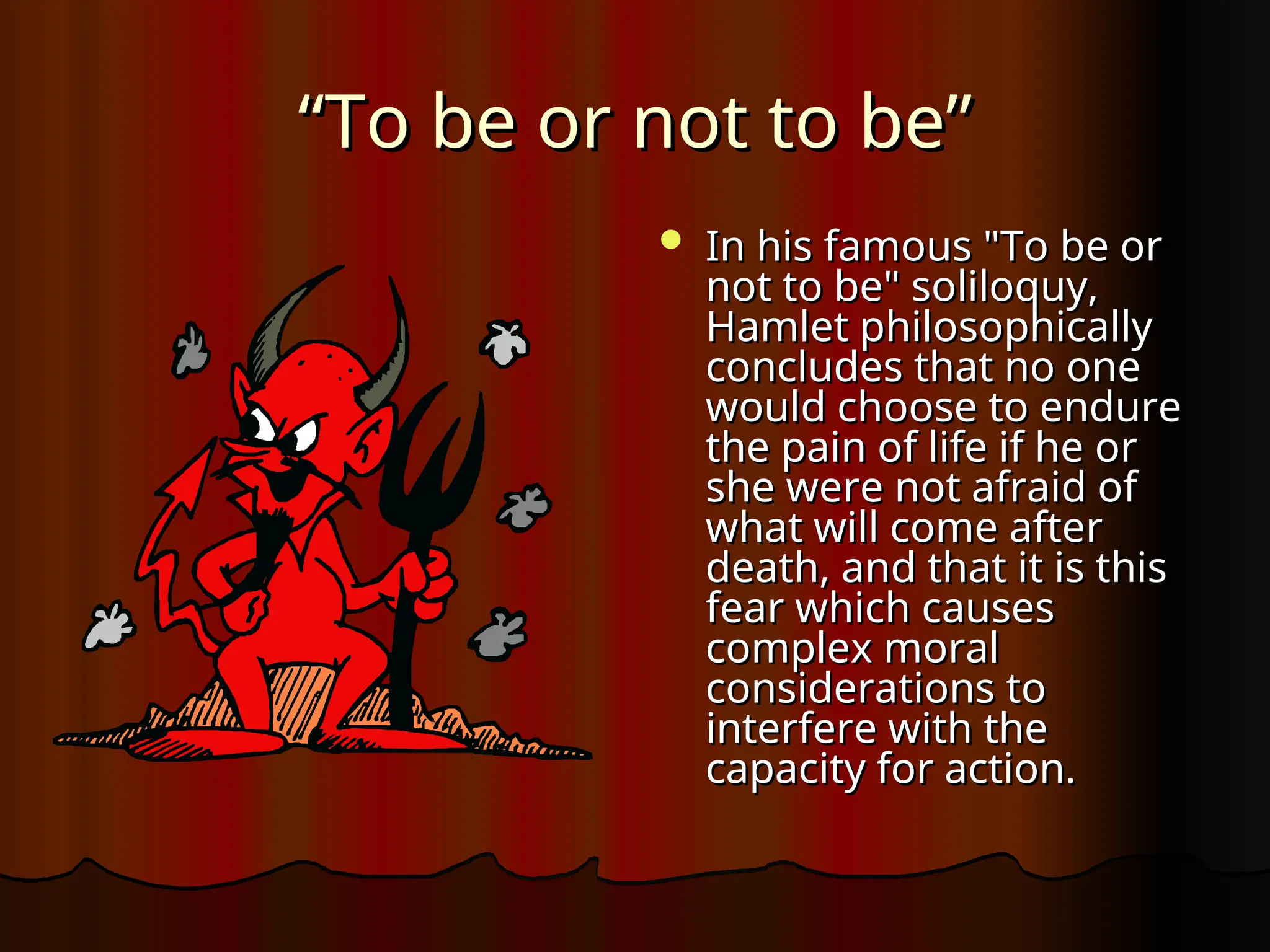
In his famous "To be or
not to be" soliloquy,
not to be" soliloquy,
Hamlet philosophically
Hamlet philosophically
concludes that no one
concludes that no one
would choose to endure
would choose to endure
the pain of life if he or
the pain of life if he or
she were not afraid of
she were not afraid of
what will come after
what will come after
death, and that it is this
death, and that it is this
fear which causes
fear which causes
complex moral
complex moral
considerations to
considerations to
interfere with the
interfere with the
capacity for action.
capacity for action.
31.
Motifs
Motifs
Motifs arerecurring
Motifs are recurring
structures,
structures,
contrasts, or literary
contrasts, or literary
devices that can help
devices that can help
to develop and
to develop and
inform the text's
inform the text's
major themes.
major themes.
32.
Motif of Misogyny
Motifof Misogyny
Shattered by his mother's repugnant
Shattered by his mother's repugnant
decision to marry Claudius so soon after
decision to marry Claudius so soon after
her husband's death, Hamlet becomes
her husband's death, Hamlet becomes
extremely cynical, even neurotic, about
extremely cynical, even neurotic, about
women in general, showing a particular
women in general, showing a particular
obsession with what he perceives to be
obsession with what he perceives to be
a connection between female sexuality
a connection between female sexuality
and moral corruption.
and moral corruption.
33.
“
“Frailty, thy nameis woman”
Frailty, thy name is woman”
This motif of misogyny, or hatred of
This motif of misogyny, or hatred of
women, occurs only sporadically
women, occurs only sporadically
throughout the play, but it is an
throughout the play, but it is an
important inhibiting factor in Hamlet's
important inhibiting factor in Hamlet's
relationships with Ophelia and
relationships with Ophelia and
Gertrude. He urges Ophelia to go to a
Gertrude. He urges Ophelia to go to a
nunnery rather than experience the
nunnery rather than experience the
corruptions of sexuality and exclaims of
corruptions of sexuality and exclaims of
Gertrude, "Frailty, thy name is woman"
Gertrude, "Frailty, thy name is woman"
34.
Motif of Earsand Hearing
Motif of Ears and Hearing
One facet of
One facet of Hamlet
Hamlet's
's
exploration of the difficulty
exploration of the difficulty
of attaining true knowledge
of attaining true knowledge
is slipperiness of language.
is slipperiness of language.
Words are used to
Words are used to
communicate ideas, but they
communicate ideas, but they
can also be used to distort
can also be used to distort
the truth, manipulate other
the truth, manipulate other
people, and serve as tools in
people, and serve as tools in
corrupt quests for power.
corrupt quests for power.
Claudius, the shrewd
Claudius, the shrewd
politician, is the most
politician, is the most
obvious example of a man
obvious example of a man
who manipulates words to
who manipulates words to
enhance his own power.
enhance his own power.
35.
Use of Words
Useof Words
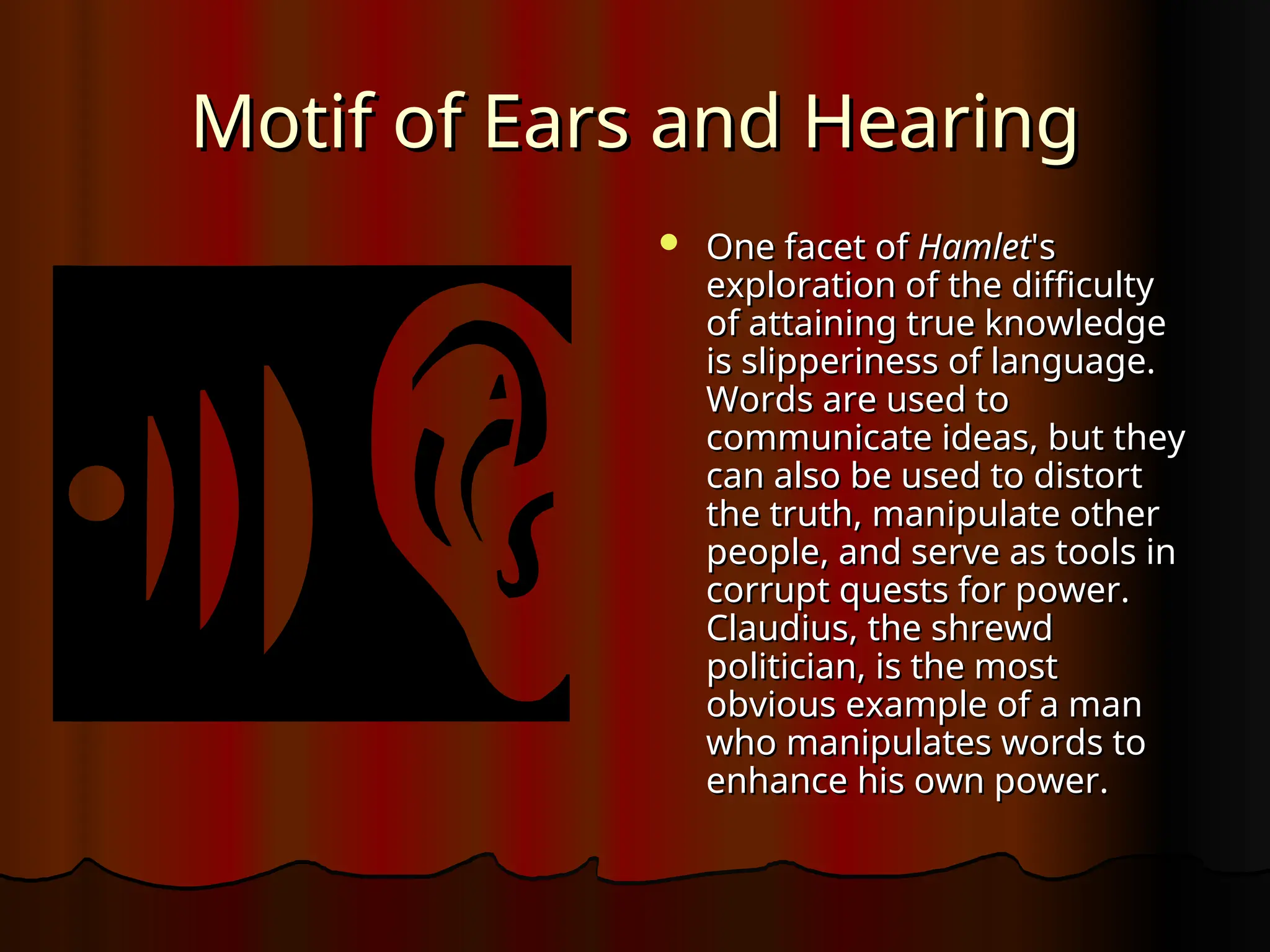
The sinister uses of words are represented by
The sinister uses of words are represented by
images of ears and hearing, from Claudius's
images of ears and hearing, from Claudius's
murder of the king by pouring poison into his
murder of the king by pouring poison into his
ear to Hamlet's claim to Horatio that "I have
ear to Hamlet's claim to Horatio that "I have
words to speak in thine ear will make thee
words to speak in thine ear will make thee
dumb". The poison poured in the king's ear
dumb". The poison poured in the king's ear
by Claudius is used by the ghost to symbolize
by Claudius is used by the ghost to symbolize
the corrosive effect of Claudius's dishonesty
the corrosive effect of Claudius's dishonesty
on the health of Denmark. Declaring that the
on the health of Denmark. Declaring that the
story that he was killed by a snake is a lie, he
story that he was killed by a snake is a lie, he
says that "the whole ear of Denmark" is
says that "the whole ear of Denmark" is
"Rankly abused….".
"Rankly abused….".
36.
Symbols
Symbols
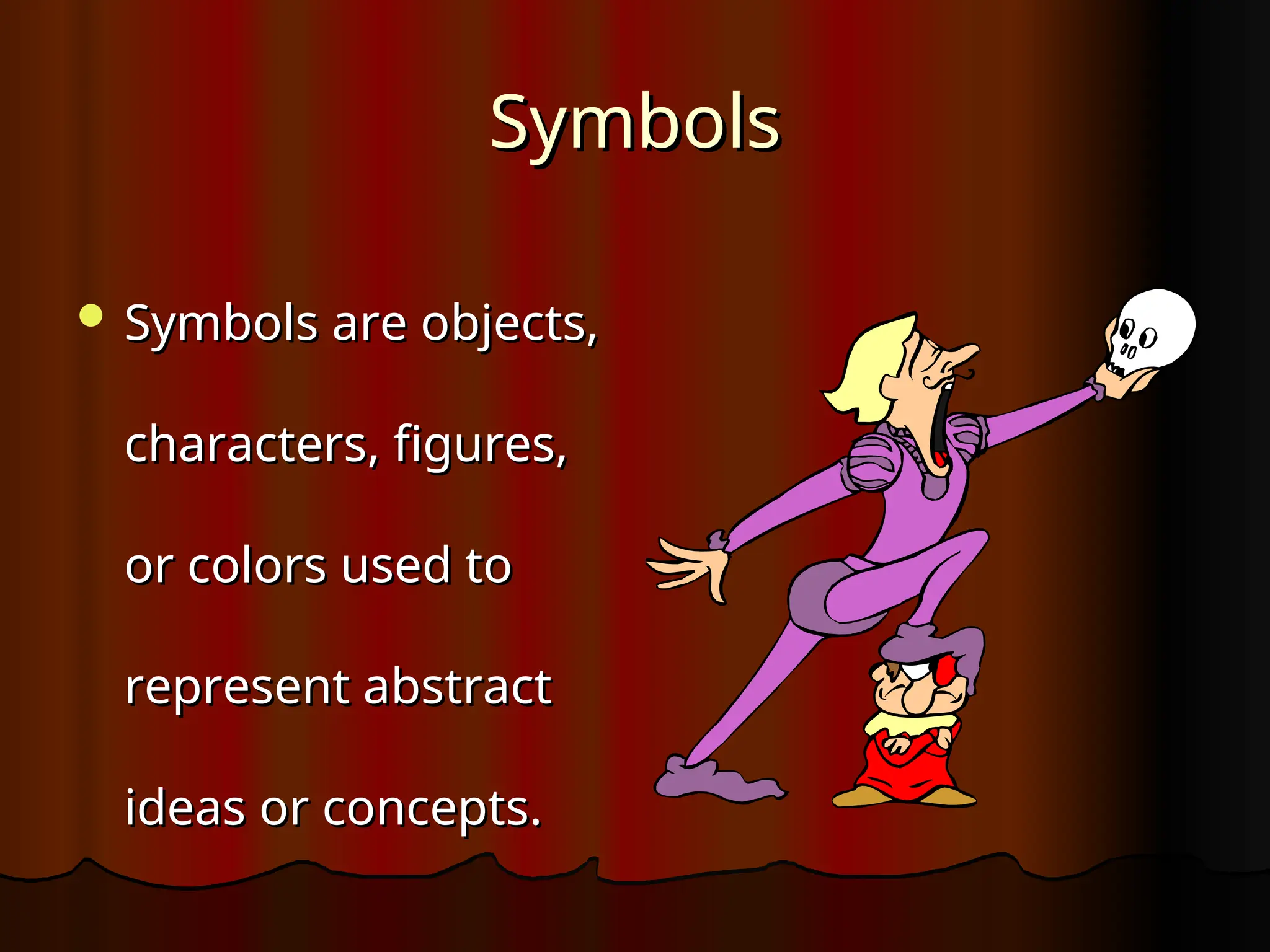
Symbols areobjects,
Symbols are objects,
characters, figures,
characters, figures,
or colors used to
or colors used to
represent abstract
represent abstract
ideas or concepts.
ideas or concepts.
37.
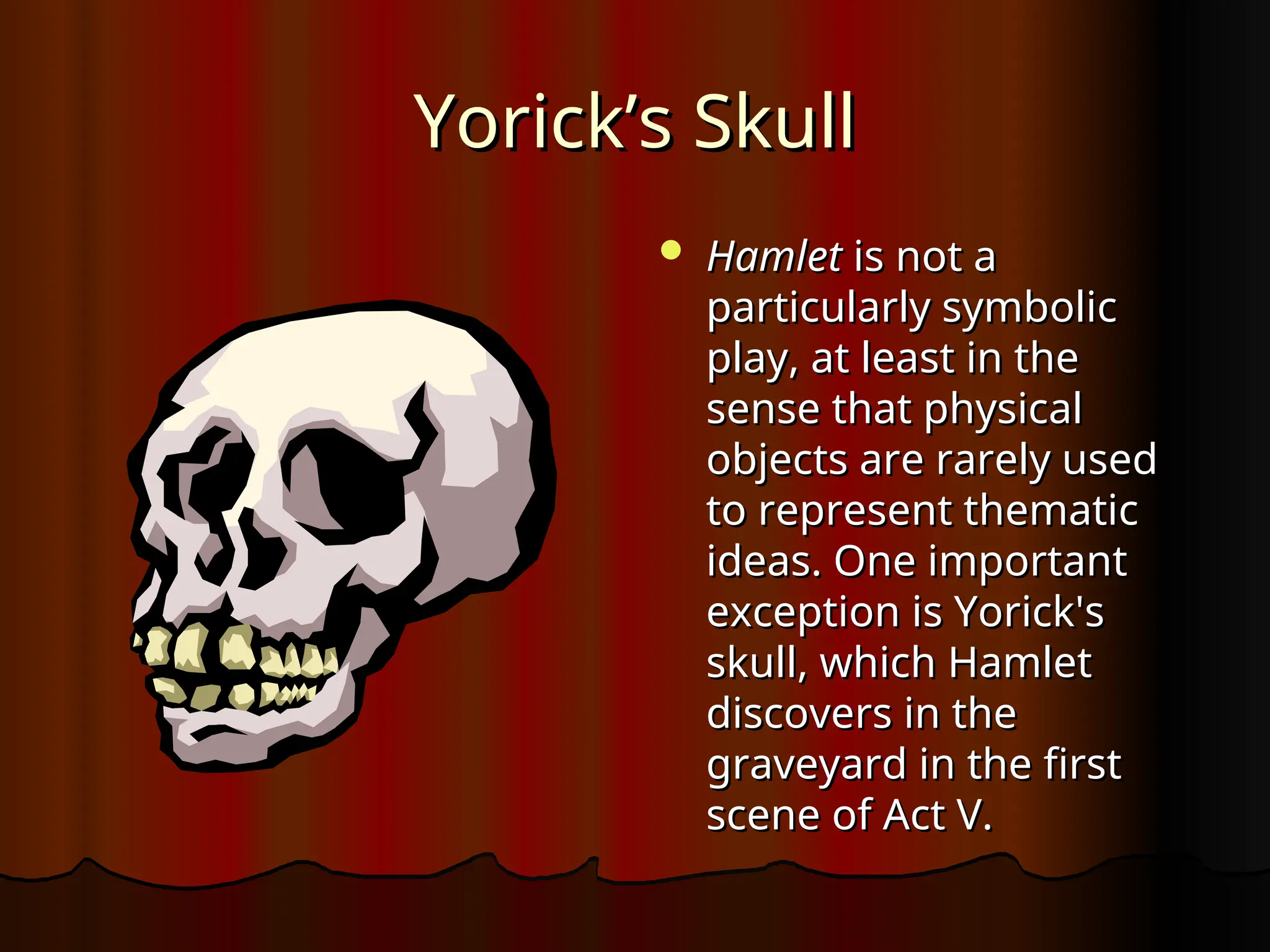
Yorick’s Skull
Yorick’s Skull
Hamlet
Hamlet is not a
is not a
particularly symbolic
particularly symbolic
play, at least in the
play, at least in the
sense that physical
sense that physical
objects are rarely used
objects are rarely used
to represent thematic
to represent thematic
ideas. One important
ideas. One important
exception is Yorick's
exception is Yorick's
skull, which Hamlet
skull, which Hamlet
discovers in the
discovers in the
graveyard in the first
graveyard in the first
scene of Act V.
scene of Act V.
38.
Different Aspects ofDeath
Different Aspects of Death
As Hamlet speaks to and about the skull of the
As Hamlet speaks to and about the skull of the
king's former jester, it becomes a symbol of
king's former jester, it becomes a symbol of
several different aspects of death, including its
several different aspects of death, including its
inevitability and its disintegration of the body.
inevitability and its disintegration of the body.
Hamlet urges the skull to "get you to my lady's
Hamlet urges the skull to "get you to my lady's
chamber, and tell her, let her paint an inch
chamber, and tell her, let her paint an inch
thick, to this favor she must come"—no one can
thick, to this favor she must come"—no one can
avoid death. He also traces the skull's mouth
avoid death. He also traces the skull's mouth
and says, "Here hung those lips that I have
and says, "Here hung those lips that I have
kissed I know not how oft," indicating his
kissed I know not how oft," indicating his
fascination with the physical consequences of
fascination with the physical consequences of
death.
death.
39.
Decay of theHuman Body
Decay of the Human Body
This latter idea is an important motif
This latter idea is an important motif
throughout the play, as Hamlet
throughout the play, as Hamlet
frequently makes comments referring to
frequently makes comments referring to
every human body's eventual decay,
every human body's eventual decay,
noting that Polonius will be eaten by
noting that Polonius will be eaten by
worms, that even kings are eaten by
worms, that even kings are eaten by
worms, and that dust from the decayed
worms, and that dust from the decayed
body of Alexander the Great might be
body of Alexander the Great might be
used to stop a hole in a beer barrel.
used to stop a hole in a beer barrel.