Hacking Quantum
Cryptography
Dr. Marina von Steinkirch
~ Yelp Security
The speaker @1bt337
Ph.D. in Physics at
Worked on astro/nuclear stuff at
Now doing Security at
(We are hiring!)
Agenda
1. Quantum Mechanics in 10 mins
2. Quantum Computing in 11 mins
3. Quantum Key Exchange in 100 mins
(or more minutes)
Some disclaimers
● This is my personal views and do not
necessarily reflect views of my employer.
● This is a physicist point of view.
● For a more in-depth discussion on the privacy
issues in the post-quantum crypto paradigm,
check out Jennifer Katherine Fernick’s work.
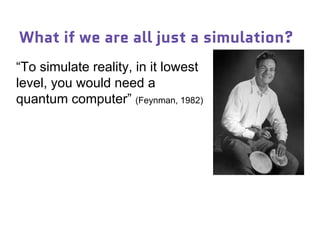
What if we are all just a simulation?
“To simulate reality, in it lowest
level, you would need a
quantum computer” (Feynman, 1982)
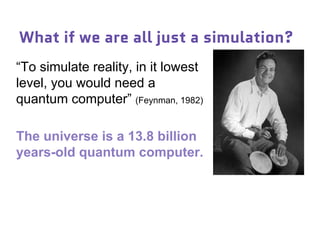
What if we are all just a simulation?
“To simulate reality, in it lowest
level, you would need a
quantum computer” (Feynman, 1982)
The universe is a 13.8 billion
years-old quantum computer.
But first, let’s understand how
quantum mechanics changed the way
we see the world...
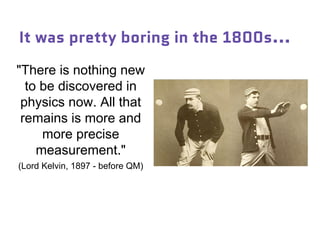
It was pretty boring in the 1800s...
"There is nothing new
to be discovered in
physics now. All that
remains is more and
more precise
measurement."
(Lord Kelvin, 1897 - before QM)
Then… the Ultraviolet Catastrophe
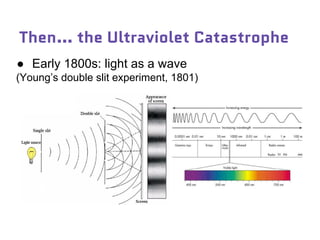
● Early 1800s: light as a wave
(Young’s double slit experiment, 1801)
Then… the Ultraviolet Catastrophe
● Early 1800s: light as a wave
(Young’s double slit experiment, 1801)
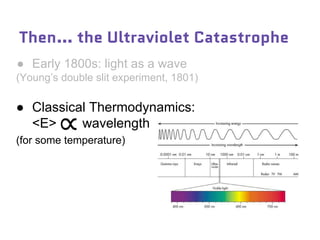
● Classical Thermodynamics:
<E> wavelength
(for some temperature)
Then… the Ultraviolet Catastrophe
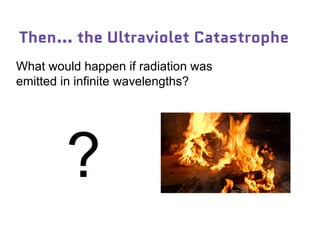
What would happen if radiation was
emitted in infinite wavelengths?
?
Then… the Ultraviolet Catastrophe
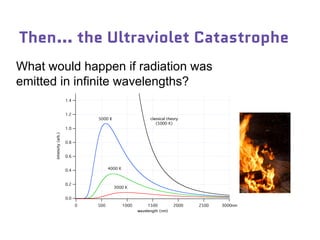
What would happen if radiation was
emitted in infinite wavelengths?
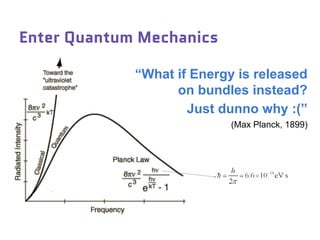
Enter Quantum Mechanics
“What if Energy is released
on bundles instead?
Just dunno why :(”
(Max Planck, 1899)
Enter Quantum Mechanics
“What if Energy is released
on bundles instead?
Just dunno why :(”
(Max Planck, 1899)
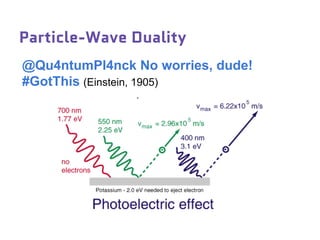
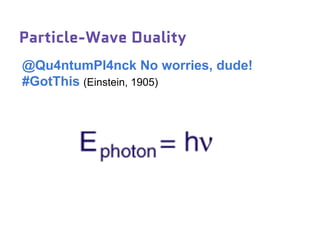
Particle-Wave Duality
@Qu4ntumPl4nck No worries, dude!
#GotThis (Einstein, 1905)
Particle-Wave Duality
@Qu4ntumPl4nck No worries, dude!
#GotThis (Einstein, 1905)
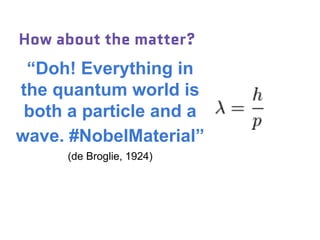
How about the matter?
“Doh! Everything in
the quantum world is
both a particle and a
wave. #NobelMaterial”
(de Broglie, 1924)
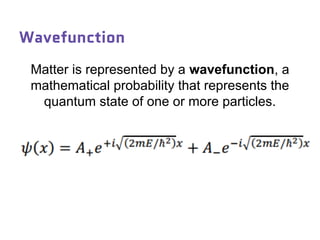
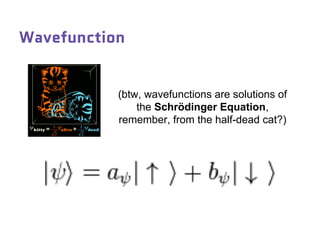
Wavefunction
Matter is represented by a wavefunction, a
mathematical probability that represents the
quantum state of one or more particles.
Wavefunction
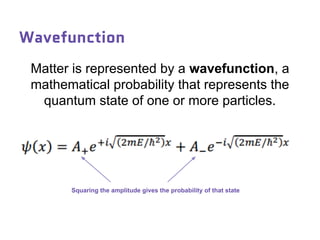
Squaring the amplitude gives the probability of that state
Matter is represented by a wavefunction, a
mathematical probability that represents the
quantum state of one or more particles.
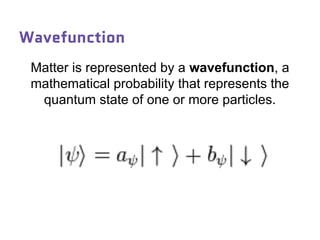
Wavefunction
Matter is represented by a wavefunction, a
mathematical probability that represents the
quantum state of one or more particles.
Wavefunction
(btw, wavefunctions are solutions of
the Schrödinger Equation,
remember, from the half-dead cat?)
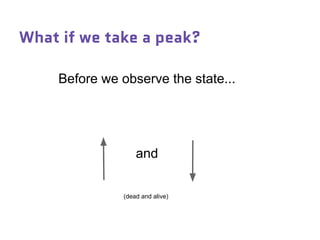
What if we take a peak?
Before we observe the state...
and
(dead and alive)
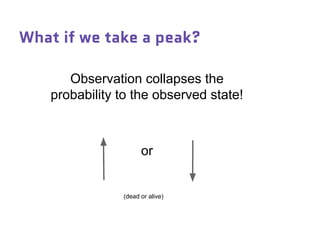
What if we take a peak?
Observation collapses the
probability to the observed state!
or
(dead or alive)
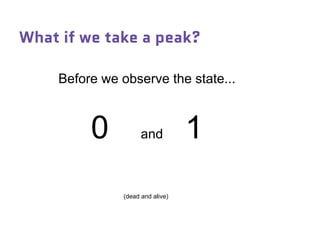
What if we take a peak?
Before we observe the state...
0 and 1
(dead and alive)
What if we take a peak?
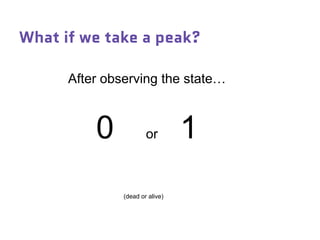
After observing the state…
0 or 1
(dead or alive)
Let’s try an experiment
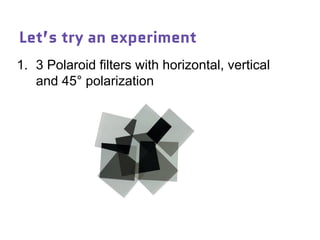
1. 3 Polaroid filters with horizontal, vertical
and 45° polarization
Let’s try an experiment
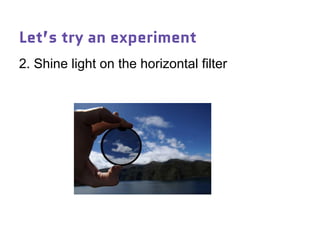
2. Shine light on the horizontal filter
Let’s try an experiment
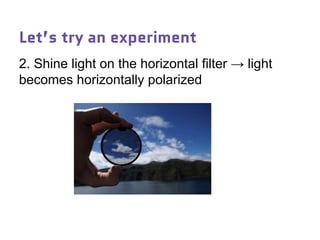
2. Shine light on the horizontal filter → light
becomes horizontally polarized
Let’s try an experiment
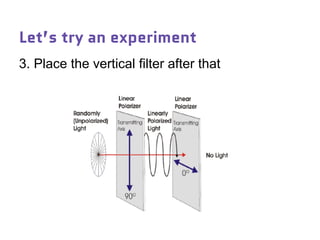
3. Place the vertical filter after that
Let’s try an experiment
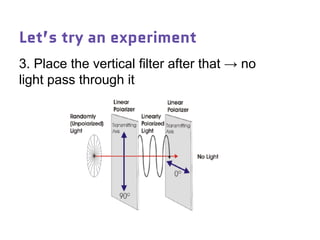
3. Place the vertical filter after that → no
light pass through it
Let’s try an experiment
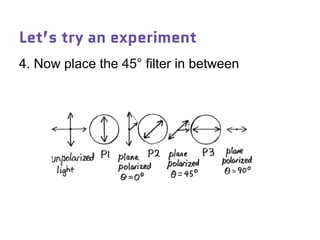
4. Now place the 45° filter in between
Let’s try an experiment
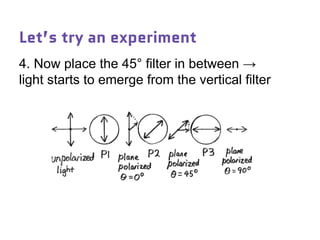
4. Now place the 45° filter in between →
light starts to emerge from the vertical filter
Say waaaat?
● Think wavefunction & probabilities
Say waaaat?
● Think wavefunction & probabilities
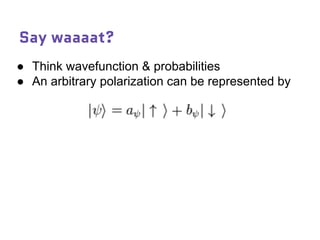
● An arbitrary polarization can be represented by
Say waaaat?
● Think wavefunction & probabilities
● An arbitrary polarization can be represented by
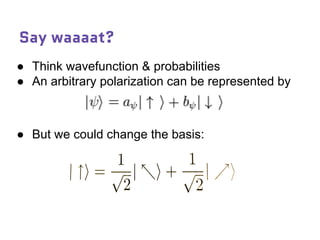
● But we could change the basis:
Say waaaat?
● Think wavefunction & probabilities
● An arbitrary polarization can be represented by
● But we could change the basis:
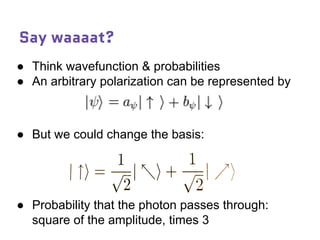
● Probability that the photon passes through:
square of the amplitude, times 3
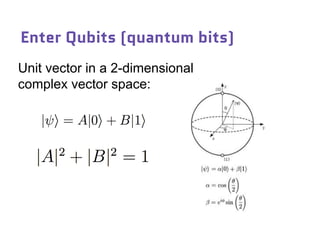
Enter Qubits (quantum bits)
Unit vector in a 2-dimensional
complex vector space:
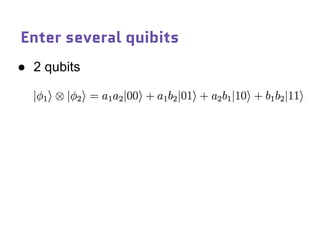
Enter several quibits
● 2 qubits
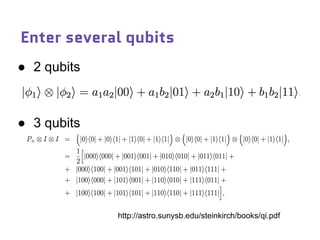
Enter several qubits
● 2 qubits
● 3 qubits
http://astro.sunysb.edu/steinkirch/books/qi.pdf
Quantum mechanics give us spooky
particles that can encode (and do)
multiple things at once, just like a
massively parallel machine
Shor’s Algorithm
● PK crypto relies on a classical computer’s
difficult at factoring large numbers (RSA, EC).
Shor’s Algorithm
● PK crypto relies on a classical computer’s
difficult at factoring large numbers (RSA, EC).
● In 1994, Peter Shor showed that a QC could
find the prime factors of a large number in
milliseconds.
Shor’s Algorithm
● PK crypto relies on a classical computer’s
difficult at factoring large numbers (RSA, EC).
● In 1994, Peter Shor showed that a QC could
find the prime factors of a large number in
milliseconds.
● In the moment when a QC is successfully built,
all the internet becomes insecure
(remember: no forward secrecy!)
Shor’s Algorithm
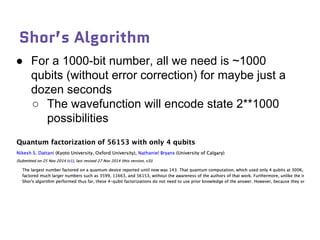
● For a 1000-bit number, all we need is ~1000
qubits (without error correction) for maybe just a
dozen seconds
Shor’s Algorithm
● For a 1000-bit number, all we need is ~1000
qubits (without error correction) for maybe just a
dozen seconds
○ The wavefunction will encode 2**1000
possibilities (states)
Shor’s Algorithm
● For a 1000-bit number, all we need is ~1000
qubits (without error correction) for maybe just a
dozen seconds
○ The wavefunction will encode state 2**1000
possibilities
Shor’s Algorithm: How?
● Quantum Fourier Transform to find the
periodicity of prime numbers
● Algorithm runs simultaneously every pair of
number: wavefunctions either constructly or
desconstructly interfer
● In the end, the right answer spike
(frequency/period/mod)
● But… what if Alice and Bob could use QM
to create and distribute a key?
Alice & Bob are kinda scared now...
● But… what if Alice and Bob could use QM
to create and distribute a key?
● Distribute qubits through a quantum
channel to establish a key that can be
used across a classical channel.
Alice & Bob are kinda scared now...
Alice, Bob and… Heisenberg
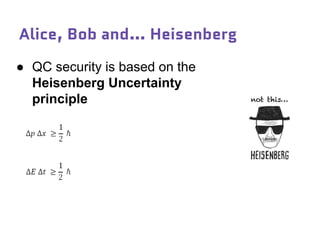
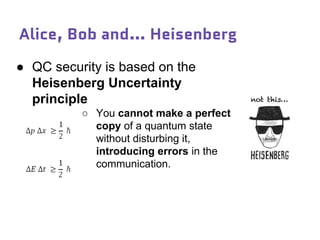
● QC security is based on the
Heisenberg Uncertainty
principle
Alice, Bob and… Heisenberg
● QC security is based on the
Heisenberg Uncertainty
principle
○ You cannot make a perfect
copy of a quantum state
without disturbing it,
introducing errors in the
communication.
Secure by Math Physics
● Alice and Bob can exchange (quantum
encoded) keys securely (e.g. photons via
fiber).
Secure by Math Physics
● Alice and Bob can exchange (quantum
encoded) keys securely (e.g. photons via
fiber).
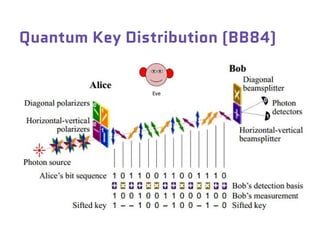
● If Eve reads the state of photon →
probability collapses and Bob and Alice
will know!
1. Alice prepares a sequence of photons,
polarize each one in of the four possibilities
of polarization.
Quantum Key Distribution (BB84)
1. Alice prepares a sequence of photons,
polarize each one in of the four possibilities
of polarization.
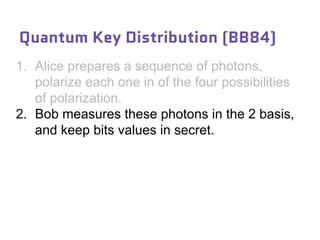
2. Bob measures these photons in the 2 basis,
and keep bits values in secret.
Quantum Key Distribution (BB84)
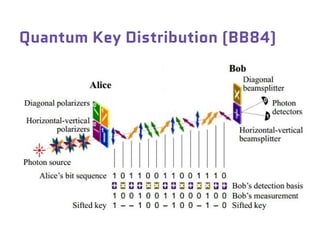
1. Alice prepares a sequence of photons,
polarize each one in of the four possibilities
of polarization.
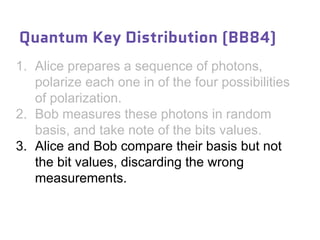
2. Bob measures these photons in random
basis, and take note of the bits values.
3. Alice and Bob compare their basis but not
the bit values, discarding the wrong
measurements.
Quantum Key Distribution (BB84)
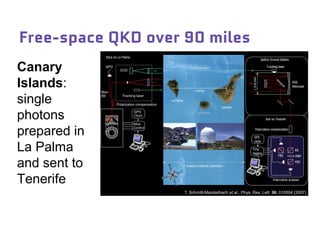
Free-space QKD over 90 miles
Canary
Islands:
single
photons
prepared in
La Palma
and sent to
Tenerife
All this is super cool... But how long is
going to take for the first quantum
computer?
Challenges in building a QC
● QCs must maintain hundreds of qubits
together for some amount of time
Challenges in building a QC
● QCs must maintain hundreds of qubits
together for some amount of time
○ Decoherence: The universe is
observing all the time!
○ Particles are absorbed by the room
and vanished!
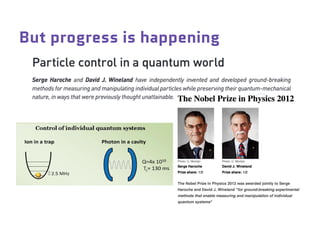
But progress is happening
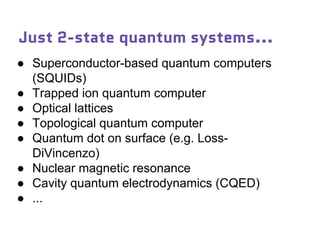
Just 2-state quantum systems...
● Superconductor-based quantum computers
(SQUIDs)
● Trapped ion quantum computer
● Optical lattices
● Topological quantum computer
● Quantum dot on surface (e.g. Loss-
DiVincenzo)
● Nuclear magnetic resonance
● Cavity quantum electrodynamics (CQED)
● ...
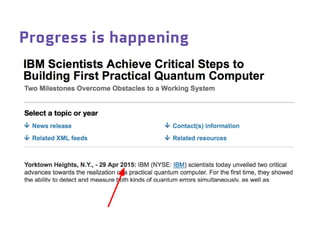
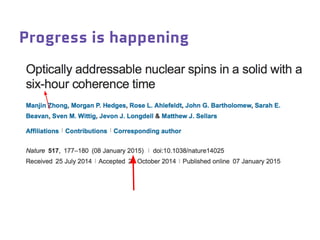
Progress is happening
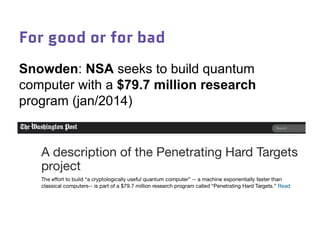
Snowden: NSA seeks to build quantum
computer with a $79.7 million research
program (jan/2014)
For good or for bad
Final Remarks
● There are lots more:
○ quantum algorithms (Grover, Simons), quantum
gates/circuits, topological quantum computing,
Deutsch parallelism, entanglement, quantum
teleportation...
Final Remarks
● There are lots more:
○ quantum algorithms (Grover, Simons), quantum
gates/circuits, topological quantum computing,
Deutsch parallelism, Entanglement, quantum
teleportation...
● This is a background, now you decide.
It’s a brave new world...
Thank you.

Hacking Quantum Cryptography

  • 1.
    Hacking Quantum Cryptography Dr. Marinavon Steinkirch ~ Yelp Security
  • 2.
    The speaker @1bt337 Ph.D.in Physics at Worked on astro/nuclear stuff at Now doing Security at (We are hiring!)
  • 3.
    Agenda 1. Quantum Mechanicsin 10 mins 2. Quantum Computing in 11 mins 3. Quantum Key Exchange in 100 mins (or more minutes)
  • 4.
    Some disclaimers ● Thisis my personal views and do not necessarily reflect views of my employer. ● This is a physicist point of view. ● For a more in-depth discussion on the privacy issues in the post-quantum crypto paradigm, check out Jennifer Katherine Fernick’s work.
  • 5.
    What if weare all just a simulation? “To simulate reality, in it lowest level, you would need a quantum computer” (Feynman, 1982)
  • 6.
    What if weare all just a simulation? “To simulate reality, in it lowest level, you would need a quantum computer” (Feynman, 1982) The universe is a 13.8 billion years-old quantum computer.
  • 7.
    But first, let’sunderstand how quantum mechanics changed the way we see the world...
  • 8.
    It was prettyboring in the 1800s... "There is nothing new to be discovered in physics now. All that remains is more and more precise measurement." (Lord Kelvin, 1897 - before QM)
  • 9.
    Then… the UltravioletCatastrophe ● Early 1800s: light as a wave (Young’s double slit experiment, 1801)
  • 10.
    Then… the UltravioletCatastrophe ● Early 1800s: light as a wave (Young’s double slit experiment, 1801) ● Classical Thermodynamics: <E> wavelength (for some temperature)
  • 11.
    Then… the UltravioletCatastrophe What would happen if radiation was emitted in infinite wavelengths? ?
  • 12.
    Then… the UltravioletCatastrophe What would happen if radiation was emitted in infinite wavelengths?
  • 13.
    Enter Quantum Mechanics “Whatif Energy is released on bundles instead? Just dunno why :(” (Max Planck, 1899)
  • 14.
    Enter Quantum Mechanics “Whatif Energy is released on bundles instead? Just dunno why :(” (Max Planck, 1899)
  • 15.
    Particle-Wave Duality @Qu4ntumPl4nck Noworries, dude! #GotThis (Einstein, 1905)
  • 16.
    Particle-Wave Duality @Qu4ntumPl4nck Noworries, dude! #GotThis (Einstein, 1905)
  • 17.
    How about thematter? “Doh! Everything in the quantum world is both a particle and a wave. #NobelMaterial” (de Broglie, 1924)
  • 18.
    Wavefunction Matter is representedby a wavefunction, a mathematical probability that represents the quantum state of one or more particles.
  • 19.
    Wavefunction Squaring the amplitudegives the probability of that state Matter is represented by a wavefunction, a mathematical probability that represents the quantum state of one or more particles.
  • 20.
    Wavefunction Matter is representedby a wavefunction, a mathematical probability that represents the quantum state of one or more particles.
  • 21.
    Wavefunction (btw, wavefunctions aresolutions of the Schrödinger Equation, remember, from the half-dead cat?)
  • 22.
    What if wetake a peak? Before we observe the state... and (dead and alive)
  • 23.
    What if wetake a peak? Observation collapses the probability to the observed state! or (dead or alive)
  • 24.
    What if wetake a peak? Before we observe the state... 0 and 1 (dead and alive)
  • 25.
    What if wetake a peak? After observing the state… 0 or 1 (dead or alive)
  • 26.
    Let’s try anexperiment 1. 3 Polaroid filters with horizontal, vertical and 45° polarization
  • 27.
    Let’s try anexperiment 2. Shine light on the horizontal filter
  • 28.
    Let’s try anexperiment 2. Shine light on the horizontal filter → light becomes horizontally polarized
  • 29.
    Let’s try anexperiment 3. Place the vertical filter after that
  • 30.
    Let’s try anexperiment 3. Place the vertical filter after that → no light pass through it
  • 31.
    Let’s try anexperiment 4. Now place the 45° filter in between
  • 32.
    Let’s try anexperiment 4. Now place the 45° filter in between → light starts to emerge from the vertical filter
  • 33.
    Say waaaat? ● Thinkwavefunction & probabilities
  • 34.
    Say waaaat? ● Thinkwavefunction & probabilities ● An arbitrary polarization can be represented by
  • 35.
    Say waaaat? ● Thinkwavefunction & probabilities ● An arbitrary polarization can be represented by ● But we could change the basis:
  • 36.
    Say waaaat? ● Thinkwavefunction & probabilities ● An arbitrary polarization can be represented by ● But we could change the basis: ● Probability that the photon passes through: square of the amplitude, times 3
  • 37.
    Enter Qubits (quantumbits) Unit vector in a 2-dimensional complex vector space:
  • 38.
  • 39.
    Enter several qubits ●2 qubits ● 3 qubits http://astro.sunysb.edu/steinkirch/books/qi.pdf
  • 40.
    Quantum mechanics giveus spooky particles that can encode (and do) multiple things at once, just like a massively parallel machine
  • 41.
    Shor’s Algorithm ● PKcrypto relies on a classical computer’s difficult at factoring large numbers (RSA, EC).
  • 42.
    Shor’s Algorithm ● PKcrypto relies on a classical computer’s difficult at factoring large numbers (RSA, EC). ● In 1994, Peter Shor showed that a QC could find the prime factors of a large number in milliseconds.
  • 43.
    Shor’s Algorithm ● PKcrypto relies on a classical computer’s difficult at factoring large numbers (RSA, EC). ● In 1994, Peter Shor showed that a QC could find the prime factors of a large number in milliseconds. ● In the moment when a QC is successfully built, all the internet becomes insecure (remember: no forward secrecy!)
  • 44.
    Shor’s Algorithm ● Fora 1000-bit number, all we need is ~1000 qubits (without error correction) for maybe just a dozen seconds
  • 45.
    Shor’s Algorithm ● Fora 1000-bit number, all we need is ~1000 qubits (without error correction) for maybe just a dozen seconds ○ The wavefunction will encode 2**1000 possibilities (states)
  • 46.
    Shor’s Algorithm ● Fora 1000-bit number, all we need is ~1000 qubits (without error correction) for maybe just a dozen seconds ○ The wavefunction will encode state 2**1000 possibilities
  • 47.
    Shor’s Algorithm: How? ●Quantum Fourier Transform to find the periodicity of prime numbers ● Algorithm runs simultaneously every pair of number: wavefunctions either constructly or desconstructly interfer ● In the end, the right answer spike (frequency/period/mod)
  • 48.
    ● But… whatif Alice and Bob could use QM to create and distribute a key? Alice & Bob are kinda scared now...
  • 49.
    ● But… whatif Alice and Bob could use QM to create and distribute a key? ● Distribute qubits through a quantum channel to establish a key that can be used across a classical channel. Alice & Bob are kinda scared now...
  • 50.
    Alice, Bob and…Heisenberg ● QC security is based on the Heisenberg Uncertainty principle
  • 51.
    Alice, Bob and…Heisenberg ● QC security is based on the Heisenberg Uncertainty principle ○ You cannot make a perfect copy of a quantum state without disturbing it, introducing errors in the communication.
  • 52.
    Secure by MathPhysics ● Alice and Bob can exchange (quantum encoded) keys securely (e.g. photons via fiber).
  • 53.
    Secure by MathPhysics ● Alice and Bob can exchange (quantum encoded) keys securely (e.g. photons via fiber). ● If Eve reads the state of photon → probability collapses and Bob and Alice will know!
  • 54.
    1. Alice preparesa sequence of photons, polarize each one in of the four possibilities of polarization. Quantum Key Distribution (BB84)
  • 55.
    1. Alice preparesa sequence of photons, polarize each one in of the four possibilities of polarization. 2. Bob measures these photons in the 2 basis, and keep bits values in secret. Quantum Key Distribution (BB84)
  • 56.
    1. Alice preparesa sequence of photons, polarize each one in of the four possibilities of polarization. 2. Bob measures these photons in random basis, and take note of the bits values. 3. Alice and Bob compare their basis but not the bit values, discarding the wrong measurements. Quantum Key Distribution (BB84)
  • 57.
  • 58.
  • 59.
    Free-space QKD over90 miles Canary Islands: single photons prepared in La Palma and sent to Tenerife
  • 60.
    All this issuper cool... But how long is going to take for the first quantum computer?
  • 61.
    Challenges in buildinga QC ● QCs must maintain hundreds of qubits together for some amount of time
  • 62.
    Challenges in buildinga QC ● QCs must maintain hundreds of qubits together for some amount of time ○ Decoherence: The universe is observing all the time! ○ Particles are absorbed by the room and vanished!
  • 63.
    But progress ishappening
  • 64.
    Just 2-state quantumsystems... ● Superconductor-based quantum computers (SQUIDs) ● Trapped ion quantum computer ● Optical lattices ● Topological quantum computer ● Quantum dot on surface (e.g. Loss- DiVincenzo) ● Nuclear magnetic resonance ● Cavity quantum electrodynamics (CQED) ● ...
  • 65.
  • 66.
  • 67.
    Snowden: NSA seeksto build quantum computer with a $79.7 million research program (jan/2014) For good or for bad
  • 68.
    Final Remarks ● Thereare lots more: ○ quantum algorithms (Grover, Simons), quantum gates/circuits, topological quantum computing, Deutsch parallelism, entanglement, quantum teleportation...
  • 69.
    Final Remarks ● Thereare lots more: ○ quantum algorithms (Grover, Simons), quantum gates/circuits, topological quantum computing, Deutsch parallelism, Entanglement, quantum teleportation... ● This is a background, now you decide.
  • 70.
    It’s a bravenew world... Thank you.