


Quantum Information
What is Quantum Mechanics? Quantum physics is a branch of science that deals with discrete, indivisible units of energy called quanta and their particle-like and wave-like behavior as described by the Quantum Theory.
Concepts in Quantum Mechanics Quantum-Discrete  Uncertainty Principle Double Slit experiment Wave/Particle Duality Wave Function Superposition Quantum field
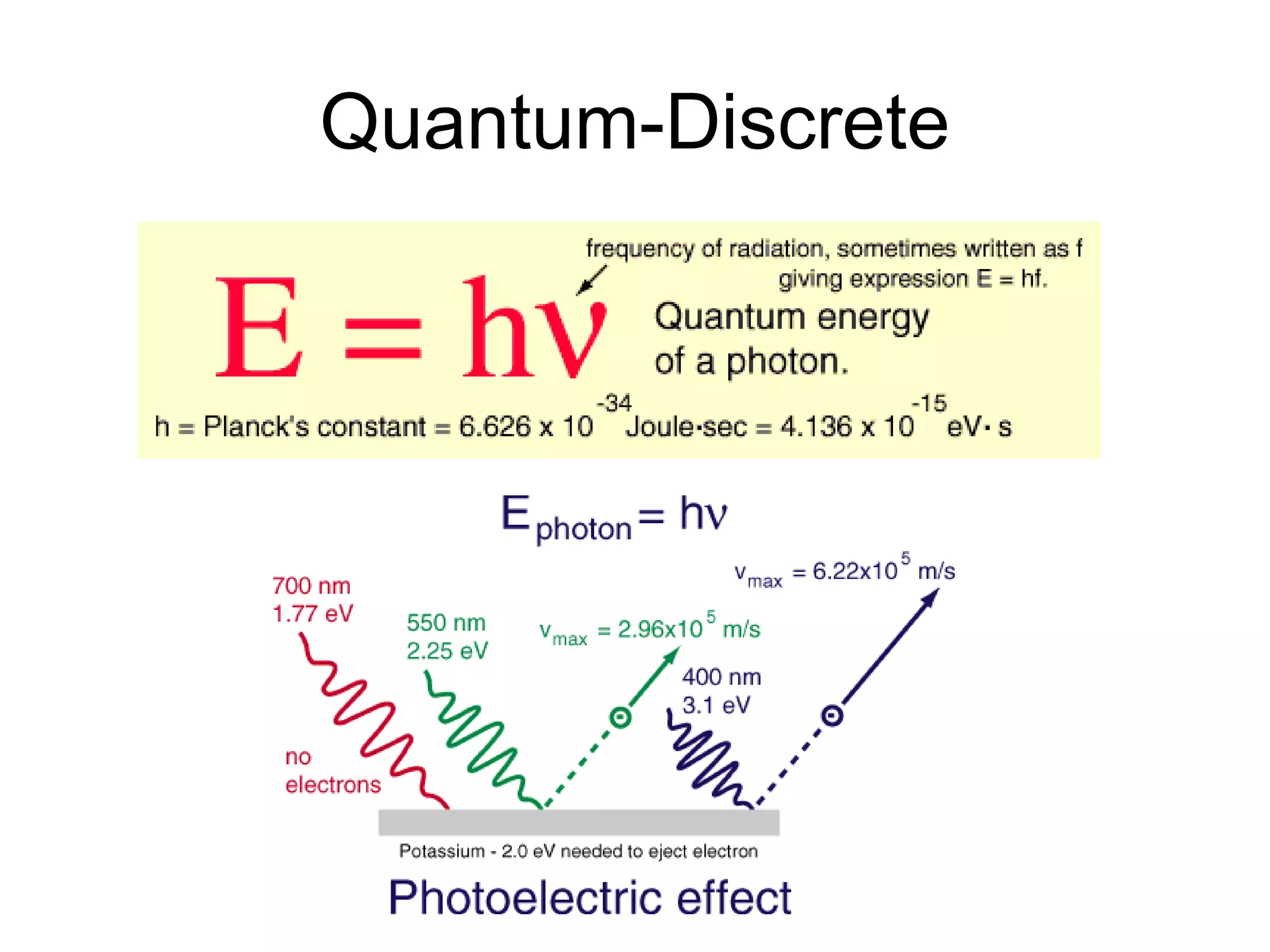
Quantum-Discrete
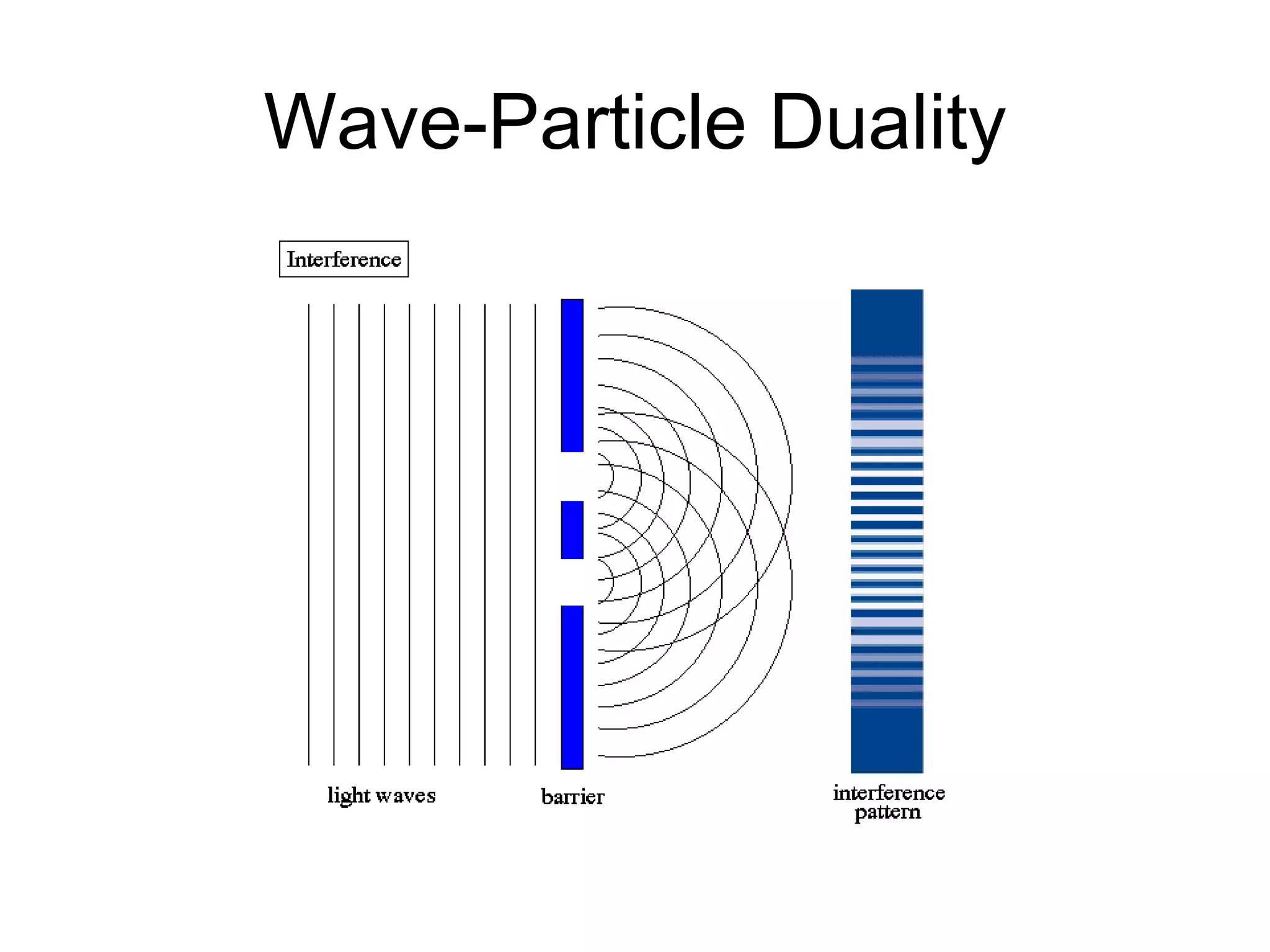
Wave-Particle Duality
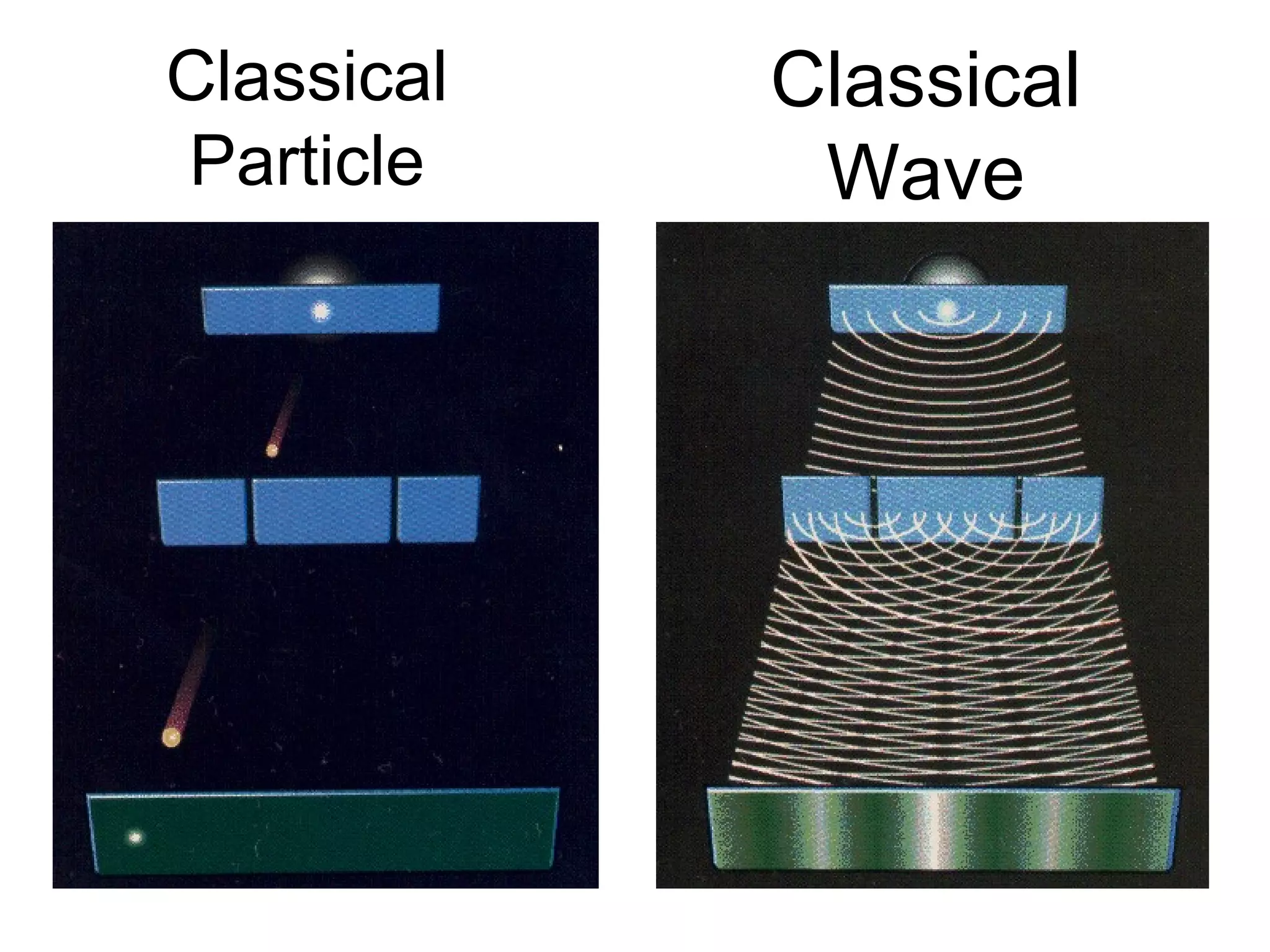
Classical Particle Classical Wave
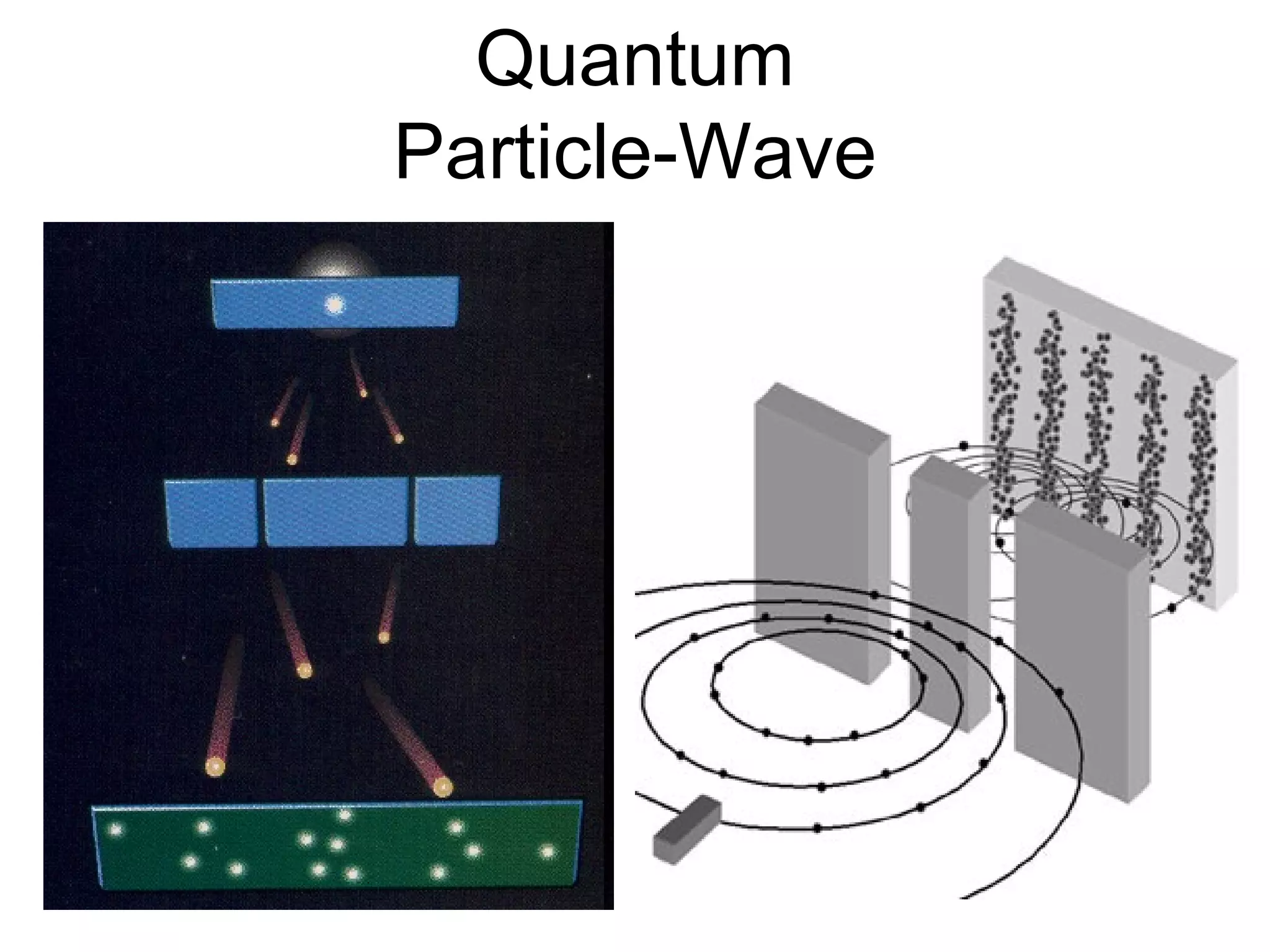
Quantum Particle-Wave
 
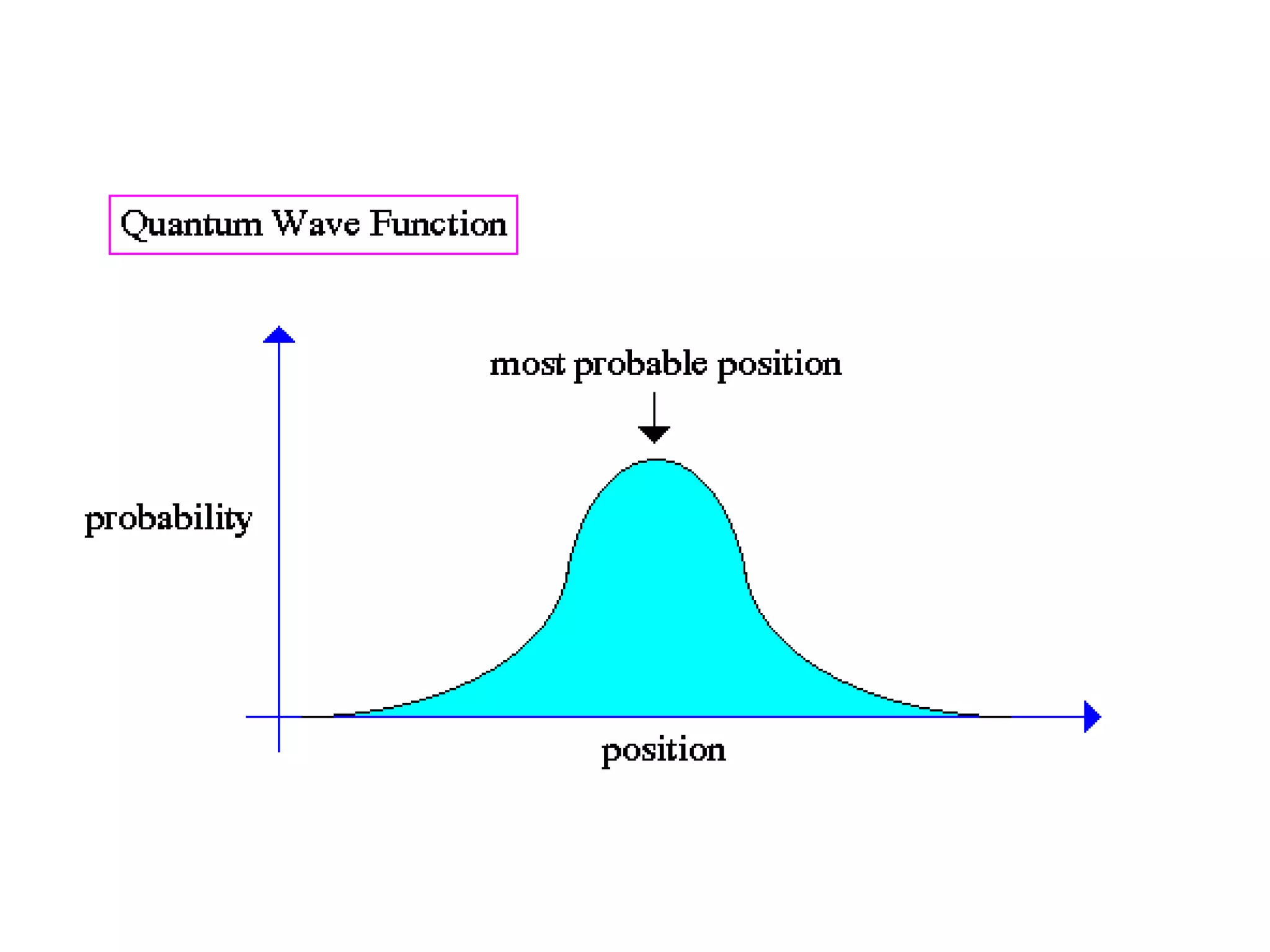
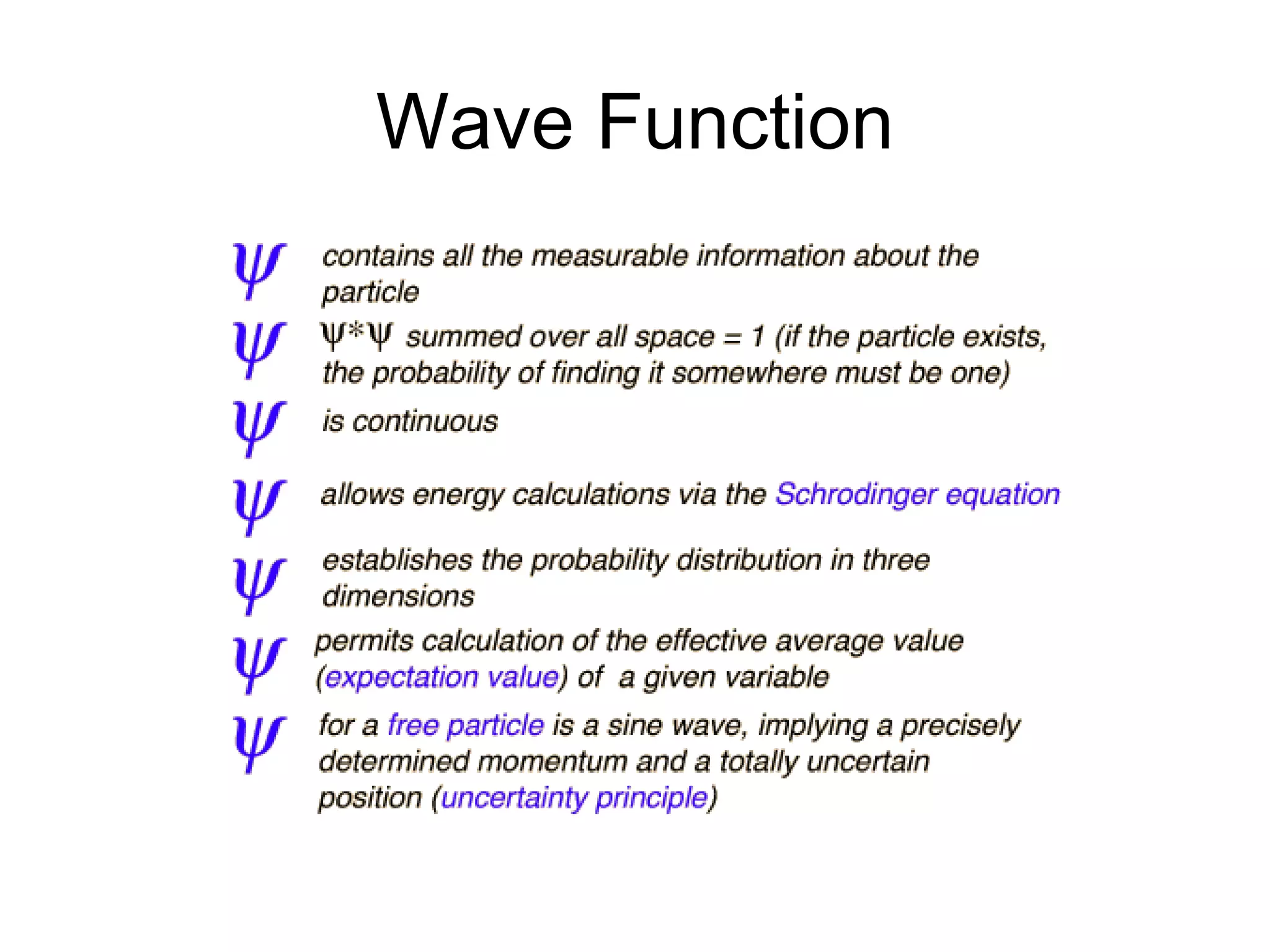
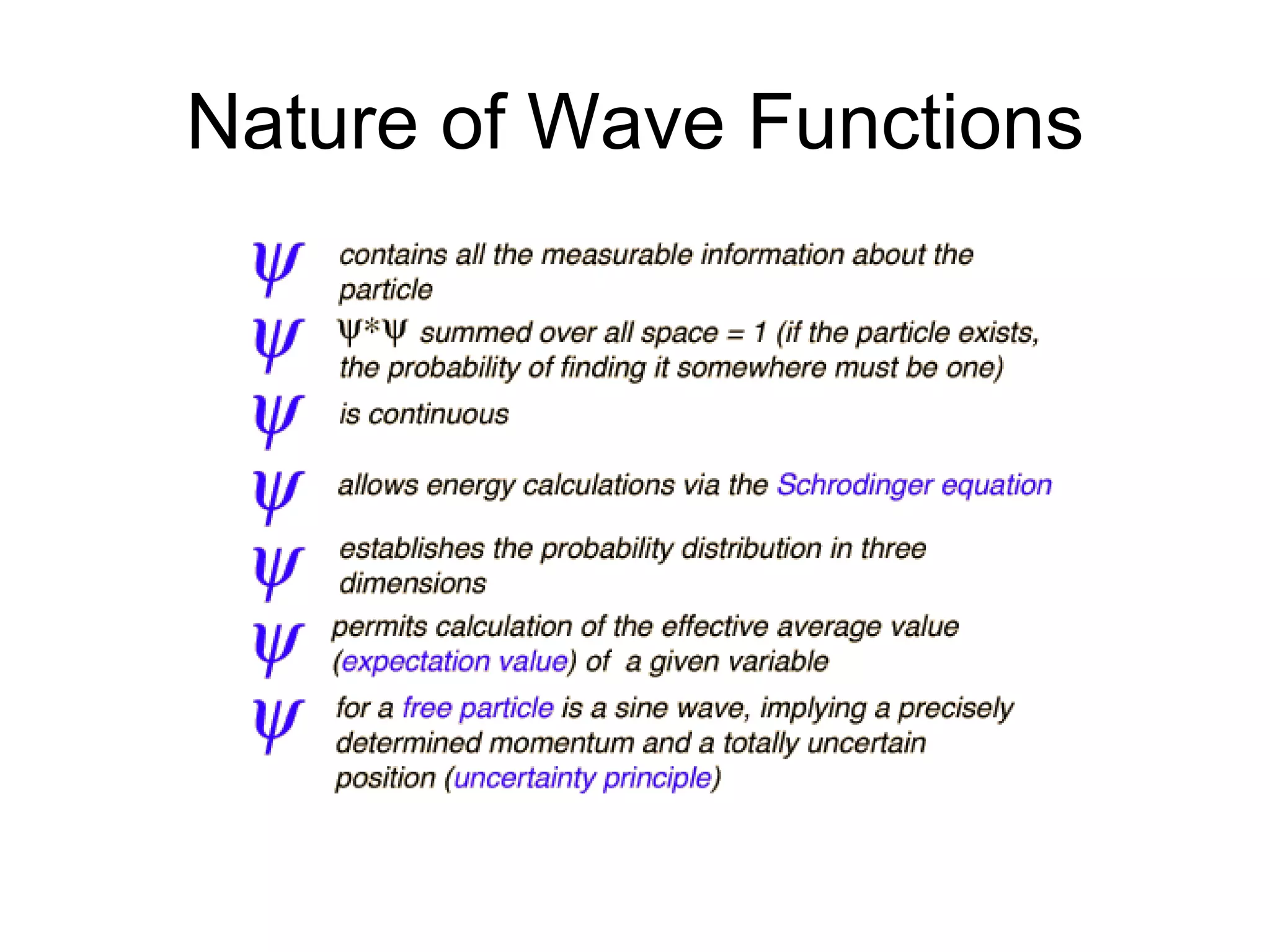
Wave Function
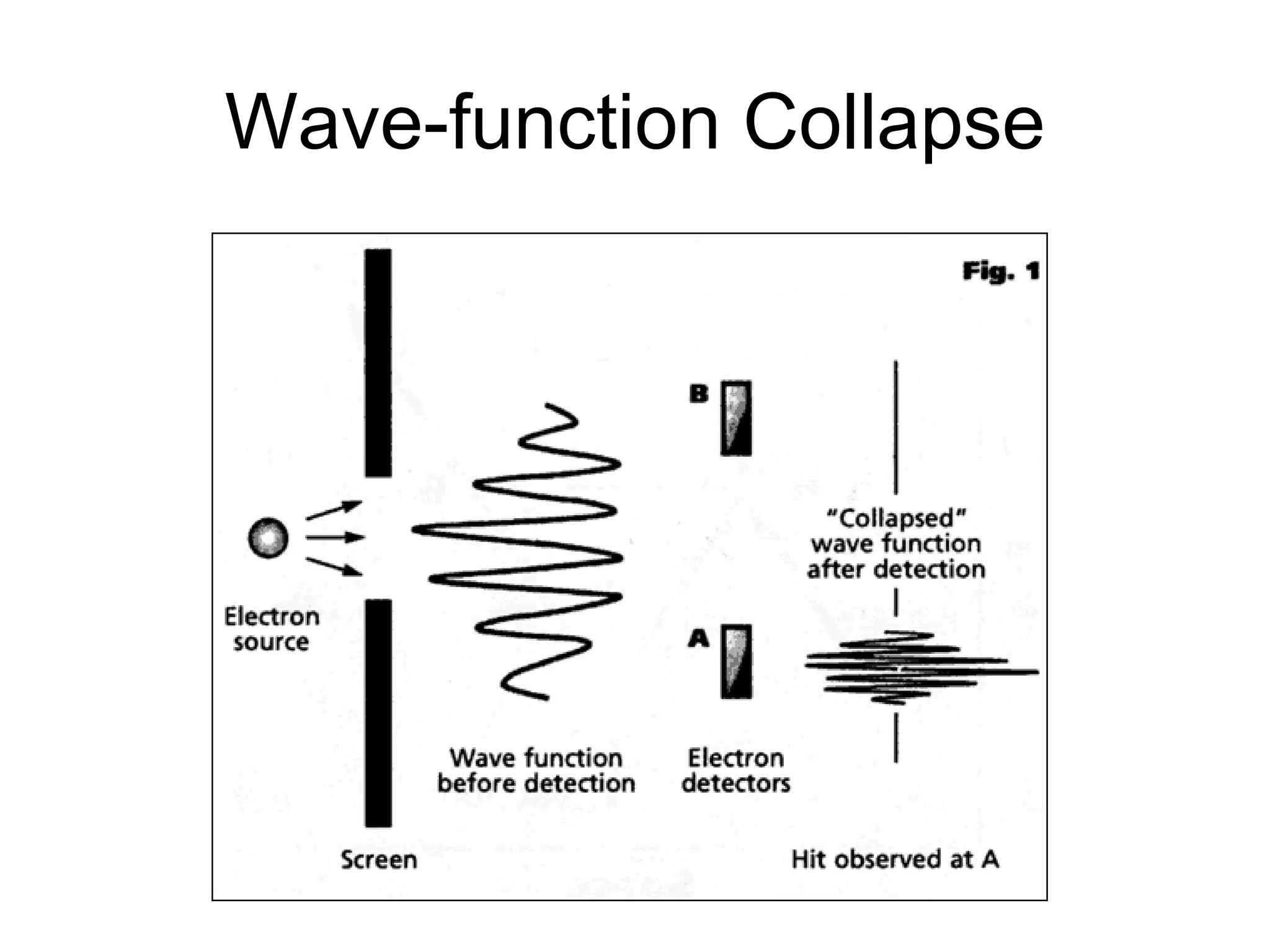
Wave-function Collapse
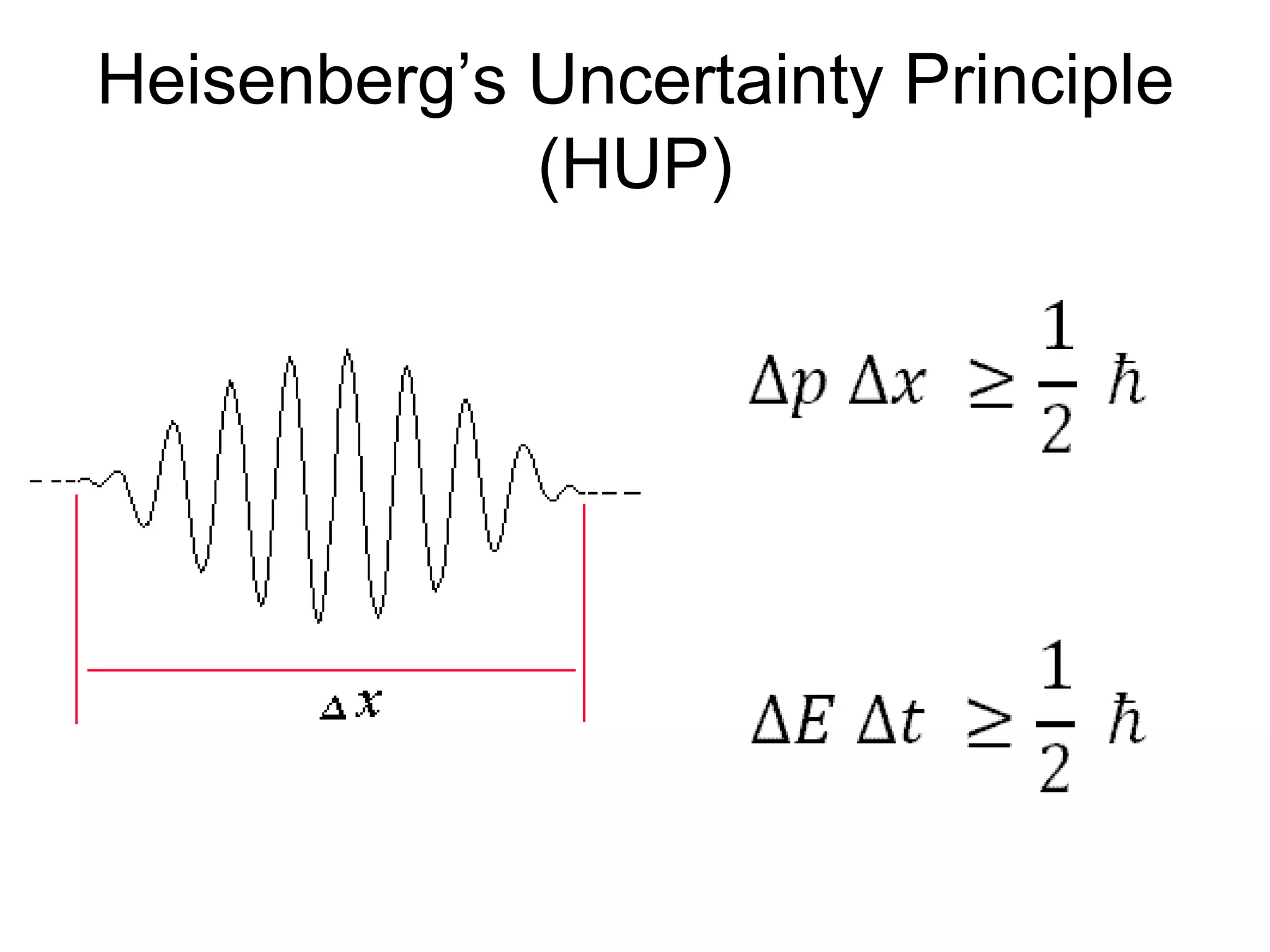
Heisenberg’s Uncertainty Principle (HUP)
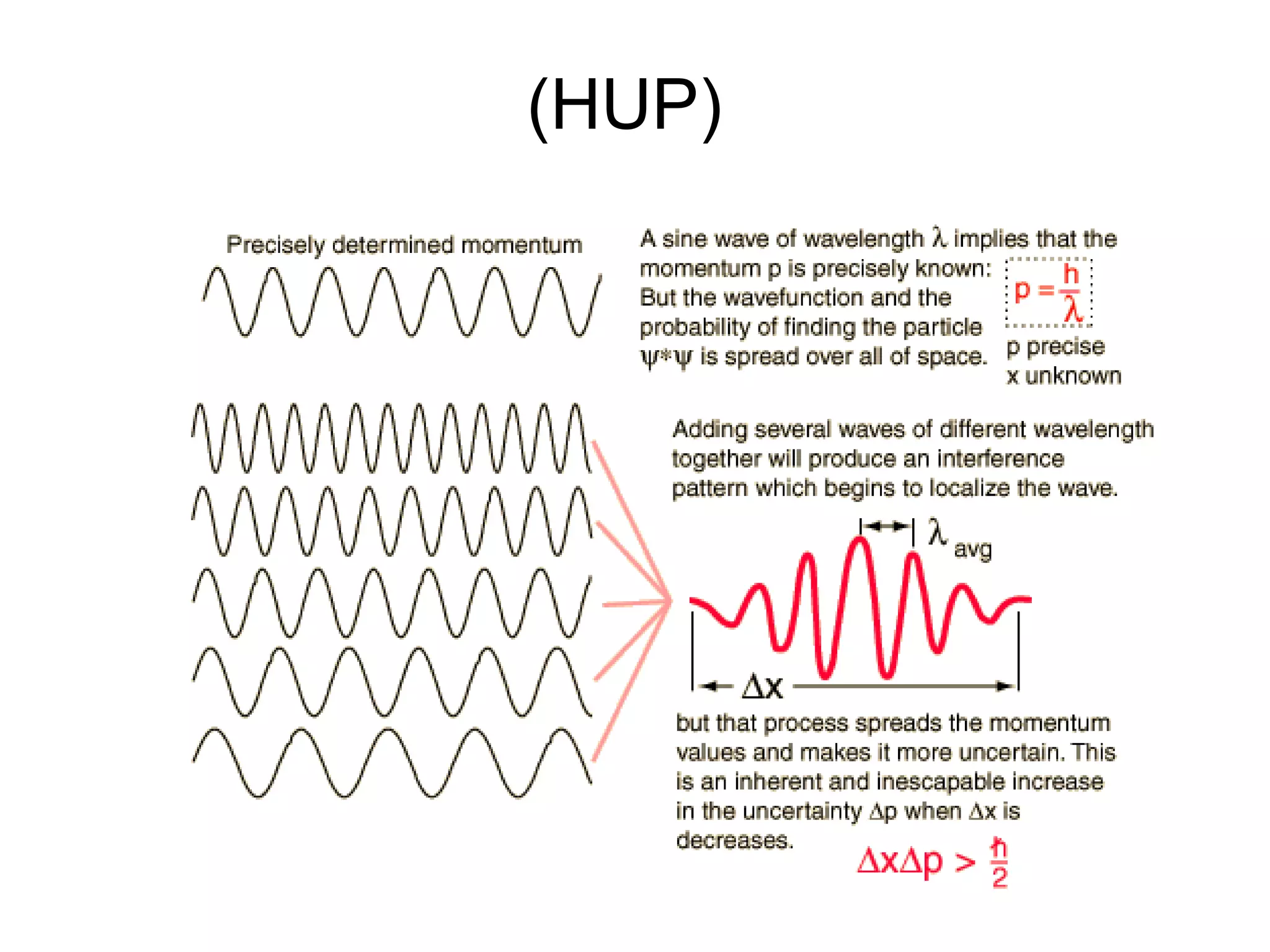
(HUP)
Metaphysics
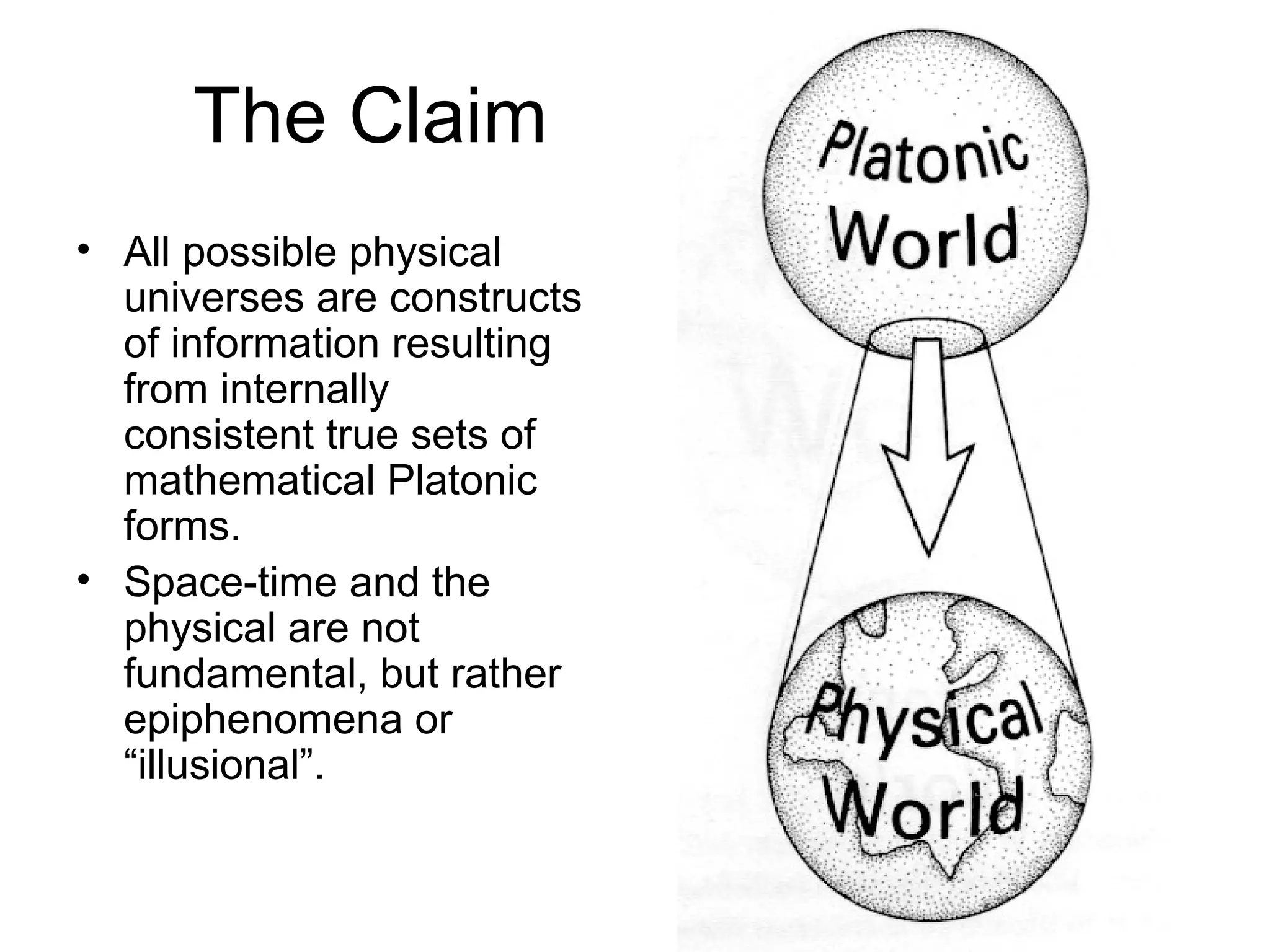
The Claim All possible physical universes are constructs of information resulting from internally consistent true sets of mathematical Platonic forms. Space-time and the physical are not fundamental, but rather epiphenomena or “illusional”.
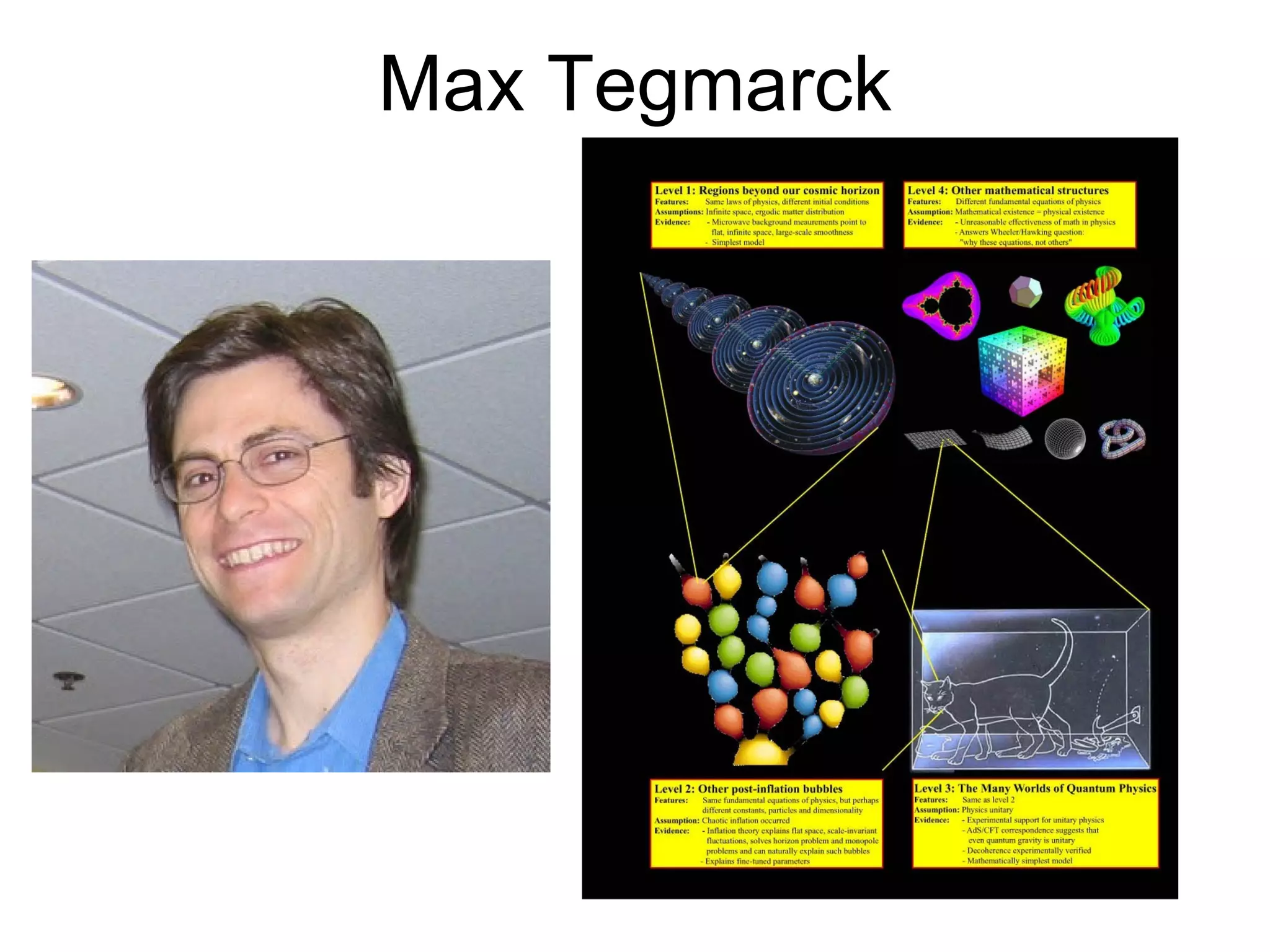
Max Tegmarck
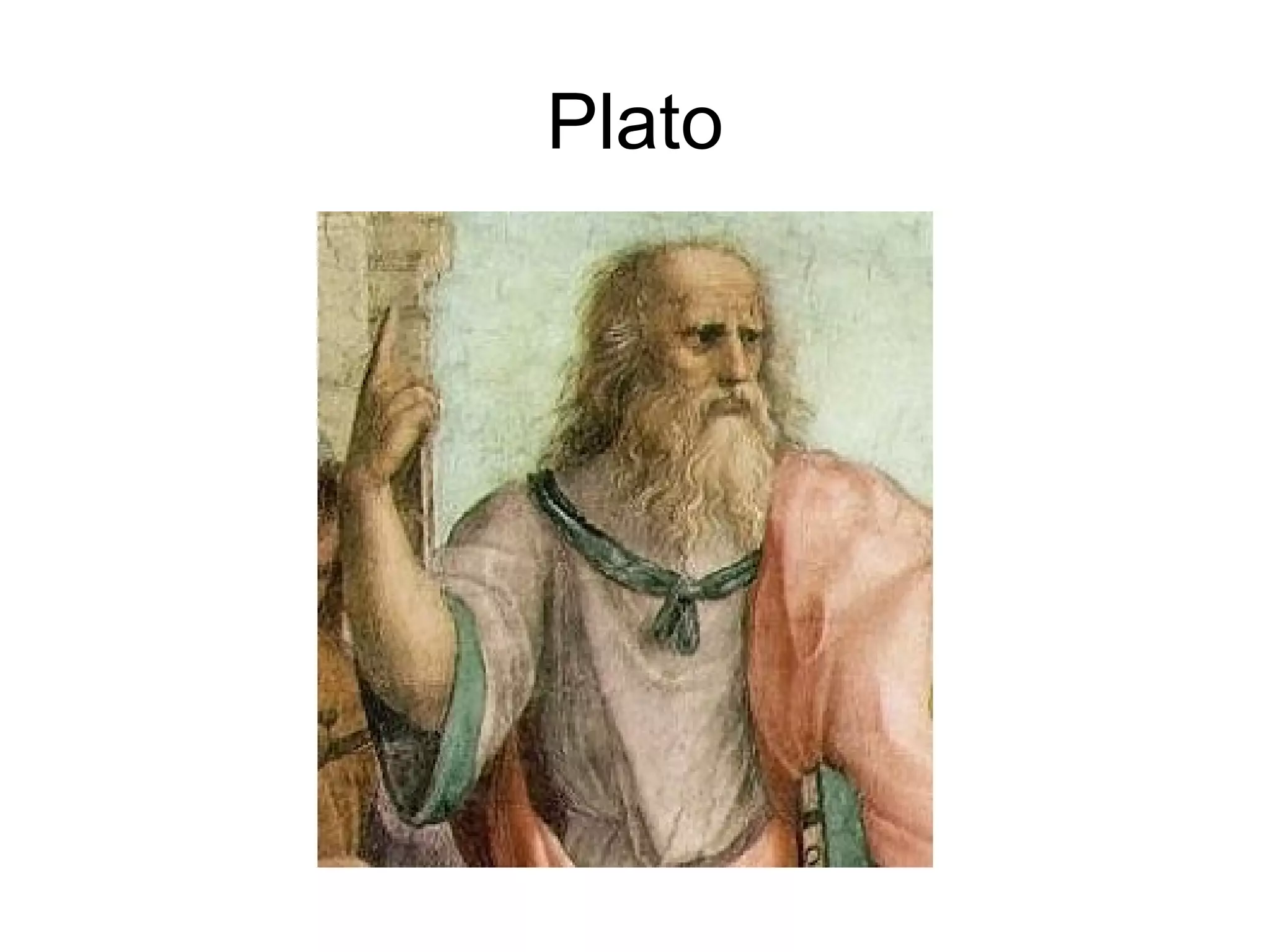
Plato
Postulates of Platonism The structure of any Platonist theory, any Platonist position has to satisfy the following propositions: There is a mathematical reality.  The existence of the objects of mathematical knowledge does not depend on actions or reactions by the cognitive subject.  In particular, the objective existence of these objects does not result from the success of the subject's cognitive performance.  The existence of the objects of mathematical knowledge does not depend on the conceptual scheme which the cognitive subject happens to be inserted in.  In particular, does not depend on the language used by the cognitive subject.  The meaning of a mathematical proposition is given by the truth-conditions which correspond to it, since it describes a fact of the mathematical reality.  The truth of a mathematical proposition is independent of its being verified, either effectively or only in principle.  Under these propositions we consider that totalities of mathematical objects are well defined when statements which use quantification over such totalities are given a truth-value. In particular this is equivalent to consider the use of the tertium non datur over such totalities as well defined.
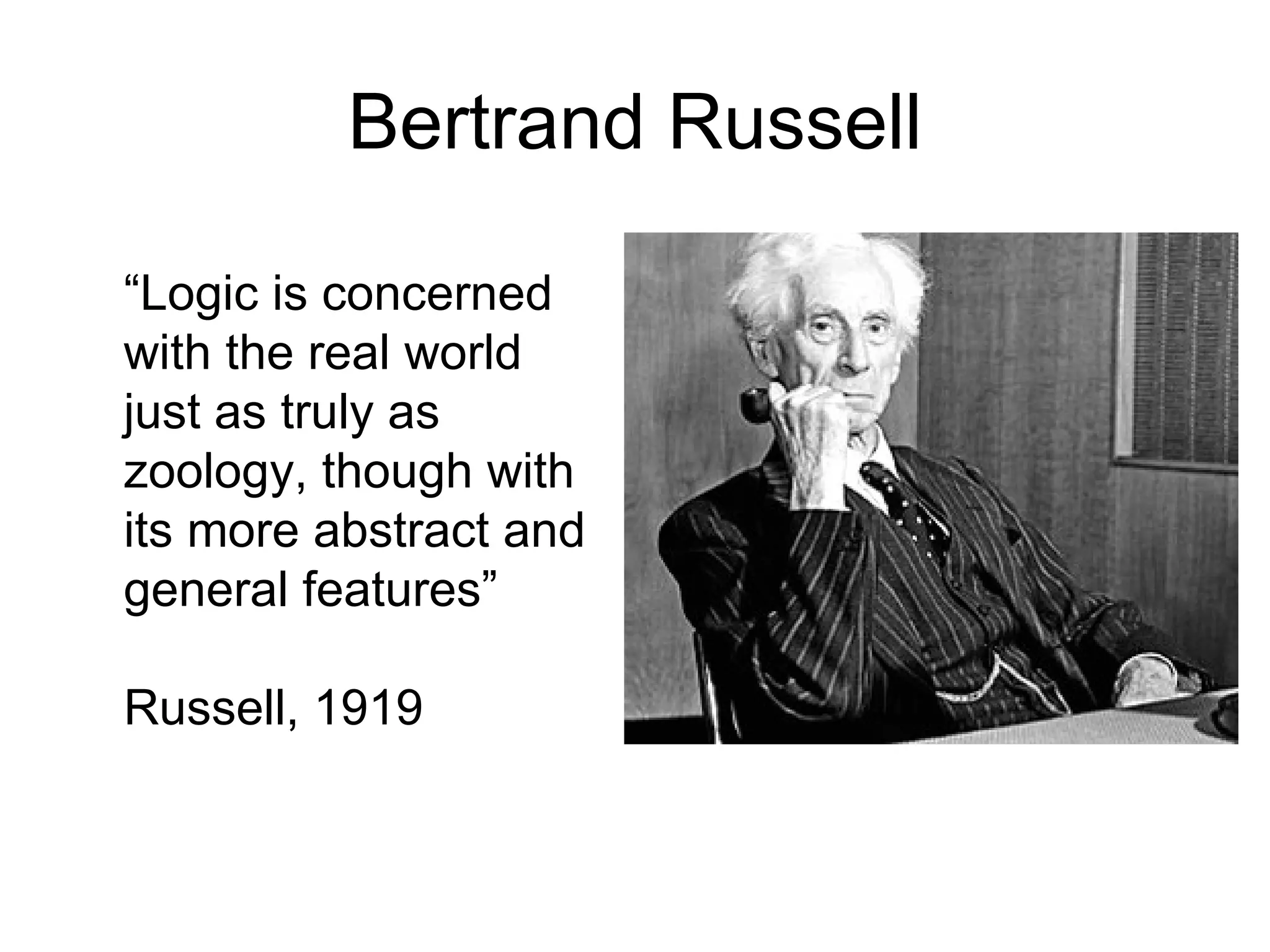
Bertrand Russell “ Logic is concerned with the real world just as truly as zoology, though with its more abstract and general features” Russell, 1919
Kurt Gödel
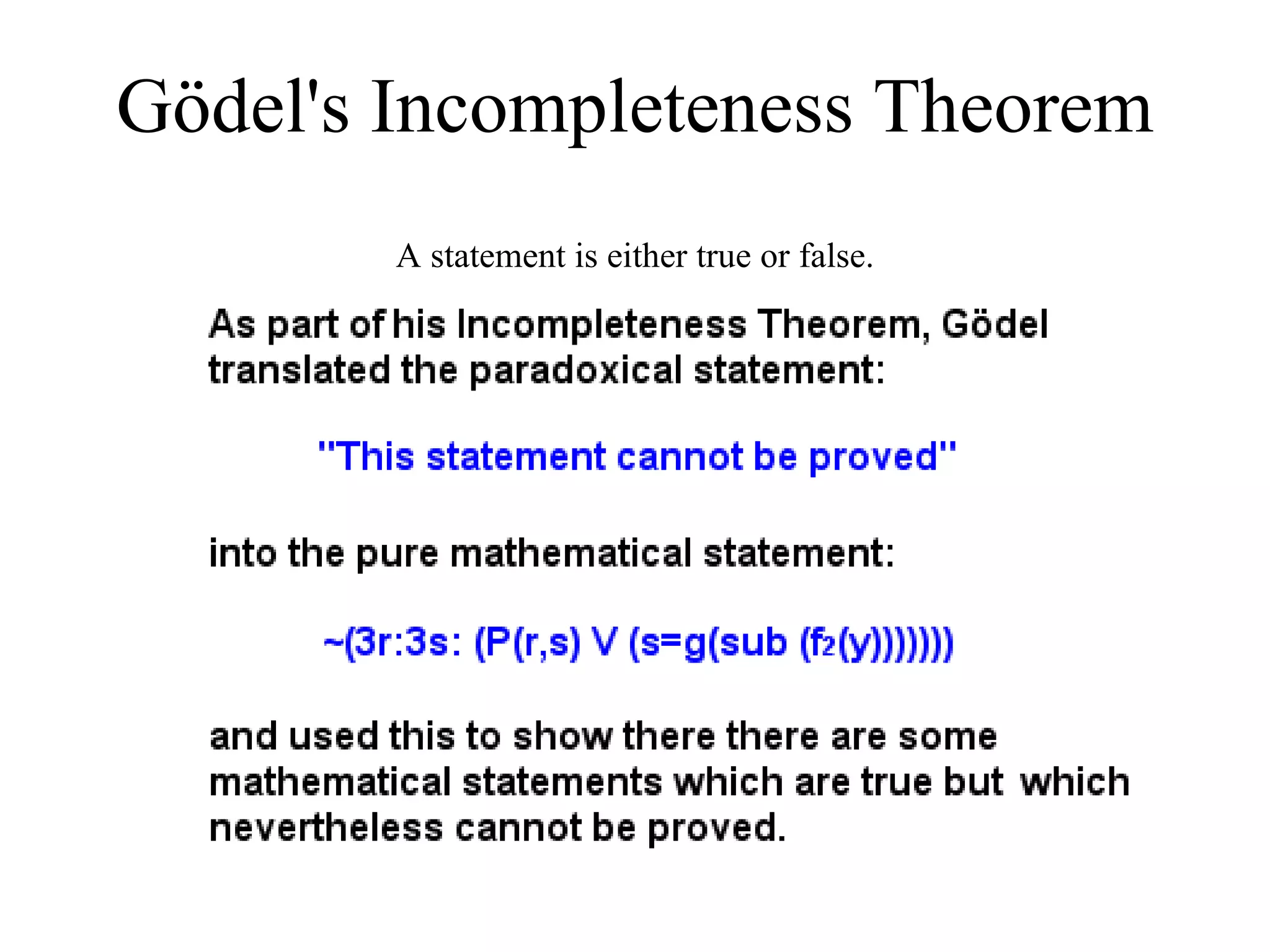
Gödel's Incompleteness Theorem A statement is either true or false.
Argument from Knowledge and Godel’s Incompleteness Theorem Can we know anything at all? Yes/No?
No, we know that we can’t know anything at all.
Can we know anything at all?  Yes/No?
Yes, we can have knowledge.
Are some things known intrinsically, or does all knowledge need independent justification?
Independent justification requires an argument with premises
Are premises proven from within their own logical system or outside of it?
Attempting to prove a premise from within it’s own logical system is circular reasoning.
Premises can only be proven from outside their own logical system.
These premises would have to be proven with further arguments based on even more premises.
A “complete” system which can prove something entirely will need to be bigger than itself as it will need premises beyond itself to prove itself.
A system which is bigger than itself is a contradiction in terms.
Thus it is not the case that all knowledge needs independent justification.  If we say that there are not Platonic forms, we must either violate the law of non-contradiction or violate Godel’s theorem.  Therefore, Platonic forms exist.
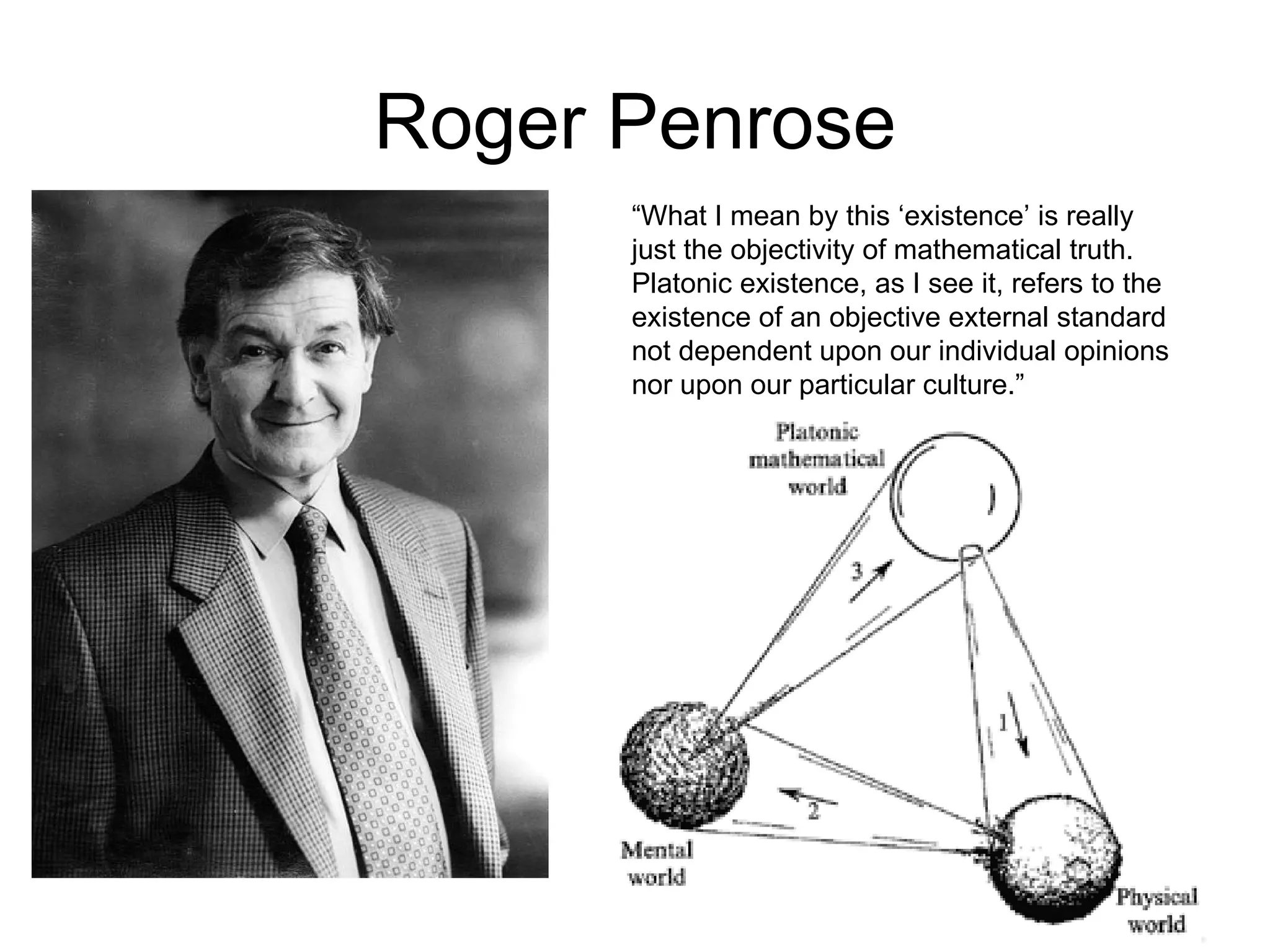
Roger Penrose “ What I mean by this ‘existence’ is really just the objectivity of mathematical truth. Platonic existence, as I see it, refers to the existence of an objective external standard not dependent upon our individual opinions nor upon our particular culture.”
Argument from Essence/Existence a) Essence precedes existence; Contradictory, doesn’t exist b) Existence precedes essence; Contradictory, doesn’t exist as anything c) Existence and essence are simultaneous d) Therefore, because mathematical proofs are objectively true and have essence, mathematical Platonic forms exist.
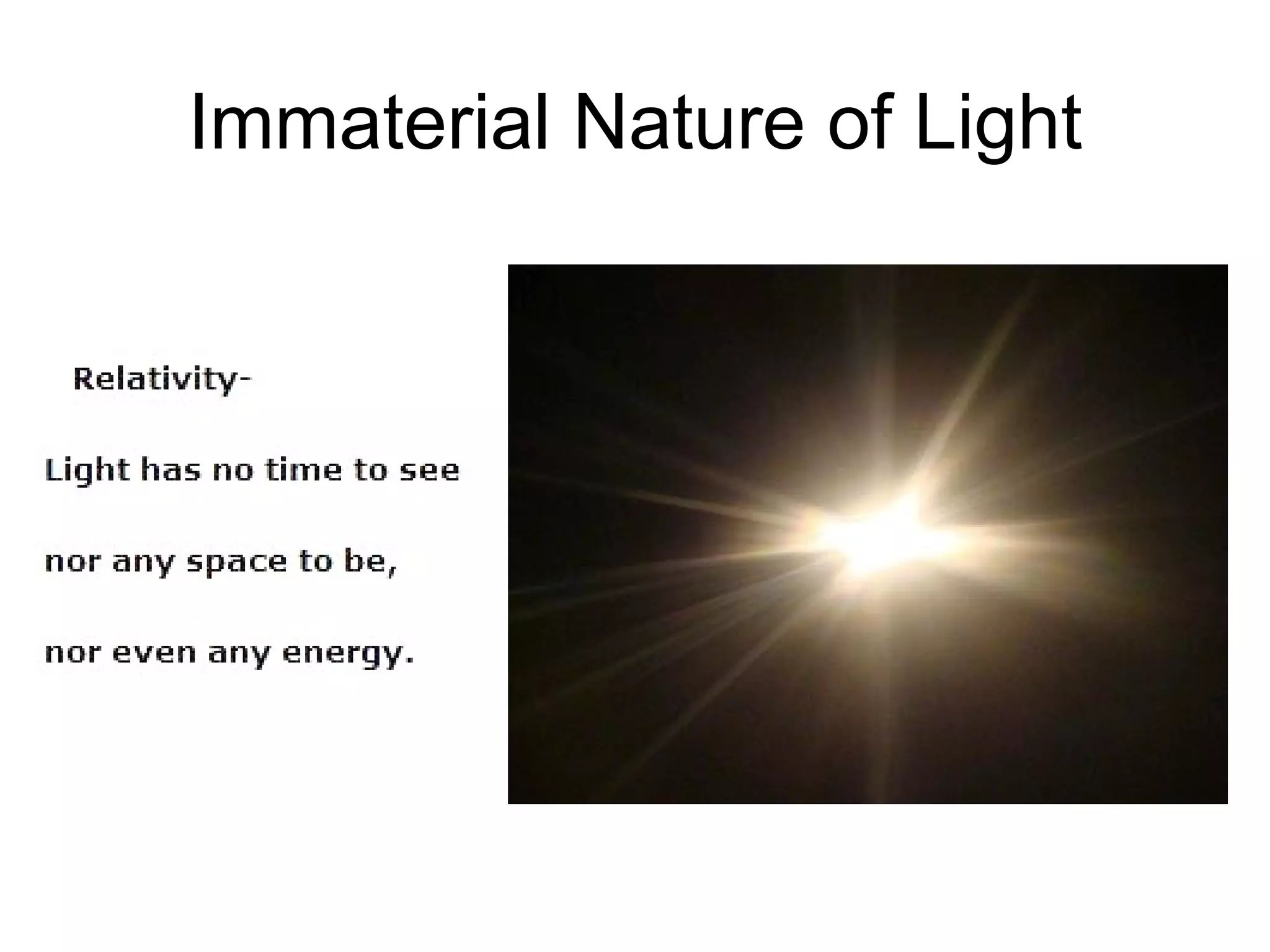
Immaterial Nature of Light
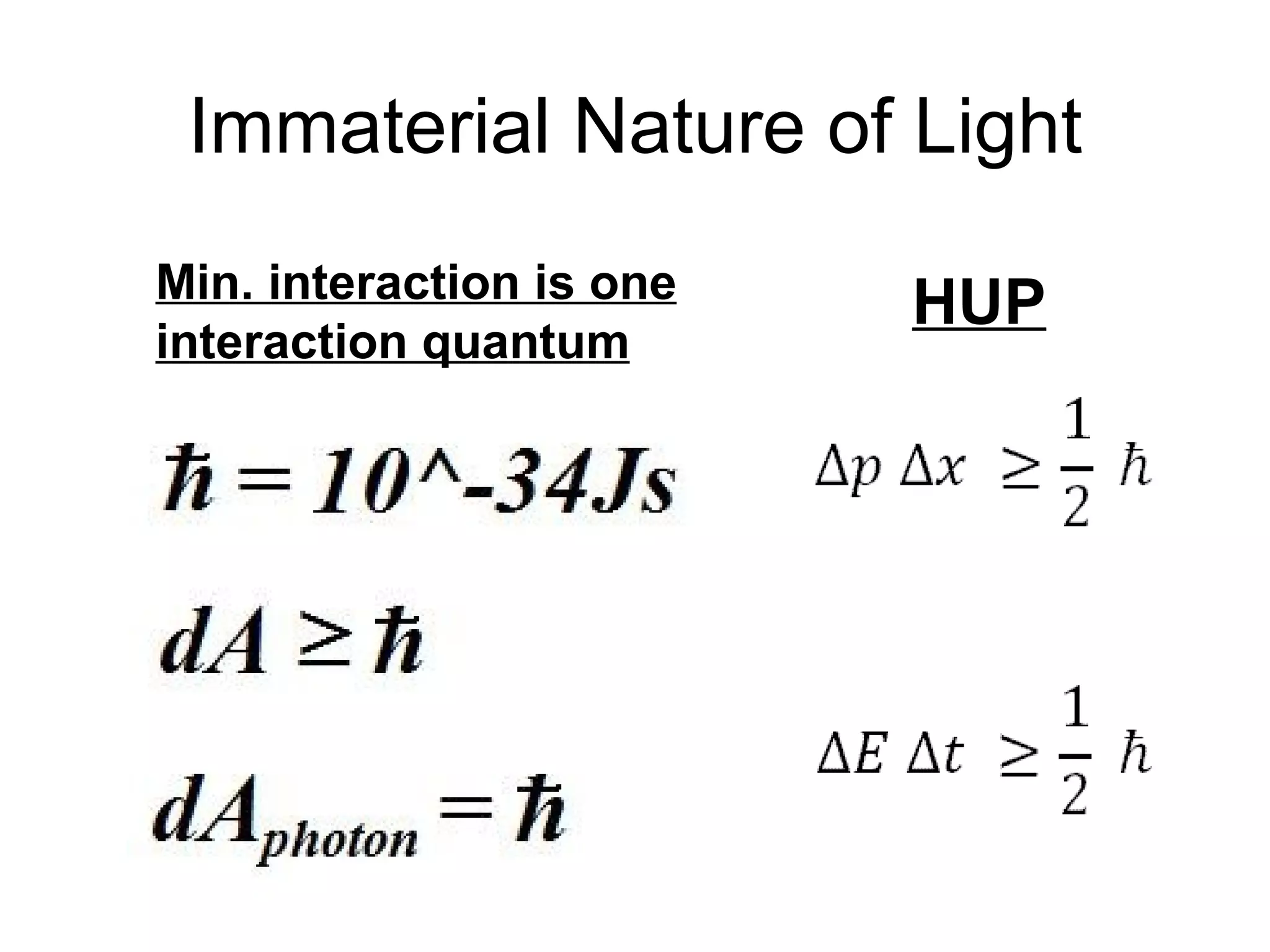
Immaterial Nature of Light HUP Min. interaction is one interaction quantum
Immaterial Nature of Light
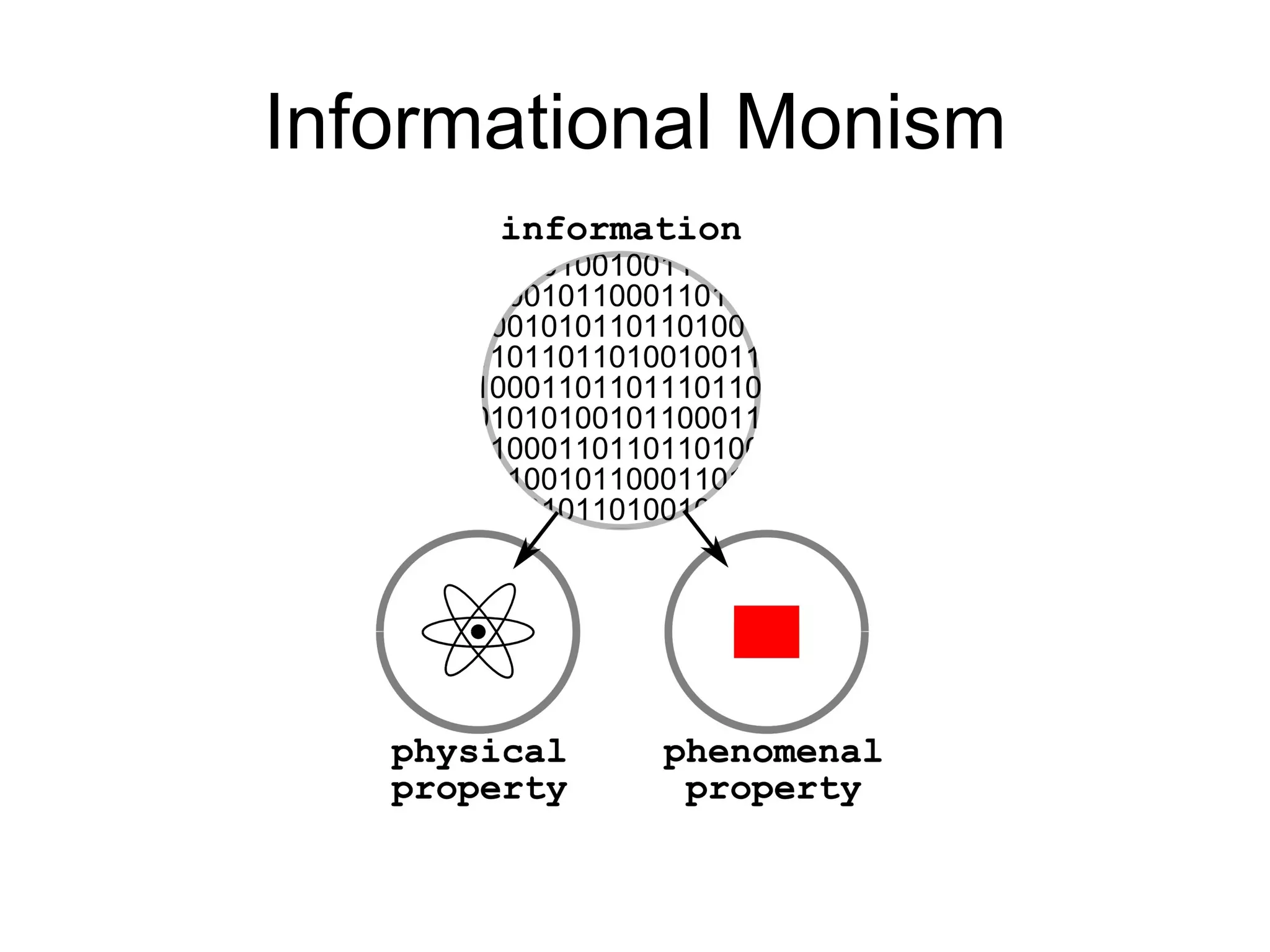
Informational Monism
Bertrand Russell
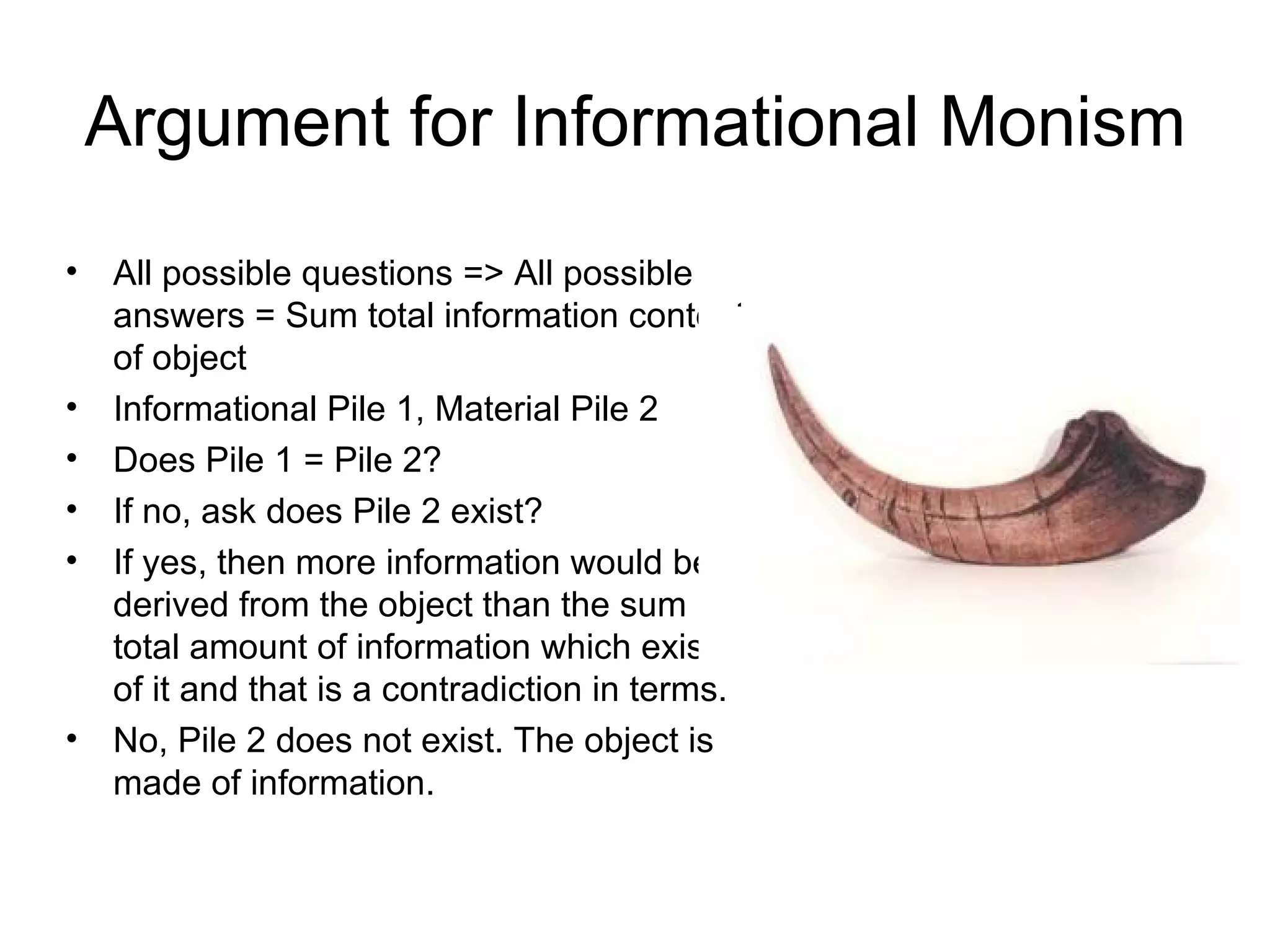
Argument for Informational Monism All possible questions => All possible answers = Sum total information content of object  Informational Pile 1, Material Pile 2 Does Pile 1 = Pile 2? If no, ask does Pile 2 exist? If yes, then more information would be derived from the object than the sum total amount of information which exists of it and that is a contradiction in terms. No, Pile 2 does not exist. The object is made of information.
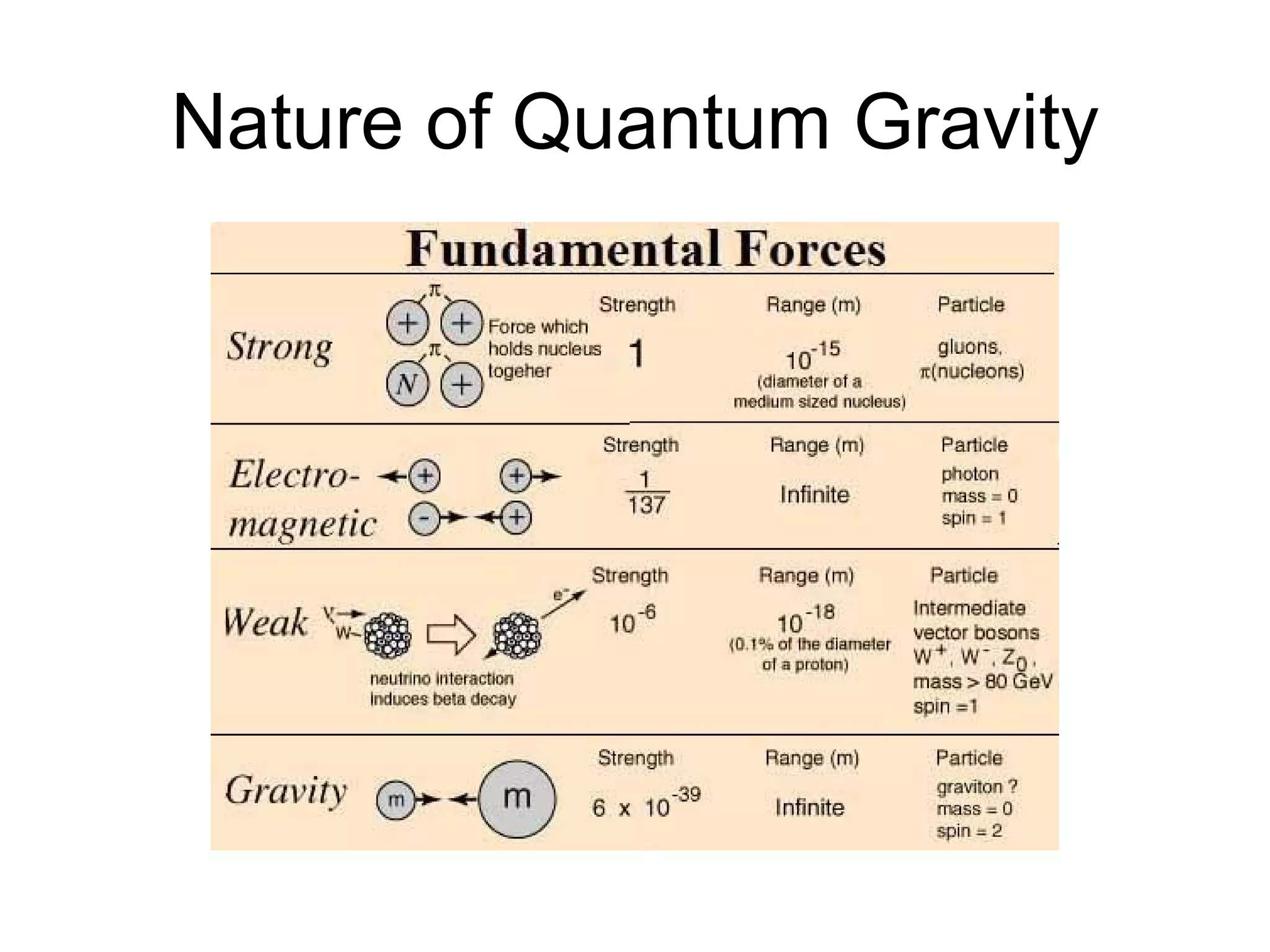
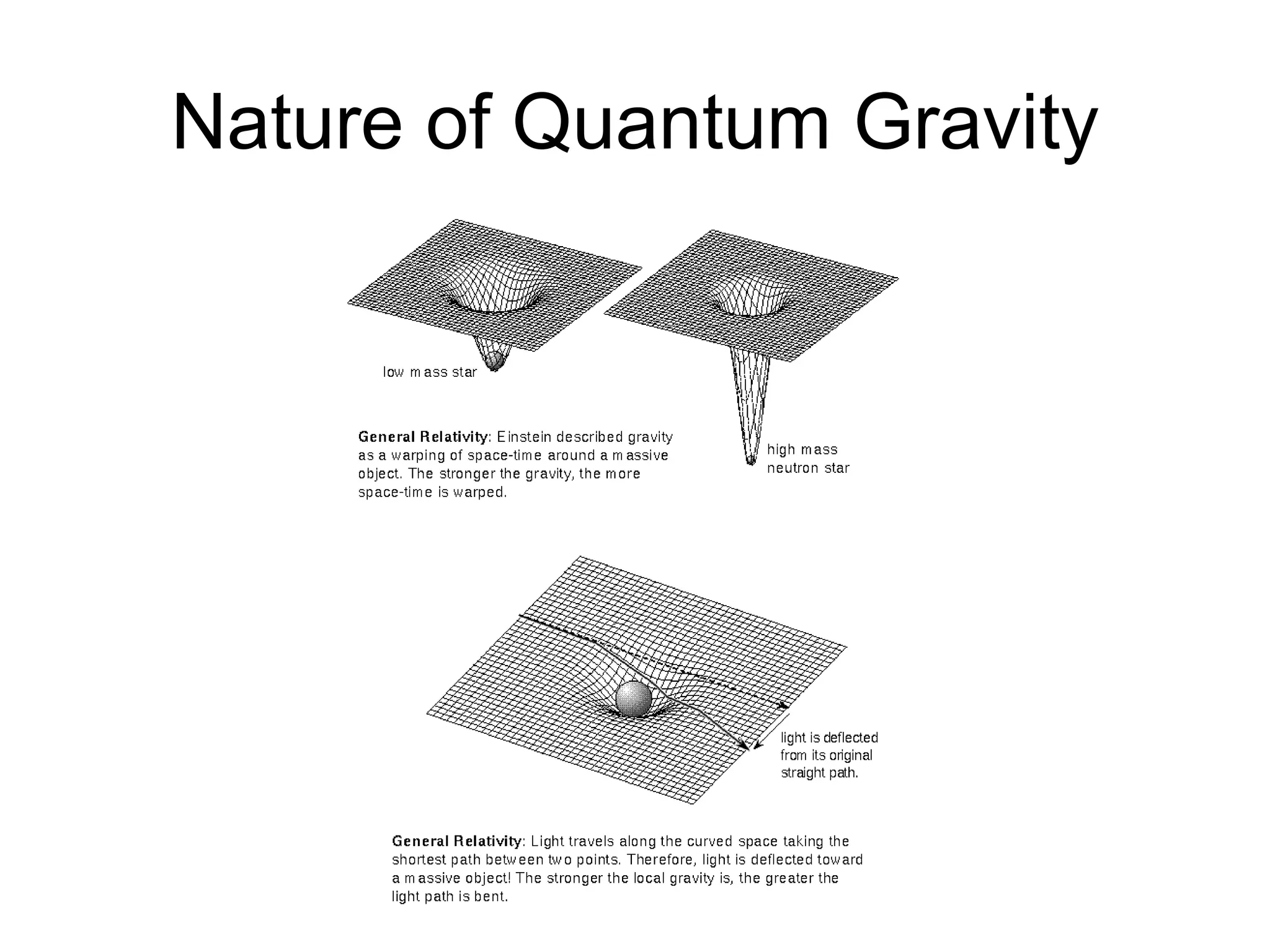
Nature of Quantum Gravity
Nature of Wave Functions
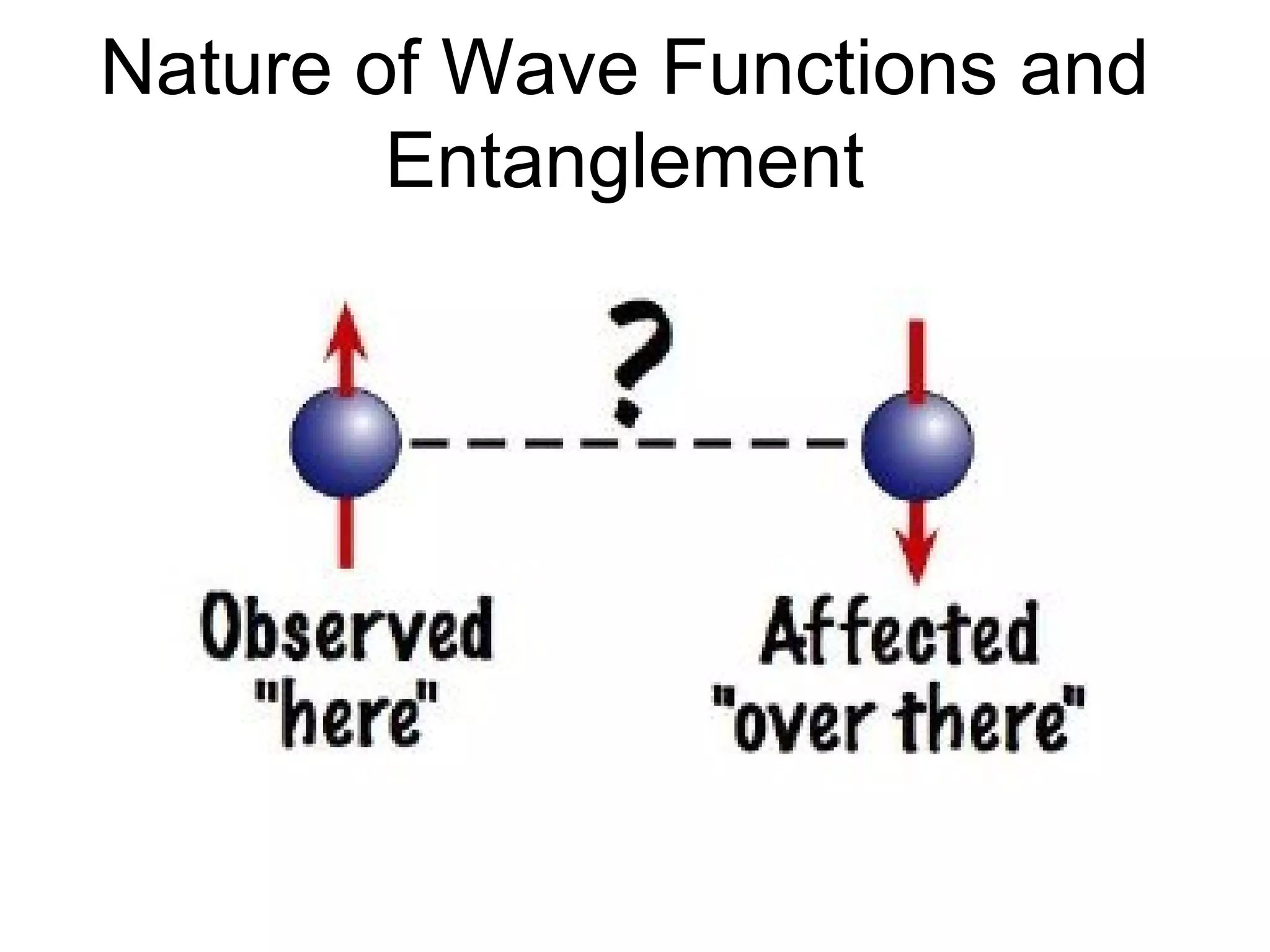
Nature of Wave Functions and Entanglement
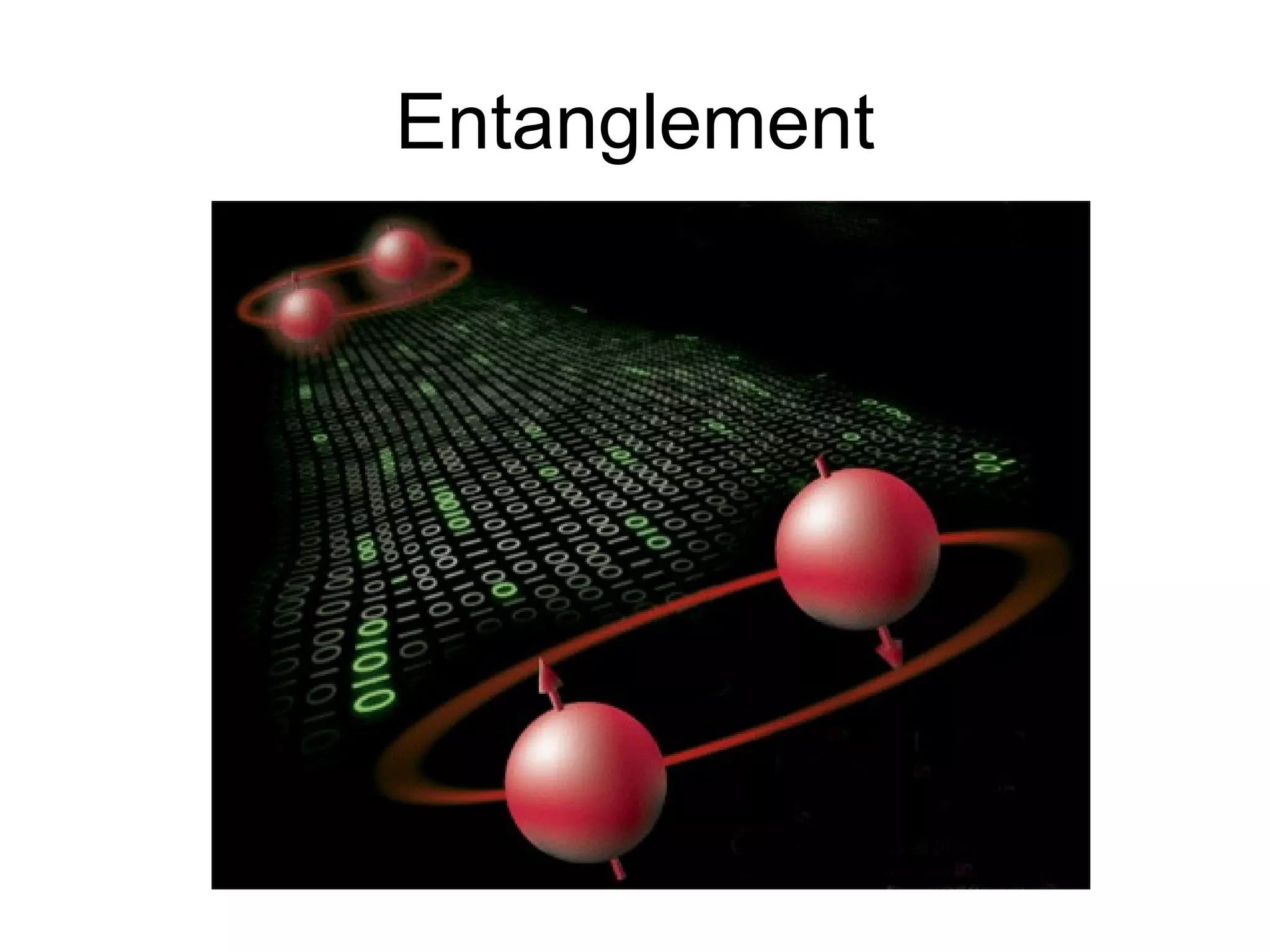
Entanglement
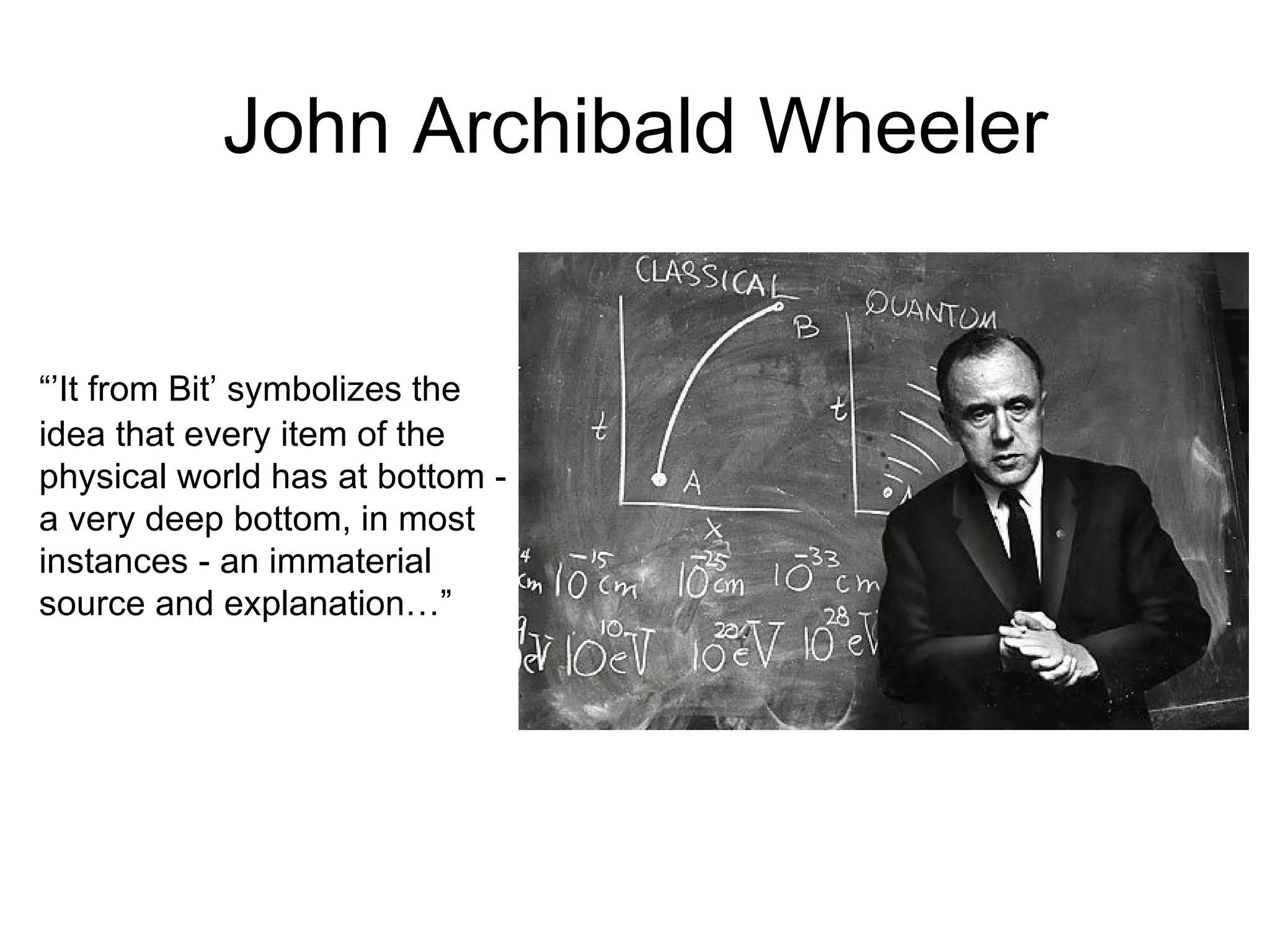
John Archibald Wheeler “’ It from Bit’ symbolizes the idea that every item of the physical world has at bottom - a very deep bottom, in most instances - an immaterial source and explanation…”
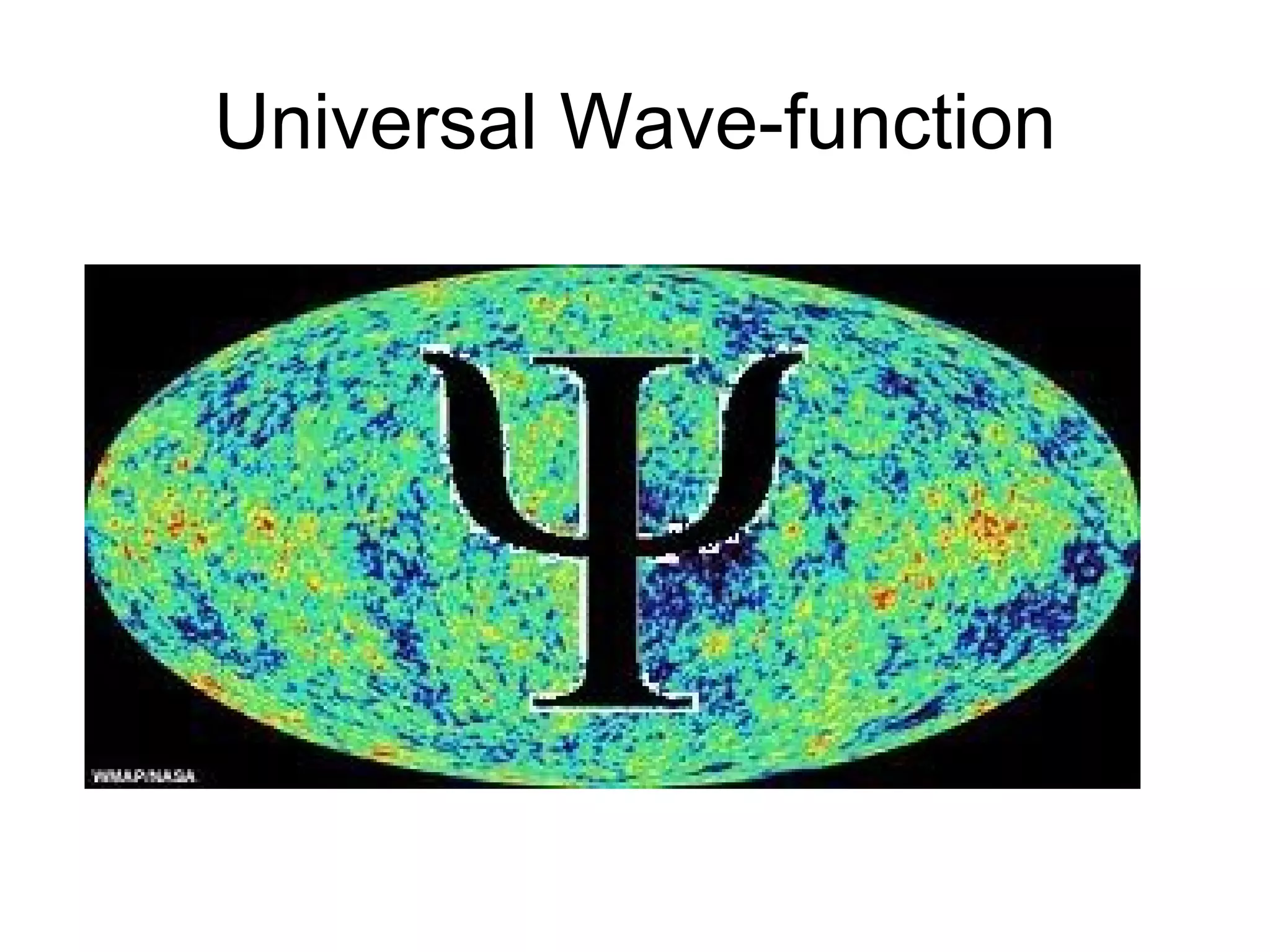
Universal Wave-function
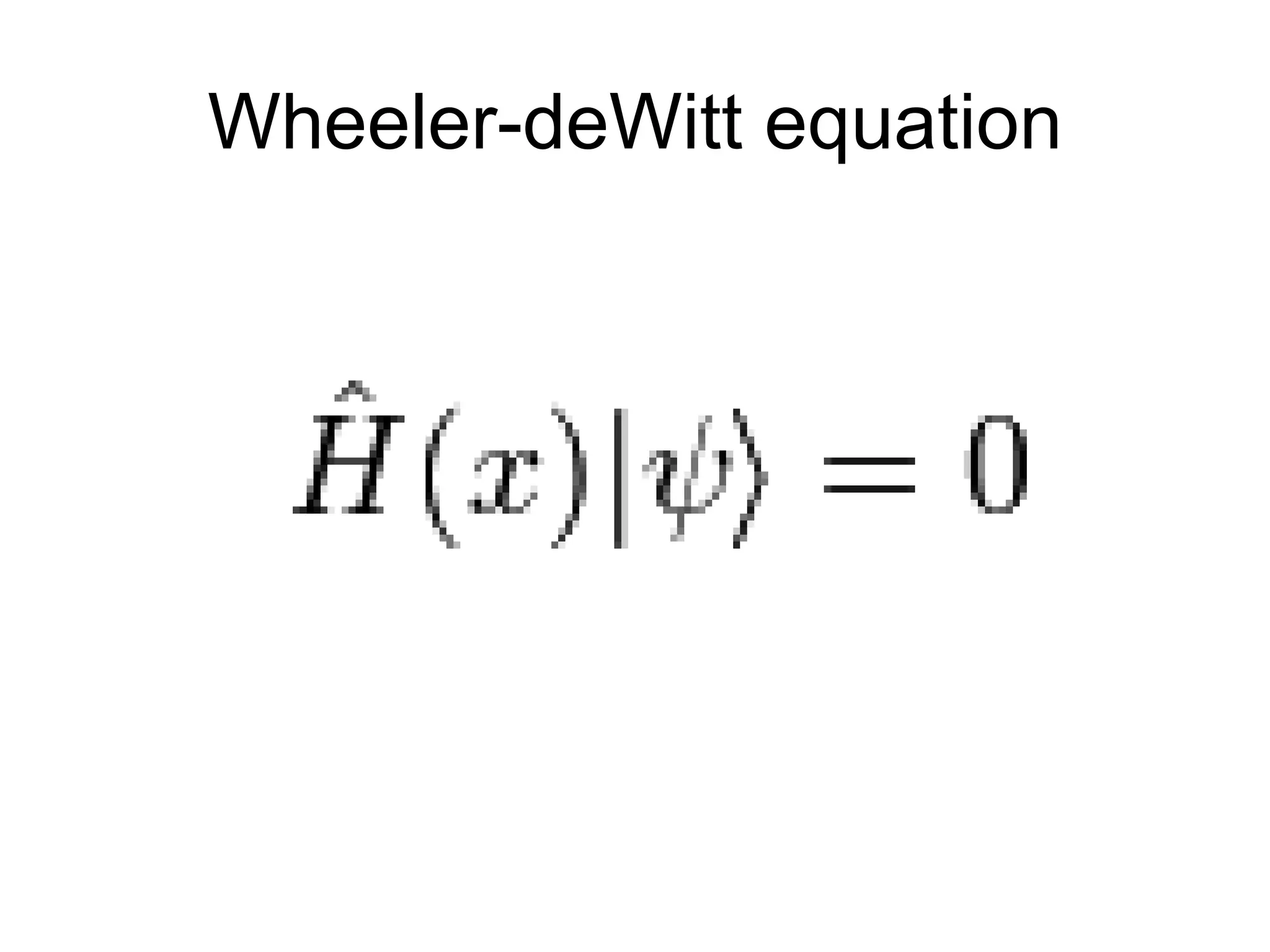
Wheeler-deWitt equation
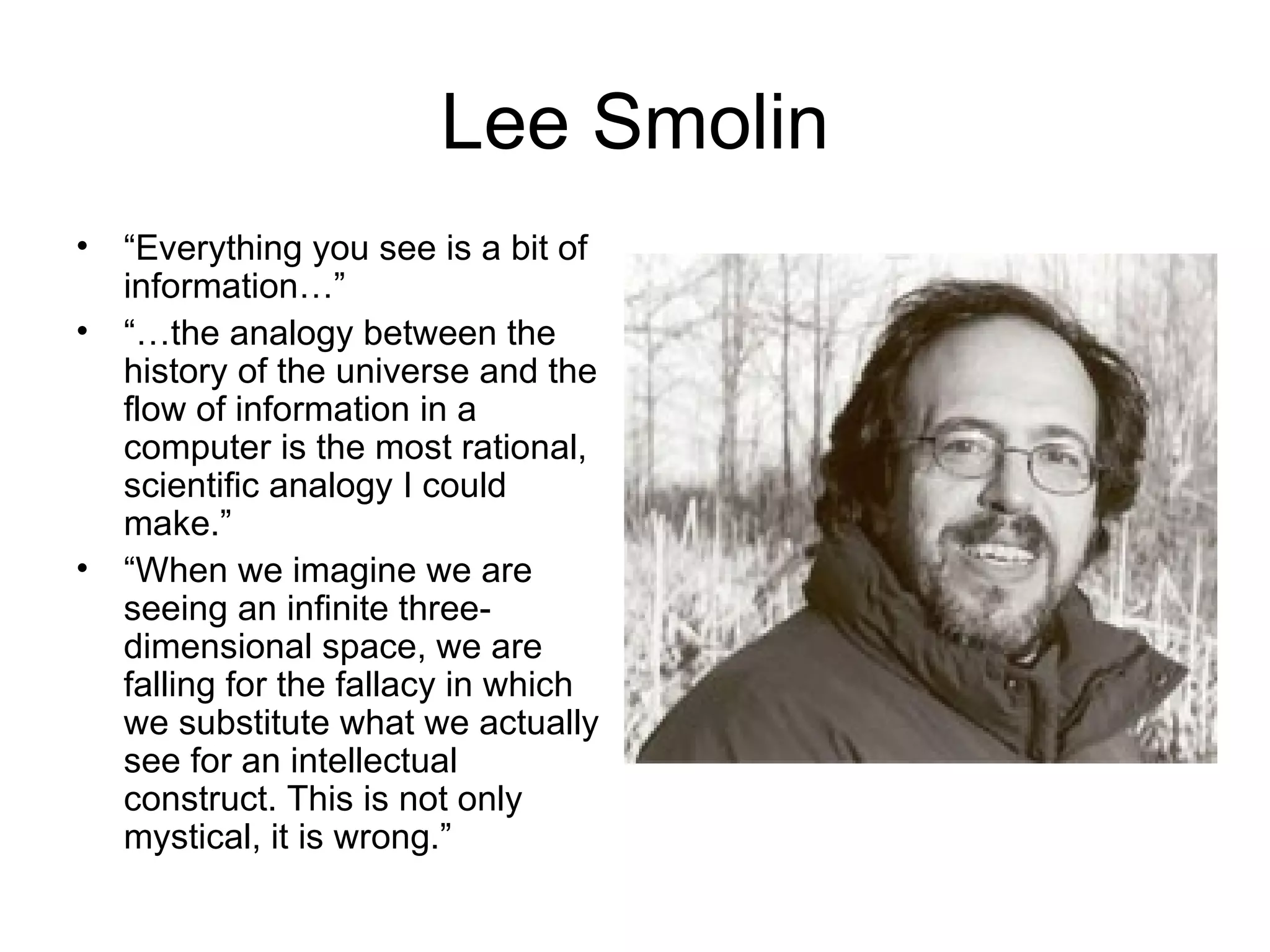
Lee Smolin “ Everything you see is a bit of information…” “… the analogy between the history of the universe and the flow of information in a computer is the most rational, scientific analogy I could make.” “ When we imagine we are seeing an infinite three-dimensional space, we are falling for the fallacy in which we substitute what we actually see for an intellectual construct. This is not only mystical, it is wrong.”
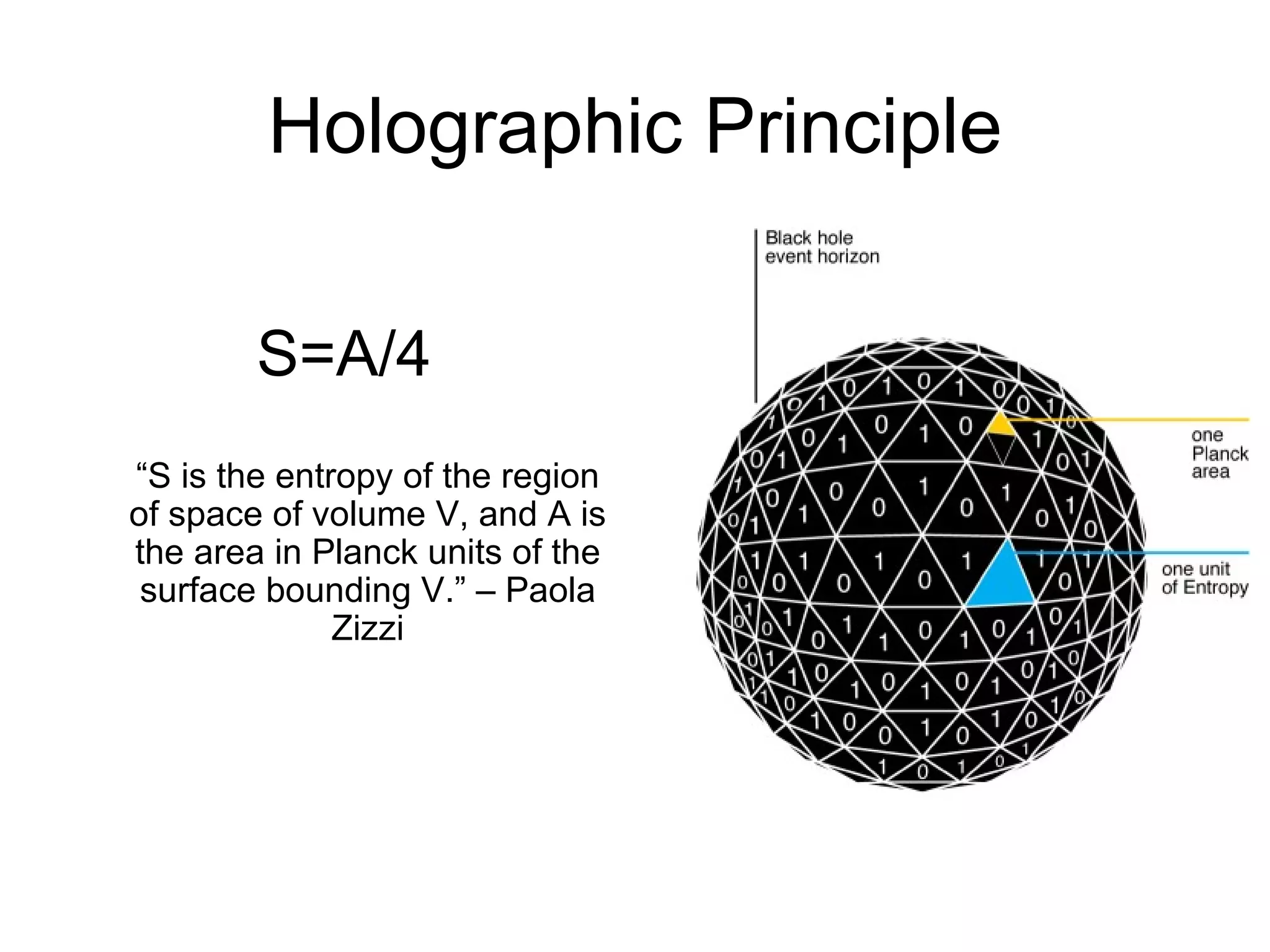
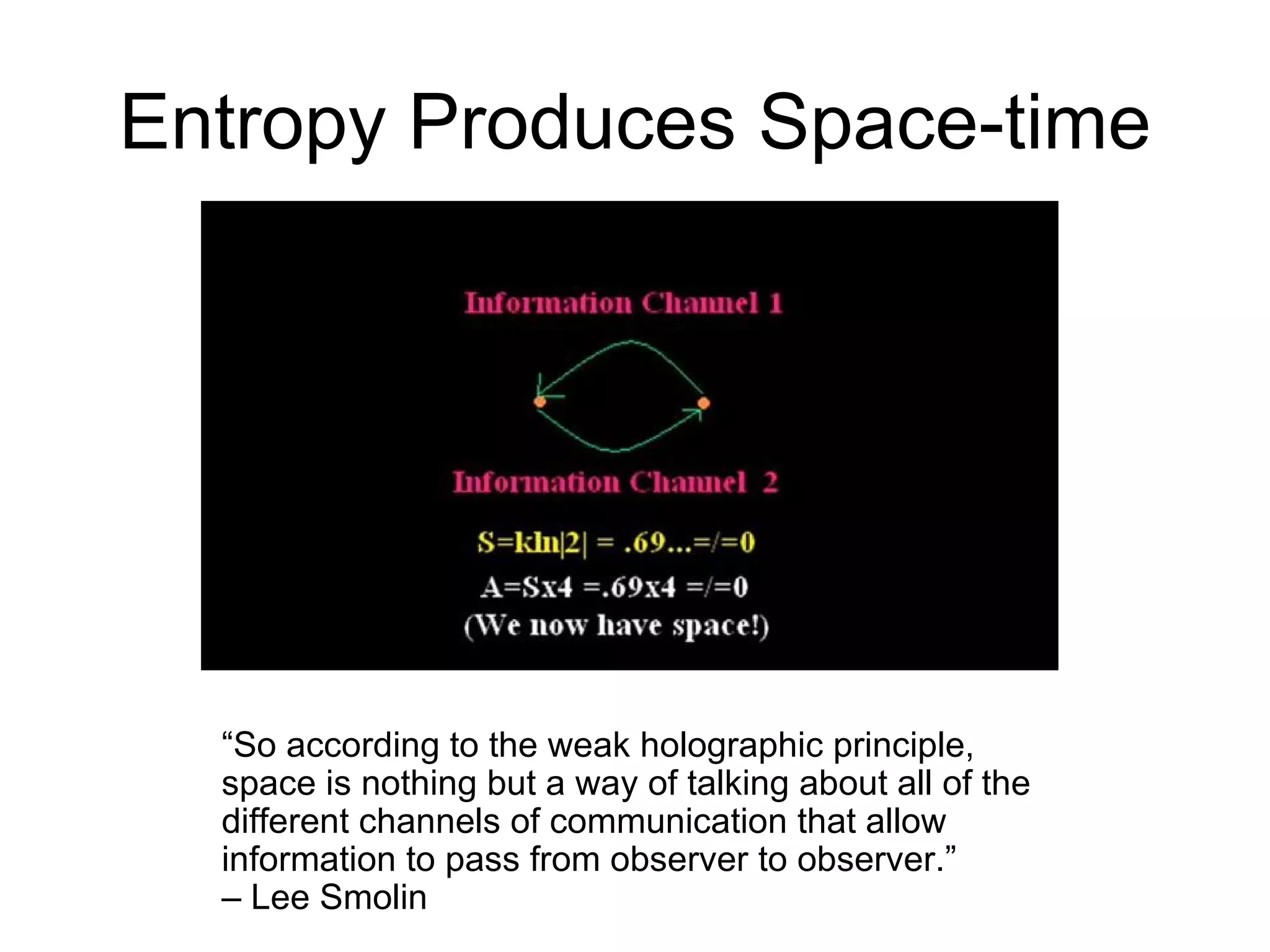
Holographic Principle S=A/4 “S is the entropy of the region of space of volume V, and A is the area in Planck units of the surface bounding V.” – Paola Zizzi
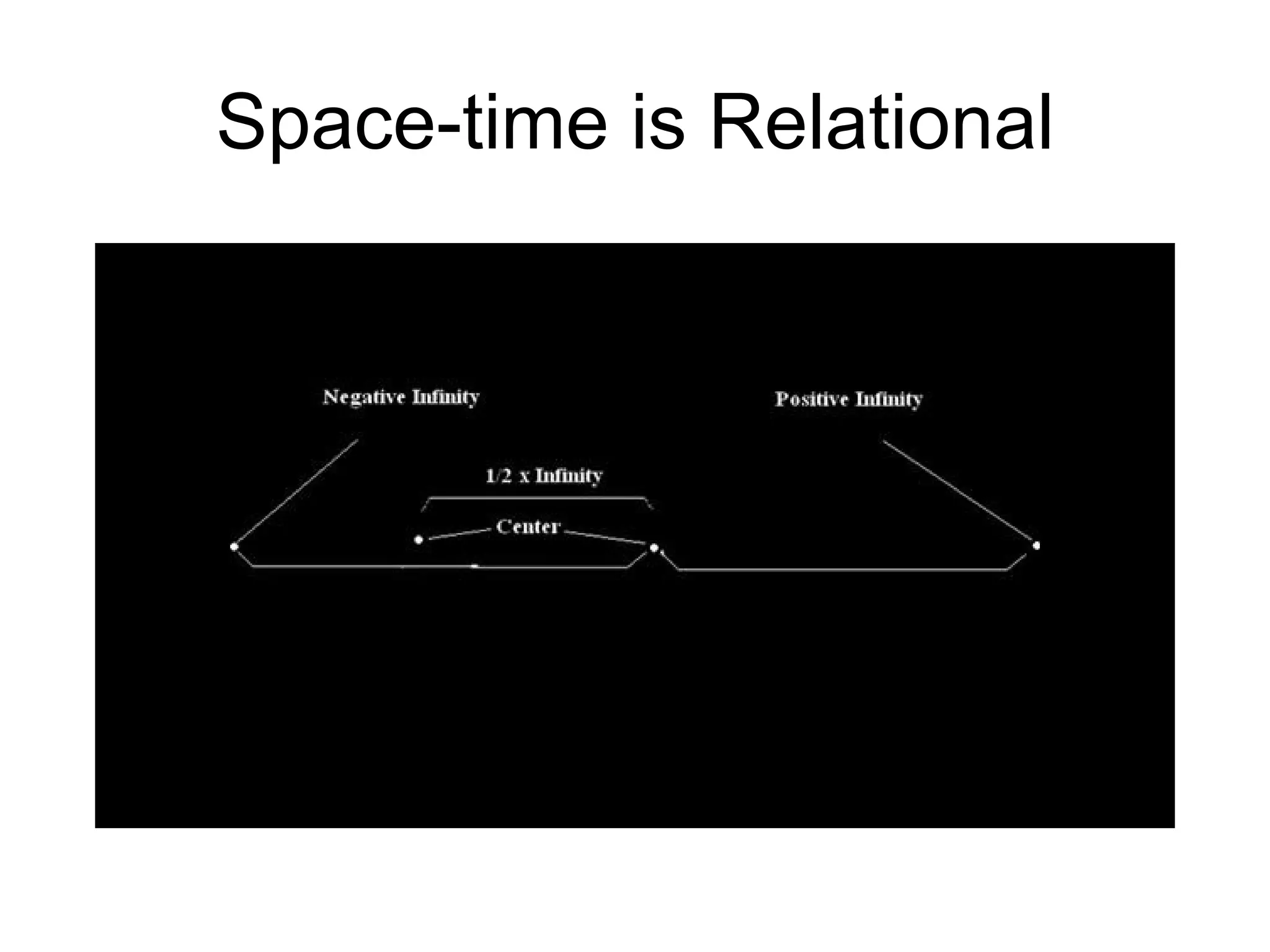
Space-time is Relational
Entropy Produces Space-time “ So according to the weak holographic principle, space is nothing but a way of talking about all of the different channels of communication that allow information to pass from observer to observer.”  – Lee Smolin
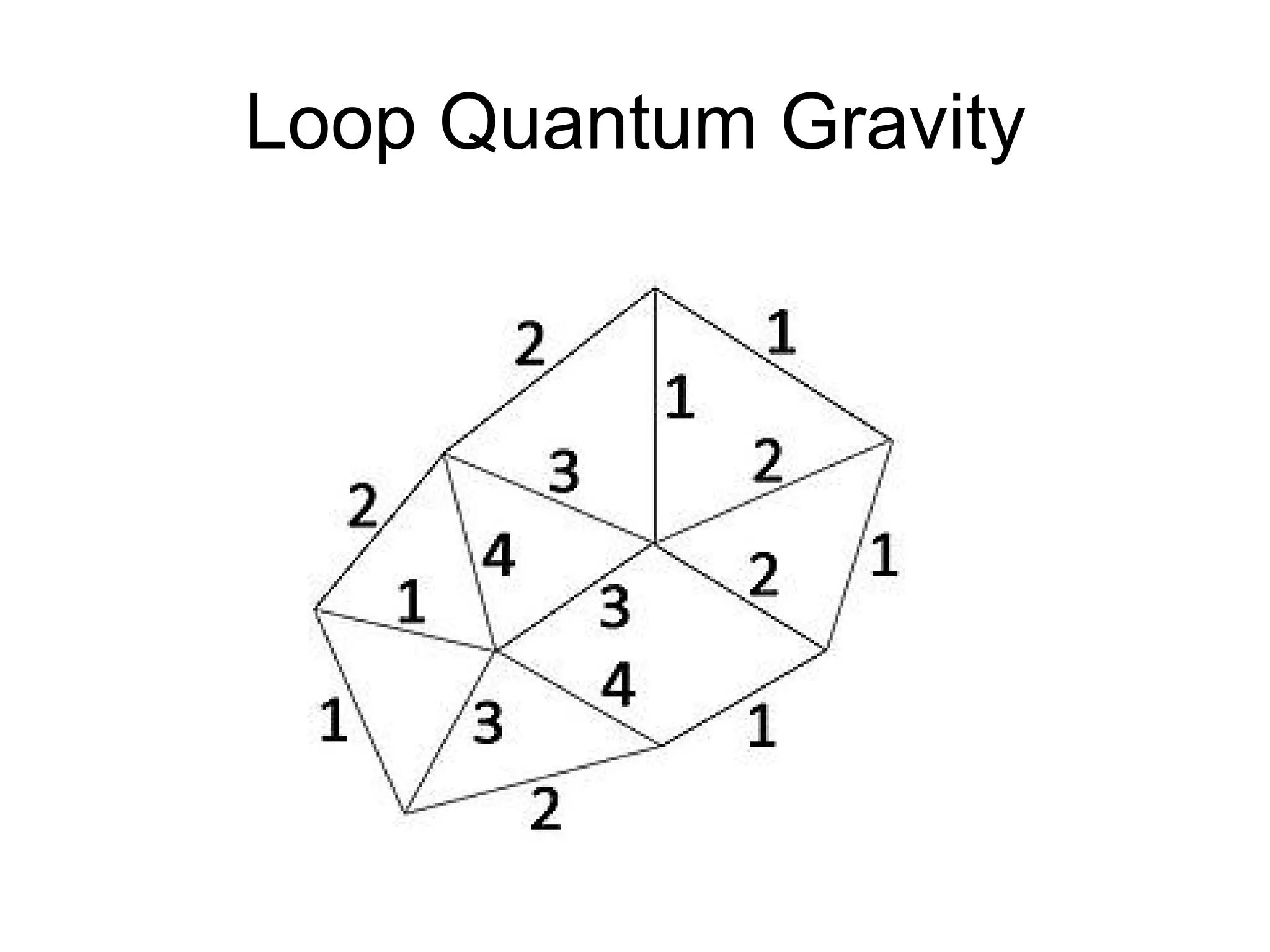
Loop Quantum Gravity
"It thus becomes possible to eliminate the embedding of circles and surfaces into spacetime through so-called diffeomorphism invariance (which does not exist in other field theories). This is accomplished by replacing these entities with a so-called "spin network" - a graph with nodes and links among them, where each link and node carry numerical values which represent abstract entities from which certain properties of spacetime can be reconstructed. Conceptually, spacetime can be thought of as cells, each with a certain volume carried by a node. Each cell has certain surfaces, and the link between different nodes (sitting inside these cells) carry the areas of the surfaces. It would not be correct to envision these cells as sitting in spacetime, since there is no "spacetime" anymore - only nodes and links, and certain numerical values associated with these nodes and links. Spacetime, therefore, is no longer fundamental, but is more accurately described as an entity emerging from the more fundamental graphs and their associated nodes and links. The graphs are called spin networks because the numerical values with which they are associated have properties well-known from quantum mechanical spins. This is a mathematical property only, and does not indicate that there are actual spinning objects. A spin network is not a mechanical object which comprises spacetime. Instead, quantized spacetime is a superposition of an infinite number of spin networks. This is very well known in quantum mechanics: there is no reason why an atom should be in a "certain state". In principle, a single atom can be in an arbitrary complex quantum state, a phenomenon which has been described as a superposition of "an atom sitting here, an atom moving in a certain direction over there, an atom moving in this or that direction, ..."."
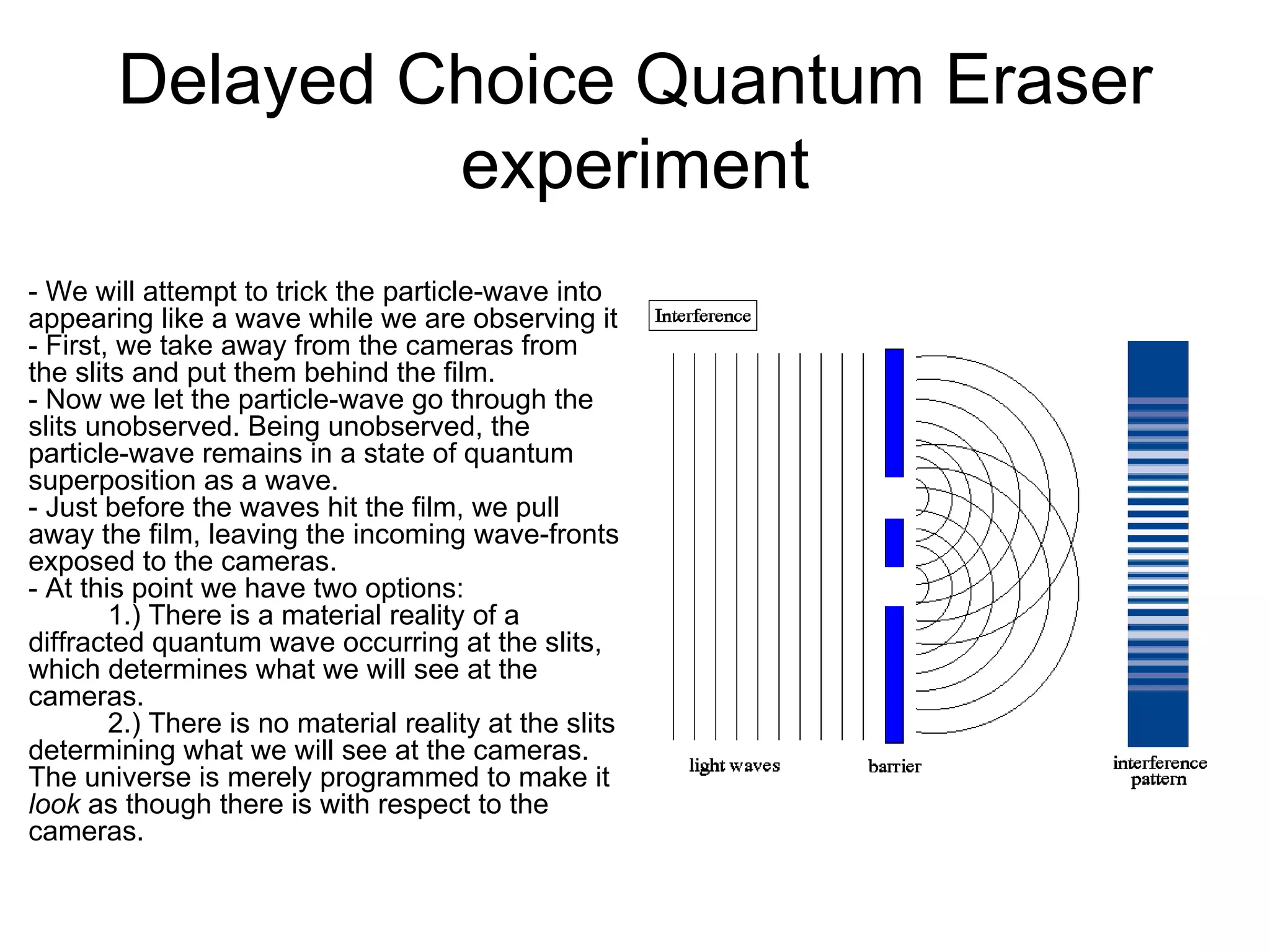
Delayed Choice Quantum Eraser experiment - We will attempt to trick the particle-wave into appearing like a wave while we are observing it - First, we take away from the cameras from the slits and put them behind the film.  - Now we let the particle-wave go through the slits unobserved. Being unobserved, the particle-wave remains in a state of quantum superposition as a wave.  - Just before the waves hit the film, we pull away the film, leaving the incoming wave-fronts exposed to the cameras. - At this point we have two options: 1.) There is a material reality of a diffracted quantum wave occurring at the slits, which determines what we will see at the cameras. 2.) There is no material reality at the slits determining what we will see at the cameras. The universe is merely programmed to make it  look  as though there is with respect to the cameras.
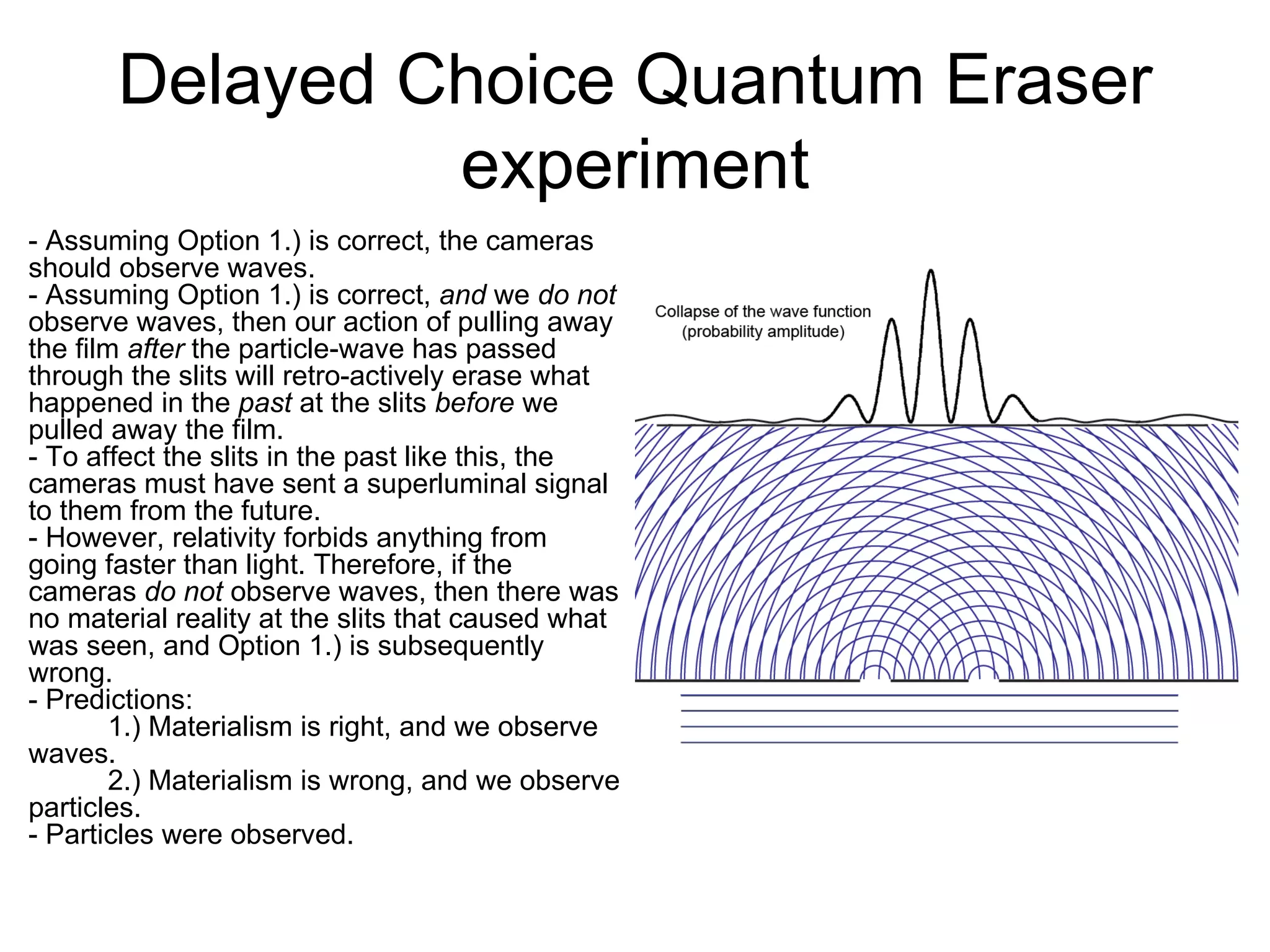
Delayed Choice Quantum Eraser experiment - Assuming Option 1.) is correct, the cameras should observe waves. - Assuming Option 1.) is correct,  and  we  do not  observe waves, then our action of pulling away the film  after  the particle-wave has passed through the slits will retro-actively erase what happened in the  past  at the slits  before  we pulled away the film.  - To affect the slits in the past like this, the cameras must have sent a superluminal signal to them from the future. - However, relativity forbids anything from going faster than light. Therefore, if the cameras  do not  observe waves, then there was no material reality at the slits that caused what was seen, and Option 1.) is subsequently wrong.  - Predictions: 1.) Materialism is right, and we observe waves. 2.) Materialism is wrong, and we observe particles.  - Particles were observed.
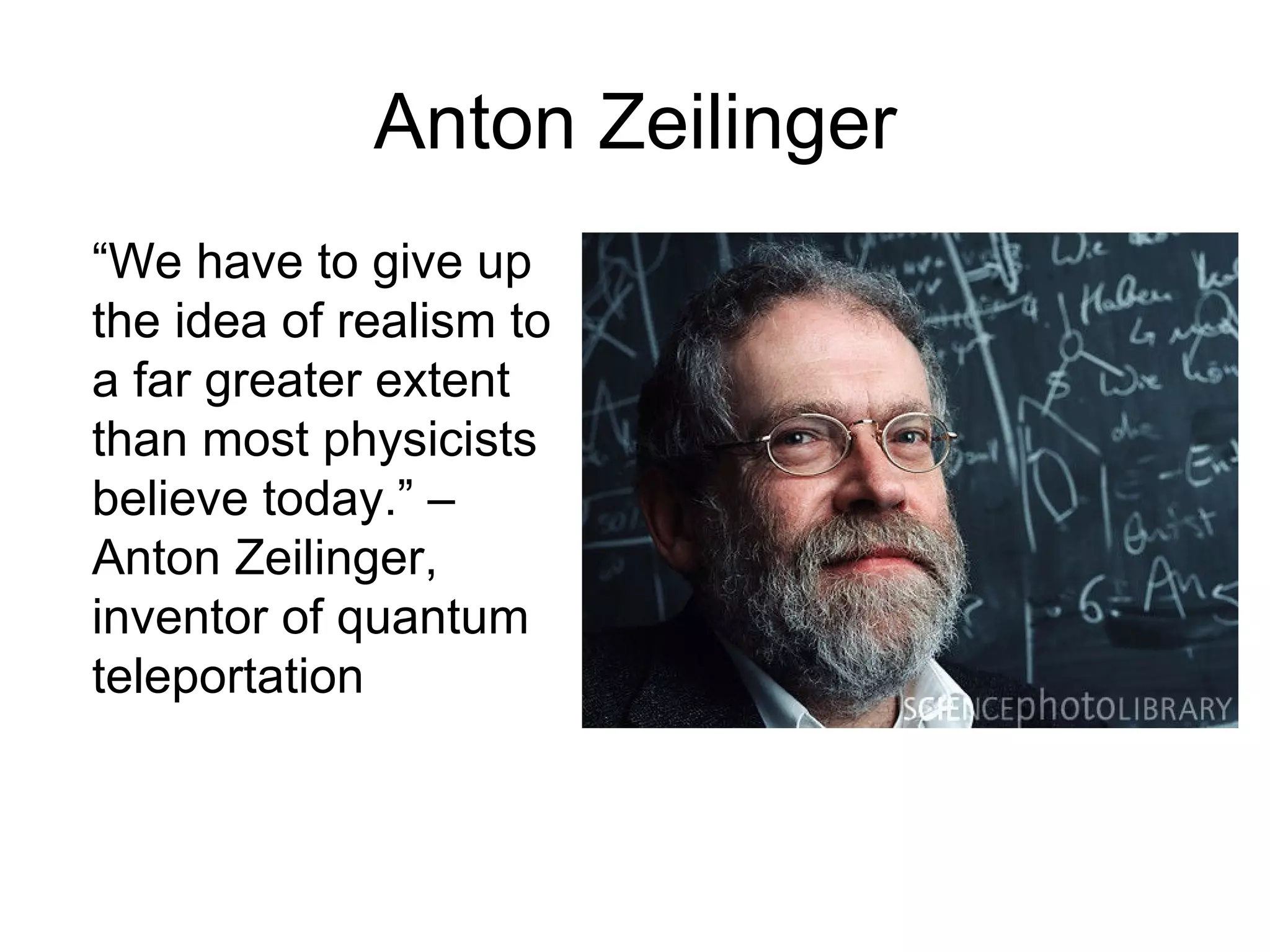
Anton Zeilinger “ We have to give up the idea of realism to a far greater extent than most physicists believe today.” – Anton Zeilinger, inventor of quantum teleportation
 

Quantum Information

  • 1.
  • 2.
    What is QuantumMechanics? Quantum physics is a branch of science that deals with discrete, indivisible units of energy called quanta and their particle-like and wave-like behavior as described by the Quantum Theory.
  • 3.
    Concepts in QuantumMechanics Quantum-Discrete Uncertainty Principle Double Slit experiment Wave/Particle Duality Wave Function Superposition Quantum field
  • 4.
  • 5.
  • 6.
  • 7.
  • 8.
  • 9.
  • 10.
  • 11.
  • 12.
  • 13.
  • 14.
    The Claim Allpossible physical universes are constructs of information resulting from internally consistent true sets of mathematical Platonic forms. Space-time and the physical are not fundamental, but rather epiphenomena or “illusional”.
  • 15.
  • 16.
  • 17.
    Postulates of PlatonismThe structure of any Platonist theory, any Platonist position has to satisfy the following propositions: There is a mathematical reality. The existence of the objects of mathematical knowledge does not depend on actions or reactions by the cognitive subject. In particular, the objective existence of these objects does not result from the success of the subject's cognitive performance. The existence of the objects of mathematical knowledge does not depend on the conceptual scheme which the cognitive subject happens to be inserted in. In particular, does not depend on the language used by the cognitive subject. The meaning of a mathematical proposition is given by the truth-conditions which correspond to it, since it describes a fact of the mathematical reality. The truth of a mathematical proposition is independent of its being verified, either effectively or only in principle. Under these propositions we consider that totalities of mathematical objects are well defined when statements which use quantification over such totalities are given a truth-value. In particular this is equivalent to consider the use of the tertium non datur over such totalities as well defined.
  • 18.
    Bertrand Russell “Logic is concerned with the real world just as truly as zoology, though with its more abstract and general features” Russell, 1919
  • 19.
  • 20.
    Gödel's Incompleteness TheoremA statement is either true or false.
  • 21.
    Argument from Knowledgeand Godel’s Incompleteness Theorem Can we know anything at all? Yes/No?
  • 22.
    No, we knowthat we can’t know anything at all.
  • 23.
    Can we knowanything at all? Yes/No?
  • 24.
    Yes, we canhave knowledge.
  • 25.
    Are some thingsknown intrinsically, or does all knowledge need independent justification?
  • 26.
    Independent justification requiresan argument with premises
  • 27.
    Are premises provenfrom within their own logical system or outside of it?
  • 28.
    Attempting to provea premise from within it’s own logical system is circular reasoning.
  • 29.
    Premises can onlybe proven from outside their own logical system.
  • 30.
    These premises wouldhave to be proven with further arguments based on even more premises.
  • 31.
    A “complete” systemwhich can prove something entirely will need to be bigger than itself as it will need premises beyond itself to prove itself.
  • 32.
    A system whichis bigger than itself is a contradiction in terms.
  • 33.
    Thus it isnot the case that all knowledge needs independent justification. If we say that there are not Platonic forms, we must either violate the law of non-contradiction or violate Godel’s theorem. Therefore, Platonic forms exist.
  • 34.
    Roger Penrose “What I mean by this ‘existence’ is really just the objectivity of mathematical truth. Platonic existence, as I see it, refers to the existence of an objective external standard not dependent upon our individual opinions nor upon our particular culture.”
  • 35.
    Argument from Essence/Existencea) Essence precedes existence; Contradictory, doesn’t exist b) Existence precedes essence; Contradictory, doesn’t exist as anything c) Existence and essence are simultaneous d) Therefore, because mathematical proofs are objectively true and have essence, mathematical Platonic forms exist.
  • 36.
  • 37.
    Immaterial Nature ofLight HUP Min. interaction is one interaction quantum
  • 38.
  • 39.
  • 40.
  • 41.
    Argument for InformationalMonism All possible questions => All possible answers = Sum total information content of object Informational Pile 1, Material Pile 2 Does Pile 1 = Pile 2? If no, ask does Pile 2 exist? If yes, then more information would be derived from the object than the sum total amount of information which exists of it and that is a contradiction in terms. No, Pile 2 does not exist. The object is made of information.
  • 42.
  • 43.
  • 44.
    Nature of WaveFunctions
  • 45.
    Nature of WaveFunctions and Entanglement
  • 46.
  • 47.
    John Archibald Wheeler“’ It from Bit’ symbolizes the idea that every item of the physical world has at bottom - a very deep bottom, in most instances - an immaterial source and explanation…”
  • 48.
  • 49.
  • 50.
    Lee Smolin “Everything you see is a bit of information…” “… the analogy between the history of the universe and the flow of information in a computer is the most rational, scientific analogy I could make.” “ When we imagine we are seeing an infinite three-dimensional space, we are falling for the fallacy in which we substitute what we actually see for an intellectual construct. This is not only mystical, it is wrong.”
  • 51.
    Holographic Principle S=A/4“S is the entropy of the region of space of volume V, and A is the area in Planck units of the surface bounding V.” – Paola Zizzi
  • 52.
  • 53.
    Entropy Produces Space-time“ So according to the weak holographic principle, space is nothing but a way of talking about all of the different channels of communication that allow information to pass from observer to observer.” – Lee Smolin
  • 54.
  • 55.
    "It thus becomespossible to eliminate the embedding of circles and surfaces into spacetime through so-called diffeomorphism invariance (which does not exist in other field theories). This is accomplished by replacing these entities with a so-called "spin network" - a graph with nodes and links among them, where each link and node carry numerical values which represent abstract entities from which certain properties of spacetime can be reconstructed. Conceptually, spacetime can be thought of as cells, each with a certain volume carried by a node. Each cell has certain surfaces, and the link between different nodes (sitting inside these cells) carry the areas of the surfaces. It would not be correct to envision these cells as sitting in spacetime, since there is no "spacetime" anymore - only nodes and links, and certain numerical values associated with these nodes and links. Spacetime, therefore, is no longer fundamental, but is more accurately described as an entity emerging from the more fundamental graphs and their associated nodes and links. The graphs are called spin networks because the numerical values with which they are associated have properties well-known from quantum mechanical spins. This is a mathematical property only, and does not indicate that there are actual spinning objects. A spin network is not a mechanical object which comprises spacetime. Instead, quantized spacetime is a superposition of an infinite number of spin networks. This is very well known in quantum mechanics: there is no reason why an atom should be in a "certain state". In principle, a single atom can be in an arbitrary complex quantum state, a phenomenon which has been described as a superposition of "an atom sitting here, an atom moving in a certain direction over there, an atom moving in this or that direction, ..."."
  • 56.
    Delayed Choice QuantumEraser experiment - We will attempt to trick the particle-wave into appearing like a wave while we are observing it - First, we take away from the cameras from the slits and put them behind the film. - Now we let the particle-wave go through the slits unobserved. Being unobserved, the particle-wave remains in a state of quantum superposition as a wave. - Just before the waves hit the film, we pull away the film, leaving the incoming wave-fronts exposed to the cameras. - At this point we have two options: 1.) There is a material reality of a diffracted quantum wave occurring at the slits, which determines what we will see at the cameras. 2.) There is no material reality at the slits determining what we will see at the cameras. The universe is merely programmed to make it look as though there is with respect to the cameras.
  • 57.
    Delayed Choice QuantumEraser experiment - Assuming Option 1.) is correct, the cameras should observe waves. - Assuming Option 1.) is correct, and we do not observe waves, then our action of pulling away the film after the particle-wave has passed through the slits will retro-actively erase what happened in the past at the slits before we pulled away the film. - To affect the slits in the past like this, the cameras must have sent a superluminal signal to them from the future. - However, relativity forbids anything from going faster than light. Therefore, if the cameras do not observe waves, then there was no material reality at the slits that caused what was seen, and Option 1.) is subsequently wrong. - Predictions: 1.) Materialism is right, and we observe waves. 2.) Materialism is wrong, and we observe particles. - Particles were observed.
  • 58.
    Anton Zeilinger “We have to give up the idea of realism to a far greater extent than most physicists believe today.” – Anton Zeilinger, inventor of quantum teleportation
  • 59.