QUANTUM CRYPTOGRAPHY
A
Seminar Presentation
On
SEMINAR
COORDINATOR:
Mr. Manas Singhal
(Assistant Professor)
SEMINAR GUIDE:
Mrs.SHUCHITA SEXANA
(Assistant Professor)
PRESENTED BY:
NAMAN KUMAR
(1208231100)
EC 3rd Year
Section: J
MIT(MORADABAD)
1
CONTENT
 Basic terms
 What is cryptography?
 The process
 Advantages and Limitations of cryptography
 RSA Crypto Scheme
 OTP (One Time Pad)
 Public Key Cryptography
 QKD (Quantum Key Distribution)
 What is quantum cryptography?
 Polarization of light
 Heisenberg’s Uncertainty Principle
 Element of quantum theory
 Qubits
 Quantum communication
 BB84 Protocol
 Advantages and Disadvantages of Quantum cryptography
 Future aspect
 Conclusion
 Refrences1
1
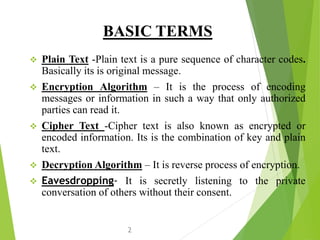
BASIC TERMS
 Plain Text -Plain text is a pure sequence of character codes.
Basically its is original message.
 Encryption Algorithm – It is the process of encoding
messages or information in such a way that only authorized
parties can read it.
 Cipher Text -Cipher text is also known as encrypted or
encoded information. Its is the combination of key and plain
text.
 Decryption Algorithm – It is reverse process of encryption.
 Eavesdropping- It is secretly listening to the private
conversation of others without their consent.
2
WHAT IS CRYPTOGRAPHY?
 Cryptography (derived from the Greek words kryptos and
graphein meaning hidden writing) is the science of codes and
ciphers.
 Cryptography is the art of encoding and decoding messages of
secure communications.
 Cryptography is of increasing importance in our technological
age using broadcast, network communications, Internet ,e-mail
etc.
3
4
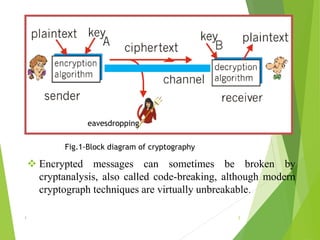
 Encrypted messages can sometimes be broken by
cryptanalysis, also called code-breaking, although modern
cryptograph techniques are virtually unbreakable.
Fig.1-Block diagram of cryptography
eavesdropping
1 5
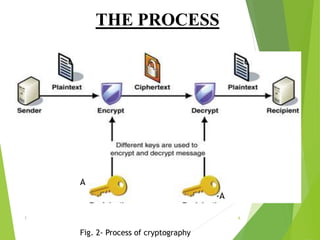
THE PROCESS
Fig. 2- Process of cryptography
A
-A
1 6
ADVANTAGES OF CRYPTOGRAPHY
 It hides the message and your privacy is safe.
 Only the person who have the key would be able to
read the desired message.
LIMITATIONS
 Key can be hacked easily.
 Not efficient.
1 7
RSA CRYPTOGRAPHY
 RSA stands for Ron Rivest, Adi Shamir and Leonard Adleman.
 RSA consist a single key.
It provide more security but still it can be hacked.
It take lot of time to generate and regenerate the code.
1 8
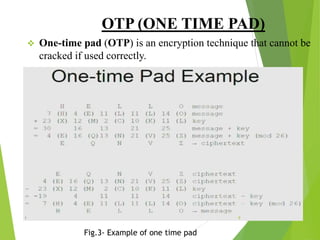
OTP (ONE TIME PAD)
 One-time pad (OTP) is an encryption technique that cannot be
cracked if used correctly.
Fig.3- Example of one time pad
1 9
 Here the problem raises how to get the key to the decrypting
party safely or how to keep both keys secure.
 One-time pads have sometimes been used when the both
parties started out at the same physical location and then
separated, each with knowledge of the keys in the one-time
pad.
 The key used in a one-time pad is called a secret key.
 Ideally destroy the key after use, to make your data to more
secure.
 Key distribution problem led to the invention of public
key cryptography.
1 10
PUBLIC KEY CRYPTOGRAPHY
 Public-key cryptography, also known as asymmetric
cryptography.
 Requires two separate key, one of which is secret (or private)
and one of which is public.
 It has better speed and less complicated then RSA and one time
pad .
 But still there is a problem that is , it can also be hacked.
1 11
QUANTUM KEY DISTRIBUTION
 Quantum key distribution (QKD) uses quantum mechanics
to guarantee secure communication.
 Quantum Key Distribution tell us all attempts of
eavesdropping.
 Quantum key distribution is only used to produce and
distribute a key, not to transmit any message data
 It enables two parties to produce a shared random bit string
known only to them, which can be used as a key for
encryption and decryption.
1 12
It is more secure then others schemes.
There is a problem that the finest optical fiber have limit
of 50 km.
1 13
WHAT IS QUANTUM CRYPTOGRAPHY ?
 Although the field of cryptography is ancient, but it is not
static. Quantum cryptography is a relatively new concept in
cryptography.
 Basically quantum cryptography is combination of OTP and
QKD.
 Quantum cryptography is based on two important
principles –
a) Polarization of light.
b) Heisenberg’s uncertainty principle.
1 14
POLARIZATION OF LIGHT
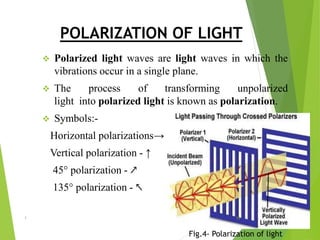
 Polarized light waves are light waves in which the
vibrations occur in a single plane.
 The process of transforming unpolarized
light into polarized light is known as polarization.
 Symbols:-
Horizontal polarizations→
Vertical polarization - ↑
45° polarization - ↗
135° polarization - ↖
Fig.4- Polarization of light
1 15
HEISENBERG’S UNCERTANITY PRINCIPLE
 According to the principle two interrelated properties
cannot be measured individually without affecting the
other.
 The principle is that you cannot partition the photon
into two halves without affect it value.
 So if someone tries to detect the state of photons being
send over to the receiver the error can be detected.
1 16
ELEMENT OF QUANTAM CRYPTOGRAPHY
 Light waves are propagated as discrete quanta called photons.
 Photons are massless but they have energy, momentum and
angular momentum which is called spin.
 Spin carries the polarization.
 If on its way we put a polarization filter a photon may pass
through it or may not.
 We can use a detector to check of a photon that has passed
through a filter
1 17
QUBITS
 A quantum bit or qubit is a unit of quantum information.
 Qubits are not like to simple bits because they have equal
possibility.
 Exists as a ‘0’, a ‘1’ or simultaneously as a superposition
of both ‘0’ & ‘1’ .
 Though the amount of information that can be retrieved in
a single qubit is equal to one bit, the difference lies in the
processing of information.
1 18
QUANTUM COMMUNICATION
Here the message is send through the public network where as
key send is through quantum channel.
Fig.5- Quantum communication
1 19
BB84 PROTOCOL
 BB84 was the first security protocol implementing Quantum
Key Distribution.
 It uses the idea of photon polarization.
 The key consists of bits that will be transmitted as photons.
 Each bit is encoded with a random polarization basis!
 First thing is matter in it that is secure connection.
 After that the connection is secure and no need to distribution
of key again and again,
1 20
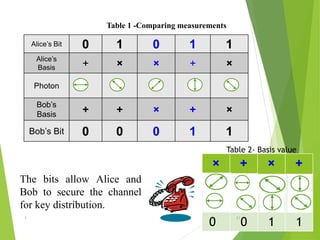
Table 1 -Comparing measurements
Alice’s Bit 0 1 0 1 1
Alice’s
Basis + × × + ×
Photon
Bob’s
Basis + + × + ×
Bob’s Bit 0 0 0 1 1
The bits allow Alice and
Bob to secure the channel
for key distribution.
× + × +
0 0 1 1
Table 2- Basis value
1 21
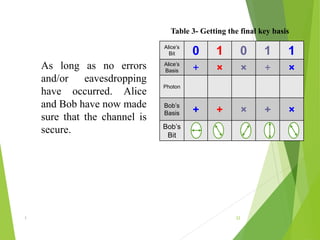
Table 3- Getting the final key basis
As long as no errors
and/or eavesdropping
have occurred. Alice
and Bob have now made
sure that the channel is
secure.
Alice’s
Bit 0 1 0 1 1
Alice’s
Basis + × × + ×
Photon
Bob’s
Basis + + × + ×
Bob’s
Bit 0 0 0 1 1
1 22
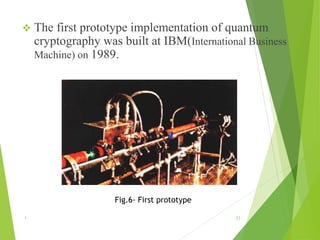
 The first prototype implementation of quantum
cryptography was built at IBM(International Business
Machine) on 1989.
Fig.6- First prototype
1 23
ADVANTAGES OF QUANTUM
CRYPTOGRAPHY
 Advantages of Quantum cryptography is un-hackable.
 Simple to use.
DISADVANTAGES
 Quantum cryptography the signal is currently limited to approx.
50 km.
 Setup is expensive.
1 24
FUTURE ASPECT
 Find the another path for key distribution because of the
limitation of quantum cable.
 Make it more secure , so that in future also it can’t be
hacked.
1 25
CONCLUSION
 Quantum cryptography is a major achievement in security
engineering.
 It secure our data transmission as it is never before.
 Easy to understand and easy to use.
 As it gets implemented, it will allow perfectly secure bank
transactions, secret discussions for government officials, and
well-guarded trade secrets for industry.
1 26
REFRENCES
 Miss. Payal P. Kilor, Mr.Pravin.D.Soni” Quantum Cryptography:
Realizing next generation information security”ISSN 2319 – 4847,Volume
3, Issue 2, February 2014 pp. 286-289.
 Simmon, G. J. ,“Symmetric and asymmetric encryption”, ISSN 2319 –
4847,Volume 3, Issue 2, February 2014. pp. 305-330.
 Avanindra Kumar Lal, Anju Rani, Dr. Shalini Sharma” The New
Approach of Quantum Cryptography in Network Security” ISSN 2250-
2459, Volume 3, Special Issue 2, January 2013 pp.122-126.
 G. Ananda Rao a, Muduganti Rathan Reddy” A note on Quantum
Cryptography”, ISSN : 0975-3397 Vol. 4 No. 09 Sep 2012 pp. 1540-1544
1 27
THANK YOU
1 28

Naman quantum cryptography

  • 1.
    QUANTUM CRYPTOGRAPHY A Seminar Presentation On SEMINAR COORDINATOR: Mr.Manas Singhal (Assistant Professor) SEMINAR GUIDE: Mrs.SHUCHITA SEXANA (Assistant Professor) PRESENTED BY: NAMAN KUMAR (1208231100) EC 3rd Year Section: J MIT(MORADABAD) 1
  • 2.
    CONTENT  Basic terms What is cryptography?  The process  Advantages and Limitations of cryptography  RSA Crypto Scheme  OTP (One Time Pad)  Public Key Cryptography  QKD (Quantum Key Distribution)  What is quantum cryptography?  Polarization of light  Heisenberg’s Uncertainty Principle  Element of quantum theory  Qubits  Quantum communication  BB84 Protocol  Advantages and Disadvantages of Quantum cryptography  Future aspect  Conclusion  Refrences1 1
  • 3.
    BASIC TERMS  PlainText -Plain text is a pure sequence of character codes. Basically its is original message.  Encryption Algorithm – It is the process of encoding messages or information in such a way that only authorized parties can read it.  Cipher Text -Cipher text is also known as encrypted or encoded information. Its is the combination of key and plain text.  Decryption Algorithm – It is reverse process of encryption.  Eavesdropping- It is secretly listening to the private conversation of others without their consent. 2
  • 4.
    WHAT IS CRYPTOGRAPHY? Cryptography (derived from the Greek words kryptos and graphein meaning hidden writing) is the science of codes and ciphers.  Cryptography is the art of encoding and decoding messages of secure communications.  Cryptography is of increasing importance in our technological age using broadcast, network communications, Internet ,e-mail etc. 3 4
  • 5.
     Encrypted messagescan sometimes be broken by cryptanalysis, also called code-breaking, although modern cryptograph techniques are virtually unbreakable. Fig.1-Block diagram of cryptography eavesdropping 1 5
  • 6.
    THE PROCESS Fig. 2-Process of cryptography A -A 1 6
  • 7.
    ADVANTAGES OF CRYPTOGRAPHY It hides the message and your privacy is safe.  Only the person who have the key would be able to read the desired message. LIMITATIONS  Key can be hacked easily.  Not efficient. 1 7
  • 8.
    RSA CRYPTOGRAPHY  RSAstands for Ron Rivest, Adi Shamir and Leonard Adleman.  RSA consist a single key. It provide more security but still it can be hacked. It take lot of time to generate and regenerate the code. 1 8
  • 9.
    OTP (ONE TIMEPAD)  One-time pad (OTP) is an encryption technique that cannot be cracked if used correctly. Fig.3- Example of one time pad 1 9
  • 10.
     Here theproblem raises how to get the key to the decrypting party safely or how to keep both keys secure.  One-time pads have sometimes been used when the both parties started out at the same physical location and then separated, each with knowledge of the keys in the one-time pad.  The key used in a one-time pad is called a secret key.  Ideally destroy the key after use, to make your data to more secure.  Key distribution problem led to the invention of public key cryptography. 1 10
  • 11.
    PUBLIC KEY CRYPTOGRAPHY Public-key cryptography, also known as asymmetric cryptography.  Requires two separate key, one of which is secret (or private) and one of which is public.  It has better speed and less complicated then RSA and one time pad .  But still there is a problem that is , it can also be hacked. 1 11
  • 12.
    QUANTUM KEY DISTRIBUTION Quantum key distribution (QKD) uses quantum mechanics to guarantee secure communication.  Quantum Key Distribution tell us all attempts of eavesdropping.  Quantum key distribution is only used to produce and distribute a key, not to transmit any message data  It enables two parties to produce a shared random bit string known only to them, which can be used as a key for encryption and decryption. 1 12
  • 13.
    It is moresecure then others schemes. There is a problem that the finest optical fiber have limit of 50 km. 1 13
  • 14.
    WHAT IS QUANTUMCRYPTOGRAPHY ?  Although the field of cryptography is ancient, but it is not static. Quantum cryptography is a relatively new concept in cryptography.  Basically quantum cryptography is combination of OTP and QKD.  Quantum cryptography is based on two important principles – a) Polarization of light. b) Heisenberg’s uncertainty principle. 1 14
  • 15.
    POLARIZATION OF LIGHT Polarized light waves are light waves in which the vibrations occur in a single plane.  The process of transforming unpolarized light into polarized light is known as polarization.  Symbols:- Horizontal polarizations→ Vertical polarization - ↑ 45° polarization - ↗ 135° polarization - ↖ Fig.4- Polarization of light 1 15
  • 16.
    HEISENBERG’S UNCERTANITY PRINCIPLE According to the principle two interrelated properties cannot be measured individually without affecting the other.  The principle is that you cannot partition the photon into two halves without affect it value.  So if someone tries to detect the state of photons being send over to the receiver the error can be detected. 1 16
  • 17.
    ELEMENT OF QUANTAMCRYPTOGRAPHY  Light waves are propagated as discrete quanta called photons.  Photons are massless but they have energy, momentum and angular momentum which is called spin.  Spin carries the polarization.  If on its way we put a polarization filter a photon may pass through it or may not.  We can use a detector to check of a photon that has passed through a filter 1 17
  • 18.
    QUBITS  A quantumbit or qubit is a unit of quantum information.  Qubits are not like to simple bits because they have equal possibility.  Exists as a ‘0’, a ‘1’ or simultaneously as a superposition of both ‘0’ & ‘1’ .  Though the amount of information that can be retrieved in a single qubit is equal to one bit, the difference lies in the processing of information. 1 18
  • 19.
    QUANTUM COMMUNICATION Here themessage is send through the public network where as key send is through quantum channel. Fig.5- Quantum communication 1 19
  • 20.
    BB84 PROTOCOL  BB84was the first security protocol implementing Quantum Key Distribution.  It uses the idea of photon polarization.  The key consists of bits that will be transmitted as photons.  Each bit is encoded with a random polarization basis!  First thing is matter in it that is secure connection.  After that the connection is secure and no need to distribution of key again and again, 1 20
  • 21.
    Table 1 -Comparingmeasurements Alice’s Bit 0 1 0 1 1 Alice’s Basis + × × + × Photon Bob’s Basis + + × + × Bob’s Bit 0 0 0 1 1 The bits allow Alice and Bob to secure the channel for key distribution. × + × + 0 0 1 1 Table 2- Basis value 1 21
  • 22.
    Table 3- Gettingthe final key basis As long as no errors and/or eavesdropping have occurred. Alice and Bob have now made sure that the channel is secure. Alice’s Bit 0 1 0 1 1 Alice’s Basis + × × + × Photon Bob’s Basis + + × + × Bob’s Bit 0 0 0 1 1 1 22
  • 23.
     The firstprototype implementation of quantum cryptography was built at IBM(International Business Machine) on 1989. Fig.6- First prototype 1 23
  • 24.
    ADVANTAGES OF QUANTUM CRYPTOGRAPHY Advantages of Quantum cryptography is un-hackable.  Simple to use. DISADVANTAGES  Quantum cryptography the signal is currently limited to approx. 50 km.  Setup is expensive. 1 24
  • 25.
    FUTURE ASPECT  Findthe another path for key distribution because of the limitation of quantum cable.  Make it more secure , so that in future also it can’t be hacked. 1 25
  • 26.
    CONCLUSION  Quantum cryptographyis a major achievement in security engineering.  It secure our data transmission as it is never before.  Easy to understand and easy to use.  As it gets implemented, it will allow perfectly secure bank transactions, secret discussions for government officials, and well-guarded trade secrets for industry. 1 26
  • 27.
    REFRENCES  Miss. PayalP. Kilor, Mr.Pravin.D.Soni” Quantum Cryptography: Realizing next generation information security”ISSN 2319 – 4847,Volume 3, Issue 2, February 2014 pp. 286-289.  Simmon, G. J. ,“Symmetric and asymmetric encryption”, ISSN 2319 – 4847,Volume 3, Issue 2, February 2014. pp. 305-330.  Avanindra Kumar Lal, Anju Rani, Dr. Shalini Sharma” The New Approach of Quantum Cryptography in Network Security” ISSN 2250- 2459, Volume 3, Special Issue 2, January 2013 pp.122-126.  G. Ananda Rao a, Muduganti Rathan Reddy” A note on Quantum Cryptography”, ISSN : 0975-3397 Vol. 4 No. 09 Sep 2012 pp. 1540-1544 1 27
  • 28.