Quantum Cryptography
Harsh Dawar
Sumit Kadyan
•Introduction
• Quantum cryptography is the one of the
most successful application of Quantum
Computing/InformationTheory.
• For the first time in history, we can use
the forces of nature to implement
perfectly secure cryptosystems.
• Quantum cryptography has been proved
to work practically.
•State of the art
• ClassicalCryptography(RSA) relies heavily on
the complexity of factoring integers.
• Future Quantum Computers can use Shor’s
Algorithm to efficiently break today’s
cryptosystems.
• Quantum computers can solve factoring
problems in polynomial time.
What happens when that day arrives?
•Today’s Talk
• Basic Ideas in
Cryptography
• Ideas from the
QuantumWorld
• Quantum Key
Distribution (QKD)
• BB84 without
eavesdropping
• BB84 with
eavesdropping
• Working Prototypes
• Practical
Implementation of
QC
• Conclusion
•Basic Ideas of Cryptography
• Cryptography: “the coding and decoding of secret
messages.”
• The basic idea is to modify a message so as to make
it unintelligible to anyone but the intended
recipient.
• For message (plaintext) M,
e(M, K) encryption - ciphertext
d[e(M, K), K] = M decryption
•Keys and key distribution
 K is called the key.
 The key is known only to
sender and receiver: it is
secret.
 Anyone who knows the key
can decrypt the message.
 Key distribution is the
problem of exchanging the
key between sender and
receiver.
•Perfect Secrecy and OTP
 There exist perfect
cryptosystems.
 Example: One-Time
Pad (OTP)
 The problem of
distributing the keys in
the first place remains.
 Key length has to be
same as message
length!!
•Quantum Key Distribution
 Using the laws of quantum mechanics, we can
distribute keys in perfect secrecy!!
 The Result:The Perfect Cryptosystem,
QC = QKD + OTP
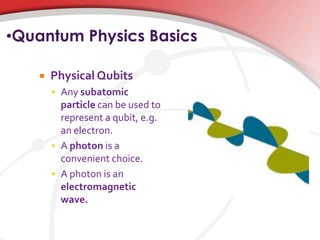
•Quantum Physics Basics
 Physical Qubits
 Any subatomic
particle can be used to
represent a qubit, e.g.
an electron.
 A photon is a
convenient choice.
 A photon is an
electromagnetic
wave.
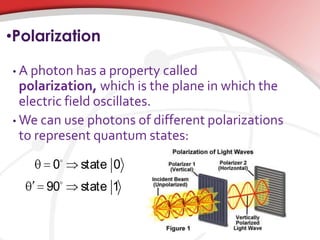
•Polarization
• A photon has a property called
polarization, which is the plane in which the
electric field oscillates.
• We can use photons of different polarizations
to represent quantum states:


0 state 0
90 state 1
•Ideas from Quantum World
 Measurement
 Observing, or measuring, a
quantum system will alter its
state.
 Example: the Qubit
 When observed, the state of a
qubit will collapse to
unpredictable random state 1 or
0.
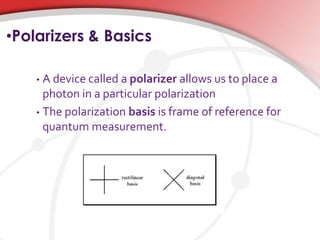
•Polarizers & Basics
• A device called a polarizer allows us to place a
photon in a particular polarization
• The polarization basis is frame of reference for
quantum measurement.
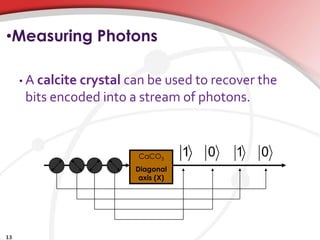
•Measuring Photons
• A calcite crystal can be used to recover the
bits encoded into a stream of photons.
13
CaCO3
Diagonal
axis (X)
1 0 1 0
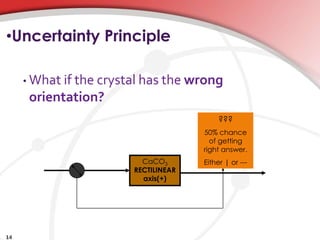
•Uncertainty Principle
• What if the crystal has the wrong
orientation?
14
CaCO3
RECTILINEAR
axis(+)
???
50% chance
of getting
right answer.
Either | or ---
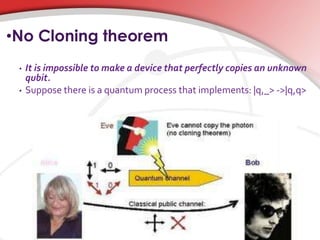
•No Cloning theorem
• It is impossible to make a device that perfectly copies an unknown
qubit.
• Suppose there is a quantum process that implements: |q,_> ->|q,q>
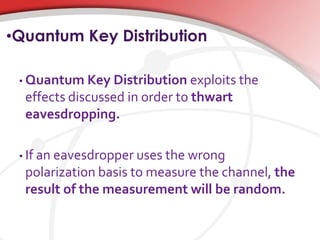
•Quantum Key Distribution
• Quantum Key Distribution exploits the
effects discussed in order to thwart
eavesdropping.
• If an eavesdropper uses the wrong
polarization basis to measure the channel, the
result of the measurement will be random.
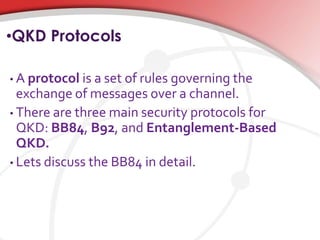
•QKD Protocols
• A protocol is a set of rules governing the
exchange of messages over a channel.
• There are three main security protocols for
QKD: BB84, B92, and Entanglement-Based
QKD.
• Lets discuss the BB84 in detail.
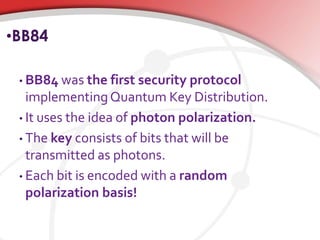
•BB84
• BB84 was the first security protocol
implementingQuantum Key Distribution.
• It uses the idea of photon polarization.
• The key consists of bits that will be
transmitted as photons.
• Each bit is encoded with a random
polarization basis!
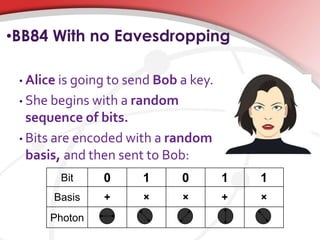
•BB84 With no Eavesdropping
• Alice is going to send Bob a key.
• She begins with a random
sequence of bits.
• Bits are encoded with a random
basis, and then sent to Bob:
Bit 0 1 0 1 1
Basis + × × + ×
Photon
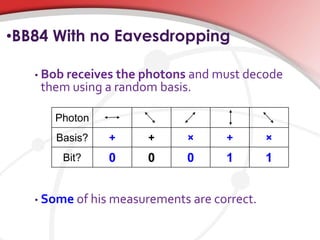
•BB84 With no Eavesdropping
• Bob receives the photons and must decode
them using a random basis.
• Some of his measurements are correct.
Photon
Basis? + + × + ×
Bit? 0 0 0 1 1
•BB84 With no eavesdropper
• Alice and Bob talk on the public encrypted
channel:
• Alice chooses a subset of the bits (the test bits)
and reveals which basis she used to encode them
to Bob.
• Bob tells Alice which basis he used to decode the
same bits.
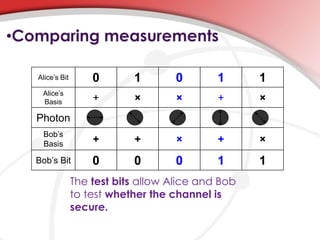
•Comparing measurements
Alice’s Bit 0 1 0 1 1
Alice’s
Basis + × × + ×
Photon
Bob’s
Basis + + × + ×
Bob’s Bit 0 0 0 1 1
The test bits allow Alice and Bob
to test whether the channel is
secure.
•The Catch
• As long as no errors and/or eavesdropping
have occurred, the test bits should agree.
• Alice and Bob have now made sure that the
channel is secure.The test bits are removed.
• Alice tells Bob the basis she used for the
other bits, and they both have a common set
of bits: the final key!
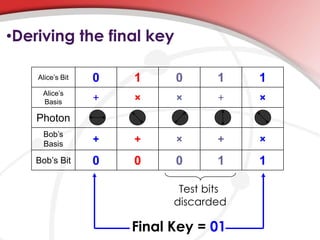
•Deriving the final key
Alice’s Bit 0 1 0 1 1
Alice’s
Basis + × × + ×
Photon
Bob’s
Basis + + × + ×
Bob’s Bit 0 0 0 1 1
Final Key = 01
Test bits
discarded
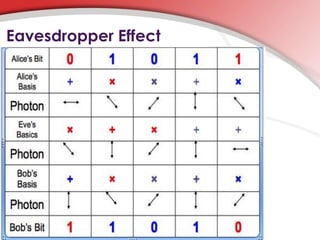
•In the presence of eavesdropper
• If an eavesdropper Eve tries to tap the channel, this
will automatically show up in Bob’s measurements.
• In those cases where Alice and Bob have used the
same basis, Bob is likely to obtain an incorrect
measurement: Eve’s measurements are bound to
affect the states of the photons.
Eavesdropper Effect
•In the presence of Eavesdropper
• As Eve intercepts Alice’s photons, she has to
measure them with a random basis and send new
photons to Bob.
• The photon states cannot be cloned (non-
cloneability).
• Eve’s presence is always detected: measuring a
quantum system irreparably alters its state.
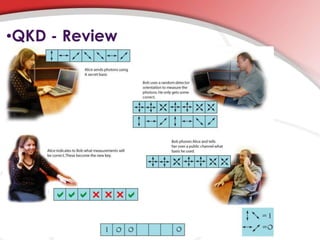
•QKD - Review
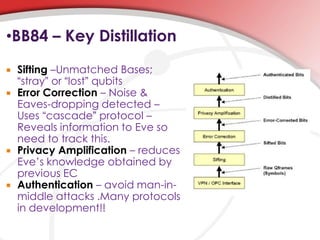
•BB84 – Key Distillation
 Sifting –Unmatched Bases;
“stray” or “lost” qubits
 Error Correction – Noise &
Eaves-dropping detected –
Uses “cascade” protocol –
Reveals information to Eve so
need to track this.
 Privacy Amplification – reduces
Eve’s knowledge obtained by
previous EC
 Authentication – avoid man-in-
middle attacks .Many protocols
in development!!
Researchers at Nokia and the University of Bristol in
UK have come up with quantum cryptography in
mobile phones.
Goal:
To perform "quantum key distribution" (QKD)
using simple and potentially inexpensive
"client" electronics that could be integrated
within a single chip.
•Making use of twisting and turning
• Makes use of the Reference
independent frame QKD[RfiQKD]
• Polarization or phase is measured in
context with a reference frame
• They select a specific threshold value
and drop below this value signals there
is an eavesdropper .
•Advantages
• It will help protect the password that are
transmitted using mobile phones
• Nokia has patented the technology and
looking forward to engineer into mobile
devices.
•Quantum City Project(Durban)
• 4 Node network connected in a star
configuration.
• Quantum Links as long as 26Kms
• Data Transmitted : data
records, telephones, and internet traffic.
• 99.3% of the time the system functioned
effectively and was stable.
•Limitations of QC
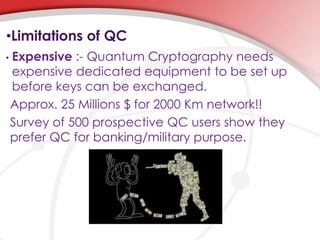
• Expensive :- Quantum Cryptography needs
expensive dedicated equipment to be set up
before keys can be exchanged.
Approx. 25 Millions $ for 2000 Km network!!
Survey of 500 prospective QC users show they
prefer QC for banking/military purpose.
•Limitations
• Range :- The current Range of QC systems
are a maximum of 250 kms. Lot of active
research is being done to increase range!!
• Since one cant use
repeaters or amplifiers
Trusted nodes are
needed to extend the
Range.
•Breaking Quantum Crypto
• Break underlying cryptography??
• Not possible!! Governed by law of physics
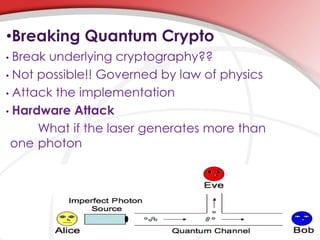
• Attack the implementation
• Hardware Attack
What if the laser generates more than
one photon
•Breaking Quantum Crypto
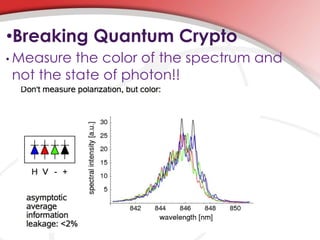
• Measure the color of the spectrum and
not the state of photon!!
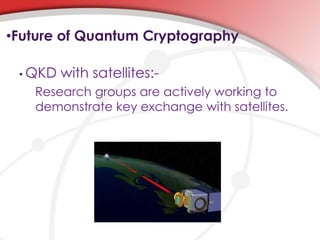
•Future of Quantum Cryptography
• QKD with satellites:-
Research groups are actively working to
demonstrate key exchange with satellites.
•Thank you!!

Cryptopresentationfinal

  • 1.
  • 2.
    •Introduction • Quantum cryptographyis the one of the most successful application of Quantum Computing/InformationTheory. • For the first time in history, we can use the forces of nature to implement perfectly secure cryptosystems. • Quantum cryptography has been proved to work practically.
  • 3.
    •State of theart • ClassicalCryptography(RSA) relies heavily on the complexity of factoring integers. • Future Quantum Computers can use Shor’s Algorithm to efficiently break today’s cryptosystems. • Quantum computers can solve factoring problems in polynomial time. What happens when that day arrives?
  • 4.
    •Today’s Talk • BasicIdeas in Cryptography • Ideas from the QuantumWorld • Quantum Key Distribution (QKD) • BB84 without eavesdropping • BB84 with eavesdropping • Working Prototypes • Practical Implementation of QC • Conclusion
  • 5.
    •Basic Ideas ofCryptography • Cryptography: “the coding and decoding of secret messages.” • The basic idea is to modify a message so as to make it unintelligible to anyone but the intended recipient. • For message (plaintext) M, e(M, K) encryption - ciphertext d[e(M, K), K] = M decryption
  • 6.
    •Keys and keydistribution  K is called the key.  The key is known only to sender and receiver: it is secret.  Anyone who knows the key can decrypt the message.  Key distribution is the problem of exchanging the key between sender and receiver.
  • 7.
    •Perfect Secrecy andOTP  There exist perfect cryptosystems.  Example: One-Time Pad (OTP)  The problem of distributing the keys in the first place remains.  Key length has to be same as message length!!
  • 8.
    •Quantum Key Distribution Using the laws of quantum mechanics, we can distribute keys in perfect secrecy!!  The Result:The Perfect Cryptosystem, QC = QKD + OTP
  • 9.
    •Quantum Physics Basics Physical Qubits  Any subatomic particle can be used to represent a qubit, e.g. an electron.  A photon is a convenient choice.  A photon is an electromagnetic wave.
  • 10.
    •Polarization • A photonhas a property called polarization, which is the plane in which the electric field oscillates. • We can use photons of different polarizations to represent quantum states:   0 state 0 90 state 1
  • 11.
    •Ideas from QuantumWorld  Measurement  Observing, or measuring, a quantum system will alter its state.  Example: the Qubit  When observed, the state of a qubit will collapse to unpredictable random state 1 or 0.
  • 12.
    •Polarizers & Basics •A device called a polarizer allows us to place a photon in a particular polarization • The polarization basis is frame of reference for quantum measurement.
  • 13.
    •Measuring Photons • Acalcite crystal can be used to recover the bits encoded into a stream of photons. 13 CaCO3 Diagonal axis (X) 1 0 1 0
  • 14.
    •Uncertainty Principle • Whatif the crystal has the wrong orientation? 14 CaCO3 RECTILINEAR axis(+) ??? 50% chance of getting right answer. Either | or ---
  • 15.
    •No Cloning theorem •It is impossible to make a device that perfectly copies an unknown qubit. • Suppose there is a quantum process that implements: |q,_> ->|q,q>
  • 16.
    •Quantum Key Distribution •Quantum Key Distribution exploits the effects discussed in order to thwart eavesdropping. • If an eavesdropper uses the wrong polarization basis to measure the channel, the result of the measurement will be random.
  • 17.
    •QKD Protocols • Aprotocol is a set of rules governing the exchange of messages over a channel. • There are three main security protocols for QKD: BB84, B92, and Entanglement-Based QKD. • Lets discuss the BB84 in detail.
  • 18.
    •BB84 • BB84 wasthe first security protocol implementingQuantum Key Distribution. • It uses the idea of photon polarization. • The key consists of bits that will be transmitted as photons. • Each bit is encoded with a random polarization basis!
  • 19.
    •BB84 With noEavesdropping • Alice is going to send Bob a key. • She begins with a random sequence of bits. • Bits are encoded with a random basis, and then sent to Bob: Bit 0 1 0 1 1 Basis + × × + × Photon
  • 20.
    •BB84 With noEavesdropping • Bob receives the photons and must decode them using a random basis. • Some of his measurements are correct. Photon Basis? + + × + × Bit? 0 0 0 1 1
  • 21.
    •BB84 With noeavesdropper • Alice and Bob talk on the public encrypted channel: • Alice chooses a subset of the bits (the test bits) and reveals which basis she used to encode them to Bob. • Bob tells Alice which basis he used to decode the same bits.
  • 22.
    •Comparing measurements Alice’s Bit0 1 0 1 1 Alice’s Basis + × × + × Photon Bob’s Basis + + × + × Bob’s Bit 0 0 0 1 1 The test bits allow Alice and Bob to test whether the channel is secure.
  • 23.
    •The Catch • Aslong as no errors and/or eavesdropping have occurred, the test bits should agree. • Alice and Bob have now made sure that the channel is secure.The test bits are removed. • Alice tells Bob the basis she used for the other bits, and they both have a common set of bits: the final key!
  • 24.
    •Deriving the finalkey Alice’s Bit 0 1 0 1 1 Alice’s Basis + × × + × Photon Bob’s Basis + + × + × Bob’s Bit 0 0 0 1 1 Final Key = 01 Test bits discarded
  • 25.
    •In the presenceof eavesdropper • If an eavesdropper Eve tries to tap the channel, this will automatically show up in Bob’s measurements. • In those cases where Alice and Bob have used the same basis, Bob is likely to obtain an incorrect measurement: Eve’s measurements are bound to affect the states of the photons.
  • 26.
  • 27.
    •In the presenceof Eavesdropper • As Eve intercepts Alice’s photons, she has to measure them with a random basis and send new photons to Bob. • The photon states cannot be cloned (non- cloneability). • Eve’s presence is always detected: measuring a quantum system irreparably alters its state.
  • 28.
  • 29.
    •BB84 – KeyDistillation  Sifting –Unmatched Bases; “stray” or “lost” qubits  Error Correction – Noise & Eaves-dropping detected – Uses “cascade” protocol – Reveals information to Eve so need to track this.  Privacy Amplification – reduces Eve’s knowledge obtained by previous EC  Authentication – avoid man-in- middle attacks .Many protocols in development!!
  • 30.
    Researchers at Nokiaand the University of Bristol in UK have come up with quantum cryptography in mobile phones. Goal: To perform "quantum key distribution" (QKD) using simple and potentially inexpensive "client" electronics that could be integrated within a single chip.
  • 31.
    •Making use oftwisting and turning • Makes use of the Reference independent frame QKD[RfiQKD] • Polarization or phase is measured in context with a reference frame • They select a specific threshold value and drop below this value signals there is an eavesdropper .
  • 32.
    •Advantages • It willhelp protect the password that are transmitted using mobile phones • Nokia has patented the technology and looking forward to engineer into mobile devices.
  • 33.
    •Quantum City Project(Durban) •4 Node network connected in a star configuration. • Quantum Links as long as 26Kms • Data Transmitted : data records, telephones, and internet traffic. • 99.3% of the time the system functioned effectively and was stable.
  • 34.
    •Limitations of QC •Expensive :- Quantum Cryptography needs expensive dedicated equipment to be set up before keys can be exchanged. Approx. 25 Millions $ for 2000 Km network!! Survey of 500 prospective QC users show they prefer QC for banking/military purpose.
  • 35.
    •Limitations • Range :-The current Range of QC systems are a maximum of 250 kms. Lot of active research is being done to increase range!! • Since one cant use repeaters or amplifiers Trusted nodes are needed to extend the Range.
  • 36.
    •Breaking Quantum Crypto •Break underlying cryptography?? • Not possible!! Governed by law of physics • Attack the implementation • Hardware Attack What if the laser generates more than one photon
  • 37.
    •Breaking Quantum Crypto •Measure the color of the spectrum and not the state of photon!!
  • 38.
    •Future of QuantumCryptography • QKD with satellites:- Research groups are actively working to demonstrate key exchange with satellites.
  • 39.