Quantum Cryptography
Opportunities and Threats in Quantum Computing
Agenda
1. Introduction to Cryptologic Terminology
2. Introduction to Quantum Mechanics and Quantum Computing
3. Quantum Cryptanalysis
4. Quantum Cryptography
5. Conclusions
Cryptologic Terminology
4

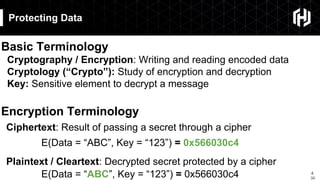
Protecting Data
Basic Terminology
Cryptography / Encryption: Writing and reading encoded data
Cryptology (“Crypto”): Study of encryption and decryption
Key: Sensitive element to decrypt a message
Encryption Terminology
Ciphertext: Result of passing a secret through a cipher
Plaintext / Cleartext: Decrypted secret protected by a cipher
E(Data = “ABC”, Key = “123”) = 0x566030c4
5

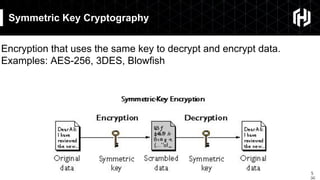
Symmetric Key Cryptography
Encryption that uses the same key to decrypt and encrypt data.
Examples: AES-256, 3DES, Blowfish
6

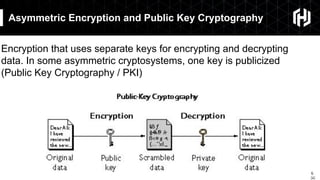
Asymmetric Encryption and Public Key Cryptography
Encryption that uses separate keys for encrypting and decrypting
data. In some asymmetric cryptosystems, one key is publicized
(Public Key Cryptography / PKI)
7

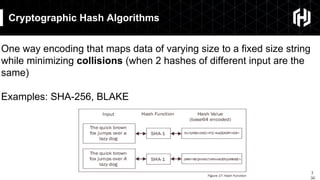
Cryptographic Hash Algorithms
One way encoding that maps data of varying size to a fixed size string
while minimizing collisions (when 2 hashes of different input are the
same)
Examples: SHA-256, BLAKE
8

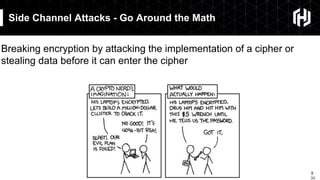
Side Channel Attacks - Go Around the Math
Breaking encryption by attacking the implementation of a cipher or
stealing data before it can enter the cipher
9

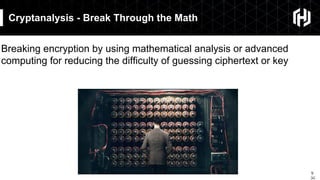
Cryptanalysis - Break Through the Math
Breaking encryption by using mathematical analysis or advanced
computing for reducing the difficulty of guessing ciphertext or key
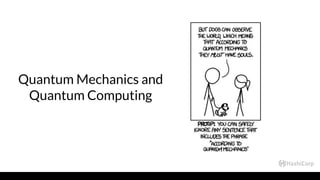
Quantum Mechanics and
Quantum Computing
1
1
Quantum Superposition and Entanglement
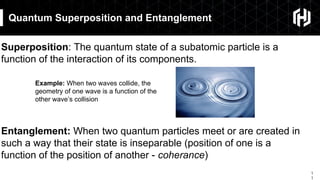
Superposition: The quantum state of a subatomic particle is a
function of the interaction of its components.
Entanglement: When two quantum particles meet or are created in
such a way that their state is inseparable (position of one is a
function of the position of another - coherance)
Example: When two waves collide, the
geometry of one wave is a function of the
other wave’s collision
1
2
Observer Effect and Quantum Uncertainty
Two key properties distinguish quantum mechanics from classical
mechanics
Quantum Uncertainty: We can’t directly observe the exact position
and velocity of a quantum particle. Quantum states are probabilistic
and cover a spread of possibilities (a PDF) with position determined
by statistical analysis of a result (expected value of the PDF).
Observer Effect: When we measure a quantum system we break its
coherence and have to start over.
1
3
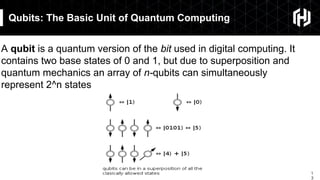
Qubits: The Basic Unit of Quantum Computing
A qubit is a quantum version of the bit used in digital computing. It
contains two base states of 0 and 1, but due to superposition and
quantum mechanics an array of n-qubits can simultaneously
represent 2^n states
1
4
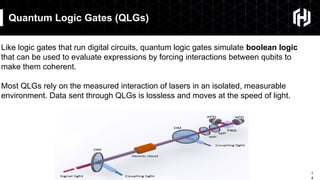
Quantum Logic Gates (QLGs)
Like logic gates that run digital circuits, quantum logic gates simulate boolean logic
that can be used to evaluate expressions by forcing interactions between qubits to
make them coherent.
Most QLGs rely on the measured interaction of lasers in an isolated, measurable
environment. Data sent through QLGs is lossless and moves at the speed of light.
1
5
Problems with QLGs: Measurement and Error
Unfortunately constructing QLGs is hard:
Isolation: Other factors may impact a quantum system and
decohere its QLGs
Uncertainty: Never know the explicit state of a qubit, only a range of
potential results
Observer Effect: Once a QLG is measured, it is docherent
1
6
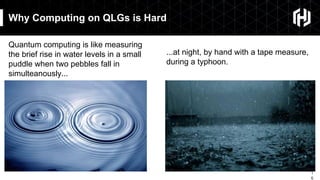
Why Computing on QLGs is Hard
Quantum computing is like measuring
the brief rise in water levels in a small
puddle when two pebbles fall in
simulteanously...
...at night, by hand with a tape measure,
during a typhoon.
1
7
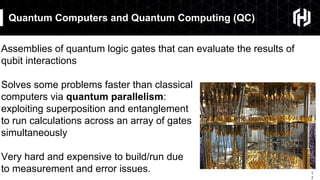
Quantum Computers and Quantum Computing (QC)
Assemblies of quantum logic gates that can evaluate the results of
qubit interactions
Solves some problems faster than classical
computers via quantum parallelism:
exploiting superposition and entanglement
to run calculations across an array of gates
simultaneously
Very hard and expensive to build/run due
to measurement and error issues.
1
8
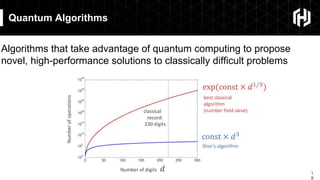
Quantum Algorithms
Algorithms that take advantage of quantum computing to propose
novel, high-performance solutions to classically difficult problems
Quantum Cryptanalysis
2
0
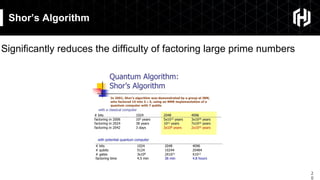
Shor’s Algorithm
Significantly reduces the difficulty of factoring large prime numbers
2
1
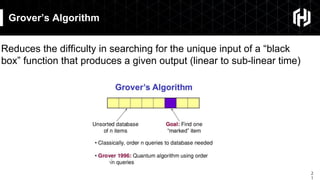
Grover’s Algorithm
Reduces the difficulty in searching for the unique input of a “black
box” function that produces a given output (linear to sub-linear time)
2
2
QC Risks for Existing Cryptography
Type of Cryptography Risk from QC Response
Cryptographic Hashes
Low: Grover’s Algorithm
moderately speeds up pre-image
attacks to search for hashes
No serious risk due to anti-collision
size protections in cyptographic
hashes. Some cryptocurrencies will
need to change their mining
algorithms (e.g.: Proof of Work)
Symmetric Crypto
Moderate: Grover’s Algorithm
speeds up brute force attacks
Double bit length of all symmetric
key cryptography
Asymmetric Crypto (PKI)
Very High: Shor’s Algorithm makes
integer factorization computationally
easy, invalidating the security of
most asymmetric crypto and PKI
Develop new PKI algorithms that
are quantum-secure (i.e.:
post-quantum cryptography)
2
3
Changes to FIPS 140-2 due to Quantum Computing
NIST has begun a Post Quantum
Cryptography Standardization program to
introduce new cryptographic standards to
FIPS 140-2
Currently reviewing alternatives to RSA,
ECDSA, and Diffie-Hellman
Planned draft changes to FIPS 140-2
beginning in 2022
Quantum Cryptography
2
5
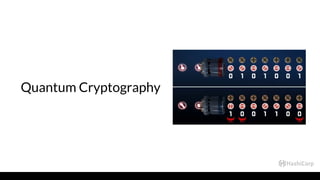
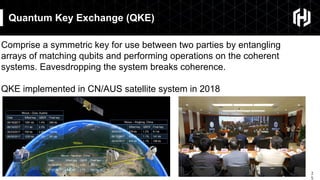
Quantum Key Exchange (QKE)
Comprise a symmetric key for use between two parties by entangling
arrays of matching qubits and performing operations on the coherent
systems. Eavesdropping the system breaks coherence.
QKE implemented in CN/AUS satellite system in 2018
2
6
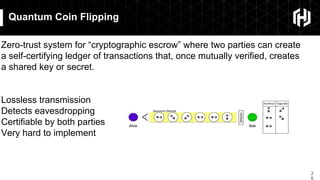
Quantum Coin Flipping
Zero-trust system for “cryptographic escrow” where two parties can create
a self-certifying ledger of transactions that, once mutually verified, creates
a shared key or secret.
Lossless transmission
Detects eavesdropping
Certifiable by both parties
Very hard to implement
Conclusions
2
8
TL;DR
We need new asymmetric cryptography / PKI
Quantum computing algorithms threaten prime factorization-based cryptography like
RSA and Diffie-Hellman, as well as cryptographic hash algorithms based on PKI
We need to increase key length for symmetric key crypto
Grover’s Algorithm requires us to double the key length for symmetric key
cryptography like AES (as well as some cryptographic hash algorithms)
...but this is not the “cryptopocalypse”
Not all cryptography is rendered insecure by QC (example: hashing) and new
methods for safeguarding data are provided by advances in quantum computing

Introduction to Quantum Cryptography

  • 1.
    Quantum Cryptography Opportunities andThreats in Quantum Computing
  • 2.
    Agenda 1. Introduction toCryptologic Terminology 2. Introduction to Quantum Mechanics and Quantum Computing 3. Quantum Cryptanalysis 4. Quantum Cryptography 5. Conclusions
  • 3.
  • 4.
    4  Protecting Data Basic Terminology Cryptography/ Encryption: Writing and reading encoded data Cryptology (“Crypto”): Study of encryption and decryption Key: Sensitive element to decrypt a message Encryption Terminology Ciphertext: Result of passing a secret through a cipher Plaintext / Cleartext: Decrypted secret protected by a cipher E(Data = “ABC”, Key = “123”) = 0x566030c4 E(Data = “ABC”, Key = “123”) = 0x566030c4
  • 5.
    5  Symmetric Key Cryptography Encryptionthat uses the same key to decrypt and encrypt data. Examples: AES-256, 3DES, Blowfish
  • 6.
    6  Asymmetric Encryption andPublic Key Cryptography Encryption that uses separate keys for encrypting and decrypting data. In some asymmetric cryptosystems, one key is publicized (Public Key Cryptography / PKI)
  • 7.
    7  Cryptographic Hash Algorithms Oneway encoding that maps data of varying size to a fixed size string while minimizing collisions (when 2 hashes of different input are the same) Examples: SHA-256, BLAKE
  • 8.
    8  Side Channel Attacks- Go Around the Math Breaking encryption by attacking the implementation of a cipher or stealing data before it can enter the cipher
  • 9.
    9  Cryptanalysis - BreakThrough the Math Breaking encryption by using mathematical analysis or advanced computing for reducing the difficulty of guessing ciphertext or key
  • 10.
  • 11.
    1 1 Quantum Superposition andEntanglement Superposition: The quantum state of a subatomic particle is a function of the interaction of its components. Entanglement: When two quantum particles meet or are created in such a way that their state is inseparable (position of one is a function of the position of another - coherance) Example: When two waves collide, the geometry of one wave is a function of the other wave’s collision
  • 12.
    1 2 Observer Effect andQuantum Uncertainty Two key properties distinguish quantum mechanics from classical mechanics Quantum Uncertainty: We can’t directly observe the exact position and velocity of a quantum particle. Quantum states are probabilistic and cover a spread of possibilities (a PDF) with position determined by statistical analysis of a result (expected value of the PDF). Observer Effect: When we measure a quantum system we break its coherence and have to start over.
  • 13.
    1 3 Qubits: The BasicUnit of Quantum Computing A qubit is a quantum version of the bit used in digital computing. It contains two base states of 0 and 1, but due to superposition and quantum mechanics an array of n-qubits can simultaneously represent 2^n states
  • 14.
    1 4 Quantum Logic Gates(QLGs) Like logic gates that run digital circuits, quantum logic gates simulate boolean logic that can be used to evaluate expressions by forcing interactions between qubits to make them coherent. Most QLGs rely on the measured interaction of lasers in an isolated, measurable environment. Data sent through QLGs is lossless and moves at the speed of light.
  • 15.
    1 5 Problems with QLGs:Measurement and Error Unfortunately constructing QLGs is hard: Isolation: Other factors may impact a quantum system and decohere its QLGs Uncertainty: Never know the explicit state of a qubit, only a range of potential results Observer Effect: Once a QLG is measured, it is docherent
  • 16.
    1 6 Why Computing onQLGs is Hard Quantum computing is like measuring the brief rise in water levels in a small puddle when two pebbles fall in simulteanously... ...at night, by hand with a tape measure, during a typhoon.
  • 17.
    1 7 Quantum Computers andQuantum Computing (QC) Assemblies of quantum logic gates that can evaluate the results of qubit interactions Solves some problems faster than classical computers via quantum parallelism: exploiting superposition and entanglement to run calculations across an array of gates simultaneously Very hard and expensive to build/run due to measurement and error issues.
  • 18.
    1 8 Quantum Algorithms Algorithms thattake advantage of quantum computing to propose novel, high-performance solutions to classically difficult problems
  • 19.
  • 20.
    2 0 Shor’s Algorithm Significantly reducesthe difficulty of factoring large prime numbers
  • 21.
    2 1 Grover’s Algorithm Reduces thedifficulty in searching for the unique input of a “black box” function that produces a given output (linear to sub-linear time)
  • 22.
    2 2 QC Risks forExisting Cryptography Type of Cryptography Risk from QC Response Cryptographic Hashes Low: Grover’s Algorithm moderately speeds up pre-image attacks to search for hashes No serious risk due to anti-collision size protections in cyptographic hashes. Some cryptocurrencies will need to change their mining algorithms (e.g.: Proof of Work) Symmetric Crypto Moderate: Grover’s Algorithm speeds up brute force attacks Double bit length of all symmetric key cryptography Asymmetric Crypto (PKI) Very High: Shor’s Algorithm makes integer factorization computationally easy, invalidating the security of most asymmetric crypto and PKI Develop new PKI algorithms that are quantum-secure (i.e.: post-quantum cryptography)
  • 23.
    2 3 Changes to FIPS140-2 due to Quantum Computing NIST has begun a Post Quantum Cryptography Standardization program to introduce new cryptographic standards to FIPS 140-2 Currently reviewing alternatives to RSA, ECDSA, and Diffie-Hellman Planned draft changes to FIPS 140-2 beginning in 2022
  • 24.
  • 25.
    2 5 Quantum Key Exchange(QKE) Comprise a symmetric key for use between two parties by entangling arrays of matching qubits and performing operations on the coherent systems. Eavesdropping the system breaks coherence. QKE implemented in CN/AUS satellite system in 2018
  • 26.
    2 6 Quantum Coin Flipping Zero-trustsystem for “cryptographic escrow” where two parties can create a self-certifying ledger of transactions that, once mutually verified, creates a shared key or secret. Lossless transmission Detects eavesdropping Certifiable by both parties Very hard to implement
  • 27.
  • 28.
    2 8 TL;DR We need newasymmetric cryptography / PKI Quantum computing algorithms threaten prime factorization-based cryptography like RSA and Diffie-Hellman, as well as cryptographic hash algorithms based on PKI We need to increase key length for symmetric key crypto Grover’s Algorithm requires us to double the key length for symmetric key cryptography like AES (as well as some cryptographic hash algorithms) ...but this is not the “cryptopocalypse” Not all cryptography is rendered insecure by QC (example: hashing) and new methods for safeguarding data are provided by advances in quantum computing