Quantum  Information  and the  Importance  of  Basic  Research Charles H. Bennett IBM Research Yorktown NIT Warangal  Videoconference 25 Sep 2009
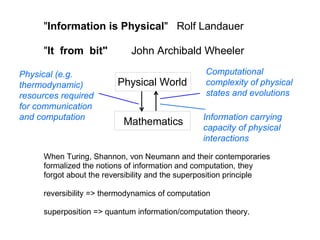
Computational complexity of physical states and evolutions Information carrying capacity of physical interactions Physical (e.g. thermodynamic) resources required for communication and computation
 
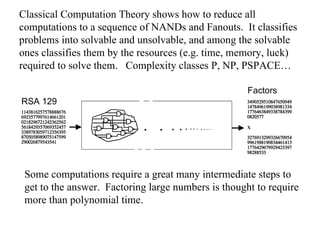
Some computations require a great many intermediate steps to get to the answer.  Factoring large numbers is thought to require more than polynomial time.  Classical Computation Theory shows how to reduce all computations to a sequence of NANDs and Fanouts.  It classifies problems into solvable and unsolvable, and among the solvable ones classifies them by the resources (e.g. time, memory, luck) required to solve them.  Complexity classes P, NP, PSPACE…
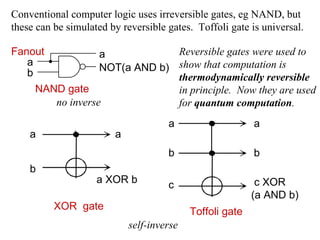
a b a a XOR b a a b b c c XOR (a AND b) XOR  gate Toffoli gate Conventional computer logic uses irreversible gates, eg NAND, but these can be simulated by reversible gates.  Toffoli gate is universal.  Reversible gates were used to show that computation is  thermodynamically reversible  in principle.  Now they are used for  quantum computation . self-inverse NAND gate a b NOT(a AND b) no inverse a Fanout
Logical Reversibility and Thermodynamics Landauer Principle: each erasure of a bit, or other logical 2:1 mapping of the state of a physical computer, increases the entropy of its environment by k log 2. Reversible computers, which by their hardware and programming avoid these logically irreversible operations, can in principle operate with arbitrarily little energy dissipation per step.
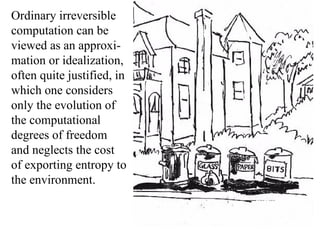
Ordinary irreversible computation can be viewed as an approxi-mation or idealization,  often quite justified, in which one considers only the evolution of the computational degrees of freedom and neglects the cost of exporting entropy to the environment.
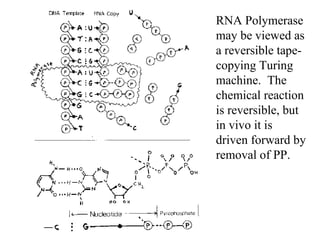
RNA Polymerase may be viewed as a reversible tape-copying Turing machine.  The chemical reaction is reversible, but in vivo it is driven forward by removal of PP.
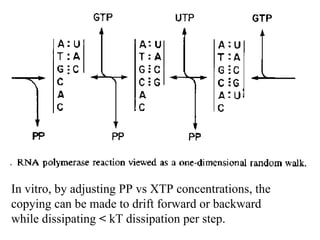
In vitro, by adjusting PP vs XTP concentrations, the copying can be made to drift forward or backward while dissipating  <  kT dissipation per step.
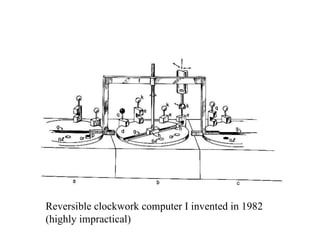
Reversible clockwork computer I invented in 1982 (highly impractical)
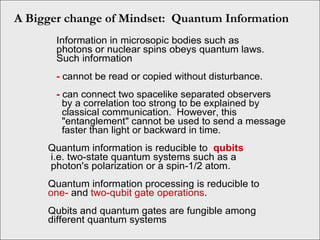
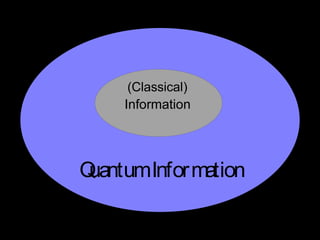
A Bigger change of Mindset:   Quantum Information
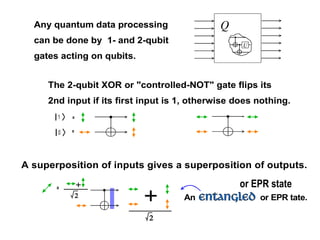
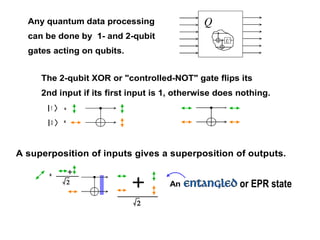
or EPR state
 
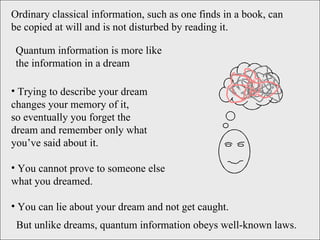
Ordinary classical information, such as one finds in a book, can be copied at will and is not disturbed by reading it. Trying to describe your dream  changes your memory of it,  so eventually you forget the  dream and remember only what  you’ve said about it.  You cannot prove to someone else  what you dreamed. You can lie about your dream and not get caught. But unlike dreams, quantum information obeys well-known laws. Quantum information is more like the information in a dream
 
 
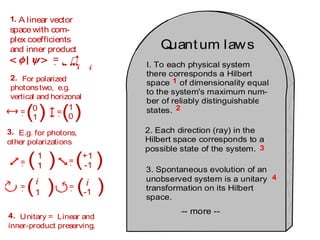
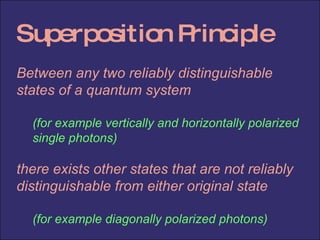
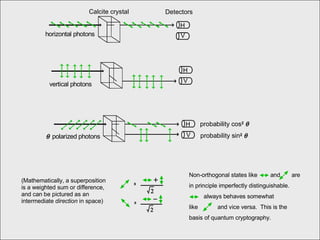
Superposition Principle Between any two reliably distinguishable states of a quantum system (for example vertically and horizontally polarized single photons) there exists other states that are not reliably distinguishable from either original state (for example diagonally polarized photons)
 
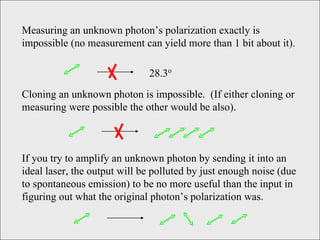
Measuring an unknown photon’s polarization exactly is impossible (no measurement can yield more than 1 bit about it). Cloning an unknown photon is impossible.  (If either cloning or measuring were possible the other would be also). If you try to amplify an unknown photon by sending it into an ideal laser, the output will be polluted by just enough noise (due to spontaneous emission) to be no more useful than the input in figuring out what the original photon’s polarization was. 28.3 o
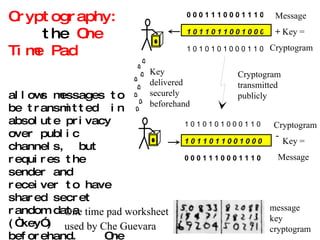
Cryptography:  the  One Time Pad   allows messages to be transmitted  in absolute privacy over public channels,  but requires the sender and receiver to have shared secret random data (“key”) beforehand.  One key digit is used  up for each message digit sent.  The key cannot be reused. If it, system becomes insecure.  Message Cryptogram Key delivered securely beforehand +  Key = Cryptogram transmitted publicly Cryptogram    Key = Message One time pad worksheet used by Che Guevara   message key cryptogram
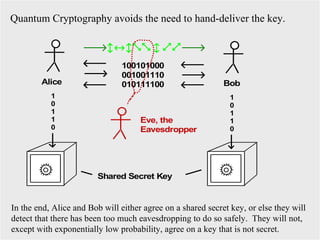
In the end, Alice and Bob will either agree on a shared secret key, or else they will detect that there has been too much eavesdropping to do so safely.  They will not, except with exponentially low probability, agree on a key that is not secret.  Quantum Cryptography avoids the need to hand-deliver the key.
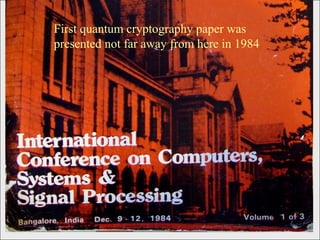
First quantum cryptography paper was presented not far away from here in 1984
 
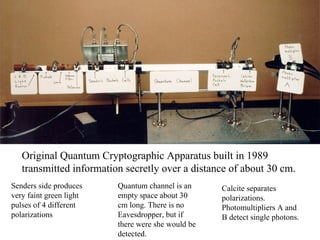
Original Quantum Cryptographic Apparatus built in 1989 transmitted information secretly over a distance of about 30 cm. Senders side produces very faint green light pulses of 4 different polarizations Quantum channel is an empty space about 30 cm long. There is no Eavesdropper, but if there were she would be detected. Calcite separates polarizations.  Photomultipliers A and B detect single photons.
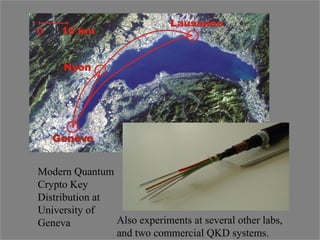
Modern Quantum  Crypto Key Distribution at  University of  Geneva Also experiments at several other labs, and two commercial QKD systems.
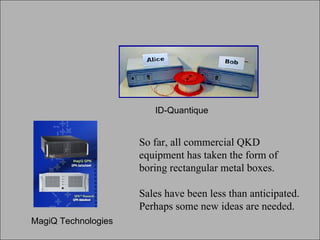
So far, all commercial QKD equipment has taken the form of boring rectangular metal boxes.  Sales have been less than anticipated. Perhaps some new ideas are needed.  ID-Quantique MagiQ Technologies
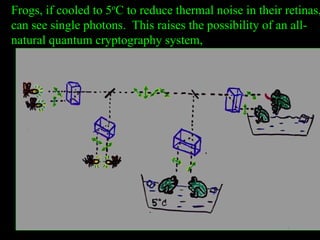
Frogs, if cooled to 5 o C to reduce thermal noise in their retinas, can see single photons.  This raises the possibility of an all-natural quantum cryptography system,
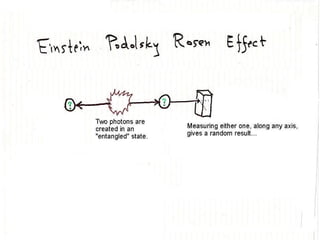
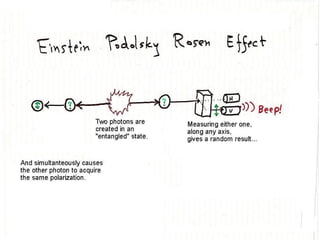
or EPR state


“ Violation of Bell’s Inequality”
 
 
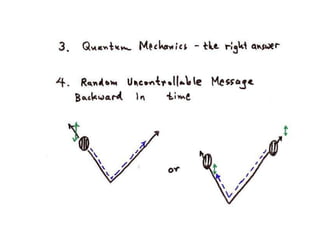
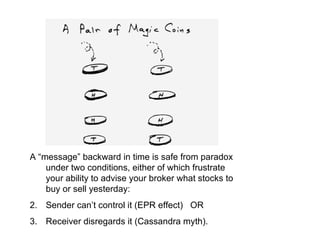
A “message” backward in time is safe from paradox under two conditions, either of which frustrate your ability to advise your broker what stocks to buy or sell yesterday: Sender can’t control it (EPR effect)  OR Receiver disregards it (Cassandra myth).
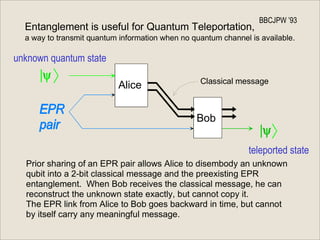
unknown quantum state teleported state BBCJPW ’93
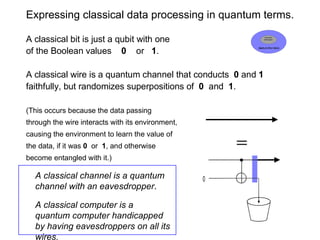
A classical channel is a quantum channel with an eavesdropper . A classical computer is a quantum computer handicapped by having eavesdroppers on all its wires.
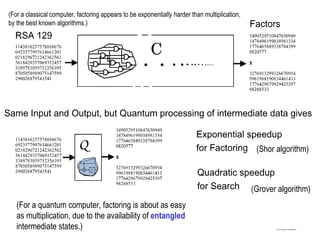
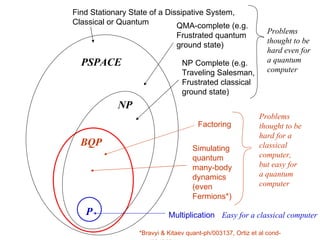
Fast Quantum Computation (Grover algorithm) (Shor algorithm) (For a quantum computer, factoring is about as easy as multiplication, due to the availability of  entangled  intermediate states.) (For a classical computer, factoring appears to be exponentially harder than multiplication, by the best known algorithms.)
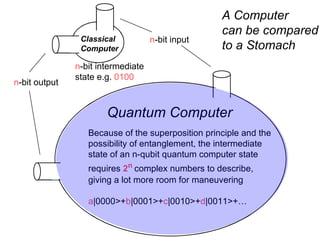
A Computer can be compared to a Stomach Classical  Computer Quantum Computer n -bit input n -bit output Because of the superposition principle and the possibility of entanglement, the intermediate  state of an n-qubit quantum computer state  requires  2 n   complex numbers to describe,  giving a lot more room for maneuvering  a |0000>+ b |0001>+ c |0010>+ d |0011>+… n -bit intermediate  state e.g.  0100
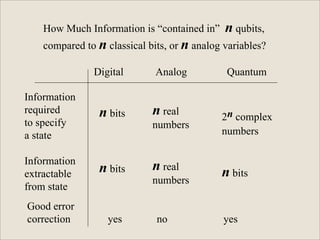
How Much Information is “contained in”  n  qubits, compared to  n  classical bits, or  n  analog variables? Digital  Analog  Quantum Information  required  to specify a state  Information  extractable from state n  bits  n  bits 2 n  complex numbers n  bits n  real numbers n  real numbers Good error  correction  yes  no  yes
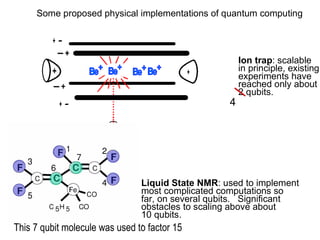
This 7 qubit molecule was used to factor 15 4
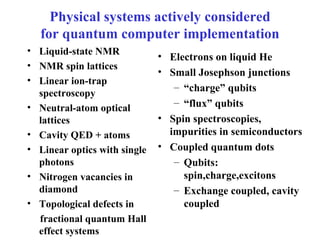
Physical systems actively considered for quantum computer implementation Liquid-state NMR NMR spin lattices Linear ion-trap spectroscopy Neutral-atom optical lattices Cavity QED + atoms Linear optics with single photons Nitrogen vacancies in diamond Topological defects in fractional quantum Hall effect systems Electrons on liquid He  Small Josephson junctions “ charge” qubits “ flux” qubits Spin spectroscopies, impurities in semiconductors Coupled quantum dots Qubits: spin,charge,excitons Exchange coupled, cavity coupled
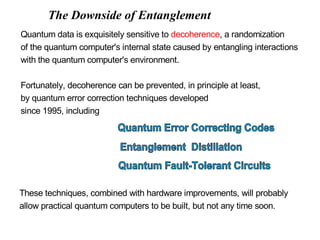
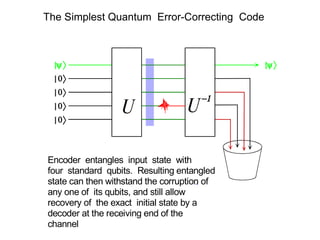
The Downside of Entanglement
 
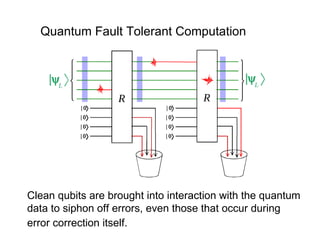
Quantum Fault Tolerant Computation  Clean qubits are brought into interaction with the quantum data to siphon off errors, even those that occur during error correction itself.
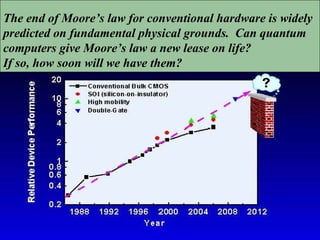
CMOS Device Performance The end of Moore’s law for conventional hardware is widely predicted on fundamental physical grounds.  Can quantum computers give Moore’s law a new lease on life?  If so, how soon will we have them?
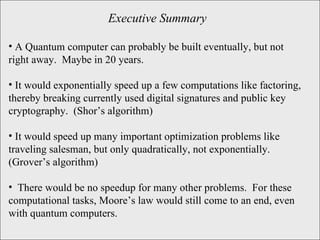
Executive Summary A Quantum computer can probably be built eventually, but not right away.  Maybe in 20 years. It would exponentially speed up a few computations like factoring, thereby breaking currently used digital signatures and public key cryptography.  (Shor’s algorithm) It would speed up many important optimization problems like traveling salesman, but only quadratically, not exponentially.  (Grover’s algorithm) There would be no speedup for many other problems.  For these computational tasks, Moore’s law would still come to an end, even with quantum computers.
BQP NP PSPACE NP Complete (e.g. Traveling Salesman, Frustrated classical ground state) Factoring Simulating  quantum  many-body  dynamics  (even  Fermions*)  QMA-complete (e.g.  Frustrated quantum ground state) Problems thought to be hard for a classical computer,  but easy for  a quantum computer Easy for a classical computer Problems thought to be hard even for a quantum computer Multiplication P Find Stationary State of a Dissipative System,  Classical or Quantum *Bravyi & Kitaev quant-ph/003137, Ortiz et al cond-mat/0012334
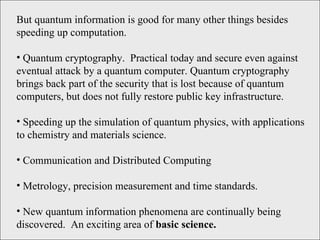
But quantum information is good for many other things besides speeding up computation. Quantum cryptography.  Practical today and secure even against eventual attack by a quantum computer. Quantum cryptography brings back part of the security that is lost because of quantum computers, but does not fully restore public key infrastructure. Speeding up the simulation of quantum physics, with applications to chemistry and materials science.  Communication and Distributed Computing Metrology, precision measurement and time standards.  New quantum information phenomena are continually being discovered.  An exciting area of  basic science.
Science as a career Science can be a very satisfying career. I always wanted to be a scientist, from before age 5, so perhaps I’m not the best person to compare science to other career choices.  Always something new to do and be curious about: the opposite of housework, which consists of doing the same job repeatedly.  Ability to appreciate progress in all areas of science, not only your own. Scientists, professional or amateur, can still almost be “renaissance persons,” at least with respect to the natural world. Less backsliding than any other area of human endeavor.  If you are patient, and live long enough, you can see questions answered you’ve been wondering about for decades, maybe even help answer them.
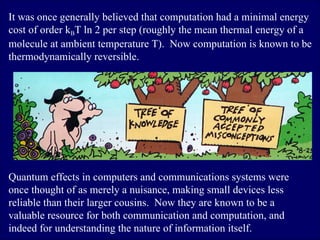
It was once generally believed that computation had a minimal energy cost of order k B T ln 2 per step (roughly the mean thermal energy of a molecule at ambient temperature T).  Now computation is known to be thermodynamically reversible.  Quantum effects in computers and communications systems were once thought of as merely a nuisance, making small devices less reliable than their larger cousins.  Now they are known to be a valuable resource for both communication and computation, and indeed for understanding the nature of information itself.
Discounting the future Individuals and institutions tend to plan ahead about as far in time as they can reasonably predict.  For politicians this is usually until the next election. We scarcely think about the very distant future, and plan ahead less when current conditions are chaotic and unpredictable.  Lunch time conversation between two astronomers First Astronomer:  “…of course the Sun will only last another 5 billion years or so.” Second Astronomer  (quite upset):   “ What? ” First Astronomer : “I said the Sun will last 5 billion years.” Second Astronomer  (relieved): “Oh!  I thought you’d said  5  million  years .”
Reminiscence of a retired engineer at NASA’s Jet Propulsion Lab whose proudest accomplishment, many years earlier, had been working on the power supplies for the two Voyager spacecraft.  As I recall he said roughly the following: We wanted to have the Voyagers visit all the big planets.  NASA said, “No. Just Jupiter and Saturn.  People don’t care about Uranus and Neptune.”  We said, “If we don’t do it now, the planets won’t be properly aligned to do it again for another 200 years.”  They said, “Legislators understand 2 years, not 200 years. You are only authorized for Jupiter and Saturn.”  So we designed all the systems very conservatively, on the pretext of being conservative, but with the intention of giving  the Voyagers enough power, fuel, and maneuvering and communication ability to go on to visit and photograph Uranus and Neptune, which they ultimately did to everyone’s great satisfaction.
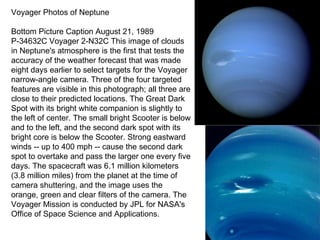
Voyager Photos of Neptune  Bottom Picture Caption August 21, 1989 P-34632C Voyager 2-N32C This image of clouds in Neptune's atmosphere is the first that tests the accuracy of the weather forecast that was made eight days earlier to select targets for the Voyager narrow-angle camera. Three of the four targeted features are visible in this photograph; all three are close to their predicted locations. The Great Dark Spot with its bright white companion is slightly to the left of center. The small bright Scooter is below and to the left, and the second dark spot with its bright core is below the Scooter. Strong eastward winds -- up to 400 mph -- cause the second dark spot to overtake and pass the larger one every five days. The spacecraft was 6.1 million kilometers (3.8 million miles) from the planet at the time of camera shuttering, and the image uses the orange, green and clear filters of the camera. The Voyager Mission is conducted by JPL for NASA's Office of Space Science and Applications.
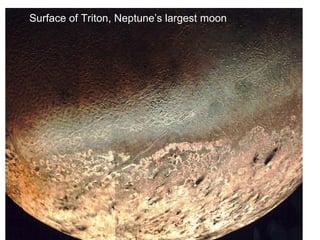
Surface of Triton, Neptune’s largest moon
 
Quantum Laws & the Universality of Interaction
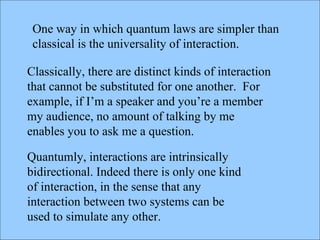
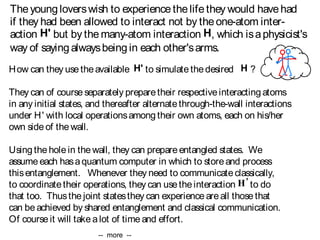
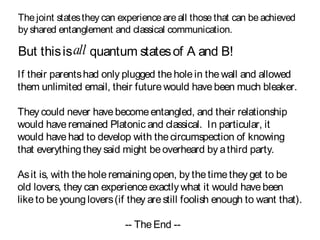
Classically, there are distinct kinds of interaction that cannot be substituted for one another.  For example, if I’m a speaker and you’re a member my audience, no amount of talking by me enables you to ask me a question. Quantumly, interactions are intrinsically bidirectional. Indeed there is only one kind of interaction, in the sense that any interaction between two systems can be used to simulate any other. One way in which quantum laws are simpler than classical is the universality of interaction.


How do Quantum Speedups Work?
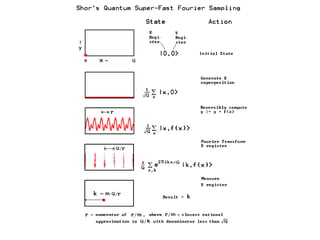
Fast Quantum Computation Shor’s algorithm – exponential speedup of factoring – Depends on fast quantum technique for finding the period of a periodic function  Grover’s algorithm – quadratic speedup of search – works by gradually focusing an initially uniform superposition over all candidates into one concentrated on the designated element. Speedup arises from the fact that a linear growth of the amplitude of the desired element in the superposition causes a quadratic growth in the element’s probability.
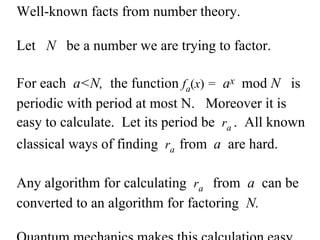
Well-known facts from number theory.  Let  N  be a number we are trying to factor. For each  a<N,   the function  f a ( x )  =   a x   mod  N  is periodic with period at most N.  Moreover it is easy to calculate.  Let its period be  r a  .  All known classical ways of finding  r a  from  a  are hard.  Any algorithm for calculating  r a  from   a  can be converted to an algorithm for factoring  N. Quantum mechanics makes this calculation easy.
 
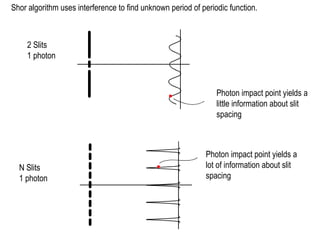
2 Slits  1 photon Shor algorithm uses interference to find unknown period of periodic function. N Slits  1 photon Photon impact point yields a little information about slit spacing Photon impact point yields a lot of information about slit spacing
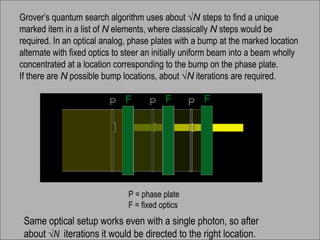
Grover’s quantum search algorithm uses about  √ N  steps to find a unique marked item in a list of  N  elements, where classically  N  steps would be required. In an optical analog, phase plates with a bump at the marked location alternate with fixed optics to steer an initially uniform beam into a beam wholly concentrated at a location corresponding to the bump on the phase plate.  If there are  N  possible bump locations, about  √ N  iterations are required. P = phase plate F = fixed optics Same optical setup works even with a single photon, so after about  √ N   iterations it would be directed to the right location.
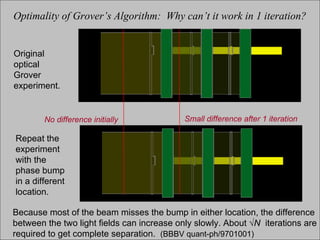
Optimality of Grover’s Algorithm:  Why can’t it work in 1 iteration? Repeat the experiment with the phase bump in a different location. Original optical Grover experiment. Because most of the beam misses the bump in either location, the difference between the two light fields can increase only slowly. About √ N  iterations are required to get complete separation.  (BBBV quant-ph/9701001) Small difference after 1 iteration No difference initially
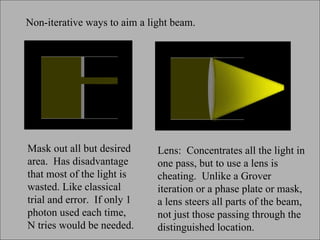
Mask out all but desired area.  Has disadvantage that most of the light is wasted. Like classical trial and error.  If only 1 photon used each time, N tries would be needed. Non-iterative ways to aim a light beam.  Lens:  Concentrates all the light in one pass, but to use a lens is cheating.  Unlike a Grover iteration or a phase plate or mask, a lens steers all parts of the beam, not just those passing through the distinguished location.
How would a working quantum computer change the world?  Exponential speedup of factoring and related problems of mainly cryptographic interest.  Known public key cryptosystems would be broken. Digital signatures broken.  Secret key systems (e.g. DES) still probably OK but would need double the key size.  (Some public key functionality can be replaced by unconditionally secure quantum cryptography.) Exponential speedup for simulating quantum physics. Quadratic speedup for optimization problems like travelling salesman.  No good reason to hope for exponential speedup. No speedup for some other problems.
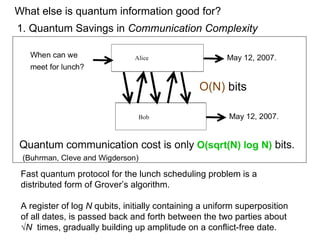
Fast quantum protocol for the lunch scheduling problem is a distributed form of Grover’s algorithm.  A register of log  N  qubits, initially containing a uniform superposition of all dates, is passed back and forth between the two parties about  √ N  times, gradually building up amplitude on a conflict-free date.  1. Quantum Savings in  Communication Complexity   What else is quantum information good for?
 
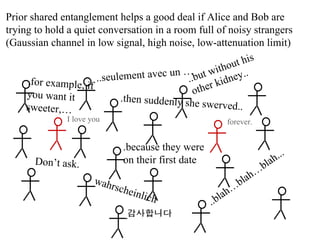
Prior shared entanglement helps a good deal if Alice and Bob are trying to hold a quiet conversation in a room full of noisy strangers (Gaussian channel in low signal, high noise, low-attenuation limit) ..seulement avec un … ..blah…blah…blah... wahrscheinlich .then suddenly she swerved.. .because they were on their first date .for example, if you want it sweeter,… I love you ..but without his other kidney.. forever. Don’t ask.
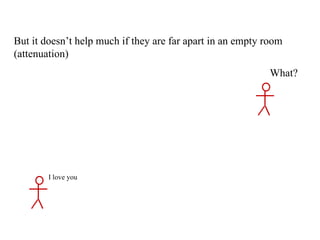
I love you But it doesn’t help much if they are far apart in an empty room (attenuation) What?

Quantum Information

  • 1.
    Quantum Information and the Importance of Basic Research Charles H. Bennett IBM Research Yorktown NIT Warangal Videoconference 25 Sep 2009
  • 2.
    Computational complexity ofphysical states and evolutions Information carrying capacity of physical interactions Physical (e.g. thermodynamic) resources required for communication and computation
  • 3.
  • 4.
    Some computations requirea great many intermediate steps to get to the answer. Factoring large numbers is thought to require more than polynomial time. Classical Computation Theory shows how to reduce all computations to a sequence of NANDs and Fanouts. It classifies problems into solvable and unsolvable, and among the solvable ones classifies them by the resources (e.g. time, memory, luck) required to solve them. Complexity classes P, NP, PSPACE…
  • 5.
    a b aa XOR b a a b b c c XOR (a AND b) XOR gate Toffoli gate Conventional computer logic uses irreversible gates, eg NAND, but these can be simulated by reversible gates. Toffoli gate is universal. Reversible gates were used to show that computation is thermodynamically reversible in principle. Now they are used for quantum computation . self-inverse NAND gate a b NOT(a AND b) no inverse a Fanout
  • 6.
    Logical Reversibility andThermodynamics Landauer Principle: each erasure of a bit, or other logical 2:1 mapping of the state of a physical computer, increases the entropy of its environment by k log 2. Reversible computers, which by their hardware and programming avoid these logically irreversible operations, can in principle operate with arbitrarily little energy dissipation per step.
  • 7.
    Ordinary irreversible computationcan be viewed as an approxi-mation or idealization, often quite justified, in which one considers only the evolution of the computational degrees of freedom and neglects the cost of exporting entropy to the environment.
  • 8.
    RNA Polymerase maybe viewed as a reversible tape-copying Turing machine. The chemical reaction is reversible, but in vivo it is driven forward by removal of PP.
  • 9.
    In vitro, byadjusting PP vs XTP concentrations, the copying can be made to drift forward or backward while dissipating < kT dissipation per step.
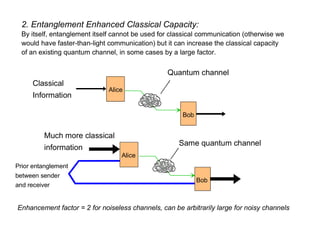
  • 10.
    Reversible clockwork computerI invented in 1982 (highly impractical)
  • 11.
    A Bigger changeof Mindset: Quantum Information
  • 12.
  • 13.
  • 14.
    Ordinary classical information,such as one finds in a book, can be copied at will and is not disturbed by reading it. Trying to describe your dream changes your memory of it, so eventually you forget the dream and remember only what you’ve said about it. You cannot prove to someone else what you dreamed. You can lie about your dream and not get caught. But unlike dreams, quantum information obeys well-known laws. Quantum information is more like the information in a dream
  • 15.
  • 16.
  • 17.
    Superposition Principle Betweenany two reliably distinguishable states of a quantum system (for example vertically and horizontally polarized single photons) there exists other states that are not reliably distinguishable from either original state (for example diagonally polarized photons)
  • 18.
  • 19.
    Measuring an unknownphoton’s polarization exactly is impossible (no measurement can yield more than 1 bit about it). Cloning an unknown photon is impossible. (If either cloning or measuring were possible the other would be also). If you try to amplify an unknown photon by sending it into an ideal laser, the output will be polluted by just enough noise (due to spontaneous emission) to be no more useful than the input in figuring out what the original photon’s polarization was. 28.3 o
  • 20.
    Cryptography: the One Time Pad allows messages to be transmitted in absolute privacy over public channels, but requires the sender and receiver to have shared secret random data (“key”) beforehand. One key digit is used up for each message digit sent. The key cannot be reused. If it, system becomes insecure. Message Cryptogram Key delivered securely beforehand + Key = Cryptogram transmitted publicly Cryptogram  Key = Message One time pad worksheet used by Che Guevara message key cryptogram
  • 21.
    In the end,Alice and Bob will either agree on a shared secret key, or else they will detect that there has been too much eavesdropping to do so safely. They will not, except with exponentially low probability, agree on a key that is not secret. Quantum Cryptography avoids the need to hand-deliver the key.
  • 22.
    First quantum cryptographypaper was presented not far away from here in 1984
  • 23.
  • 24.
    Original Quantum CryptographicApparatus built in 1989 transmitted information secretly over a distance of about 30 cm. Senders side produces very faint green light pulses of 4 different polarizations Quantum channel is an empty space about 30 cm long. There is no Eavesdropper, but if there were she would be detected. Calcite separates polarizations. Photomultipliers A and B detect single photons.
  • 25.
    Modern Quantum Crypto Key Distribution at University of Geneva Also experiments at several other labs, and two commercial QKD systems.
  • 26.
    So far, allcommercial QKD equipment has taken the form of boring rectangular metal boxes. Sales have been less than anticipated. Perhaps some new ideas are needed. ID-Quantique MagiQ Technologies
  • 27.
    Frogs, if cooledto 5 o C to reduce thermal noise in their retinas, can see single photons. This raises the possibility of an all-natural quantum cryptography system,
  • 28.
  • 29.
  • 30.
  • 31.
  • 32.
    “ Violation ofBell’s Inequality”
  • 33.
  • 34.
  • 35.
    A “message” backwardin time is safe from paradox under two conditions, either of which frustrate your ability to advise your broker what stocks to buy or sell yesterday: Sender can’t control it (EPR effect) OR Receiver disregards it (Cassandra myth).
  • 36.
    unknown quantum stateteleported state BBCJPW ’93
  • 37.
    A classical channelis a quantum channel with an eavesdropper . A classical computer is a quantum computer handicapped by having eavesdroppers on all its wires.
  • 38.
    Fast Quantum Computation(Grover algorithm) (Shor algorithm) (For a quantum computer, factoring is about as easy as multiplication, due to the availability of entangled intermediate states.) (For a classical computer, factoring appears to be exponentially harder than multiplication, by the best known algorithms.)
  • 39.
    A Computer canbe compared to a Stomach Classical Computer Quantum Computer n -bit input n -bit output Because of the superposition principle and the possibility of entanglement, the intermediate state of an n-qubit quantum computer state requires 2 n complex numbers to describe, giving a lot more room for maneuvering a |0000>+ b |0001>+ c |0010>+ d |0011>+… n -bit intermediate state e.g. 0100
  • 40.
    How Much Informationis “contained in” n qubits, compared to n classical bits, or n analog variables? Digital Analog Quantum Information required to specify a state Information extractable from state n bits n bits 2 n complex numbers n bits n real numbers n real numbers Good error correction yes no yes
  • 41.
    This 7 qubitmolecule was used to factor 15 4
  • 42.
    Physical systems activelyconsidered for quantum computer implementation Liquid-state NMR NMR spin lattices Linear ion-trap spectroscopy Neutral-atom optical lattices Cavity QED + atoms Linear optics with single photons Nitrogen vacancies in diamond Topological defects in fractional quantum Hall effect systems Electrons on liquid He Small Josephson junctions “ charge” qubits “ flux” qubits Spin spectroscopies, impurities in semiconductors Coupled quantum dots Qubits: spin,charge,excitons Exchange coupled, cavity coupled
  • 43.
    The Downside ofEntanglement
  • 44.
  • 45.
    Quantum Fault TolerantComputation Clean qubits are brought into interaction with the quantum data to siphon off errors, even those that occur during error correction itself.
  • 46.
    CMOS Device PerformanceThe end of Moore’s law for conventional hardware is widely predicted on fundamental physical grounds. Can quantum computers give Moore’s law a new lease on life? If so, how soon will we have them?
  • 47.
    Executive Summary AQuantum computer can probably be built eventually, but not right away. Maybe in 20 years. It would exponentially speed up a few computations like factoring, thereby breaking currently used digital signatures and public key cryptography. (Shor’s algorithm) It would speed up many important optimization problems like traveling salesman, but only quadratically, not exponentially. (Grover’s algorithm) There would be no speedup for many other problems. For these computational tasks, Moore’s law would still come to an end, even with quantum computers.
  • 48.
    BQP NP PSPACENP Complete (e.g. Traveling Salesman, Frustrated classical ground state) Factoring Simulating quantum many-body dynamics (even Fermions*) QMA-complete (e.g. Frustrated quantum ground state) Problems thought to be hard for a classical computer, but easy for a quantum computer Easy for a classical computer Problems thought to be hard even for a quantum computer Multiplication P Find Stationary State of a Dissipative System, Classical or Quantum *Bravyi & Kitaev quant-ph/003137, Ortiz et al cond-mat/0012334
  • 49.
    But quantum informationis good for many other things besides speeding up computation. Quantum cryptography. Practical today and secure even against eventual attack by a quantum computer. Quantum cryptography brings back part of the security that is lost because of quantum computers, but does not fully restore public key infrastructure. Speeding up the simulation of quantum physics, with applications to chemistry and materials science. Communication and Distributed Computing Metrology, precision measurement and time standards. New quantum information phenomena are continually being discovered. An exciting area of basic science.
  • 50.
    Science as acareer Science can be a very satisfying career. I always wanted to be a scientist, from before age 5, so perhaps I’m not the best person to compare science to other career choices. Always something new to do and be curious about: the opposite of housework, which consists of doing the same job repeatedly. Ability to appreciate progress in all areas of science, not only your own. Scientists, professional or amateur, can still almost be “renaissance persons,” at least with respect to the natural world. Less backsliding than any other area of human endeavor. If you are patient, and live long enough, you can see questions answered you’ve been wondering about for decades, maybe even help answer them.
  • 51.
    It was oncegenerally believed that computation had a minimal energy cost of order k B T ln 2 per step (roughly the mean thermal energy of a molecule at ambient temperature T). Now computation is known to be thermodynamically reversible. Quantum effects in computers and communications systems were once thought of as merely a nuisance, making small devices less reliable than their larger cousins. Now they are known to be a valuable resource for both communication and computation, and indeed for understanding the nature of information itself.
  • 52.
    Discounting the futureIndividuals and institutions tend to plan ahead about as far in time as they can reasonably predict. For politicians this is usually until the next election. We scarcely think about the very distant future, and plan ahead less when current conditions are chaotic and unpredictable. Lunch time conversation between two astronomers First Astronomer: “…of course the Sun will only last another 5 billion years or so.” Second Astronomer (quite upset): “ What? ” First Astronomer : “I said the Sun will last 5 billion years.” Second Astronomer (relieved): “Oh! I thought you’d said 5 million years .”
  • 53.
    Reminiscence of aretired engineer at NASA’s Jet Propulsion Lab whose proudest accomplishment, many years earlier, had been working on the power supplies for the two Voyager spacecraft. As I recall he said roughly the following: We wanted to have the Voyagers visit all the big planets. NASA said, “No. Just Jupiter and Saturn. People don’t care about Uranus and Neptune.” We said, “If we don’t do it now, the planets won’t be properly aligned to do it again for another 200 years.” They said, “Legislators understand 2 years, not 200 years. You are only authorized for Jupiter and Saturn.” So we designed all the systems very conservatively, on the pretext of being conservative, but with the intention of giving the Voyagers enough power, fuel, and maneuvering and communication ability to go on to visit and photograph Uranus and Neptune, which they ultimately did to everyone’s great satisfaction.
  • 54.
    Voyager Photos ofNeptune Bottom Picture Caption August 21, 1989 P-34632C Voyager 2-N32C This image of clouds in Neptune's atmosphere is the first that tests the accuracy of the weather forecast that was made eight days earlier to select targets for the Voyager narrow-angle camera. Three of the four targeted features are visible in this photograph; all three are close to their predicted locations. The Great Dark Spot with its bright white companion is slightly to the left of center. The small bright Scooter is below and to the left, and the second dark spot with its bright core is below the Scooter. Strong eastward winds -- up to 400 mph -- cause the second dark spot to overtake and pass the larger one every five days. The spacecraft was 6.1 million kilometers (3.8 million miles) from the planet at the time of camera shuttering, and the image uses the orange, green and clear filters of the camera. The Voyager Mission is conducted by JPL for NASA's Office of Space Science and Applications.
  • 55.
    Surface of Triton,Neptune’s largest moon
  • 56.
  • 57.
    Quantum Laws &the Universality of Interaction
  • 58.
    Classically, there aredistinct kinds of interaction that cannot be substituted for one another. For example, if I’m a speaker and you’re a member my audience, no amount of talking by me enables you to ask me a question. Quantumly, interactions are intrinsically bidirectional. Indeed there is only one kind of interaction, in the sense that any interaction between two systems can be used to simulate any other. One way in which quantum laws are simpler than classical is the universality of interaction.
  • 59.
  • 60.
  • 61.
  • 62.
  • 63.
    How do QuantumSpeedups Work?
  • 64.
    Fast Quantum ComputationShor’s algorithm – exponential speedup of factoring – Depends on fast quantum technique for finding the period of a periodic function Grover’s algorithm – quadratic speedup of search – works by gradually focusing an initially uniform superposition over all candidates into one concentrated on the designated element. Speedup arises from the fact that a linear growth of the amplitude of the desired element in the superposition causes a quadratic growth in the element’s probability.
  • 65.
    Well-known facts fromnumber theory. Let N be a number we are trying to factor. For each a<N, the function f a ( x ) = a x mod N is periodic with period at most N. Moreover it is easy to calculate. Let its period be r a . All known classical ways of finding r a from a are hard. Any algorithm for calculating r a from a can be converted to an algorithm for factoring N. Quantum mechanics makes this calculation easy.
  • 66.
  • 67.
    2 Slits 1 photon Shor algorithm uses interference to find unknown period of periodic function. N Slits 1 photon Photon impact point yields a little information about slit spacing Photon impact point yields a lot of information about slit spacing
  • 68.
    Grover’s quantum searchalgorithm uses about √ N steps to find a unique marked item in a list of N elements, where classically N steps would be required. In an optical analog, phase plates with a bump at the marked location alternate with fixed optics to steer an initially uniform beam into a beam wholly concentrated at a location corresponding to the bump on the phase plate. If there are N possible bump locations, about √ N iterations are required. P = phase plate F = fixed optics Same optical setup works even with a single photon, so after about √ N iterations it would be directed to the right location.
  • 69.
    Optimality of Grover’sAlgorithm: Why can’t it work in 1 iteration? Repeat the experiment with the phase bump in a different location. Original optical Grover experiment. Because most of the beam misses the bump in either location, the difference between the two light fields can increase only slowly. About √ N iterations are required to get complete separation. (BBBV quant-ph/9701001) Small difference after 1 iteration No difference initially
  • 70.
    Mask out allbut desired area. Has disadvantage that most of the light is wasted. Like classical trial and error. If only 1 photon used each time, N tries would be needed. Non-iterative ways to aim a light beam. Lens: Concentrates all the light in one pass, but to use a lens is cheating. Unlike a Grover iteration or a phase plate or mask, a lens steers all parts of the beam, not just those passing through the distinguished location.
  • 71.
    How would aworking quantum computer change the world? Exponential speedup of factoring and related problems of mainly cryptographic interest. Known public key cryptosystems would be broken. Digital signatures broken. Secret key systems (e.g. DES) still probably OK but would need double the key size. (Some public key functionality can be replaced by unconditionally secure quantum cryptography.) Exponential speedup for simulating quantum physics. Quadratic speedup for optimization problems like travelling salesman. No good reason to hope for exponential speedup. No speedup for some other problems.
  • 72.
    Fast quantum protocolfor the lunch scheduling problem is a distributed form of Grover’s algorithm. A register of log N qubits, initially containing a uniform superposition of all dates, is passed back and forth between the two parties about √ N times, gradually building up amplitude on a conflict-free date. 1. Quantum Savings in Communication Complexity What else is quantum information good for?
  • 73.
  • 74.
    Prior shared entanglementhelps a good deal if Alice and Bob are trying to hold a quiet conversation in a room full of noisy strangers (Gaussian channel in low signal, high noise, low-attenuation limit) ..seulement avec un … ..blah…blah…blah... wahrscheinlich .then suddenly she swerved.. .because they were on their first date .for example, if you want it sweeter,… I love you ..but without his other kidney.. forever. Don’t ask.
  • 75.
    I love youBut it doesn’t help much if they are far apart in an empty room (attenuation) What?

Editor's Notes

  • #4 What is information? It is distinguishability considered abstractly, separate from any other property of the things being distinguished. The digital revolution is based on the fact that all information can be expressed in bits, and any needed transformation of it can be accomplished by simple logic operations (“gates”) acting on the bits one and two at a time. The fact that information is independent of its physical embodiment makes possible Moore’s law. Making bits ten times smaller and cheaper increases their usefullness, unlike making shoes or cars ten times smaller and cheaper. We usually take for granted that information can be read or copied without disturbing it. And of course it cannot travel faster than light or backwards in time.
  • #8 How quantum information is different from, and similar to, classical information.
  • #12 How quantum information is different from, and similar to, classical information.
  • #13 Quantum cryptography just involves preparing and measuring qubits, but a quantum computer allows them to interact, via quantum logic gates, to perform computations. The most famous 2-bit quantum gate is the Conrtolled-NOT, the quantum version of the classical EXCLUSIVE-OR or XOR gate. It can be used to copy a vertical or horizontal qubit, but if one tries to copy a diagonal qubit, the copying attempt fails and a new kind of quantum state results instead, a so-called entangled or Einstein-Podolsky-Rosen state of the two qubits that have interacted.
  • #14 Quantum Information. Quantum theory (as suggested by the medieval-looking font) is older than information and computation theory, dating from the early 20’th century. It has been applied throughout physics, chemistry and engineering with enormous success, but until recently was not directly applied to information processing.
  • #18 The foundation of quantum mechanics is incomplete distinguishability, embodied in the superposition principle
  • #19 Superposition illustrated by polarized photons. Horizontal and vertical photons can be reliably distinguished, and can be used to carry one bit each. But when a diagonal photon is subjected to the same measurement process, it behaves sometimes like a horizontal photon and sometimes like a vertical photon. Two polarized photons can be reliably distinguished if and only if their polarization directions are at right angles to one another (“orthogonal”).
  • #20 Superposition illustrated by polarized photons. Horizontal and vertical photons can be reliably distinguished, and can be used to carry one bit each. But when a diagonal photon is subjected to the same measurement process, it behaves sometimes like a horizontal photon and sometimes like a vertical photon. Two polarized photons can be reliably distinguished if and only if their polarization directions are at right angles to one another (“orthogonal”).
  • #22 In Quantum Key Distribution, users “Alice” and “Bob” communicate by a quantum channel (green photons) and a classical channel (black bits). An eavesdropper “Eve” eavesdrops on all their classical messages, and can eavesdrop on the photons as much as she dares. But of course eavesdropping on the photons disturbs them. This dilemma means that there are two possible outcomes. If Eve eavesdrops only a little, Alice and Bob will be able to agree on a secret key, a supply of bits known by them and no one else. If Eve eavesdrops too much, Alice and Bob will almost always detect the eavesdropping and abort the protocol. Except with negligible probability, Alice and Bob will not be tricked into agreeing on a key that is not secret. There also exist classical methods of key distribution, in which all communication between Alice and Bob is classical, but these methods are insecure in principle. They can all be broken by an Eve with a sufficiently powerful classical computer, and many of them in widespread use today could be easily broken on a quantum computer. But, unless the laws of quantum mechanics are incorrect, quantum key distribution cannot be broken by any amount of computing power, quantum or classical.
  • #23 Superposition illustrated by polarized photons. Horizontal and vertical photons can be reliably distinguished, and can be used to carry one bit each. But when a diagonal photon is subjected to the same measurement process, it behaves sometimes like a horizontal photon and sometimes like a vertical photon. Two polarized photons can be reliably distinguished if and only if their polarization directions are at right angles to one another (“orthogonal”).
  • #29 Quantum cryptography just involves preparing and measuring qubits, but a quantum computer allows them to interact, via quantum logic gates, to perform computations. The most famous 2-bit quantum gate is the Conrtolled-NOT, the quantum version of the classical EXCLUSIVE-OR or XOR gate. It can be used to copy a vertical or horizontal qubit, but if one tries to copy a diagonal qubit, the copying attempt fails and a new kind of quantum state results instead, a so-called entangled or Einstein-Podolsky-Rosen state of the two qubits that have interacted.
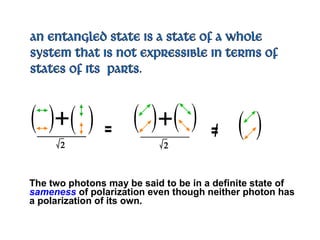
  • #30 When two systems are entangled, they have a definite relation, even though neither system has a state of its own. Entanglement is unlike anything in ordinary experience or classical information theory. It might be compared to the feeling, common in the late 1960’s, of having no opinion oneself but being sure you are on the same wavelength as someone else. Nevertheless it has an exact mathematical description.
  • #39 Much of the interest in quantum computers stems from the fact that they could greatly speed the solution of up some hard problems, the most famous of which is the factoring of large numbers. Top: a very large classical computation was required to factor the number RSA129. The same number could have been factored in a much smaller number of steps on a quantum computer (the shading inside the quantum computer indicates that during the computation the qubits on the different wires are entangled, even though the final answer is not). If one attempted to observe this intermediate data before the computation was done, the data would be disturbed and the computation would give the wrong answer.
  • #42 Two implementations that have been tried in the laboratory are linear ion traps and liquid-state nuclear magnetic resonance (NMR).
  • #43 It is too early to decide which, if any, of these very different physical implementations will work to build a quantum computer.
  • #44 Between 1994, when Shor discovered his fast quantum factoring algorithm, and 1995, quantum computers were thought to be a fascinating theoretical idea but wildly impractical and unlikely ever to be built. This changed when error-correcting techniques were discovered. These techniques are the quantum version of the discovery by von Neumann that a reliable classical computer could be built out of unreliable parts, if the parts were connected together in a properly redundant fashion.
  • #46 Quantum fault tolerant computation involves not only error-correction, but the ability to correct errors that happen during the error-correction process, and the ability to overcome the unavoidable spread of errors when an erroneous qubit interacts with a good one. Fortunately all this can be done, if the error rate of the individual gates and wires is low enough to begin with.
  • #48 Superposition illustrated by polarized photons. Horizontal and vertical photons can be reliably distinguished, and can be used to carry one bit each. But when a diagonal photon is subjected to the same measurement process, it behaves sometimes like a horizontal photon and sometimes like a vertical photon. Two polarized photons can be reliably distinguished if and only if their polarization directions are at right angles to one another (“orthogonal”).
  • #50 Superposition illustrated by polarized photons. Horizontal and vertical photons can be reliably distinguished, and can be used to carry one bit each. But when a diagonal photon is subjected to the same measurement process, it behaves sometimes like a horizontal photon and sometimes like a vertical photon. Two polarized photons can be reliably distinguished if and only if their polarization directions are at right angles to one another (“orthogonal”).
  • #65 Much of the interest in quantum computers stems from the fact that they could greatly speed the solution of up some hard problems, the most famous of which is the factoring of large numbers. Top: a very large classical computation was required to factor the number RSA129. The same number could have been factored in a much smaller number of steps on a quantum computer (the shading inside the quantum computer indicates that during the computation the qubits on the different wires are entangled, even though the final answer is not). If one attempted to observe this intermediate data before the computation was done, the data would be disturbed and the computation would give the wrong answer.
  • #67 Much of the interest in quantum computers stems from the fact that they could greatly speed the solution of up some hard problems, the most famous of which is the factoring of large numbers. Top: a very large classical computation was required to factor the number RSA129. The same number could have been factored in a much smaller number of steps on a quantum computer (the shading inside the quantum computer indicates that during the computation the qubits on the different wires are entangled, even though the final answer is not). If one attempted to observe this intermediate data before the computation was done, the data would be disturbed and the computation would give the wrong answer.
  • #68 Much of the interest in quantum computers stems from the fact that they could greatly speed the solution of up some hard problems, the most famous of which is the factoring of large numbers. Top: a very large classical computation was required to factor the number RSA129. The same number could have been factored in a much smaller number of steps on a quantum computer (the shading inside the quantum computer indicates that during the computation the qubits on the different wires are entangled, even though the final answer is not). If one attempted to observe this intermediate data before the computation was done, the data would be disturbed and the computation would give the wrong answer.
  • #69 Much of the interest in quantum computers stems from the fact that they could greatly speed the solution of up some hard problems, the most famous of which is the factoring of large numbers. Top: a very large classical computation was required to factor the number RSA129. The same number could have been factored in a much smaller number of steps on a quantum computer (the shading inside the quantum computer indicates that during the computation the qubits on the different wires are entangled, even though the final answer is not). If one attempted to observe this intermediate data before the computation was done, the data would be disturbed and the computation would give the wrong answer.
  • #70 Much of the interest in quantum computers stems from the fact that they could greatly speed the solution of up some hard problems, the most famous of which is the factoring of large numbers. Top: a very large classical computation was required to factor the number RSA129. The same number could have been factored in a much smaller number of steps on a quantum computer (the shading inside the quantum computer indicates that during the computation the qubits on the different wires are entangled, even though the final answer is not). If one attempted to observe this intermediate data before the computation was done, the data would be disturbed and the computation would give the wrong answer.
  • #71 Much of the interest in quantum computers stems from the fact that they could greatly speed the solution of up some hard problems, the most famous of which is the factoring of large numbers. Top: a very large classical computation was required to factor the number RSA129. The same number could have been factored in a much smaller number of steps on a quantum computer (the shading inside the quantum computer indicates that during the computation the qubits on the different wires are entangled, even though the final answer is not). If one attempted to observe this intermediate data before the computation was done, the data would be disturbed and the computation would give the wrong answer.
  • #72 Superposition illustrated by polarized photons. Horizontal and vertical photons can be reliably distinguished, and can be used to carry one bit each. But when a diagonal photon is subjected to the same measurement process, it behaves sometimes like a horizontal photon and sometimes like a vertical photon. Two polarized photons can be reliably distinguished if and only if their polarization directions are at right angles to one another (“orthogonal”).
  • #73 Aside from the question of how one might build a quantum computer, the question of what one might do with it is wide open. Quantum computers have been shown to be capable of many other surprising tasks than fast factoring or fast search. To solve the lunchtime scheduling problem classically requires that the two parties exchange a number of bits roughly equal to the size of the less busy person’s calendar. If they use quantum communication, the job can be done in a little over the square root of that amount of communication, O(sqrt(N)log(N)) qubits to be precise.
  • #74 One promising theoretical field is entanglement assisted communication. Here the two parties, Alice and Bob, share entangled particles beforehand, and it helps them perform various communications tasks, such as sending classical messages from Alice to Bob. Entanglement doubles the rate at which classical information can be sent through a noiseless quantum channel. If the channel is noisy, the rate can be increased by an even larger factor. Another thing prior entanglement makes possible is transmitting intact quantum states through a classical channel. This is called “quantum teleportation”, but is expected mainly to be useful in safely transmitting quantum information from one part of a quantum computer to another, or between quantum computers tied together in a “quantum internet”.